
Thrust Augmented Rocket SAM (TARSAM)

Rosdivan

ACCESS: Confidential
Joined
2 November 2007
Messages
103
Reaction score
109
History of Ramjet and Scramjet Propulsion Development
for U.S. Navy Missiles


In 1965, the Navy initiated an advanced development program to determine the performance of air-ducted rocket propelled missiles. Thus began the Augmented Thómst Propulsion program conducted at APL with its two subcontractors, Martin Marietta/Denver and the Atlantic Research Corp. The objectives of the Augmented Thrust Propulsion program were to develop the propulsion (APL), fuels (Atlantic Research Corp.), and missile configuration (Martin Marietta/Denver) for an antiair alternative to the then-existing SM (Terrier, SM-I) and Talos missile systems. The emerging integral rocket ramjet (IRR) technology was also to be investigated. The propulsion and solid- fuel technology programs were successfully carried out in a collaborative effort between APL and the Atlantic Research Corp. High ramjet combustion efficiency (up to 90%) with up to 60% boron-loaded solid fuels was demonstrated, as were high-efficiency axisymmetric and half-axisymmetric conical inlet designs. Two-dimensional flush-mounted (during boost), pop-out inlets were also demonstrated to perform adequately.

Two basic tactical missile configurations that also evolved were designated Thrust Augmented Rocket Surface-to-Air Missiles (TARSAMs). Both configurations were 13.5 in. in diameter and were designed to cruise at Mach 3.8 after boost to Mach 2.7. The medium-range version had a predicted powered range on the order of 80 nmi, and the extended-range configuration (TARSAM-ER) had a powered range of around 160 nmi. This program was concluded as planned in 1971, but the proposed follow-on flight tests were not funded.

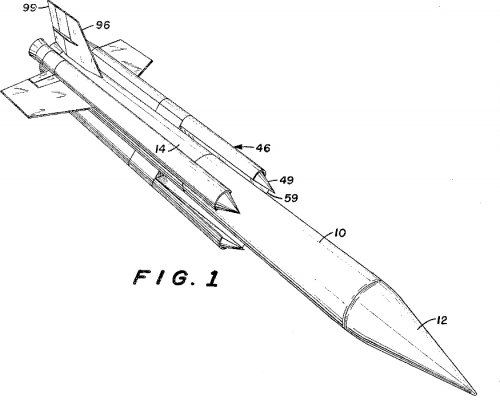
This appears to be the patent for the missile. The attached image is extracted from it. The fuel used is 50% boron. Would this be a significant contributing reason as to why the missile was not funded for further development and flight testing? If my memory serves me, boron was highly carcinogenic and made for a very smoky exhaust in the High Energy Fuels program for the Valkyrie.

The propellant grain, in one planned embodiment, is composed of 50% boron, 4% aluminum, 25% ammonium perchlorate, 15% binder and 6% nBF additive. The propellant grain surface is conical to accommodate the burn rate characteristics of the wire

Also, I do not understand why the extended range version of the missile would be 4 inches shorter (though with a booster 148 inches long) and weigh almost 4700 pounds (3.6 times) more for only twice the range. Granted, I'm no engineering person, so there's probably some blatantly obvious reason that I simply don't know of.
 

Attachments

  • TARSAM.jpg
    TARSAM.jpg
    134.7 KB · Views: 264
Rosdivan said:
Would this be a significant contributing reason as to why the missile was not funded for further development and flight testing?

Almost certainly, especially considering, after the aforementioned carcinogenic effects of boron were discovered, the Air Force quickly shut down plans to manufacture boron-based fuels:

http://www.airfields-freeman.com/CA/Airfields_CA_Mojave.htm#boron
 
I know thread resurrection is looked on favourably in these parts, but sixteen years must be some kind of a record. Updated link here:
https://secwww.jhuapl.edu/techdigest/content/techdigest/pdf/V18-N02/18-02-Waltrup.pdf
This appears to be the patent for the missile. The attached image is extracted from it. The fuel used is 50% boron. Would this be a significant contributing reason as to why the missile was not funded for further development and flight testing?
It strikes me that TARSAM-ER and Typhon LR are pretty comparable - solid booster, ramjet sustainer, broadly Terrier-sized missiles. Of the two, Typhon LR was faster, higher-flying, longer ranged, shorter and lighter - yet also eight years earlier. I suspect that a large part of it not getting further development was a realisation that it just didn't offer that much over the older missile!
Also, I do not understand why the extended range version of the missile would be 4 inches shorter (though with a booster 148 inches long) and weigh almost 4700 pounds (3.6 times) more for only twice the range. Granted, I'm no engineering person, so there's probably some blatantly obvious reason that I simply don't know of.
I'm guessing the shorter-range version had some stuff at the back end to get it from zero speed/zero altitude to sustainer ignition, which accounts for the extra length, then th motor grain likely had a fast initial to complete acceleration. In the ER version, I expect the booster gets it all the way to cruise speed, with the sustainer being cruise-only. Still the same amount of energy in the sustainer, so you won't get that much more range, but the comparatively dumb booster means it can save more for later.
 
Almost certainly, especially considering, after the aforementioned carcinogenic effects of boron were discovered, the Air Force quickly shut down plans to manufacture boron-based fuels:

http://www.airfields-freeman.com/CA/Airfields_CA_Mojave.htm#boron
Perhaps this could be re-thought
https://phys.org/news/2026-05-chemists-isolate-boronoxygen-molecule.html

In a study published in Nature Chemistry, researchers from the labs of MIT professors Christopher C. Cummins and Robert J. Gilliard, Jr. have revealed a brand-new type of peroxide containing boron. This molecule, called a dioxaborirane, represents a major advance in a field where such structures were long-proposed, but considered too unstable to actually isolate.

Dioxaborirane forms when a specially engineered boron molecule reacts with oxygen gas. What makes this discovery remarkable is that the reaction happens almost instantly at room temperature. Usually, creating strained oxygen-containing rings like this requires extreme, "punishing" conditions—like freezing temperatures or high pressure—to keep the molecule from falling apart.

Using advanced tools such as crystallography and computational modeling, the team proved the existence of a highly strained, three-member ring made of one boron and two oxygen atoms.

The most exciting part of the discovery is how the molecule behaves. Depending on its electrical charge, it acts in two very different ways:


  • The builder: It can donate oxygen atoms to help construct new chemical compounds.
  • The trapper: It can react with carbon dioxide, potentially offering a new way to capture and transform greenhouse gases.
"By showing that these compounds can be generated under mild conditions, our work opens the door to entirely new types of chemistry," says Chonghe Zhang, the first author of the paper and an MIT chemistry graduate student co-advised by Cummins and Gilliard. "In the long term, these findings could provide us with powerful new tools for oxidation reactions in synthesis and materials science."

For slurry fuels?
https://phys.org/news/2026-05-tiny-big-effects-particle-interactions.html
 
Last edited:

Similar threads

Back
Top Bottom