
You are using an out of date browser. It may not display this or other websites correctly.
You should upgrade or use an alternative browser.
You should upgrade or use an alternative browser.
TAI TF-X / Milli Muharip Uçak MMU Kaan
- Thread starter ocay
- Start date


- Joined
- 15 July 2020
- Messages
- 2,083
- Reaction score
- 7,451
Negative. Most of the engineers working on Hurjet were previously working on SNC for the U.S. Air Force’s (USAF) T-X lead-in fighter-trainerlooks like the chinese jl-10 trainer. are they receiving help from xi's China ?
https://quwa.org/2017/09/27/sierra-...rogress-with-t-x-freedom-trainer-development/
Hurjet is not based on any other aircraft.
- Joined
- 15 July 2020
- Messages
- 2,083
- Reaction score
- 7,451
Key takeaways and my thoughts :
No delays until now, and no signs of future delays as of yet.
- (they've claimed they are actually ahead of schedule a few months ago)
Started some of the wind tunnel testing already.
- (Considering that wind tunnel testing obviously should have been conducted since years ago, maybe he means conducting it in the ones in Turkey?)
BAE assistance going smooth it seems.
Hiring more engineers and training them to participate in the project.
- (From what I know, this "training" must be very marginal and those engineers must be already very experienced in their fields, just not in designing a fighter jet. I've forgot the source but I remember reading a French aviation engineer describing the life of an engineer as consisted of first 10 years of learning in the field, the next 15~20 years of actually working in some project, and the last 10 years of training the next generation. From such perspective, an aviation engineer is not what you could just "train" for some months and bring to work on an actual project.)
Have started preparing for the production of the first prototype, namely the metal cutting.
- (Wouldn't put too much emphasis on simply cutting a metal)
"Initial development" of the Turkish engine started.
Selected 1 or 2 readily available engines as an interim solution.
- (Considering the fact that this time he doesn't go on to mention the F110 but "1 or perhaps 2 engines", maybe Turkey is planning to try getting the approval from the US for the use of their license produced F110 for the TF-X? Also perhaps, to be prepared in case that doesn't work out, negotiating with another party for the supplying of the engine in the meantime. There are only two countries who have F110 equivalent engines ready apart from the US, and I think Russia would be the most likely candidate considering their recent statements about the possible sales of Sukhois to Turkey.)
- (Though I am guessing that they are currently designing TF-X with F110 in mind, as that is the only solution that has been mentioned numerous times by Turkish engineers and officials, if Turkey cannot get the approval of the use of F110 for TF-X, that should either mean scraping the detailed design that went through CDR and get to work on a new detailed design with the alternative engine in mind, or delay detailed design phase and CDR all together until the approval is given/denied for the F110. Maybe working parallel on 2 detailed designs, each with F110 and AL-31F in the same time?)
Turkish engine to be ready after 2026 or 2027.
- (Those 2026~2027 figure probably comes from the current schedule of maiden flight of the prototype in between Q4 of 2026 and Q1 of 2027.)
- (As I have also posted on this thread based on the infos from Turkish officials, their plan was - and probably still is - to get the engine to run hot for the first time in 2026 and fly it for the first time around 2028~2029. As I've noted a few times, this timeline is already ambitious enough so I don't expect such development schedule to have changed, hence him saying "after" 2026~2027, which the 2028~2029 technically fits into.)
The used render of the TF-X is still the same or at least almost the same from last year.
- (probably down to the fact that this aircraft hasn't even passed PDR yet.)
- (I expect changes of the design during the rest of the preliminary design and detailed design which is soon to follow. I'm curious about what they're gonna do with the IRST in front of the cockpit, considering they already have a EOTS like stuff below the nose as well.)
Last edited:
... BAE assistance going smooth it seems ... There are only two countries who have F110 equivalent engines ready apart from the US, and I think Russia would be the most likely candidate considering their recent statements about the possible sales of Sukhois to Turkey.
I find it hard to believe that BAE would provide any assistance whatsoever if there were realistic possibilities of Russian companies being involved. Then again, even against the backdrop of Turkey's ongoing S-400 project I find BAE's involvement at least somewhat ill considered; such decisions are never purely business based so I guess the larger NATO/EU context has, for the moment, found a way to provide incentives for re-establishing more meaningful ties via this project. There must be points along the way where risk/reward considerations will be re-examined, as the state dynamics of both the UK and Turkey have their obvious idiosyncractic precarities. While the Middle East is somewhat a reduced priority for the US going forward in the medium term, Russia's current leadership isn't going to be in the position of enjoying geopolitical or strategic freebies in that area any more (or anywhere). Still, mischief on Putin's part is guaranteed so some of the responsibility in providing clarity rests squarely on Turkey, or rather Erdoğan's administration. We'll see if they're up to providing it and how it will reflect on projects like the TFX.

- Joined
- 2 January 2006
- Messages
- 4,235
- Reaction score
- 8,279
Thanks for posting
Key takeaways and my thoughts :
No delays until now, and no signs of future delays as of yet.
- (they've claimed they are actually ahead of schedule a few months ago)
Started some of the wind tunnel testing already.
- (Considering that wind tunnel testing obviously should have been conducted since years ago, maybe he means conducting it in the ones in Turkey?)
BAE assistance going smooth it seems.
Hiring more engineers and training them to participate in the project.
- (From what I know, this "training" must be very marginal and those engineers must be already very experienced in their fields, just not in designing a fighter jet. I've forgot the source but I remember reading a French aviation engineer describing the life of an engineer as consisted of first 10 years of learning in the field, the next 15~20 years of actually working in some project, and the last 10 years of training the next generation. From such perspective, an aviation engineer is not what you could just "train" for some months and bring to work on an actual project.)
Have started preparing for the production of the first prototype, namely the metal cutting.
- (Wouldn't put too much emphasis on simply cutting a metal)
"Initial development" of the Turkish engine started.
Selected 1 or 2 readily available engines as an interim solution.
- (Considering the fact that this time he doesn't go on to mention the F110 but "1 or perhaps 2 engines", maybe Turkey is planning to try getting the approval from the US for the use of their license produced F110 for the TF-X? Also perhaps, to be prepared in case that doesn't work out, negotiating with another party for the supplying of the engine in the meantime. There are only two countries who have F110 equivalent engines ready apart from the US, and I think Russia would be the most likely candidate considering their recent statements about the possible sales of Sukhois to Turkey.)
- (Though I am guessing that they are currently designing TF-X with F110 in mind, as that is the only solution that has been mentioned numerous times by Turkish engineers and officials, if Turkey cannot get the approval of the use of F110 for TF-X, that should either mean scraping the detailed design that went through CDR and get to work on a new detailed design with the alternative engine in mind, or delay detailed design phase and CDR all together until the approval is given/denied for the F110. Maybe working parallel on 2 detailed designs, each with F110 and AL-31F in the same time?)
Turkish engine to be ready after 2026 or 2027.
- (Those 2026~2027 figure probably comes from the current schedule of maiden flight of the prototype in between Q4 of 2026 and Q1 of 2027.)
- (As I have also posted on this thread based on the infos from Turkish officials, their plan was - and probably still is - to get the engine to run hot for the first time in 2026 and fly it for the first time around 2028~2029. As I've noted a few times, this timeline is already ambitious enough so I don't expect such development schedule to have changed, hence him saying "after" 2026~2027, which the 2028~2029 technically fits into.)
The used render of the TF-X is still the same or at least almost the same from last year.
- (probably down to the fact that this aircraft hasn't even passed PDR yet.)
- (I expect changes of the design during the rest of the preliminary design and detailed design which is soon to follow. I'm curious about what they're gonna do with the IRST in front of the cockpit, considering they already have a EOTS like stuff below the nose as well.)
Thanks a lot for your effort to provide a translated summary, and so it is getting more and more interesting.
However the mentioned and previously discussed questions are all still open, however again no answers were given.
@Combat-Master ??? Still no replies?
- Joined
- 11 February 2010
- Messages
- 1,719
- Reaction score
- 3,181
Well, how far is it US Sanction toward Turkey ? Other than sacking from JSF and some political sabre rattlings + some Turkish officials cannot go abroad nor doing business with US firms... i dont see anything severe. the CAATSA seems to target only the individuals involved with the S-400 deals.
Other than that :
https://www.power-eng.com/nuclear/g...-turkeys-first-ever-nuclear-power-plant/#gref
It's business usual.
I guess US will also cut some slack in use of the F-100/F-110 engine for Turkish TFX's. I would also assume the indigenous engine would be of the similar stats as F-110.
This could allow some estimates. e.g Take off weight of at least 26000 Kg for T/W=1.
Other than that :
https://www.power-eng.com/nuclear/g...-turkeys-first-ever-nuclear-power-plant/#gref
It's business usual.
I guess US will also cut some slack in use of the F-100/F-110 engine for Turkish TFX's. I would also assume the indigenous engine would be of the similar stats as F-110.
This could allow some estimates. e.g Take off weight of at least 26000 Kg for T/W=1.
Thank you very much, Maro.Kyo.
- Joined
- 15 July 2020
- Messages
- 2,083
- Reaction score
- 7,451
The video is in English
Thanks for posting
Key takeaways and my thoughts :
No delays until now, and no signs of future delays as of yet.
- (they've claimed they are actually ahead of schedule a few months ago)
Started some of the wind tunnel testing already.
- (Considering that wind tunnel testing obviously should have been conducted since years ago, maybe he means conducting it in the ones in Turkey?)
BAE assistance going smooth it seems.
Hiring more engineers and training them to participate in the project.
- (From what I know, this "training" must be very marginal and those engineers must be already very experienced in their fields, just not in designing a fighter jet. I've forgot the source but I remember reading a French aviation engineer describing the life of an engineer as consisted of first 10 years of learning in the field, the next 15~20 years of actually working in some project, and the last 10 years of training the next generation. From such perspective, an aviation engineer is not what you could just "train" for some months and bring to work on an actual project.)
Have started preparing for the production of the first prototype, namely the metal cutting.
- (Wouldn't put too much emphasis on simply cutting a metal)
"Initial development" of the Turkish engine started.
Selected 1 or 2 readily available engines as an interim solution.
- (Considering the fact that this time he doesn't go on to mention the F110 but "1 or perhaps 2 engines", maybe Turkey is planning to try getting the approval from the US for the use of their license produced F110 for the TF-X? Also perhaps, to be prepared in case that doesn't work out, negotiating with another party for the supplying of the engine in the meantime. There are only two countries who have F110 equivalent engines ready apart from the US, and I think Russia would be the most likely candidate considering their recent statements about the possible sales of Sukhois to Turkey.)
- (Though I am guessing that they are currently designing TF-X with F110 in mind, as that is the only solution that has been mentioned numerous times by Turkish engineers and officials, if Turkey cannot get the approval of the use of F110 for TF-X, that should either mean scraping the detailed design that went through CDR and get to work on a new detailed design with the alternative engine in mind, or delay detailed design phase and CDR all together until the approval is given/denied for the F110. Maybe working parallel on 2 detailed designs, each with F110 and AL-31F in the same time?)
Turkish engine to be ready after 2026 or 2027.
- (Those 2026~2027 figure probably comes from the current schedule of maiden flight of the prototype in between Q4 of 2026 and Q1 of 2027.)
- (As I have also posted on this thread based on the infos from Turkish officials, their plan was - and probably still is - to get the engine to run hot for the first time in 2026 and fly it for the first time around 2028~2029. As I've noted a few times, this timeline is already ambitious enough so I don't expect such development schedule to have changed, hence him saying "after" 2026~2027, which the 2028~2029 technically fits into.)
The used render of the TF-X is still the same or at least almost the same from last year.
- (probably down to the fact that this aircraft hasn't even passed PDR yet.)
- (I expect changes of the design during the rest of the preliminary design and detailed design which is soon to follow. I'm curious about what they're gonna do with the IRST in front of the cockpit, considering they already have a EOTS like stuff below the nose as well.)
Thanks a lot for your effort to provide a translated summary, and so it is getting more and more interesting.
However the mentioned and previously discussed questions are all still open, however again no answers were given.
@Combat-Master ??? Still no replies?
- Joined
- 15 July 2020
- Messages
- 2,083
- Reaction score
- 7,451
But you are probably the best one to answer the still open questions?
I post information that is open source, TAI are tight lipped about TFX and Hurjet. TAI cannot not release any information unless it is approved by the Turkish MOD, every image, pdf and press releases goes through Turkish MOD before it goes public. This is also the case with foreign partners doing business with Turkey, except Ukrainian defence industry has fudged up a few times and disclosed information on Turkey's procurement of engines for LACM missiles...
- Joined
- 2 January 2006
- Messages
- 4,235
- Reaction score
- 8,279
But you are probably the best one to answer the still open questions?
I post information that is open source, TAI are tight lipped about TFX and Hurjet. TAI cannot not release any information unless it is approved by the Turkish MOD, every image, pdf and press releases goes through Turkish MOD before it goes public. This is also the case with foreign partners doing business with Turkey, except Ukrainian defence industry has fudged up a few times and disclosed information on Turkey's procurement of engines for LACM missiles...
Agreed, but again, based on their own schedule, time is running fast and I'm not the only one who sees no answers or options on how they will reach their goal ... but let's wait.
- Joined
- 2 January 2006
- Messages
- 4,235
- Reaction score
- 8,279
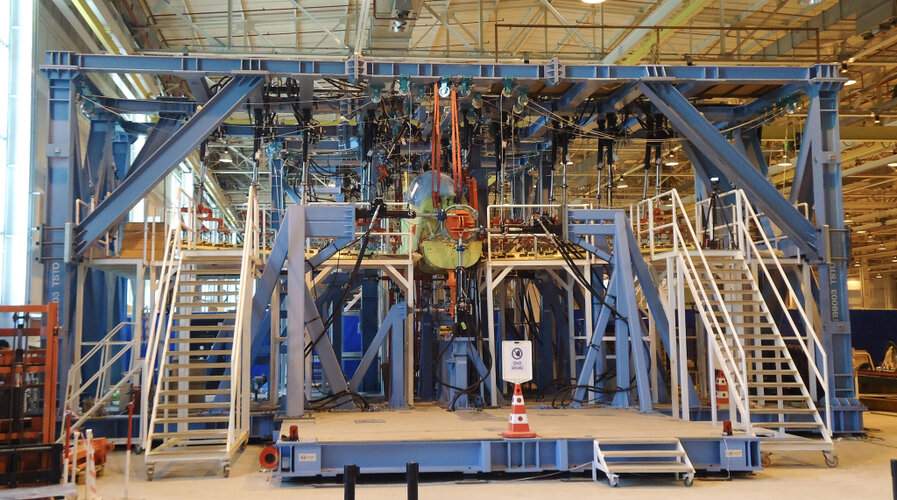
Again not meant as an offence but only as an argument, why so many are sceptical towards any Turkish claims for their own Hürjet and even more the MMU/TFX: This is how a prototype of an advanced fighter aircraft should look like at the moment when you want to aim for a maiden flight in early 2022.
View: https://twitter.com/RupprechtDeino/status/1366282075440111617
View: https://twitter.com/RupprechtDeino/status/1366282075440111617
- Joined
- 15 July 2020
- Messages
- 2,083
- Reaction score
- 7,451
Again not meant as an offence but only as an argument, why so many are sceptical towards any Turkish claims for their own Hürjet and even more the MMU/TFX: This is how a prototype of an advanced fighter aircraft should look like at the moment when you want to aim for a maiden flight in early 2022.
View: https://twitter.com/RupprechtDeino/status/1366282075440111617
The skepticism is completely understandable, especially the way TAI are very tight lipped; for instance the recent reveal of an unmanned 6 ton attack helicopter - nothing was previously mentioned about it, no one was aware TAI were working on an hybrid propulsion system either. We'll be drip fed information or they'll just show it off for maximum political gain.
Anyway, Hurjet is said to be revealed this year. 9 months left for them to keep to their word an another 21 months for a flight test.. not long to go..
Attachments

- Joined
- 29 November 2010
- Messages
- 2,275
- Reaction score
- 5,186
^ I know Deino is a bit of a skeptical scottie in regards to Turkish aviation
and I think that the Hurjet is very likely soon. But I share the same skepticism with Deino over the TFX.
I still feel Turkey should have stayed with Korea and indonesia in working on the KFX.
the three have a long history of working together and it could have been the first true "Asiafighter"!
and I think that the Hurjet is very likely soon. But I share the same skepticism with Deino over the TFX.
I still feel Turkey should have stayed with Korea and indonesia in working on the KFX.
the three have a long history of working together and it could have been the first true "Asiafighter"!
- Joined
- 15 July 2020
- Messages
- 2,083
- Reaction score
- 7,451
^ I know Deino is a bit of a skeptical scottie in regards to Turkish aviation
and I think that the Hurjet is very likely soon. But I share the same skepticism with Deino over the TFX.
I still feel Turkey should have stayed with Korea and indonesia in working on the KFX.
the three have a long history of working together and it could have been the first true "Asiafighter"!
I don't feel the same, I believe Turkey did good in staying out of the KFX. KFX would have definitely been the least riskiest option, but it does not benefit Turkey towards the ambitions the current government has for Turkey. This is why Turkey and US have a falling out, Turkey is not going with the script (CENTCOM) US has of the region (Syria,Iraq) and US script doesn't work without Turkey.
It's going to be tough but I don't doubt my countrymen's capability, only time will tell though..

kaiserd
I really should change my personal text
- Joined
- 25 October 2013
- Messages
- 1,656
- Reaction score
- 1,796
South Korea must be so happy they don’t have to deal with the multiple issues that joint development with Turkey would have inevitably led to; they very much dodged a bullet in that regard.^ I know Deino is a bit of a skeptical scottie in regards to Turkish aviation
and I think that the Hurjet is very likely soon. But I share the same skepticism with Deino over the TFX.
I still feel Turkey should have stayed with Korea and indonesia in working on the KFX.
the three have a long history of working together and it could have been the first true "Asiafighter"!
I don't feel the same, I believe Turkey did good in staying out of the KFX. KFX would have definitely been the least riskiest option, but it does not benefit Turkey towards the ambitions the current government has for Turkey. This is why Turkey and US have a falling out, Turkey is not going with the script (CENTCOM) US has of the region (Syria,Iraq) and US script doesn't work without Turkey.
It's going to be tough but I don't doubt my countrymen's capability, only time will tell though..

tequilashooter
ACCESS: Top Secret
- Joined
- 1 January 2021
- Messages
- 699
- Reaction score
- 902
What is causing me to scratch my head is not just the past Trump administration but even Biden administration still having high hopes that Turkey will ditch the S-400 for F-35s, while Turkey has high hopes that exceptions will be made to keep the S-400 and get F-35s always makes me chuckle. But it already looks like Turkey wont be the 1st to budge(based on aircraft and drone developments) and I do not know how desperate the U.S. is to get a profit for 100 F-35s. Its already made clear by how lively this thread is on the TAI-TFX and Hurjet projects and we simply cannot forget all their chest thumping on their drone projects.
But they really are hoping it will go their way considering a 2nd S-400 batch.
But they really are hoping it will go their way considering a 2nd S-400 batch.
Last edited:
You're fairly cryptic about these "ambitions". In terms of capability KFX can't be far from whatever TFX could be in such a constricted time frame and makes one wonder what on earth made Turkish decision makers forsake F-35 for some rather dubious AA missiles then? Additionally, any move that could exclude Turkey from NATO will also hamper co-operation with BAE.I don't feel the same, I believe Turkey did good in staying out of the KFX. KFX would have definitely been the least riskiest option, but it does not benefit Turkey towards the ambitions the current government has for Turkey. This is why Turkey and US have a falling out, Turkey is not going with the script (CENTCOM) US has of the region (Syria,Iraq) and US script doesn't work without Turkey.
It's going to be tough but I don't doubt my countrymen's capability, only time will tell though..
Insofar there's a US "script" in the area (and what role Turkey might play in it) the last four years it has been incoherent, save for the US basically giving Putin one gift after another. This will of course change now. Erdoğan's personal approach (wherein it might not align perfectly with the official above the board foreign policy) has been even more complicated, what with former Gen. Flynn's "consulting" work in trying to basically arrange the abduction of Gülen from the US into Turkey and some dubious bankers being let off by Barr's justice department "just because" (and I'm sure I'm forgetting some stuff). There's just not that much to "fall out" from, so I'm surprised by the dramatic imagery. Mutual opportunities abound.
So where's the strategic interest? Going towards Greece would be an absolute s**tshow and a joyful occasion for basically all of Turkey's less than democratic and opportunistic neighbors. Seriously, the potential Med oil fields cannot be worth that, in this day and age. Russian and Turkish proxy interests basically keep tripping over each other all over the place, so trying to establish a more strategically coherent area of Turcik peoples will certainly run into that. Black sea endeavors with Ukraine without NATO would be foolhardy. Besides, why even dabble with S-400s then? Historically, Turkish attitude towards Kurds and Armenians has been abysmal but even in worst case scenarios TFX isn't really an applicable capability there. Besides, Kurds will not be thrown under the bus while Biden is president and likely not even after that. What would the rationale in going into Iraq even be? Infuriating all of the the Arab world? Iran, on its part, will continue to have greater problems than Turkey for the foreseeable future. Little to be gained in Syria, except empty chauvinistic boasting. To be clear, these are all pretty much quagmires, morally reprehensible scenarios and hopefully very, very unlikely for the human cost alone.
Still, I can understand TFX for the strategic leverage alone, it keeps options open and perhaps helps other industries. For a while, new design and production methodologies seem to enable almost purely national fighter efforts again, if there's a will to do it. It will be interesting to see. And it's always good to keep up with the Joneses.
- Joined
- 15 July 2020
- Messages
- 2,083
- Reaction score
- 7,451
South Korea must be so happy they don’t have to deal with the multiple issues that joint development with Turkey would have inevitably led to; they very much dodged a bullet in that regard.^ I know Deino is a bit of a skeptical scottie in regards to Turkish aviation
and I think that the Hurjet is very likely soon. But I share the same skepticism with Deino over the TFX.
I still feel Turkey should have stayed with Korea and indonesia in working on the KFX.
the three have a long history of working together and it could have been the first true "Asiafighter"!
I don't feel the same, I believe Turkey did good in staying out of the KFX. KFX would have definitely been the least riskiest option, but it does not benefit Turkey towards the ambitions the current government has for Turkey. This is why Turkey and US have a falling out, Turkey is not going with the script (CENTCOM) US has of the region (Syria,Iraq) and US script doesn't work without Turkey.
It's going to be tough but I don't doubt my countrymen's capability, only time will tell though..
lol okay! It just goes to show you how dependent the S.Korean aviation is on another country.
Last edited:
kaiserd
I really should change my personal text
- Joined
- 25 October 2013
- Messages
- 1,656
- Reaction score
- 1,796
As is Turkey to exactly the same (or greater) extent, empty ultra-nationalist rhetoric aside.South Korea must be so happy they don’t have to deal with the multiple issues that joint development with Turkey would have inevitably led to; they very much dodged a bullet in that regard.^ I know Deino is a bit of a skeptical scottie in regards to Turkish aviation
and I think that the Hurjet is very likely soon. But I share the same skepticism with Deino over the TFX.
I still feel Turkey should have stayed with Korea and indonesia in working on the KFX.
the three have a long history of working together and it could have been the first true "Asiafighter"!
I don't feel the same, I believe Turkey did good in staying out of the KFX. KFX would have definitely been the least riskiest option, but it does not benefit Turkey towards the ambitions the current government has for Turkey. This is why Turkey and US have a falling out, Turkey is not going with the script (CENTCOM) US has of the region (Syria,Iraq) and US script doesn't work without Turkey.
It's going to be tough but I don't doubt my countrymen's capability, only time will tell though..
lol okay! It just goes to show you how dependent the S.Korean aviation is on another country.
South Korea actually has more experience and credibility in this regard, with a greater number of technically successful domestic and/ or joint programs already to their credit.
And to be clear I have no skin in this game.
tequilashooter
ACCESS: Top Secret
- Joined
- 1 January 2021
- Messages
- 699
- Reaction score
- 902
Good news for Russia is whatever jackass expeditions they pull in the middle east, NATO would not feel that obligated to assist them. I get tired of the F-35 this, su-57 that on every forum. I feel like a excited school boy going out on a date with his crush with their new drones and aviation projects because I know that military wise they are active and I would love to see much of their equipment get tested against air defenses and possibly new air defenses as well, or hell even a possible conventional drone on drone conflict also involving EW systems with Russia, etc.
- Joined
- 2 January 2006
- Messages
- 4,235
- Reaction score
- 8,279
South Korea must be so happy they don’t have to deal with the multiple issues that joint development with Turkey would have inevitably led to; they very much dodged a bullet in that regard.^ I know Deino is a bit of a skeptical scottie in regards to Turkish aviation
and I think that the Hurjet is very likely soon. But I share the same skepticism with Deino over the TFX.
I still feel Turkey should have stayed with Korea and indonesia in working on the KFX.
the three have a long history of working together and it could have been the first true "Asiafighter"!
I don't feel the same, I believe Turkey did good in staying out of the KFX. KFX would have definitely been the least riskiest option, but it does not benefit Turkey towards the ambitions the current government has for Turkey. This is why Turkey and US have a falling out, Turkey is not going with the script (CENTCOM) US has of the region (Syria,Iraq) and US script doesn't work without Turkey.
It's going to be tough but I don't doubt my countrymen's capability, only time will tell though..
lol okay! It just goes to show you how dependent the S.Korean aviation is on another country.
That's exactly that attitude that annoys so many: South Korea indeed is fully dependent on US systems like engines (not unlike Turkey) but they admit it, they make the best out of their situation with a NOT less ambitious and sure more realistic concept. They have built a vast experience over the year with licence manufacturing, cooperation and in recent years even indigenous designs ... in contrast to Turkey they have at least successfully completed development of several projects, whereas Turkey has what archived so far?
Like @kaiserd just noted and I would even extend it to nothing but "ultra-nationalist rhetoric"!
But again, let's wait and see but don't be upset when the whole world of aviation enthusiasts will make a lot of fun if nothing happens.
Well, tbf at least Turkey has multitude UAVs and munitions for them developed and fielded. Yes, their internals are basically a kitbash of export elements, but even that is not exceptionally easy, otherwise we would see more of that.
But indigenous 5 gen multirole fighter is whole another matter ofc, esp from country that has ZERO experience in manned high end aviation field.
But indigenous 5 gen multirole fighter is whole another matter ofc, esp from country that has ZERO experience in manned high end aviation field.
tequilashooter
ACCESS: Top Secret
- Joined
- 1 January 2021
- Messages
- 699
- Reaction score
- 902
Out of all 5th gen programs, everyone has beef with this one(declining 100 F-35s leaves a bad aftertaste?)  I feel like its just me and another user here on this thread that supports Turkeys 5th gen program. The aircraft looks cool as hell and so does the hurjet.
I dont know why everyone is supporting the same story on the TFX with no lessons learned on the Su-57. I remember how one 5th gen aircraft in 2006 mentioned applying DIRCM, with a user in 2009 stating that this 5th gen will be the 1st 5th gen to have DIRCM, fast forward to the present the 5th gen that was a prototype was getting shit on by other proclaimed aviation fans for still being a prototype aircraft was given DIRCM, while the already operational 5th gen is now at the point that I dont even think DIRCM will ever be applied.
Dont even get me started where many users accussed Russia of having no past stealth aircrafts, no AESA radar or new engines with accusations that it will be cancelled. Fast forward to the Su-57 right now, new engines are being tested, more stealth patents on each choice they made applying for the aircraft(new research achievements with metamaterials on the rise) and of course news left and right on photonic radars where RTI in september 2019 states a multifuncional aircraft in a few years will receive their photonic prototype radar and the new Su-57 getting new avionics in 2022 to be tested to the end of 2024 might be what they are talking about(unless they are talking about lmfs or mig-41?) so they might have something a little better than AESA and of course new weapons. I think Turkey is capable of progressing in technology for their 5th gen what are other peoples thoughts that they are not capable? Or does everyone have to be put in a brighter mood that the aircraft has to fly and than have reasons to shit on its features later for not being the same as their ideal 5th gen as we have seen in the past plenty of times with su-57 threads? Before having reasons to shit on the TFX think of the Su-57 in other words, be fair and discreet doing it atleast give it a chance to not appear bias to others for better credibility.
Turkey is accussed of being too nationalistic? What about the U.S. and Russia?
I feel like its just me and another user here on this thread that supports Turkeys 5th gen program. The aircraft looks cool as hell and so does the hurjet.I dont know why everyone is supporting the same story on the TFX with no lessons learned on the Su-57. I remember how one 5th gen aircraft in 2006 mentioned applying DIRCM, with a user in 2009 stating that this 5th gen will be the 1st 5th gen to have DIRCM, fast forward to the present the 5th gen that was a prototype was getting shit on by other proclaimed aviation fans for still being a prototype aircraft was given DIRCM, while the already operational 5th gen is now at the point that I dont even think DIRCM will ever be applied.
Dont even get me started where many users accussed Russia of having no past stealth aircrafts, no AESA radar or new engines with accusations that it will be cancelled. Fast forward to the Su-57 right now, new engines are being tested, more stealth patents on each choice they made applying for the aircraft(new research achievements with metamaterials on the rise) and of course news left and right on photonic radars where RTI in september 2019 states a multifuncional aircraft in a few years will receive their photonic prototype radar and the new Su-57 getting new avionics in 2022 to be tested to the end of 2024 might be what they are talking about(unless they are talking about lmfs or mig-41?) so they might have something a little better than AESA and of course new weapons. I think Turkey is capable of progressing in technology for their 5th gen what are other peoples thoughts that they are not capable? Or does everyone have to be put in a brighter mood that the aircraft has to fly and than have reasons to shit on its features later for not being the same as their ideal 5th gen as we have seen in the past plenty of times with su-57 threads? Before having reasons to shit on the TFX think of the Su-57 in other words, be fair and discreet doing it atleast give it a chance to not appear bias to others for better credibility.
Turkey is accussed of being too nationalistic? What about the U.S. and Russia?

Bhurki
ACCESS: Secret
- Joined
- 16 July 2020
- Messages
- 345
- Reaction score
- 389
Thats true.Out of all 5th gen programs, everyone has beef with this one(declining 100 F-35s leaves a bad aftertaste?)
Directly comparing Turkey to Russia will be problematic for all the obvious reasons.Dont even get me started where many users accussed Russia of having no past stealth aircrafts, no AESA radar or new engines with accusations that it will be cancelled.
Most of us come to this forum to look past the nationalistic crap and half brained media reports to truly understand whats the scope and progress of a certain military program.Before having reasons to shit on the TFX think of the Su-57 in other words, be fair and discreet doing it atleast give it a chance to not appear bias to others for better credibility.
Turkey, as of now, is projecting way more than it can fulfill (based solely on the targets not met on previous timelines).
The likes of Deino regularly point out the disconnect between projected timelines and milestones that should have been met to achieve those timelines.
Its not that people here feel joy to shoot down achievements of a particular country, but if there's not enough evidence to stand up to expectations, its only fair to shoot it down.
kaiserd
I really should change my personal text
- Joined
- 25 October 2013
- Messages
- 1,656
- Reaction score
- 1,796
The concern is that much of “official” news on the TFX (that is then being propagated here) is essentially state propaganda to compensate for/ run interference on the fact that Turkey was kicked out of the F-35 program, which was very much intended as the future central pillar of their airforce.
It is highly dubious that it is within Turkey’s realistic technical reach to build what appears to be aiming to be a direct F-22 equivalent within anything like the officials stated timescale (particularly, as it appears, without extensive foreign assistance which looks hard to obtain given Turkey’s current poor relationships with many of the plausible candidates).
This is not some kind of slam on Turkey or the capabilities of Turkish engineers, designers etc. But the required underlying capabilities are inevitably hard won and would require long term investment and development to fruition, and preceding interim steps like other less demanding classes of aircraft (e.g. an advanced jet trainer).
Very few countries can or could build a F-22 /F-35/ Su-57 class of fighter and expecting that the Turkish aviation industry can quickly jump to this level, as it would now be politically convenient for a government otherwise trapped by a string of poor decisions and their resulting consequences to make such a leap, is not based on a realistic appraisal of probable/ possible.
It is highly dubious that it is within Turkey’s realistic technical reach to build what appears to be aiming to be a direct F-22 equivalent within anything like the officials stated timescale (particularly, as it appears, without extensive foreign assistance which looks hard to obtain given Turkey’s current poor relationships with many of the plausible candidates).
This is not some kind of slam on Turkey or the capabilities of Turkish engineers, designers etc. But the required underlying capabilities are inevitably hard won and would require long term investment and development to fruition, and preceding interim steps like other less demanding classes of aircraft (e.g. an advanced jet trainer).
Very few countries can or could build a F-22 /F-35/ Su-57 class of fighter and expecting that the Turkish aviation industry can quickly jump to this level, as it would now be politically convenient for a government otherwise trapped by a string of poor decisions and their resulting consequences to make such a leap, is not based on a realistic appraisal of probable/ possible.
Okay, but if we go with the assumption that Turkish high ranking officials/people in the know/experts/generals etc know and privately accept Turkish inability to produce a satisfactory plane within the next 10 years or so...
What could be the real Turkish plan?
I mean, if TFX is just propaganda, a smokescreen if you will, then what is going to happen to Turkish AF behind that smokescreen?
Are Turkish government and Turkish AF intentions to:
A) Fly the F-16s for as long as they humanly can? Perhaps upward of next 20 years?
B) Change Turkish relationship with the US so it becomes good enough to get back to the F-35 program?
C) Adjust their relationship with the West enough so they somehow get their hands on Rafales or Eurofighters?
D) Approach Russia even more, so they get their hands on Su-35 or even Su-57?
E) Approach China even more, so they get their hands on FC-31 derived plane and/or its tech?
What could be the real Turkish plan?
I mean, if TFX is just propaganda, a smokescreen if you will, then what is going to happen to Turkish AF behind that smokescreen?
Are Turkish government and Turkish AF intentions to:
A) Fly the F-16s for as long as they humanly can? Perhaps upward of next 20 years?
B) Change Turkish relationship with the US so it becomes good enough to get back to the F-35 program?
C) Adjust their relationship with the West enough so they somehow get their hands on Rafales or Eurofighters?
D) Approach Russia even more, so they get their hands on Su-35 or even Su-57?
E) Approach China even more, so they get their hands on FC-31 derived plane and/or its tech?
- Joined
- 2 January 2006
- Messages
- 4,235
- Reaction score
- 8,279
@Combat-Master ... any reason, why you deleted your post with the Hurjet's CDR Report?
Out of all 5th gen programs, everyone has beef with this one(declining 100 F-35s leaves a bad aftertaste?)
I dont know why everyone is supporting the same story on the TFX with no lessons learned on the Su-57. I remember how one 5th gen aircraft in 2006 mentioned applying DIRCM, with a user in 2009 stating that this 5th gen will be the 1st 5th gen to have DIRCM, fast forward to the present the 5th gen that was a prototype was getting shit on by other proclaimed aviation fans for still being a prototype aircraft was given DIRCM, while the already operational 5th gen is now at the point that I dont even think DIRCM will ever be applied.
Dont even get me started where many users accussed Russia of having no past stealth aircrafts, no AESA radar or new engines with accusations that it will be cancelled. Fast forward to the Su-57 right now, new engines are being tested, more stealth patents on each choice they made applying for the aircraft(new research achievements with metamaterials on the rise) and of course news left and right on photonic radars where RTI in september 2019 states a multifuncional aircraft in a few years will receive their photonic prototype radar and the new Su-57 getting new avionics in 2022 to be tested to the end of 2024 might be what they are talking about(unless they are talking about lmfs or mig-41?) so they might have something a little better than AESA and of course new weapons. I think Turkey is capable of progressing in technology for their 5th gen what are other peoples thoughts that they are not capable? Or does everyone have to be put in a brighter mood that the aircraft has to fly and than have reasons to shit on its features later for not being the same as their ideal 5th gen as we have seen in the past plenty of times with su-57 threads? Before having reasons to shit on the TFX think of the Su-57 in other words, be fair and discreet doing it atleast give it a chance to not appear bias to others for better credibility.
Turkey is accussed of being too nationalistic? What about the U.S. and Russia?
It's not a matter of hate or love, or anything to do with preference. I must first question if you know what actually means to be 5th gen in the first place. As we all know, building a 5th generation aircraft doesn't simply mean getting some edges aligned and add an internal weapons bay. What's crucial would be integration of every avionics and achieving higher level of sophistication.
One example would be how F-35 fuses its data from various sensor to form a unified picture of 2-sphere airspace and every traffic around it, applies that data to its CNI channel and identify those tracks from 2-sphere with its SDR radios and respond if the bogey is found to be hostile. By analyzing the level of threat, suggest its pilot the best solution, which would either be to ignore, re-route, use EW to electronically attack or directly engage with its munitions and LPI radar mode. It is also able to share this picture and data (sufficient for fire control purposes) using highly stealthy LPI data links such as those ones like MADL or simply use other JTRS like the WNW. This combined with the VLO airframe design lets this aircraft to operate as VLO. It's crucial that both sides exists as a single package.
It is pretty hard to think that countries like Turkey would be able to realize such sophisticated system. We don't even know which level of integration their mission computer will be able to achieve in terms of its system boundary, ie if its going to be something akin to Pave Pillar and other JIAWG derivative architectures or something more advance like Pave Pace.
Overall, without these kind of system integration and capability implementation, the TF-X wouldn't be able to carry out missions that are a standard for other 5th generation aircrafts, which is exactly what I am calling out to be very hard.
Moreover, you call people out to 'hate TF-X only, when there are other fighter jet development programs going on internationally' but I haven't seen anyone apart from the Indian themselves who think AMCA to be realistic at all, for example. Apart from that, the KF-X is clearly 4.5th gen and will be 4.5th gen, Japan's plan to build 5.5th gen aircraft cannot be compared to the aforementioned examples since their technology level far exceeds any of these 3 countries. Chinese 5th generation programs are the results of their sheer amount of investment which is incomparable to that of Turkey or India. We also understand nowadays that the Russians are taking, say, a different approach to 5th generation compared to other countries.
So it's not that "people are having beef with it" but rather that the Turkish ambition is decoupled from the level of technology they have (unlike Japan), level of financial investment they could commit (unlike China) , the level of past know-how and is more conventional kind of an approach (unlike Russia).
Lastly, it's not like photonic radars are something "better" than the phased array but a different kind of antenna back end. Also, first implement, then talk. If anything, I'm still more impressed with fully digital beam forming arrays that are being developed in the west right now, which is also far more technologically ambitious.
In same sense, the DIRCM of Su-57 and the lack thereof on F-35 should be understood as what I mentioned to be the different approach to 5th generation. It's not like doom and gloom all of the sudden for the J-20 and Lightning because the Felon has one and it doesn't
Last edited:
Okay, but if we go with the assumption that Turkish high ranking officials/people in the know/experts/generals etc know and privately accept Turkish inability to produce a satisfactory plane within the next 10 years or so...
What could be the real Turkish plan?
I mean, if TFX is just propaganda, a smokescreen if you will, then what is going to happen to Turkish AF behind that smokescreen?
Are Turkish government and Turkish AF intentions to:
A) Fly the F-16s for as long as they humanly can? Perhaps upward of next 20 years?
B) Change Turkish relationship with the US so it becomes good enough to get back to the F-35 program?
C) Adjust their relationship with the West enough so they somehow get their hands on Rafales or Eurofighters?
D) Approach Russia even more, so they get their hands on Su-35 or even Su-57?
E) Approach China even more, so they get their hands on FC-31 derived plane and/or its tech?
It's just the matter of fact that the requirement of this aircraft is keep changing. One of the most recent and significant change or will I say, "reveal of the actual plan" opposed to former claims, was that the Turks are planning to build a 4.5th generation aircraft first, dubbed block 1, then build a fully 5th generation aircraft afterwards, dubbed the block 2. I think I've posted about this on this thread a few pages back but I'll repeat.
There are 2 things dubious about this plan of building a block 2 5th gen aircraft. (let's ignore all the other mismatches for now) :
Firstly, they are planning to build this "block 2" by 2031. That is just 2 measly years after block 1. I don't know in which world a 5th generation aircraft could suddenly be built out of 4.5th generation aircraft within the span of just 2 friggin years.
Secondly, like I've said above, I think Turkey has far bigger ambition, which is building a 5th generation aircraft, although they haven't even built a fighter jet before, let alone an airbreathing supersonic aircraft, compared to what they are committing in terms of resource and time.
From these two reason I am doubtful if Turkey will be able to build a 5th generation aircraft.
What I do believe though, which would be the answer to you question, is that they are probably capable to build something akin to 4.5th generation aircraft, given that they are heavily collaborating with a foreign partner, which in this case would be BAE. It's also not true to say that Turkey is completely blank in the field of avionics when they did have developed a couple of them ranging from MFDs to a targeting pod and mission computers. They are also developing avionics for their Özgur F-16 upgrade programs, which includes avionics like AESA, some of which also developed in collaboration with BAE such as the SPEWS-II EW system and this would definitely help developing the avionics for the TF-X.
The thing is, I still think that their current development schedule is a bit unrealistic even with regards to the 4.5th generation TF-X block 1. The flight testing schedule is too short and their engine development schedule is also way too short. There is also a mismatch in the engine development schedule and prototype flight testing schedule. It might be a few years later than what they want when the development of block 1 is complete but I believe they will be able to get there at some point.
Last but not least, I expect the 5th generation block 2 to be very hard to realize, as mentioned above. Just for instance, I don't think Turkey has the capability to develop a full CNI capable SDR with a conformal antenna, let alone just a conformal antenna itself. And that's just one part of what a 5th generation aircraft likely requires.
So to sum it up, no they would probably stick to TF-X and continue to work with BAE, although block 2 seems unlikely and even block 1 could be subject to delays considering their ambitious schedule.
tequilashooter
ACCESS: Top Secret
- Joined
- 1 January 2021
- Messages
- 699
- Reaction score
- 902
Everyone has their own definition of 5th gen such as one having preference for 360 degree radar coverage over midwave, short wave infrared coverage. Some 5th gens have a preference for a secondary sensor long wave infrared target detection.It's not a matter of hate or love, or anything to do with preference. I must first question if you know what actually means to be 5th gen in the first place. As we all know, building a 5th generation aircraft doesn't simply mean getting some edges aligned and add an internal weapons bay. What's crucial would be integration of every avionics and achieving higher level of sophistication.
One example would be how F-35 fuses its data from various sensor to form a unified picture of 2-sphere airspace and every traffic around it, applies that data to its CNI channel and identify those tracks from 2-sphere with its SDR radios and respond if the bogey is found to be hostile. By analyzing the level of threat, suggest its pilot the best solution, which would either be to ignore, re-route, use EW to electronically attack or directly engage with its munitions and LPI radar mode. It is also able to share this picture and data (sufficient for fire control purposes) using highly stealthy LPI data links such as those ones like MADL or simply use other JTRS like the WNW. This combined with the VLO airframe design lets this aircraft to operate as VLO. It's crucial that both sides exists as a single package.
Turkey seems to also pursue sensor fusion for the TFX according to what I am reading here so we cant say the TFX wont be able to share information https://www.defenceturkey.com/en/co...tically-with-the-turkish-fighter-project-4312. Well I honestly am a critic at some of there claims from before that were not TFX related but they seem to take sensor fusion into consideration but when to apply it there is no time frame.
Moreover, you call people out to 'hate TF-X only, when there are other fighter jet development programs going on internationally' but I haven't seen anyone apart from the Indian themselves who think AMCA to be realistic at all, for example. Apart from that, the KF-X is clearly 4.5th gen and will be 4.5th gen, Japan's plan to build 5.5th gen aircraft cannot be compared to the aforementioned examples since their technology level far exceeds any of these 3 countries. Chinese 5th generation programs are the results of their sheer amount of investment which is incomparable to that of Turkey or India. We also understand nowadays that the Russians are taking, say, a different approach to 5th generation compared to other countries.
Yeah funding is important but so are lowering maintenance costs like using fiber optics to sense wear and tear in an aircraft or trying to reduce flight costs of 44,000$. I cant determine Turkey's financial situation of what they are willing to fund other than appearing serious about building aircraft related factories or what numbers they want. Stealth as a 5th gen requirement can be improved with more breakthroughs in metamaterials, like the Russian's stating that bending radiowaves around an aircraft works better than absorption and reflecting radio waves away and China stating 1000 times lower RCS for aircrafts if applied. But I do not know where the U.S. stands between the two in this field but for a country like Turkey that might be a little difficult. Countries have different low RCS requirements which no one can determine which option is the best.
Lastly, it's not like photonic radars are something "better" than the phased array but a different kind of antenna back end. Also, first implement, then talk. If anything, I'm still more impressed with fully digital beam forming arrays that are being developed in the west right now, which is also far more technologically ambitious.
There are slight advantages that I see with AESA MMICs over PESA but the advantages of the news reports of PICs appear to be more huge that I might even go as far as stating that a 4th gen equipped with such a radar might give a 5th gen a run for its money. If you want sources for the below points I wont mind providing them to you but I do not really want to stray away from this thread.
1. Chinese stating the background noise is lowered more than 100 times, while KRET stats a Kamaz truck mounted radar would have the same kind of radar performance in finding targets as a ground building radar that is several stories high.
2. radars having EW immunity in which they state there is no such thing that can exceed 200 decibels to jam the radar, so imagine a bunch of aircrafts trying to jam the radar performance of a single aircraft that remains unaffected while that aircraft can freely jam other aircrafts.
3. Using lower waves than firecontrol has resulted in 10 times increase in RCS but a less precision in tracking but performances in firecontrol homing radar beams on air to air missiles will search where the big target is for better precision and engagement.
4. SAR resolution capabilities of seeing and recognizing human faces.
5. 100ghz would offer amazing high precision tracking capabilities and lowering the noise loss would give it a better range than what MMICs have offered with it before. The news that was received yesterday has shown that the antennas seem a little bit thicker than paint so 360 degree coverage would be perfect to create a mini-missile APS probably the size of the quadpack pantsir proposal, because I am sure the homing performance might suck based on size but what the ranges are of the 100ghz higher precision tracking being used with photonic integrated circuits might compensate for the homing capabilities of miniature APS missile to engage air to air missiles instead of just DIRCM.
6. 100s of qubits of radar data transmission claimed, that just for the fun of it I decided to find out what the data traffic of the entire UK is and apparently the radar meets or exceeds the busiest traffic hours of the entire country and lets just say I know a 6th gen aircraft with radar data transmission claims of a city's worth of data.
7. This is rather unknown but I wonder how good the EW suppression capabilities might be.
Sure their companies KRET and RTI state the they are 5-10 years behind the west in MMICs, maybe even further behind when comparing them to Japan, South Korea and Taiwan, but PICs are a different animal from MMICs.
In same sense, the DIRCM of Su-57 and the lack thereof on F-35 should be understood as what I mentioned to be the different approach to 5th generation. It's not like doom and gloom all of the sudden for the J-20 and Lightning because the Felon has one and it doesn't
Countries have a different pace in technology and some that are hard to determine such as Russia had no major drone projects and yet they surprised everyone out of nowhere with a heavy stealth drone project while giving production dates while other countries that had heavy stealth drone projects longer have not offered any production dates. Had no operational AESA but might be the 1st to equip ROFAR. Had no major laser projects like the kilowatt projects offered by other countries than all of a sudden I see megawatt laser projects from them emerging. Soviet union made the kholod project, Ufimtsev work being praised by skunkworks as a rosetta stone, operation mount hope 3, project azorian shows creativity from one country that does not invest a crazy amount of money on projects causes another richer country to be curious. I would like to see Turkey's creativity.
Bhurki
ACCESS: Secret
- Joined
- 16 July 2020
- Messages
- 345
- Reaction score
- 389
Subsonic drones aren't cutting edge. All the ingredients required to make it are essentially commercially available.Countries have a different pace in technology and some that are hard to determine such as Russia had no major drone projects and yet they surprised everyone out of nowhere with a heavy stealth drone project while giving production dates while other countries that had heavy stealth drone projects longer have not offered any production dates.
Sure there are software and network leaps required to get to NLOS presistent operation, but the underlying 'hard' tech is all already there (engine, airframe material, targeting sensors etc) which can be sources from pre-existing miltech.
A drone for example doesn't need to perform a supersonic dash, make 9g turns and attack something thats doing the same, all the while protecting itself against double digit SA batteries.
Creativity can only take you so far. It certainly allows to repackage the tech you already have into innovative platforms to cut costs or enhance mission capability for the same set of targets.I would like to see Turkey's creativity.
But it requires hard cash, crap ton of engineers and decades to learn how to maintain 2000°C TIT for hours without sustaining turbine damage. It requires a litter of hundred mil $ labs to test out all the subsystem prototypes and also an ecosystem that can digest the knowledge to then put it into production efficiently without each unit costing the equivalent of a small nation's budget.
- Joined
- 15 July 2020
- Messages
- 2,083
- Reaction score
- 7,451
The original source deleted it, so I in return deleted what was posted here. I'm sure there's scatterings of the image elsewhere..@Combat-Master ... any reason, why you deleted your post with the Hurjet's CDR Report?
- Joined
- 15 July 2020
- Messages
- 2,083
- Reaction score
- 7,451
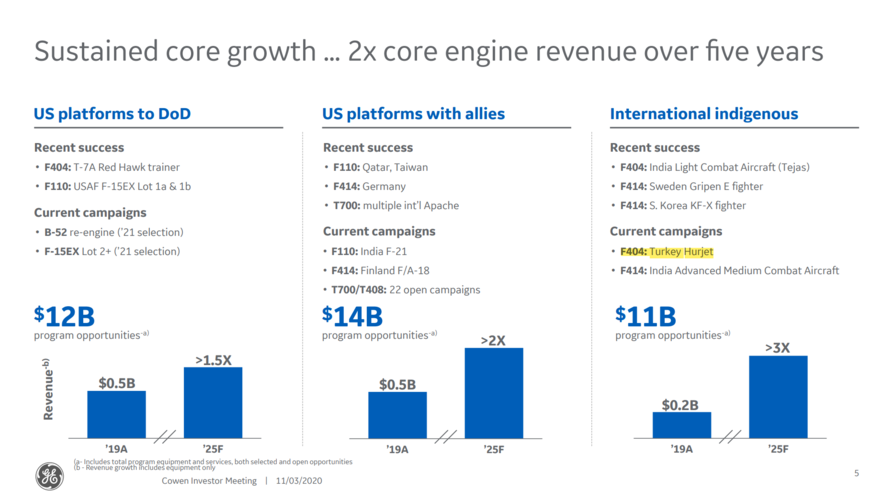
I posted this some time back, presentation document here - https://www.ge.com/sites/default/files/ge_webcast_presentation_11042020.pdf
Though, with rumours that US has blocked MK41 VLS launcher sales for Turkey's I-Class frigate (Turkish VLS launchers are being developed). It is looking ever more grim for US engines on Turkish aircraft, I'm sure there were alternative engines in the pipework however, let's see how this unfolds.
Everyone has their own definition of 5th gen such as one having preference for 360 degree radar coverage over midwave, short wave infrared coverage. Some 5th gens have a preference for a secondary sensor long wave infrared target detection.
They all have something in common such as lowering the returning RF signals from hostile active sensors or incorporating multiple passive sensors with fusion engine. All of these done in a level higher than what the legacy 4th and 4.5th generation aircraft could do is what puts these 5th generation aircrafts apart.
Turkey seems to also pursue sensor fusion for the TFX according to what I am reading here so we cant say the TFX wont be able to share information https://www.defenceturkey.com/en/co...tically-with-the-turkish-fighter-project-4312. Well I honestly am a critic at some of there claims from before that were not TFX related but they seem to take sensor fusion into consideration but when to apply it there is no time frame.
Everyone could just say I could do this and that. Remember that every 4.5th generation aircraft also do incorporate data fusion to a certain extent. It's just that the level of implementation is such that it is incomparable to what the 5tth generation aircraft could achieve. Well to be exact, what the American 5th generation could achieve since there are not much known about the capabilities of the Russian sensor fusion engine. From that reason the scape of operation are vastly different between the two.
Yeah funding is important but so are lowering maintenance costs like using fiber optics to sense wear and tear in an aircraft or trying to reduce flight costs of 44,000$. I cant determine Turkey's financial situation of what they are willing to fund other than appearing serious about building aircraft related factories or what numbers they want. Stealth as a 5th gen requirement can be improved with more breakthroughs in metamaterials, like the Russian's stating that bending radiowaves around an aircraft works better than absorption and reflecting radio waves away and China stating 1000 times lower RCS for aircrafts if applied. But I do not know where the U.S. stands between the two in this field but for a country like Turkey that might be a little difficult. Countries have different low RCS requirements which no one can determine which option is the best.
They are investing a measly $ 8 billion into their development program. Even when we consider the recent devaluation of Lira, it is still a extremely small budget for a 5th generation stealth fighter jet. Also keep in mind that they are paying BAE in dollars and paying a lot. I didn't even talk about F-35 so you're hitting a strawman.
Also meta materials ain't anything new. Moreover it is not just limited to signal reduction of aircrafts but could be implemented for a very wide range of technology starting from IR or acoustic signal reduction to application into sensors like single array multi-band radar or even LED display panels. To think that US is playing around not doing much in such field of useful technology is delusional, thus is incorrect.
Requirement for RCS is what you can tradeoff. For example the US and Chinese fighter planes went with a fundamentally lower RCS planes with higher passive SA capabilities housed conformally in the fuselage in mind. On the other hand, the Russians opted for a more hard kill option, a DIRCM coupled with more active sensors such as the side facing radars and wing leading edge L-Band radars, higher kinematics capability. I've also said that it is a "different approach", by which I mean that it isn't something superior nor inferior. Different requirements and approach for the same goal ain't
There are slight advantages that I see with AESA MMICs over PESA but the advantages of the news reports of PICs appear to be more huge that I might even go as far as stating that a 4th gen equipped with such a radar might give a 5th gen a run for its money. If you want sources for the below points I wont mind providing them to you but I do not really want to stray away from this thread.
1. Chinese stating the background noise is lowered more than 100 times, while KRET stats a Kamaz truck mounted radar would have the same kind of radar performance in finding targets as a ground building radar that is several stories high.
2. radars having EW immunity in which they state there is no such thing that can exceed 200 decibels to jam the radar, so imagine a bunch of aircrafts trying to jam the radar performance of a single aircraft that remains unaffected while that aircraft can freely jam other aircrafts.
3. Using lower waves than firecontrol has resulted in 10 times increase in RCS but a less precision in tracking but performances in firecontrol homing radar beams on air to air missiles will search where the big target is for better precision and engagement.
4. SAR resolution capabilities of seeing and recognizing human faces.
5. 100ghz would offer amazing high precision tracking capabilities and lowering the noise loss would give it a better range than what MMICs have offered with it before. The news that was received yesterday has shown that the antennas seem a little bit thicker than paint so 360 degree coverage would be perfect to create a mini-missile APS probably the size of the quadpack pantsir proposal, because I am sure the homing performance might suck based on size but what the ranges are of the 100ghz higher precision tracking being used with photonic integrated circuits might compensate for the homing capabilities of miniature APS missile to engage air to air missiles instead of just DIRCM.
6. 100s of qubits of radar data transmission claimed, that just for the fun of it I decided to find out what the data traffic of the entire UK is and apparently the radar meets or exceeds the busiest traffic hours of the entire country and lets just say I know a 6th gen aircraft with radar data transmission claims of a city's worth of data.
7. This is rather unknown but I wonder how good the EW suppression capabilities might be.
Sure their companies KRET and RTI state the they are 5-10 years behind the west in MMICs, maybe even further behind when comparing them to Japan, South Korea and Taiwan, but PICs are a different animal from MMICs.
I should tell you one thing. The Japanese have already implemented photonic AESA radars for their P-1 few years ago. Sure, photonic radars give you SNR advantage among other things but I wouldn't buy into all those fancy numbers without a concrete context. Also, while Russia was lagging behind in AESA capabilities, Japan was the first country in the world to field AESA on their ship as well as their planes. To think that the west, especially those like Japan and the US are lagging behind in this field is, once more, delusional. If they aren't using it yet for fighter jets, there is a reason for it. In this case, not worth all the fuzz as of yet because the current analog back end being replaced with digital back end already gives significant leap. Thus going even further with technologies like fully digital array where every single TRM acts as one channel, dubbed TRC.
Countries have a different pace in technology and some that are hard to determine such as Russia had no major drone projects and yet they surprised everyone out of nowhere with a heavy stealth drone project while giving production dates while other countries that had heavy stealth drone projects longer have not offered any production dates. Had no operational AESA but might be the 1st to equip ROFAR. Had no major laser projects like the kilowatt projects offered by other countries than all of a sudden I see megawatt laser projects from them emerging. Soviet union made the kholod project, Ufimtsev work being praised by skunkworks as a rosetta stone, operation mount hope 3, project azorian shows creativity from one country that does not invest a crazy amount of money on projects causes another richer country to be curious. I would like to see Turkey's creativity.
The US has seen more advantage in a refueling drone than the outright UCAVs and therefore changed its requirements for the UCLASS. They are opting for even higher levels of MUMT before actually using the UCAVs for such roles and as of now we could already see how this is turning out with their competition for the AI that is to be equipped on board of SKYBORG UCAVs.
To think that this "different pace" thing is actually the case at all is baffling. The US has been fielding various DIRCMs and has been researching photonic radars for years now. If anything, the Russians not being able to implement the works of Ufimtsev before the US only shows the capability of the US to capitalize on a theory for real world advantage and would even fit more to your narrative of "different pace in technology" favoring the US.
tequilashooter
ACCESS: Top Secret
- Joined
- 1 January 2021
- Messages
- 699
- Reaction score
- 902
Of course its nothing new but has to be further researched for better results, sort of like scramjets not going immediately into military operation when the kholod project was presented, all the way until the mid 2020s https://naukatehnika.com/anapol-novyij-metamaterial-dlya-stels-pokryitij.html "The international team of scientists from NITU "MISS" and the Polytechnic University of Turin (Italy) in cooperation on the project ANASTASIA proposed a fundamentally new version of stealth camouflage, which will allow the radar signal sent to the object not to be reflected, not absorbed, but simply to pass through, as if there is no object. This method of camouflage is not based on the creation of a concealer coating, but on the change of the configuration of the entire system of the object. "The stealth camouflage used today is far from perfect. Such coating is expensive, and for more efficient work it needs the most smooth surface - as a result, in aircraft, for example, have to sacrifice aerodynamic characteristics of the device. At the same time, the absorbed signal still creates a "shadow" - a small response that can detect more advanced location systems. The task of our team was to "teach" objects not to reflect the signal, but to pass it through due to the incitement of the special state of electromagnetic fields," commented Alexey Basharin, project manager for NITU "MISS."Also meta materials ain't anything new. Moreover it is not just limited to signal reduction of aircrafts but could be implemented for a very wide range of technology starting from IR or acoustic signal reduction to application into sensors like single array multi-band radar or even LED display panels. To think that US is playing around not doing much in such field of useful technology is delusional, thus is incorrect.
https://eurasiantimes.com/china-loo...h-fighter-jets-with-new-metamaterial-element/ "According to South China Morning Post, Professor Luo Xiangang and his colleagues at the Chengdu-based Institute of Optics and Electronics, Chinese Academy of Sciences, have created the world’s first-ever mathematical model which precisely describes the behavior of electromagnetic waves when they “strike a piece of metal engraved with microscopic patterns”.
As per a test conducted, the Metamaterials are aimed at making the aircraft, stealthier, lighter and cheaper to build, cut the strength of a reflected radar signal (measured in decibels) by between 10 and nearly 30dB in a frequency range from 0.3 to 40 gigahertz."
Requirement for RCS is what you can tradeoff. For example the US and Chinese fighter planes went with a fundamentally lower RCS planes with higher passive SA capabilities housed conformally in the fuselage in mind. On the other hand, the Russians opted for a more hard kill option, a DIRCM coupled with more active sensors such as the side facing radars and wing leading edge L-Band radars, higher kinematics capability. I've also said that it is a "different approach", by which I mean that it isn't something superior nor inferior. Different requirements and approach for the same goal ain't
I remember in the distant past the Su-57 was criticized for not using square exhaust nozzles for a lower infrared signature hence Su-57 fundamentally having less stealth, when the Russians introduced the same thing on their Su-27s but were disappointed with the thrust decrease that they opted for round nozzles and an aerosol solution that lowers their infrared signature for the exhaust 3 - 3.5 times, without sacrificing thrust.
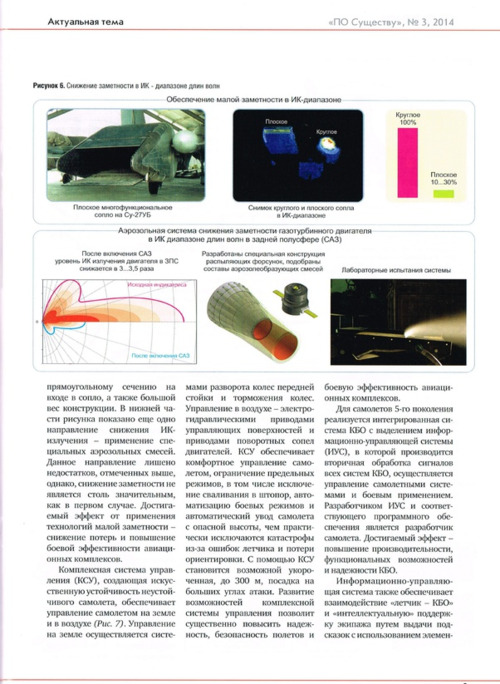 Don't even get me started with the ducts and other features, lets agree to disagree the admin created the Su-57 RCS thread for a reason from a Su-57 thread.
I should tell you one thing. The Japanese have already implemented photonic AESA radars for their P-1 few years ago. Sure, photonic radars give you SNR advantage among other things but I wouldn't buy into all those fancy numbers without a concrete context. Also, while Russia was lagging behind in AESA capabilities, Japan was the first country in the world to field AESA on their ship as well as their planes. To think that the west, especially those like Japan and the US are lagging behind in this field is, once more, delusional. If they aren't using it yet for fighter jets, there is a reason for it. In this case, not worth all the fuzz as of yet because the current analog back end being replaced with digital back end already gives significant leap. Thus going even further with technologies like fully digital array where every single TRM acts as one channel, dubbed TRC.
Do you have a source to support that the P-1 had a photonic radar because google search is not helping me? But if you dont think they are not lagging in this field I will make a couple of points regarding their photonic related projects?
1. Has Japan or the U.S. presented terahertz detection for airport security by having people walk through a 10 meter corridor?
2. Has Japan or the U.S. presented any 1hz to 100ghz wideband radar detection for airborne radars?
3. Has Japan or the U.S. presented any ground radar projects or plans of construction dates for them to operate in meter, decimeter, centimeter and millimeter waves.
4. Has Japan or the U.S. presented any submillimeter radars or radars that would work above 300 ghz in detection against miniature drones?
The same company is working on a radar shadowing technique to make detection easier for stealth, but we have yet to see how far they will get with that(The pentagon is probably praying they fail). So do those countries have any similar related projects mentioned from the 4 points above? I tried to find the P-1 source.
The US has seen more advantage in a refueling drone than the outright UCAVs and therefore changed its requirements for the UCLASS. They are opting for even higher levels of MUMT before actually using the UCAVs for such roles and as of now we could already see how this is turning out with their competition for the AI that is to be equipped on board of SKYBORG UCAVs.
To think that this "different pace" thing is actually the case at all is baffling. The US has been fielding various DIRCMs and has been researching photonic radars for years now. If anything, the Russians not being able to implement the works of Ufimtsev before the US only shows the capability of the US to capitalize on a theory for real world advantage and would even fit more to your narrative of "different pace in technology" favoring the US.
Yeah I guess it did look bad that the X-47B was cancelled and that the phantom ray drone is now doing refueling missions? Though I would like the U.S. to soon start testing air to air missiles for drones soon for better overall missions.
They have fielded DIRCM but not for 5th gens yet. and regarding photonic radars are there any such military developments? I see higher credibility with that in Russia than I do with the U.S. and Japan. Rather if they didn't implement Ufimtsev work new discoveries are already on the way in changing the battlefield as always.
Of course its nothing new but has to be further researched for better results, sort of like scramjets not going immediately into military operation when the kholod project was presented, all the way until the mid 2020s https://naukatehnika.com/anapol-novyij-metamaterial-dlya-stels-pokryitij.html "The international team of scientists from NITU "MISS" and the Polytechnic University of Turin (Italy) in cooperation on the project ANASTASIA proposed a fundamentally new version of stealth camouflage, which will allow the radar signal sent to the object not to be reflected, not absorbed, but simply to pass through, as if there is no object. This method of camouflage is not based on the creation of a concealer coating, but on the change of the configuration of the entire system of the object. "The stealth camouflage used today is far from perfect. Such coating is expensive, and for more efficient work it needs the most smooth surface - as a result, in aircraft, for example, have to sacrifice aerodynamic characteristics of the device. At the same time, the absorbed signal still creates a "shadow" - a small response that can detect more advanced location systems. The task of our team was to "teach" objects not to reflect the signal, but to pass it through due to the incitement of the special state of electromagnetic fields," commented Alexey Basharin, project manager for NITU "MISS."Also meta materials ain't anything new. Moreover it is not just limited to signal reduction of aircrafts but could be implemented for a very wide range of technology starting from IR or acoustic signal reduction to application into sensors like single array multi-band radar or even LED display panels. To think that US is playing around not doing much in such field of useful technology is delusional, thus is incorrect.
https://eurasiantimes.com/china-loo...h-fighter-jets-with-new-metamaterial-element/ "According to South China Morning Post, Professor Luo Xiangang and his colleagues at the Chengdu-based Institute of Optics and Electronics, Chinese Academy of Sciences, have created the world’s first-ever mathematical model which precisely describes the behavior of electromagnetic waves when they “strike a piece of metal engraved with microscopic patterns”.
As per a test conducted, the Metamaterials are aimed at making the aircraft, stealthier, lighter and cheaper to build, cut the strength of a reflected radar signal (measured in decibels) by between 10 and nearly 30dB in a frequency range from 0.3 to 40 gigahertz."
Requirement for RCS is what you can tradeoff. For example the US and Chinese fighter planes went with a fundamentally lower RCS planes with higher passive SA capabilities housed conformally in the fuselage in mind. On the other hand, the Russians opted for a more hard kill option, a DIRCM coupled with more active sensors such as the side facing radars and wing leading edge L-Band radars, higher kinematics capability. I've also said that it is a "different approach", by which I mean that it isn't something superior nor inferior. Different requirements and approach for the same goal ain't
I remember in the distant past the Su-57 was criticized for not using square exhaust nozzles for a lower infrared signature hence Su-57 fundamentally having less stealth, when the Russians introduced the same thing on their Su-27s but were disappointed with the thrust decrease that they opted for round nozzles and an aerosol solution that lowers their infrared signature for the exhaust 3 - 3.5 times, without sacrificing thrust.
View attachment 652006 Don't even get me started with the ducts and other features, lets agree to disagree the admin created the Su-57 RCS thread for a reason from a Su-57 thread.
I should tell you one thing. The Japanese have already implemented photonic AESA radars for their P-1 few years ago. Sure, photonic radars give you SNR advantage among other things but I wouldn't buy into all those fancy numbers without a concrete context. Also, while Russia was lagging behind in AESA capabilities, Japan was the first country in the world to field AESA on their ship as well as their planes. To think that the west, especially those like Japan and the US are lagging behind in this field is, once more, delusional. If they aren't using it yet for fighter jets, there is a reason for it. In this case, not worth all the fuzz as of yet because the current analog back end being replaced with digital back end already gives significant leap. Thus going even further with technologies like fully digital array where every single TRM acts as one channel, dubbed TRC.
Do you have a source to support that the P-1 had a photonic radar because google search is not helping me? But if you dont think they are not lagging in this field I will make a couple of points regarding their photonic related projects?
1. Has Japan or the U.S. presented terahertz detection for airport security by having people walk through a 10 meter corridor?
2. Has Japan or the U.S. presented any 1hz to 100ghz wideband radar detection for airborne radars?
3. Has Japan or the U.S. presented any ground radar projects or plans of construction dates for them to operate in meter, decimeter, centimeter and millimeter waves.
4. Has Japan or the U.S. presented any submillimeter radars or radars that would work above 300 ghz in detection against miniature drones?
The same company is working on a radar shadowing technique to make detection easier for stealth, but we have yet to see how far they will get with that(The pentagon is probably praying they fail). So do those countries have any similar related projects mentioned from the 4 points above? I tried to find the P-1 source.
The US has seen more advantage in a refueling drone than the outright UCAVs and therefore changed its requirements for the UCLASS. They are opting for even higher levels of MUMT before actually using the UCAVs for such roles and as of now we could already see how this is turning out with their competition for the AI that is to be equipped on board of SKYBORG UCAVs.
To think that this "different pace" thing is actually the case at all is baffling. The US has been fielding various DIRCMs and has been researching photonic radars for years now. If anything, the Russians not being able to implement the works of Ufimtsev before the US only shows the capability of the US to capitalize on a theory for real world advantage and would even fit more to your narrative of "different pace in technology" favoring the US.
Yeah I guess it did look bad that the X-47B was cancelled and that the phantom ray drone is now doing refueling missions? Though I would like the U.S. to soon start testing air to air missiles for drones soon for better overall missions.
They have fielded DIRCM but not for 5th gens yet. and regarding photonic radars are there any such military developments? I see higher credibility with that in Russia than I do with the U.S. and Japan. Rather if they didn't implement Ufimtsev work new discoveries are already on the way in changing the battlefield as always.
Wow you are really doing your work giving me all those starwman arguments about something that I didn't really argue about aren't ya? I don't give two sh.. if someone has claimed Su-57 to be flawed or not, because that was not what I have been arguing for.
Also for the other counter arguments you are giving me, firstly, like I've said, comeback when all those fancy techs are already fielded and are being operated. Secondly, as you have said "I see higher credibility with that in Russia than I do with the U.S. and Japan. Rather if they didn't implement Ufimtsev work new discoveries are already on the way in changing the battlefield as always.", does it hold any meaning for me to find the sources to back my arguments up? You're basically demanding me sources to back my arguments up while in the same time saying you don't give a damn if I do find them or not because it is of no value for you anyways. If anything, that is a very flawed way of discussing things.
Last but not least, you seem to realize that you are derailing the thread since the original post of yours, mentioning all these unrelated Russian yada yada but are demanding others to stop and go to other threads for it. Well I suggest it to be otherwise. You first should not bring anything that is not related to TF-X to this thread, then ask for such.
I mean to think about, I am expecting too much from someone that thinks Russia, who has been in an abysmal economic disaster just before and after the collapse of USSR and moreover was already behind in terms of electronics technology during the cold wars, to be actually ahead of the like of US and Japan, especially the US, who have been leading this field of technology for the past decades and absorbing all the brightest academics and researches from around the globe. Any sane man with basic education about how development of technologies work will not argue such.
I should thank you for one thing though, as I have searched once more about the photonic radar on P-1 and have found out that it was a translation mistake. You are right in fact, that Japan has not deployed any photonic radar as of yet, which in other words mean that no one has deployed such technology for now.
Back to the topic.
Last edited:
tequilashooter
ACCESS: Top Secret
- Joined
- 1 January 2021
- Messages
- 699
- Reaction score
- 902
Of course its nothing new but has to be further researched for better results, sort of like scramjets not going immediately into military operation when the kholod project was presented, all the way until the mid 2020s https://naukatehnika.com/anapol-novyij-metamaterial-dlya-stels-pokryitij.html "The international team of scientists from NITU "MISS" and the Polytechnic University of Turin (Italy) in cooperation on the project ANASTASIA proposed a fundamentally new version of stealth camouflage, which will allow the radar signal sent to the object not to be reflected, not absorbed, but simply to pass through, as if there is no object. This method of camouflage is not based on the creation of a concealer coating, but on the change of the configuration of the entire system of the object. "The stealth camouflage used today is far from perfect. Such coating is expensive, and for more efficient work it needs the most smooth surface - as a result, in aircraft, for example, have to sacrifice aerodynamic characteristics of the device. At the same time, the absorbed signal still creates a "shadow" - a small response that can detect more advanced location systems. The task of our team was to "teach" objects not to reflect the signal, but to pass it through due to the incitement of the special state of electromagnetic fields," commented Alexey Basharin, project manager for NITU "MISS."Also meta materials ain't anything new. Moreover it is not just limited to signal reduction of aircrafts but could be implemented for a very wide range of technology starting from IR or acoustic signal reduction to application into sensors like single array multi-band radar or even LED display panels. To think that US is playing around not doing much in such field of useful technology is delusional, thus is incorrect.
https://eurasiantimes.com/china-loo...h-fighter-jets-with-new-metamaterial-element/ "According to South China Morning Post, Professor Luo Xiangang and his colleagues at the Chengdu-based Institute of Optics and Electronics, Chinese Academy of Sciences, have created the world’s first-ever mathematical model which precisely describes the behavior of electromagnetic waves when they “strike a piece of metal engraved with microscopic patterns”.
As per a test conducted, the Metamaterials are aimed at making the aircraft, stealthier, lighter and cheaper to build, cut the strength of a reflected radar signal (measured in decibels) by between 10 and nearly 30dB in a frequency range from 0.3 to 40 gigahertz."
Requirement for RCS is what you can tradeoff. For example the US and Chinese fighter planes went with a fundamentally lower RCS planes with higher passive SA capabilities housed conformally in the fuselage in mind. On the other hand, the Russians opted for a more hard kill option, a DIRCM coupled with more active sensors such as the side facing radars and wing leading edge L-Band radars, higher kinematics capability. I've also said that it is a "different approach", by which I mean that it isn't something superior nor inferior. Different requirements and approach for the same goal ain't
I remember in the distant past the Su-57 was criticized for not using square exhaust nozzles for a lower infrared signature hence Su-57 fundamentally having less stealth, when the Russians introduced the same thing on their Su-27s but were disappointed with the thrust decrease that they opted for round nozzles and an aerosol solution that lowers their infrared signature for the exhaust 3 - 3.5 times, without sacrificing thrust.
View attachment 652006 Don't even get me started with the ducts and other features, lets agree to disagree the admin created the Su-57 RCS thread for a reason from a Su-57 thread.
I should tell you one thing. The Japanese have already implemented photonic AESA radars for their P-1 few years ago. Sure, photonic radars give you SNR advantage among other things but I wouldn't buy into all those fancy numbers without a concrete context. Also, while Russia was lagging behind in AESA capabilities, Japan was the first country in the world to field AESA on their ship as well as their planes. To think that the west, especially those like Japan and the US are lagging behind in this field is, once more, delusional. If they aren't using it yet for fighter jets, there is a reason for it. In this case, not worth all the fuzz as of yet because the current analog back end being replaced with digital back end already gives significant leap. Thus going even further with technologies like fully digital array where every single TRM acts as one channel, dubbed TRC.
Do you have a source to support that the P-1 had a photonic radar because google search is not helping me? But if you dont think they are not lagging in this field I will make a couple of points regarding their photonic related projects?
1. Has Japan or the U.S. presented terahertz detection for airport security by having people walk through a 10 meter corridor?
2. Has Japan or the U.S. presented any 1hz to 100ghz wideband radar detection for airborne radars?
3. Has Japan or the U.S. presented any ground radar projects or plans of construction dates for them to operate in meter, decimeter, centimeter and millimeter waves.
4. Has Japan or the U.S. presented any submillimeter radars or radars that would work above 300 ghz in detection against miniature drones?
The same company is working on a radar shadowing technique to make detection easier for stealth, but we have yet to see how far they will get with that(The pentagon is probably praying they fail). So do those countries have any similar related projects mentioned from the 4 points above? I tried to find the P-1 source.
The US has seen more advantage in a refueling drone than the outright UCAVs and therefore changed its requirements for the UCLASS. They are opting for even higher levels of MUMT before actually using the UCAVs for such roles and as of now we could already see how this is turning out with their competition for the AI that is to be equipped on board of SKYBORG UCAVs.
To think that this "different pace" thing is actually the case at all is baffling. The US has been fielding various DIRCMs and has been researching photonic radars for years now. If anything, the Russians not being able to implement the works of Ufimtsev before the US only shows the capability of the US to capitalize on a theory for real world advantage and would even fit more to your narrative of "different pace in technology" favoring the US.
Yeah I guess it did look bad that the X-47B was cancelled and that the phantom ray drone is now doing refueling missions? Though I would like the U.S. to soon start testing air to air missiles for drones soon for better overall missions.
They have fielded DIRCM but not for 5th gens yet. and regarding photonic radars are there any such military developments? I see higher credibility with that in Russia than I do with the U.S. and Japan. Rather if they didn't implement Ufimtsev work new discoveries are already on the way in changing the battlefield as always.
Wow you are really doing your work giving me all those starwman arguments about something that I didn't really argue about aren't ya? I don't give two sh.. if someone has claimed Su-57 to be flawed or not, because that was not what I have been arguing for.
Also for the other counter arguments you are giving me, firstly, like I've said, comeback when all those fancy techs are already fielded and are being operated. Secondly, as you have said "I see higher credibility with that in Russia than I do with the U.S. and Japan. Rather if they didn't implement Ufimtsev work new discoveries are already on the way in changing the battlefield as always.", does it hold any meaning for me to find the sources to back my arguments up? You're basically demanding me sources to back my arguments up while in the same time saying you don't give a damn if I do find them or not because it is of no value for you anyways. If anything, that is a very flawed way of discussing things.
Last but not least, you seem to realize that you are derailing the thread since the original post of yours, mentioning all these unrelated Russian yada yada but are demanding others to stop and go to other threads for it. Well I suggest it to be otherwise. You first should not bring anything that is not related to TF-X to this thread, then ask for such.
I mean to think about, I am expecting too much from someone that thinks Russia, who has been in an abysmal economic disaster just before and after the collapse of USSR and moreover was already behind in terms of electronics technology during the cold wars, to be actually ahead of the like of US and Japan, especially the US, who have been leading this field of technology for the past decades and absorbing all the brightest academics and researches from around the globe. Any sane man with basic education about how development of technologies work will not argue such.
I should thank you for one thing though, as I have searched once more about the photonic radar on P-1 and have found out that it was a translation mistake. You are right in fact, that Japan has not deployed any photonic radar as of yet, which in other words mean that no one has deployed such technology for now.
Back to the topic.
Hold up, I only brought up the Su-57 for users to please not bring in repeated jump the gun criticism on the TFX. Everyones issue here is just the timeframe of the aircraft. There was criticism on a 5th gen aircraft for having a forward antenna, which we saw later removed. Just asking users to be fair.
Well yeah, I do not want a repeat of the aircraft being bashed as insulting the country's pursuit.
Here is the photonic discussion I included you https://www.secretprojects.co.uk/threads/photonic-integrated-circuits-and-radar-developement.32576/
Last edited:
Similar threads
-
-

-
 Turkish Special Mission Aircrafts | Projects, News & Discussion
- Started by Combat-Master
- Replies: 19
-
Turkish Land Forces Projects and Developments
- Started by Combat-Master
- Replies: 30
-