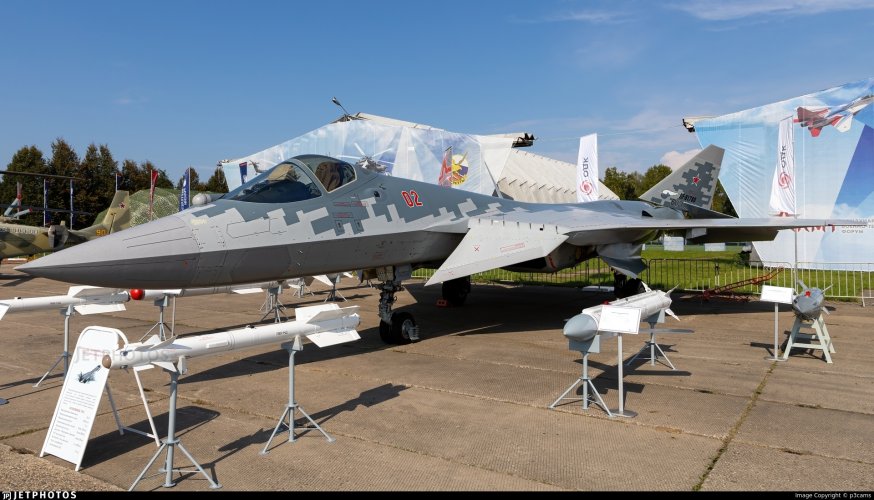
Agree, minimal TVC deflections would not have any substantial effects on the LO performance during egresion, the typical situation where rear-aspect RCS may be relevant. It is questionable to what extent deflection of aerodynamic surfaces is not a bigger factor than TVC in that regard.


I wonder if he is being strict with that 'original' sense of the term as 'higher than 1.5M'. The thrust difference between Izd.117 and F119 alone is enough to be skeptic in that regard, but who knows.

I don't know what speed they had in mind, but it is hard to draw any conclusions since we don't know what the dynamic thrust is for the Izd.117 and F119 at supersonic conditions, especially since the Su-57 has variable air intakes and the F-22 doesn't. Also, the lift-to-drag ratio plays a significant role in the calculations.
 
I think you didn't understand what I was saying.
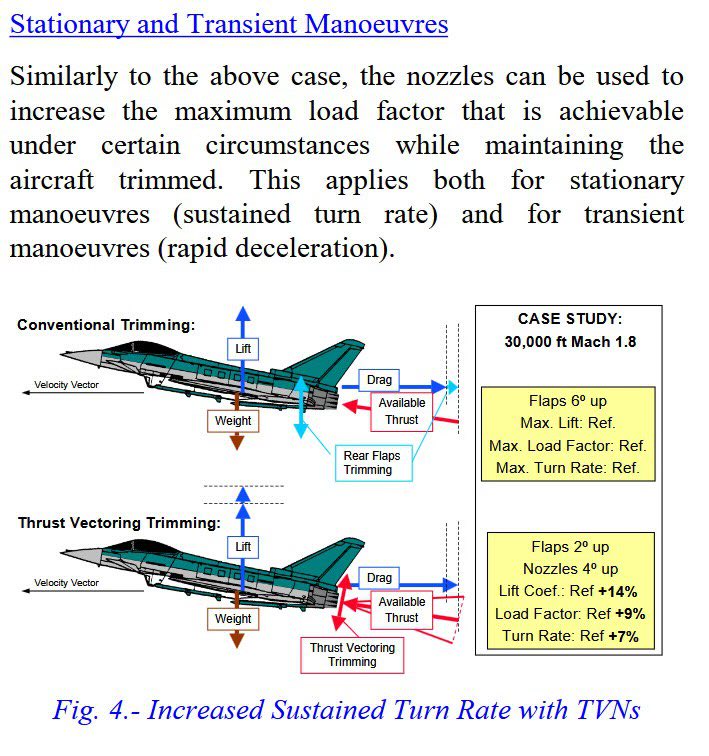
The effect of the TVC on supersonic trim reduction is significant, but the nozzle deflection is minimal, just a few degrees, even for the planes that don't have the LEVCONs.
Su-57 LEVCONs have just a few degrees of positive deflection (in relation to the airframe), and that is most likely correlated with the highly relaxed longitudinal stability of the plane. Modern fighters usually fix their longitudinal instability at 3% of the average aerodynamic chord length. With further relaxing of the longitudinal stability, the Su-57 enjoys a significant improvement in the lift-to-drag ratio. Relaxing the longitudinal instability not only increases take-off and landing characteristics and maximizes low-speed lift characteristics, but could also enhance transonic lift-to-drag characteristics and improve supersonic lift-to-drag capabilities. Yet, an increase in longitudinal instability will also increase the burden on high AOA pitch-down controls, which in a pure tail configuration would be absolutely inadequate.
According to the T-50 patent, during supersonic flight, LEVCONs don't have negative deflection in relation to the airframe; instead, they are in a neutral position, perfectly aligned with the wings (airframe), which is the best solution from the RCS standpoint.
For that reason, I think the Su-57 needs less nozzle deflection in supersonic flight compared to pure tail designs like the Su-35S or F-22.
My mention of Lockheed retention of TVC was specifically for stealth across all flight envelops. My mention of transonic or above trim drag was a separate point
 
How do you feel about the thesis that a controlled thrust vector is effective only when afterburning is running?

That's nonsense, with afterburner it's ofcourse more effective, or generally spoken the more thrust the more powerful the impact of the thrust vector. Doesn't mean it's ineffective without it.
 
I don't know what speed they had in mind, but it is hard to draw any conclusions since we don't know what the dynamic thrust is for the Izd.117 and F119 at supersonic conditions, especially since the Su-57 has variable air intakes and the F-22 doesn't. Also, the lift-to-drag ratio plays a significant role in the calculations.
At supercruise Mn of 1.7 or less, there is little difference in pressure recovery between a fixed caret inlet and a variable ramp external shock inlet. The variable ramp inlet gains a significant advantage in pressure recovery as you go faster, until the size of the inlet becomes a drag problem. In the M3+ environment, you have to go to a multiple shock mixed flow inlet like the SR-71. Since the F-22 is capable of M2+ with its fixed caret inlet, it avoids the weight, LO impacts and reliability issues of a a vari ramp inlet, and appears to be good enough.
 
How do you feel about the thesis that a controlled thrust vector is effective only when afterburning is running?
On the F-22, whenever the flight controls call for vectored thrust, the nozzle respond regardless of the throttle position. The engines also communicate the engines gross thrust, which goes into the calculation of how big a thrust angle to request. Obviously, there is more pitch authority per degree of thrust vector at high power than at idle.
 
Last edited:
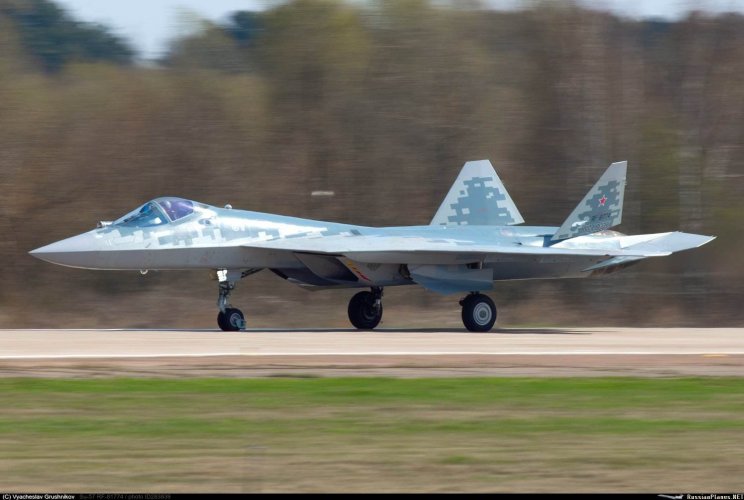
Now,even after 24 hours ,there is no public news about delivery of the new Su-57's. It is obvious that they 'hide' them from the public.Last time exept that one from yesterday ,we saw two new during delivery on April this year thanks to some spotters on the Tolmachevo-Novosibirsk airport.They were Bort 25 and 26 red.

View: https://www.reddit.com/r/WarplanePorn/comments/1jx6q3j/1280x853_newly_spotted_su57s_25_red_and_26_red/#lightbox


This is from summer of this year ...

Su-57 production in 2022,23,24.jpg

MWM also has article about this :


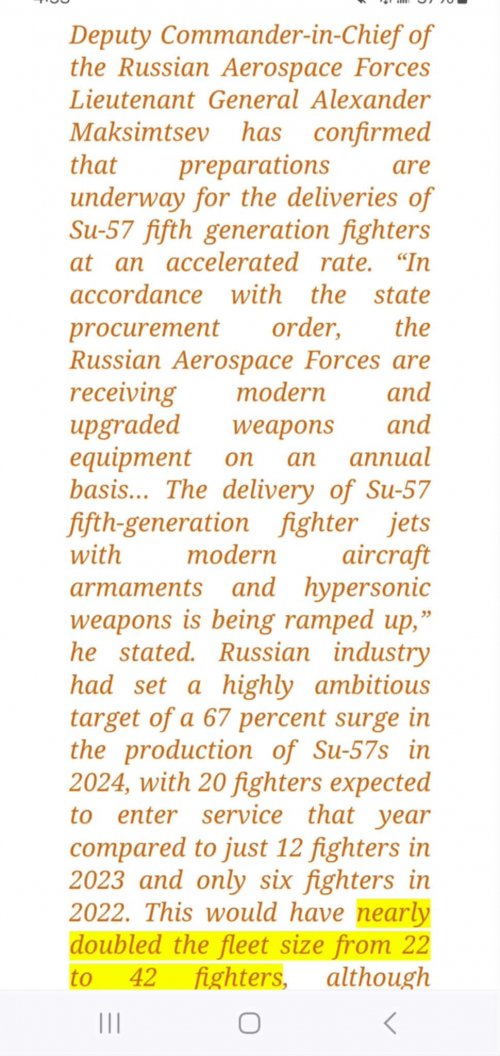
So we have : 2021-4 ,2022-6, 2023-12 ,2024-20 ( or even more) , 2025 ? Until the beginning of 2025, VKS had about 40 Su-57's. It is interesting to note that second serial/first operational Bort 01 blue has reg. No RF-81774.

Su-57 Bort br 01 plavi RF-81774.jpg

Reg. No RF-81775 has Bort 52 red .

View: https://www.reddit.com/r/WarplanePorn/comments/1905yz8/sukhoi_su57s_rf81775_52_red_delivered_to_the_vvs/#lightbox


Btw, reg. No's RF-81774 and 81775 wore two second stage prototypes 509 blue and 511 blue during their first combat engagement in Syria between 21 and 23 Feb. 2018 .

As we can see, Bort 26 red from April this year has reg. No RF-81797. If we count those reg. No's , that's the 24th in a row. Until the beginning of 2028 ,they have only 2026 and 2027 for serial production and delivery of the remaining Su-57's.Question, is there someone with more info about the serial production/delivery so far?
 
Last edited:
20..22 in 2024 is an upper bound.
However, an increase in the production rate means an upgrade of the construction site. Such an update was planned for 2024, but I didn’t find any evidence that it was completed on time.
 
Well, what i understand from deliberately vague insiders is that for some reason the powers that be haven't publicized deliveries of VKS Su-57s lately. From that i interpret that likely there were Su-57 deliveries, just not publicized. Now whether it's just silly OPSEC, or there is something special about these latest Su-57s (like new engines?) it's open to speculation.
 
20..22 in 2024 is an upper bound.
However, an increase in the production rate means an upgrade of the construction site. Such an update was planned for 2024, but I didn’t find any evidence that it was completed on time.

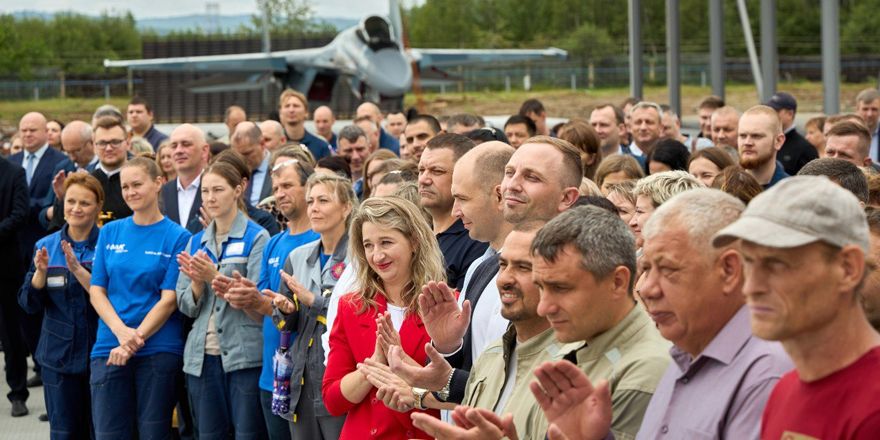
Yes, there were news like this one from Aug 2024 :

''The Komsomolsk-on-Amur Aviation Plant has completed construction of new facilities to expand production of Su-57 fighters. The commissioning ceremony of the new facilities was timed to coincide with the 90th anniversary of the enterprise. As part of the renovation, fuel system development buildings were launched, and the first stage of construction of a boathouse designed for testing on-board radio-electronic equipment was completed. This is reported by the press service of the United Aircraft Corporation.''


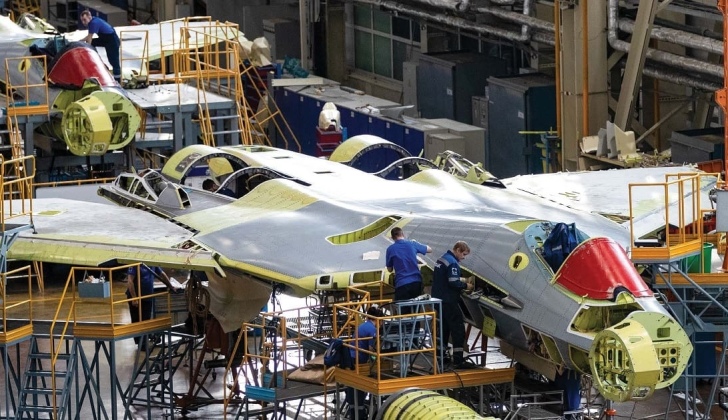
During July 2024 ,KnAAZ celebrated its 90th anniversary. In this article we have video where we can see several Su-57's during serial production in one line only .Of course, question is,when the sequences were made anyway?


Another source :

''Торжественное мероприятие по вводу мощностей в эксплуатацию приурочили к 90-летнему юбилею предприятия. На заводе построили новые объекты для развития производства самолетов пятого поколения Су-57. Запущены в строй корпуса отработки топливной системы, также завершена первая очередь строительства эллинга для отработки бортового радиоэлектронного оборудования (БРЭО) для масштабирования серийного производства самолетов. Планируется и дальнейшее развитие производства. В частности, в эксплуатацию будет введен ангар для отработки систем и наземных испытаний Су-57. Новые промышленные мощности в Комсомольске-на-Амуре позволят сделать процесс выпуска необходимого количества самолетов по заказу Министерства обороны России более технологичным и эффективным.''

''The ceremonial commissioning of the new facilities coincided with the plant's 90th anniversary. New facilities were built at the plant to expand production of the fifth-generation Su-57 aircraft.
The fuel system development facility has been commissioned, and the first phase of construction of the hangar for development of onboard radio-electronic equipment (avionics) has been completed to scale up serial production of aircraft.Further development of production is also planned. Specifically, a hangar for systems development and ground testing of the Su-57 will be commissioned.
New industrial capacity in Komsomolsk-on-Amur will make the process of producing the required number of aircraft ordered by the Russian Ministry of Defense more technologically advanced and efficient.''

Source : https://www.profavia.ru/news/novosty/organizatsij-profsoyuza/18480-zavod-kak-letopis-pokolenij
 
My mention of Lockheed retention of TVC was specifically for stealth across all flight envelops. My mention of transonic or above trim drag was a separate point

Actually, in the transonic/supersonic area, you get the most benefit regarding RCS reduction of the plane because of the trim drag reduction and less deflection of the aerodynamic surfaces.
You don't get that in subsonic region because most of the time nozzles are in neutral position (conventional take off and landing, cruise flight, low to moderate AoA maneuvering etc.)

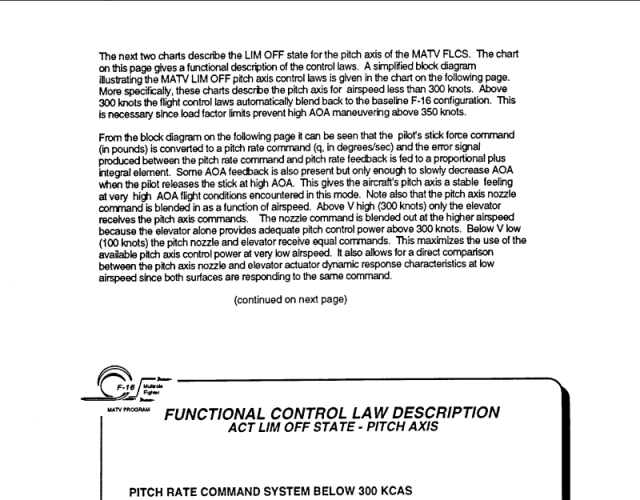
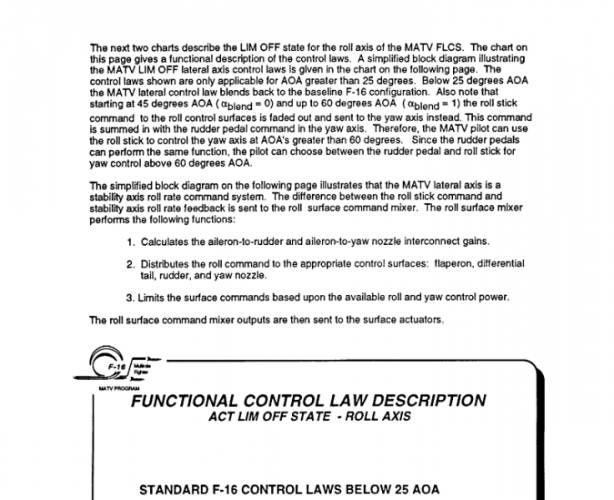
Just to give you example here are the F-16 MATV control laws (CLAW):

claw.PNG

claw1.PNG

As we can see, above 300 knots, or 555 km/h, the flight control laws automatically blend back to the baseline F-16 configuration, as well as below 25 deg. AoA.
This means that the TVC is primarily used for moderate/slow speed, high AoA maneuvering, and the post-stall region during subsonic flight. That also doesn't mean that the conventional aerodynamic surfaces will have less deflection during such conditions; it only means that they will be used to provide additional control to back up the TVC.
For example, during the flat spin, the F-22 CLAW is using the TVC to control the pitch, and the horizontal tails are used to control the yaw. The same thing is happening during moderate to high AoA roll, where the TVC is controlling the pitch axis, and the tails are freed from that role, being used primarily to control the roll axis, providing significantly faster roll rates and roll control at much higher AoA.
Unlike the F-22, the Su-57's TVC can also control the roll and yaw, and it is used more frequently in the conventional envelope, but that doesn't mean that there will be any RCS reduction because conventional control surfaces will be used extensively to increase flight performance and controllability.
Here is a recent example where the Su-57 is using the TVC vertical tails and LEVCONs to control the roll/yaw, while the horizontal tails are used for pitch control during the weapons bay opening while banking.


View: https://www.youtube.com/shorts/7VT8Facxnv8


This also answers the "paralay" question about the usage and effectiveness of the TVC when the afterburners are off. Like others have mentioned, the effectiveness is less pronounced when the AB is off, but when you have 22 tons of thrust at military power, that is certainly going to have a significant impact on the controllability of the plane.
 
At supercruise Mn of 1.7 or less, there is little difference in pressure recovery between a fixed caret inlet and a variable ramp external shock inlet. The variable ramp inlet gains a significant advantage in pressure recovery as you go faster, until the size of the inlet becomes a drag problem. In the M3+ environment, you have to go to a multiple shock mixed flow inlet like the SR-71. Since the F-22 is capable of M2+ with its fixed caret inlet, it avoids the weight, LO impacts and reliability issues of a a vari ramp inlet, and appears to be good enough.

While I agree with you that the biggest difference is seen as the supersonic speed increases, still, variable intakes are superior in all ranges of supersonic speeds.
And the Russians seem to prefer the increase in performance compared to the caret inlet:


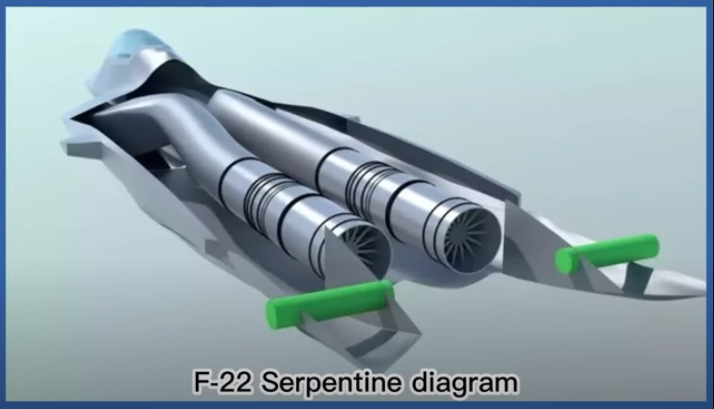
A A supersonic air intake of F-22 aircraft implementing a scheme of three-dimensional compression of supersonic flow (Aerodynamics, Stability and Maneuverability of Supersonic Aircraft, ed. G. S. Byushgens. M.: Nauka. Fizmatlit, 1998) may be referred to as a prior art. To reduce radar perceptibility of the F-22 aircraft the air intake is swept on all edges of the entrance. As seen from the front, the air intake entrance has the shape of a parallelogram. The air intake has one decelerating stage per each perforated vertical and horizontal wedge, and air bypass doors in the duct. The air intake duct is S-shaped. The minimum flow passage area (throat) is non adjustable. The lack of adjusting the air intake throat in the F-22 aircraft is a disadvantage. For this reason, the air intake performance at supersonic flight regimes is below the level typical for adjustable air intakes (System Analysis of Technical Aspect of “Raptor” F/A-22 aircraft, Report of FGUP “GosNIIAS” No.68 (15396), 2005). Apparently, the air intake is not designed to fly with a Mach number over M=2.0

From what I have heard, the practical top speed of the F-22 is Mach 2. The Su-57 can fly at 2,500 km/h with an external air-to-air weapons load with the first-stage engines, and we can argue about the weight penalty and other side effects of both solutions. In my opinion, the main reason for the Su-57's variable air intakes is the ability of the plane to supercruise at a high Mach number with the second-stage engines, as that makes the most sense in practical terms of using high supersonic speed. High top speed is always a good thing but is significantly less practical in terms of fuel consumption, flight time and range.
So having the variable intakes would be the most practical solution for the high Mach supercruise, and the added weight is basically nonexistent in comparison to the weight the S-shaped intakes are bringing to the table directly and indirectly.
Directly because their size and weight are far greater than the weight of a few ramps and small actuators, and indirectly because that kind of intake takes up a huge part of the internal volume of the airframe (decreasing the useful space for the fuel and weapons bays) that needs to be additionally strengthened (not to mention the additional increase in the plane's cross-section that has a negative impact on the lift-to-drag ratio).

s.PNG

Both solutions are to a certain extent trade-offs, and the only question is which solution is more useful in today's modern warfare.
I tend to believe that the Su-57 is far more practical and versatile choice for the real war against the peer opponent with big land mass.
 
. The lack of adjusting the air intake throat in the F-22 aircraft is a disadvantage. For this reason, the air intake performance at supersonic flight regimes is below the level typical for adjustable air intakes (System Analysis of Technical Aspect of “Raptor” F/A-22 aircraft, Report of FGUP “GosNIIAS” No.68 (15396), 2005). Apparently, the air intake is not designed to fly with a Mach number over M=2.0

From what I have heard, the practical top speed of the F-22 is Mach 2.

On the other side, Su-57's air intakes are capable for Mach 3 .

СПОСОБ РЕГУЛИРОВАНИЯ СВЕРХЗВУКОВОГО ВОЗДУХОЗАБОРНИКА


Изобретение относится к авиационной технике, а именно к воздухозаборникам силовых установок сверхзвуковых самолетов. Преимущественной областью применения изобретения являются самолеты с ТРДД с максимальным числом Маха не более 3-х.

В качестве прототипа изобретения принят способ регулирования сверхзвукового воздухозаборника, при котором осуществляют изменение площади горла и положение скачков уплотнения (RU 2343297 C1). В известном решении реализуется пространственное торможение потока за счет использования V-образного клина (т.е. двух примыкающих друг к другу стреловидных клиньев, ориентированных друг к другу на виде спереди под тупым углом). Воздухозаборник выполнен с приданием стреловидности всем кромкам входа. Регулирование воздухозаборника осуществляется при помощи двух пар поворачивающихся относительно соответствующих осей панелей. Передние панели каждой из пар являются частью поверхностей торможения. Задние панели являются частью канала. При регулировании каждой пары панелей между их смежными торцевыми сторонами возникают поперечные щели, а между их боковыми сторонами возникают продольные щели как по стыкам с боковыми стенками, так и по стыкам друг с другом. Данное техническое решение имеет следующие недостатки:

- способ регулирования воздухозаборника не обеспечивает необходимую площадь горла на дозвуковых и малых сверхзвуковых скоростях полета, т.к. амплитуда перемещения подвижных панелей мала. В противном случаем возникают упомянутые продольные щели неприемлемых размеров. Это означает, что воздухозаборник не обеспечивает работу ТРДД во всем эксплуатационном диапазоне скоростей и не является многорежимным;

- технически сложная реализация способа регулирования воздухозаборника.

Технический результат, на достижение которого направлено изобретение, заключается в обеспечении возможности изменения угла раствора ступеней одного из стреловидных клиньев торможения и минимальной площади проходного сечения воздухозаборника (горла) без образования в его канале нежелательных продольных щелей и заедания подвижных элементов. Такое регулирование позволит, в свою очередь, обеспечить устойчивую работу двигателя на всех режимах полета летательного аппарата вплоть до числа Маха М=3.0 с коэффициентом восстановления полного давления на входе в двигатель на уровне не ниже типового для регулируемых плоских воздухозаборников и суммарной неоднородностью потока ниже максимально допустимой величины («Аэродинамика, устойчивость и управляемость сверхзвуковых самолетов», под ред. Г.С.Бюшгенса. - М.: Наука. Физматлит, 1998). При этом за счет параллелограммной формы входа воздухозаборника на виде спереди и придания всем его кромкам стреловидности достигается снижение РЛ-заметности объекта, на котором он установлен. Наибольший эффект снижения РЛ-заметности будет достигаться в случае, когда кромки воздухозаборника параллельны каким-либо элементам объекта (передним или задним кромкам крыла, оперения и др.).

METHOD OF ADJUSTING SUPERSONIC AIR INTAKE

The invention relates to aircraft technology, specifically to air intakes for supersonic aircraft power plants. The invention is primarily applicable to aircraft powered by turbofan engines with a maximum Mach number of no more than 3.

As a prototype of the invention, a method for regulating a supersonic air intake is adopted, in which the throat area and the position of the compression shocks are changed (RU 2343297 C1).In a known solution, spatial flow braking is achieved by using a V-shaped wedge (i.e. two adjacent arrow-shaped wedges oriented towards each other in the front view at an obtuse angle).
The air intake is designed with a sweepback shape at all inlet edges. The air intake is adjusted using two pairs of panels that rotate relative to their respective axes. The front panels of each pair are part of the braking surfaces.The rear panels are part of the channel. When adjusting each pair of panels, transverse gaps appear between their adjacent end faces, and longitudinal gaps appear between their side faces, both at the joints with the side walls and at the joints with each other.

This technical solution has the following disadvantages:

-The method of regulating the air intake does not provide the required throat area at subsonic and low supersonic flight speeds, since the amplitude of movement of the movable panels is small.
Otherwise, the aforementioned longitudinal gaps of unacceptable dimensions will appear. This means that the air intake does not support turbofan engine operation across the entire operating speed range and is not multi-mode;

- technically complex implementation of the air intake regulation method.

The technical result that the invention is aimed at achieving is to ensure the possibility of changing the opening angle of the steps of one of the arrow-shaped braking wedges and the minimum cross-sectional area of the air intake (throat) without the formation of unwanted longitudinal cracks in its channel and jamming of moving elements.
Such regulation will, in turn, ensure stable operation of the engine in all flight modes of the aircraft up to the Mach number M = 3.0 with a recovery coefficient of the total pressure at the engine inlet at a level not lower than the typical one for adjustable flat air intakes and a total non-uniformity of the flow below the maximum permissible value (“Aerodynamics, stability and controllability of supersonic aircraft”, edited by G.S. Byushgens. - M.: Nauka. Fizmatlit, 1998).

At the same time, due to the parallelogram shape of the air intake inlet in the front view and the fact that all of its edges are swept back, the radar signature of the object on which it is installed is reduced.
The greatest effect of reducing radar signature will be achieved when the edges of the air intake are parallel to some elements of the object (leading or trailing edges of the wing, empennage, etc.).

 
While I agree with you that the biggest difference is seen as the supersonic speed increases, still, variable intakes are superior in all ranges of supersonic speeds.
And the Russians seem to prefer the increase in performance compared to the caret inlet:


A A supersonic air intake of F-22 aircraft implementing a scheme of three-dimensional compression of supersonic flow (Aerodynamics, Stability and Maneuverability of Supersonic Aircraft, ed. G. S. Byushgens. M.: Nauka. Fizmatlit, 1998) may be referred to as a prior art. To reduce radar perceptibility of the F-22 aircraft the air intake is swept on all edges of the entrance. As seen from the front, the air intake entrance has the shape of a parallelogram. The air intake has one decelerating stage per each perforated vertical and horizontal wedge, and air bypass doors in the duct. The air intake duct is S-shaped. The minimum flow passage area (throat) is non adjustable. The lack of adjusting the air intake throat in the F-22 aircraft is a disadvantage. For this reason, the air intake performance at supersonic flight regimes is below the level typical for adjustable air intakes (System Analysis of Technical Aspect of “Raptor” F/A-22 aircraft, Report of FGUP “GosNIIAS” No.68 (15396), 2005). Apparently, the air intake is not designed to fly with a Mach number over M=2.0

From what I have heard, the practical top speed of the F-22 is Mach 2. The Su-57 can fly at 2,500 km/h with an external air-to-air weapons load with the first-stage engines, and we can argue about the weight penalty and other side effects of both solutions. In my opinion, the main reason for the Su-57's variable air intakes is the ability of the plane to supercruise at a high Mach number with the second-stage engines, as that makes the most sense in practical terms of using high supersonic speed. High top speed is always a good thing but is significantly less practical in terms of fuel consumption, flight time and range.
So having the variable intakes would be the most practical solution for the high Mach supercruise, and the added weight is basically nonexistent in comparison to the weight the S-shaped intakes are bringing to the table directly and indirectly.
Directly because their size and weight are far greater than the weight of a few ramps and small actuators, and indirectly because that kind of intake takes up a huge part of the internal volume of the airframe (decreasing the useful space for the fuel and weapons bays) that needs to be additionally strengthened (not to mention the additional increase in the plane's cross-section that has a negative impact on the lift-to-drag ratio).

View attachment 796590

Both solutions are to a certain extent trade-offs, and the only question is which solution is more useful in today's modern warfare.
I tend to believe that the Su-57 is far more practical and versatile choice for the real war against the peer opponent with big land mass.
Per the Western Museum of Flight by F-22 test pilot JB Brown (
View: https://youtu.be/lltMfkj1yPU?si=7zA9RchkvIsq2Cko
), the F-22 flight envelope is M2 at 36k to 60k ft, with only approx 1/3 AB thrust needed to maintain M2 at 40k, and has been tested to a comfortable margin beyond that. While the efficiency of the 2 shock fixed caret inlet may be dropping off at M2+, the aircraft is very comfortable at flying to the edges of the design flight envelope.

During envelope expansion flight test at Edwards AFB, the F-15C chase plane (with centerline tank) was always miles behind the F-22 down the supersonic corridor, despite its 3 shock moveable ramp inlet capable of M2.5.

As for the Su-57 intake being capable of M3, that may be true. But the aluminum / composite airframe and polycarbonate canopy are unlikely to withstand the aero heating beyond M2.3, and the engine may not be able to flow sufficient air to match the inlet flow requirements at those elevated inlet temperatures, making that complication unnecessary for the flight envelope of the Su-57
 
the F-22 flight envelope is M2 at 36k to 60k ft, with only approx 1/3 AB thrust needed to maintain M2 at 40k,
That is very interesting indeed, and the kind of improvement potential that Sukhoi engineers may have looked at, when they chose the adjustable intakes for the PAK-FA despite the downsides.
 
As for the Su-57 intake being capable of M3, that may be true. But the aluminum / composite airframe and polycarbonate canopy are unlikely to withstand the aero heating beyond M2.3, and the engine may not be able to flow sufficient air to match the inlet flow requirements at those elevated inlet temperatures, making that complication unnecessary for the flight envelope of the Su-57

It is limitation only for the air intake itself ,not for the Su-57 ,especially with the AL-41F-1. Even with AL-51F ,Su-57 would not reach Mach 3 in acceleration on the Full AB mode.

So the air intake itself described by the Patent doc. is capable to provide for 'given aircraft' with the 'given engine' max true air speed of 3 Mach. We already commented that max true air speed of Su-57 in stratosphere with AL-41F-1 can be about 2.4 Mach ( with time limitation max 5 min maybe and another limitations by windshield and cockpit canopy ,skin RAM layers etc ).

Of course ,that max true airspeed ( during accelaration on the Full AB mode) is something that is not so interesting like max long-term cruising speed on the MP mode.In that case ,we already mentioned some details in the connection with the Su-27 air intakes where program for the automatic regulation of the intake's ramps/panels begin to work when the true air speed of 1.35 M is reached. Suppose that Su-57's air intakes have the same or very similar program for automatic regulation, thus it is very likely what S.Bogdan said that with T-50 he reached 1.3 M in so-called 'supercruise' mode ( flying on the MP ,non-AB mode).
 
Starting to move the ramps at M1.3 would be normal control strategy for a variable ramp inlet.

The point is that there is very little ram recovery gain between M1.3 and M2.0 between a 2 shock fixed caret inlet and a 3 shock vari-ramp inlet. Is the 3 shock vari-ramp better - yes, at ram recovery. Is it better for the weapons system overall if the flight envelope is limited to the M2.0 or slightly higher range - debatable.

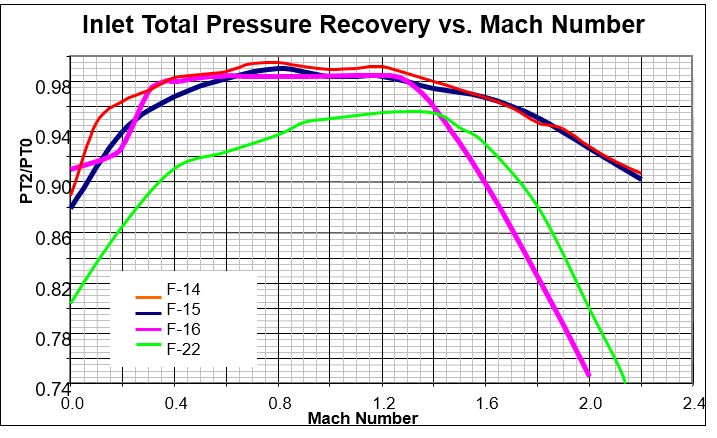
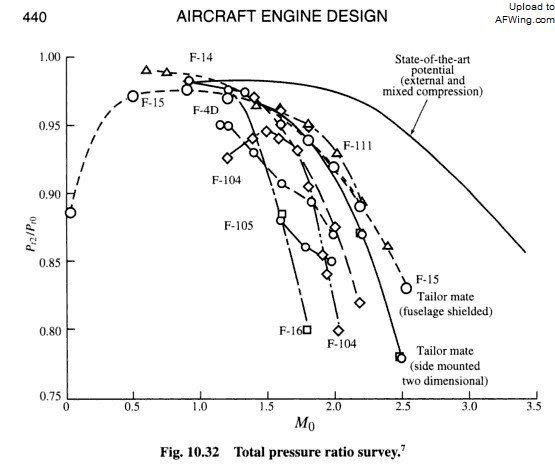
The F-22 inlet is likely optimized for the M1.5 -M1.8 supercruise speeds, so it might be better than this diagram showing relative supersonic inlet performance differences between various generic inlet configurations
 
As for the Su-57 intake being capable of M3, that may be true. But the aluminum / composite airframe and polycarbonate canopy are unlikely to withstand the aero heating beyond M2.3, and the engine may not be able to flow sufficient air to match the inlet flow requirements at those elevated inlet temperatures, making that complication unnecessary for the flight envelope of the Su-57
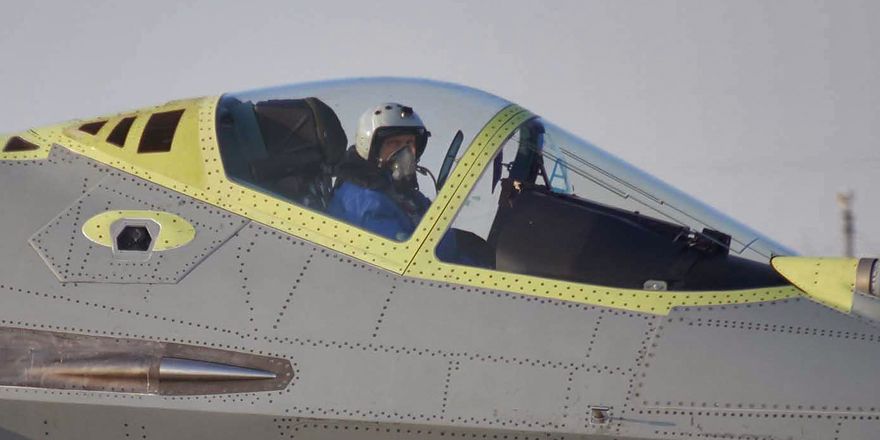
FWIW, the fixed windscreen part of the Su-57 canopy is silica glass, IIRC (which would make it a lot more heat resistant).
 
It should be added that the curvature of modern intakes also serves the purpose of slowing the air down before it hits the compressor, which increases thrust efficiency without the need for ramps.
 
It should be added that the curvature of modern intakes also serves the purpose of slowing the air down before it hits the compressor, which increases thrust efficiency without the need for ramps.

For comparison with the air intakes of the Su-27/30 ( FFF ), which are straight ,Su-57's air intakes have curvature.Of course, it is not the real S-shape like it should be but enough for that purpose?

Su-27 air intake.jpg


Su-57 air intake 5.jpg

 
Last edited:
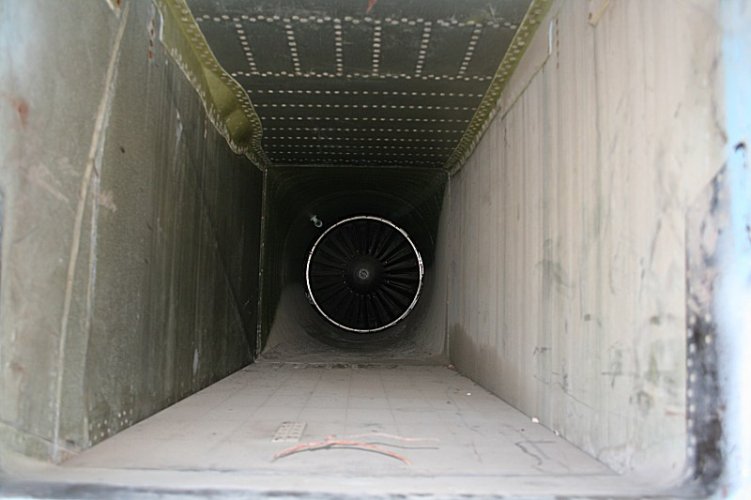
Aft of the terminal shock at the throat of the inlet, the Mach number of the airflow will be something like 0.8 - 0.9, depending on the strength of the terminal shock. The job of the duct leading to the engine inlet is to slow that air to the 0.5 - 0.6 Mn as a divergent diffuser, while minimizing distortion at the engine face. Curvature of the duct has little positive impact on this pressure recovery, as long as it doesn’t negatively impact it with flow separation or other cause of distortion or unsteady flow. S-ducts obviously have LO advantages, and have to be carefully designed to not reduce the performance or operability of the propulsion system.
 
Some comments and details from Ilya Fedorov, head of the NPO Saturn then (2010) about the first-stage engine Izd. 117 especially about its 'super cruise' capability. Of course,that was the time when flight testing of
T-50 started.

From 5:00

Т-50: технологии взлёта. Т-50: technologies of launch.​


View: https://www.youtube.com/watch?v=bNyfClu4HVA
 
Per the Western Museum of Flight by F-22 test pilot JB Brown (
View: https://youtu.be/lltMfkj1yPU?si=7zA9RchkvIsq2Cko
), the F-22 flight envelope is M2 at 36k to 60k ft, with only approx 1/3 AB thrust needed to maintain M2 at 40k, and has been tested to a comfortable margin beyond that. While the efficiency of the 2 shock fixed caret inlet may be dropping off at M2+, the aircraft is very comfortable at flying to the edges of the design flight envelope.

So he basically confirmed what we already knew, that the F-22 is M2 fighter. He said that the top speed they achieved during testing was M2.1, and he also confirmed that the F-15 is faster, even though the Raptor feels more comfortable at M2. The fact that you have a certain percentage of the throttle in AB left when flying at M2 doesn't mean that the speed will increase linearly for the same percentage because above M2, the F-22 intakes are inefficient and will not cause such a significant power increase, no matter the throttle position.

During envelope expansion flight test at Edwards AFB, the F-15C chase plane (with centerline tank) was always miles behind the F-22 down the supersonic corridor, despite its 3 shock moveable ramp inlet capable of M2.5.

That is probably due to the F-22 superior acceleration and the fact that the F-15C was carrying EFT.

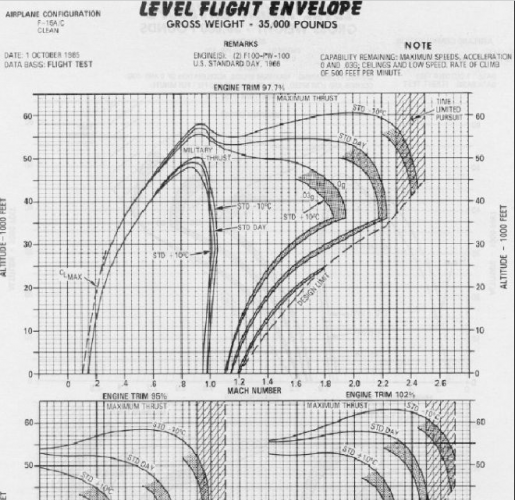
em.PNG

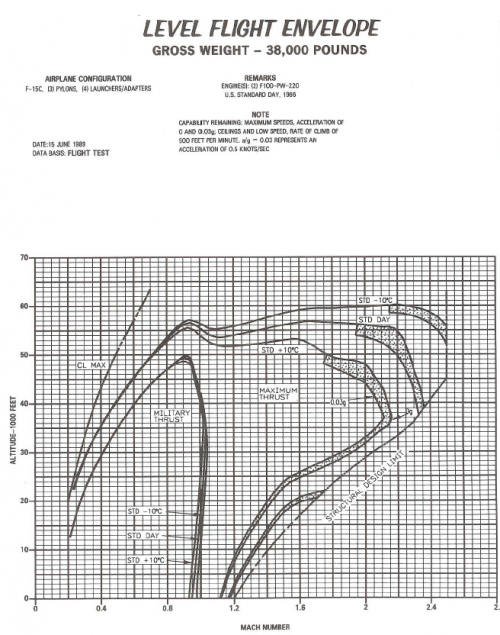
We can see that the clean F-15C top speed is actually around M2.24 at standard day conditions, and the centerline tank will undoubtedly reduce that speed, and will also have negative impact on the Eagles acceleration.

As for the Su-57 intake being capable of M3, that may be true. But the aluminum / composite airframe and polycarbonate canopy are unlikely to withstand the aero heating beyond M2.3, and the engine may not be able to flow sufficient air to match the inlet flow requirements at those elevated inlet temperatures, making that complication unnecessary for the flight envelope of the Su-57

Probably true, but the officially cited top speed for the Su-57 is around M2.5 (most likely time-limited). Also, the solution with the canopy bow allows for the thicker frontal part of the canopy if needed (in reality, the thickness is actually reduced compared to the first examples of the canopy used initially).


It is also interesting to note that the parts of the airframe that are most critical temperature-wise are not made from the composite materials, judging by the color of the materials.
We already know that the plane was tested with air-to-air weapons load at 2,500 km/h with the first stage engines, so obviously, that is the operational speed at which the plane is capable of flying. As a matter of fact, only the MiG-31BM is capable of flying at that speed (or higher) with the four R-33/37 missiles.
 
Last edited:
I'm somewhat ignorant on the topic, but my understanding is that the Su-57 intakes are a close cousin of the Su-27's design - which also wasn't really designed for top speed. From what I remember, the ramps purpose is not only shockwave positioning but also throat area control to avoid overpressure in certain engine conditions by reducing the effective area of the intake. The F-22 has opted to use bleed doors for this purpose so that it can vent the excess air after it has entered the intake. I don't know the respective tradeoffs for these solutions, but there must be advantages and disadvantages for both approaches.
484996912_676407244919725_8842036151690280119_n.jpg
 
above M2, the F-22 intakes are inefficient
I’m a bit curious where this characterization comes from. The inlet is a caret design that generates multiple oblique shocks before the terminal normal shock at the throat. The F-22 has an operational limit of Mach 2.0, but that is not due to aerodynamic or total temperature limits of the airframe’s structure.

The graph you used is for the F-15 equipped with the F100-100 engines; with the -220s starting in 1986, it will achieve Mach 2.45 on a standard day.

The claims for the Su-57’s maximum speed runs directly counter to official Sukhoi publications and statements, which again points to factors other than aerodynamics as the reason for the Mach 2.0 limit.
 
The F-22 fixed caret intakes are likely to become less efficient beyond M2 than an adjustable ramp multishock inlet like the F-15 or Su-57, but it still works beyond M2. They were designed to the requirements envelope for both speed and signature. Will they work well at M2.5 - probably not optimum, but that wasn’t the requirement. Per the JB Brown video, there is a portion of the flight envelope at mid altitudes that is temperature limited, and this temperature limit can be reached at high altitudes when flying beyond the M2 envelope, so there is no need for a M2+ optimized inlet.

The bypass doors are capable of venting excess inlet air to prevent spillage drag and inlet instability. I don’t know if this is necessary to match the fixed area inlet with engine flow at Mil/Max AB power settings within the normal flight envelope. However, the bypass is needed when the throttles are retarded below Mil power to slow down from supercruise. The reduction in engine airflow would cause inlet instability (buzz) at those Mach numbers. On the F-15 and F-16, the engine is automatically held at a minimum of Mil power above M1.4 to prevent inlet buzz, while wouldn’t work for the F-22 since it would never slow down.
 
I no longer recall the source and reverse image search produces no worthwhile hits - might have been a university paper?
Possibly, the other chart that compares total pressure recovery of various inlet design is this, which I believe is from Dan Raymer or Leland Nicolai (I’ll have to check my books to verify). Roughly similar but doesn’t quite exactly match yours, so I’m wondering if it was simulated/calculated.

Even though the F-22 inlet is generated multiple shock, I do expect that the pressure recovery drops off steeper past Mach 2 than variable geometry designs (i.e. F-15, Su-57) as flow conditions and shock positions no longer become ideal, and the downstream bleed and pressure system can only do so much.
 

Attachments

  • IMG_2779.jpeg
    IMG_2779.jpeg
    49.7 KB · Views: 59
I'm somewhat ignorant on the topic, but my understanding is that the Su-57 intakes are a close cousin of the Su-27's design - which also wasn't really designed for top speed. From what I remember, the ramps purpose is not only shockwave positioning but also throat area control to avoid overpressure in certain engine conditions by reducing the effective area of the intake. The F-22 has opted to use bleed doors for this purpose so that it can vent the excess air after it has entered the intake. I don't know the respective tradeoffs for these solutions, but there must be advantages and disadvantages for both approaches.
I stand to be corrected, but IIRC, in the discussion on the thread about Su-57 propulsion the point was brought that Sukhoi designs the intake area for some point in the flight envelope, I don't remember anymore if that was max speed, therefore additional intakes exist both in Su-27 and Su-57 for the takeoff. In the F-22 that is not the case and therefore extra intakes for the take off are not normally used, while bleed doors are required. This is a crude simplification I know, but the differences in design philosophy may be worth considering
 
Last edited:
I stand to be corrected, but IIRC, in the discussion on the thread about Su-57 propulsion the point was brought that Sukhoi designs the intake area for some point in the flight envelope, I don't remember anymore if that was max speed, therefore additional intakes exist both in Su-27 and Su-57 for the takeoff. In the F-22 that is not the case and therefore extra intakes for the take off are not normally used, while bleed doors are required. This is a crude simplification I know, but the differences in design philosophy may be worth considering
There are spring loaded doors on the bottom of the Su-27s intakes, these are used to suck in extra air at takeoff, and during post-stall manuevers at low speeds, but those are closed during level flight. The earlier Su-57s had the exact same arrangement, but the more recent ones seem to be boasting some mesh-like arrangement. This is different from the F-22 bypass doors, as those are used to get rid of excess air as @F119Doctor said. Afair the Su27/57 ramps serve to constrict the throat diameter instead.
 
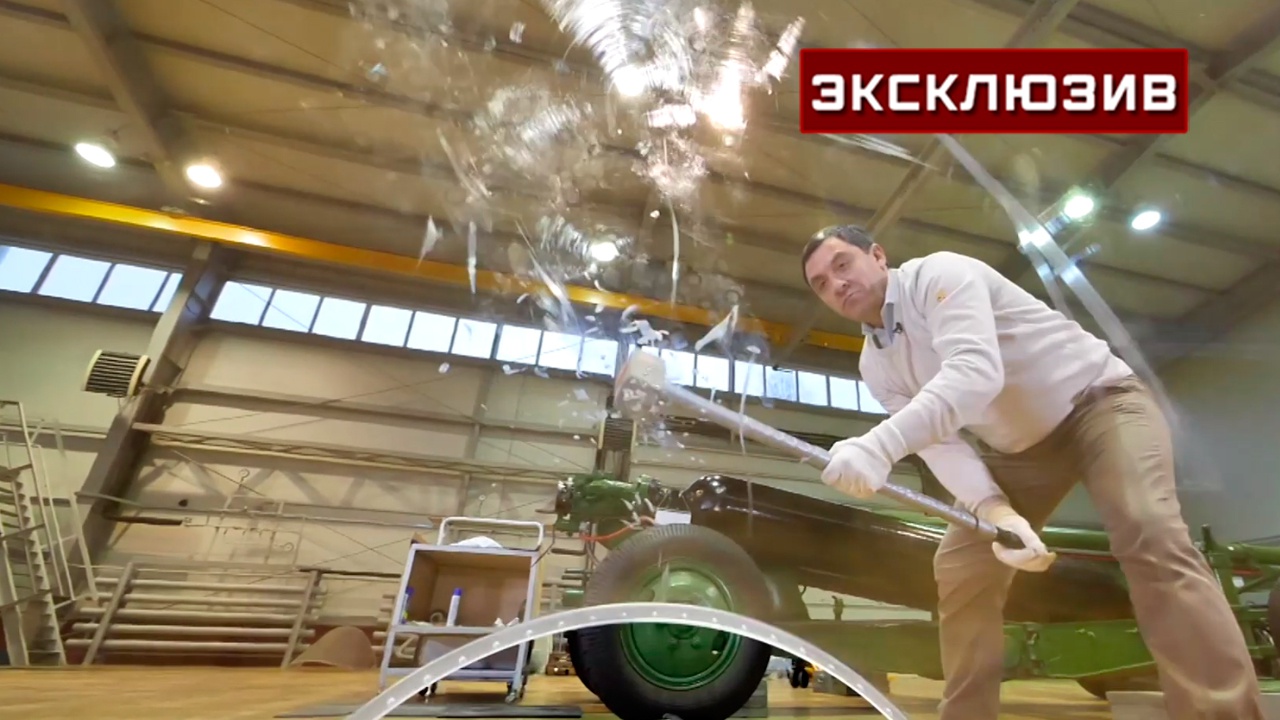
Also, the solution with the canopy bow allows for the thicker frontal part of the canopy if needed (in reality, the thickness is actually reduced compared to the first examples of the canopy used initially).

Aleksey Yegorov with the sledgehammer :cool:

Стекло против кувалды: опубликованы кадры жестких испытаний фонаря новейшего истребителя Су-57​


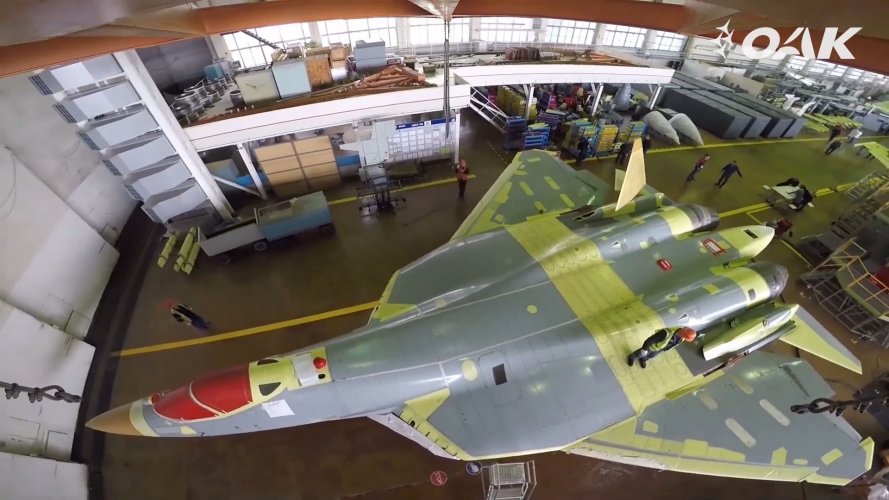
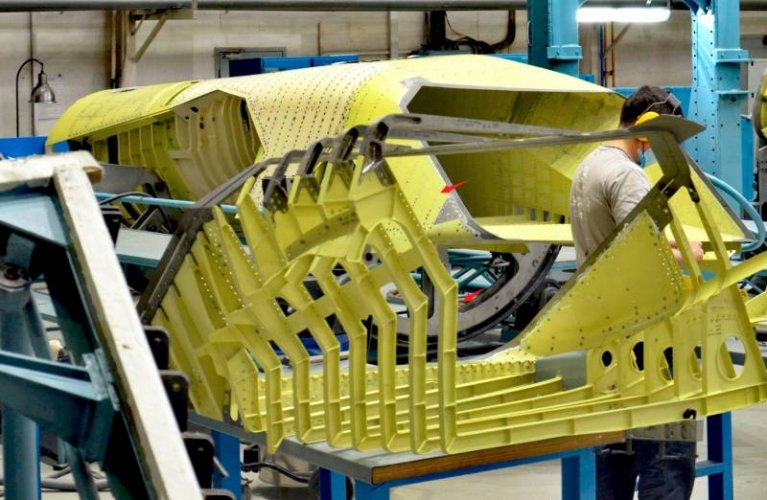
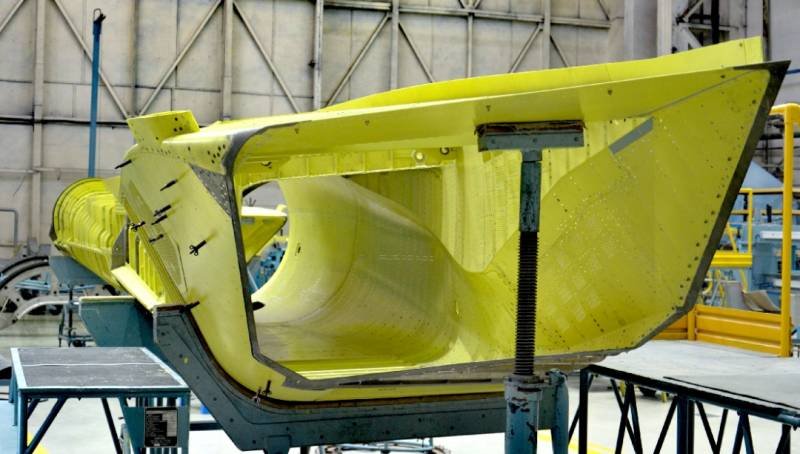
It is also interesting to note that the parts of the airframe that are most critical temperature-wise are not made from the composite materials, judging by the color of the materials.

Metallic skin structural parts with yellow color ( AL-Li Alloy) are used on the forward loooking radar radar block,windshield/canopy frame,than LEVCONs ,wingslats, wingtips,frontal section of the horizontal and complete skin section of the vertical stabilizers.Radome with that specific ocher color is made from composites besides other skin panels with greyish color.

Su-57 KnAAZ Konstrukcija planera.jpg

Air intakes are almost completely made from the Al-Li Alloys.

Su-57 air intake.jpg

Su-57 air intake 1.jpg

View: https://www.youtube.com/watch?v=R0ykwDn9Tcs
 
Last edited:
I’m a bit curious where this characterization comes from. The inlet is a caret design that generates multiple oblique shocks before the terminal normal shock at the throat. The F-22 has an operational limit of Mach 2.0, but that is not due to aerodynamic or total temperature limits of the airframe’s structure.

It is inefficient compared to the variable intakes past M2. If you have the throttle/power reserve when flying at M2, you are not going to achieve the same power/speed past M2 compared to the plane with the variable intakes because fixed intakes that are usually optimized for a certain speed span can't operate as efficiently as variable intakes, especially at speeds past M2.
That doesn't mean the F-22 can't go past M2 (it can; it was tested at M2.1 with its powerful F119 engines), but a relatively large throttle reserve doesn't mean a large speed reserve past M2. I think there is an objective reason why the Russians are bothering with the very complex Su-57 intakes instead of fixed ones.

The graph you used is for the F-15 equipped with the F100-100 engines; with the -220s starting in 1986, it will achieve Mach 2.45 on a standard day.

That is correct, I didn't have the EM chart for the F-15C with 220 engines.
But even just with 3 pylons and 4 adapters the speed drops to M2,35:

Qz6jGH4.png

I think that the centerline EFT will make bigger impact.

The claims for the Su-57’s maximum speed runs directly counter to official Sukhoi publications and statements, which again points to factors other than aerodynamics as the reason for the Mach 2.0 limit.

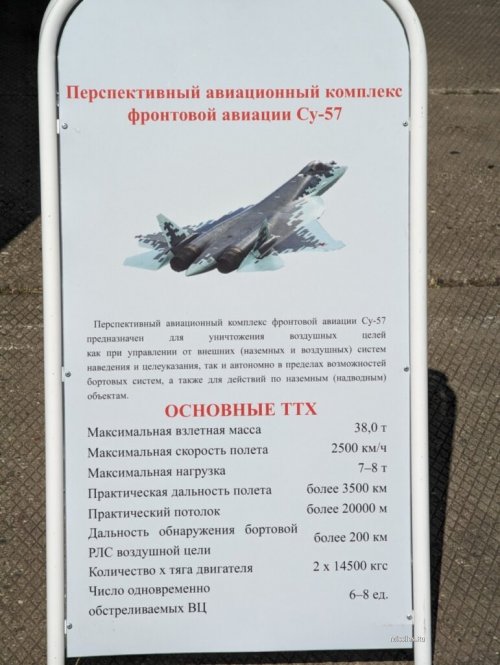
It is the other way around; the highest-ranking people from Sukhoi and technical specifications are supporting the claim that the plane can fly past M2. I'm sure you have watched the latest interview with Chief Test Pilot Sergey Bogdan, where he claims that the plane can fly at 2500 km/h in combat configuration. Here are the technical specifications that were presented in front of the operational Su-57:

8493990c2ccd43b5e4832b5155967fefb42ff766.jpeg

They are in line with what the Sergey Bogdan was claiming, and also in the line with the numbers given by the Mikhail Pogoshyan etc.
 
This means that the TVC is primarily used for moderate/slow speed, high AoA maneuvering, and the post-stall region during subsonic flight. That also doesn't mean that the conventional aerodynamic surfaces will have less deflection during such conditions; it only means that they will be used to provide additional control to back up the TVC.
I think I found this picture on this forum.
5f7c9a0a2340df4cc040f9e9a1d21071.jpg


Take note the supersonic speed.
 
Yes, 14:08. Here's his quote:
"At supersonic speed, it performs no worse than aircraft of previous generations, such as the Su-27, Su-30, and Su-35. In particular, during flight tests, even with air-to-air weapons onboard, we conduct flights at speeds of up to 2,500 km/h. At these speeds, we achieve load factors exceeding six G. At the same time, the angular roll rates reach very high values"

(Russian: На сверхзвуковой скорости он себя ведёт не хуже, чем самолёты прошлых поколений, такие как Су-27, Су30 и Су-35. В частности, мы при испытаниях, даже при наличии оружия класса воздух-воздух выполняем полёты со скоростью 2 500 км/ч. И на этих на этих скоростях мы выходим на перегрузку больше шести единиц же. При этом угловые вращения по крену достигают очень высоких значений.)
 

Similar threads

Back
Top Bottom