
You are using an out of date browser. It may not display this or other websites correctly.
You should upgrade or use an alternative browser.
You should upgrade or use an alternative browser.
Sukhoi Su-57 flight testing and development
- Thread starter overscan (PaulMM)
- Start date
I would not be so certain that Izdeliye 177 is purely an export product.
Piotr Butowski mentioned years ago in his book (ISBN 1913870448) the Udlinitel’ project, whose goal was to develop an interim powerplant in case of delays to Izdeliye 30.
And that is exactly what happened, with one of the main causes of the delay reportedly being the uncompromising VKS requirement for a flat nozzle, which necessitated the development of new solutions.
Piotr Butowski mentioned years ago in his book (ISBN 1913870448) the Udlinitel’ project, whose goal was to develop an interim powerplant in case of delays to Izdeliye 30.
And that is exactly what happened, with one of the main causes of the delay reportedly being the uncompromising VKS requirement for a flat nozzle, which necessitated the development of new solutions.
Would be glad to. could you please share an authentic source? These seem to be hard to come by.@Elysium Look at the specs of the 177. The whole discussion for years has been how izd. 30 could join the SFC of AL-31F and the specific thrust of F119 in the same engine.
Wasn't the flat nozzle flying demonstrator AL-31 based rather than next gen?I would not be so certain that Izdeliye 177 is purely an export product.
Piotr Butowski mentioned years ago in his book (ISBN 1913870448) the Udlinitel’ project, whose goal was to develop an interim powerplant in case of delays to Izdeliye 30.
And that is exactly what happened, with one of the main causes of the delay reportedly being the uncompromising VKS requirement for a flat nozzle, which necessitated the development of new solutions.
Ainen
I really should change my personal text
- Joined
- 25 August 2011
- Messages
- 2,113
- Reaction score
- 3,599
Flat nozzle - AL-51F (with new nozzle). Su-57M only. Not sure if AL-51F with axiosymmetric nozzle with be fielded.Wasn't the flat nozzle flying demonstrator AL-31 based rather than next gen?
It most certainly not an export product (first).I would not be so certain that Izdeliye 177 is purely an export product.
VKS itself is stretched over multiple AL-31/41 variants, with hundreds of underpowered aircraft at hand.
Among the things of note, as flight testing of Izd. 177 is just starting, even assuming a smooth testing program it's hard to expect series production much before 2030. Meanwhile Izd. 30 would have flown for over a decade, surely production should be ongoing by then.I would not be so certain that Izdeliye 177 is purely an export product.
Piotr Butowski mentioned years ago in his book (ISBN 1913870448) the Udlinitel’ project, whose goal was to develop an interim powerplant in case of delays to Izdeliye 30.
And that is exactly what happened, with one of the main causes of the delay reportedly being the uncompromising VKS requirement for a flat nozzle, which necessitated the development of new solutions.
Depending how cheapskate VKS is to buy new engines or upgrade older ones, Izd.177S would be perfect to re-engine Su-30SM and Su-34, while Izd.177 could power Su-35 and the current series version of Su-57. So this is already a potentially huge market before any export orders, of which India is an obvious candidate though their procurement is a mess, Algeria another strong possibility, plus potentially other smaller T-10 family operators. Plus possibly T-75 might be powered by the Izd. 177 too.
So all in all, potential market of thousands of engines, which is probably one of the reasons why they went with the Izd.177 program (apart from being a Izd. 30 back-up).

BonPlan2
ACCESS: Secret
- Joined
- 5 June 2025
- Messages
- 364
- Reaction score
- 500
If Su57 is supercruising without this new engine, it may be a true 5th gen if it is also : affordable (not a single 5th gen is), agile at least as a F16, with sensor fusion, stealthy (what is the limit ?).Export customers demand 5th gen technologies now, but Russia is not going to offer izd. 30. That is the rationale, I would say.
So nothing in direct link with the new engine (if it is spercruising with the actual one).
Ainen
I really should change my personal text
- Joined
- 25 August 2011
- Messages
- 2,113
- Reaction score
- 3,599
Hard to tell;If Su57 is supercruising without this new engine, it may be a true 5th gen if it is also : affordable (not a single 5th gen is), agile at least as a F16, with sensor fusion, stealthy (what is the limit ?).
So nothing in direct link with the new engine (if it is spercruising with the actual one).
Apparently it does, but with 117 engine it is not very operationally relevant (probably low mach with negligible non-reheat acceleration). Either way, both Su-57 and J-20 are viewed as interim solutions with their current engines. I.e. likely no significant progress over for example Rafale in this regard.
J-20 appears to be more handicapped(as a more straighforward air dominance design with higher performance goals), but neither of them are where their owners want them to be.
Maiden flight with Izd.177

ПАО «ОАК»
⚡️Самолет Су-57 впервые поднялся в небо с перспективным двигателем пятого поколения «изделие 177» Специалисты Объединенной авиастроительной корпорации и Объединенной двигателестроительной корпорации (входят в Госкорпорацию Ростех) приступили к летным испытаниям двигателя «изделие 177» в...t.me
To note , this is in fact Izdeliye 177 , not 117S.
As it is mentioned :
''Перспективный двигатель «изделие 177» создан ОДК для применения в авиационных комплексах пятого поколения. В новейшем двигателе тяга на форсаже составляет 16000 кгс.''
''The promising "Product 177" engine was developed by UEC for use in fifth-generation aircraft systems. This latest engine delivers 16,000 kgf of afterburning thrust.''
So we have 177 with max static thrust on Full AB of 16000kgf and the 177S with max static thrust on Full AB of 14500kgf

Potential candidates for '177' ? Su-57's which are operational in VKS , Su-57E ,Su-75.
Last edited:

- Joined
- 1 April 2006
- Messages
- 12,024
- Reaction score
- 13,950
dead link to copy of original video from UAC Telegram channel posted before I guess


LMFS
ACCESS: Top Secret
- Joined
- 19 March 2019
- Messages
- 563
- Reaction score
- 975
Actually, this is not silly at all. Why not use a 11/16tf engine with improved nozzle over an older one with lower thrust and worse LO performance, specially when using it in the VKS can encourage foreign customers to buy the plane? Nothing wrong with it, I would say. But the domestic engine that defines the state of the art in Russia remains classified, I have no doubts about it.I would not be so certain that Izdeliye 177 is purely an export product.
Piotr Butowski mentioned years ago in his book (ISBN 1913870448) the Udlinitel’ project, whose goal was to develop an interim powerplant in case of delays to Izdeliye 30.
And that is exactly what happened, with one of the main causes of the delay reportedly being the uncompromising VKS requirement for a flat nozzle, which necessitated the development of new solutions.
Izd. 177's specs have been publicly shown in Dubai:Would be glad to. could you please share an authentic source? These seem to be hard to come by.
Can be used domestically. But already with the export in mind. Otherwise, specs would not be published at an airshow abroad.It most certainly not an export product (first).
VKS itself is stretched over multiple AL-31/41 variants, with hundreds of underpowered aircraft at hand.
This supercruising crap is really a plague. No plane crosses the sound barrier and spends lots of fuel to "cruise", this is dashing on mil power. But still, Su-57 is supposedly capable of doing that, only the 1st stage engine is not optimized for it. As for F-16 agility... Su-57 has no AoA limits and retains yaw authority at zero airspeed. Is that enough?If Su57 is supercruising without this new engine, it may be a true 5th gen if it is also : affordable (not a single 5th gen is), agile at least as a F16, with sensor fusion, stealthy (what is the limit ?).
So nothing in direct link with the new engine (if it is spercruising with the actual one).
The new engine has roughly the supposed mil thrust of the F119, probably with lower exhaust velocity, but still should have more than a decent speed on mil power. Izd. 30 should match or surpass F119, according to published qualitative data.
Last edited:

Erdosain
ACCESS: Top Secret
- Joined
- 10 March 2020
- Messages
- 621
- Reaction score
- 2,577

Russia’s Su-57 Flies with New Izdeliye 177 ‘Gen. 5’ Engine
The development of the Izdeliye 177 appears to be driven by the need to upgrade the earlier Su-57 production models and offer a new powerplant to
 theaviationist.com
As per reports from 2023, the ten Su-57s delivered to the Russian Aerospace Forces (RuAF) until the end of that year from the Komsomolsk-on-Amur plant, and all future production batches, were flying with the Stage 2 Izdeliye/Product 30 (or the AL-51F-1). All these engines are developed by the UEC’s NPO Saturn.

- Joined
- 2 January 2006
- Messages
- 4,147
- Reaction score
- 7,740
Russia’s Su-57 Flies with New Izdeliye 177 ‘Gen. 5’ Engine
The development of the Izdeliye 177 appears to be driven by the need to upgrade the earlier Su-57 production models and offer a new powerplant to
As per reports from 2023, the ten Su-57s delivered to the Russian Aerospace Forces (RuAF) until the end of that year from the Komsomolsk-on-Amur plant, and all future production batches, were flying with the Stage 2 Izdeliye/Product 30 (or the AL-51F-1). All these engines are developed by the UEC’s NPO Saturn.
Please check from what „source“ what Information stems… and this is surely Not a „source“.
And in terms of BS it is comparable to Minnie Chan‘s Reports in the SCMP claiming already in 2019 there would be about 200+ J-20 in service all using the WS-15.
BonPlan2
ACCESS: Secret
- Joined
- 5 June 2025
- Messages
- 364
- Reaction score
- 500
It was a request of ATF.No plane crosses the sound barrier and spends lots of fuel to "cruise",
YF22, YF23 and now F22 were or are clearly able to.
Ainen
I really should change my personal text
- Joined
- 25 August 2011
- Messages
- 2,113
- Reaction score
- 3,599
They still fly on mil power (100%), and in case of f-22 it's time-limited (temperature rather than just fuel).It was a request of ATF.
YF22, YF23 and now F22 were or are clearly able to.
While there's second high speed optimum, actual cruise is still subsonic.
- Joined
- 15 January 2021
- Messages
- 589
- Reaction score
- 2,554
F-22 supercruise at M1.5+ is performed at Mil power or slightly below, and does burn fuel at a higher rate than subsonic cruise. But supercruise duration is fuel limited, not time limited.
The F-22 has its basic full flight envelope that can be flown in AB beyond the supercruise envelope, once again unlimited duration as long as fuel is available. There is a time limited envelope faster than the basic KEAS and Mn limits primarily to thermally protect the canopy.
The F-22 has its basic full flight envelope that can be flown in AB beyond the supercruise envelope, once again unlimited duration as long as fuel is available. There is a time limited envelope faster than the basic KEAS and Mn limits primarily to thermally protect the canopy.
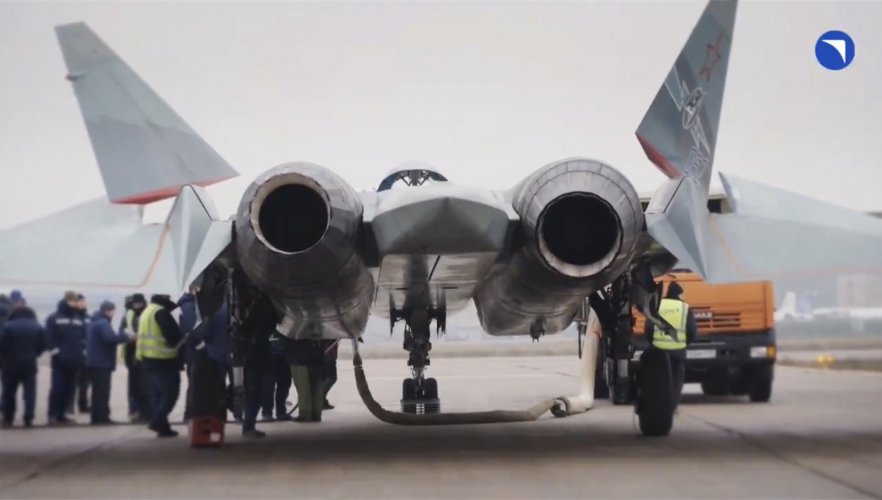
No 2D TVC on this one for some reason:
View attachment 796087
Yes,interesting detail and interesting citation :
''The development of the Izdeliye 177 appears to be driven by the need to upgrade the earlier Su-57 production models and offer a new powerplant to international customers.''
https://theaviationist.com/2025/12/22/su-57-new-izdeliye-177-engine/
Hm, why would they install engines w/o TVC capability into Su-57's produced so far and Su-57E instead of AL-41F-1?
Last edited by a moderator:

Product 177 is a single engine for the entire Su-27 family. And also for the export version of the Su-75. The Su-57 has its own engine.
Product 177 is a single engine for the entire Su-27 family. And also for the export version of the Su-75. The Su-57 has its own engine.
So there is 177 w/o TVC and 177S with TVC ?
- Joined
- 15 January 2021
- Messages
- 589
- Reaction score
- 2,554
The new nozzle appears to be an attempt to improve the aft end LO characteristics of the Su-57. If the both nozzles are pivoting up and down independently on their rolled vector axis in response to the flight controls, it is likely that they will be reflecting RF signals in multiple unpredictable directions, making any stealth shaping useless in improving the airframe signature in flight.Yes,interesting detail and interesting citation :
https://theaviationist.com/2025/12/22/su-57-new-izdeliye-177-engine/
Hm, why would they install engines w/o TVC capability into Su-57's produced so far and Su-57E instead of AL-41F-1?
PeregrineFalcon
ACCESS: Confidential
- Joined
- 31 January 2023
- Messages
- 66
- Reaction score
- 247
Yes,interesting detail and interesting citation :
https://theaviationist.com/2025/12/22/su-57-new-izdeliye-177-engine/
Hm, why would they install engines w/o TVC capability into Su-57's produced so far and Su-57E instead of AL-41F-1?
177 engine definitely has TVC nozzle:
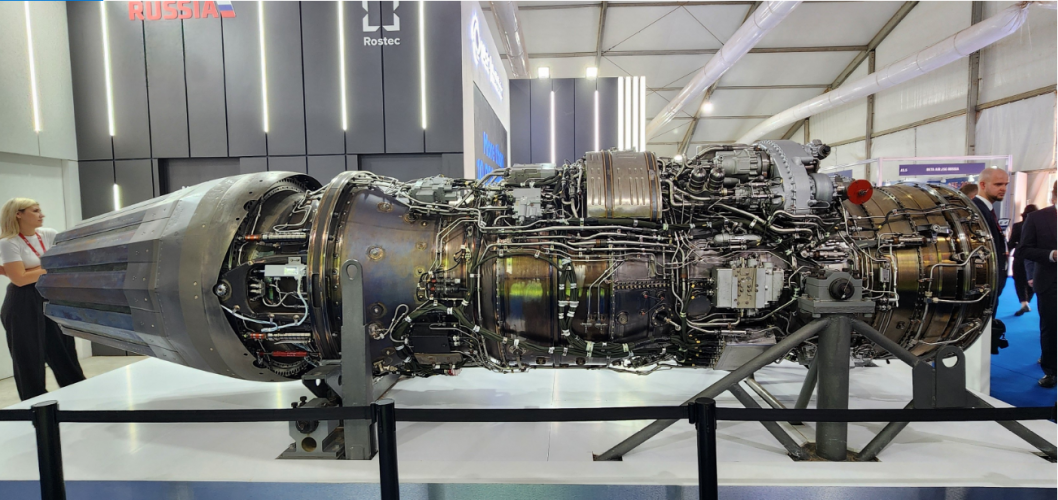
We can see two actuators, the hinge over which the nozzle rotates, and the nozzle here is fixed in neutral position.
And you can see similar nozzle "arrangement" during pre-flight checking and engine startups on all the Russian Sukhois with TVC engines:
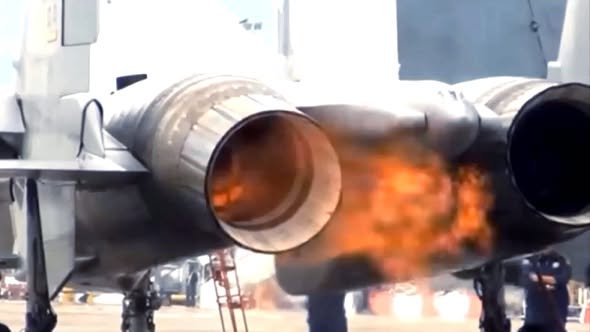
And since the Russians are exporting and using Flanker models with TVC, I doubt there will be the version of the engine without TVC. Su-34 doesn't need TVC, but it is questionable if they will use 177S/177 at all for that jet?!
PeregrineFalcon
ACCESS: Confidential
- Joined
- 31 January 2023
- Messages
- 66
- Reaction score
- 247
It is not an attempt, the nozzle definitely improves the aft end LO characteristics of the Su-57, and in standard flight envelope Su-57 doesn't need to use TVC.The new nozzle appears to be an attempt to improve the aft end LO characteristics of the Su-57. If the both nozzles are pivoting up and down independently on their rolled vector axis in response to the flight controls, it is likely that they will be reflecting RF signals in multiple unpredictable directions, making any stealth shaping useless in improving the airframe signature in flight.
TVC is primarily used at high AoA and Post Stall region (mostly during the WVR fight) which means that nozzle stealth shaping is not useless.
The new nozzle appears to be an attempt to improve the aft end LO characteristics of the Su-57. If the both nozzles are pivoting up and down independently on their rolled vector axis in response to the flight controls, it is likely that they will be reflecting RF signals in multiple unpredictable directions, making any stealth shaping useless in improving the airframe signature in flight.
Yes, if we talk about reducing RCS from the rear but on the other side it will be degrading overall maneuvering characteristics and capabilities ( if the nozzles are not with TVC of course ) .
@PeregrineFalcon
Thanks for the info/data .Hm, what if this new engine ( Izd 177 ) is in fact replace for the first stage engine Izd 117/ AL-41F-1 and will give serial produced/operational Su-57's so far ,real supercruise capability ? Yury Slyusar told once that second stage engine Izdeliye 30 will not be integrated into serial produced Su-57's so far. Reason is simple, Izd 30 is completely new engine and requires some modifications and new details inside of the engine nacelles.

donnage99
ACCESS: Top Secret
- Joined
- 16 June 2008
- Messages
- 1,545
- Reaction score
- 1,546
Not specifically about the Su-57 but thrust vector is quite useful in helping with trim drag in transonic flight and reduce control surface deflections which help stealth, pretty useful for BVR.It is not an attempt, the nozzle definitely improves the aft end LO characteristics of the Su-57, and in standard flight envelope Su-57 doesn't need to use TVC.
TVC is primarily used at high AoA and Post Stall region (mostly during the WVR fight) which means that nozzle stealth shaping is not useless.
PeregrineFalcon
ACCESS: Confidential
- Joined
- 31 January 2023
- Messages
- 66
- Reaction score
- 247
Thanks for the info/data .Hm, what if this new engine ( Izd 177 ) is in fact replace for the first stage engine Izd 117/ AL-41F-1 and will give serial produced/operational Su-57's so far ,real supercruise capability ? Yury Slyusar told once that second stage engine Izdeliye 30 will not be integrated into serial produced Su-57's so far. Reason is simple, Izd 30 is completely new engine and requires some modifications and new details inside of the engine nacelles.
I don't know about that info regarding Yury Slyusar, but it seems that the Russians are planning to introduce the Izd.30 with the flat /stealthy nozzle, and that takes additional time for testing. We will probably know more in 2026?!
And according to the highest ranking Sukhoi people, Su-57 can supercruise with 117 engines:
"We planned to reach a certain level and I believe that we have successfully solved this problem in the network of the first stage. Some parameters appeared to be even higher than expected. For example, we have obtained outstanding characteristics in the area of supersonic cruise and super-maneuverability», - the First Deputy Director General of Project and Research Scientific Center of Sukhoi Design Bureau, Mikhail Strelets, said."
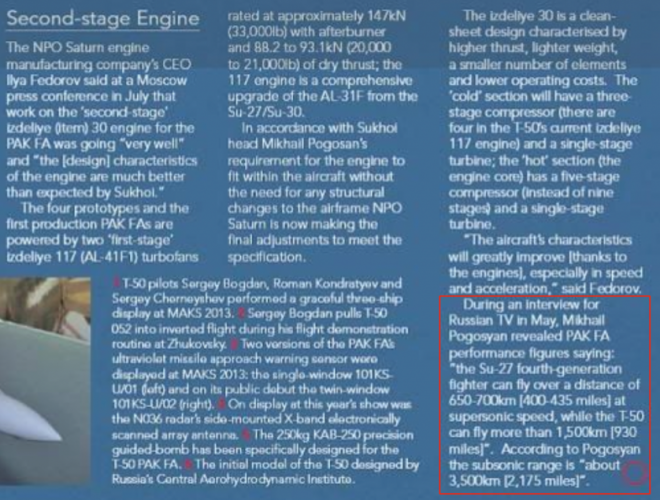
While the 117 engine is not dedicated supercruising engine, in combination with the Su-57 excellent aerodynamics that is optimised for prolonged supersonic flights, it seems that Felon can supercruise while having over 1500 km range!
And that is not surprising when we know that the heavy, dragy and underpowered two seater Su-27UB can fly supersonic without AB:
Flying the Flanker (Topgun)
Slowing the Flanker down after almost 25 minutes of supersonic flight also showed interesting results. "I take it out of burner and I'm just at mil power and the speed dropped down to--I was still supersonic," he says. "By the time we got done, 25 minutes supersonic, I looked at the gas and go 'you know I could turn around fly back the way I came supersonic and still have a normal amount of gas left to land'," Gallop says. "I had more fuel when I was done that profile than a single centerline Hornet had on the ramp."
Last edited:
PeregrineFalcon
ACCESS: Confidential
- Joined
- 31 January 2023
- Messages
- 66
- Reaction score
- 247
Not specifically about the Su-57 but thrust vector is quite useful in helping with trim drag in transonic flight and reduce control surface deflections which help stealth, pretty useful for BVR.
Sure, and such type of deflections are minimal, and will probably have minor effect, if any, on "RCS degradation". Su-57 is also using the LEVCONS for the supersonic trim drag with positive deflection in front of CG significantly improving Lift to drag ratio in supersonic region so the TVC deflection would be minimal, or even absent.
I think the engines can be equipped in any combination. The customer will decide what they needSo there is 177 w/o TVC and 177S with TVC ?
I don't know about that info regarding Yury Slyusar
He said that in Dec. 2023 interview on Rossiya-24 TV channel. Su-57's delivered between 2020 and 2023 will not receive new (second stage) engines as he said. We know ( what is publicly known in fact ) ,that those delivered during 2024 and 2025 also has AL-41F-1.My opinion is that those produced and delivered so far will get these Izd 177 when the time comes.
T-50-2LL ( Izdeliye 177 not 117 on the bottom pic) .
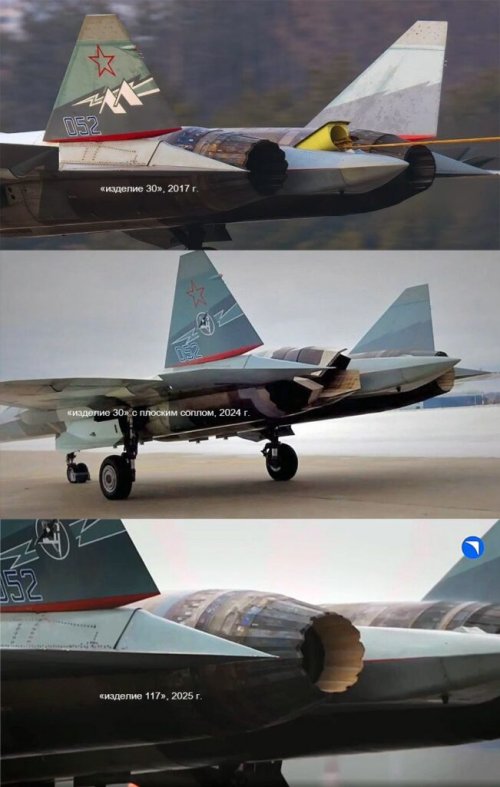
donnage99
ACCESS: Top Secret
- Joined
- 16 June 2008
- Messages
- 1,545
- Reaction score
- 1,546
It's significant enough that Lockheed was citing it as 1 of the 2 main reasons they retaining TVC for their A/F-X program.Sure, and such type of deflections are minimal, and will probably have minor effect, if any, on "RCS degradation". Su-57 is also using the LEVCONS for the supersonic trim drag with positive deflection in front of CG significantly improving Lift to drag ratio in supersonic region so the TVC deflection would be minimal, or even absent.
LEVCONS deflection would be frontal hemisphere. Using TVC while minimizing LEVCONS would have positive effect on RCS and thus preferred.
Last edited:
LMFS
ACCESS: Top Secret
- Joined
- 19 March 2019
- Messages
- 563
- Reaction score
- 975
I know the requirement of the ATF program and the original definition of supercruise as flying on mil power above 1.5M (later degraded by common use into anything higher than 1M). I mean that the term is misleading, since the intent of this feature is clearly not to 'cruise', but typically to extend the duration of a high energy status for an air superiority fighter during a combat mission. Fuel consumption and engine stress is normally not worth it in a peacetime mission.It was a request of ATF.
YF22, YF23 and now F22 were or are clearly able to.
Agree, minimal TVC deflections would not have any substantial effects on the LO performance during egresion, the typical situation where rear-aspect RCS may be relevant. It is questionable to what extent deflection of aerodynamic surfaces is not a bigger factor than TVC in that regard.It is not an attempt, the nozzle definitely improves the aft end LO characteristics of the Su-57, and in standard flight envelope Su-57 doesn't need to use TVC.
TVC is primarily used at high AoA and Post Stall region (mostly during the WVR fight) which means that nozzle stealth shaping is not useless.
I wonder if he is being strict with that 'original' sense of the term as 'higher than 1.5M'. The thrust difference between Izd.117 and F119 alone is enough to be skeptic in that regard, but who knows.For example, we have obtained outstanding characteristics in the area of supersonic cruise and super-maneuverability», - the First Deputy Director General of Project and Research Scientific Center of Sukhoi Design Bureau, Mikhail Strelets, said."
Fine, so logically deflection of aerodynamic surfaces is more damaging to RCS than TVC. With two 'unconventional' options to trim, one on the rear hemisphere (TVC) and one on the frontal one (LEVCONS), the Su-57 has the options, at least on paper, to chose the one which is best for the situation, depending on what aspect is being exposed to enemy detection. Whether that is implemented on the flight controls or not is another issueIt's significant enough that Lockheed was citing it as 1 of the 2 main reasons they retaining TVC for their A/F-X program.
LEVCONS deflection would be frontal hemisphere. Using TVC while minimizing LEVCONS would have positive effect on RCS and thus preferred.
I wonder if he is being strict with that 'original' sense of the term as 'higher than 1.5M'. The thrust difference between Izd.117 and F119 alone is enough to be skeptic in that regard, but who knows.
If I remember well, Sergey Bogdan once mentioned that he achieved cruising speed about M 1.3 on the MP mode ( of course with AL-41F-1 ) For how long , we don't know ( it seems that it can fly about 1500kms in that mode?) but there is some interesting details to consider.
From our colleague PeregrineFalcon's post ( about Gallop's supersonic flight in Su-27UB) we can find in connection with those info some very interesting details in the Su-27SK F.M .
First ,some details about two main working modes of the engines : training-combat and the combat mode:
Двигатели АЛ-31Ф имеют боевой и учебно-боевой режимы работы. Учебно-боевой режим имеет пониженные относительно боевого режима параметры на максимале и форсаже (температура газов ниже на 60°С, обороты ниже на 2,5 %). Выбор режимов определяется положением переключателя РЕЖИМ ДВИГ УЧЕБНО-БОЕВОЙ – БОЕВОЙ на левом борту кабины самолета.На режимах МАКСИМАЛ и ФОРСАЖ максимальные обороты ротора высокого давления (РВД) не должны превышать: 98,5 % на учебно-боевом, 101,5 % на боевом режимах.
Transl ..
AL-31F engines have combat and training-combat modes of operation. The training-combat mode has lower parameters compared to the combat mode on the maximum and afterburners (gas temperature lower to 60°C, revolutions lower to 2.5%).
The choice of modes is determined by placing the TWO LEARNING-COMBAT MODE - COMBAT MODE switch on the left side of the aircraft cabin. In the MAXIMUM and FORSAZ modes, the maximum high-pressure rotor revolutions (RVD) must not exceed: 98.5% in the training-combat mode, 101.5% in the combat mode.
Than some interesting details about those air intakes :
Механизация воздухозаборников включает электрогидравлическую систему регулирования АРВ-40А и систему защиты воздухозаборников и двигателей от попадания посторонних предметов.
Система АРВ-40А предназначена для управления положением панелей двух раздельных воздухозаборников с целью обеспечения оптимальных характеристик совместной работы воздухозаборников с двигателями.
Управление положением панелей осуществляется:
на основном канале – автоматически по программе в зависимости от приведенных оборотов двигателя с коррекцией по высоте, а также по сигналам от системы регулирования двигателя. Управление панелями начинается при достижении числа М=1,35, а до этого они в убранном положении;
Tranls ...
The air intake mechanization includes the ARV-40A electro-hydraulic control system and a system for protecting the air intakes and engines from foreign objects.
The ARV-40A system is designed to control the position of panels of two separate air intakes in order to ensure optimal performance of the combined operation of the air intakes with the engines.
The panel position is controlled:
On the main channel – automatically, according to a program, depending on the engine speed, with altitude correction, as well as by signals from the engine control system. Panel control begins when Mach 1.35 is reached; prior to this, they are in the retracted position;
In connection with the pilot Gallop's story ,I suppose that they flew in the UB mode ( not combat mode of the AL-31F ). We can see also that reached true air speed of that Su-27UB was directly in relationship with the panels position of the air intakes.
Again testimony by pilot Gallop :
"We brought it back to min burner, but I'm cruising at 1.3 Mach,Slowing the Flanker down after almost 25 minutes of supersonic flight also showed interesting results. "I take it out of burner and I'm just at mil power and the speed dropped down to--I was still supersonic," he says. "By the time we got done, 25 minutes supersonic,...''
If one Su-27UB ( of course heavier and with more drag than Su-57 ) ,with less power of its engines ( again suppose that they worked on the UB mode) , could achieve such a result than it is not questionable what can one Su-57 achieve with less drag ,more powerfull engines and maybe better air intake automatization system.
About Su-57's air intakes ,we don't know what is the true air speed limitation for the actuation of those panels. Aerodynamic drag,air intake's panel position,working mode of the engines ( e.g. combat or special), all of this can be crucial for reaching given supercruise speed and for given time of flying in that mode.
According to this Chemezov says 177 will indeed be installed on VKS(?) Su-30, 35, 57, not clear if new, retrofit or both. 2 x 14,500 kgf izd. 177S for Su-30SM (and maybe Su-34?) and 2x 16,000 kgf izd.177 for Su-35 and (early?) Su-57 sounds very logical to me.
View: https://x.com/La_souris_DA/status/2004159762368549097
View: https://x.com/La_souris_DA/status/2004159762368549097
There is no news about new delivery of the Su-57's to VKS so far. In fact, we didn't see any new from April this year. On this photo from today, we can see one new Su-57 ( flight test station of the KnAAZ).

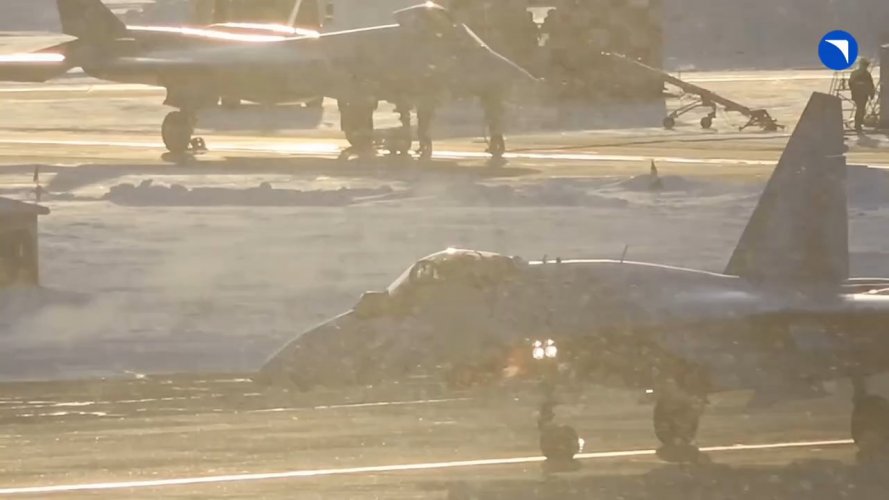
A prosaic question: isn't the absence of TVC on Izd. 177 related to the upcoming T-75 flight?
I also thought that and it is logical by the way.It seems that 177 has TVC but we will see.
Good idea and plan. With TVC there is no need to install 177/177S into Su-34/M(NVO). 177 for the Su-30SM2,Su-35S and for sure Su-57's produced and delivered so far.Installing can be done during overhaul process.According to this Chemezov says 177 will indeed be installed on VKS(?) Su-30, 35, 57, not clear if new, retrofit or both. 2 x 14,500 kgf izd. 177S for Su-30SM (and maybe Su-34?) and 2x 16,000 kgf izd.177 for Su-35 and (early?) Su-57 sounds very logical to me.
Su-57 fighter jet successfully evades enemy radars and electronic warfare — Chemezov
Rostec CEO noted that the corporation received feedback on all equipment deployed in the zone of the special military operation
MOSCOW, December 25. /TASS/. Russia’s Su-57 fighter jet that is employed in the special military operation zone, successfully evades enemy radars and electronic warfare systems, and the Russian military is satisfied with it, CEO of Russia’s state-run corporation Rostec Sergey Chemezov told reporters, answering a TASS question.
"At least our military is satisfied. The aircraft evades all kinds of obstacles very well, I mean radars and electronic warfare systems," he said before a State Council meeting devoted to training personnel for the Russian economy.
He noted that Rostec receives feedback on all equipment deployed in the zone of the special military operation. The equipment is modernized based on the military's suggestions and comments. "Most of the military equipment has been upgraded compared to what it was originally," Chemezov added.

Su-57 fighter jet successfully evades enemy radars and electronic warfare â Chemezov
Rostec CEO noted that the corporation received feedback on all equipment deployed in the zone of the special military operation
 tass.com
PeregrineFalcon
ACCESS: Confidential
- Joined
- 31 January 2023
- Messages
- 66
- Reaction score
- 247
It's significant enough that Lockheed was citing it as 1 of the 2 main reasons they retaining TVC for their A/F-X program.
LEVCONS deflection would be frontal hemisphere. Using TVC while minimizing LEVCONS would have positive effect on RCS and thus preferred.
I think you didn't understand what I was saying.
The effect of the TVC on supersonic trim reduction is significant, but the nozzle deflection is minimal, just a few degrees, even for the planes that don't have the LEVCONs.
Su-57 LEVCONs have just a few degrees of positive deflection (in relation to the airframe), and that is most likely correlated with the highly relaxed longitudinal stability of the plane. Modern fighters usually fix their longitudinal instability at 3% of the average aerodynamic chord length. With further relaxing of the longitudinal stability, the Su-57 enjoys a significant improvement in the lift-to-drag ratio. Relaxing the longitudinal instability not only increases take-off and landing characteristics and maximizes low-speed lift characteristics, but could also enhance transonic lift-to-drag characteristics and improve supersonic lift-to-drag capabilities. Yet, an increase in longitudinal instability will also increase the burden on high AOA pitch-down controls, which in a pure tail configuration would be absolutely inadequate.
According to the T-50 patent, during supersonic flight, LEVCONs don't have negative deflection in relation to the airframe; instead, they are in a neutral position, perfectly aligned with the wings (airframe), which is the best solution from the RCS standpoint.
For that reason, I think the Su-57 needs less nozzle deflection in supersonic flight compared to pure tail designs like the Su-35S or F-22.
Similar threads
-
 Sukhoi Su-57 / T-50 / PAK FA first flight - pictures, videos and analysis [2010]
- Started by flateric
- Replies: 872
-
 Sukhoi Su-57 / T-50 / PAK FA - flight testing and development Part I [2010-2012]
- Started by Matej
- Replies: 760
-
-
 Sukhoi PAK FA news and speculation (T-50, I-21) Part I [2006-2008]
- Started by overscan (PaulMM)
- Replies: 455
-