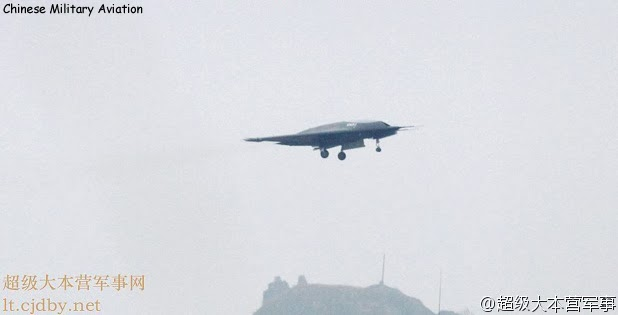
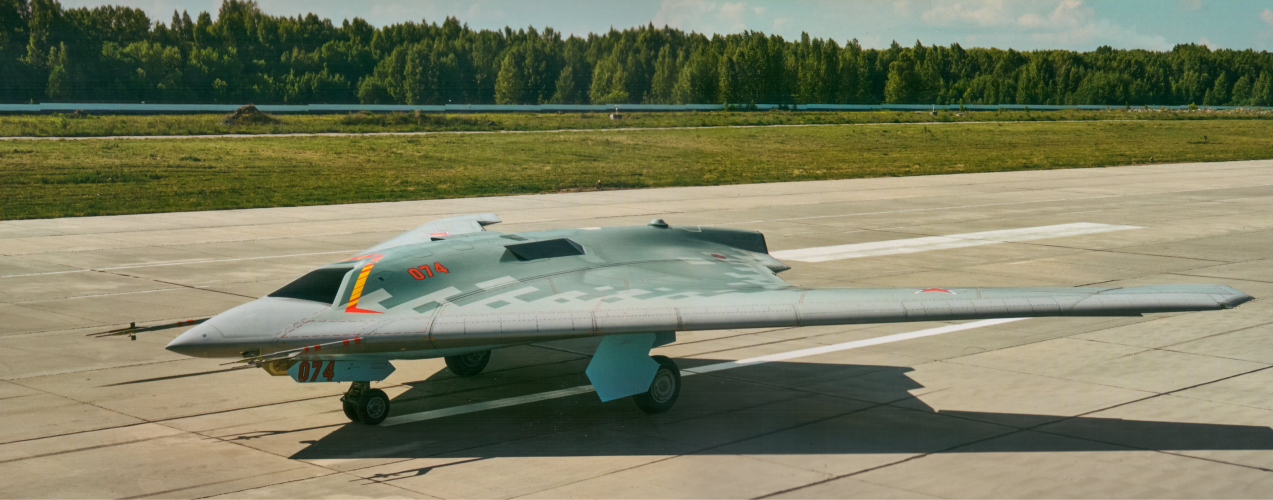
Interesting esp. in comparison to China's own GJ-11 or initially the Sharp Sword UCAV, where a scale model was published first in September 2011 and the full-scale demonstrator flew for the first time on November 21, 2013.
I've been intending to make this post for a long time, I once did a much more detailed writeup with a few calculations, but I never had the proper time to actually refresh my knowledge of E&M and double check what I wrote, so if someone can maybe refine (or refute) my thinking, please go ahead.
I think the state and toolbox of Russian stealth, with regards to materials and coatings is a frequent discussing of aviation ethusiasts everywhere, including this forum, sorry if this has been discussed before, but I haven't really seen it pointed out elswhere.
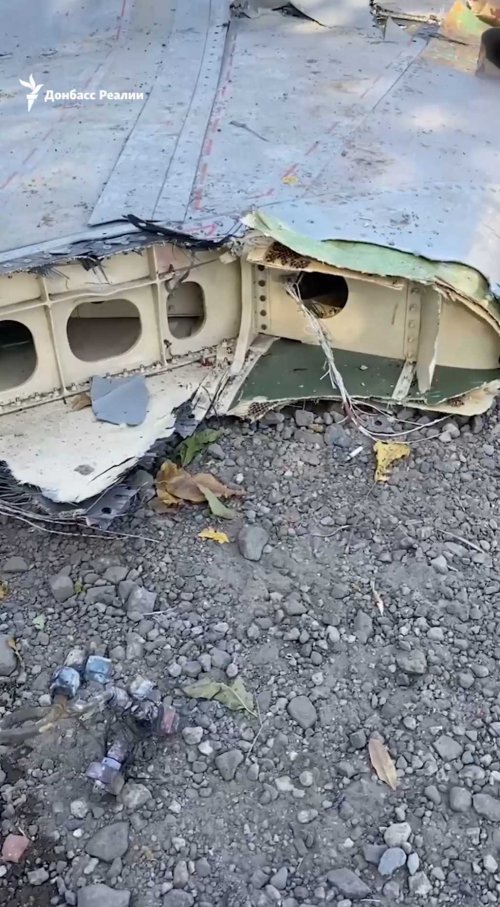
I believe the pictures of the crash of the S-70 have revealed a key detail about the specific stealth methodology in use:
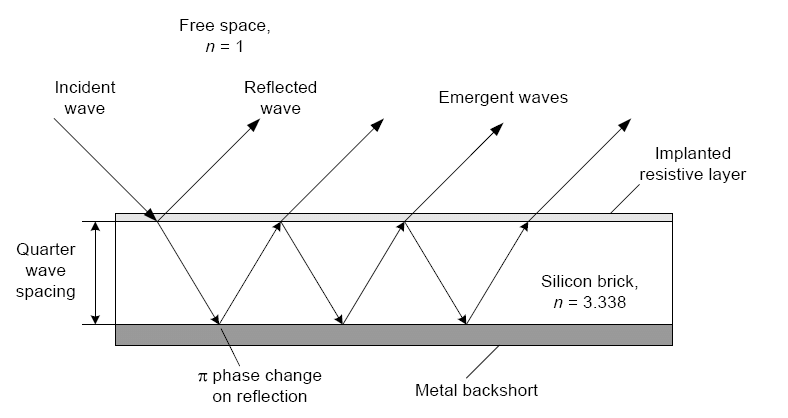
I believe what we're looking at is a Salisbury screen. It's a technique invented by the British during WW2, and is an extremely effective (theoretically perfect) absorber on a single frequency. Here's an illustrative abstract image:
It works by reflecting the incoming radar waves 180 degrees out of phase, which in a sinusoidal waveform means cancellation, thereby eliminating radar returns at the particular frequency it's tuned at.
It consist of 3 layers - an outer layer that's probably 'traditional' RAM that creates some attenuation and reflection, a specially sized middle layer that's quarter wavelength, so that total travel distance of the wave is half wavelength, and a reflective base layer that reflects the incoming waves, which is supposed to be a very good conductor.
Now, for the 10GHz band, the wavelength of a wave traveling at c (in free space or open air) is about 3cm, so the quarter wavelength would be 0.75cm, which would be rather thick. But in other mediums with different electric permittivity and magnetic permeability this value is sqrt(electricPermittivity*magneticPermeability) - permeability for non metallic materials tends to be 1, but there's a wide variety of plastics and fibers for which ePerm can be in the 4-20 range even at high frequencies, allowing us to cut material thickness to a much lower value. Using simple glass fibers, withe the permittivity of 4, we can halve the thickness to a much more reasonable 0.4cm.
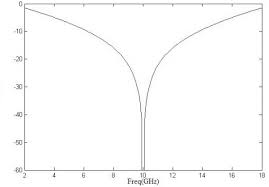
Now. what's the weakness of this method? Assuming a material tuned for perfect absorption at 10GHz, assuming the X-band goes from 8-12Ghz, just calculating the incomplete phase shift at the edges of the band and adding together the sinusoidals, we get about 80-85% absorption (not sure, maybe modeling it as a transmission line would yield more accurate results). But here's a pretty picture of how the effectiveness wrt frequency works:
Now how does this relate to the picture?
I think we can see different layers here, there's a beige colored bottom layer, which I think is the structural composite. On top of which there's a think layer of conductive carbon fiber. After that comes some weave of unknown material (which is the quarter-wave space, that I outlined needn't be anything exotic). Finally on top of there's the RAM paint.
I believe given the relatively simple shape of the aircraft, and the pictures we've seen of the production process with automated tape laying machines, such a scheme would be both reasonably cheap and simple to implement in the manufacturing, while offering a very good RCS reduction in the X-band.
I don’t think it relates at all, because in the photo I see protruding rivets and untreated straight RAM joints. The only conclusion this image suggests is that Russian stealth is facing fundamental problems.
I don’t think it relates at all, because in the photo I see protruding rivets and untreated straight RAM joints. The only conclusion this image suggests is that Russian stealth is facing fundamental problems.
While I don't think your concerns aren't warranted (or in need of an explanation), could you (and everyone else who does this) stop referring to hex screws as rivets? You're not talking about the Zero.
Please note I just grabbed that image to illustrate the shape of the characteristic, disregard the numbers you see there, I'll make an attempt to derive the actual numbers some time in the future.
I don’t think it relates at all, because in the photo I see protruding rivets and untreated straight RAM joints. The only conclusion this image suggests is that Russian stealth is facing fundamental problems.
the first serial s-70 is said to be in assembly right now, the sukhoi engineer on twitter also said that the ones that were flying before were frankensteins, and the one that lost control and had to be shot down was due to FCS error
While I don't think your concerns aren't warranted (or in need of an explanation), could you (and everyone else who does this) stop referring to hex screws as rivets? You're not talking about the Zero.
As you wish. It’s just that to me this doesn’t look like a hex but a cruciform, like on the Su-57. It was just funny reading that whole long post full of speculation about the "advanced technologies" used, when the photo shows this thing with screws sticking out of it. On the other hand, it becomes clear why the Russians are hesitant to use their stealth aircraft in the current conflict.
the first serial s-70 is said to be in assembly right now, the sukhoi engineer on twitter also said that the ones that were flying before were frankensteins, and the one that lost control and had to be shot down was due to FCS error
I think there must be a very weighty reason why it’s forbidden to apply RAM to prototypes, especially ones taking part in real combat — but I can’t immediately think of such a reason.
Losing prototypes over enemy territory after friday deploy and sharing these layers with ukrainians isn't exactly a dream scenario. One can imagine S-70 story desroyed a few promising careers.
I think there must be a very weighty reason why it’s forbidden to apply RAM to prototypes, especially ones taking part in real combat — but I can’t immediately think of such a reason.
Lack of finished facility to do such application for sure doesn't come to mind. We went through same exact steps for Su-57, it isn't worth an account to start it all over again.
Losing prototypes over enemy territory after friday deploy and sharing these layers with ukrainians isn't exactly a dream scenario. One can imagine that S-70 story desroyed more than a few promising careers.
Usually, the main threat to a military commander's career is unacceptable losses among personnel, not an unmanned vehicle that is supposed to support them.
Lack of finished facility to do such application for sure doesn't come to mind. We went through same exact steps for Su-57, it isn't worth an account to start it all over again.
I think there must be a very weighty reason why it’s forbidden to apply RAM to prototypes, especially ones taking part in real combat — but I can’t immediately think of such a reason.
what are you talking about, there's clearly RAM in it, the rough assembly is apparently normal for their prototypes, about the rivets I don't know if anyone wants to talk about it anymore, the T-50 vs serial difference is notable and apparently the subject was closed for the 57, it will probably happen here too
what are you talking about, there's clearly RAM in it, the rough assembly is apparently normal for their prototypes, about the rivets I don't know if anyone wants to talk about it anymore, the T-50 vs serial difference is notable and apparently the subject was closed for the 57, it will probably happen here too
Usually, the main threat to a military commander's career is unacceptable losses among personnel, not an unmanned vehicle that is supposed to support them.
That's why meteor was forbidden overflight of german territory entirely. More than few careers were destroyed by lesser leaks than kindly delivering an in-depth look into future russian aircraft (not attritable one) before it is even deployed.
Recent Growler panic ew in SCS comes to mind.
That's why meteor was forbidden overflight of german territory entirely. More than few careers were destroyed by lesser leaks than kindly delivering an in-depth look into future russian aircraft (not attritable one) before it is even deployed.
Dude, you understand what I mean. Germany isn’t at war, but if it were, and the public saw footage of several dozen German soldiers being wiped out while assaulting an enemy fortification in rusty Leopards — I think for the top leadership it wouldn’t stop at resignations, it would escalate to criminal cases. So in such a situation nobody would prioritize the safety of drones, even secret ones.
Dude, you understand what I mean. Germany isn’t at war, but if it were, and the public saw footage of several dozen German soldiers being wiped out while assaulting an enemy fortification in rusty Leopards — I think for the top leadership it wouldn’t stop at resignations, it would escalate to criminal cases. So in such a situation nobody would prioritize the safety of drones, even secret ones.
That’s a shame. I haven’t seen any photos of the Su-57 with RAM applied, even though such photos should exist by now.
It seems that even for the F-35 this thing already existed in the form of a tape. Besides, those screws in the photo are clearly not located in places that need to be disassembled after every flight.
It seems that even for the F-35 this thing already existed in the form of a tape. Besides, those screws in the photo are clearly not located in places that need to be disassembled after every flight.
In any case, there's little reason to potray what leans more toward inept mission planning and software failures as an inherent flaw on the S-70. RQ-170 got spoofed into landing in Iran, remember? Everyone's gotta learn that someday.
The discussion on RAM, etc is really not conducive to anything. We don't know what phase of development does it belongs to. Su-57 had massive structural surgery before, it's common sense to assume S-70 will receive the same treatment.
I doubt they're fully scrapping a prototype like that even if it's cancelled. I'm pretty sure the one that got shot down was repeatedly bombed so it being that intact would also be surprising. The size of it doesn't look right either.
The main reason I'm sceptical about this, is quite frankly that Russia rarely bothers to take prototypes apart. Even when it comes to programs that were axed, the remaining airframes are usually just dumped at some airfield outside. Great examples include the 1.44, Su-47, some T-50s and various other rare aircraft that are left to the elements unless they're getting restored for a static display.
So while this habit is usually rather distasteful to me as an aviation enthusiast, believing these should belong in a proper indoor musuem in perfectly restored condition, in this instance it's actually useful to keep in mind. I doubt they'd bother to cut apart a drone, tbh.
If they made the decision to scrap it, I think it's possible the thing was full of sensitive electronics, stuff that is still flying and out there, and they had to take it apart to remove everything, and they didn't bother putting it together again. Still seems strange.
Would have thought it would have been of interest and value to a Western intel agency...unless they've had a good look and thought there was nothing of interest to exploit, which is possible with a prototype. Still would have thought they'd have retained it though..
Would have thought it would have been of interest and value to a Western intel agency...unless they've had a good look and thought there was nothing of interest to exploit, which is possible with a prototype. Still would have thought they'd have retained it though..
I'm pretty sure there was - I'm sure there are 'tourists' on the ground who immediately circled in on the aircraft and picked it clean of sensitive electronics. It looks like there's almost nothing left in there.
This site uses cookies to help personalise content, tailor your experience and to keep you logged in if you register.
By continuing to use this site, you are consenting to our use of cookies.