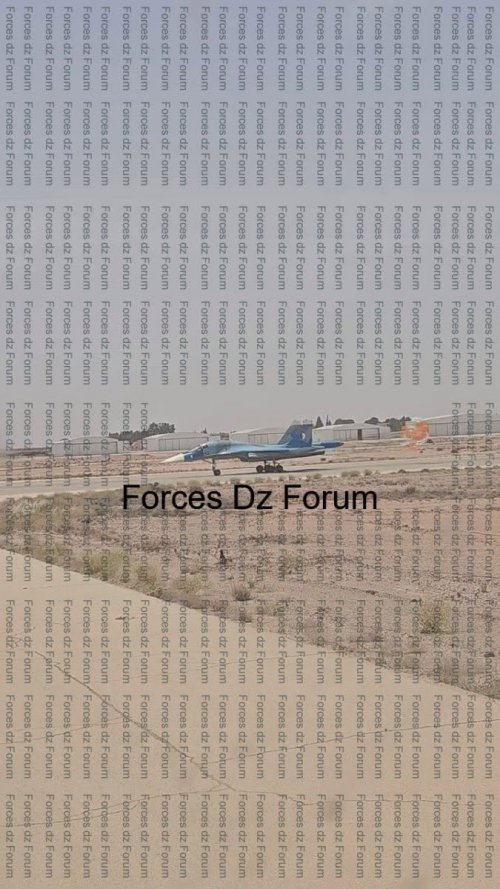
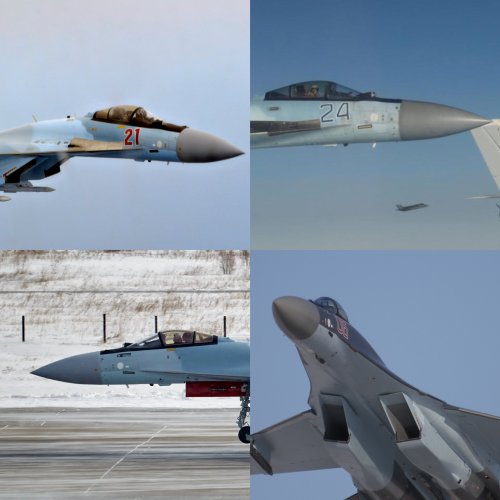
even Su-35S on speed Mach 0.7, missile can reach +160 km on altitude of +10 km (thick clouds)


Source: View: https://x.com/magictouch190/status/2058868433681273155


Simply that is because new R-37M has loft capability but there is a catch. AAM's like old R-40,R-33 and especially R-27E with straight flight capability only are faster what is logical.Example,AIM-54A/C and R-33 are in the same category, heavy long range AAM's where Phoenix is much slower thanks to the much slower max possible 'first speed' and to the loft capability.Mach 4-5 is max reachable speed.On the other side ,MiG-31BM with old R-33 can reach 2.8 M ( first speed ) and after launch ,missile itself during straight flight can reach more than 6 M. When it comes to the Su-35S ,I think that with two R-37M's attached under the fuselage, between the air intakes and the engine nacelles,with the given fuel weight,he can reach 18km and speed over 2 M.

Real question is, does R-37M has in fact two possible trajectories ? One with 'lofting' for the given scenario and another as the straight flight for some other scenario.

PS

Maybe this is better for this thread ?

https://www.secretprojects.co.uk/threads/r-33-r-37-and-r-72-ks-172s-1-alraam-missiles.72/page-6
 
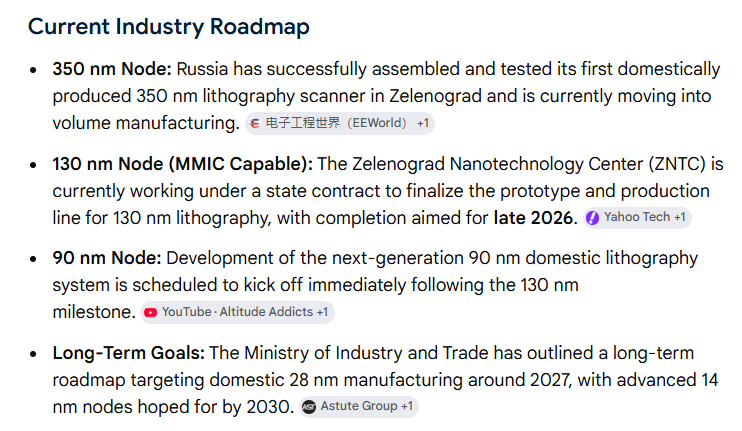
Building state of the art digital radars requires not just advanced chip manufacturing and board integration facilities, it requires a lot of stuff that's very specific to miniaturizing T/R modules. Only a handful of companies have these capabilities globally. None of them are in Russia. Russia can build AESA radars just not to the same level of quality.

https://en.topwar.ru/282193-importo...hestvennyj-fotolitograf-progress-stp-350.html

They really do not have to be Taiwan level miniaturizing chips to meet the node requirements for an aircraft fire control radar.

Source: View: https://x.com/magictouch190/status/2058868433681273155


Simply that is because new R-37M has loft capability but there is a catch. AAM's like old R-40,R-33 and especially R-27E with straight flight capability only are faster what is logical.Example,AIM-54A/C and R-33 are in the same category, heavy long range AAM's where Phoenix is much slower thanks to the much slower max possible 'first speed' and to the loft capability.Mach 4-5 is max reachable speed.On the other side ,MiG-31BM with old R-33 can reach 2.8 M ( first speed ) and after launch ,missile itself during straight flight can reach more than 6 M. When it comes to the Su-35S ,I think that with two R-37M's attached under the fuselage, between the air intakes and the engine nacelles,with the given fuel weight,he can reach 18km and speed over 2 M.

Real question is, does R-37M has in fact two possible trajectories ? One with 'lofting' for the given scenario and another as the straight flight for some other scenario.

PS

Maybe this is better for this thread ?

https://www.secretprojects.co.uk/threads/r-33-r-37-and-r-72-ks-172s-1-alraam-missiles.72/page-6
Ukraine needs stupidly long-range air to air missiles to combat back or the entire debate of I have better radars does not help; dragon teeth fortifications now being built in Odessa suggests time passing with no long-range air missiles provided means less and less aerial flights from Ukraine if airspace keeps shrinking therefore increasing effectiveness of Sukhoi strikes more and more.
 

Attachments

  • 1780208776680.png
    1780208776680.png
    107.1 KB · Views: 133
  • 1780209611326.png
    1780209611326.png
    90.4 KB · Views: 746
Last edited by a moderator:
View attachment 814020
https://en.topwar.ru/282193-importo...hestvennyj-fotolitograf-progress-stp-350.html
View attachment 814025
They really do not have to be Taiwan level miniaturizing chips to meet the node requirements for an aircraft fire control radar.


Ukraine needs stupidly long-range air to air missiles to combat back or the entire debate of I have better radars does not help; dragon teeth fortifications now being built in Odessa suggests time passing with no long-range air missiles provided means less and less aerial flights from Ukraine if airspace keeps shrinking therefore increasing effectiveness of Sukhoi strikes more and more.
Ukraine needs meteors to spam back, or Aim 174Bs. meteor seems like the only realistic option though with gripen deliveries likely so lets see.
 
Ukraine needs stupidly long-range air to air missiles to combat back or the entire debate of I have better radars does not help

First there is ( long range) radar,than there is (long range) AAM.UkrAF right now has nothing of these.All available fighters ( MiG-29,Su-27,F-16AM, M-20005F) have radars with max detection range in the HPRF mode no more than 150km.All of them have forward RCS (as armed of course) of 5 sqm and more.As it is mentioned before,all of them can be detected by N035 even 400km away in any case of flying higher than usual.As we can see, in subsonic regime Su-35S can engage even low flying targets from 150-200 km away with R-37M. Big danger for the UkrAF fighters can be also 'dual-pulsed' long-range R-77M.

Combat tactics of using R-37M and UkrAF counter tactics are described here earlier:

https://www.secretprojects.co.uk/th...-172s-1-alraam-missiles.72/page-6#post-909216

Even if UkrAF acquire Swedish fighters JAS-39E/F equipped with AESA Raven ES-05 and MBDA Meteor AAM's (no more than 200km of max detection range and possible launch distance) as they hope to,there will be very little or no chance of survival in any long range BVR combat.For any long range BVR, fighter must fly higher ,must fly in the stratosphere (air superiority/air dominance role) .In any case, UkrAF fighters can not fly higher than those from VKS.Tactical advantage of the R-37M with MiG-31BM and Su-35S and especially of Izd. 810 and Su-57 is obvious.
 
https://www.skoltech.ru/news/skolte...ommunikaciyah-i-ii?ysclid=mpngsny6c6121643704
In the exhibition zone of the stand of the VEB.RF group "Digital Fortress" Rector Skoltech, Academician of the Russian Academy of Sciences Yulia Gorbunova presented technological solutions to the Institute Deputy Prime Minister of the Russian Federation Dmitry Grigorenko. The exhibition includes five projects:

  • Transmission module for inter-satellite laser communication (Project Center of Applied Photonics).
Laser communication will increase the data rate between satellites up to 100 Gbps. The presented coherent transmitter based on photon integrated circuits uses complex signal modulation formats, multiplying the content density to the channel. The sample passed the flight qualification.

  • Coherent transceiver for backbone lines (Project center of application photonics).
Fully functional prototype of the transceiver on a photonic integrated circuit. It will become the basis for the first domestic coherent transceivers in the main networks and data centers.

  • Temperature control system of the spacecraft (Project center of applied photonics).
It is based on fiber-optic sensors and a compact questionnaire based on photonic integrated circuits with machine learning algorithms. The flight sample for the satellites CubeSat 3U is scheduled to be presented before the end of 2026.

  • Photon integral circuits for signal transmission and processing (Center for Engineering Physics).
Samples are manufactured according to the standards of mass microelectronic production and passed tests. They are ready to integrate into real electro-optical systems and confirm the prospects of the domestic photon integrated platform for the digital industry.

  • Model of a quantum sensor for navigation and mapping (Project Center of Applied Photonics).
Based on the Ion trap of Paul and elements of photonic integrated circuits. Such sensors allow you to create high-precision gravitational maps of the Earth, and also open up opportunities for autonomous navigation in the absence of a GPS signal.

As part of the business program of the conference, Skoltech became the organizer of two sessions at the VEB.RF site. At the discussion “From Models to Machines”, the leading developers and customers of technology discussed what hinders the introduction of laboratory models on the way to real business. The session was moderated by Skoltech Vice President for Technological Partnerships Shamkhal Dzhabrailov. Main points of the participants:

  • Alexey Zaitsev, an associate professor at the Skoltech Center, believes that 10% in the production is not a failure:
“Companies actually had a year to bring to the production of heavy technology, which is changing business processes. 10% have already coped, the rest are still in the process. I look at the situation very optimistically.”

The speaker stressed that the effect of the introduction of AI is not always expressed in one direct figure. Often, together with the model, new competencies, computing infrastructure, data ontology, the logic of their collection and storage appear in the company. This changes the culture of working with data and helps the following AI projects to run faster.

  • Oleg Tretyak, Director of Digital Transformation of Gazprom Neft, highlighted the key barriers to the accelerated development and implementation of AI:
“Technological leadership in AI is achieved not by the number of models, but by the ability to turn them into products, to count efficiency and provide infrastructure. Businesses need to solve business problems. Until we move from scientific research to the stage of productivity, nothing will work.”

No less important component for the AI industry is trust in models, constant monitoring and stability of AI models.

With large LLM-models, it is impossible to drive away the entire set of tests, it all depends on the industrial scenarios. Updated open-source models appear every two weeks, so there is no architectural binding to one model in the perimeter of the company, the internal platform includes a set of repositories of models that quickly switch to solutions.

  • In the continuation of the theme of productization, Nikolai Truzcal, Director for the Development of AI Technologies, FabricaONE.AI (Somftline Group) noted that when talking about productivization, it is necessary to go down to a level lower - the level of platforming:
“With the spread of AI, the input barrier to the development of software is reduced. We need a platform where each company will assemble its own architecture.”

At the same time, it is critical to change the culture: the risks from working with AI should not try to blindly prevent, but learn how to correctly evaluate and calculate them.

  • Denis Surzhko, Deputy Head of Data Modeling and Analysis Department, VTB Bank:
“According to studies, only 5-7% of organizations from those that use generative AI in their processes felt the economic effect of its implementation. The key difficulties are the presence of deep internal expertise, the development of interaction with AI users and the high cost of computing resources.

He also shared an interesting case: VTB, together with T1 and Chinese partners, was able to successfully adapt alternative Nvidia solutions, creating the largest cluster independent of the American monopolie in Nvidia Free, which allows you to make fully import-placed solutions.

  • Igor Drozdov, Deputy Chairman of VEB.RF, began his speech with the fact that Skoltech is part of the VEB.RF group, and through it the development institution supports the AI industry. But for any bank, the key criterion is to prove the economic efficiency of the project and ensure the return on investment.
“We are not on the sidelines of foreign progress, we are developing and implementing different solutions, but so far this is the development of hypotheses. AI is a support tool, and the decision is made by a person in the end.”

Opening the second session of Skoltech at the VEB.RF platform “Developing 5GA/6G. Promising technologies through the cooperation of science, state and business”, moderator Natalia Kosmodemyanskaya, head of the Skoltech Project Support Department, noted that although the commercial introduction of next-generation technologies is not expected until 2030, the whole world has already actively joined this race.

“We have starting conditions more difficult: 5G networks have not yet been fully implemented, and there are many other priority tasks in the country. However, in recent years, its own scientific and technological agenda 6G has begun to form.

  • Deputy Minister of Digital Development Alexander Shoitov noted that the introduction of the data economy depends on the speed of the Internet connection. According to him, new effective systems are needed. In 2025, the Ministry of Digital Development launched a roadmap for the development of key technologies 5G Advanced and 6G - the winner of the competition was Skoltech, the deputy head of the department recalled. He stressed that by 2030, all critical technologies should be fully developed in the direction of 5G Advanced. By the same date, it is necessary to create a maximum reserve for 6G, he concluded.
  • Alexey Frolov, professor, director of the Project Center for Wireless Communication and the Internet of Things Skoltech, spoke about the eight-year reserve of the Institute for 5G base stations.
“In 2023, the first experimental sample of 5G base stations was created. These works continue within the framework of the roadmap, and we thank the Ministry of Finance for their support. As part of the roadmap, we chose critical areas: software with AI elements, digital twins and antenna systems based on photon integrated circuits. And it is also important to cooperate with the state, vendors and operators to clarify the tasks, to learn new ones, to receive feedback.

  • Dmitry Lakontsev, CEO of Irtea, noted that it is difficult to build direct communication with the industry.
“Let’s be honest: some fragmentary things have been preserved in our universities. I hope that the roadmap will build a systemic cooperation between us. Another problem that is present in our universities is a rather low level of technology readiness.”

  • Yulia Klebanova (GC "Picle") stressed the pragmatic approach.
“To go further and plan the implementation of 5G Advanced and 6G, we need to adhere to the basic principle – this is the principle of economic feasibility and recognition of the decision. The theme of AI is not just some fashionable hype, but an obvious need at the moment of transition, since it is impossible to manage such a number of tasks with the help of classical superstructured systems. ”

  • Vladimir Franchman (Protei) added that the industry is changing quickly, so industry players need to constantly monitor this development.
“We are trying to make sure that the product can be offered, among other things, to the global market. We want to understand what’s going on in the industry and we want to follow it. We have some part of the team always working on promising technologies.”

  • Grigory Seregun (MIPT) shared his experience in creating the first pilot zone and identified a number of problems.
“In the process of development, we are faced with the lack of initial data and with the inconsistency of what is written in the specification. It is necessary to get rid of false information in the marketing materials of manufacturers. To do this, it is necessary to create independent pilot zones in Russia.

  • Evgeny Novikov (DIT of Moscow) presented the work of DIT in the field of promising technologies:
“We tested about 80 startups on the basis of our Democenter. In Moscow, it is planned to open two or three more 5G landfills, which will become pilots.

According to the speaker, in terms of promising research, DIT closely cooperates with universities. The study on the world trends in cooperation 6G can serve as a starting point for the formation of domestic models of cooperation.

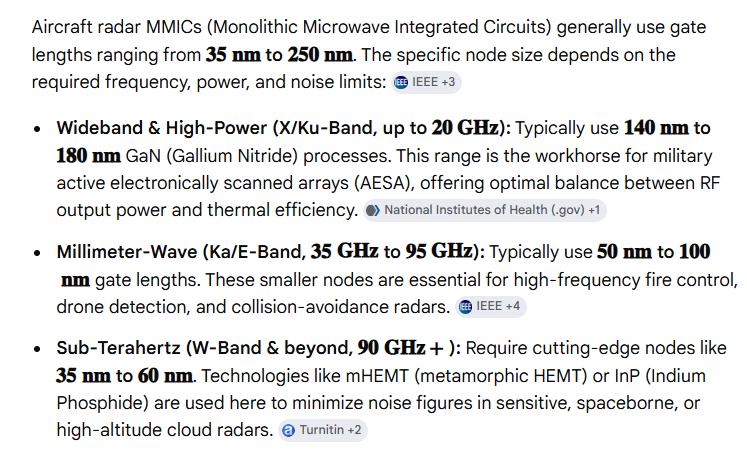
If aircraft radars are nothing more than 1000s of transceivers then it would be assumed that whoever 1st gets transceivers using PICs will have enhanced detection and tracking capabilities and operate in higher frequencies. Current MMIC radars on aircrafts are 140nm or higher or else they suffer from these bottleneck issues.
Airborne radars do not use microscopic MMIC (Monolithic Microwave Integrated Circuit) nodes because radar power and range scale exponentially with physics. Shrinking MMICs to smartphone or 5G scales introduces severe physical and performance bottlenecks, including: [1]
  • Power Output Limits: Aircraft require long-range detection, which relies on high radio-frequency (RF) power. Extremely small nodes cannot handle or dissipate the wattage (often requiring thousands of watts pulsed) needed to project radar beams over \(50+\) nautical miles. [1, 2, 3]
  • Thermal Management: Transmit/Receive (T/R) modules generate a significant amount of waste heat. Sub-micron MMICs trap this heat in tight spaces, leading to early failure, whereas larger modules provide the surface area needed for liquid or forced-air cooling. [1, 2]
  • Noise and Sensitivity: Radar receivers must isolate faint target echoes (from objects like small stealth aircraft) against the noise of the atmosphere. Larger, specialized MMICs utilizing materials like Gallium Nitride (GaN) or Gallium Arsenide (GaAs) perform better at high frequencies with extremely low noise figures. [1, 2, 3, 4, 5]
PICs dont suffer with power issues or heat is rather non-existent, therefore they can be scaled at a smaller node size. Even if Russia uses PIC transceivers on aircrafts radar 1st it won't be long until Taiwan pushes out PIC transceivers in way smaller nodes for western aircraft radars unless Russia gets China to agree with a PIC production plan using their node manufacturing capabilities.

I hear stories that background noise in searching for targets gets completely erased because light doesn't formulate noise compared to moving electrons (which also overheat transceivers) like MMICs and because heat is not an issue PICs can be scaled in lower node technology which is what is required for most higher then X-band radars. I still don't know if this technology would put stealth aircrafts in as great danger as being no different than a 4th gen aircraft, if it really is the case then he who has the longest-range air to air missiles will always win.

The size of the semiconductor transistor is strictly dependent on a radar's operating frequency. The maximum operating frequency limit of a transistor is inversely proportional to its gate length. For high-frequency radar, node sizes must be reduced to achieve shorter electron transit times(which causes overheating issues). In other words, it is Russia's fault for falling asleep on their own electronics industry base in the 1990s.There are E-Band & Sub-THz Imaging Radars that operate at 100ghz-300ghz but use 22nm-40nm node technology so maybe getting the minimum of a 20-40nm production unless they break a deal with China to use their manufacturing capabilities.
 
I certainly preferred the reddish brown, regardless, nice seeing some closer pictures of them in Algeria with their markings too
 
Ukraine too, after early losses it generally preferred giving risky Frontline tasks to mig-29s over flankers. There are again multiple factors, especially since their jets predate major signature work, but mig does have a substantially smaller signature than vanilla flanker.
I don't think it's the case of RCS at all. The main case IMO, is lack of spare parts for SU-27 series compared to MiG-29. There are a lot more of MiG-29 spares and planes in NATO and Ukraine-aligned countries than for Su-27. Case in point: Poland, Bulgaria, Azerbaijan etc. Plus Ukrainian Repair plants are more accustomed to Mig-29 repairs, than Su-27.
OG Su-27 saw much less export, and Su-30 is not that compatible and was exported in countries that are unlike to help.
 
Real question is, does R-37M has in fact two possible trajectories ? One with 'lofting' for the given scenario and another as the straight flight for some other scenario.
Any missile that lofts, like AIM-7F/M or AIM-52 Phoenix even will adjust the severity of the loft and turn it off completely depending on range speed altitude.

Within DrMax2/NEZ loft would have no benefit. This is why Phoenix for instant won’t loft on shots less then 20-30 km I believe. And the pilot could very easily have the choice to force it off if they so choose.
 
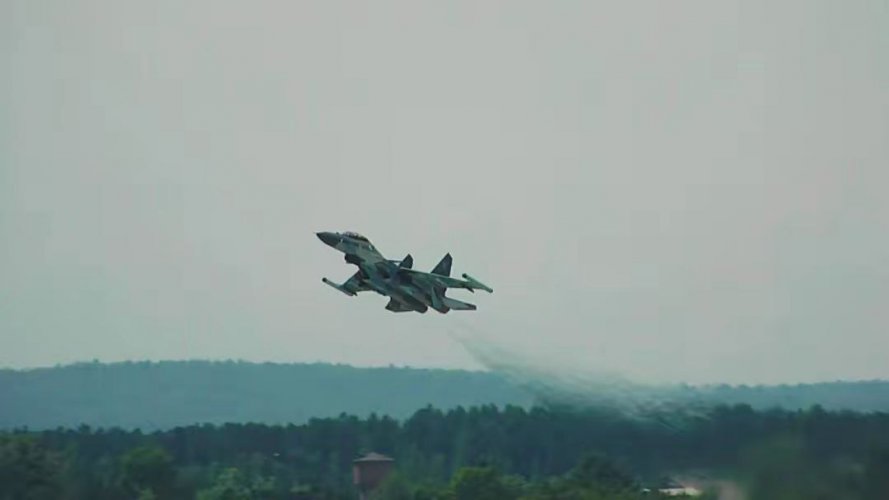
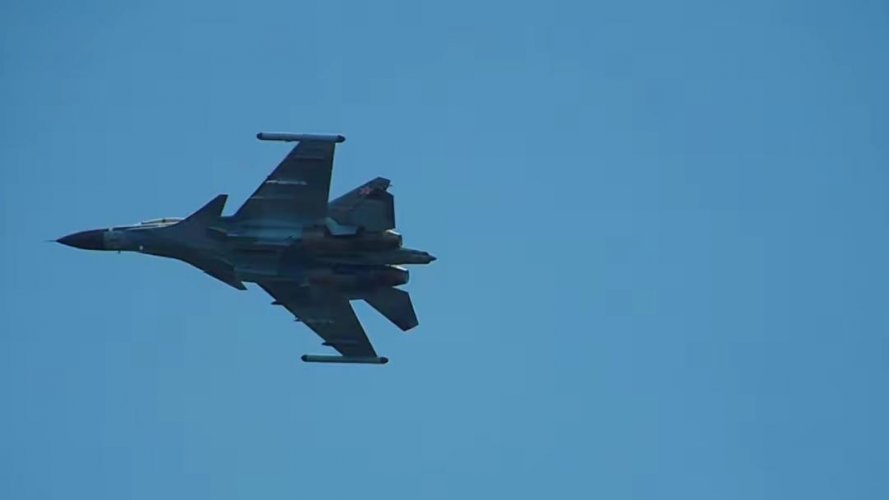
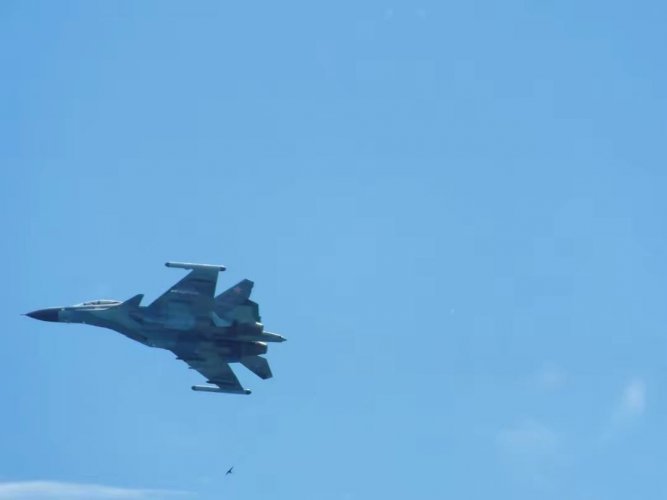
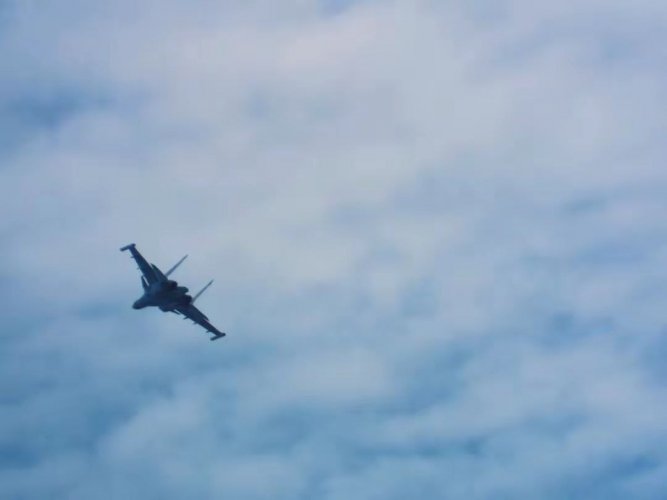
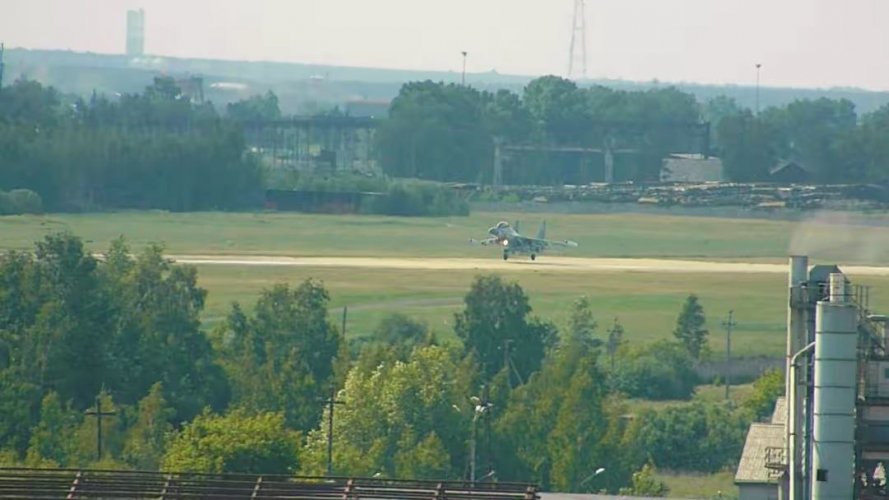
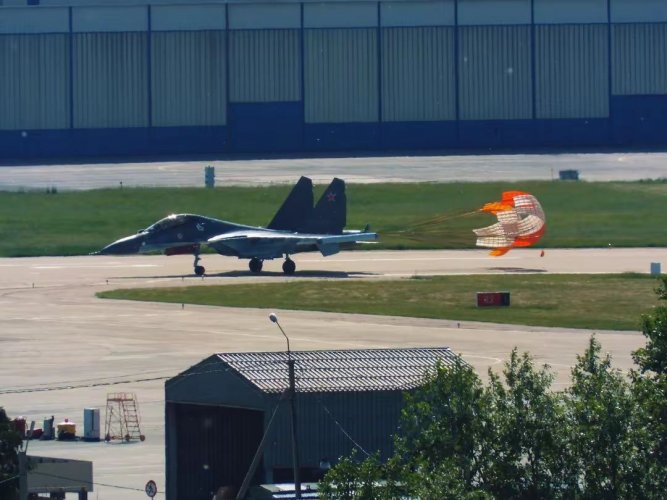
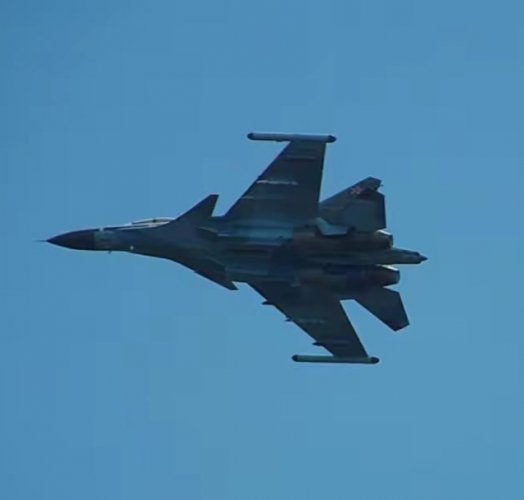
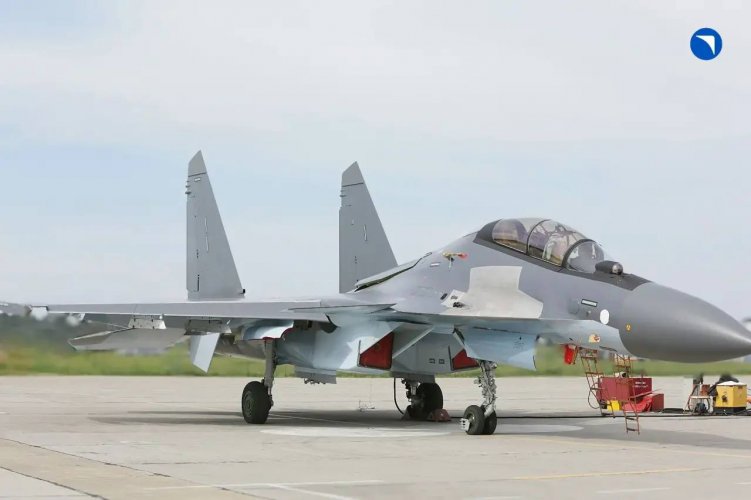
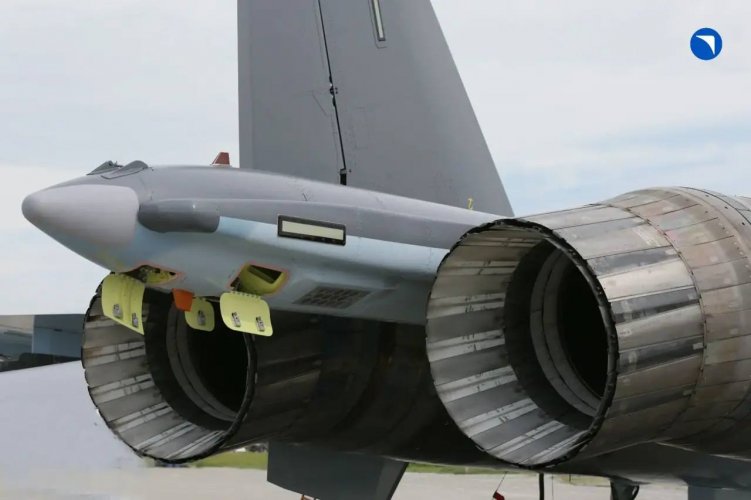
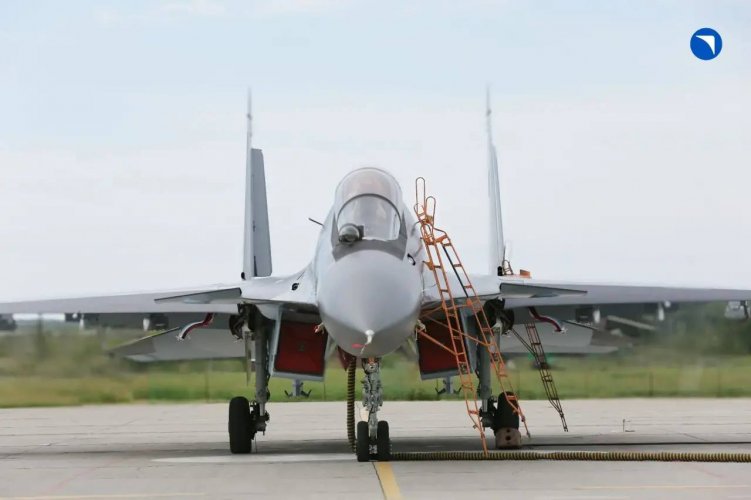
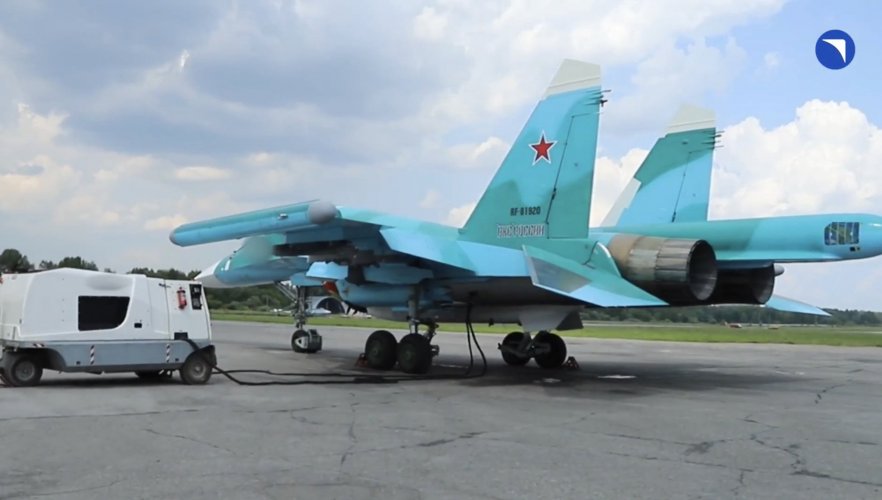
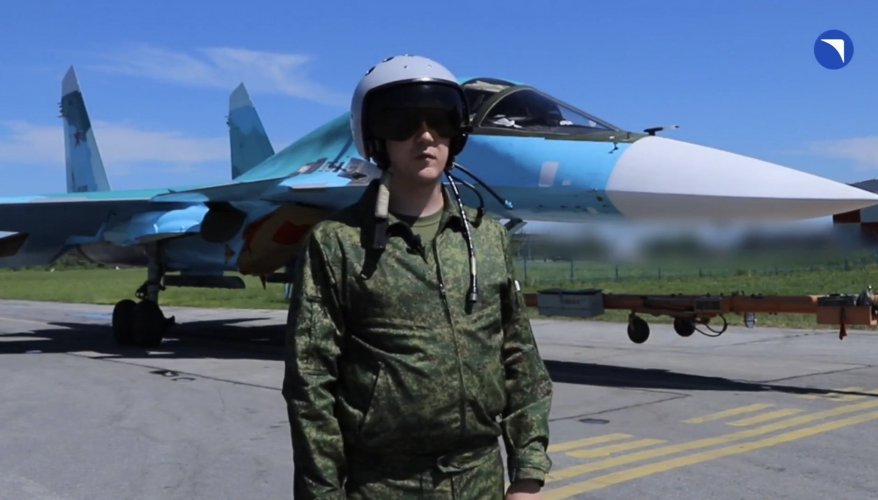
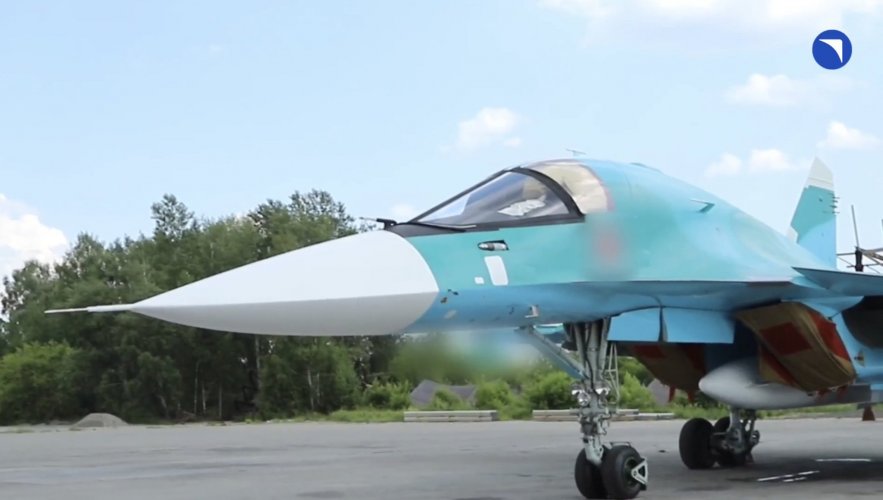
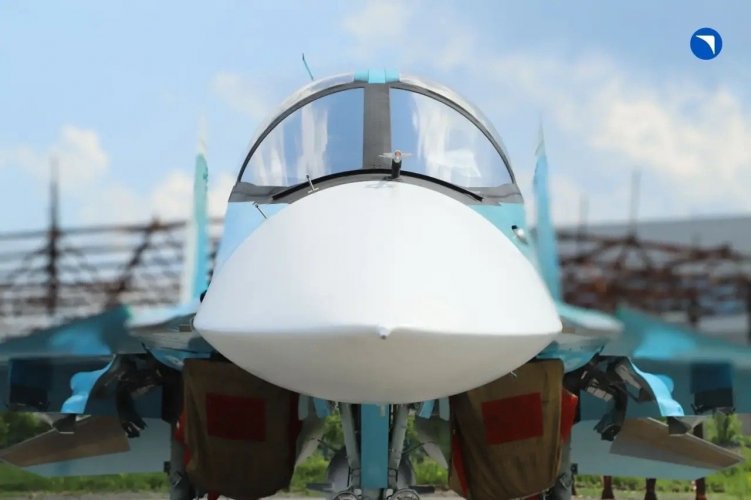
Su-30SM2 with black nose
 

Attachments

  • IMG_20260704_121719_499.jpg
    IMG_20260704_121719_499.jpg
    22.4 KB · Views: 113
  • IMG_20260704_121719_528.jpg
    IMG_20260704_121719_528.jpg
    15.4 KB · Views: 88
  • IMG_20260704_121719_923.jpg
    IMG_20260704_121719_923.jpg
    17 KB · Views: 89
  • IMG_20260704_121719_973.jpg
    IMG_20260704_121719_973.jpg
    28.7 KB · Views: 85
  • IMG_20260704_121719_828.jpg
    IMG_20260704_121719_828.jpg
    80.9 KB · Views: 130
Does the nose cone look slightly angled to anyone else?
It isn't angled.

It does remind me of the dark radome used on the Su-35S though, or the MiG-35. Possibly testing the integration of a new radar (my bet would be Irbis).
 

Attachments

  • IMG_20260707_000403.jpg
    IMG_20260707_000403.jpg
    43.8 KB · Views: 477
Last edited by a moderator:
It does remind me of the dark radome used on the Su-35S though, or the MiG-35. Possibly testing the integration of a new radar (my bet would be Irbis).
Su-35s radome is anything but dark, and Mig-35 AESA one is white...
 
Su-35s radome is anything but dark, and Mig-35 AESA one is white...
It is literally dark grey, just like the one on the Su-30.
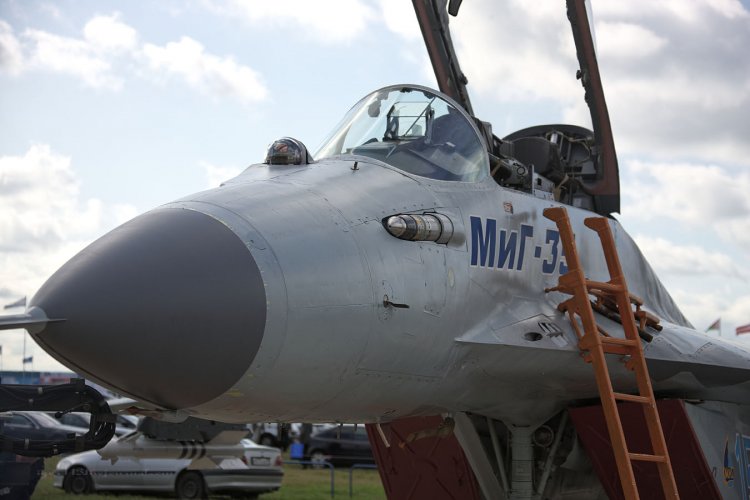
Meanwhile MiG-35 '154' (the one with the AESA), also dark grey radome.
 

Attachments

  • retouch_2026070703250894.jpg
    retouch_2026070703250894.jpg
    3.4 MB · Views: 37
  • 2417653_original.jpg
    2417653_original.jpg
    140.9 KB · Views: 29
Last edited by a moderator:
t is literally dark grey, just like the one on the Su-30.
Su-30 one is evidently darker; that's the point...
Meanwhile MiG-35 '154' (the one with the AESA), also dark grey radome.
It's an ancient MMRCA demonstrator with failed radar(2000s Zhuk-A, the one with pitiful TRM numbers...).

Relevant Zhuk-MA installation (and current Mig-35 demonstrator) looks like this:
 
Last edited by a moderator:
Su-30 one is evidently darker; that's the point...

It's an ancient MMRCA demonstrator with failed radar(2000s Zhuk-A, the one with pitiful TRM numbers...).

Relevant Zhuk-MA installation (and Mig-35 demonstrator) looks like this:
I just said MiG-35, I had the original demo in mind ¯\_(ツ)_/¯

As for Su-30, I didn't say that they took the exact radome of the Su-35, which it evidently isn't. Rather I said that it has a similarly dark (grey) color. And yes the Su-35s radome is a dark shade of grey, not extremely dark but it's not a light color either.

Regardless, I doubt they have a different radome on that jet just for fun. It'll be interesting to see where this goes
 

Attachments

  • HMxEmfWbsAADd8M.jpg
    HMxEmfWbsAADd8M.jpg
    168.1 KB · Views: 36
  • HMxEmdba0AAiTR-.jpg
    HMxEmdba0AAiTR-.jpg
    190.5 KB · Views: 36
  • HMxEmdaakAA-7uF.jpg
    HMxEmdaakAA-7uF.jpg
    150.7 KB · Views: 32
  • HMxEmdZbkAAW_yG.jpg
    HMxEmdZbkAAW_yG.jpg
    95.8 KB · Views: 28

Similar threads

Back
Top Bottom