^

There is a video also ...

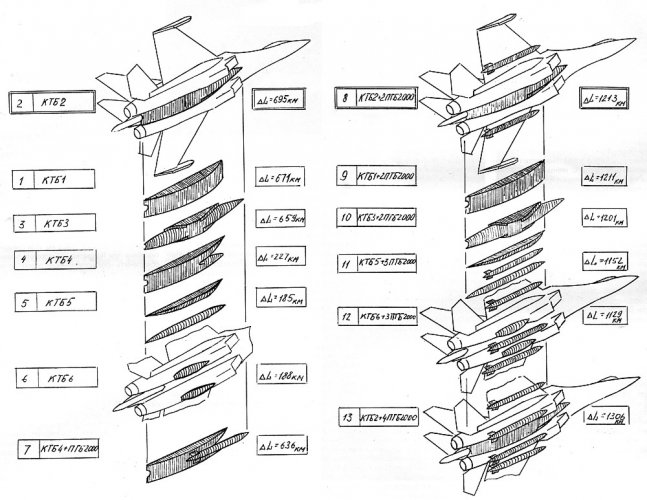
''Russians increase Su-34 bomber payload to six guided bombs''

"A picture of a Russian Su-34 bomber with four UMPK guided bombs and two UMPB guided bombs simultaneously suspended was posted on the Network. There was also a video on which you can see the dropping of 5 bombs. In 2023, the Russians installed only two bombs for departure, " the agency reports.


Source: https://www.facebook.com/groups/1538069254070571/posts/1727086648502163/
 
It's an interesting investment. Admittedly at first glance it seems logical, but then it comes to mind that the Su-30 will never be an aircraft that can boast significant radar signature reduction. Coatings will go a certain way but the overall aircraft is just not meant to be a stealthy weapon. On the J-16 one can chalk it down due to being an entirely different manufacturing process.

But when one looks at how the Russians never bothered giving the Su-35 and Su-30 RAM coatings, or how the Americans never bothered to give the F-15, even the F-15EX, RAM coating, the question for the "why" arises. After all these fourth generation bomb trucks and long range missile slingers only benefit so much from it.

Surely, there is a well thought out idea behind the act, after all significant sums of money and R&D went into this, but this makes me curious for the reason even more. Are the marginal gains truly worth the cost? It will be interesting to see application and cost estimates (especially for maintenance) in the future.
 
But when one looks at how the Russians never bothered giving the Su-35 and Su-30 RAM coatings, or how the Americans never bothered to give the F-15, even the F-15EX, RAM coating, the question for the "why" arises. After all these fourth generation bomb trucks and long range missile slingers only benefit so much from it.

Without an internally weapons bay and conformal fuel tanks the effort is largely futile. Air to ground armament and drop tanks have huge radar signatures. In order to make something effective you need to do something like this.
https://nationalinterest.org/blog/b...le-stealth-f-15-never-joined-air-force-207324

Even without heavy application of RAM (which anecdotally was on a wrong side of cost/maintenance cost curve), one of the most laborious works done on su-35s as compared to original t-10 family was exactly cleaning it's signature, with substantial results.

Yes, it's true it is not on the same level as more dedicated reduced signature work(super hornet, eurocanards), yes, there were other powerful factors in play (much better onboard EW, better performance, different tasks).

But su-35s has proven itself so fundamentally more survivable than su-30sm during spring 22 that VKS mostly removed 30s away from the frontline later same year.
Ukraine too, after early losses it generally preferred giving risky Frontline tasks to mig-29s over flankers. There are again multiple factors, especially since their jets predate major signature work, but mig does have a substantially smaller signature than vanilla flanker.

We don't know much about operations over Iran yet, but I'd really like to see similar study on jets over Iran, how often they run into trouble, whether we can extract signature reduction and RAM impact there.

I.e. no, it doesn't make you stealth, and it should be heavily controlled to keep performance gain in line with maintenance. But results of signature management are in fact impressive.
 
Last edited:
Even without heavy application of RAM (which anecdotally was on a wrong side of cost/maintenance cost curve), one of the most laborious works done on su-35s as compared to original t-10 family was exactly cleaning it's signature, with substantial results.

Yes, it's true it is not on the same level as more dedicated reduced signature work(super hornet, eurocanards), yes, there were other powerful factors in play (much better onboard EW, better performance, different tasks).
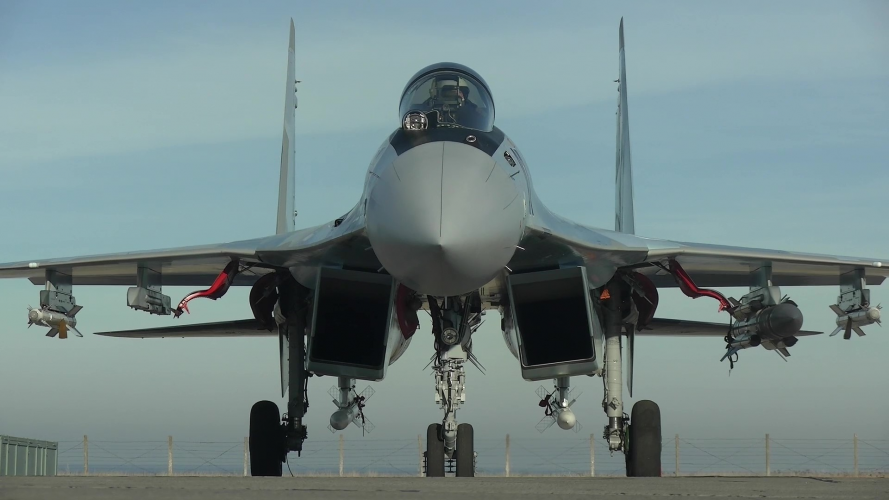
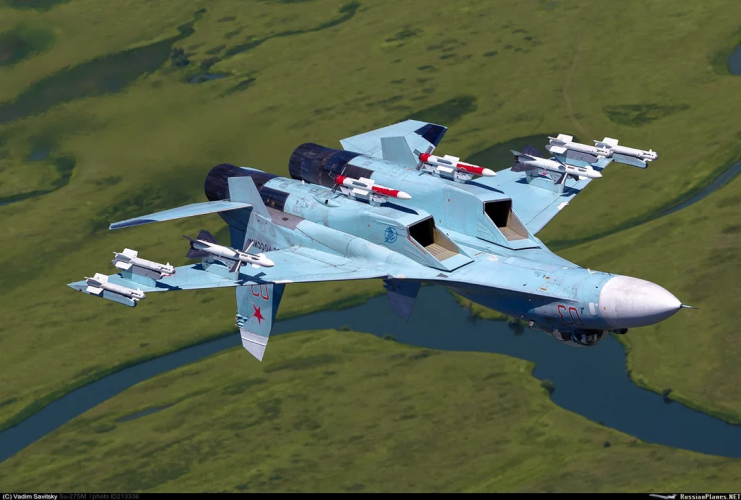
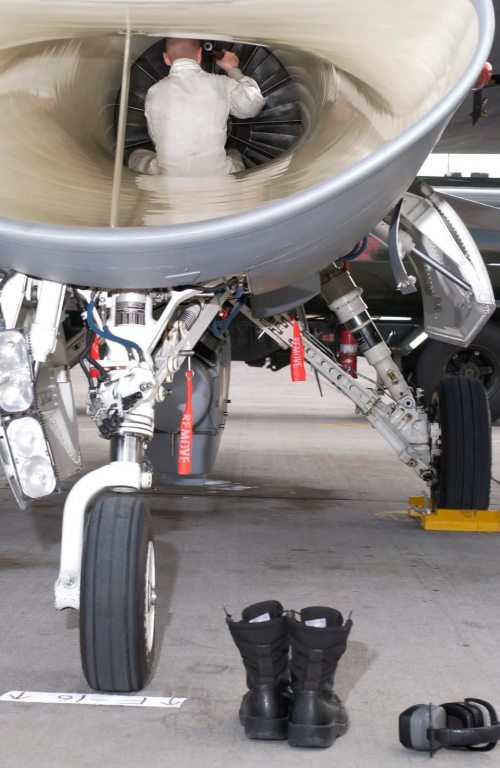
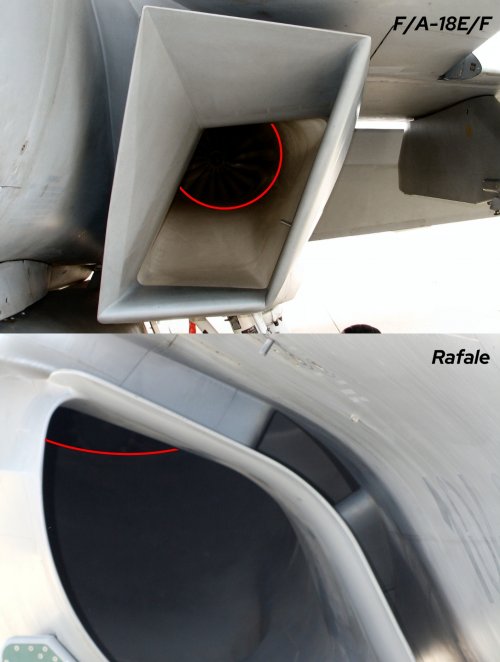
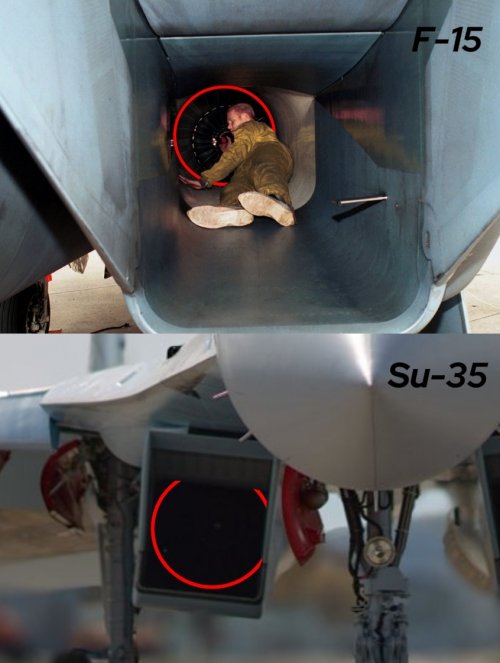
From the point of view of RCS reduction measures, the Su-35 and it`s family have a fatal design flaw: the turbines blades are exposed when watched from the front.

1779815707354.png

1779815586737.png

There is nothing you can do to eliminate the masive signature of those turbine blades. You can`t coat them, you can`t mask them.

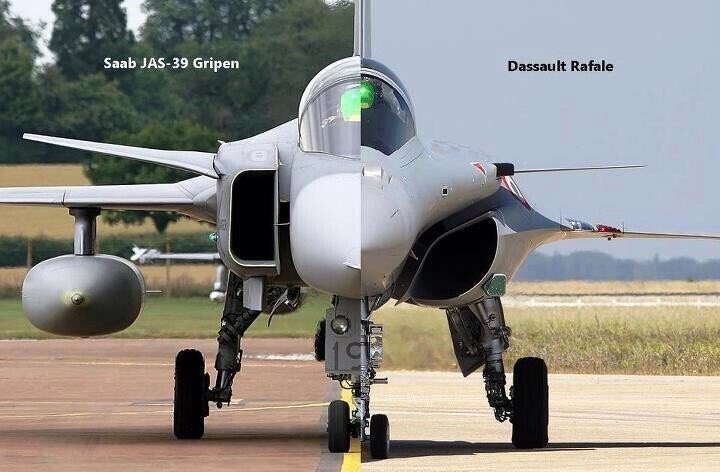
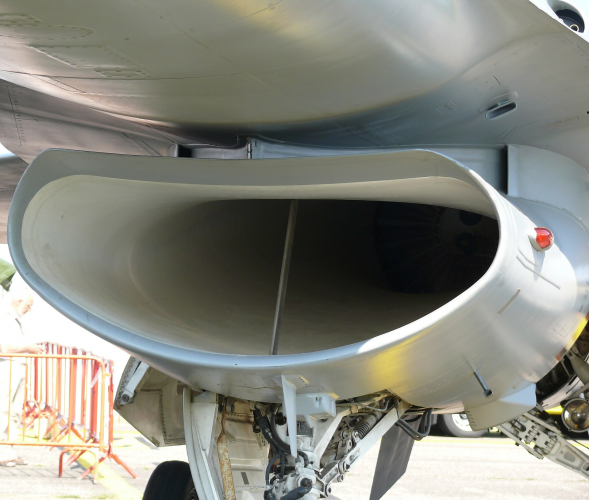
Other aircrafts have the intakes in a S-ducted shape which doesn`t exposes the blades to a radar looking from the front. This gives them more stealthyness potential.

1779816197808.png

F-16
1779816354751.png
 
From the point of view of RCS reduction measures, the Su-35 and it`s family have a fatal design flaw: the turbines blades are exposed when watched from the front.

View attachment 813559

View attachment 813558

There is nothing you can do to eliminate the masive signature of those turbine blades. You can`t coat them, you can`t mask them.

Other aircrafts have the intakes in a S-ducted shape which doesn`t exposes the blades to a radar looking from the front. This gives them more stealthyness potential.

View attachment 813560

F-16
View attachment 813561
1779817225794.png
Far from an expert on the subject but the F-16 is a wrong choice for this comparison.
 
From the point of view of RCS reduction measures, the Su-35 and it`s family have a fatal design flaw: the turbines blades are exposed when watched from the front.
You still can treat airframe and intake; it's absolutely worth it over doing nothing(which in flanker case results in rcs going all the way to double digits).

It produces significant difference in aircraft performance, especially together with onboard EW.
 
It produces significant difference in aircraft performance, especially together with onboard EW.

Possibly. It certainly changes some engagement parameters, but that only goes so far and can only be justifiable in terms of cost to a certain point. Which is why I brought up the F-15EX and Su-35S as modern examples of advanced multirole fighters which forego intense pursuit of signature reduction. Focusing on superior sensors, modern avionics, long range weapons and ECM to increase survivability.

Which is why I'm surprised to find India investing into RAM coating for their Su-30s. It's also debatable if the measures taken by the likes of Rafale or the F/A-18E/F provide a true real world advantage, compared to the route the Su-35 and F-15 have taken¹. After all, the Rafale and Super Hornet are ultimately still infinitely more vulnerable than true stealth aircraft which were designed around rigorous signature reduction in various spectrums.

¹[Attachments]
 

Attachments

  • IMG_20260526_224957.jpg
    IMG_20260526_224957.jpg
    1.2 MB · Views: 101
  • IMG_20260526_225010.jpg
    IMG_20260526_225010.jpg
    463.9 KB · Views: 69
Last edited:
Which is why I brought up the F-15EX and Su-35S as modern examples of advanced multirole fighters which forego intense pursuit of signature reduction.
In understand the logic, but su-35 is a bad example here.
Most of F-15EX design effort went into FbW.

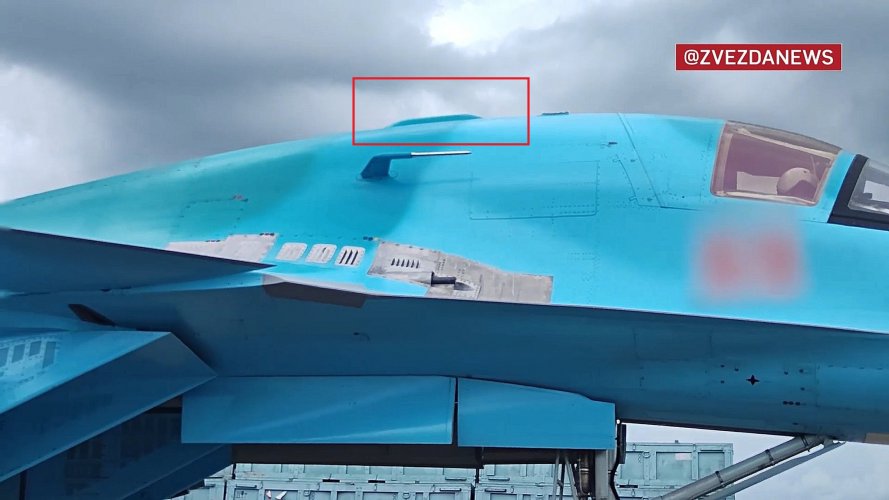
Much(probably most, certainly from OD itself) of Su-35s design effort there went exactly into new body, and specifically into signature reduction. In form of painstakingly cleansing small antennas, access hatches(and rearranging internal equipment to make it feasible), etc, as well as hotspot treatment (first flanker with obvious canopy treatment, for example).
 
Much(probably most, certainly from OD itself) of Su-35s design effort there went exactly into new body, and specifically into signature reduction. In form of painstakingly cleansing small antennas, access hatches(and rearranging internal equipment to make it feasible), etc, as well as hotspot treatment (first flanker with obvious canopy treatment, for example).
That's mostly a side effect though, as the Su-35 is the result of a deep modernization of the Flanker recipe. Modern materials, modern manufacturing methods, modern avionics and sensors, all of these aspects formed the Su-35. Reduction in it's radar signature is coincidental compared to other performance increases over legacy Flankers (for example opting for selective usage of RAM at the intakes versus full on RAM coating, canted tails, redesigned intakes etc). It's essentially the Flanker as if it was designed in the early 2000s, rather than the 1970s.

The J-16 is arguably the most extreme modern Flanker in that regard, it's unique traits born from being essentially completely unrelated to Russian Flankers today. But even there aside from the RAM other properties are the result of Chinese manufacturing, material science and the desire to cut weight. And not the desire to make an inherently "unstealthy" aircraft somehow "stealthy". It's a beneficial side effect of the new development. The RAM application is what set it apart, until now with the Indians wanting to do something similar to their Su-30MKI. While the Su-35S didn't opt for a full on coating and instead saw the application of RAM to critical areas.
 
That's mostly a side effect though, as the Su-35 is the result of a deep modernization of the Flanker recipe. Modern materials, modern manufacturing methods, modern avionics and sensors, all of these aspects formed the Su-35. Reduction in it's radar signature is coincidental compared to other performance increases over legacy Flankers (for example opting for selective usage of RAM at the intakes versus full on RAM coating, canted tails, redesigned intakes etc). It's essentially the Flanker as if it was designed in the early 2000s, rather than the 1970s.
It wasn't accidental, it was the point.
And honestly I (and likely vks themselves)was personally surprised, how much more difficult it is to shoot down su-35 when compared to su-30sm/34.

For entire 2010s there was a prevailing idea that Su-35 as a product is a bad deal for anyone who already had Su-30xyz, as it was more or less the same aircraft, just with a different supply chain and for almost x2 the cost.

Turned out, difference was huge: switch from (roughly) 5-10m rcs to 1-2 (+stores in both cases ) turned out to be absolutely huge and impactful.
I think I heard similar comments from USAF about F-16 treatment(with RAM). It shouldn't be that important, but it turns out to be damn important in real world conditions.
The J-16 is arguably the most extreme modern Flanker in that regard, it's unique traits born from being essentially completely unrelated to Russian Flankers today.
Entirely different base and development path.
But, per my understanding, structurally and RCS-wise j-16 is rather basic (su-30mkk/j-11bs mix), despite the generous use of composite skin and stabilizers (area where China pulled ahead of USSR alre in mid 1980s).

I haven't been at zhuhai 2024 so I can't tell for sure, but my current impression is that first Chinese flanker with deep rcs treatment is j-15b.
 
Last edited:
The difference in survivability of the Su-35 to the Su-30SM and Su-34 shouldn't be surprising and is mostly down to doctrine, mission and the Su-35 having a better ECM suite than the 30SM and the base 34 (Su-34M alleviates this a bit).

The Su-35 conducts air superiority missions, patrols and launches ARM at SAM systems. The Su-30SM and Su-34 conduct interdiction, SEAD, anti-UAS/USV etc. Meaning that when you drop large volumes of glide bombs onto the frontline from medium to high altitudes, you're in more immediate danger than loitering firmly within your air space and launching an R-37M or R-77M at an unfortunate MiG-29 that pulled up a couple meters too much.

Now, the Su-35 is more survivable regardless, yes, which is why they are often paired with lesser aircraft to alleviate the shortcomings of thos and provide them with situational awareness. But it shouldn't be discounted that the mission profile of the Su-35 puts it into significantly less danger than the Su-30s or Su-34s.
 
As I know the number of Su-35S will be more than 48 unit ?.
 
The difference in survivability of the Su-35 to the Su-30SM and Su-34 shouldn't be surprising and is mostly down to doctrine, mission and the Su-35 having a better ECM suite than the 30SM and the base 34 (Su-34M alleviates this a bit).
Back in spring 22 su-35s did SEAD of the most risky kind (serving as bait); they also performed their share of strike.
I.e. mission is not an excuse here.

And while ECM is an obvious candidate, my take is that hiding a smaller 1m RCS from ECCM efforts within jamming is just plain easier than hiding 10m... especially when Ukrainian systems early war were largely pre-1990 ones, and the lower RCS put them beyond their original area of comfort.
 
Last edited:
drop tanks have huge radar signatures.
drop tanks shouldn't be a massive issue considering the size of the internal fuel capacity of the su30, External weapons do remain significant issues though.
Turned out, difference was huge: switch from (roughly) 5-10m rcs to 1-2 (+stores in both cases ) turned out to be absolutely huge and impactful.
I think I heard similar comments from USAF about F-16 treatment(with RAM). It shouldn't be that important, but it turns out to be damn important in real world conditions.


But, per my understanding, structurally and RCS-wise j-16 is rather basic (su-30mkk/j-11bs mix), despite the generous use of composite skin and stabilizers (area where China pulled ahead of USSR alre in mid 1980s).

I haven't been at zhuhai 2024 so I can't tell for sure, but my current impression is that first Chinese flanker with deep rcs treatment is j-15b.
ehhhh i would have to disagree with the J16 considering the very generous use of composite materials as well as a more refined structure vs the mkk. Its probably closer to the su35 level. Its easily the bets flanker on the planet today because of the insanely quick evolution of Chinese radar etc.

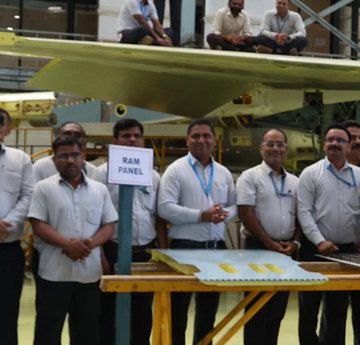
India also seems to want to reduce the RCS of the su30mki and bring it under a much more survivable threshold similar to the su35. Whether HAL uses only RAM or even things like https://www.indiatoday.in/education...objects-invisible-to-radar-2640990-2024-11-27 (pls use an adblocker, the ads will probably be horrible) in combination to try and reduce the RCS even futhur is yet to be seen.
 
ehhhh i would have to disagree with the J16 considering the very generous use of composite materials as well as a more refined structure vs the mkk. Its probably closer to the su35 level. Its easily the bets flanker on the planet today because of the insanely quick evolution of Chinese radar etc.
Composites themselves don't make plane stealthy; rcs treatment is either done or it isn't.
In su-35 development story RCS part is very prominent (almost central point, right next to irbis). In j-16 one it isn't mentioned. Furthermore, there's no visible canopy treatment.

Plane can be advanced without rcs treatment. In fact, general sentiment was(and largely is) that flanker rcs is unsalvageable, you just fit better sensors and live with it.
Su-30sm2, for instance, got treated canopy and likely updated hotspot treatment (it's a ctrl+v solution), but nothing at su-35 scale. Too expensive, no customer interest, no original developer interest.
 
Not to go off-topic, but i'm wondering why the US didn't put more effort into the F-15EX, it would've significantly increased it's relevance on the modern battlefield and even more so in the future. I'm not saying it's a bad plane, far from it, but the survivability of 4th gen airframes without major RCS reduction efforts against modern threats (especially against China) is going to be very low indeed.
On the topic of the J-16, i'm likewise surprised by the lack of serious RCS reduction efforts, but i suppose that unlike Russia, which used the Su-35 as a testbed for the Su-57, China had no need since the J-20 was already developed. Moreover, with the production rate of 5th gen aircraft China won't really need to make many 4th gens to plug the gap, though i think it's a shame since their 4th gens are really cool and would like to see more.
On the topic of the Su-35, other than a new AESA radar, and perhaps new engines (177s), are there any planned upgrades for the airframe down the line? With the R-37M and the R-77M it's certainly still a credible threat against western 4th gens, but i think Russia needs to step up their game with all the new 5th gens making their way into Europe right now.
 
Let's review the material.

Several measures and techniques are used for reducing the overall forward RCS in the centimetric radar bands of the Su-35S. From the composite radome ( w/o the pitot tube),via special coatings inside of the cockpit canopy ( don't sure for the windshield) ,RAM used in the leading edges of LERX's and wingslats,than RAM /paints used in the air intakes and for the IGV of AL-41F-1S etc. But that is only for the reducing of forward RCS and that doesn't mean that Su-35S is stealth fighter,of course it is not, just like all 4th gen fighters .Su-35S has no composite airframe skin at all ,engine nacelles are made from Ti -Alloys w/o adhesive painting ,there is no internal weapon carriage at all etc...

If and only if it is right that Su-35S with all these measures and techniques has forward RCS of only 3 sqm ,it is big ,very big improvement.Of course as a clean aircraft not as armed.Than it is at least ,three to four times less frontal RCS than in the case of Su-27S.That is at least in the level of one light single engine fighter MiG-21 ( as a flying winged tube).

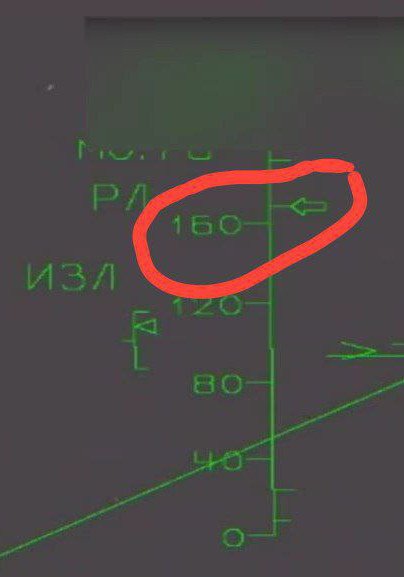
Armed with all these short,medium and big/very big range AAM's, ARM's as we can see during this war ,forward RCS is much ,much bigger.But what about the western NATO light/medium 4th gen fighters like canard equipped Typhoons,Gripens and Rafales ,than US SH's and FF's ??? RCS of 1 or 2 sqm ? Yes, maybe, but only unarmed .Armed and equipped with the AAM's ,ASM's and fuel tanks which are inevitable,forward RCS is of course much, much bigger, 5-10 sqm ,that is real. If combat /tactical situation ensures ,with N035 Irbis working in the PPS-DO combat mode ( no radio-silence mode),all of them can be detected from 400km away.Radars of all mentioned western fighters have no such a great detection range at all. Of course there are AWACS assets in the vicinity but but...

FFF (Flanker Family Fighters ) with that huge wings, stabilizers, air intakes which are widely spaced have RCS which can be measured maybe in several tens of sqm,really,20,30 or more,as armed with missiles and bombs.Will repeat the case from 28 Feb 2022 ,in the vicinity of the city of Kropnitsky ,when UkrAF MiG-29 pilot Lt. Andrey Gerus shot down with one R-27R his colleuge Maj. Stepan Chobanu( KIA) in the Su-27 armed with all ten AAM's. He told later that he meant he has RuAF airlifter Il-76MD on his radar screen.RCS of ''FFF'' in the real war situation ....

About the Su-30MKI and IAF experiences during the Oper.Sindoor on May 2025 .As I mentioned earlier what happened to the IAF crews especially Su-30MKI as FFF was somehow ridiculous.With that so huge heavy long range fighter equipped with long range radar ( 400 km in the HPRF mode), they also have a very big RCS fighter which was detected/tracked by Paki AWACS assets and then by the J-10C radars from very big distances. What was very strange ,those fighters had no real big/very big range AAM at all.R-27ER1? No way, R-77-1EL ,of course not. Paki had those PL-15E ( engaged IAF fighters from about 200km away).Now what we have as a result of that 7th May'25 oper Sindoor ? They use some RAM to reduce overall RCS and finally they bought Russian very big range R-37M/Izd. 620 missiles. Finally, after that operation.

PS

Su-35S/Su-27 Family Walkaround & Reference

https://www.flickr.com/photos/100009549@N06/albums/72157685375253980/

 
with N035 Irbis working in the PPS-DO combat mode ( no radio-silence mode),all of them can be detected from 400km away.Radars of all mentioned western fighters have no such a great detection range at all. Of course there are AWACS assets in the vicinity but but...
Isn't that 350-400km figure for a 3m^2 target only when it's functioning in a very narrow mode?

Who knows what detection range the new ECRS radars will have, although raw detection range is probably not the important factor in actual combat.
 
Last edited:
It has Russian roundels, so I don't think it's an export article. Possibly a test article though? Would explain the look and possibly the numbering on the stabilizer, I.e. it belongs to the manufacturer, maybe converted from a past or future service unit.

That would be my guess.

Because export aircraft are usually not adorned with Russian roundels but left bare except the camouflage itself (like the Su-34ME). And also, the bort number wouldn't be Russian either.
 
It wasn't accidental, it was the point.
in mid-1980s, China used composite materials to manufacture the J-7, surpassing the Soviet Union, which was building the 'Buran' space shuttle at the time?
 
Last edited by a moderator:
Isn't that 350-400km figure for a 3m^2 target only when it's functioning in a very narrow mode?
It's one of main combat modes of all Russian/Soviet fighter radars right since the 1960s.

It allowed seamless integration in GCI automatic intercept (control points fighter radar and ensures right target is locked/engaged, even when fighter radar can barely discern anything).
In the right conditions, it also allowed to overcome technical inferiority of Soviet radar (but also navigation) technology, at the expense of the independence of individual fighter aircraft, which is why VVS fighters happily used it too.

It is indeed a trick, but it isn't commercial. Rather a clever use of asset in the real world, conscious of one's own limitations. Outside of this context, it of course turned into PR tactics, but there's substance behind it.
For most Western aircraft, it's a long-abandoned way of doing things (SAGE did the same thing); China also apparently moved away from it in the 2010s. Perhaps Swedes still do it (unnatural ranges they managed to get out of PS/05 may indicate that), but I am not too familiar with their system.
 
Last edited:
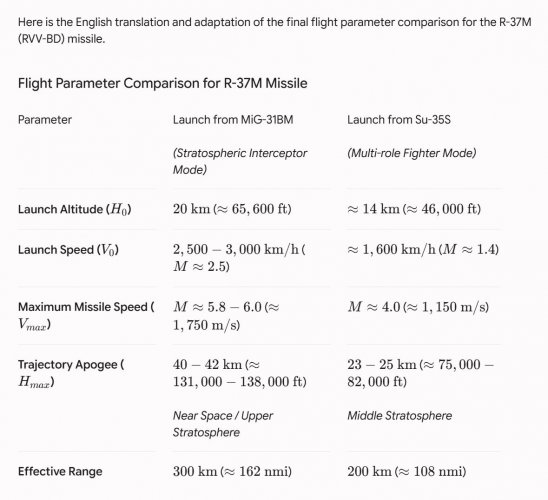
can somebody provide reliable source for R-37M (RVV-BD) maximum and median speed? ROE doesnt state it and i wonder why other sources claims R-37M being capable of flying with hypersonic speed
 
It's one of main combat modes of all Russian/Soviet fighter radars right since the 1960s.

It allowed seamless integration in GCI automatic intercept (control points fighter radar and ensures right target is locked/engaged, even when fighter radar can barely discern anything).
In the right conditions, it also allowed to overcome technical inferiority of Soviet radar (but also navigation) technology, at the expense of the independence of individual fighter aircraft, which is why VVS fighters happily used it too.

It is indeed a trick, but it isn't commercial. Rather a clever use of asset in the real world, conscious of one's own limitations. Outside of this context, it of course turned into PR tactics, but there's substance behind it.
For most Western aircraft, it's a long-abandoned way of doing things (SAGE did the same thing); China also apparently moved away from it in the 2010s. Perhaps Swedes still do it (unnatural ranges they managed to get out of PS/05 may indicate that), but I am not too familiar with their system.
Fair enough, I don't know that much about USSR/Russian doctrine other than they didn't afford the pilots much autonomy.
Does that mean that they are essentially dependent on ground/air based radar warning to tell them which small part of the sky the need to focus their radar on?
 
Fair enough, I don't know that much about USSR/Russian doctrine other than they didn't afford the pilots much autonomy.
Does that mean that they are essentially dependent on ground/air based radar warning to tell them which small part of the sky the need to focus their radar on?
Nowwadays dependant is perhaps too much of a word (fighters can search the normal way, or can point their long-range mode manually), but yes, GCI (or any other control line) can point aircraft radar in the same way SAM guides the seeker on the missile.
And yes, this is the advantageous course of action for Russian fighter aircraft.
 
can somebody provide reliable source for R-37M (RVV-BD) maximum and median speed? ROE doesnt state it and i wonder why other sources claims R-37M being capable of flying with hypersonic speed

Key Takeaways​

  • The "First Stage" Advantage: These metrics clearly demonstrate why the MiG-31BM acts as an ideal "first stage" booster for the R-37M. Launching at Mach 2.5+ at 20 km grants the missile immense initial kinetic and potential energy.
  • Atmospheric Drag: When fired from the Su-35S, the missile has to punch through much denser air layers, which consumes a significant portion of its solid-propellant motor impulse just to overcome aerodynamic drag.
  • The Lofted Trajectory: By reaching an apogee of over 40 km when launched from the MiG-31BM, the R-37M spends most of its cruise phase in a near-vacuum environment. This allows it to retain hypersonic speeds during its passive glide toward the target, extending its range by an extra 100 km.
 

Attachments

  • 37.JPG
    37.JPG
    113.3 KB · Views: 60
Nowwadays dependant is perhaps too much of a word (fighters can search the normal way, or can point their long-range mode manually), but yes, GCI (or any other control line) can point aircraft radar in the same way SAM guides the seeker on the missile.
And yes, this is the advantageous course of action for Russian fighter aircraft.
Thank you.
I can see how, in a perfect world, there are be benefits to this approach where a robust integrated system is more efficient (ground/air long range early warning informs of threats and directs fighters to scan specific areas for them at long range).
However, in both the military and aviation in general, the "swiss-cheese" model is something everyone has to be conscious of, and having as many overlapping detection systems to avoid a catastrophe if some are defeated seems the most sensible approach.

I have more questions but not really suited for this thread.
 

Similar threads

Back
Top Bottom