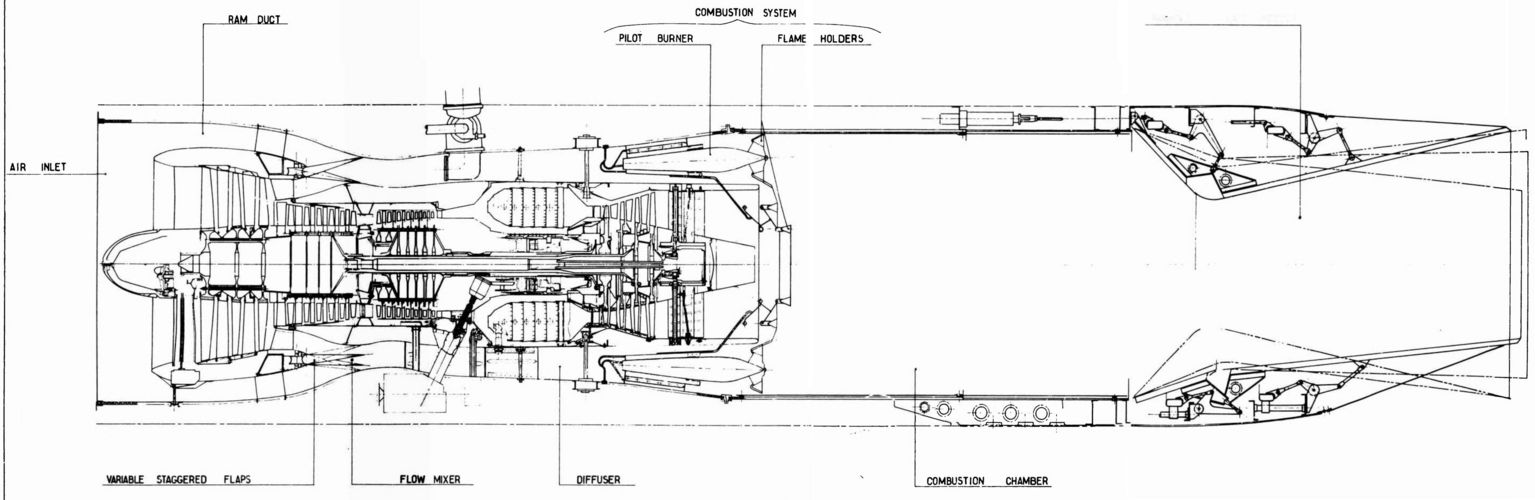
SNECMA TF104/TF106/TF306 Turbofans

overscan (PaulMM)

Administrator
Staff member
Joined
27 December 2005
Messages
19,229
Reaction score
35,676
Some good info here:
In 1959 Pratt & Whitney Aircraft, through the United Aircraft Corporation purchased a minor holding in SNECMA. Two important outcomes of this agreement have been SNECMA's overhaul of P&W engines in Europe, notably the JT3 and JT4, and France's development of the P&W JTF10 turbofan for the Mirage IIIV V/STOL interceptor. This latter work has evolved in two stages, producing first the TF104 and 106, of 10,500lb and 11,210lb thrust, respectively (both of which were closely derived from the original civil JTF10) and secondly the TF306, more closely related to the P&W TF30 powering the General Dynamics F-111.

Read more:

http://www.flightglobal.com/FlightPDFArchive/1966/1966 - 0031.pdf
 
Thanks again Overscan ;)

It should be interesting to know the M-45G rate.
 
Ah, but the interesting thing is why P&W was allowed to buy such a holding, 'twas part of the contract to allow French production of the military JT4C (J75) for the proposed Mirage IVB. Personally, I think SNECMA did better with the TF30 than P&W did; much as the Swedes got better performance from an afterburning Avon than RR did, for equivalent marks.
 
TF104

Dry thrust: 3800kg
A/B thrust: 5800-6200kg
SFC: 0.6/2.55
Bypass ratio: 1.5
Weight: 1550kg
length: 5m
Diameter: 1.3m

TF106A2
Dry thrust: 4200kg
A/B thrust: 7500kg (TF106A3, 500kg more thrust)
SFC: 0.66/2.5
Bypass ratio: 1.3
Mass: 1780kg

TF306
Dry thrust: 5210kg (C), 5780kg (D), 5970kg (E), 6550kg (F)
A/B thrust: 9150kg (C), 10000kg (D), 10330kg (E), 11000kg (F)
SFC: 0.65/2.35
Bypass ratio: 1.03
Mass: 1750kg
Length: 5.3m
Diameter: 1.2m

Liebert & Buyck, Mirage F1 et les Mirage de seconde generation
 
Interesting, Snecma worked in 1966/1967 on "ramjet" TF 306 for "high Mach fighter projects" (M 48 and M51) (think it was like the PW J58 on SR-71).
 
Le Fana mention the deal in its 336, October 1997 edition. Think SNECMA gave 10.9% or so.

Well, J.C Carbonel had a nice article on the J-58 at its "aerostories" website.
It briefly mentioned that the J-58 had been considered for Concorde before the Olympus came in, hence the presence of the engine at Le Bourget airshow in 1963...

The Mirage IVB was supposed to be 57 tons, 5000 km range, enlarged variant of the Mirage IVA.
Alas, France didn't have an engine powerfull enough for such a monster. As a consequence, four engines were considered
- RB-142
- Olympus
- Iroquois (damn... the CF-105 engine)
- And the J-75!

But De Gaulle aparently stated that the french nuclear bomber couldn't rely on foreign engines. Hence the return to the IVA.. and buying of KC-135FR in 1964.
 
Re: SNECMA TF-106 experimental afterburning turbofan......

Dear Boys and Girls, here is an article in French about the SNECMA TF-106 experimental afterburning turbofan which was derived from the Pratt & Whitney JTF10 engine. It was flight-tested in the Avions Marcel Dassault Mirage III T test-bed and was also used for the early test-flights of the Avions Marcel Dassault Mirage III V-01 VTOL fighter prototype......

Moderators; this Topic is a suitable candidate for transfer to the new Propulsion forum; these engines were experimental and never made it to full production status……

The article comes from the 16th June 1961 issue of Les Ailes......

Terry (Caravellarella)
 
Were TF306 to find its way in production aircraft would the United States be able to impose export restrictions on say Mirage F3?
 
I wondered what was in te fine print of the deal so to speak. If it was just a license agreement it would had been obvious. But SNECMA had gotten the design as part of the partnership deal with P+W and then went on to modify it a fair deal.
 
I wish I could know when was the TF306 officially abandonned.
- Aviation Magazine says December 1969.
- Both Mirage F2 and G flew until 1971 when the former was retired and the later crashed.
- But the writting was on the wall for TF306 since the Mirage F3 had been scrapped in 1967 and the 9K50, scaled-down F1 chosen instead.

So I still have no idea whether that engine was stopped in 1967 (F3) 1968 (M53 development began) or 1969 (December)

Sweet Jesus. The years 1965-1975 saw a complete mess of prototypes and requirements - between Dassault, the AdA, Aéronavale, and French ministry of Defense.
And SNECMA for the engines: 9K50 and M45 and M53 and TF106 and TF306.
And the Jaguar on top of that.
 
You have cited reliable sources, but there is also the official website of Dassault and Camareo 10 "T2 military aircraft". who knows maybe there is an exact confirmation in the latter.
 
Turbo-Ramjet Combination Engine using a TF106 core:
https://archive.org/details/DTIC_AD0486375/page/n1/mode/1up

Very interesting. A long time ago (2006 I think) Le Fana de l'aviation had a monography related to Dassault Mach 3+ projects (MD-750 and countless others). And turboramjet TF306s featured prominently, which makes some sense before 1970 and the M53. TF306 was to be SNECMA entry into the supersonic fighter turbofan area, post- Atar. But it ended too expensive and troubled, and American with that - anatema to De Gaulle and Pompidou policies...
 
Was the TF-106 the same diameter as the tf-30 or was it scaled down, because it would be very impressive if the French were able to put a 49in dimaitor engine into a plane biult for a 39in engine (The Mirage III-T).
 
Ok I don't want to create a new thread so I'm asking the question here.

What was wrong with the TF104 / 106 / 30 / 306 family of Pratt turbofans ? And how did it impacted SNECMA own take at improving that engine ?

I presently have the following (scattered) elements
- TF30 started as the F6D subsonic turbofan
- Trouble started when Pratt made it supersonic for the F-111B and later the Tomcat
- Even subsonic, it wasn't that good, as A-7 got a massive performance boost when USAF, then USN, switched to Allison TF41 / Spey
- SNECMA seemingly made a better job than Pratt on TF306, correcting a turbine blade problem
- Mirage F2 and Mirage G seems to have flown pretty well (1966-69 and 1967-71 respectively)
- So did the TF30s A-7, never heard of deadly compressor stalls issues for A-7s and Mirage F2 / G
- Before that however, TF106 in Mirage III-T and III-V 01 seemingly sucked immensely
- compressor stalls seems to be a common feature between SNECMA issues and the Tomcat own problems
- yet as far as the F-111A was concerned, the intakes were trickier too, so not TF30 fault there

Was there some kind of flaw in the TF30 compressor ? something akin to rampant compressor stalls that could be aggravated by ill-suited intakes - as shown by the Mirage III-T (too small intakes) and F-111 (intakes done wrong) ?
 
Basically, state of the art for fan & compressor design from the late 1950s. The TF30 performed reasonably well for the time, but the fan / compressor were not very tolerant of inlet airflow distortion. Bad inlet design (early F-111) can cause distortion, better inlet design (F-14) can still have high levels of distortion at high AOA and sideslip. The A-7 engines had some problems with steam ingestion on the carrier catapult.

The TF30-P-100/111 engine for the F-111F had a redesigned fan and low compressor with a bulged flow path in the LPC that increases airflow, pressure ratio, and distortion tolerance, which in addition to a higher temperature capable turbine resulted in a big step up in performance, with takeoff max AB thrust going up from the 19k range to 25k lbs thrust. In the mid 1980s, P&W proposed developing a similar fan/LPC design for the F-14 P-414 engine, but the Navy didn’t fund it..

The A-7 performance increase with the TF41 engine was primarily due to it being a bigger engine with higher airflow, pushing the thrust up from 12.5k to the 14.5k lb range. The TF30 was lighter and had better SFC, giving it some performance advantages over the TF41, but it was hard to argue against the increased thrust.
 
The TF30-P-100/111 engine for the F-111F had a redesigned fan and low compressor with a bulged flow path in the LPC that increases airflow, pressure ratio, and distortion tolerance, which in addition to a higher temperature capable turbine resulted in a big step up in performance, with takeoff max AB thrust going up from the 19k range to 25k lbs thrust. In the mid 1980s, P&W proposed developing a similar fan/LPC design for the F-14 P-414 engine, but the Navy didn’t fund it..
By then the F101/110 was well on its way I guess, but I read the P-100 was introduced in 1970 with the 111F so how come P&W offered the design so late for F-14?
 
In 1970, the F-14 was brand new and the TF30 was considered to be an interim engine until the F401 was ready. Then the F401 was cancelled and the F-14 was in full production with the original TF30-P-412. Some fan blade containment issues resulted in the P-414 version that introduced beefed up fan cases and changes to the fan stator inner rub strips to eliminate the possibility of fan blades coming thru the cases and prevent any fan rub titanium fires. The customer was more concerned with safety and durability improvements with their Component Improvement Program dollars than improving performance and operability.

As noted, by the time it was thought that changing the fan / LPC configuration, the F101DFE program was bringing the F110 engine to reality. When the F110-400 was installed in the F-14, the performance that was predicted for the F401 became reality.
 
Thanks you for the explanations. Of course the F-14D (mostly) went by the window, courtesy of the aptly named Dick Cheney - and the Tomcat soldiered on with TF30s until 2006.
 
I have searched some more in the Safran database, there are too many pdfs to add but for anyone interested I'd suggest downloading all the pdf files (generally in the last few pages after all the photos) in the 3 following searches:

https://heritage.medialibrary.safran-group.com/Heritage/search.do?q=TF104&page=5https://heritage.medialibrary.safran-group.com/Heritage/search.do?q=TF106&page=4https://heritage.medialibrary.safran-group.com/Heritage/search.do?q=TF306&page=5
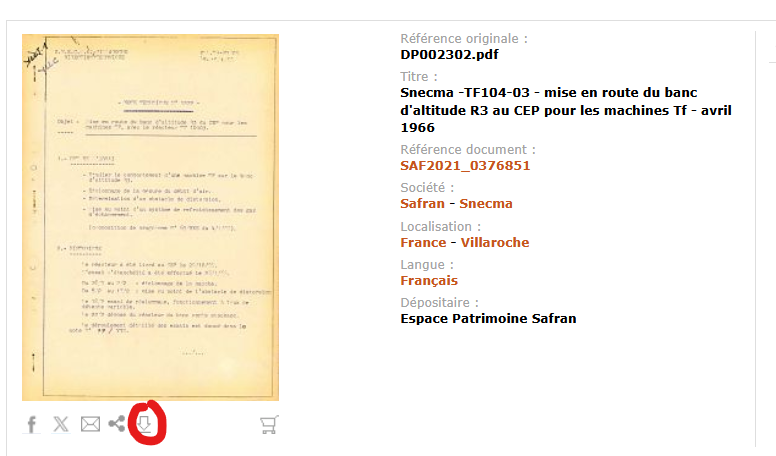
To download you need to select the paper icon on the bottom left of each picture in the search page, then select the download icon (down arrow): 1768499087186.png 1768499102271.png
 
I have searched some more in the Safran database, there are too many pdfs to add but for anyone interested I'd suggest downloading all the pdf files (generally in the last few pages after all the photos) in the 3 following searches:

https://heritage.medialibrary.safran-group.com/Heritage/search.do?q=TF104&page=5
Amazing resource. Thanks!

There's also a whole book on the Atar family with lots of technical detail, technical drawings etc... well worth downloading.
 

Similar threads

Back
Top Bottom