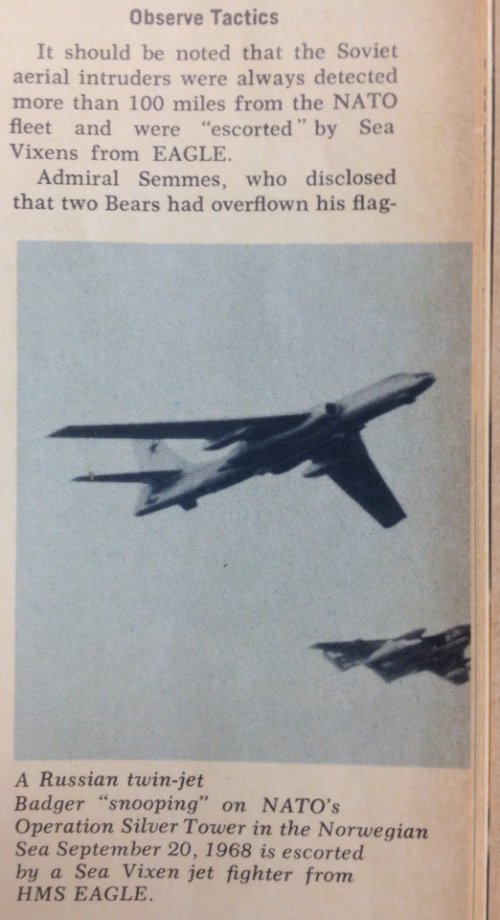
Maybe in it's secondary ground attack role?
The fact that it's fine in SACLANT, not so good in SACEUR is what suggests to me that being out of range of enemy fighters - or rather, enemy fighters having to go through the rest of NATO's air strength before they can engage the Sea Vixen - is what makes it fine. Also being able to operate at night and in crap weather when a substantial proportion of enemy fighters can't engage it.
 
TBH there's not many Cold War combat aircraft worth stretching out, and certainly subsonic 50s fighters in the 60s are at the bottom of the list.
 
Wondering whether a Phantom radar and SARH missiles could have been stuffed into a Sea Vixen. Just random thinking.
 
Wasn't Sea Vixen's low service ceiling and climbing speed the major problem in 1960's and -especially- 1970's? Some interviewed pilots I watched seem to be attached to the idea of higher service ceiling.
 
Wondering whether a Phantom radar and SARH missiles could have been stuffed into a Sea Vixen. Just random thinking.
I'm perplexed that it wasn't done for the Javelin, some marks of which had American radars. But then it was always just about to go out of service, and nobody expected that they would last to 1968

If you can't find a radar/FCS combination of the appropriate size and weight that will handle Sparrow, you could at the very least find one that will enable the use of SARH Falcons. Your backup in extremis is the Crusader's AIM-9C fit-out.
 
The fact that it's fine in SACLANT, not so good in SACEUR is what suggests to me that being out of range of enemy fighters - or rather, enemy fighters having to go through the rest of NATO's air strength before they can engage the Sea Vixen - is what makes it fine. Also being able to operate at night and in crap weather when a substantial proportion of enemy fighters can't engage it.

Seek out the Tu-16 Badger that ventured out to the sea, but avoid the MiG-21 Fishbed when you go over land.

1968_Sea_Vixen.jpg
 
Would / could an AN/APQ-81 radar have been fitted to the Sea Vixen?
 
Would / could an AN/APQ-81 radar have been fitted to the Sea Vixen?
You mean, the radar of the F6D Missileer ? with the Eagle big AAMs ? not sure one could cram that into a Sea Vixen. The radar antenna alone was enormous, see the A3D modified for the testing job.
View: https://www.reddit.com/r/WeirdWings/comments/8q7mcz/nra3b_snoopy_radar_test_conversion_of_an_a3/
 
Last edited:
If the RN had been less ambitious/greedy could it have kept these types into the early 70s long enough for a similar sized replacement aircraft to be developed?
Unlikely, IMO.

Remember that France gave up on trying to build a carrier-capable aircraft in the 1950s/60s to buy Crusaders as "too expensive", and France's economy was in much better shape than the UK's was.
 
Yep, the french navy wanted three carriers as a bare minimum but was actually lucky to have PA55 Foch built after PA54 Clemenceau. Circa 1954-1955 it took some political and budget cleverness to get that second Clemenceau carrier funded.

As for the third carrier it shrunk from "45 000 tons PA58" to "a clone of Foch, PA59" to "let's keep Arromanches as long as possible (1974)".

Finally, the Clems ended trapped in a corner: forced to use Crusaders until the end of their useful lives, that is 1999. Hornets barely fit, Rafales even less.

Very interestingly the Super Etendard in the 1990s on the Clems was like Buccaneers on Victorious and Hermes in the 1960's. That is: the slower attack plane fits the carriers, but the supersonic interceptor is tricky.
 
Last edited:
The threat to carriers from supersonic bombers feared from the 50s on did not materialise until Backfires arrive in the 70s.
Arguably only the F14 offered a realistic chance of downing them before they released their missiles. This was beyond the means of UK and France.
 
The threat to carriers from supersonic bombers feared from the 50s on did not materialise until Backfires arrive in the 70s.
Arguably only the F14 offered a realistic chance of downing them before they released their missiles. This was beyond the means of UK and France.
On the other hand, missile-armed Badgers remained a significant part of the VMAF naval force until after the Cold War, and basically the entire force until the 1980s, and those Badgers could be intercepted by Phantoms but less capable fighters and SAMs struggled, something the Australians identified in the early 1960s.

So you've got basically a 20-year period where the missile-armed Badger is the reference threat, and a threat that can be handled by Phantoms but not much less than Phantoms.
 
Unlikely, IMO.

Remember that France gave up on trying to build a carrier-capable aircraft in the 1950s/60s to buy Crusaders as "too expensive", and France's economy was in much better shape than the UK's was.

I think France's problem isn't cost per se, but rather the tiny fleet they required. Much like the RN at the time their Naval Fighter fleet was too small to warrant the expense of developing their own aircraft.
 
Yes. Besides the 42 Crusaders procured, only 90 Etendard IVM/P and 71 Super Etendard were built. Jaguar M procurement plans: 100 or less.

There was a 1958 RFP for a Mach 2 naval fighter, one competitor being my all time favorite Breguet fighter design: the Br.1120 Sirocco. It was very much a Mirage F1 a decade before the F1, their similarities are striking. Then again, there are not that many ways of designing a Mach 2 fighter with Atar 9, swept wings, and "mice" in the air intakes.
But the RFP went nowhere, too expensive for a smallish fleet.

Funny to think that at the same moment the USN actually had too many (almost) Mach 2 fighters on its plate
-Crusader II
-Crusader III
-Skylancer
-Super Tiger
-Phantom

 
I think France's problem isn't cost per se, but rather the tiny fleet they required. Much like the RN at the time their Naval Fighter fleet was too small to warrant the expense of developing their own aircraft.
Same problem the UK has, to an lesser extent for the UK.
 
Yes, their fighter fleet could be at least double and maybe triple that of France. however, it has to be world class, having a second rate fighter fleet like France will not do.
Which makes the development expensive, and spread across only a couple dozen aircraft makes those aircraft really expensive.
 
Sea Vixen production: 151
Scimitar production: 76
Buccaneer production: 211
...
Etendard IV production: 90
Super Etendard production: 85 (of which 71 went to the Aéronavale and the rest to Argentina)
 
Last edited:
Sea Vixen production: 151
Scimitar production: 76
Buccaneer production: 211
...
Etendard IV production: 90
Super Etendard production: 85 (of which 71 went to the Aéronavale)

Apart from the Buccaneer those are quite simple aircraft and therefore quite cheap to develop, and Buccaneer used a version of the radar from the Lightning, which helped reduce cost. A Mach 2 interceptor with comprehensive AAM engagement capability is much more expensive than those aircraft and its much more important to spread those development costs over a larger production run. IIUC the initial RN Phantom requirement was for 140 aircraft, 4 embarked sqns, an HQ sqn/OCU and a Trials unit; this isn't a big enough production run to amortise the development of what would have been an expensive arcraft.
 

Similar threads

Back
Top Bottom