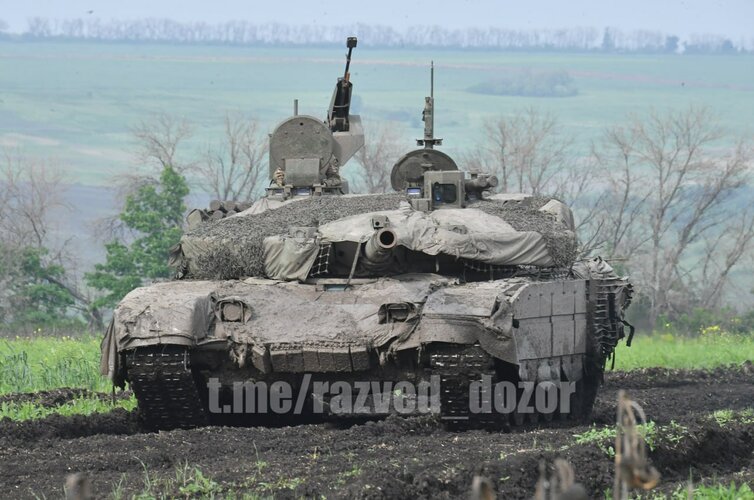
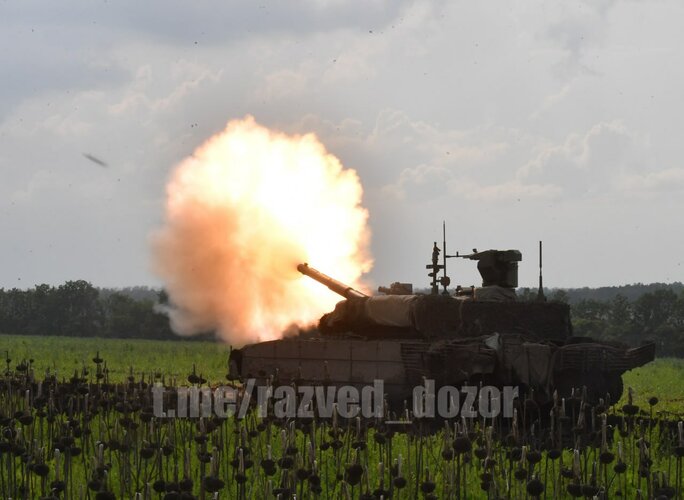
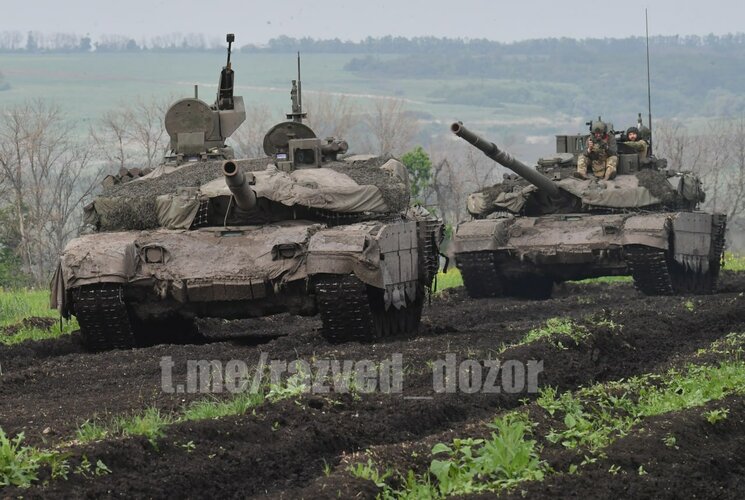
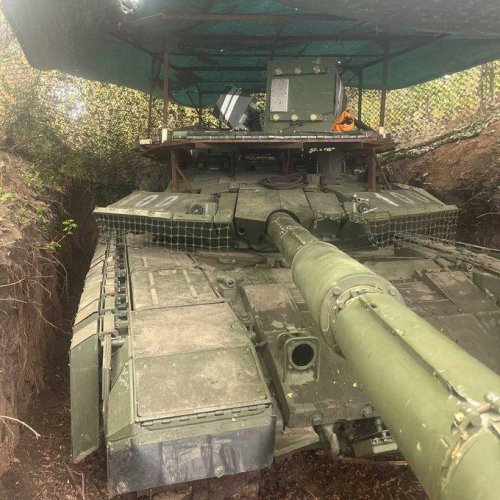
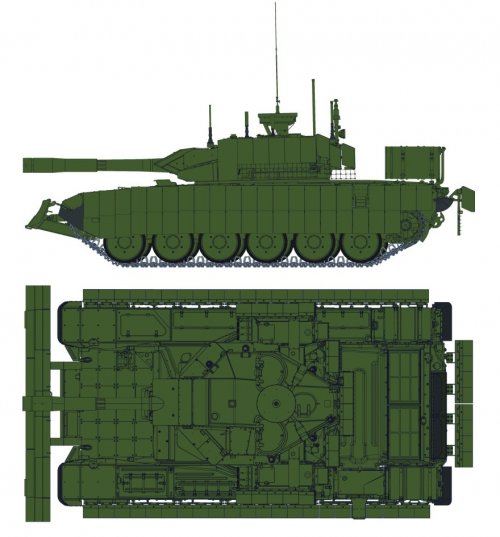
A shed load of elbow grease to buff that out. A pity the quality is so poor but normal for this type of issue.

 
I'll zoom in here for a sec:
9PxxXdp.png


View: https://i.imgur.com/9PxxXdp.png


This looks awful.
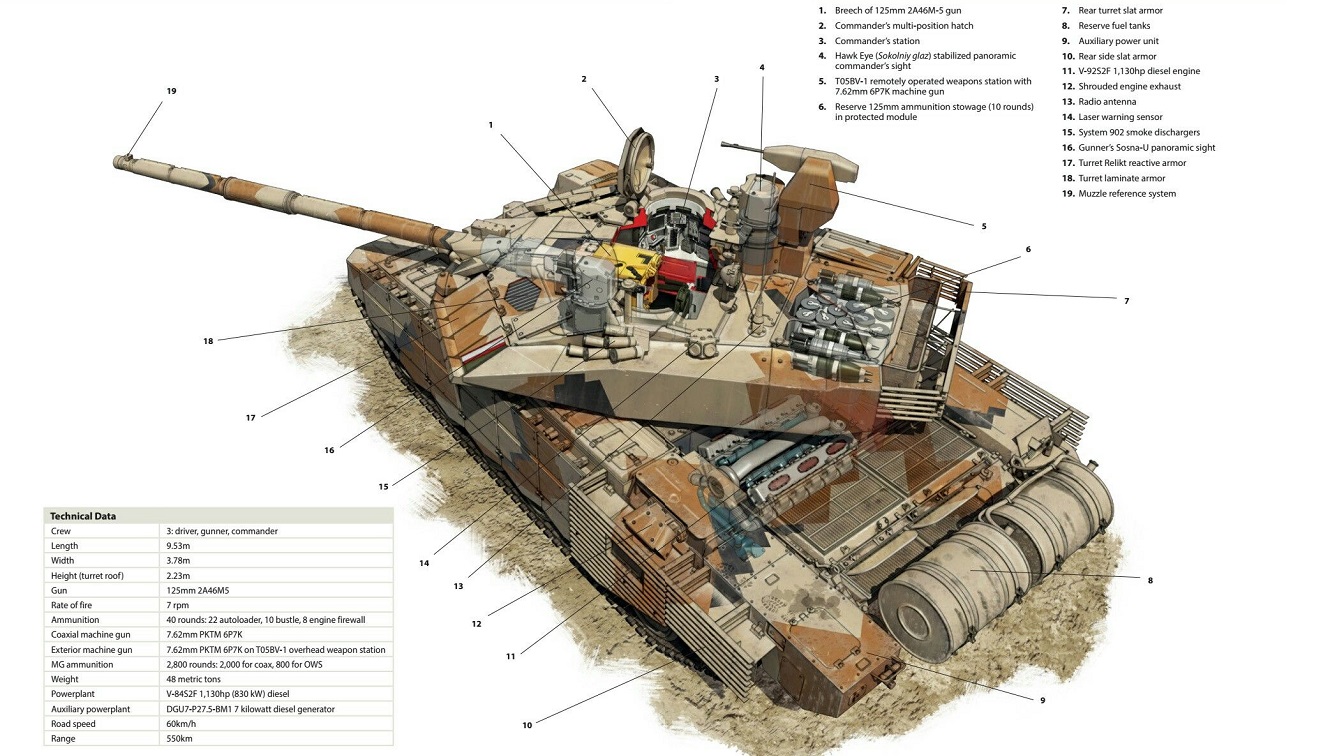
I assume they're not really aiming to protect the reserve ammo stowage at the back, but rather prevent a penetration from the rear that goes through it and into the crew compartment.
T-9020Tank.jpg

Also seems they want to protect the engine, but the only real defense it has are mudflaps. I see their merit against the usual drone that'll probably have its blades broken by it, changing its trajectory and maybe causing a miss, but there is definitely more that can be done.
Overall it seems like the perspective from which they designed it is "horizontal" and not vertical, which is in line with the cold war era mindset that still prevails in some countries still focusing on frontal armor and better main guns instead of getting APS, mine kits, and side armor.
Logistically it seems like a nightmare. It'll look like that until the first hit and then it's again frankensteins. From this angle alone, I can see 5 distinct layers, of which a drone can hit 4 if it aims for the turret.
This shouldn't be a problem for Russia, as a tank rarely survives an assault to later be repaired and restored. But when you're pitching this as an export product, it's not a good look at all.
It screams "look what we have to put on our flagship tank just to make it work". In contrast, Arab buyers are seeing the offered Abrams, Leopard, and Leclerc fairly clean.
I'd also argue that for countries at peace, it'd be better to simply install a basic cage against dropper drones, and not a full kit that'll have to be developed and adjusted in time proximity to a war.

EDIT: My image did not embed properly so I added a link.
 
To be fair, it is a bad time to buy or sell tanks. Too much is in flow right know. One year ago you could tackle the whole FPV problematic with jammer systems but after the fiberoptic cable solutions, that does not cut it anymore.
To the contrary. Now is a peak in MBT market activity and it's only estimated to rise until the mid 2030's.
The contributing factors are the war in Ukraine which drives acquisition across the entire Europe, which is the largest market for first hand MBTs, and maturity of tech that enables a radical redesign of the crew compartment and recalibration of crew roles.
Munitions with fiber-optics were available for a very long time. Over 20 years I believe, and today they exist among the majority of modern armed forces. The most widely used example is the Spike.

Both Ukraine and Russia are unbalanced forces. Hence we should not draw too many lessons from Ukraine. Over-learning is often just as dangerous as under-learning. You could learn the wrong lesson.

All the “clean” tank systems are not battle tested and I think a real solution will have major operational consequences. Perhaps like having a dedicated vehicle always around or getting the omitted loader back inside the tank, with additional duties and therefore thwarting the T-14 concept.
Europe has no AFVs with APS, sans demonstrators. That is a major issue. But I doubt they'll need to be cluttered as much to properly defend.
An APS, and some form of automatic system that can shoot down drones at hundreds of meters away, are all you'll really need.
 
The war in Ukraine is a largely static one. As mentioned, this might teach the wrong lessons. First person drone control is likely far less practical in a moving battlefield, as is fiber optics. Full autonomous UAVs will be an issue soon but are likely far more expensive and fewer in number for the time being.

I think the MBT of the future will employ a medium velocity 30mm time fused cannon as a secondary remote weapon station, along with 360 EO/IR coverage linked to a computer system with target recognition. Ideally the radar system for the APS is also linked to this, and the fire control resembles almost more of a ship based combat system where multiple sensors are integrated to multiple weapons and the most appropriate cued for automatic or semi automatic responses.
 
And another contributor to AFVs remaining "clean" in the forseeable future is the subject of spectrum dominance. It's a fairly silent revolution of the battlefield.
Every armed force would want to know what's being transmitted around the battlefield, by whom (friend or foe), from where, and for what task.
If you deploy an inter-communicating drone swarm, it'll get picked up. Operators in the rear will get quickly picked up as well.
electronic-warfare-top.jpg


And then this hard labor will see 2 things.
Ground controllers will see this:
Capture.png


And the swarm will see this:
FylQmjyaQAAQcpB


What this means is that the combat element of 2030 will already have a comprehensive multi-layered protection against above ground and aerial threats, and this leaves the average AFV with a need for only slight modifications for increased survivability.
The clutter we see on that T-90MS is something that by 2030 should be completely gone, and I'd argue that for a modern force in 2025 is wholly unnecessary.
 
Both Ukraine and Russia are unbalanced forces. Hence we should not draw too many lessons from Ukraine. Over-learning is often just as dangerous as under-learning. You could learn the wrong lesson.
Unbalanced in which way?
Ground controllers will see this:
Poor relay drone(10k usd something apiece, with a few more in nearby treeline on standby).
Probably won't suffer much, but still an emotional trauma.

Drones, their ralays, antennas and operators(hidden and not) represent far too ambigous(well hidden), too numerous and too varied(air, ground, static and moving, emitting and not) target set than what tactical fires can realistically cover.

For breakthrough, you need to be able to physically locate and personally remove all or most of them in a short order, to try to collapse the whole local network.
Doesn't guarantee things(4k commercial drones and/or optics on buildings, masts and so on still can coordinate fires from dozens of kms away), but at least battlefield cohesion will die.
Or, alternatively, do it over time - but it is a game with uncertain result.
And the swarm will see this:
Looks expensive and emmittey.
I wonder how this, in the middle of the battlefield, will react to an average 6" splinter rain.
Or, more disguistingly, to a personal optical FPV sneaking by down low.

Big artillery radars often suffer dozens of miles behind battlefield. Now you want one at LOC.
 
Last edited:
Unbalanced in which way?
It is a Soviet era armed force with point additions of western tech of varying levels of modernity, and domestic equipment based on civilian grade tech.
Its current composition does not allow it to maintain a system of force multipliers as in a proper western armed force.
Looks expensive and emmittey.
I wonder how this, in the middle of the battlefield, will react to an average 6" splinter rain.
Or, more disguistingly, to a personal optical FPV sneaking by down low.

Big artillery radars often suffer dozens of miles behind battlefield. Now you want one at LOC.
Artillery radars must emit for a long time. High power microwaves only emit for very short periods, only when engaging an enemy. There is no practical resemblance to a radar in terms of emission.
What I showed is a large variant, probably meant for fixed installations. There are smaller variants for a maneuvering force. That's a bit beyond the point here. For how to kill drones, there's a dedicated thread. An MBT is neither dead, nor should be covered in metal barns.
 
And another contributor to AFVs remaining "clean" in the forseeable future is the subject of spectrum dominance. It's a fairly silent revolution of the battlefield.
Every armed force would want to know what's being transmitted around the battlefield, by whom (friend or foe), from where, and for what task.
If you deploy an inter-communicating drone swarm, it'll get picked up. Operators in the rear will get quickly picked up as well.
electronic-warfare-top.jpg


And then this hard labor will see 2 things.
Ground controllers will see this:
Capture.png
If you have enough long range fire to blast every hole and $100 dollar radio emitter within the tactical depth of 20km, why would you bother with a force structure around a weapon with 500m effective range and design vehicles exclusively to defend against a weapon with 500m range?

You think it is harder to silence individual man in tunnels going through dozens of wires and cables and indirect relays within 20km, or a vehicle that naturally blasts 745kw+ just in thermal energy on top of APS radar, AA radar, battlefield networking and basics of a 50ton large vehicle in motion and is only a threat at line of sight ranges?

It is like the classic, if you escort an Iowa with enough AEGIS you can indeed get into 16" ramming range, but the same VLS tubes can kill the other side long before that because defense is harder.

Now, I am sure some one with figure out counter arguments like the NSFS crowd, but ultimately optimality in a narrow, rarely encountered niche is generally not war winning.
 
It seems to me that the greatest threat to AFVs is the thing they don’t see. In the future I think tanks and other front line vehicles will have to employ a combat system not unlike a ships which integrates all sensors, and crews would be prompted target recognition software to look at anything identified as hostile. Sensors would include the current thermal sites but also 360 EO coverage and the radar of the APS, if present. Targets would be UAVs, ATGWs, infantry, and other vehicles. The crew might optionally allow/confirm an automatic response by the fire control to engage the target with whatever weapon is most practical, be a RWS or even the main armament.
 
It seems to me that the greatest threat to AFVs is the thing they don’t see.
Other AFVs are pretty damn big and easy to see, so the greatest threat to AFVs is not other AFVs.

The gun is a weapon system that is very big for the projectile performance given. Many vehicles have a 10ton weapon system with equal projectile performance as a manpack <100kg system using rocket propulsion. Before electronics rocket propulsion result in very poor accuracy, but since it gun systems have far more niche advantages like ammo cost, reaction time and such which have also eroded with time.

All things equal, the most stealthy platform have the greatest ratio between main payload and chassis. The tank have a lot of mass in armor and defensive systems and is thus not stealthy at all compared to a minimalist vehicle with the biggest weapon that'd fit, or something like stationary bouncing top attack EFP mine that is 100% weapon.
---------------------------
If one looks at how naval warfare shakes out, AFVs would in the end becomes mainly escorts that is versatile and can deal with all sort of large and small (mostly small) threats. Attacking platforms can get better throw weight for cost by not having endurance (bombers) or focus on stealth (submarines) and deal with only a subset of threats. (subs don't do AA, bombers don't do ASW) The extra cost of non-stealthy, persistent platforms is mainly justified in missions that do not involve stealth and need persistence, like escorting reforger.

Decisive battle in transparent battlefield would end up like in the world wars where one or both sides can avoid a decisive naval engagement due to recon and it takes very specific situations for battleships to engaged each other in pitched battle. This is not so for carrier battles since carrier's effective scouting range is less than its striking range, thus you can get a midway where one side detects and attacks first.
 
Last edited:
My point was not about AFVs not seeing other AFVs, though there are a number of videos of almost point blank engagements where crews clearly lost situational awareness. I meant broadly that it is the threat you do not see - an ATGW, an inbound FPV, a hovering UAV bomber - that is the most dangerous. Most of these threats could be engaged with some think like 30mm RWS with time fused ammunition, were they identified in time. In the case of an opponent vehicle suddenly breaking cover, the main gun might be more appropriate. In IFVs, the turret cannon might be most appropriate for all surprise targets. But the biggest problem is rapidly identifying threats across every possible arc. I think we are very close to having target recognition algorithms that could do this, if they could be linked to an adequate array of sensors. EO is sufficiently cheap there should be no reason not to ring an MBT/IFV with them. I also think having two independently stabilized thermal sights, either of which can be slaved to any of the vehicles weapons, will become the norm, for purposes of long range scanning and redundancy. An active APS radar, if present, could also be integrated into this system to provide multi mode detection or as a ranging/velocity measurement sensor after initial detection (for appropriate target types).
 
Last edited:
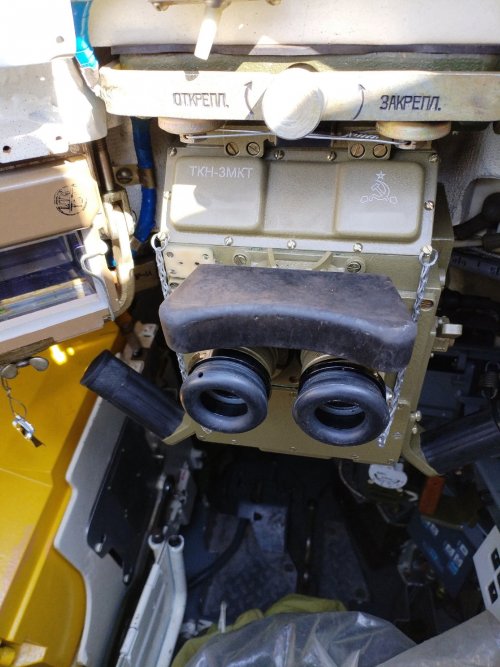
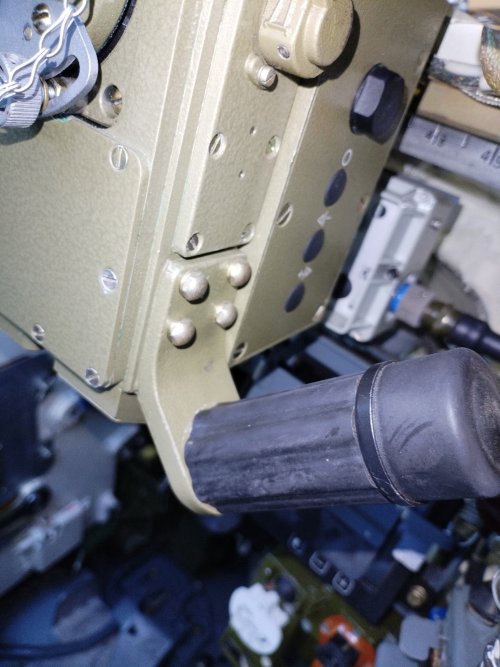
We have a (99%) confirmation that indeed RU started putting thermals for the commander in T-72B3M/T-80BVM, pictured is TKN-3MKT made by NPZ, letter T indicating Thermal and previously noticed lack of IR lamps alongside new image correction buttons on the side basically confirm it
 

Attachments

  • 20250711_110350.jpg
    20250711_110350.jpg
    880.4 KB · Views: 56
  • 20250711_110353.jpg
    20250711_110353.jpg
    862.9 KB · Views: 53
We have a (99%) confirmation that indeed RU started putting thermals for the commander in T-72B3M/T-80BVM, pictured is TKN-3MKT made by NPZ, letter T indicating Thermal and previously noticed lack of IR lamps alongside new image correction buttons on the side basically confirm it
Better late than never.
Edit: it's an upgrade that can be done even by the crews, so it's possible that lot of tanks will get it, not just new production. Provided that they make enough.
 
Last edited:
I know he can't reply
I read his comments and realized that his view is very biased and that he is a clown. The tank is more than 20 years old, the tank participated in combat operations and not in the desert of Iraq where it is dry. And in a continental climate under snow and rain. His M1 tank in Iraq was hardly more than 10 years old.
Abrams have not had a single new hull made since the 1990s.

They've only been refitted to new standards.


But the biggest problem is rapidly identifying threats across every possible arc. I think we are very close to having target recognition algorithms that could do this, if they could be linked to an adequate array of sensors. EO is sufficiently cheap there should be no reason not to ring an MBT/IFV with them. I also think having two independently stabilized thermal sights, either of which can be slaved to any of the vehicles weapons, will become the norm, for purposes of long range scanning and redundancy. An active APS radar, if present, could also be integrated into this system to provide multi mode detection or as a ranging/velocity measurement sensor after initial detection (for appropriate target types).
I'd been thinking that, but then I realized that your RWS will also have pretty much the same sensors as in your stabilized thermal sights, laser rangefinder and all. So do you need both dual CITVs and dual RWS-with-CITV-sensors, or do you just use the RWS sensors and skip the CITVs?


Bad news for Western countries I guess.
Russians now have enough spare thermals for secondary needs.
Or they have decided that passive thermals for drivers is where they need to be spending money.
 

I'm also unsure if "City warfare" is the intended translation, urban warfare or siege warfare are probably more accurate.

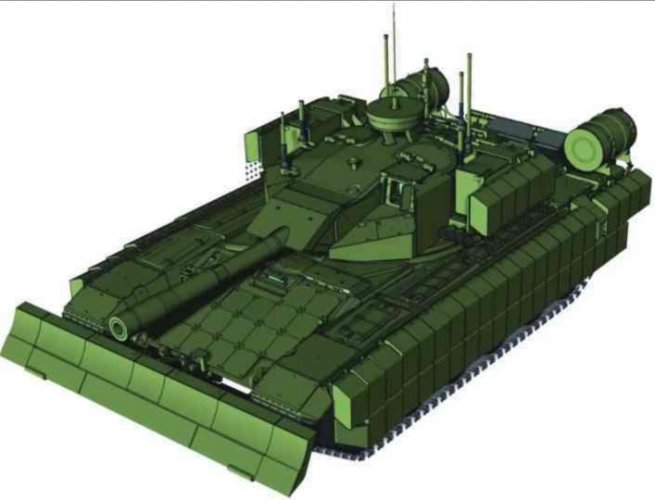
Given that the presumed goal of this vehicle is to conduct assaults on enemy held positions with minimal risk to the own troops (which is why it's presumably unmanned/optionally manned). The shortened but strengthened gun emphasizes this, being meant to sling HE at positions and adversaries, rather than engage enemy armor with sabot rounds. I assume canister shot, if available is also an ammo type of choice.

The idea is to level buildings and positions and shred infantry with explosives and shrapnel, the dozer blade on the renderings was assumed to move rubble and perhaps even mines out of the way. The strengthened barrel on the other hand is meant to shrug off hits by drones and their shaped charges more easily. The shorter barrel also has benefits with regards to turret rotation in urban environments.

I think it's adequate to call this the modern incarnation of the assault guns of WW2.
 
Last edited:
It not a single vehicle but a number of them , optionally manned assault tank ,second being a heavy APC control unit and third a heavy IFV- BTR-T with 8 dismounts to protect the control vehicle

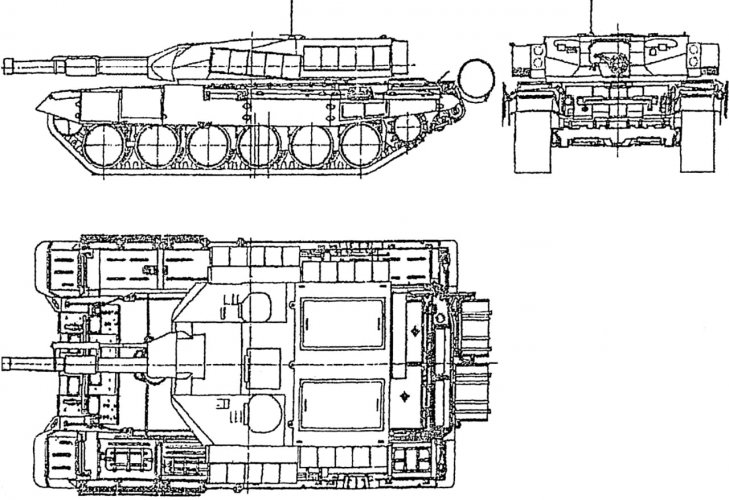
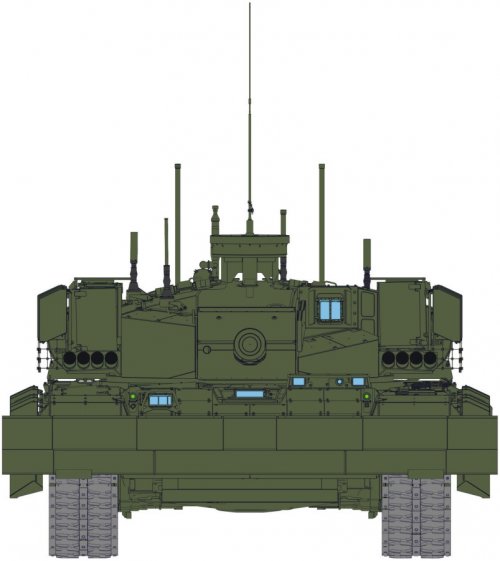
Heavy Robotic Assault Complex TSHRK "Shturm" includes remotely controlled tanks (with the option for crew operation) and control vehicles based on the T-72 (T-90) chassis.
It features a shortened 125 mm gun barrel (a 152 mm variant is in development) for urban combat conditions, a bulldozer blade, and all-aspect protection against cumulative anti-tank weapons.
The turret is also equipped with launchers for rocket flamethrowers or other weaponry.


from AndreiBT

Historical Overview of the "Assault" Project. Budget Robot-Tank, 2018:

The Uralvagonzavod Corporation (part of Rostec) is developing a robotic complex based on the T-72BZ tank at the request of the Ministry of Defense, said Alexander Potapov, General Director of UVZ, at the ADEX exhibition, as reported by RBC. According to Potapov, considering that the technical specifications for the robotic complex based on the T-72 have been agreed upon with the Ministry of Defense, the manufacturer is "already somewhat confident that there will be prospects for an order from the armed forces." However, Potapov found it difficult to specify when the first prototype of the robotic complex based on the T-72B3 would be ready.

In August, RBC reported that UVZ is developing a heavy assault robotic complex on the chassis of the T-72B3 tank. This was disclosed by a source in the Ministry of Defense and confirmed by someone close to UVZ. The R&D work is named "Assault," as clarified by RBC's sources. According to the MoD source, a mock-up of the complex with combat equipment has already been created, which "allows demonstrating elements of movement."

The purpose of the assault robotic complex in combat is to be the vanguard of the battle formation, to breach enemy defenses and locate their firing positions, destroying them or providing targeting information when possible, explained Victor Murakhovsky, editor-in-chief of the journal "Arsenal of the Fatherland," to RBC.

"Given that in real combat operations, it's not always possible to keep the equipment intact, losing a complex based on the T-72 would not be as painful as losing a robotic 'Armata'," believes the military expert. He noted that this concept was conceived back in the 1980s, but the technological level of Russian enterprises at that time did not allow for its implementation.

According to an MoD source cited by RBC, among the primary requirements for the robotic complex based on the T-72 are:

All-around super-high protection, which would maintain combat capability after being hit by 10-15 hand-held anti-tank grenades (RPGs) and mine blasts.
The ability to maneuver in the confined spaces of urban environments, including free 360-degree turret rotation in narrow passages.


Older concept also had a 30mm coaxial
GfLzpa1W0AEygXq.jpg
 
Last edited:
Here's the full report...


And Frontelligence's Tatirigami's X thread..

View: https://x.com/Tatarigami_UA/status/1977350132027842995


It's fair to say there are a lot of doubts about the Russian's plans....particularly around the conversions proposed (using the last T-72B and T-72 Ural/A to T-90M/M2 and T-72B3M...)
 
Here's the full report...


It's fair to say there are a lot of doubts about the Russian's plans....particularly around the conversions proposed (using the last T-72B and T-72 Ural/A to T-90M/M2 and T-72B3M...)

Of course, plans are not guarantees. Production targets can slip, resources can fall short, and some programs may never reach scale. But dismissing Russia’s rearmament efforts outright would be a mistake. The scale of the planned programs implies major financial commitments as well as significant imports of both components and industrial equipment.

Doesn't sound like there are lots of doubts tbh.
 
From other commenters. including knowledgeable ones.
Please at least highlight those commenters in what they said, are you talking about twitter users or whats in that report? I already saw someone using pre-2014 sanctions number estimates on the T-14 as an example to compare that to an already 20 times sanctioned country is not a knowledgeable commenter.
 
Presumably this mean Aramata is dead?

It doesn't, the T-14 is independent from whatever is ongoing with the T-90. But as the T-90 is, as it stands, the workhorse of the modern Russian Army (as compared to the less sophisticated albeit still modernized soviet era T-72 from which it descended), keeping it relevant and capable for the current and near future battlefield is a logical step. Especially given the cost benefits of simply modernizing and improving an already established platform, as well as the fact that the exact same thing is going on in the west really. What are "new" western tanks these days? Leopard 2 developments, for the most part. KF51 or A-RC 3.0, they're both heavily modernized and altered Leopard 2s, same goes for the boat load of EMBT demonstrators. The Abrams is also a true Methusalem that refuses to perish. In that sense, the reasoning for further modernizing the T-90 is that it is cheap, available, numerous and that there isn't anything drastically better elsewhere.

The T-14, which will eventually replace it, is being trialed. You see them pop up here and there and usually more than one or two. However one has to consider the current moment as well, what benefit is there to push a tank into production now that's for the most part an unchanged system from 2015? It needs it's own production line, spares, maintenance crews, logistics network, repair facilities, supply chain and what not. As the vehicle stands right now it's not anymore prepared for modern warfare as the T-90, the Leopard or M1 really. It's a juiced up "conventional" tank. But "conventional", as in "cold war era thinking" isn't really cutting it anymore. So while survivability may be even further enhanced thanks to it's layout, it's just as susceptible to drones, mines and all the other hazards encountered by MBTs these days, especially Russian MBTs. And because of all these things the most fundamentally stupid thing to do would be to close T-90 production and go all in on the T-14 during an ongoing war of attrition.

The T-14 will have it's time, but it will see changes before that happens. Be it an autocannon based CIWS, electronic warfare equipment, further expanded hard kill system, overhauled turret armor or anything you could imagine really. Something will change, because otherwise it's obsolete upon proper full scale introduction. And at that point you might as well just produce more T-90s, because in practice it would be pretty much the same thing from a combat effectiveness POV.

Something that could threaten the Armata platform long term may be the Shturm remote controlled tank. Such a radically different approach to the same issues at hand could pay off much more comprehensively and cheaper than just developing another "super tank". But we have yet to see it perform in action.

To conclude, keeping the T-90 in production and modernizing it beyond the current M standard is pure pragmatism at work. This doesn't spell doom for the Armata, a development which demise has been prophezied for as long as it's been in development. If anything, future modifications to the T-14 design will benefit massively from the experience gained with the T-90M and then T-90M2 in the field. Lastly, if the Russians know how to do one thing, it's how to design tanks. Together with the Americans and us Germans they've historically been at the forefront of pushing the envelope with regards to AFVs. So I "trust" them in this regard.
 
Last edited:

Similar threads

Back
Top Bottom