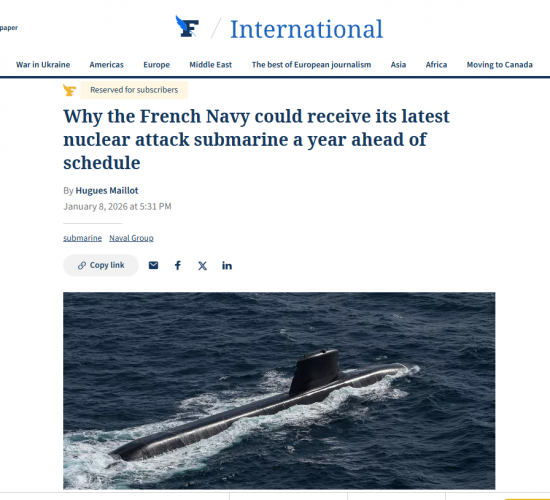
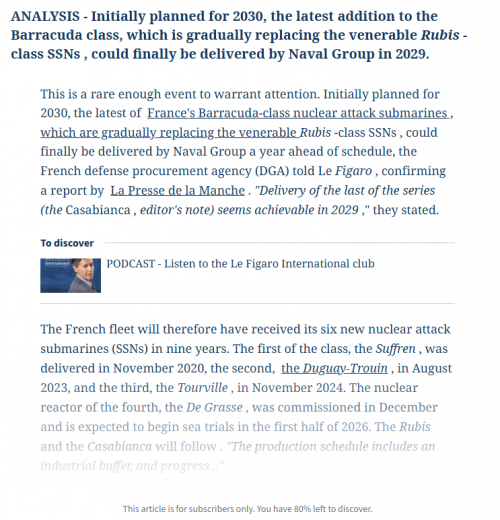
Interestingly, in this article, Naval News refer to the design as:

An accurate depiction of what the SSN-AUKUS will look like, as displayed by Rolls-Royce with a London bus alongside to give scale.
Not sure whether I'm missing a joke, or if this actually is indicative of the final design.

Yeah that has thrown me too, I was sure we'd see some kind of hull shaping rather than just being a generic tube.
There seems to be very little Astute DNA in this.
There's an ever so slight Vanguard/Dreadnought-esque kink in the nose section which I like. I wish it had Dreadnought's sloped sail and whale nose, would've looked great. But yeah, the only Astute-class features I'm seeing are the six torpedo tubes, clearly visible in this profile shot:

1762476134612.png
Really feels as though it'll be Virginia, but with British insides. Something a little French about it as well.
 
Comparison with the Dreadnought model

1762416759069-jpeg.790576

Dreadnaught-class-SSBN.jpg


The hull shape is the same, just the bow and aft have been shortened, the missile section has obviously been removed and the front of the sail is different.
 
Last edited:
I was trying to measure the model and I got two very different estimates.
If you assume the reactor compartment is the same length (12m) then going by the external markings she comes out about 150m in length, only a tiny bit shorter than the Dreadnought. If you go by the bus model, then a New Routemaster is 11.2m, which results in a length of about 95m, about the same as an Astute which I think is unlikely based on her proportions.
 
Stern planes are the same as SSN(X)'s slightly offset x-stern and yes the sail looks like the Suffren's.

1762484373564.png

There's a question around the scaling as well because a London bus is 11.2m long according to sources, so a Suffren is about 9 buses long. The model of the SSN-AUKUS above, isn't much more than that.
 
I was trying to measure the model and I got two very different estimates.
If you assume the reactor compartment is the same length (12m) then going by the external markings she comes out about 150m in length, only a tiny bit shorter than the Dreadnought. If you go by the bus model, then a New Routemaster is 11.2m, which results in a length of about 95m, about the same as an Astute which I think is unlikely based on her proportions.
Remember that the beam is about 12m on Dreadnought, so you end up with kinda chunky proportions, same as with the SSN-21s.

Edit: I am leaning towards "roughly the same length as Astutes" being the correct answer. The different proportions at bow and stern compared to Dreadnought are likely due to those areas being the ballast tanks and so they need to be much smaller for a smaller ship.
 
1762476134612-png.790677


Dreadnought-Class-Construction-Units.jpg


On the Dreadnought compartments B-J are pressurised. You obviously discard the missile compartment F/M. And then the profile actually looks more similar than it did at first glance with the main differences being the sail design and the rudders placement relative to the propulsor.

2.png
(Compartment cropped then rescaled to match nose to prop length of the model)

My guts telling me a length of 120-125m, halfway between the two.
 
Last edited:
Clearer pic of the model:

There was some discussion of this when these images were posted to the r/Warshipporn and r/Submarines groups on Reddit, but there's no visible vertical launch system on the model.

It does have six torpedo tubes, though.
 
The Navy’s Virginia-Class Submarine Program Is Falling Apart
The Virginia-class attack submarine program was supposed to deliver two boats a year. Instead, production is stuck around 1.2 annually, with Block V subs years behind schedule and billions over plan.
With only 47 attack subs in the fleet against a requirement of 66, delay is becoming a strategic risk.
 

This thread seems to have become the hub for all SSN-AUKUS news, perhaps a name change is in order?
 
I would hope that State and Defense remind Congress that it is a really terrible idea to make the word of the United States government not worth the paper it's written on.
Ah, it's just ragebait to give the anti-AUKUS crowd something to cry about. Last year's report included *the exact same language.*

The CRS can posit anything they they want--it's the entirety of their job. Their words carry no power or weight and they have no authority of their own. (And quite frankly, sometimes get a bit out of their depth imho.)
 
Australia announces its released $3.9bn towards the submarine program infrastructure out of a projected $30bn project cost.
Enabling works worth $2bn, and construction of a fabrication area costing $5bn and a skills academy costing $500m have already begun.

The next stage an outfitting area will cost $8bn to build while a final stage of a consolidation, testing, launching and commissioning facility will cost $15bn.

4,000 workers will be employed designing and building the construction facilities while 5,500 would work in them once complete.

2b2e3ba3cfa66a7c522adcd35db32df6


Instead of hoping that Virginias will become available and not be blocked by US Congress because they can't be built fast enough, bring back an updated Soryu as an interim sub that can be built until the first AUKUS SSN is ready.

This time it would be the Taigei class, stirling AIP been replaced by extra lithium batteries to give it more and faster AIP performance. Sonar, quietening and other things been updated too. If you had to give it a stretch for extra batteries or fuel, it wouldn't change the design too much.
 
Instead of hoping that Virginias will become available and not be blocked by US Congress because they can't be built fast enough, bring back an updated Soryu as an interim sub that can be built until the first AUKUS SSN is ready.

This time it would be the Taigei class, stirling AIP been replaced by extra lithium batteries to give it more and faster AIP performance. Sonar, quietening and other things been updated too. If you had to give it a stretch for extra batteries or fuel, it wouldn't change the design too much.
Still think that an Australian version should keep AIP but use lithium batteries.
 
The whole reason they went nuclear was because the French were years late in delivering plans for the Shortfin Barracuda, when it was cancelled in 2021 they still hadn't progressed them past 80% design maturity after five years of development work (on what was sold as a mature design) Naval Group missed multiple contractual deadlines for delivery of the plans, even though the keel was meant to be laid down in 2023 so long lead items should have already been ordered. And the expected commissioning date for the first in class had slipped out to 2037 when it was 2030 in the contract award (and even that was back from 2025 envisaged when the program was begun in 2012, but they didn't award the development contract to Naval group until 2016).
 
Last edited:
The whole reason they went nuclear was because the French were years late in delivering plans for the Shortfin Barracuda, when it was cancelled in 2021 they still hadn't progressed them past 80% design maturity after five years of development work (on what was sold as a mature design) Naval Group missed multiple contractual deadlines for delivery of the plans, even though the keel was meant to be laid down in 2023 so long lead items should have already been ordered. And the expected commissioning date for the first in class had slipped out to 2037.
This is going to be fun. Care to support any of your statements with sources?

Because I can pull the NAO reports and read in black and white that the Attack program was actually progressing quite well compared to all the other AUS procurement disasters. Preliminary design reviews had been completed, critical design review was tracking ~12 months behind the original 2017 schedule, with responsibility for the delay shared between government (changing requirements), Naval Group, and Covid. There was a plan in place to recover these minor delays and be on time for sea trials in 2031-32. Equally importantly, costs were also under control, with the final estimate before cancellation (August 2021) of $46.4 billion in 2016 constant dollars. A Cabinet memo stated that this "remains within the original acquisition cost estimate of $50 billion in 2016 constant dollars announced at the outset of the Attack class submarine program in April 2016".

Here's the actual timeline from official sources, not the imaginary one in your post:
Key milestones of the Future Submarine Program are as follows:
  • Preliminary Design Review – scheduled to conclude in March 2020 (actual: Feb 2021, 11 month delay partly impacted by Covid).
  • Critical Design Review – scheduled to conclude in June 2022 (Note: later revised to June 2023, 12 month delay)
  • Operation of the Propulsion System Land Based Test Site – scheduled to commence in 2022/23.
  • Operation of the Combat System Physical Integration Facility – scheduled to commence in 2022/23.
  • Construction of the first Future Submarine – scheduled to commence in 2022/23 (First hull qualification section to start construction as soon as government-owned Osborne North shipyard complete in 2023, ~6mo delay)
  • Construction of the second Future Submarine – scheduled to commence in 2025/26.
  • Sea trials for the first Future Submarine – scheduled to commence in 2031/32.
  • Acceptance of first Future Submarine – scheduled for 2032/33.
Source: https://www.aph.gov.au/api/qon/down...timatesRoundId2-PortfolioId7-QuestionNumber41
 
Last edited:
Australian defence procurement history 101, ignore the facts and blame the people doing the work.

HMAS Adelaide I was years late (nicknamed HMAS Muchdelayed) and became one of the underpinning reasons given for not building future cruisers in Australia.

The reality:
  • Her ordering and early construction was delayed as the government considered advice from the Admiralty to build her to a new design based on the Atlantic Cruiser concept (precursor to the Frobishers)
  • Her construction was delayed again as the war was coming to an end and it was realised, she would not be completed in time, so was slowed to incorporate further design changes based on wartime experience.
  • Critical forgings from the UK were lost in transit due to enemy action.
Context is everything. Many defence projects are criticized for delays and blame is often mis applied.

Another example, no matter how often o how badly Austal screw up, they always get more orders and politicians blow wind up their backsides. Quite literally the best people from around the globe can be contacted in, a world class yard be built and the project overcomes incredible adversity not of their making, delivering a world class capability at competitive cost and schedule for a new design out of a new yard, yet still it is seen as a failure.
 
Here's the actual timeline from official sources, not the imaginary one in your post:

Source: https://www.aph.gov.au/api/qon/down...timatesRoundId2-PortfolioId7-QuestionNumber41

Yep, in that 2018 (three years before the program was cancelled) schedule:

Preliminary Design Review– scheduled to conclude in March 2020
Critical Design Review– scheduled to conclude in June 2022
Shore testing of components/propulsion in 2022/23
Construction of the first submarine was due to commence in 2022/23,
Sea trials were due to commence in 2031/32 and acceptance was scheduled for 2032/33

When the Attack Class was cancelled in September 2021:
Preliminary Design Review– uncompleted
Critical Design Review–uncompleted
Construction of the first submarine had slipped to 2025 and Naval Group wanted this to occur in France not Australia
sea trials to commence in '2030's' - date now indeterminate
Acceptance pushed back to 2037
A$2.4bn of the A$3.5bn contracted spend on design and shipyard modernisation spent with no work at Osborne to show for it.
Australia share of the work reduced from 90% contracted in 2016 to Naval Group only promising 60% and was asking for even more of the work to be done in France as well as refusing Australia's request for annual audits of whether the workshare requirement was being met.
Australia was now facing the fact that it had to modernise the Collins class because the Attack Class wouldn't be ready until the late 2030's.

Contract for design and shipyard Osborne shipyard modernisation was signed in June 2016
Order for submarine construction was signed in 2019
October 2019 ANAO audit finds design review meetings running five weeks behind schedule, cant comment on upcoming preliminary design review, considers project on track.
March 2020- Preliminary Design review missed, Naval Group says now expected to be complete in January 2021
Nov 2020 Naval Group asks for fresh 9 month extension to complete the preliminary design review (already was running 9 months late now indicating it will be at least 18 months late) They also informed Keel laying was now delayed from 2023 until 2025.
In Jan 2021 Australia refused to make anymore payments because the program was 18 months behind schedule, construction costs had ballooned from $50bn in 2016 to $90bn 2020 estimate and none of the Osborne shipyard work that it had already made contractual payments for for had been completed. Naval Group implemented a hiring freeze in Cherbourg
In May 2021 Naval Group stopped work on the Attack Class
In Sep 2021 Australia cancelled the submarine.

 
Last edited:
@WatcherZero Let's try again. You post links that don't support any of your claims, from generalist media that haven't a clue. Care to source from the NAO report or parliamentary briefings?

Litterally 90% of the claims made are wrong... edits below.

The real question is, why are some people still so afraid of the Attack program, to the point of continuing a slander campaign 5 years after it was cancelled?
When the Attack Class was cancelled in September 2021:
Preliminary Design Review– uncompleted Completed Feb 2021.
Critical Design Review–uncompleted. Duh... wasn't due till June 2022, delayed to June 2023.
Construction of the first submarine had slipped to 2025 and Naval Group wanted this to occur in France not Australia WRONG. First hull qualification sections scheduled for 2023, as soon as gov. work on Osborne North was complete. Followed by first actual hull section in 2024. No plan to build in France.
sea trials to commence in '2030's' - date now indeterminate. WRONG. Official statements that original timeline was still in force, with plan in place to recover 12 month design delay.
Acceptance pushed back to 2037. No evidence or gov statements to support this.
A$2.4bn of the A$3.5bn contracted spend on design and shipyard modernisation spent with no work at Osborne to show for it. Osborne North shipyard was still being built... by the gov! Work on hull to start as soon as yard was completed and workforce trained.
Australia share of the work reduced from 90% contracted in 2016 to Naval Group only promising 60% and was asking for even more of the work to be done in France as well as refusing Australia's request for annual audits of whether the workshare requirement was being met. WRONG - no official % in original contract.
Australia was now facing the fact that it had to modernise the Collins class because the Attack Class wouldn't be ready until the late 2030's. NOPE. Some form of Collins life extension was always the plan and nothing to do with the Attack class.

March 2020- Preliminary Design review missed, Naval Group says now expected to be complete in January 2021. PDR was substantially complete in Jan 2021... 9 month delay due to Covid. Wow, what a disaster!
Nov 2020 Naval Group asks for fresh 9 month extension to complete the preliminary design review (already was running 9 months late now indicating it will be at least 18 months late) They also informed Keel laying was now delayed from 2023 until 2025. Keel laying always starts 12-18 months after hull construction, which was delayed from 2023 to 2024 due to gov. delays at Osborne North. At most 6 month delay.
In Jan 2021 Australia refused to make anymore payments because the program was 18 months behind schedule, construction costs had ballooned from $50bn in 2016 to $90bn 2020 estimate and none of the Osborne shipyard work that it had already made contractual payments for for had been completed. Naval Group implemented a hiring freeze in Cherbourg. Cabinet memo stating program was on $50B budget in constant dollars. Public slander campaign intentionally misrepresented costs that were in current vs constant dollars to give the impression of a budget blowout.
In May 2021 Naval Group stopped work on the Attack Class. Not NG's fault. They had completed PDR and were waiting for gov. approval to move to the next phase, but this was slow in coming (very likely being slow-rolled intentionally due to AUKUS negotiations).
In Sep 2021 Australia cancelled the submarine. Yeah. Captain's decision just as cabinet was reviewing authorization to proceed with official memos indicating that Attack was on budget, had satisfactorily completed PDR and was moving towards CDR and start of construction with slight recoverable delays of <12 months.
 
Last edited:
You havent provided any evidence to support your claims, only a parliamentary question from 2018 that you claimed showed the project was on track when it was cancelled.

It appears I was wrong when I said the preliminary design review wasn't completed when the project was cancelled and so were you claiming it was completed in Feb 2021. According to the Auditor Generals report the final element of the preliminary design review, the Functional Ship - System Functional Review, was finally completed in September 2021 the same month the submarine was cancelled, exactly 18 months late.

 
Last edited:
@WatcherZero It's all in the Senate estimates in addition to the NAO report.

Senators repeatedly tried to insinuate that the Attack program was excessively delayed and blowing its budget, but the response was consistently "on budget and on track", with minor recoverable delays at the early design stage that didn't impact the production and delivery timeline for sea acceptance trials in mid-2031, delivery late 2032, followed by 2 years of operational test & evaluation with FOC in 2034.

There was some confusion between entry & exit dates for each design review (as open items identified during the reviews took time to close out, without impacting ongoing design work), and re: how these reviews were phased (as phasing changed midway during the project to better separate hull vs. combat systems design reviews and also to split out PDR into 2 stages including a new Ship Systems Functional Review stage). This created ample opportunity to imply massive delays by misusing terms when in fact the design was progressing and start of hull construction was being paced by North Osborne shipyard & workforce readiness.

Senate estimates, 1 June 2021
Mr Sammut: From where we are today, we are completing the design process. The next major milestone in the design process will be preliminary design review. After which, we will go into detailed design. Detailed design will go into also developing the work instructions to build the submarine. We will build the submarine over a period of time. As part of the build process, we will be testing various elements of the submarine; examples being the combatsystem, the propulsion system and other platform based systems. The submarine will be assembled. Then, those elements, once they're in the submarine, will be commissioned—in other words, they will start working. We will do harbour acceptance trials on the submarine.

Senator WONG: Okay. So you told me—or told one of us, because we seem to talk about this a lot—in April of 2019 that the first Attack class would be delivered in 2032 and commence operational test and evaluation then, and that process would be completed by 2034. Is that still the time line, or has that shifted?
Mr Sammut: We haven't changed that schedule at this point.
Senator WONG: 'At this point'? Okay. You also told us that the date of construction of the vessel itself will commence in 2024. That's what you told us in, I think, November 2019 and March 2020. Is that still the case?
Mr Sammut: That's still the case.
Senator WONG: So there has been no slippage on the commencement date?
Mr Sammut: No.
Senator WONG: And the nominal drum beat of one boat every two years—is that still the case?
Mr Sammut: That remains the nominal schedule for deliveries.
Senator WONG: What does that mean—'nominal'? You didn't just say yes; you said,'That remains the nominal schedule'. Can you tell me what you are alluding to?
Mr Sammut: We could increase the rate of production, if necessary.
Senator WONG: Okay. So I will just go back to the first one. If I go through your list—'harbour acceptance', is that what you referred to previously as 'harbour trials'?
Mr Sammut: Harbour acceptance trials.
Senator WONG: Acceptance trials?
Mr Sammut: Yes.
Senator WONG: When is that intended to commence in relation to the first submarine?
Mr Sammut: That would be around 2030.
Senator WONG: And what about sea acceptance trials? That was the next one in your list.
Mr Sammut: Mid-2031.
Senator WONG: And delivery?
Mr Sammut: Late 2032.
Senator WONG: So, in fact, that would mean not actually fully operational—on the timeline you gave—until 2034. Is that right?
Mr Sammut: After operational test and evaluation commencing from late 2032.
Senator WONG: No. You told me it would take up to two years post-delivery. You would then have the operational test and evaluation, and that will take up to two years before it's fully operational.
Mr Sammut: And I believe I just said, 'commencing from late 2032, operational test and evaluation', which takes you to your 2034 time point, to be declared fully operational by Chief of Navy.
Senator WONG: Okay. And the second future sub is not scheduled to commence construction until 2026, correct?
Mr Sammut: That's the current plan, yes.
Senator WONG: I'm just looking back and I'm reminded of Minister Andrews saying in 2015 that the future submarines were to be delivered by the mid 2020s—about a decade late.
Mr Sammut: All I can say is it was never Defence's view that we could deliver submarines by the mid 2020s. To do that, we would have had to commence the submarine program in the late 2000s.
Senator WONG: Yes. So, when the coalition government minister said that, they were just not telling the truth. Is that what you are telling us?
Mr Sammut: I'm just saying that it wasn't our view that we could deliver the future submarines in that time frame.
Mr Moriarty: Senator, of course this particular program hadn't been selected bygovernment at that stage.
Senator WONG: I'm just quoting what he said. Can I just check something? We had a discussion also about the preponderance of the Attack class subs. So I think your evidence previously was that the preponderance—that is, the majority—of our submarine capability will be Attack class in 2042; was that right?
Mr Sammut: That's correct.
Senator WONG: Does that remain the same?
Mr Sammut: Yes.
Senator WONG: There has been no revision?
Mr Sammut: No.

Senator PATRICK: Last estimates you advised that the system function review, formerly the preliminary design review, which was scheduled to be completed in January 2021 had not been exited but was planned to exit in mid-April. Based on testimony this morning, I presume you still haven't exited that?
Mr Sammut: That's correct.
Senator PATRICK: When do you expect to do so?
Mr Sammut: Mid- to late-June 2021.
Senator PATRICK: You would understand the concern as we watch you make statements close to the deadline and then find that it shifts a couple of months again.
Mr Sammut: Yes, I do understand that. What I can say is that design work is progressing on those areas of the systems functional review that enables design to continue. We are still contending with the impact of COVID-19 in France. You may be aware that the average daily rate of infection is still around 9,500. There was, in fact, an outbreak in the Naval Group shipyard which prevented access to classified computer systems there for a period of time, which interrupted our plan.
Senator PATRICK: What's the milestone date for the CDR?
Mr Sammut: The preliminary design review is currently scheduled, not contracted, for the latter half of 2023, with CDR occurring in the 2026 time frame.
Senator PATRICK: Weren't we supposed to be in build in 2026?
Mr Sammut: We will be in build in 2026, with the pressure hull commencing in 2024. So there is in fact an earlier PDR and an earlier CDR for the pressure hull, but the complete CDR for the entire submarine will be later.
Senator PATRICK: Do you have dates for those PDRs for the hull?
Mr Sammut: Yes, but I will have to come back to you. The proposed dates are late 2022 for the Hull Preliminary Design Review and late 2023 for Critical Design Review.
Senator PATRICK:
Combat system PDR was scheduled for—
Mr Sammut: It's currently on track for August 2021.

Senator PATRICK: There are two significant milestones in the platform system. One is the preliminary design review, which was originally scheduled to be completed in March 2019; it completed about 16 months late. I think I just heard that the next milestone, which is the functional design review, has still not concluded. That was supposed to be concluded in January. Do you have concerns about these schedule slippages?
Vice Adm. Hilarides: The systems functional review was entered on time. It is a very difficult and a very important review. I believe they are on track to finish here, as I said, within the next several months. Given the disruptions in Europe, the design teams et cetera, if we were to finish within a couple of months I would consider that a very good sign for the program.
Senator PATRICK:
We are very early into this very long program. Just to make sure that everyone who is listening understands: the dates in the contract in relation to these milestones are not entry points but exit points. So it looks like we are into six months delay, even though less than a year ago, in the context of COVID, Mr Sammut was very adamant that he would hit that milestone. You would understand there would be apprehension on this side of the table, noting the sorts of claims that are made and the delays that have been experienced to date. I just wonder whether you share those concerns. You have been around programs for along, long time.
Vice Adm. Hilarides: I'm not sure what the question was, but in order to enter and leave these reviews there is very specific criteria. You do your very best to enter them on time and leave them on time. The conditions of the program dictate when you get to leave. I believe they're managing appropriately to exit the systems functional review.
Senator PATRICK:
My question—I apologise if I didn't articulate it well—went to the fact that these milestones are delayed. You've been around project management for a longtime; you were when you were at NAVSEA. You would appreciate that very rarely do you recover time frames, certainly not without injecting additional resources or reducing the performance requirements of a vessel. My question goes to how the board is feeling in relation to this and what advice it might be giving government in relation to these delays?
Vice Adm. Hilarides: I won't repeat the advice, but the view is that getting into a systems functional review when we did, and having what I believe is a relatively clear path to exiting within this time period, is remarkable, considering the conditions under which it occurred—particularly with COVID in Europe.
Mr Moriarty: I do wish to ensure that there's no misunderstanding of my evidence yesterday concerning construction of the Future Submarine pressure hull in Australia. The pressure hull for the Future Submarine fleet will be constructed in Australia. This is clearly evident in the development of the submarine construction yard in Adelaide, which includes a major hull and structure haul designed for the build of the pressure hull. The CEO of Australian Naval Infrastructure confirmed that this facility, comprising buildings 2 and 3 in the yard layout plan, will be delivered in 2023. It is also evident in our plans to build a hull qualification section in Adelaide in late 2023 to prove Australian skills, processes and tools in the construction of the pressure hull before we commence construction of the pressure hull of the first submarine in Osborne in 2024.
Senator WONG: So there will be 250 to 300 submarines in the Indo-Pacific region by 2035. Remind me: how many Attack class submarines will we have in the water then?
Vice Adm. Noonan: In 2035 the first of the Attack class submarines will be delivered.
Senator WONG: But it won't actually be operational?
Vice Adm. Noonan: I expect it to be operational in 2035.
Senator WONG: Sorry, I apologise, you're right. Test and evaluation late 2032, then progressively released for operations by 2034—fully operable by 2034.
 

Attachments

  • Attack class costs 2020 10 31.pdf
    591.7 KB · Views: 5
Last edited:
Exactly all that backs up what I said, they were in June 2021 forecasting that the preliminary design review would slip to late 2022 when you claimed it was completed in February 2021. Test hull sections would be built at Osborne in 2023... which is on schedule for the yard work the delay is on the French design end.

You give the example of reviews taking longer to close out than expected, exactly. That 2019 review that was five weeks late being completed identified issues in the design that took an additional 9 months to rectify and so close out the review as satisfactorily completed.

A $46.4bn out turned dollars contract in 2016 using constant prices inflation adjusted would be $50.81bn in 2021, however Mr Sammut the General Manager that confuses millions and billions in that hearing says;

Senator WONG: I'm going to do some cost updates on the future submarines, and then I think Senator Canavan wanted the call, so I will try to get this done reasonably promptly. I think at the March estimates, Mr Sammut, you told me the acquisition cost of the Future Submarine project was $88.5 billion in out-turned dollars and sustainment costs were around in $145 billion in out-turned dollars to 2080. Could you update those figures please?
Mr Sammut: Yes. Updated for PBS 2021-22, the estimated acquisition cost is $88 billion and the sustainment costs are still projected, remembering these are ROM costs for sustainment—
Senator WONG: ROM?
Mr Sammut: I beg your pardon—rough order magnitude.
Senator WONG: Yes. Still $145 billion to 2080?
Mr Sammut: Yes, $145 out to around 2080.
Senator WONG: And it's only a small variation between March and May. Mr Sammut: From PAES to PBS.
Senator WONG: Is that as a result of currency moves?
Mr Sammut: Currency moves.
Senator WONG: Only?
Mr Sammut: Yes, Senator.

That is because it was revealed that the government had always known $46.4bn would with inflation of the life time of the construction result in $78.9bn being the true build cost. But by the time of cancellation cost overruns had pushed that to $90bn.


But if you want evidence of the lack of communication between Naval Groups French HQ, its Australian arm and how the Navy's advisory panel weren't even being informed by the French HQ of program construction dates...

Mr Finlay: Currently, the program has not developed a full schedule and cost. It's in a process of working from the preliminary design through the requirements phase, and we understand that the process you're referring to will occur as part of core work scope No. 2, which is not scheduled to commence until later this year.
Senator KITCHING: When do you think you'll have that? When you say 'later this year', what do you mean by that?
Mr Finlay: Senator, I'm finding it very hard to hear you.
Senator KITCHING: When you say 'later this year', what month are you talking about?
Mr Finlay: I think in the third quarter. It is scheduled by the end of September but may occur earlier.
Senator PATRICK: Are you saying an integrated master schedule doesn't exist?
Mr Finlay: An integrated master schedule has been developed, yes.
Senator PATRICK: Doesn't that go to Senator Kitching's question about schedules?
Senator KITCHING: And time lines and costs?
Mr Finlay: We have not been briefed on the integrated master schedule, as it is currently with Naval Group.
Senator KITCHING: When are you expecting a briefing?
Mr Finlay: My understanding is that the management of the integrated master schedule will be transferred to Naval Group Australia sometime in 2021. I'm not aware of the particular date.
Vice Adm. Hilarides: The high-level schedules—a very core sense of how many years it takes to complete a design followed by how many years it takes to complete construction—exist from the very beginning. As the requirements for the submarine are defined, which is the phase we're in right now, those cost and schedule estimates become more and more refined, but they are still on a band. They start in a very wide band and begin to narrow as the requirements are set for the ship, and the shipbuilder and the government discover exactly how to build it—where to get all the equipment from et cetera. It's an iterative process. There is a very high level schedule now. The next level of indenture, if you will—the next round of the schedule—is due to the government this summer.
Senator KITCHING: Are you talking your summer or our summer?
Vice Adm. Hilarides: My summer, your winter. I apologise.
Senator KITCHING: Thank you. Can I go to the remuneration of the—
Senator WONG: Sorry, Senator, but would you mind if I asked something before we do that? I may have misunderstood the evidence about the master schedule. Could you repeat that please, Admiral?
Vice Adm. Hilarides: Senator Wong, what I said was that a master schedule exists from the very beginning. At the very beginning it's a very high level— Senator WONG: I'm sorry to interrupt, but the previous evidence was revision to that master schedule, not finalised, and then Mr Finlay said that, once finalised, it would then be transferred to Naval Group Australia for management. Correct?
Mr Finlay: I didn't say finalised. I said developed.
Senator WONG: Sorry; developed. So it hasn't been developed?
Mr Finlay: The requirements that are being developed at the moment then feed into a schedule. At the moment, it's a very high level with very broad dates for events in the future. As the requirements are refined and, therefore, a resource application to the schedule can be developed, that will be developed in France, as I understand it, and then transferred to Australia.
Senator WONG: Okay. I don't understand how we reconcile your evidence and the admiral's evidence. You said a master schedule always exists. You said, Mr Finlay, that that is still being developed. It has not yet been finalised.
Mr Finlay: I will correct my evidence. There always was a very-high-level schedule.
Senator WONG: Right, but it's basically becoming more granular and as yet it has not been given to Naval Group Australia because it's not been finalised. Is that right?
Mr Finlay: That's my understanding.
Vice Adm. Hilarides: My understanding is that the work for the process of doing this level of detail of the schedule has predominantly been transferred to Australia with the goal to have that schedule managed in Australia at the completion of the contract for core work scope 2.
Senator WONG: And the time frame for that is this year, but as yet it is still being developed in France?
Vice Adm. Hilarides: That is our understanding, yes. Senator WONG: Have you been aware of a change in the dates between the higher-level master schedule and the one that they're currently working on?
Mr Finlay: I'm not aware of those changes.
Senator WONG: Have either of you sighted any of these documents?
Mr Finlay: No.
 
Last edited:
Exactly all that backs up what I said, they were in June 2021 forecasting that the preliminary design review would slip to late 2022 when you claimed it was completed in February 2021. Test hull sections would be built at Osborne in 2023... which is on schedule for the yard work the delay is on the French design end.

You give the example of reviews taking longer to close out than expected, exactly. That 2019 review that was five weeks late being completed identified issues in the design that took an additional 9 months to rectify and so close out the review as satisfactorily completed.

A $46.4bn out turned dollars contract in 2016 using constant prices inflation adjusted would be $50.81bn in 2021, however Mr Sammut the General Manager that confuses millions and billions in that hearing says. That is because it was revealed that the government had always known $46.4bn would with inflation of the life time of the construction result in $78.9bn being the true build cost. But by the time of cancellation cost overruns had pushed that to $90bn.

Great to hear you admit - no cost overruns in constant currency. Just different costs being variously (mis)quoted using constant vs current prices, and updated with changing exchange rate and inflation assumptions (see Oct 2020 Senate estimate Q&A below).

But nice try at misrepresenting the costs... I'll ask again, why are you so afraid of a dead program?

The projected total acquisition cost over the life of the project, which will run through until the mid-2050s, was $50 billion in 2016 constant dollars and $78.9 billion in out-turned dollars (Pre-ERC 2015-16price and exchange). The projected total acquisition cost for the Future Submarine Program remains $50 billion 2016 constant dollars, which in today’s out-turned dollars is $88.5 billion (PBS 2020-21 price and exchange), reflecting changes in foreign exchange rates. There have been no changes to the projected acquisition cost due to other factors.

As for the delays, aside from the 12mo design delay most of the milestone changes were a reflection of new more detailed contractual definitions (see NAO's extensive notes). For example the PDR stage was split into 2 parts, with the original PDR milestone being renamed "Functional Ship Systems Review" and being satisfactorily completed in 2021 (as also explained in the Senate estimates). The design work was further split into Hull vs Combat Systems work (which was not in the initial 2018 program definition), with specific milestones added still in line with the overall delivery timeline, e.g. Hull PDR prior to construction of the first hull module.

The bottom line being that all this was progressing with small delays without impacting the construction kick-off in 2023/24, which COULDN'T START until the gov. delivered the shipyard infrastructure!!
 
Last edited:
Was it coincidence that Attack class was cancelled just in time to negotiate the AUKUS deal? It does seem like the government had been looking for an excuse to cancel. Either way, still nothing being built in 2026 to replace Collins.
 

Similar threads

Back
Top Bottom