"Training was not rigorous enough, in that there were no individual examination failures, nor were there any overall question failures."
Written tests for nukes are expected to be so hard that someone MUST fail, and one question per exam is supposed to be so difficult that NO ONE gets it right. (failing a question means that you get assigned extra lessons on whatever that question covered, failing a test means you get those extra lessons for every question.)

Or it was felt that the training program had been lessened in strength and/or depth in order to either make the students look better or to give the department head or CO something to polish their resume with - "every boat but ours had test failures, see how complete and effective our training is?"
 
The whippings will continue until morale improves...
The ship's office on Kentucky Gold gave the new XO a t-shirt that said that...


Or it was felt that the training program had been lessened in strength and/or depth in order to either make the students look better or to give the department head or CO something to polish their resume with - "every boat but ours had test failures, see how complete and effective our training is?"

As the Squadron Nukes explained, it's a requirement from Naval Reactors that the tests have at least one person fail and at least one F-U question per test. Edit: specifically to prevent people lessening the training program to make an officer "look good". The "perfect" Navy Nuke training program has the Bell Curve set so that there is only one dude who fails the entire test and one question nobody gets right.
 
Last edited:
Another take....

asiatimes.com

Abandoning AUKUS: a better way to defend Australia - Asia Times

For more than a century, Australia has followed the same defence policy: dependence on a great power. This was first the United Kingdom and then the
asiatimes.com
asiatimes.com


Regards
Pioneer
 
Another take....

asiatimes.com

Abandoning AUKUS: a better way to defend Australia - Asia Times

For more than a century, Australia has followed the same defence policy: dependence on a great power. This was first the United Kingdom and then the
asiatimes.com
asiatimes.com


Regards
Pioneer
Says someone who has NO CLUE about what submarines bring to the table.

Not to mention that Oz alone would have to develop all the stuff they want to buy in order to be independent of a great power. And somehow do this with the population of London, England.
 
Says someone who has NO CLUE about what submarines bring to the table.

Not to mention that Oz alone would have to develop all the stuff they want to buy in order to be independent of a great power. And somehow do this with the population of London, England.
I appreciate your views Scott Kenny.
In a world dominated by "experts" and military/political and business sociopaths, I for one appreciate and think that a wider spectrum of backgrounds and points of views should put light on a sector like the Department of Defence and the Australian Defence and Industry, which deems itself untouchable and unaccountable to public/government opinion and scrutiny, as apply demonstrated with various Australian government/DoD/ADF programs...... Let alone one that is going to cost us the stupendous hundreds of billions of dollars, with no firm assurance of delivery or said capabilities.

Regards
Pioneer
 
Last edited:
The ship's office on Kentucky Gold gave the new XO a t-shirt that said that...


As the Squadron Nukes explained, it's a requirement from Naval Reactors that the tests have at least one person fail and at least one F-U question per test. Edit: specifically to prevent people lessening the training program to make an officer "look good". The "perfect" Navy Nuke training program has the Bell Curve set so that there is only one dude who fails the entire test and one question nobody gets right.
I can see why they are doing it but there are issues with it as technically from year to year it will rank students within their course but not against other courses. It is possible for the best student one year to have less knowledge than the lowest ranked student of another year.

The joys of statistics.
 
I can see why they are doing it but there are issues with it as technically from year to year it will rank students within their course but not against other courses. It is possible for the best student one year to have less knowledge than the lowest ranked student of another year.

The joys of statistics.
True, while you're dealing with school years.

This same training protocol applies to nuclear-powered ships, so you can pretty rapidly compare the different class years onboard ship, and any egregiously below-standards arrivals will get a nasty letter sent back from the ship to the school pipeline.
 
Asia Times (Chinese: 亞洲時報), formerly known as Asia Times Online, is a Hong Kong–based English language news media publishing group, covering politics, economics, business, and culture from an Asian perspective.[2] Asia Times publishes in English and simplified Chinese.

So the "news organization" based in the PRC wants Australia to give up on the SSNs that are planned to defend against the PRC and go back to less-capable SSKs.

Who'd 'ave thot it?
 
I have zero difficuty, folk can come up with all sorts in the rest phase beween one rational thought process and another.....
 
Coming back to submarines for the Royal Australian Navy. I believe that at this point there isn't much of a different option than commit to AUKUS and run with it. The window of opportunity to explore other viable options has closed for a while now and every current option is definitely less attractive from a capability/strategic point of view. And while the Americans will begrudgingly hand over their much needed Virginias as an interim, I'm confident that they'll stick to it regardless. Basically, the submarines aren't really gone anyway, just operated and deployed by the RAN in a sense. They'll still be operated in a way to counter Chinese ambitions, and thanks to their range they can definitely be deployed from Australia to the WESTPAC closer to China and shadow Chinese ships and submarines. With that in mind, I think the Americans will be slightly less saddened by handing over these SSNs to Australia as an interim for the AUKUS SSN.
 
Last edited by a moderator:
Please stop this debate, which has gone OT and political ! Take a deep breath, read the forum rules and the announcement from the 4th of April, and then stay on topic, please.
Please regard this as a warning.
 
Rex Patrick on the AUKUS program's nuclear waste issues. Comparisons with the current US process and some reasonable questions that aren't getting answered.
https://michaelwest.com.au/trillion-dollar-aukus-subs-plus-nuclear-waste-in-perpetuity/
Not sure I can take seriously an article that tries to posit that the cost of monitoring a sealed nuclear waste storage facility for the next 100,000 years and attribute that to poor management and budgetary planning.

Even at an annual cost of only $30 million per annum, that’s close to $4B over 120 years. And if the site is then sealed for 100,000 years, as the Finnish intend to do with their underground facility, there’s even more cost. Even if monitoring of sealed waste only cost 1/10th of the yearly operating cost, say $3million, the cradle-to-grave cost of dealing with AUKUS high level waste will add up to more than $300 billion; $300B that seems to have slipped ASA’s minds.

A big loss for taxpayers that... :rolleyes:
 
Not sure I can take seriously an article that tries to posit that the cost of monitoring a sealed nuclear waste storage facility for the next 100,000 years and attribute that to poor management and budgetary planning.


A big loss for taxpayers that... :rolleyes:

Agreed, but someone will need to keep an eye on it all, no?
 
Rex Patrick on the AUKUS program's nuclear waste issues. Comparisons with the current US process and some reasonable questions that aren't getting answered.
https://michaelwest.com.au/trillion-dollar-aukus-subs-plus-nuclear-waste-in-perpetuity/

Pretty poor stuff. Australia may not be permitted to reprocess the spent fuel, due to Australian laws, but the UK or US could. And laws can change.

“Even at an annual cost of only $30 million per annum, that’s close to $4B over 120 years. And if the site is then sealed for 100,000 years, as the Finnish intend to do with their underground facility, there’s even more cost. Even if monitoring of sealed waste only cost 1/10th of the yearly operating cost, say $3million, the cradle-to-grave cost of dealing with AUKUS high level waste will add up to more than $300 billion; $300B that seems to have slipped ASA’s minds.”

$4B over 120 years? Well… that’s close to $30 million per year - doesn’t sound so bad!

As for the “sealed waste cost”, it seems to have slipped Rex Patrick’s mind that the whole point of a geological repository is that you can seal it up and walk away from it.

That’s if you’re not emptying it and using the ‘spent fuel’ in advanced reactors.
 
Pretty poor stuff. Australia may not be permitted to reprocess the spent fuel, due to Australian laws, but the UK or US could. And laws can change.

As it stands though, the current AUKUS agreement makes the waste 100% an Australian problem, any 'reprocessing' is outside of the current scope. Yes, laws can change, and new deals can be made, but for Australia to do anything other than store this waste at the moment, that's what would need to happen.

That’s if you’re not emptying it and using the ‘spent fuel’ in advanced reactors.

Whose advanced reactors?

https://www.asa.gov.au/aukus/nuclear-stewardship-and-waste
 
Last edited:
As I understand it, the Oz Virginia's reactors will be the responsibility of the US to decommission.

AUKUS-SSN would be a different story.

I would hope that laws change, because the best way to deal with spent fuel is to reprocess it until all the fuel is burnt down to fission products. And then you further irradiate those fission products until they're very hot and decay into non-radioactive items within 300 years.
 
Agreed, but someone will need to keep an eye on it all, no?
Sure, when the first reactors from SSN-AUKUS are decommissioned in the 2070s it might be something worth reviewing...

A smarter play here would be to also store all the waste from our uranium exports. Get the radioactive material back and be paid then twice to handle it. If Australia is building a facility to handle the SSN material making extra money out of it at the same time makes sense. There is plenty of geologically stable land in the country away from people that would be ideal for this.
 
As it stands though, the current AUKUS agreement makes the waste 100% an Australian problem, any 'reprocessing' is outside of the current scope. Yes, laws can change, and new deals can be made, but for Australia to do anything other than store this waste at the moment, that's what would need to happen.

Well, according to your link, Australia is at the start of the process. I’m sure there’ll be different viewpoints and stances taken as the years go by.

Whose advanced reactors?

To paraphrase Stingray: “Anything can happen in the next half-century”
 
As I understand it, the Oz Virginia's reactors will be the responsibility of the US to decommission.

AUKUS-SSN would be a different story.

I would hope that laws change, because the best way to deal with spent fuel is to reprocess it until all the fuel is burnt down to fission products. And then you further irradiate those fission products until they're very hot and decay into non-radioactive items within 300 years.

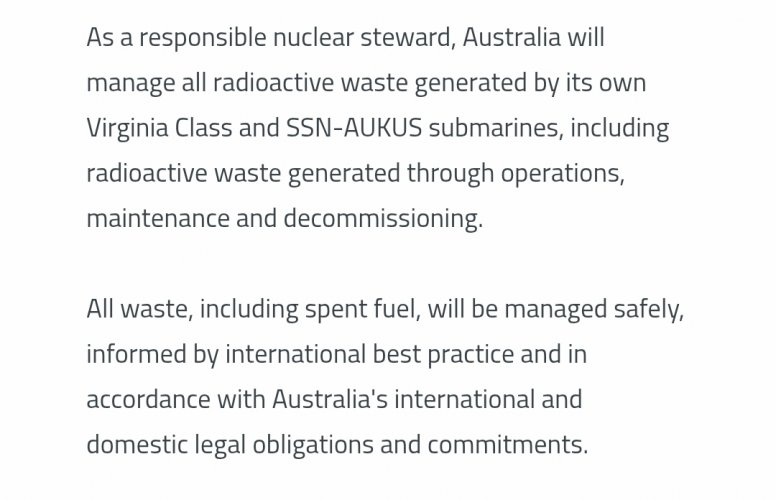
As per the Australian Submarine Agency:
Screenshot_20250724_115750_Chrome.jpg

Sure, when the first reactors from SSN-AUKUS are decommissioned in the 2070s it might be something worth reviewing...

Virginia reactors will have less than thirty years of reactor life left when they arrive in 2035 (if they arrive), except for boat three which will be a new build block VII (iirc).

A smarter play here would be to also store all the waste from our uranium exports. Get the radioactive material back and be paid then twice to handle it. If Australia is building a facility to handle the SSN material making extra money out of it at the same time makes sense. There is plenty of geologically stable land in the country away from people that would be ideal for this.

Political degree of difficulty: extreme.

Australians won't agree on a nuclear waste site for our own waste, good luck getting them to agree to a site for other country's.

Australia has a deep phobia of nuclear energy and Australians have an extreme allergy to nuclear waste sites (that's why much of the waste from ANSTO's Lucas Heights reactor is still stored on site).

So barring a major political/cultural change, no advanced reactors in Australia, so no reprocessing here and NPT risks make moving the waste half way around the world for reprocessing problematic, so that leaves storage - here somewhere.

So, given Australians phobia about waste, the government looks like it's going to try to deliver a fait accompli, wrapped in secrecy, to sidestep the democratic process. An approach that seems to be becoming a central theme of AUKUS.
 
Last edited:
As per the Australian Submarine Agency:
View attachment 778948
Huh. Naval Reactors might have words to say about that.


Virginia reactors will have less than thirty years of reactor life left when they arrive in 2035 (if they arrive), except for boat three which will be a new build block VII (iirc).
Which would still be looking at IIRC ~35 years hull life. I don't believe any Virginia is designed for 40-50 years hull life.


Political degree of difficulty: extreme.

Australians won't agree on a nuclear waste site for our own waste, good luck getting them to agree to a site for other country's.

Australia has a deep phobia of nuclear energy and Australians have an extreme allergy to nuclear waste sites (that's why much of the waste from ANSTO's Lucas Heights reactor is still stored on site).

So barring a major political/cultural change, no advanced reactors in Australia, so no reprocessing here and NPT risks make moving the waste half way around the world for reprocessing problematic, so that leaves storage - here somewhere.

So, given Australians phobia about waste, the government looks like it's going to try to deliver a fait accompli, wrapped in secrecy, to sidestep the democratic process. An approach that seems to be becoming a central theme of AUKUS.
My back must be killing me, I'm really tempted to give a really blunt comment about how the Australian people can either find a place to store the waste after reprocessing (so that there is the smallest possible amount of waste to deal with and it decays within 300 years), or they can get real comfortable with living like the traditional Aborigines. No electricity at all.
 
As per the Australian Submarine Agency:
View attachment 778948

Virginia reactors will have less than thirty years of reactor life left when they arrive in 2035 (if they arrive), except for boat three which will be a new build block VII (iirc).
Not sure what the problem is then other than the sensationalist article claiming the cost will blow out without a single realistic assessment.

Australia will do the right thing by the waste.

Political degree of difficulty: extreme.

Australians won't agree on a nuclear waste site for our own waste, good luck getting them to agree to a site for other country's.

Australia has a deep phobia of nuclear energy and Australians have an extreme allergy to nuclear waste sites (that's why much of the waste from ANSTO's Lucas Heights reactor is still stored on site).

So barring a major political/cultural change, no advanced reactors in Australia, so no reprocessing here and NPT risks make moving the waste half way around the world for reprocessing problematic, so that leaves storage - here somewhere.

So, given Australians phobia about waste, the government looks like it's going to try to deliver a fait accompli, wrapped in secrecy, to sidestep the democratic process. An approach that seems to be becoming a central theme of AUKUS.
The one redeeming fact in the article is the acknowledgement the Govt doesn't need public permission to decide where to store the waste, it can just acquire the land and build the facility if it chooses a site not already on defence land.

Public opinion isn't overly opposed to nuclear anything, polls from the last three years put it just above 50% support, and is essentially a political non issue bar some fringe groups who make a lot of noise but don't represent the majority.
 
provides a clear and joint focus in delivering the UK sovereign sonar capability of the future.
So it still exists and has some value.
Which means Thales and BAE Systems haven't handed it to others without UK authorisation.
 
Potential new AUKUS submarine customer?
No, I don't believe so.

The US and Japan don't have a close enough relationship for the US to share nuclear tech. Before AUKUS, the US had only shared a single S5W with the UK in the late 1950s/early 1960s. US Naval Nuclear Propulsion Information is classified Confidential-Restricted Data, and is unable to be released to non-citizens without high level US Gov approval.

I'd honestly expect Japan to develop their own high-density reactor for Naval use (also for icebreakers around Hokkaido and maybe up through the Bering Sea). They've been designing PWRs for decades!
 
Specifically, asiatimes.com recommends Australia sign a treaty with Beijing whereby Australia becomes a "special administrative region" just like Hong Kong - in order to ensure Australian security.
The promise seems hollow, I'm not confident China will be able to protect us from aggressive regional nations like New Zealand.
 
Thanks for providing the link, Pioneer. Article makes some good points, especially about sensors and long range missiles.

Australia's already made a start on autonomous underwater systems and given the likelihood that the US will refuse to supply Virginia-class boats, a plan B built around an IRBM program would be an excellent way to hedge our bets with what would likely be an even more effective deterrent. Additionally, the technology could be adapted to launch small payloads into orbits useful to Australian intelligence gathering efforts.

We should also point out that the article above was written by an Australian academic and republished in the asian times, lest the casual reader get the mistaken idea it was some sort of Chinese plot.

Screenshot_20250923_113144_Chrome.jpg
 
US AUKUS review still underway but has already decided to reconfirm the previously agreed Virginia delivery schedule.
With one HUGE caveat: "While industrial delays might affect the delivery of the submarines, no political decision had been made to alter the schedule."

So basically "we are reconfirming the schedule, but everyone knows we can't deliver on time so don't expect your first sub in 2032".

P.S. The DoDs ability to honor its commitment hinges not just on the delivery of 13 Virginias between 2025-2032 (a production rate of 1.6 SSNs/year which is well short of the stated need of 2.3 SSNs/year and which it currently is failing to achieve, with both FY25 deliveries having already been pushed into FY26). The DoD also needs to refuel and life extend 6 older SSNs. This plan is not going well, with the first hull (SSN Cheyenne) now 5 years into a planned 2.5 year overhaul. At this rate there is a 0% chance that 19 new/life extended subs will be delivered by 2032. Given that 20 SSN/SSGNs are being retired over the same time period (16 Los Angeles + 4 Ohio SSGNs), the USN's sub force is going to continue shrinking for the next decade.
 
Last edited:

Similar threads

Back
Top Bottom