R-33, R-37 and R-72/KS-172S-1 ALRAAM missiles

I hope we can all agree now all sources are clear initial versions of R-33 and R-27 do not use lofted profiles. This limits their maximum range, and 120km is a typical launch range for R-33 against a bomber target.

R-33 had a loft, but R-27ER did not.
 
Last edited:
What made you think this? Did you read the previous 6 pages before the post you replied to?
I remember that Ka‑bot from YouTube said so.
The discussion on the forum is garbage. If there were any proof presented there, the discussion would end right away. Without the need to write hundreds of messages.
 
I remember that Ka‑bot from YouTube said so.
The discussion on the forum is garbage. If there were any proof presented there, the discussion would end right away. Without the need to write hundreds of messages.
But u ignored the entire pages of info provided to prove the claims they made lolz
 
It's a concept dead for decades. It was never meant for MiG-31, and
I know, that why it is such a big surprise for me to hear that they integrated it on Mig-31 just in 2025? maybe it a hoax similar to the rumor that they testing towed decoy on Mig-31?
Russia has taken an entirely different LRAAM path.
R-37?
PL-17 is what KS-172 could've been.
agree
 
Summary:

R-33/Izd 410 is about 500kg weight ( 497kg in fact), has single-chamber dual-phase solid fuel rocket engine with total burn time about 30sec and with controllable flight time of 60sec. I must admit that I also thought it has loft trajectory but it hasn't ,only straight flight one just like older R-40,than R-23/24 and of course R-27/E. In all videos which I 've found ,we can see that R-33 after catapult launch flies in a straight line.

From 18:40

View: https://www.youtube.com/watch?v=t25tDBZM7No


Another videos :

View: https://www.youtube.com/watch?v=ZWZDgHPTgDU

View: https://www.youtube.com/watch?v=JyeeFdgJlkg


From what we learned through the the time ,those number values like 90km,120km,160km ( many textual sources ,charts ,tables etc...) , I've already expressed my opinion that those values are only for the R-33 ,not for the modernised R-33S.

Based on what I could understand in the manuals for the Su-27SK and MiG-29, these are, in my opinion, the very possible max ( possible authorised) launch distances calculated by the radar's and WCS computer for a small, medium and big air target. In the case of some bigger and of course faster incoming target, 160km is quite possible max launch range for the old,basic R-33 concluded that 60 sec controllable flight time. If we count that max launch speed of one MiG-31BM can be 800m/s-900m/s and the rate of increase in speed of launched R-33 can be even 1000m/s or more (5.8M as min) ,than I think all of this is possible?


R-33S/Izd 520 is 520kg heavy ,modernised version from the mid 1980's. It has also INS+SARH guidance( not ARH) ,better stability and controllability with those destabilizers (forward 'fins'),shorter wings and a little bit different stabilizers.With the new autopilot and better control system this version got the 'loft' capability.

Some citations from one article about R-33S ( on the 2nd page) :

''In the mid-1980s, Vympel began modernizing the R-33 missile. According to customer requirements, it was to differ significantly from the baseline version by having an increased launch range, a heavier warhead, a more sophisticated control system, increased flight time, and a new propulsion system.
Serial production of the modernized R-33 missile was entrusted to the Tushino Machine-Building Plant. Preparations for this began in 1988, and for several years, the missiles were mass-produced. ''

For now we have only several pics of the R-33S and none video where we can see old MiG-31B/BS or newer BM with this version on the tarmac or in the flight or e.g during the launch.So R-33S can perform the same 'lofting' as US AAM's like AIM-7,AIM-54 and AIM-120.With this kind of flight ,I suppose AAM itself must be slower than in the case of flying in the straight line. At the end, it is logical. I also mentioned that letter 'S' does not mean Spetsialnaya or special ,meaning that it has nuclear warhead. I don't think that one AAM can have nuclear warhead 'cause missile itself than must be registered as a carrier of a nuclear warhead, that is, as a nuclear weapon according to agreements between the USSR/Russian Federation and the USA.

For all these decades,I've never find any accurate,real data of max possible launch range against some bigger/faster incoming target for the R-33S but for me it is very possible that taking into account loft capability and possible MiG-31B/BS/BM launch velocity and height ,it can be in the range 250-300km.

What I've found interesting with the 'lofting' AAMs is that they first go into a dive after launch than they go to climb/loft.I didn't see this possibility with the old R-33.

R-37M launched by the Su-35S, from 0:29

View: https://www.youtube.com/watch?v=zm2odB-tp4s


AIM-54A launched by the F-14A( famous test 'six on six' from 1973)

View: https://www.youtube.com/watch?v=9RKWwPbimgU


@Ronny

Instead of that canceled KS-172 ( R-72 as proposed military designation by some sources ), we have R-37M of course ( MiG-31BM,Su-30SM2 and Su-35S and IAF Su-30MKI for now) .Quite a nice 400km as max launch range....
 
Summary: blah-blah-blah...
1) Apparently, R‑33 originally had the logic of a loft. That’s what those who know the subject say.
2) You’re known here as someone who likes to flood the thread,by fantasizing and mixing facts with their own assumptions,
posting more and more new meaningless messages and ignoring logic and common sense. At the same time, you know practically nothing.
 
1) Apparently, R‑33 originally had the logic of a loft. That’s what those who know the subject say.
2) You’re known here as someone who likes to flood the thread,by fantasizing and mixing facts with their own assumptions,
posting more and more new meaningless messages and ignoring logic and common sense. At the same time, you know practically nothing.
The main discussion was between me and Squirrel. Squirrel realized that the original versiom didn’t have loft. I don’t always agree with Squirrel but atleast this debate had a conclusion and Squirrel posts and translate lots of good information and videos on many many topics.

If R-33S does loft, that also complicates matters.

You could even skip the posts of people you don’t like.
No one is going to re tread this debate succinctly for you here other then the “no loft” you already received.

No one is perfect, Ka-bot doesn’t know everything, I’m sure he’s said things in video he later learned were not correct like all YouTubers. Saying it had loft “originally” could also have implied it was desired but not implemented or removed at some point.

If you knew “why” he thought that and it brought some new information to light, that would be worth discussing

There is no benefit to loft a missile that has similar aerodynamics and deltav as AIM-54 for only 60s flight time, for reference the AIM-54 Phoenix can fly for 200 seconds. Read the previous pages to find out why we think this if that’s not enough or even search by “loft.”
 
Last edited:
No one is perfect, Ka-bot doesn’t know everything

There is no benefit to loft a missile that has similar aerodynamics and deltav as AIM-54 for only 60s flight time, for reference the AIM-54 Phoenix can fly for 200 seconds. Read the previous pages to find out why we think this if that’s not enough or even search by “loft.”
Of course no one is perfect, but it’s obvious that Ka-bot knows much more about Russian and Soviet technologies. As for you, you don’t even know that the Phoenix doesn’t fly for 200 seconds, but only for 160.

It makes sense for the AA or SA missile to make a loft regardless of the flight time — whether it’s 60 seconds or 160. 60 seconds is a long time, during which the missile can fly very far if it goes to the loft. When the S‑300P shoots down a target at a range of 40 km at an altitude of 5 km, it moving towards the target in an arc rises to a height of up to 10 km — despite the fact that the flight time is less than 40 seconds.
 
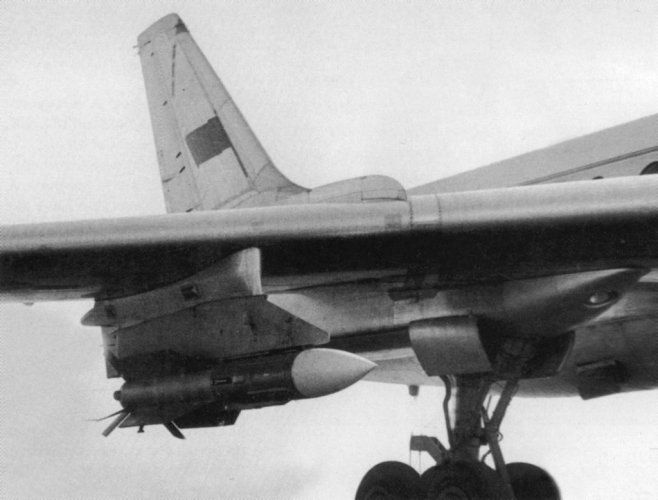
''В 1969-1970-м гг. два пассажирских самолёта Ту-104 были переоборудованы в летающие лаборатории. Работы по созданию лабораторий были проведены в рамках темы "Заслон" - создания истребителя-перехватчика МиГ-31. На обоих самолётах разместили радиолокационные станции, впоследствии, на Ту-104ЛЛ-2 был установлен и пилон для подвески ракеты Р-33. В 1975-м году самолёт участвовал в испытаниях УР Р-33, произведя при этом два пуска ракеты. Самолёт Ту-104ЛЛ-2 использовался до конца 70-х гг., после чего был передан для переоборудования в метеолабораторию.''

''In 1969–1970, two Tu-104 passenger aircraft were converted into flying laboratories. This work was carried out as part of the "Zaslon" project—the development of the MiG-31 interceptor. Both aircraft were equipped with radar systems; subsequently, the Tu-104LL-2 was also fitted with a pylon for carrying the R-33 missile. In 1975, the aircraft participated in trials of the R-33 guided missile, conducting two test launches. The Tu-104LL-2 remained in service until the late 1970s, after which it was transferred for conversion into a meteorological laboratory.''


Source: https://477768.livejournal.com/6072317.html

''С самолета-лаборатории Ту-104 были проведены даже первые управляемые пуски ракет К-33, правда, с рельсовым стартом. Близость конструктивного облика и характеристик Е-155МП и МиГ-25П позволили развернуть отработку катапультного старта ракет К-33 на самолете-лаборатории МиГ-25П-10 на реальных скоростях и высотах с опережением по отношению к постройке реальных опытных самолетов Е-155МП. В ходе летных испытаний, проведенных в 1975-1980 гг. была отработана конструкция оперения, исключающая возможность возникновения флаттера, система управления ракетой в широком диапазоне высот, помехозащита головки самонаведения, работоспособность системы управления и радиовзрывательного устройства на фоне земной поверхности на предельно малых высотах. Первая самолетная мишень МиГ-17 была сбита 26 марта 1976 г. до того пуски велись по парашютным мишеням ПР''

''The first guided launches of K-33 missiles—albeit using rail launchers—were even conducted from a Tu-104 flying laboratory. The similarity in design and performance characteristics between the E-155MP and the MiG-25P made it possible to begin testing the K-33’s ejection-launch system on the MiG-25P-10 flying laboratory at actual speeds and altitudes, ahead of the construction of the actual E-155MP prototypes. Flight tests conducted between 1975 and 1980 validated the fin design (eliminating the risk of flutter), the missile control system across a wide altitude range, the homing head's resistance to countermeasures, and the functionality of the control system and radio proximity fuze against ground clutter at extremely low altitudes. The first MiG-17 aerial target was shot down on March 26, 1976; prior to that, launches had been conducted against parachute targets.''

Source: https://www.airwar.ru/weapon/avv/r33.html

Ту-104А / Ту-104ЛЛ

''Борт был оборудован специальным подфюзеляжным пилоном под подвеску тяжёлых ракет К-33 (Р-33), а также агрегатами станции «Заслон», включая два ветрогенератора и заборник системы охлаждения аппаратуры под фюзеляжем за нишей шасси.В 1975 году с этого самолёта было успешно выполнено два уникальных пуска ракеты Р-33.''

''The aircraft was equipped with a special under-fuselage pylon for carrying heavy K-33 (R-33) missiles, as well as components of the "Zaslon" system—including two wind-driven generators and an equipment cooling system intake located under the fuselage aft of the landing gear bay.In 1975, two unique launches of the R-33 missile were successfully carried out from this aircraft.''
 

Attachments

  • R-33 test  in 1975 with Tu-104LL-2.jpg
    R-33 test in 1975 with Tu-104LL-2.jpg
    95.3 KB · Views: 5
Last edited by a moderator:
If R-33S does loft...

Basic R-33 ,not R-33S , than one 'half a tone monster' has the same max possible launch ranges like 160+kg heavy AIM-120C/D ( 120km/160km).I doubt it.

Again, I also thought that but overscan and you provided proof it was wrong. Now if basic R-33 has really loft capability than those known launch ranges are much greater,must be. 350kg heavy R-27ER, max launch range against some bigger incoming target =130 km, 500kg heavy R-33 max =160km ? Both missiles have 60 sec controllable flight time.Rocket engine burn time? R-27ER =10 sec with very big t/w ratio (boost phase works only 2 sec with 7500 kgf of thrust) , R-33 ≤ 30sec.
 
for you, you don’t even know that the Phoenix doesn’t fly for 200 seconds, but only for 160.
Thanks for letting me now, neither Ka-bot or I really research or specialize in NATO airframes, so yes, I know hardly anything about AIM-54 that a well read enthusiast wouldn’t know.

makes sense for the AA or SA missile to make a loft regardless of the flight time — whether it’s 60 seconds or 160. 60 seconds is a long time,
Makes sense ≠ evidence or proof
Lots of things make sense, like prioritizing a straight flight profile for maximum average speed.

You could say same of R-27R/ER, a later missile by Vympel considered by them to be a modern generation and it doesn’t loft with 60s flight time. Neither does R-77 RVV-AE and it can fly for much longer.

No other Soviet air to air missile lofts and the air to ground missiles are using a less then optimized trajectory that focuses on being able to loft without range information.

Vympel just was not lofting air to air missiles until later. Especially as the Soviet air to air doctrine heavily focused on defeating NATO missiles that were usually longer ranged (R-23R vs AIM-7E, R-27R/24R vs AIM-7F/M, R-33 vs AIM-54) by having a missile that was faster and able to destroy the enemy plane before the enemy missile reached the target.

A loft will slow down the missile, increasing Time of Flight. It’s not always significant, but it always is if you are doing anything but the gentlest curve.

As the missile is slower from lofting, it flies more efficiently allowing it to fly for longer (note: during a max range launch at high altitude, the R-27R/ER/33 is still going Mach 2+ at impact at 58-59s), at ranges that are already at the limit of their carrier plane’s radar for fighter sized targets.

So it would barely benefit or largely hurt the Soviet BVR strategy with the limits of the 60s turbo generator and aircraft radars having little more then 100-120 km range against fighters and little more then 20-40 km at altitude.

What advantage do you expect to have? And like we said, if you read the pages before this we discussed the exact same thing there.
 
Last edited:

Similar threads

Back
Top Bottom