
You are using an out of date browser. It may not display this or other websites correctly.
You should upgrade or use an alternative browser.
You should upgrade or use an alternative browser.
R-33, R-37 and R-72/KS-172S-1 ALRAAM missiles
- Thread starter Pit
- Start date
Guided missile of long range R-33
Chapter from the book “air defense aviation of Russia and scientific technical progress” TSNII are ACE edited by academician E. A. Fedosov.
Chapter from the book “air defense aviation of Russia and scientific technical progress” TSNII are ACE edited by academician E. A. Fedosov.
The rocket of long range R -33 is equipped only with radar homing head. It is designed for the multichannel guidance, it was developed exclusively for the destroyer, which has on board PHASED-ARRAY RADAR, which permits implementation of a semi-active guidance of several missiles at several targets simultaneously. In this case homing each of the released rockets is carried out in the intermittent duty, since the illumination of purposes is achieved consecutively, moreover the part of time is expended on the retention of survey and the organization of the target of new lock-ons.
Semi-active RGS of rocket R -33 is equipped with the calculator, which forecasts the angular velocity of the line of sighting, analogous established in the rocket R-24R calculator the model of the kinematic relationships of relative motion - initial conditions (relative distance, rate of closure and the projection of the angular velocity of range line) in the flight mission are obtained.
The special feature of the calculator of rocket R-33, in contrast to the calculator of rocket R-24R, lies in the fact that it begins its work from the moment of the end of finalizing with the stabilization system of starting disturbances. Therefore rocket flight to the moment of switching on of calculator must lead rocket into the predetermined point, and on board the destroyer must be calculated the estimations of distance, rate of closure and angular velocity of range line after 2 sec afterward the gathering. Initial antenna position (angular aim designation) also must be forecast on the carrier aircraft before the launching at the moment indicated.
In the process of rocket flight to the seizure the orientation of antenna is determined by the estimations of the angular velocity of range line, manufactured by calculator taking into account the current measured transfer of rocket. The formation of the given g-force is determined by the same estimations of angular velocity.
In the head the indicator gyrostabilizer, built on the base of the sensors of angular velocity, is used. The target lock-on by self-homing head can occur after third of the flight time of rocket. This is reached, in particular, because of the high accuracy of the evaluation of the angular velocity of the line of the sighting BRLS of the carrier (error they are 0,01… 0,03 deg/s).
Doppler self-homing head is characterized by strict agreements of all taking place in it processes with the intervals of the illumination of the assigned for it purpose, equal to 20 ms. In the period indicated is produced the target search in the frequency, and in the process of tracking the measurement of frequency detuning and error angle is carried out. All the remaining time to the following interval of illumination head “is closed” for the method and the signals, formed with it, are calculated as a result forecast from the previous measurements.
In the head the method of direction-finding with processing of signal by the two-channel receiver, which realizes the method of the so-called reserved conical scanning with the compensation, is realized. In each channel independent of others as the normalizing devices are used the diagrams ARU. The accuracy of the measurement of the angular coordinates of target by head, including with amplitude jamming [e.g. inverse gain jamming- PMM], approaches accuracy of monopulse system.
The distance of seizure by the head of a purpose of the type Tu-16 is about 90 km, which taking into account inertial guidance to the seizure provides the possibility of launching from distance on the order of 120… 130 km.
Homing system after seizure consecutively has two structures:
From the moment of seizure on the larger part of way the model of the kinematic relationships as the filter of the measurements of the angular velocity (instead of the acceleration of purpose to the entrance of model it will be given a difference in the measurement of angular velocity and its estimation), is used;
then it is built as stationary (locked outline of the angle tracking of head forms the measurements of the angular velocity of the line of the sightings, which are passed through the stationary filter and after multiplication by the measured rate of closure is formed the given g-force).
A certain decrease of requirements for the value of gradient of synchronous error is achieved because of the application of a negative speed feedback of a change in the angle of deflection of antenna.
Rocket R-33 is built according to normal diagram. Its construction is traditional, and the layout and the aerodynamic shapes influenced the need for the conformal suspension of rocket under the fuselage of aircraft MiG-31.
The characteristics of the rocket of long range R -37 and of its system for control are better than rocket R-33: above located overloads, the permissible launching ranges, noise protection, especially with the guidance to the low-flying and multiple targets.
Rocket R-37, mainly due to a certain increase in power-weight ratio and considerable increase in the time of the work of power unit, fundamentally new construction of control system, provides the possibility of launching from the distance of more than 300 km.
Rocket can be used both from the modernized destroyer MiG-31 and from the destroyers Su-27, Su-35 with the condition of the modification of their software.
9E50M1 semi-active seaker head from AGAT for R-33.

9B-1388 mixed semi-active/active seaker head. Max range in SARH is 75 km, active mode 25km. Weight, 45kg without the radome. For K-37.
The 9B-1388 is used along a MCGU with a max range of 100km.

Look at the datalink aerial on K-37
Source -
Sistemas de Armas website
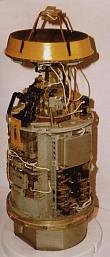
9B-1388 mixed semi-active/active seaker head. Max range in SARH is 75 km, active mode 25km. Weight, 45kg without the radome. For K-37.
The 9B-1388 is used along a MCGU with a max range of 100km.
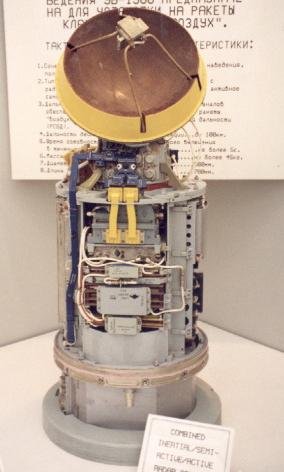
Look at the datalink aerial on K-37
Source -
Sistemas de Armas website
Last edited by a moderator:
Ok, I'm convinced - and more than a little bit surprised! Con-scan on R-33, what will they think of doing wrong next... :
So, according to this book (and briefly not to go too far off-topic), what is RVV-AE? Inverse conical-scan, or monopulse?
Thanks!
So, according to this book (and briefly not to go too far off-topic), what is RVV-AE? Inverse conical-scan, or monopulse?
Thanks!

- Joined
- 27 December 2005
- Messages
- 19,229
- Reaction score
- 35,676
CONOPULSE is a hybrid angle-tracking system combining
monopulse and conical scan techniques. Two squinted beams
are rotated or nutated in space in a conical scan manner. The
received signals are processed either with monopulse processing
followed by conical scan or vice versa. The advantage
claimed for the conopulse technique is that, like monopulse,
amplitude fluctuations do not affect the angular accuracy,
while only two receivers are required instead of three used in
a conventional monopulse tracker. With modern solid-state
technology, it can be easier to realize the third receiver than to
arrange proper scanning of a pair of squinted beams. Sometimes
conopulse is called scan with compensation.
This sounds to me like what is described above.
Makes sense! Its a hybrid system which has similar resistance to angle deception as monopulse but uses less reciever channels, and has fallen out of use with "modern solid-state technology".
Source: Barton & Leonov, Radar Technology Encyclopaedia, Artech House
- Joined
- 27 December 2005
- Messages
- 19,229
- Reaction score
- 35,676
Conopulse Reference
I've found references at least as old as 1975 for this technology.
Two methods are usually used for angle-tracking radar. They are monopulse and conical scan. The former is free from target-signal amplitude-fluctuation effects but requires multi-channel receiver equipment. The latter requires only one channel but is affected by target-signal amplitude-fluctuation effects. A method is proposed in this paper, conopulse, which combines the advantages of both. Conopulse requires only two channels, and is free from the signal disturbances to which conical scan is subjected. Its main disadvantage is its lower data rate.
I've found references at least as old as 1975 for this technology.
- Joined
- 27 December 2005
- Messages
- 19,229
- Reaction score
- 35,676
Note that the original R-37 seeker seems to have the same antenna as the R-33 seeker, implying it also uses conopulse?
The conopulse concept is new to me and sounds interesting, but I question whether that second photo is really a 9B-1388 active seeker, or just a 9E50M1 stand-in labelled "active" at an airshow. I can't see any difference between the two. Meanwhile we've already seen two seekers for the same missile (R-27R) that look wildly different in appearance, not to mention the family of RVV-AE seekers that has been multiplying like rabbits, no two looking alike. Going from a passive to an active seeker should require some significant design changes, especially the presence of a higher-power waveguide leading to the feed, which seems absent in the "9B-1388" photo.
- Joined
- 27 December 2005
- Messages
- 19,229
- Reaction score
- 35,676
http://www.milparade.com/catalog/pdf/402-403.pdf
Has the same thing labelled as 9B-1388. It should of course have a transmitter, which it didn't have before. There is always the probability that the R-33 seeker picture Pit uploaded is incorrect (no offence, Pit)
The 9B-1388 seeker seems to have been totally abandoned anyway in favour of different sized variants of the 9B-1103M anyway.
Has the same thing labelled as 9B-1388. It should of course have a transmitter, which it didn't have before. There is always the probability that the R-33 seeker picture Pit uploaded is incorrect (no offence, Pit)
The 9B-1388 seeker seems to have been totally abandoned anyway in favour of different sized variants of the 9B-1103M anyway.
Interesting, I found this, pay a look:
http://www.niip.info/main.php?page=raz_sky_RGS
Check the R-33's seaker...different name ???...
http://www.niip.info/main.php?page=raz_sky_RGS
Check the R-33's seaker...different name ???...
- Joined
- 27 December 2005
- Messages
- 19,229
- Reaction score
- 35,676

Vadifon
ACCESS: Restricted
Monopulse (Fedosov's book).Dilbert said:So, according to this book (and briefly not to go too far off-topic), what is RVV-AE? Inverse conical-scan, or monopulse?
i think you are right. There is no mention about monopulse in describtion of missile modernization(R-33>R-37) in Fedosov's book.Note that the original R-37 seeker seems to have the same antenna as the R-33 seeker, implying it also uses conopulse?
mrdetonator
ACCESS: Secret
I`ve found this 9E-50M1E seeker in the book "Russia`s modern military Aviation"
[image link broken - Admin]
[image link broken - Admin]
Last edited by a moderator:
- Joined
- 27 December 2005
- Messages
- 19,229
- Reaction score
- 35,676
Yes, thats the upgraded Buk SAM seeker.
It is possible that it used similar technology to the R-33 seeker, as they were both developed by NIIP around the same era.
It is possible that it used similar technology to the R-33 seeker, as they were both developed by NIIP around the same era.
For a western antenna designer, this is quite something to see... It appears that for twenty years, USSR managed to develop and produce EVERY antenna technology under the sun, no two alike... except the slotted array.
Dilbert said:For a western antenna designer, this is quite something to see... It appears that for twenty years, USSR managed to develop and produce EVERY antenna technology under the sun, no two alike... except the slotted array.
My friend, the USSR developed slotted array aerials for the ARGS-35 seeker of SS-N-25 "Switchblade" AShM, IOC 1994 ;D...
And guess if they used slotted array technology on 3M80 or P-700
(Off Topic out)
mrdetonator
ACCESS: Secret
from the NIIP Tikhomirov brochure.....

- Joined
- 27 December 2005
- Messages
- 19,229
- Reaction score
- 35,676
Thanks a lot Martin! The English brochures I collected had nothing about the older models.
- Joined
- 27 December 2005
- Messages
- 19,229
- Reaction score
- 35,676
Yefim Gordon does mention MFBU-410.
He seems to think its an onboard system of the MiG-31. According to him, it stands for MnogoFoonktsionahl'nyy Blok Oopravleniya or multifunction missile control module. 410 is the R-33 (Izdeliyie 410).
He seems to think its an onboard system of the MiG-31. According to him, it stands for MnogoFoonktsionahl'nyy Blok Oopravleniya or multifunction missile control module. 410 is the R-33 (Izdeliyie 410).
mrdetonator
ACCESS: Secret
the MFBU could be pretty common abbreviation, describing blocks on the aircraft, probably he is mixing up two different things.overscan said:Yefim Gordon does mention MFBU-410.
He seems to think its an onboard system of the MiG-31. According to him, it stands for MnogoFoonktsionahl'nyy Blok Oopravleniya or multifunction missile control module. 410 is the R-33 (Izdeliyie 410).
In a side note:
Accordin to the December 2005 issue of "Vzlet" (Take-off) journal by Andrei Fomin, the Su-35/T-10BM should be capable of carrying up to 5 "long range missiles", maybe talking about KS-172S-1 (R-72).
It's interesting to know what happened to the K-37M program once slatted as "winner" of the Russian Long Range contest for ALRAAM missiles instead of KS-172 (russian version, range up to 400km)...seems to be superceeded by other developments.
According to Y. Gordon on his last MiG-31 book, the MiG-31B's datalink (intra-flight datalink) should be capable of shared homming for the R-33 missile (R-33S?), maybe on a similar fashion as TDILS-39 datalink of JAS-39 Gripen works...anybody knows if R-33S introduces MCGU from the Zaslon-A radar?.
Thanks!
Accordin to the December 2005 issue of "Vzlet" (Take-off) journal by Andrei Fomin, the Su-35/T-10BM should be capable of carrying up to 5 "long range missiles", maybe talking about KS-172S-1 (R-72).
It's interesting to know what happened to the K-37M program once slatted as "winner" of the Russian Long Range contest for ALRAAM missiles instead of KS-172 (russian version, range up to 400km)...seems to be superceeded by other developments.
According to Y. Gordon on his last MiG-31 book, the MiG-31B's datalink (intra-flight datalink) should be capable of shared homming for the R-33 missile (R-33S?), maybe on a similar fashion as TDILS-39 datalink of JAS-39 Gripen works...anybody knows if R-33S introduces MCGU from the Zaslon-A radar?.
Thanks!
- Joined
- 27 December 2005
- Messages
- 19,229
- Reaction score
- 35,676
None that I have seen. Sorry!
I heard about the ultra-long range AAM KS-172. Its range was supposed to be 400km, to kill AWACS whithout being detected! I want to know more anout this missile... Was it tested on su-27?
Another interesting russian AAM was the R-37, mounted on the MiG-31M.
The performances of this missile impressed me : it could kill a target flying at mach-6, 40km height, and 300 km away! Why such a missile? to kill aurora spy plane? ICBM nuclear warhead?
Is there other russian AAM of this class?
Another interesting russian AAM was the R-37, mounted on the MiG-31M.
The performances of this missile impressed me : it could kill a target flying at mach-6, 40km height, and 300 km away! Why such a missile? to kill aurora spy plane? ICBM nuclear warhead?
Is there other russian AAM of this class?
Pit said:In a side note:
It's interesting to know what happened to the K-37M program once slatted as "winner" of the Russian Long Range contest for ALRAAM missiles instead of KS-172 (russian version, range up to 400km)...seems to be superceeded by other developments.
You mean that the KS-172 and R-37 were ompetitors at one time?
- Joined
- 27 December 2005
- Messages
- 19,229
- Reaction score
- 35,676
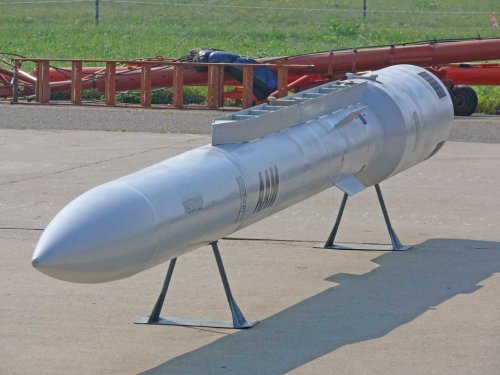
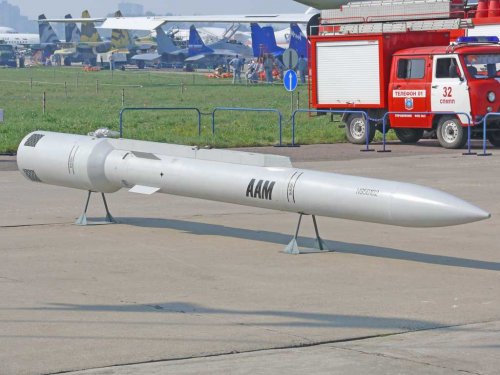

Avimimus
ACCESS: Top Secret
- Joined
- 15 December 2007
- Messages
- 2,716
- Reaction score
- 1,411
I thought I'd bring this back up to the surface - given that we now have pictures (and some stats) for the RVV-BD.
I have a couple of quick questions to discuss:
- Has there been any mention of an Infra-Red terminal homing version?
- Also, how big a limitation is the <8G target (presumably as a result of the conventional control system and large size) - In other words, is the PAK-FA built around a weapon system that many fighters can out turn?
Thanks,
I have a couple of quick questions to discuss:
- Has there been any mention of an Infra-Red terminal homing version?
- Also, how big a limitation is the <8G target (presumably as a result of the conventional control system and large size) - In other words, is the PAK-FA built around a weapon system that many fighters can out turn?
Thanks,

- Joined
- 24 January 2006
- Messages
- 1,380
- Reaction score
- 709

- Joined
- 24 January 2006
- Messages
- 1,380
- Reaction score
- 709
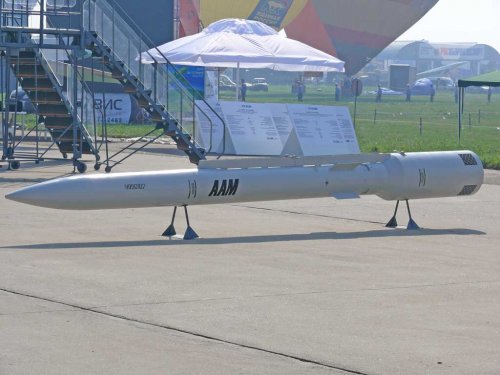
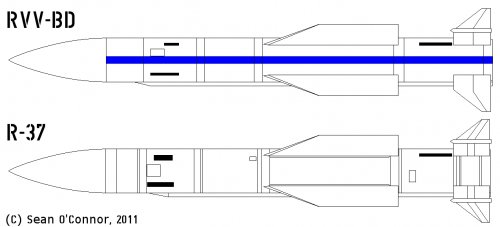
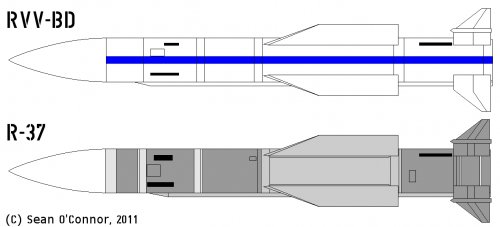
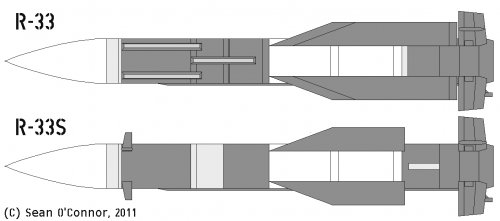
It appears to be a bit longer, but not necessarily as much as you think. That's a bad image, with a little bit of fisheye effect going on to skew the airframe. Besides, it can't be significantly longer: the dimensions in the brochure don't indicate such (although we don't have "official" R-37 specs to reference), and it can't be physically much bigger to still fit under the MiG-31BM which it appears optimized for, with the folding upper rear fins as on the R-33 and R-33S. To fit this thing in an internal bay you'll want all four sets of fins to fold.
Working on fixing the nosecone, the illustration was prepared before I'd seen any images of the RVV-BD without the red nose cover.
Working on fixing the nosecone, the illustration was prepared before I'd seen any images of the RVV-BD without the red nose cover.

- Joined
- 1 April 2006
- Messages
- 12,280
- Reaction score
- 15,100
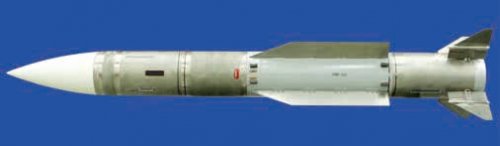
cone is longer in relation to total lenght in comparison to R-33/R-37 (not a guess)SOC said:It appears to be a bit longer, but not necessarily as much as you think.
This RVV-BD is not for PAK FA.SOC said:To fit this thing in an internal bay you'll want all four sets of fins to fold.
nice results then!SOC said:Working on fixing the nosecone, the illustration was prepared before I'd seen any images of the RVV-BD without the red nose cover.
- Joined
- 24 January 2006
- Messages
- 1,380
- Reaction score
- 709
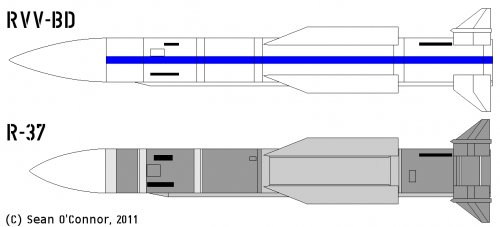
That image highlights one of the problems: I had the mid-body wings a bit too large spanwise. This seems to be a bit better, with a reprofiled nosecone for the R-37. Looking at the weapons underneath the MiG-31M prototypes, their nosecones are "blunter" than the RVV-BD.
Attachments

FighterJock
ACCESS: Above Top Secret
- Joined
- 29 October 2007
- Messages
- 7,244
- Reaction score
- 8,557
It is only when you see the R-37 close up in pictures that you realise just how big a missile it is, and to think that the MiG-31 can carry four of those huge missiles.
Last edited by a moderator:
Now some data for the 'overscan' and other members about R-33. To know some details and data for the R-33 we must first know some details and data about the radar N007 Zaslon.
Like I mentioned in the topic about R-27 ,this mighy radar has also some calibrated/calculated launch distances and they depend of cource on the target's RCS. Now I will finally explain what does that ''120km'' for the R-33 mean anyway. That 120km is in fact max calibrated launch distance against the small incoming air target with the 3sqm of frontal RCS ,nothing else. It is not some max ( possible or achievable or whatever), launch distance for the half a tone monster like R-33.' Calibrated and calculated launch distances' because in USSR before and now in Russia they use RC-aircraft like e.g. MiG-21 to simulate small air target with 3m2 RCS during live tests.
So 120 km is max launch distance against some small air target , again, it is not max possible launch distance. For the 500kg heavy AAM and the interceptor which can launch four of them under 10 sec with max true air speed 2.8M at alt almost 22km ,it would be funny and silly to have only ''120km range AAM'' .Especially when it is known that max detect/track distance in HPRF mode is staggering 600 km ( of course for some big incoming aircraft).Launch distances against medium and bigger incoming air targets are of course much greater.
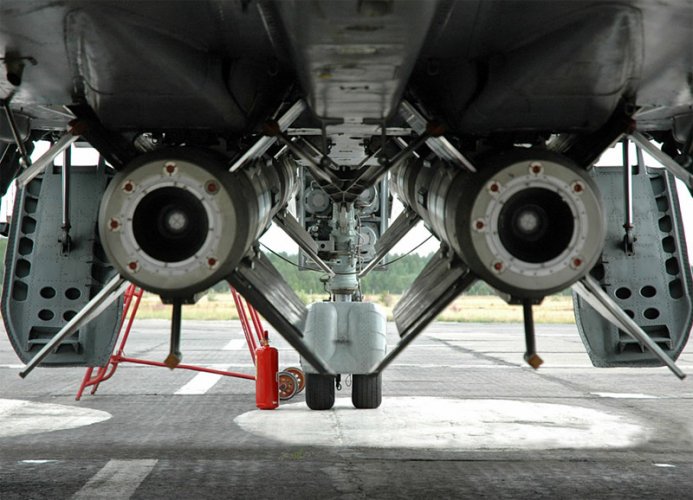
What we can see between those two lower stabilizers ? It is receive antenna for the RC-channel which have max range from the radar even 100km. I already mentioned so called 'Tandem' combat mode where one MiG-31 flying in complete radio- silence mode can launch all four R-33's w/o use of its own radar. Radar of some other MiG-31 in the patrolling group will track targets and translate coded signals of the RC-channel through the sidelobe.RC channel has max range 100km and one R-33 has max launch range of 120km ? Where is logic there ?
I will repeat,R-33 can fly in ballistic/parabolic trajectory ,not only straight and where only 20% of its flight path is in fact inertial guidance with possible use of that RC channel.Other 80% is the SARH mode.
Bigger air target means greater launch distances. RIO in the rear cabine can determine many parameters ( launch speed,distance for the radio proximity fuse etc) and other data, pilot is one which will launch AAM's.
Now after almost 35 years of time distance, I suppose,suppose that someone gave some data about R-33 on the Le Bourget 1991 where MiG-31 with that long range AAM were publicly shown.Of course, real data were already known by CIA agents /USAF officers even 10 yeasr earlier.We know from whom those data came.
Data about ''120 km range'' for the R-33 unfortunately incomplete , were presented through decades even in some 'books' not only articles ,magazines etc.Many authors used those '120km' as max (possible) launch range what was completely wrong.Not only that was wrong but the real data stayed hidden from the open sources.Even today when maybe most people believe that monster like R-33 has only '120 km range', 40 years ago on one exercise ,two MiG-31 simulated intercept of the two Tu-95MS-6 ( simulated USAF B-52H), where detect distance was almost 600km in PPS and 'uslovny pusk' or simulated launch was executed from about 300km.
For the end, one question.How can one 250kg heavy AAM ( R-27R) has max launch distance of 90km against bigger incoming air target and one twice as much heavier R-33 has only 120km?
Like I mentioned in the topic about R-27 ,this mighy radar has also some calibrated/calculated launch distances and they depend of cource on the target's RCS. Now I will finally explain what does that ''120km'' for the R-33 mean anyway. That 120km is in fact max calibrated launch distance against the small incoming air target with the 3sqm of frontal RCS ,nothing else. It is not some max ( possible or achievable or whatever), launch distance for the half a tone monster like R-33.' Calibrated and calculated launch distances' because in USSR before and now in Russia they use RC-aircraft like e.g. MiG-21 to simulate small air target with 3m2 RCS during live tests.
So 120 km is max launch distance against some small air target , again, it is not max possible launch distance. For the 500kg heavy AAM and the interceptor which can launch four of them under 10 sec with max true air speed 2.8M at alt almost 22km ,it would be funny and silly to have only ''120km range AAM'' .Especially when it is known that max detect/track distance in HPRF mode is staggering 600 km ( of course for some big incoming aircraft).Launch distances against medium and bigger incoming air targets are of course much greater.
What we can see between those two lower stabilizers ? It is receive antenna for the RC-channel which have max range from the radar even 100km. I already mentioned so called 'Tandem' combat mode where one MiG-31 flying in complete radio- silence mode can launch all four R-33's w/o use of its own radar. Radar of some other MiG-31 in the patrolling group will track targets and translate coded signals of the RC-channel through the sidelobe.RC channel has max range 100km and one R-33 has max launch range of 120km ? Where is logic there ?
I will repeat,R-33 can fly in ballistic/parabolic trajectory ,not only straight and where only 20% of its flight path is in fact inertial guidance with possible use of that RC channel.Other 80% is the SARH mode.
Bigger air target means greater launch distances. RIO in the rear cabine can determine many parameters ( launch speed,distance for the radio proximity fuse etc) and other data, pilot is one which will launch AAM's.
Now after almost 35 years of time distance, I suppose,suppose that someone gave some data about R-33 on the Le Bourget 1991 where MiG-31 with that long range AAM were publicly shown.Of course, real data were already known by CIA agents /USAF officers even 10 yeasr earlier.We know from whom those data came.
Data about ''120 km range'' for the R-33 unfortunately incomplete , were presented through decades even in some 'books' not only articles ,magazines etc.Many authors used those '120km' as max (possible) launch range what was completely wrong.Not only that was wrong but the real data stayed hidden from the open sources.Even today when maybe most people believe that monster like R-33 has only '120 km range', 40 years ago on one exercise ,two MiG-31 simulated intercept of the two Tu-95MS-6 ( simulated USAF B-52H), where detect distance was almost 600km in PPS and 'uslovny pusk' or simulated launch was executed from about 300km.
For the end, one question.How can one 250kg heavy AAM ( R-27R) has max launch distance of 90km against bigger incoming air target and one twice as much heavier R-33 has only 120km?
Attachments
Last edited by a moderator:
- Joined
- 27 December 2005
- Messages
- 19,229
- Reaction score
- 35,676
In 1985?40 years ago on one exercise ,two MiG-31 simulated intercept of the two Tu-95MS-6 ( simulated USAF B-52H), where detect distance was almost 600km in PPS and 'uslovny pusk' or simulated launch was executed from about 300km.
So why bother with inventing the even bigger R-37 and giant 1.4 m antenna Zaslon-M for the MiG-31M and then being super-proud in 1994 of a test where it achieved 280km launch range when Zaslon and R-33 can do it all already? Source? Or is it your usual "trust me bro".
R-27R typical launch range is 50km. R-27ER, 75km. R-33, 120km. Seems legit.For the end, one question.How can one 250kg heavy AAM ( R-27R) has max launch distance of 90km against bigger incoming air target and one twice as much heavier R-33 has only 120km?
We have information from radar developers, GosNIIAS experts, Mikoyan, that Zaslon could detect a Tu-16 at 180-200km. Even assuming Tu-16 RCS is 16 sq m (I've seen 16 sq m and 19 sq m quoted) and taking 200km not 180km, that means that the Tu-95 has an RCS of about 1,296 m². I don't think the radar display can even show a target that far away - I'm pretty sure max instrumented range is 300km.
Similar threads
-

-

-
-
-
Mig-31 and Su-27 speed limit when loaded with missiles.
- Started by Ronny
- Replies: 11