R-33, R-37 and R-72/KS-172S-1 ALRAAM missiles

The R-33 guidance system is more complex and sophisticated than that of the basic Phoenix. It includes an inertial segment.
As far as I know, the R-27 employs a unique mid-course guidance method known as a "pseudo-kinematic link," which guides the missile by feeding false target position data to the onboard computer via a data link. Based on available information—specifically regarding the launch platforms for the R-24 and R-27—this mid-course guidance method does not utilize a high-loft trajectory. I believe the R-33 likely employs a similar mid-course guidance scheme.
Furthermore, I do not understand the statement that "the higher the burn-out velocity, the less distance the missile can cover in level flight"; there seems to be no reason to assume a shorter flight range when the total kinetic energy is higher.
 
As far as I know, the R-27 employs a unique mid-course guidance method known as a "pseudo-kinematic link," which guides the missile by feeding false target position data to the onboard computer via a data link. Based on available information—specifically regarding the launch platforms for the R-24 and R-27—this mid-course guidance method does not utilize a high-loft trajectory. I believe the R-33 likely employs a similar mid-course guidance scheme.
Furthermore, I do not understand the statement that "the higher the burn-out velocity, the less distance the missile can cover in level flight"; there seems to be no reason to assume a shorter flight range when the total kinetic energy is higher.
The R‑27 has a different guidance system than the R‑24. It has a full‑fledged platform‑based INS+RC channel (although it can sometimes use only pseudo‑kinematic link without INS). Bot these missiles don’t have a loft capability. But the R‑33 is the R‑33.

If the missile’s acceleration is lower, and the engine runs for a longer period, the distance traveled will be greater (with the same fuel weight)
 
If the missile’s acceleration is lower, and the engine runs for a longer period, the distance traveled will be greater (with the same fuel weight)
What I mean is that the R-33 missile may have a more desirable dry mass ratio and burn-out rate.
 
At a long distance, the loft makes the missile faster, not slower.

Again,this is completely wrong.AAM which fly in the straight-line flight path will always be faster than those flying with the loft trajectory.Even your own source 'Ka-bot 15A' from the YT channel mentioned that(proved you wrong). It is pure physics,pure flight mechanics,at the end ,pure logic.That's why he said that R-40 was 1000km/h faster than AIM-54. Every AAM which fly in the straight line ( by the chosen program made before launching) ,will achieve max possible speed during acceleration phase.

Of course ,very important is the speed of the launching platform( fighter) 'cause it is the first speed of the launched AAM.In the case of the MiG-25P/PD(PDE/PDS), old R-40 was launched from the rail-launcher ,so there was no losses in the speed during launch sequence.For the loft scenario,some (usually bigger ,heavier,longer range and ejected from the catapult launchers) AAM's first go to dive than after sec or two they go to climb phase.All of this can be seen on many videos/pics.So 'AG' was right ,you were wrong.

Both flying scenario have sense only in the rare stratosphere and not in the dense troposphere.Where was the tactical/technical advantage of the R-33&R-40 in comparison with the AIM-54? As I wrote, both AAM's could be launched from higher than 20km ( you wrote that 14km for the AIM-54 launch was 'very high' btw).In that case, both missiles could achieve their max possible speed, flying in the straight line ( launch speed of both carrier-interceptors can be in the range 2500km/h-3000km/h as max for some given combat, intercept scenario). Max possible speed? Mach number very close to 6 at height 20-21km.This could have been the perfect scenario in the possible engagements/interceptions against super fast SR-71 in both hemisphere forward or rear e.g.

Rather, it’s related to the ability of the new guidance system of the missile to hit a target at such a great distance.The missile doesn’t need either an INS or a digital computer for the loft profile. All that is needed is the appropriate algorithm and some kind of storage device.

Every long range AAM has capability to possess several flight paths by the chosen programes. It depends on the given distance to target (launch distance).In some case when distance to target is greater, radar/WCS- comp. will give data to the missile's on board comp. via so called 'LITER codes/programes' to done loft climb or to done so called 'oblique throw technique'.In the same time ,pilot ( e.g of the MiG-29/Su-27 in case of using R-27R/ER) will get command 'Gorka' ( pop-up maneuver).When distance to target is smaller, AAM will of course fly in the straight line.I suppose you know what are so called LITER codes/programmes?

So from ''the new guidance system to the appropriate algorithm and some kind of storage device ...''

Exactly! But those who know little should shut up and listen to those who know more. Isn't it? You know very little, but you don’t want to follow this rule. You prefer to flood the forum with a huge number of slop messages.

What can I say/write ? As mentioned before,it is your attitude ( blah blah blah...bullshit, You know very little, And yes, I know better, It’s just nonsense...) Only on one, the previous page of this thread, you made so many mistakes and wrote so many contradictories.None of us used words and sentences (listed in parentheses), like you used.First, judge your own knowledge than judge the knowledge of others and that is the real rule,life rule.Remember one thing, knowledge is relative but attitude is something different.

1)The R-27 does not have a loft...2) Without a loft, a missile cannot fly a long distance.

Now the question,if R-27ER (e.g.) does not have a loft as you wrote , how that long range AAM can engage some big/faster incoming target from 130km.Yes, the max possible launch range for the R-27ER can be 130km.With flying in the straight line flypath? No way.

From 14:18 ,130 km as the max launch distance ,of course in the 'Drmax-1 launch parameter'. You know what that means?

View: https://www.youtube.com/watch?v=WA2pewYPA8s


much like the R-27ER—to achieve a 120 km launch range in level flight.

No friend,like I mentioned before AAM's like R-27(R/ER) and R-33 have programmed flight paths.All depends on given distance to target and of course other fighter/target flight parameters ( closure speed,angular coordinates e.g. etc). In this case,we are talking/writing about the distance.If distance to target is small, AAM like mentioned ones will fly in straight line flight path or the level flight as you wrote. If distance to target is greater ( e.g. more then 100 kms), than AAM will fly in parabolic flight path. Loft/lofting is nothing but flying in parabolic line ( the arc look-like trajectory).

So in order to achieve that max possible -130km launch range in the 'Dr max 1' launch parameter or the parameter for engaging non-maneuvering target ( btw launch range is calculated and authorised by the radar/WCS computer) ,MiG-29/Su-27 pilot will get the command 'Gorka' ( pop-up maneuver) meaning climb,designation on the HUD is this : Г↑ . So yes, R-27ER can do loft ,can achieve that kind of flight path-parabolic flight but with the 'help of pilot' who must pitch up his fighter to the certain angle.As I mentioned before, it is 'oblique throw technique'. Reason is simple, R-27 family of AAM's have no possibility to make that climb after launch by themself.

Now we come to the old,basic R-33 .If one 350kg heavy long range R-27ER must do 'lofting' to achieve such a big launch range ( 130 km) where controled flight time is 60sec and flight speed is certainly slower than in the case of straight level flight,it is obvious that basic almost 500kg heavy R-33 has also lofting capabilities to achieve max launch ranges ( 120-160km). About loft capabilites of the basic R-33, there will be some details in the next post . So 'A12' was right ,others ( including me) were not. Yes ,I was maybe the first one to mentioned that but I didn't have possible real proof and data for all of that.After that, I wrote that R-33 hasn't loft capabilities what was wrong.

 
@overscan

Because both of us started this story ,the story about R-33's loft capabilities ,this post is meant for you. Now one important detail I missed watching the video by Zvezda channel ( first video from above on the previous page).Only last night, I saw something very interesting ,something that is worth comments.

Pls take a careful look at launch sequence from exactly 17:55 until 18:00. What can we see ? First we can see that missile after catapulting launch go to dive and in the next sequence we can see ,it went to climb (last sequence as the start of climbing) .Btw it was prototype No '302 blue' which launched R-33 ( I suppose ) for the loft test launch. Why is this so important for comment ? Because in every other video which we have here ,every R-33 launched went straight (level flight).As mentioned ,AAM catapulted from the launcher in the long range engagement, first go into dive and then after that ,missile will go into climb,into lofted/parabolic trajectory.We can see this technique from old AIM-54 to newer R-37M. In any case ,can you confirm all of this after watching the mentioned sequence ?

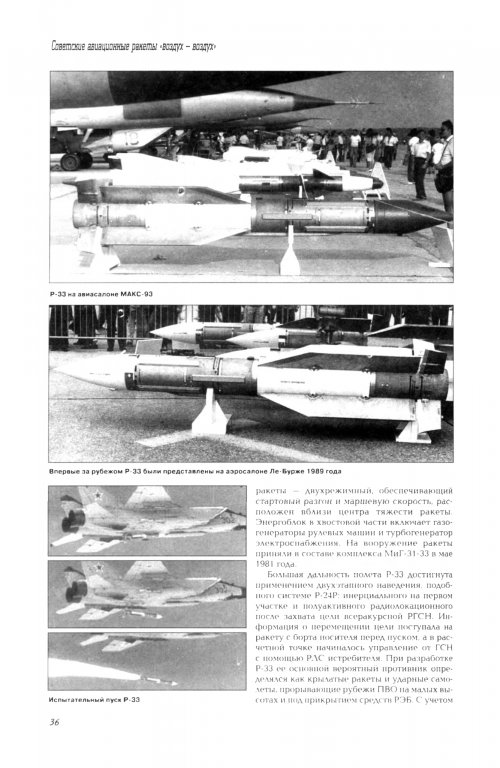
This is the page ( 36th) from the well-known book,on the bottom photo we can see how R-33 went to dive :

R-33 loft.jpg

Source: https://ukr.bulletpicker.com/pdf/советские авиационные ракеты воздух-воздух.pdf

Looking for some more details about Yuriy Zakharov ,I've found this :

Юрий Константинович Захаров, бывший ведущий конструктор и заместитель Главного конструктора ГосМКБ «Вымпел» по ракете Р-33 (К-33), в своих воспоминаниях и профильных публикациях подробно описывал ключевые особенности траекторий и профилей полета этой уникальной ракеты «воздух-воздух» большой дальности, созданной для перехватчика МиГ-31.

Главная задача, которая стояла перед конструкторами во главе со специалистами «Вымпела» (включая Ю.К. Захарова), заключалась в обеспечении перехвата как сверхвысотных и скоростных целей (типа разведчика SR-71), так и маловысотных крылатых ракет на фоне земли.
Для реализации этого ракета Р-33 получила комбинированную систему управления (инерциальная на начальном этапе + полуактивная радиолокационная на конечном) и три основных профиля (траектории) полета в зависимости от взаимного положения носителя и цели:

1. Траектория навесного типа (с «горкой») — для дальних целей
Этот профиль применяется при пуске на максимальную дальность (до 120–160 км)

  • Суть профиля: После схода с катапультного устройства МиГ-31 ракета выполняет энергичный маневр набора высоты («горку»), выходя в разреженные слои атмосферы.
  • Зачем это нужно: В верхних слоях атмосферы сопротивление воздуха минимально, что позволяет ракете сохранять кинетическую энергию и развивать скорость до 4,5–4,8 Маха. На конечном участке Р-33 пикирует на цель сверху, используя накопленную скорость
2. Прямая (настильная) траектория — для скоростных высотных целей

Профиль задействуется для перехвата целей, летящих на средних и больших высотах (до 26–28 км) на относительно небольшом или среднем удалении.
  • Суть профиля: Ракета летит к цели практически по кратчайшей прямой линии, постоянно удерживая её в поле зрения и интенсивно ускоряясь. Инерциальная система ведет её в расчетную точку встречи, после чего активируется захват полуактивной головкой самонаведения (ГСН).

  • 3. Траектория пикирования — для низколетящих целей

  • Один из самых сложных профилей, который Ю.К. Захаров и команда инженеров дорабатывали для борьбы с крылатыми ракетами (типа ALCM), летящими на высотах от 25–50 метров над поверхностью
  • Суть профиля:МиГ-31 производит пуск, находясь на значительной высоте. Ракета идет в верхнем эшелоне, а затем выполняет крутое пикирование на маловысотную цель сверху вниз.

  • Преимущество:Бортовая РЛС «Заслон» и ГСН ракеты подсвечивают и выделяют цель сверху на фоне отражений от подстилающей земной или водной поверхности. Пассивные помехи и отражения от земли благодаря такой геометрии полета и селекции скоростей эффективно отсеиваются.

  • Техническое обеспечение профилей (по Захарову).Как отмечалось в материалах разработчиков, реализация этих профилей стала возможной благодаря:Интеллектуальному прогнозированию: Перед пуском бортовой комплекс МиГ-31 рассчитывает оптимальный профиль траектории и «закладывает» угловое целеуказание в память ракеты. Газодинамическому управлению: На начальном этапе, пока ракета еще не набрала скорость для эффективной работы аэродинамических рулей, правильное направление и начальный профиль полета обеспечиваются в том числе за счет особенностей сопла и рулевых приводов.

  • Tranls :

  • ''Yuri Konstantinovich Zakharov—formerly a lead designer and Deputy Chief Designer at GosMKB Vympel for the R-33 (K-33) missile—described in detail, within his memoirs and specialized publications, the key trajectory and flight profile characteristics of this unique long-range air-to-air missile designed for the MiG-31 interceptor.The primary task facing the design team—led by specialists from Vympel (including Yu.K. Zakharov)—was to ensure the interception of both ultra-high-altitude, high-speed targets (such as the SR-71 reconnaissance aircraft) and low-altitude cruise missiles flying against a ground background.To achieve this, the R-33 missile was equipped with a combined guidance system (inertial for the initial phase and semi-active radar for the terminal phase) and three primary flight profiles (trajectories), depending on the relative positions of the launch platform and the target.

  • 1. High-trajectory profile (with an "arc") — for long-range targets. This profile is used for launches to maximum range (up to 120–160 km).
  • Flight profile: After releasing from the MiG-31's launch mechanism, the missile executes a vigorous climb maneuver (a "zoom climb") to reach the thinner layers of the atmosphere.
  • Purpose: Air resistance is minimal in the upper atmosphere, allowing the missile to conserve kinetic energy and reach speeds of Mach 4.5–4.8. In the terminal phase, the R-33 dives onto the target from above, utilizing its accumulated speed.

  • 2. Direct (flat) trajectory — for high-speed, high-altitude targets.The profile is employed to intercept targets flying at medium to high altitudes (up to 26–28 km) at relatively short or medium ranges.
  • Profile essence: The missile flies toward the target along a virtually direct path, constantly keeping it in view while accelerating rapidly. An inertial system guides it to the calculated intercept point, at which stage the semi-active homing seeker acquires the target.

  • 3. Dive trajectory — for low-flying targets.One of the most challenging profiles that Yu.K. Zakharov and his team of engineers refined was designed to counter cruise missiles (such as ALCMs) flying at altitudes of 25–50 meters above the surface.
  • Profile essence: The MiG-31 launches the missile from a high altitude. The missile travels at a high altitude before executing a steep dive onto a low-altitude target.

  • Advantage: The onboard Zaslon radar and the missile's seeker illuminate and isolate the target from above against the background of reflections from the terrain or water surface. Thanks to this flight geometry and velocity discrimination, passive interference and ground clutter are effectively filtered out.

  • Technical support for the profiles (according to Zakharov): As noted in the developers' materials, the implementation of these profiles was made possible by:Intelligent prediction: Prior to launch, the MiG-31’s onboard system calculates the optimal trajectory profile and programs the angular target designation into the missile's memory.Regarding gas-dynamic control: In the initial phase, before the missile has gained sufficient speed for aerodynamic control surfaces to function effectively, the correct heading and initial flight profile are maintained—among other means—through the specific design of the nozzle and steering actuators.''

  • As we can see, the max M -number of the R-33 during loft is lower than in the case of flying in straight flight.

  • Now I will be honest with you. How I came to all of this data ? As you know ,I know Russian ,so I tried to find during the last night some additional info about mentioned Vimpel's designer in that way to google on Russian Cyrilic of course.In most cases, I got so called ''404 Ошибка'' /Error message.So what was the catch for all these citations? It is nothing but Google-AI overview created probably by copying what this designer stated in his memoirs and books?It mentions some sources but I think,I suppose ,that all of this very interesting details and data in fact came from some real 'golden mine'. I think like that because as we can see details like most of them we can not find in some ordinary Internet sources/sites. All of these data and comments simply must come from some real source.If you are suspicious for all of this, let me know,tnx.

  • Anyway ,you must admit that we now have very interesting details and data for our next comments. Some next details,first for that 60sec max controlable flight time of the R-33, I must admit, I became very suspicious for that data.Second ,I must go back to that 18 Avg 1993 test launch .From the Fedosov's article ( edition from 2005 in Radio -engineering magazine ,page 20 ,on the thread's page 2) and from the source: ''Flight tests of SUV “Zaslon” ,Vladimir Ilin in “Aerospace review”, №5, 2005, pages 42-43 ( on the thread's page 3) ,citation :

  • ''On 18 August of 1993 was carried out a series of flying experiments on the interception of target at maximum range. In the course of the first of them the radio-controlled target, which flies at the height of 10.300 m with a velocity of 189 meters per second, was locked on by interceptor MiG-31(flight altitude 8480 m, velocity - 669,3 meters per second) at the range if 319,5 kilometers the launch of rocket R-33 (successfully destroyed target) was carried out at the distance 228 kilometers''

  • My conclusion is next : it was basic MiG-31 with the basic R-33 ( in fact test-telemetric K-33) .It was nothing but experiment,test for the max possible,achievable launch range of the basic R-33 using the loft trajectory. Lock on range was almost 320km and launch range was 228km. It was not MiG-31B ( with R-33S) neither MiG-31M with its R-37.Why did I mention K-33 not R-33? Because in that experiment, test version K-33 ( w/o the warhead) was used.If we compare basic AIM-54A and basic R-33 ,they both practically achieved almost the same max launch distances.AIM-54A 204km in April 1973 test and K-33 achieved 228 km in Aug 1993 test.There is that data about 244km as the max launch range achieved by AIM-54A launched by the IRIAF F-14A during one test in Jan 1978.
 
Last edited:
Without a loft, a missile cannot fly a long distance. I have provided the data for Phoenix
You prefer to ignore this and keep repeating nonsense.
You also ignored my explanations of the differing conditions of the Soviets. R-27R may have 50-90 km range but they still expected the average 1st BVR shot even for Su-27 to be 30-40 km on average, from its manual. And there are other threads here that will show even the original MiG-31 Zaslon radar would have an average lock distance of no more then 120-140 km and often less depending on RCS. Further locks would only be possible against large RCS.

What if long distance wasn’t the only parameter?. Soviets knew very well they had inferior radio reciever technology to the west, their radars could rarely see over 100 km, can you tell me what the use is of launching your missile before your radar can even detect or lock target?
It was a strategy across all their platforms to maximize the lethality of their worse radar and seeker ranges. Just compare ability of AIM-7E seeker to detect a target via CW at ranges equal to 80s R-27R/ER, and AIM-7F achieves PDI reception at nearly twice the range. Things were not equal, and this shapes military strategy
The R‑33 will experience exactly the same speed loss without a loft.
It’s a heavier missile designed for high altitudes and a shorter burning motor (18-20s) to get it to speed faster for a higher average speed. The conditions of DrMax1 (Soviet max range) are a Mach 2 shot against a Mach 2 head on target at 15-20 km, however in this case the missile can be launched at Mach 2.83 giving it an extra 245 m/s deltav.

I assure you AIM-54 without loft is going much further then 45 km in this case before it slows down below target speed. R-33 will still go over 25 km in front aspect at sea level providing a Mach 1 target and shooter.
4) The R‑33 must hit a B‑1‑type target at a launch range of 110–120 km on a head‑on course — that is, in reality, it must fly about 85-90 km to the meeting point to hit it. This is only possible with a loft.
In 60s a Mach 2 target travels 36 km. It would need to travel 84 km over 60s, loft would harm it in this aspect as it would reach lower top speed. It may be inefficient in your eyes but it is faster over the shorter distances and TOF it’s designed for.

And yes, it can’t hit a B-1B at that range becuase B-1B can only reach Mach 1.2.
Conversely. The higher the burn-out velocity, the less distance the missile can cover in level flight.
Exactly, the priority wasn’t pure range. Higher burn out velocity will lead to higher average velocity over the short interval of 30-60s flight time depending on altitude.

So what makes you so sure of the ballistics at 15-20 km altitude for Mach 2.35-2.83 target and head on Mach 2 target for R-33? Have you seen a CFD we haven’t? Do you know of some Phoenix test at this altitude and straight shot that we don’t? If you have something please share it.
possible launch range for the R-27ER can be 130km.With flying in the straight line flypath? No way.
Why don’t we take R-27ER discussion to R-27 thread where we discussed the average speed needed to hit a Mach 2 target at 15-20 km altitude.

.
6) Your sources about 60 seconds for the R-33 are slop. They’re just unreviewed compilations that repeat each other. You don’t have a technical description of the R‑33 that would indicate a 60‑second timeframe.
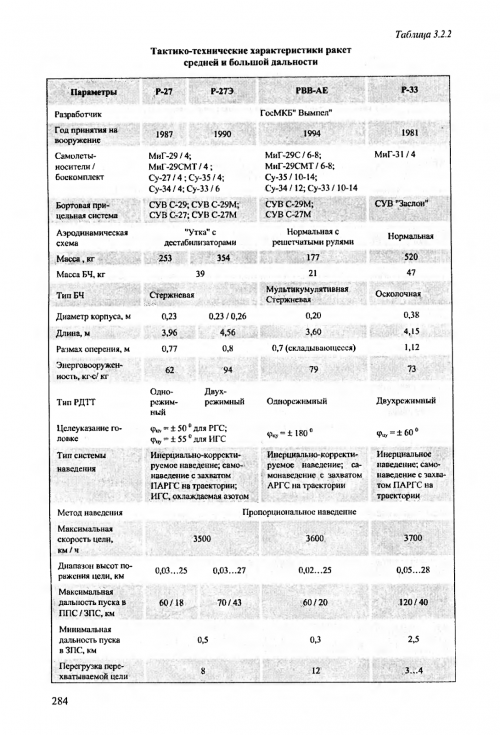
Thats only your opinion, they are from books by Markovsky and Fedosov, probably 2 of the best Soviet historians publishing such detailed books with peerless information for a commercial book. Markovsky was writing a book on all Soviet weapons, Fedosov was detailing the weaponry of the PVO in a way while keeping space for the purpose of the book, the PVO. The chart is from Kopenko in his well known book on post WWII+ era Soviet missiles.

The other source you dismissed for having a single mistake comes straight from Ulyanovsk Higher Aviation School run by the Russian MOD.

These three sources are both more numerous and much higher credentialed and quality then the 0 evidence that has been posted here to the contrary.

If you don’t have anything saying something different, I’m sorry but I disagree that it is “slop.” There is a reason they repeat each other.

There are no MiG-31 Manuals we can read online, there is only information from books and brochures and such, the MiG-31 will always be black hole of information most likely.

No one has a full technical breakdown that has shared it online and no one might ever. This does not invalidate the information brought to light in other ways even if not as complete as you prefer.

Thanks to Fedosov we also know the overall power of its motor compared to weight along with the burn time 19.5s average burn time from the Ulyanovsk book. IMG_7993.png
 
Last edited:
Why don’t we take R-27ER discussion to R-27 thread where we discussed the average speed needed to hit a Mach 2 target at 15-20 km altitude.

It 's OK of course and I wrote some new details there. New moment is that we must count on those launching programs with its flight profiles as it was mentioned in my previous post.As we can see, long range R-33 has three main flight profiles, so I assume that long range R-27ER has also something similar.

Now some additional details about R-33S and the comparison with older,basic R-33.

R-33S got completely new aerodynamic layout with shortened wings and that new destabilizers ( forward fins). Question is ,why destabilizers? Many sources mentioned that R-33S together with MiG-31B and its upgraded N007A was the result of A.Tolkachev espionage.

Maybe the R-33S was in fact result of the project for counterting than new USAF extra-low flying subsonic strategic and first real stealth cruise missile known as AGM-129A ACM ?

Citation :

''In 1982, the US Air Force began studies for a new cruise missile with low-observable characteristics after it became clear that the AGM-86B cruise missile would have difficulty penetrating future air defense systems. The AGM-86B relied on low-altitude flight to penetrate the Soviet air defense system centered on surface to air missiles. The deployment of the airborne early warning systems, together with the Zaslon PESA radar on MiG-31 and Myech radar on Su-27 interceptors, all three "look-down/shoot-down" radars, reduced the likelihood that the low-altitude AGM-86B would reach its target.
The solution was to incorporate various "low-observable" ('stealth') technologies into a new Advanced Cruise Missile system. The newer guidance system increased accuracy to a quoted figure of between 100 and 300 ft (30 and 90 m).''

I will repeat what Y.Zakharov wrote about the Izdeliye 520 or R-33S :

''In the mid-1980s, Vympel began modernizing the R-33 missile. According to customer requirements, it was to differ significantly from the baseline version by having an increased launch range, a heavier warhead, a more sophisticated control system, increased flight time, and a new propulsion system.''

He didn't mention new flight profiles at all and that is very interesting.My opinion is that those destabilizers ( canards?) are there for better aerodynamic stability and controllability during very low flight in any possible engagement against mentioned CM's.

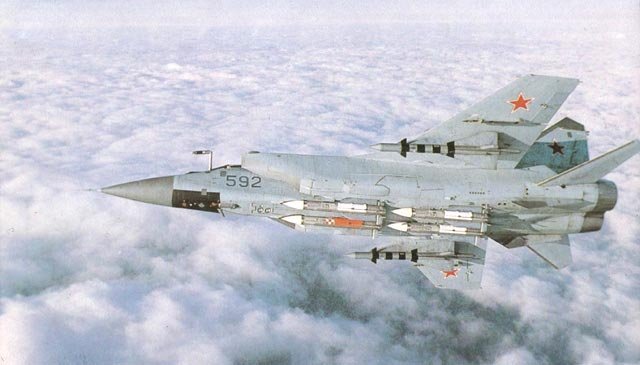
Because I previously mentioned that test-telemetric version K-33, here it is. First right missile attached on the prototype of the MiG-31B ( 592 blue),latter known as the prototype of the MiG-31BM ( after 2000).

mig-31-33.jpg
 
So what makes you so sure of the ballistics at 15-20 km altitude for Mach 2.35-2.83 target and head on Mach 2 target for R-33? Have you seen a CFD we haven’t? Do you know of some Phoenix test at this altitude and straight shot that we don’t? If you have something please share it.
I don’t have all of this. Ka-bot said that the R‑33 has the capability to loft. It also has real Phoenix speeds at different altitudes. I remember one of these speeds — a loss of speed from Mach 3.4 to Mach 1 at an altitude of 14 km in less than half a minute after the engine is shut down.

Furthermore, the squirrel finally did the only useful thing — it found evidence from the designer of the R‑33 that there really is a possibility of a loft.

Fedosov indeed is an authoritative source. But he doesn’t say anything about the absence of a loft. And he doesn’t provide the engine operating time and controlled flight time. He only gives the missile’s impulse.
For the R‑27E, the launch range is less than 100 km, so it is NOT a long‑range AA missile. Soviets consider a launch range of more than 100 km to be long. The R‑27E was never officially referred to as a long‑range missile in the USSR or Russia. 130 launch range is a figure from some unreliable source that has become widely disseminated.

So, the R‑27E is faster than the R‑33. Even though the Su‑27 has a lower flight speed when launching the R‑27E (up to Mach 2.16) compared to the MiG‑31 (standard speed Mach 2.35, maximum 2.83), the top speed of the R‑27E is higher than that of the R‑33 or the Phoenix. But it doesn’t have a loft. And it’s not a long‑range missile.

How can the R‑33 with top speed of about Mach 4.5-4.8 without a loft be able to hit a target at a greater distance than the R‑27E which has top speed of about Mach 5.9?

With a loft, missile accelerates to a higher speed than without a loft. Furthermore, it consumes the speed it has gained much more slowly than a missile flying at the same altitude. As a result, the average flight speed of a AAM with a loft is much higher. I repeat once again: I saw the actual data for the Phoenix with and without a loft in Ka‑bot’s video, but that video is no longer on his channel. I can’t find it there. But that’s not very important. What’s important is that the Phoenix during the flight with the engine running (about 27-28 seconds) with the loft achieved much greater speed than when it was flying in level flight at the altitude at which it was launched ( 14 km). At high altitudes, drag is much smaller, and the missile loses significantly less speed.
 
Last edited:
Again,this is completely wrong.AAM which fly in the straight-line flight path will always be faster than those flying with the loft trajectory.Even your own source 'Ka-bot 15A' from the YT channel mentioned that(proved you wrong). It is pure physics,pure flight mechanics,at the end ,pure logic.That's why he said that R-40 was 1000km/h faster than AIM-54. Every AAM which fly in the straight line ( by the chosen program made before launching) ,will achieve max possible speed during acceleration phase.
Again, you’re completely wrong. AAM that performs a loft will always be faster than a missile that flies straight. Even my source, Ka-bot 15A, mentioned this, proving that I’m right while you wrong. He said that the R‑40 is 1,000 km/h faster than the Phoenix because the MiG‑25 launches the R‑40 at a very high speed. It just adds its own enormous speed to the missile’s speed. This is pure physics, pure flight mechanics, and pure logic. And he says that the R‑40’s own speed is up to Mach 2.5, and the Phoenix’s own speed is up to Mach 2.6. And absolutely anyone can verify this. The video is available. At 5:55.

View: https://www.youtube.com/watch?v=F5s0zieHSXY
 
Last edited:
So in order to achieve that max possible -130km launch range in the 'Dr max 1' launch parameter or the parameter for engaging non-maneuvering target ( btw launch range is calculated and authorised by the radar/WCS computer) ,MiG-29/Su-27 pilot will get the command 'Gorka' ( pop-up maneuver) meaning climb,designation on the HUD is this : Г↑ . So yes, R-27ER can do loft ,can achieve that kind of flight path-parabolic flight but with the 'help of pilot' who must pitch up his fighter to the certain angle.As I mentioned before, it is 'oblique throw technique'. Reason is simple, R-27 family of AAM's have no possibility to make that climb after launch by themself.
Let me retract what I just said—do you have a source for this? I’m very interested in it.
 
AAM that performs a loft will always be faster than a missile that flies straight.

Let us finish all of this 'cause we already gone too far,OK ?

First your comments :

So, the R‑27E is faster than the R‑33, the top speed of the R‑27E is higher than that of the R‑33 or the Phoenix

R-27E flies only in straight line,that's your statement(yes that's right btw) and R-33 and AIM-54 can fly with that loft.

He said that the R‑40 is 1,000 km/h faster than the Phoenix because the MiG‑25 launches the R‑40 at a very high speed.

R-40 flies like R-27/E only in straight flight line,correct ?

And he says that the R‑40’s own speed is up to Mach 2.5, and the Phoenix’s own speed is up to Mach 2.6.

Yes but he said relative to the speed of launcher/fighter and what we have now ?

So when ''Ka-bot 15A'' mentioned that MiG-25P(PD) is 1000km/h faster than F-14( already knew that) ,he meant on the max possible launch speed : 3000km/h or 2.83M at about 20km vs 2000km/h or 1.9M at about 15km and of course to be repeated, it is in fact the first speed of the AAM.

Speed of the sound in the range 15-20km of height is little more than 1000km/h or almost 300m/s.

https://www.engineersedge.com/physics/speed_of_sound_13241.htm

Now we have that top speed of the R-40 during acceleration phase in the straight flight is 2.5M greater than the speed of the MiG-25P/PD ,that is : 2.8M +2.5M = 5.3M .In the case of the F-14 and AIM-54, it will be : 1.9M +2.6M=4.5M. So we have 5.3M vs 4.5M . Note: I mentioned that speed 2000 km/h for the F-14 but it is question ,whether that fighter can perform ( is it possible anyway) to launch AIM-54 for the loft trajectory with that flight/launch speed? If we assume the same speed/launch scenario for both fighters: H=15km,V=1500km/h (let us say) and with both AAM flying in straight line after launch.In that case, I suppose ,AIM-54 will be faster than R-40.In the straight line flightpath only.

Understand now? Btw ,I saw what did you write as a comment about all of this (very soon the comment was erased by you or Admin/Mod ,nevermind) but I moved past that.

Next details, these are from Zakharov's statement about the R-33 :

During the loft trajectory as he said , ''air resistance is minimal in the upper atmosphere, allowing the missile to conserve kinetic energy and reach speeds of Mach 4.5–4.8.''

So, top speed of ther R-33 is little bit greater in comparison with the top speed of AIM-54A during loft.
What is happening during the direct/flat or as we use to say 'straight line trajectory'? As he said :

''The missile flies toward the target along a virtually direct path, constantly keeping it in view while accelerating rapidly.''

Top speed of the R-33 during that straight flight acceleration must be over 5M especially when it is known that MiG-31 can launch R-33 with its top speed 2.8M (3000km/h).

Other details to consider: As it was mentioned ,this so called 'flat trajectory' can be performed when fighter reaches max possible launch speed.For the loft scenario ,I doubt in that and I think it is only possible to achieve in subsonic and lower supersonic speed mode.

Btw, there is one very interesting switch in the RIO's cabin of the MiG-31, on the control panel
from the right side .It has letter 'M' and numbers: 0.85,1.4,1.9,2.35 and 2.8 ,So that is Mach number values.
I assume that those numbers are maybe connected to the given flight profile through the launch program and those M-numbers.Of course, it would be good to have confirmation of this.


Let me retract what I just said—do you have a source for this? I’m very interested in it.

If you don't mind ,we can continue on the appropriate R-23,24 &27 thread.
 
For the R‑27E, the launch range is less than 100 km, so it is NOT a long‑range AA missile. Soviets consider a launch range of more than 100 km to be long. The R‑27E was never officially referred to as a long‑range missile in the USSR or Russia. 130 launch range is a figure from some unreliable source that has become widely disseminated.
I will check R-27 thread and reply to you there, but all the authoritative evidence from manufacturer and designer is there along with 90-95 km max range of the R-27R, which has approximately 2/3rds the range of ER.

>100 km =long range, where did Soviets define this? In Soviet documents I almost never see missiles categorized as long/medium/short range using a specific range cutoff, it seems to me to be a very western oriented metric to put them in such rigid grouping unless there is some Soviet source I missed (that isn’t just using short/medium/long range as a wide envelope to quickly communicate the role of the missile).
How can the R‑33 with top speed of about Mach 4.5-4.8 without a loft be able to hit a target at a greater distance than the R‑27E which has top speed of about Mach 5.9?
Becuase it’s heavier. There’s a reason missiles don’t try to be light weight as possible, you want a missile to have a balance of weight and power or else your drag will over power your inertia at far greater rate upon burnout
With a loft, missile accelerates to a higher speed than without a loft.
loft achieved much greater speed than when it was flying in level flight at the altitude at which it was launched ( 14 km
Please post a source for this, it’s a complex topic, of course a ballistic missile may reach higher speeds via loft because it goes into space, this is just not always the case for all missiles. Even AIM-54 information might be acceptable if it shows a higher top speed from its aggressive loft profile.

Either way, even if loft made the R-33 have a faster top speed, it does not mean that Vympel would have engineered it in.
 
Last edited:

Similar threads

Back
Top Bottom