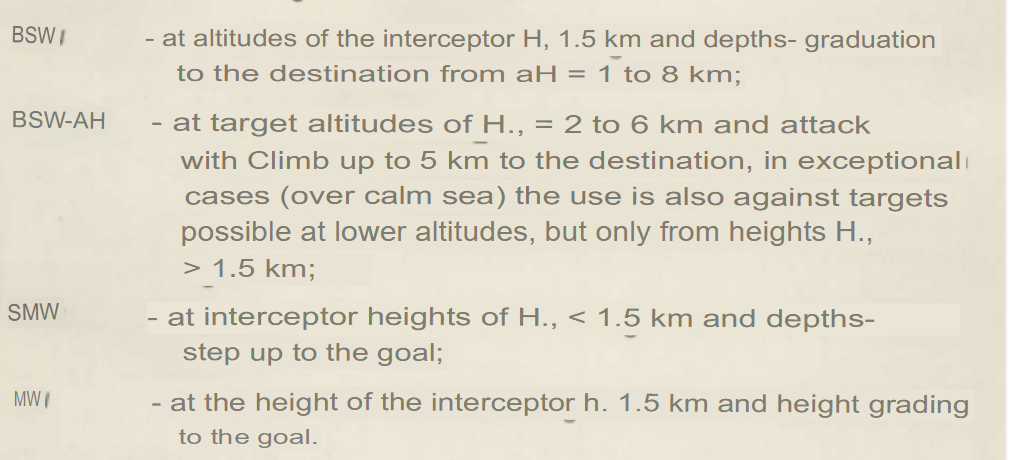
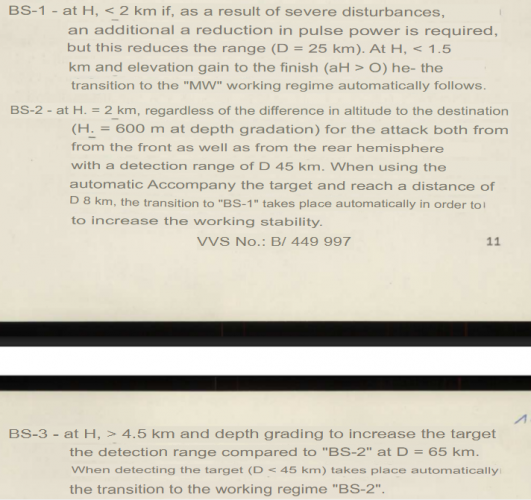
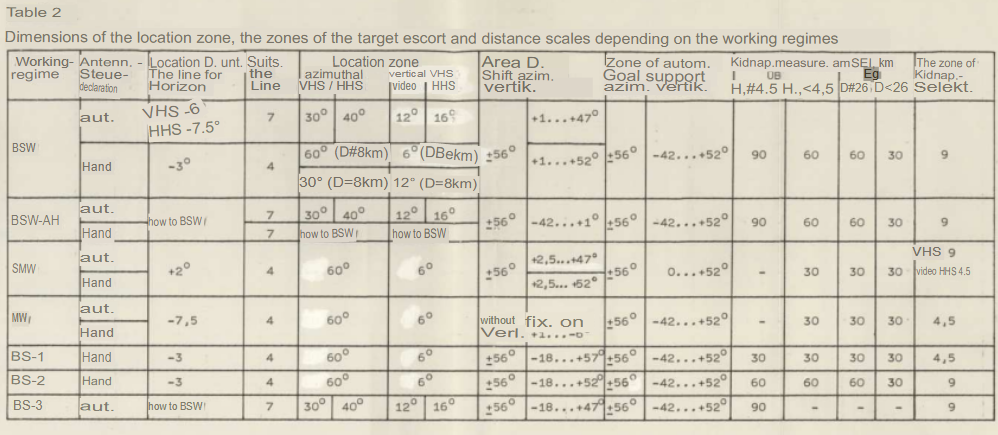
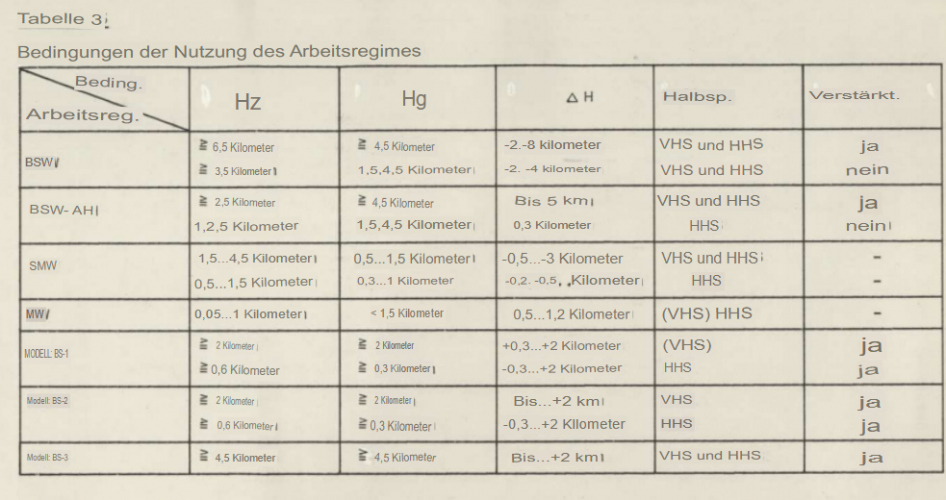
(notes marked with numbers in brackets)
Just for clarification. All radars used in Mig-25 (at least in serial production) were LPRF, both Smierch and Saphir.
And even if Saphir - had some Doppler modes to look though ground clutter (but rather not "look down, shoot down", rather "slant look" ), even those "Doppler modes" were still, in my opinion*(1), LPRF.
Low PRF - by definition that distance measurement is unambiguous. In most "non Doppler" modes Sapfir - is just classical LPRF - with no doubts.
For "Doppler modes" , well: This design still, according to my knowledge, uses magnetron**(2) for main signal generation.
So emitted pulses have random phases -they are not coherent. To achieve coherence "on receive"
(see also
https://www.radartutorial.eu/08.transmitters/Pseudo-coherent Radar.en.html )
, one approach would be to use internal coherent generator (COHO) - as reference signal (internal coherence).
In such setup - received phase of echo from each emitted pulse is somehow corrected - to align with reference, coherent signal.
How could be this accomplish technically? when pulse is emitted - there is measured its phase with reference to COHO signal.
Then on receive - this difference is added in some kind of "phase shiftier"***(3) placed somewhere in receiving path.
As a result - echos after this "phase shiftied signals", are coherent - and they can be processed using well known Doppler processing. This measured phase is changed from pulse to pulse, as each emitted pulse has random phase and need to be corrected separately, and phase correction can be applied
only to the last emitted pulse****(4). In other words - Doppler processing can be applied to the first unambiguous distance. (So by definition - this is still LPRF).
Some other speculations:
Unambiguous range is of course (1/2)*c*T = (1/2) * c * (1/PRF). So for example: when PRF is 1kHz - distance is 150km.
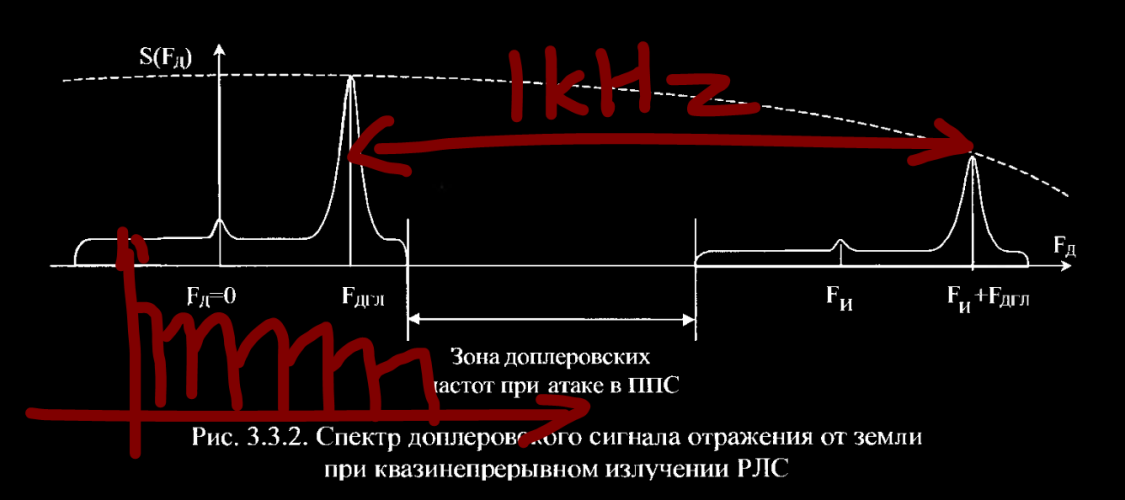
On the other hand - i "Frequency/Doppler space" - in coherent systems, unambiguous frequency is 1/PRF. So for example PRF=1kHz - all frequencies repeats with such frequency. They are "wrapped" into that frequency interval.
It is simple not possible to recognize the real Doppler frequency (maybe only by changing PRF in consecutive pulse bursts).
Moreover - there is folded everything to such limited frequency range:
- ground returns (whose are not strictly "0Hz" but tooks some space - depending on antenna beam width and scanning angle in respect to direction of flight. Actually this alone may cover the whole 1kHz window ...*****(5)
- slow moving ground objects (for example cars etc) ******(6)
- "real" targets
All in all 1kHz PRF is completely useless from Doppler processing point of view...
So what can be done? Of course an option is to increase PRF, to , let say 4kHz or even better to 8kHz. In 4kHz setup - ground returns will take >1kHz so there is still <3kHz for all other returns, so chance that target will be covered by ground returns is >~25%, not so bad... and in case of PRF=8kHz - is even better.
But 4kHz provides unambiguous range only 37km and 8kHz just 18,7km.
So, in case of 8kHz - if we observe return "on oscilloscope" from distance 10km we just do not know if it is from the first range 10km or the second range: 28.7km.
If we have - truly Doppler radar ( "on send and receive") - when all emitted/received pulses are coherent, it does not matter so much: we still does not know real distance and real closing speed (they are both "wrapped"), but returns from all distances are coherent - and may be processed with Doppler processing.
And the real values of distance and closure speed can be resolved later by changing PRF in consecutive pulse bursts.
And the PRF might be further increased above this 4 or 8kHz , depending on needs or radar design
But here we just land in Medium PRF, and radars like APG-66, PS-46/A (Viggen).... and so on..
But in case Saphire - it is not possible... it can correctly process only the last pulse****(4), so it can process the single, the closest range using Doppler filters.
Echos from the second range (from last but one emitted pulse) - are received but each of them is corrected using information about the phase of the last pulse. So effectively - all pulses from second range have random phases... so they are in frequency space nothing more than broad band noise, including also strong returns from ground..
That,
for sure, does not help in any case. Even if we want only process "coherent targets" from the first window..******(6)
(See
https://www.radartutorial.eu/08.transmitters/Pseudo-coherent Radar.en.html - the last sentence)
Also - increase of PRF, to solve narrow window in frequency space, can not be done freely, as this limits instrumental range (to the first unambiguous range).
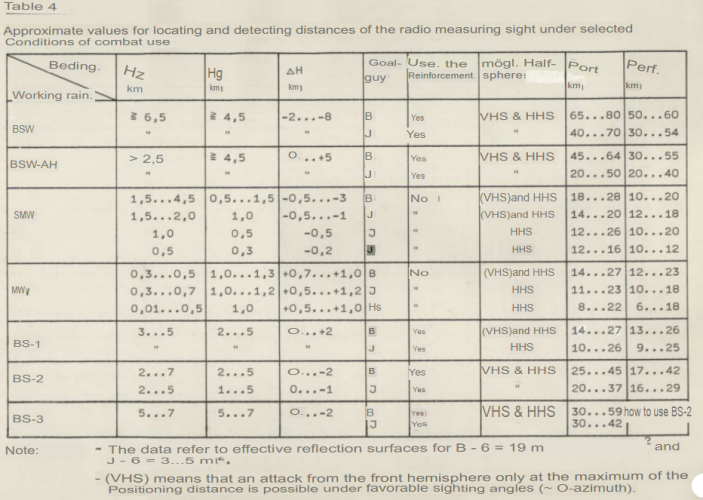
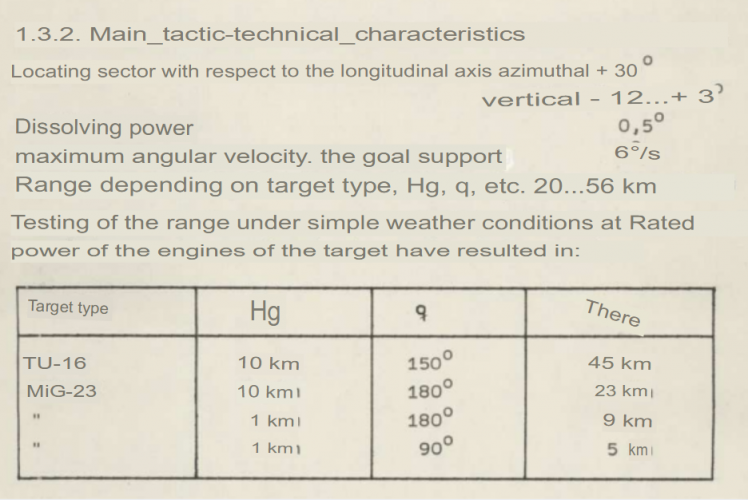
In case of Saphire pulse -Doppler modes cited range is somehow 15km , 24km , or even 28km.
So this results in PRF in range from somehow, let say above 4kHz and below 9kHz.
All in all - still somehow useful.
In "Doppler weather modes" instrumental range can be selected manually to somehow longer ranges - the longer range decreases probability of detection - there is higher change that target will be in blind frequency. But pilot has some trade-off. to manually select range.
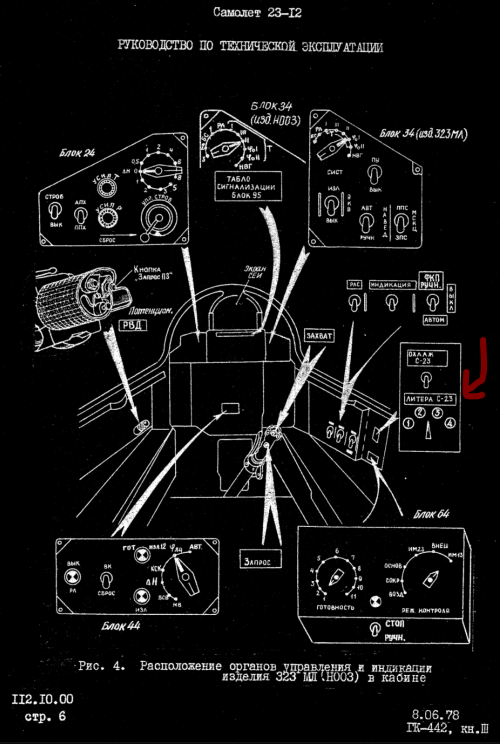
In case of Mig23/25 - there is not used internal "coherent" oscillator, but as coherent reference are taken signals from ground returns, taken by sidelobes ("external coherence"). Thus Doppler modes works only if such ground return from side-lobe is present. Thus plane have to fly not higher than 500m above ground and radar beam is pointer somehow ~1bar down (thus it is not possible to fly high and look down, so I called this "slant down radar", with vertical 1 bar scan pattern, limited to somehow in azimuth to +/-30 deg respect to axis of plane. (greater angles increases blind areas in LPRF frequencies - as mentioned above - so for that reason are forbidden.)
And for "meteo" Doppler modes (to filter returns from radio -reflective clouds, or chaffs) - there are no limitations of flight altitude or scan limits... but there is
curiosity - that - to detect target - it has to fly trough that reflective environment...
So if there are two targets - one in such radio-reflective cloud and second not... in this mode the second will be (might be?) not detected - as there is no interference to be source of Doppler reference signal ... and in manual .. this mode is rather advised to be used only when necessary..
Notes:
*(1) If somebody has better understanding/knowledge I am curious to get familiar with them
**(2) some sources claims that, at least since ML variant, there are two Klystrons - one for low power continuous harmonic signal for missile illumination, - and that is understandable.
the second ... for normal radar work. Well I am not sure about the second - if this really klystron or just magnetron. Normal radar work of LPRF radars requires high power emitted pulse, and this is easily provided by magnetrons. And using klystron (actually they are for sure used as main emitter since Mig-29,31, Su-27), allows to control emitted pulse, and to achieve fully coherent radar "on emit" .
And in Mig-23/25 - this is not the case, as they required "external coherence". But maybe there is used Klystron (without fully coherent input signal), and that allows to have more "clean" pulse without somehow intra-pulse defects , with more stable frequency, but still not fully coherent (?) Better emitted signal might improve Doppler processing on receive, as only phase need to be corrected...
Somehow similar case is observed in evolution of Cyrano IV into RDM radar - they also replaced magnetron by klystron. But that design still is LPRF and has severely limited look down - shoot down capability. So maybe it is more difficult to create fully coherent radar (this coherent oscillator, and all backends) than to use Klystron? But Klystron still may provide some benefits, in terms of signal purity? Even if not fully coherent ? Or maybe RDM is fully coherent radar, but for some reasons, only LPRF?
***(3) actually - this in side of receiving path, not like in PESA radars

, and even simpler, when signal is converted to digital form, but idea is the same...correct phases of received signals.. to make them coherent in receive path
****(4) as far as I remember , in mig-25 manual, there is switch - to select detection range: closer from 0 to let say 15km (I write from memory) and further (let say from 14 ... 28 km...) .. so maybe still it is possible to process the second range window? in such case, there will be memorize phase of signal , and it would be used to correct not the echo from last pulse , but one before last... maybe this is still possible, but I do not know how to be implemented "with external coherence"
*****(5) (for let say taking some extreme case : antenna beam 3.5 deg , set to 45 degree with plane speed 300m/s , f=10GHz according to my calculations - difference in ground speeds in respect to plane on "sides" of the beam is ~13m/s - as is shown bellow - this is almost 1kHz
******(6) ground moving objects (cars etc) - those have low speed (for example for radar frequency f =10GHz , and car speed 50km/h - 50km/h/3.6 -> ~14m/s -> 2*v/c* f -> (~30m/s / 3* 10^8 m/s )* 10^10Hz = ~10^3 = 1kHz.
*******(7) Good side is - that echo from the second (and also following) range interval(s) will influence only corresponding range bin in the first "coherent" internal. So taking in account the above mentioned example 8kHz and with first range: 0..18.5km ... echo (either ground clutter or something else) from distance 28.5 km will impact only to range cell placed in 10km. And as range cells are rather narrow - corresponds to pulse length that is in case of Saphir - let say 4microseconds (I do not know what is pulsewith in PD mode..)- thus only from area 1200m .. and signals from long range will be still weaker .. and smash over the whole frequency range, whereas echo from first "coherent" range - will be rather sharp(er).. this might not prevent detection in many cases...
But this still is some "background noise" that decrease sensitivity, at least comparing with true PD radars..