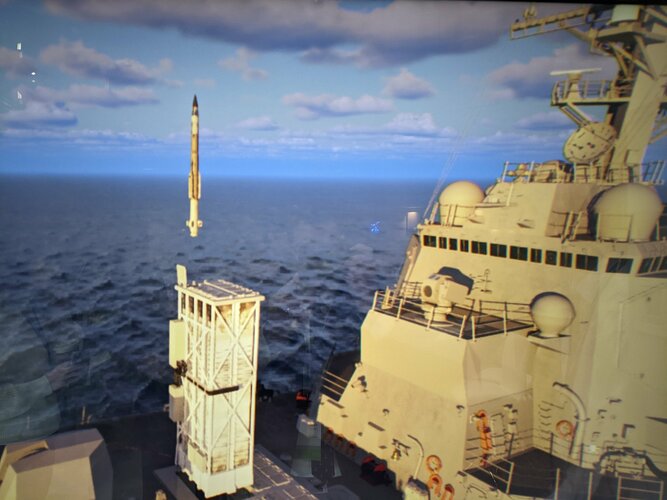
PAC-3 MSE

Lower thrust and longer burn time being exactly what one looks for in a *checks notes* terminal defense weapon engaging high-velocity targets.

No, wait, I think I'm wrong. I think that's exactly what one doesn't want.

Well in that case the booster to use would be the Mk-72.
 
At this point the two are merging anyway. The two are are collaborating on Guams defense using every missile family and radar they have.
I think that is more a matter of just how critical Guam is to the US forces in the western Pacific...
 
How long is the Mk-114? The only measurement I know for sure about it is its diameter (14.1").


I checked the Mk-41 wikipedia article and:


I don't know about the 209" tactical canister but the 303" strike version should be able to fit a PAC3 with with an attached Mk-114 booster or a booster based on it.
You once estimated the length of the Mk114 booster as 72 inches (6 feet), which looks about right to me, eyeballing it compared to the 9-ft length of the Mk 54 torpedo payload. (This also jibes with the fact that the 14-ft LRASM plus VLA booster fits in a Strike-length cell but is too long for a Tactical one). Mk 72 is about 5.5 feet, so not much shorter.

The wiki numbers are the physical depth of the launcher, but there is stuff under the canisters in each launcher (exhaust plenum, foundations, etc.). The actual canister length for Strike is 22 feet (264 inches) and for Tactical is 19 feet (228 inches). The max missile length inside that canister is about six inches less than that thanks to seals, hold downs, etc.

Now, MSE is 17 feet long on its own; there is clearly no room for 5-6 feet of booster under it. There is the Tomahawk booster, but it's not the right kind of thing for this -- its job is to get 1.3 tons of Tomahawk out of the tube, pointed away from the ship in roughly the right direction, and high enough for the turbine to start after the booster falls away.

If they wanted to add a booster to MSE for naval use, I'm sure they could design one, but it would be quite a redesign. And as stated, LM's goal is for the missile to be interchangeable off the assembly line for both applications.
 
Last edited:
If they wanted to add a booster to MSE for naval use, I'm sure they could design one, but it would be quite a redesign. And as stated, LM's goal is for the missile to be interchangeable off the assembly line for both applications.
Exactly. If the USN needs a longer ranged SAM/ABM, they have SM2s and SM6s. Once the SM2 ARH is the normal production version, I expect the Army to buy a pile of SM2s to fill the area between Patriot and THAAD.
 
So twin cell Pac-3 MSE? Sounds good to me. Maybe one could buy them for other stuff than hypersonic defense too
 
It would require PAC-3 to fold its control surfaces, which would be separate production line. I think the USN is more likely to go for a quad pack option, if one can be found.
 
It would require PAC-3 to fold its control surfaces, which would be separate production line. I think the USN is more likely to go for a quad pack option, if one can be found.
Quadpacked PAC-3 CRI instead of MSE?

SM-6 can still take the distant targets and let the Compact Agile Interceptor take the close-in terminal shots.

Or do we have a diameter for David's Sling/Stunner/PAAC-4?
 
Quadpacked PAC-3 CRI instead of MSE?

SM-6 can still take the distant targets and let the Compact Agile Interceptor take the close-in terminal shots.

Or do we have a diameter for David's Sling/Stunner/PAAC-4?
How does Stunner compare to PAC-3 MSE? My impression is that it is distinctly inferior.
 
Quadpacked PAC-3 CRI instead of MSE?

SM-6 can still take the distant targets and let the Compact Agile Interceptor take the close-in terminal shots.

Or do we have a diameter for David's Sling/Stunner/PAAC-4?


This project seems in its very early stages; they do not seem to have even settled on propulsion yet. I’m not sure what exactly they are tested, but a baseline PAC-3 does not seem to solve the problem and the project seems to contemplate clean sheet designs. Or possibly even multiple designs. It seems unclear from the article.
 
It would require PAC-3 to fold its control surfaces, which would be separate production line.

Why would that need a seperate production line? The only thing different is that missile's fins and strakes would be foldable.

Pac-3 MSE with MK.114 as booster to your service xD

The Mk-114 would definitely work (11,000Lb of thrust for five seconds burn time) or you could use the R/UGM-84's launch booster (12,000Lb thrust for 2.9 seconds).
 
PAC-3 MSE is not capable of being multi-packed in a Mark 41 VLS cell like the quad packed RIM-162 ESSM, and the Navy has expressed no interest in making modifications to the PAC-3 to allow for multi-packing. According to Cook, Lockheed Martin’s next-generation 34-inch diameter Growth VLS (G-VLS) could make multi-packing PAC-3s a reality.
 

This $9.8B multi-year contract for 1,970 missiles is for FY24-FY-26. It covers Army, Navy, and significant FMS sales.

Over FY24-FY26, the Army procured 230+214+320 = 764 PAC-3 MSE interceptors. The navy procured 12, which is testing PAC-3 MSE. A PAC-3 was fired using a virtualized AEGIS system last year. The current MK-41 layout would have only one MSE per cell. The MSE should be able to be dual-packed given its dimensions, which would be fantastic for magazine depth on any ship carrying it. A quad pack would require the PAC-3 CRI, which is no longer in production, Lockheed has said.

Assuming the remaining 1,194 missiles from this multi-year order are for FMS customers would make sense, as there have been reports of very large buys from the likes of Poland and Germany.

Lockheed is currently producing 600 MSEs per year. They should be at 650 per year within the next year.
The company is also looking at “the efficiencies and streamlining and doing everything we can to stretch those dollars actually to take that to a higher capacity, upwards of around 750 per year by 2027,” Reynolds said.

The government has not yet officially released the number for a top production level, but “if you take that trajectory and you project it forward into the future years, you will see as well north of 1,000 and then even much higher after that,” he said.

750 per year, or even 1,000 per year, likely still isn't enough. Assuming the dollars and euros are allocated to actually buy what the objective is, we can estimate what the purchases should be.

Army:
The Army has purchased 2,811 MSEs so far, including FY26. They recently increased their acquisition objective from 3,376 to 13,773, leaving 10,962 to procure from FY27 onwards. At their current rates, they would have completed the MSE program after about 15 years of procurement. However, that included the lower-buy LRIP years and the pre-Ukraine years. Prior to 2022, the Army was purchasing less than 200 per year in most years.

If the acquisition objective of 13,773 means anything and isn't just a fairytale, they should aim to achieve that within 10 to 15 years. If they do achieve their AO within the next 10-15 years, I would be shocked and pleasantly surprised. Lockheed cannot produce enough yet, so the numbers would have to drastically increase in the latter years. We can assume that 20 years would be more likely given production and budgeting constraints. That gives us the Army's required annual procurement:
548 - 1,096 per year.

FMS:
The recent MYP included about 400 missiles per year for FMS customers. However, Lockheed cannot yet build all of these missiles. Presumably some will be late. We could assume the buying frenzy remains high for the upper bound, and assume souring relations with the US for the lower bound, and get:
100-400 per year

Navy
:
The Navy has an interceptor shortage and a magazine depth issue. The MSE is not really an "affordable" missile, but could fill certain gaps for the USN, assuming funding is provided. Let's look at their current interceptors:

SM-6: production is being increased to 200 per year by 2028. 139 were purchased for FY26 at a cost of $5.3M per.
SM-2: The SM-2 block IIIC had a very short production run of only a few dozen units. Block IIICU is in the works, with IOT&E in FY27. Block IIIC cost about $2M per. We can assume the IIICU will not be cheaper, as it is only an upgrade to the guidance section to address obsolete parts.
Both missiles are modifications to legacy SM-2 Block III/IIIA/IIIB missiles. The most significant modification is replacement of the legacy semiactive missile seeker with a dualmode semi-active and active missile seeker based on SM-6 Block I technology. The SM-2 Block IIIC and Block IIICU additionally have a new dorsal fin design and a thrust vectoring jet tab assembly to control trajectory as the missile egresses the launcher.
The other problem with the SM-2 IIIC/U is that these old SM-2 missiles do not have an infinite shelf life. The SM-2 IIIC/U is essentially an active SM-6 but without the booster.
ESSM Blk II: 305 purchased in FY26, $1.35M per. These missiles also have an active seeker.

Where does that leave the PAC-3 MSE? Well, the Navy clearly doesn't see much value in semi-active seekers. New procurement (SM-6, ESSM) all have active seekers. Upgrades (SM-2 IIIC/U) have active seekers. The threat environment is also getting more threatening. The Navy clearly believes they need these higher-end interceptors to be higher-end. Capacity issues are being addressed via things like HVP, other Mk-45 solutions, and Coyote/Roadrunner. I believe the Navy has a need for an affordable, SM-2-range, quad-packable interceptor.

The PAC-3, however, fills a high-end niche that the Navy doesn't currently have. It has SM-6-like performance but with a much shorter minimum engagement range. It will have superior performance for some intercept geometries. It is a high-end interceptor for TBMD, cruise missiles, supersonics, and even hypersonics to an extent. Considering the relative costs and performance metrics, I could see the Navy purchasing 50 per year in the interim to fill the MSE's niche that is currently unfilled, and 100-200 per year a decade from now to make up some of the capacity/shelf life issues of the SM-2.
50-200 per year

Therefore, assuming the various customers actually purchase according to their stated and signaled needs, we get the following yearly production needs for PAC-3 MSE:
698-1696 per year

We can also estimate what this would do to the cost. The current cost per MSE is $3.8M per, $4.1M per when including things like advanced procurement, obsolescence, and other fixed costs. Assuming a 15% reduction in costs if the upper bound of that production target is reached (1600-1700 per year) and assuming improved amortization of fixed costs, we could see the cost per AUR decrease to as low as $3.3M marginal, $3.5M total when including fixed/ancillary costs.

Army spend on PAC-3 MSE might then look like this:
  • 320 per year, $1.3B total, $4.1M per (current actual)
  • 548 per year, $2.1B total, $3.8M per
  • 1096 per year, $3.8B total $3.5M per
Navy spend would likewise become $200-800M per year for their 50-200 missiles, depending on Army-driven pricing.

The point is: these are certainly significant numbers, but the economies of scale help, and these aren't unacheivable quantities if the DOD wants to prioritize this.

 
There's a lot of wishful thinking here and the budget increase to sustain 3-5x the buy rates is always just outside the FYDP. Army's priorities if one thinks rationally would be to actually equip the IFPC and CsUAS force structure it is buying with adequate quantity and quality of interceptors. Not one or two launcher reloads in total. It will be busy doing that for at least the next half a decade to a decade of procurement (begining FY27). That takes care of a bunch of its funded ADA growth dollars. That leaves little to dramatically increase MSE procurement. I am not factoring in a need to bulk up THAAD buys since that is MDA but still stresses the overall missile defense purse.

Then, the Army actually needs a qualitatively superior interceptor to go after the sizable gap between the MSEs max altitude, and THAAD's min altitude. Aeroballistic and HGVs both can exploit that and both NoKo and China field several types. This was why the Army has always wanted LT-FI by 2030. LT-FI would also have to be a new clean sheet missile as a MSE is pretty much maxed out. So with all those things considered, unless there is a significant reduction in Army force structure outside of the ADA, or a rather dramatic increase in defense spending the prospects of going from 650 MSEs a year to the 2,000 a year rate, that LM has been said to have been asked to explore, seem highly unlikely and unrealistic.

I do not want to comment much on the Navy as it has to test the Naval MSE first and we will see how it fairs and what the Navy thinks. No one has ever tested the MSE against a low altitude supersonic threat for example so we will see how the Navy assesses the missile and what it feels about buying it in quantity relatively to increasing SM-6 buys now that it is funding second SRM sources for the DTRM and booster.

I an ideal world, both the MSE and SM-6 should be approaching a capacity of 1,000 a year and working up from that. But clearly there is no appetite to spend that much given other priorities and no political desire to increase defense spending and base budgets further.
 
Last edited:

This $9.8B multi-year contract for 1,970 missiles is for FY24-FY-26. It covers Army, Navy, and significant FMS sales.

Over FY24-FY26, the Army procured 230+214+320 = 764 PAC-3 MSE interceptors.

Assuming the remaining 1,194 missiles from this multi-year order are for FMS customers would make sense, as there have been reports of very large buys from the likes of Poland and Germany.

Lockheed is currently producing 600 MSEs per year. They should be at 650 per year within the next year.

Therefore, assuming the various customers actually purchase according to their stated and signaled needs, we get the following yearly production needs for PAC-3 MSE:
698-1696 per year

DepSecDef Feinberg is asking Lockheed to increase the production rate of PAC-3 to about 2,000 interceptors per year. This push for higher production rates applies to 12 key missiles. It's not clear that any additional contracts or funding have been provided for these efforts other than the ones we have already heard about.

 
Aside from the extra money required wouldn't that also entail setting a second-source production line?
If you mean a second contractor via an open competition, probably not. The DOD would sole-source this to Lockheed and justify it by appealing to an urgent need and the fact that Lockheed is the only suitable contractor.
 
If you mean a second contractor via an open competition, probably not.

That would be ideal however either way I mean an actual physically seperate production line (While that would cost a fair bit of money to set up in the long it should enable a far higher annual rate of production).
 
That would be ideal however either way I mean an actual physically seperate production line (While that would cost a fair bit of money to set up in the long it should enable a far higher annual rate of production).

Lockheed would just build more facilities in Camden AK. They have already built 2 additional final assembly buildings for their missiles & fire control segment, as you can see here:
1759202789183.png
Those are 3 All Up Round facilities, as they call them. The most recent one opened in 2022. If they aren't able squeeze more juice out of each line, they will just build more. Lockheed has a sprawling complex of facilities for missile production here, in an area that is largely unused and heavily forested. Plenty of space for more construction. If they want to reach 2,000 AURs per year without adding graveyard shifts or heavily changing the production process, they'll need to build a few more of these final assembly facilities.

When you're building things that explode and ignite, it's a good idea to not put all your employees in one building:
1759203047919.png

I'm not sure what investments would be needed in raw inputs and subsystems to support increased production.
 
Final assembly is one of the easier bottlenecks to solve. As mentioned above, as long as you don't have workforce challenges in a given location, you can just add more square footage for final assembly and grow headcount over time.

The real challenge in going to be increasing production of things like the dual pulse solid rocket motor, seeker and other key components that have a single source. While the Army did reach out to industry to find a second source for the seeker they would have to do the same for a few other components for such a dramatic increase in production being targeted. The SRM base has recovered but is still finding it hard to manage all these concurrent program ramps. I think that will remain a challenge in the near term especially since the MSE is using a fairly advanced motor.
 
Last edited:
IIRC Boeing is growing MSE seeker capacity at its Huntsville site but remains a component bottleneck to push AUR production into the quadruple digit pa range.

In the main, seeker production remains a problem spot for the US but this should be addressable - first step is demand signaling, which Feinberg is clearly doing.

Link https://www.defensenews.com/digital...ac-3-missile-seeker-annual-production-record/
 
Was looking at this a little closer and is that white area insulation? (See below.) If that's the case, given that you don't see that on ESSM, SM-2/6, PAC-2, S-300, etc. that thing must really move.
I know this post is about 10 years old, but didn't see anyone respond. That section is the Attitude Control Motors (ACM). There is just a protective coating over them . I'm not exactly sure why they need the coating since the interceptor is housed in a sealed canister.
 

Attachments

  • German-modified_M903_Patriot_launcher_successfully_launches_Lockheed_Martin_PAC-3_MSE_Intercep...jpg
    German-modified_M903_Patriot_launcher_successfully_launches_Lockheed_Martin_PAC-3_MSE_Intercep...jpg
    182.2 KB · Views: 27
  • pac-3-mse-improvements.jpg
    pac-3-mse-improvements.jpg
    137.2 KB · Views: 27
I know this post is about 10 years old, but didn't see anyone respond. That section is the Attitude Control Motors (ACM). There is just a protective coating over them . I'm not exactly sure why they need the coating since the interceptor is housed in a sealed canister.
Maybe it is insulation to prevent the one-shot motors from being damaged by the heat during flight.
 
Maybe it is insulation to prevent the one-shot motors from being damaged by the heat during flight.
Yeah, I imagine it has something to do with that or to help preserve aerodynamics or maybe both.

Ive observed them being installed a few times over the years, but never saw the coating being applied.
 
In particular THAAD is endo and exo atmospheric capable (SM-3 is purely exo) so there likely is no gap. If anything I wonder if there might be a gap between SM-6 and SM-3.
I think just based on the region, there are coverage gaps. But if you look at Guam and Hawaii. You've got the SBX radar that can see just about everything in the Pacific, then you've got the Aegis destroyers that can be stationed around the islands. Now, add both THAAD and Patriot batteries and you've got a highly layered missile defense.

Add in the IBCS with carrier or ground based based F35s to detect and track incoming missile threats, I'd say you've got a pretty solid missile defense shield.
 

Similar threads

Back
Top Bottom