https://www.defensenews.com/land/20...-lockheed-record-98-billion-missile-contract/
This $9.8B multi-year contract for 1,970 missiles is for FY24-FY-26. It covers Army, Navy, and significant FMS sales.
Over FY24-FY26, the Army procured 230+214+320 =
764 PAC-3 MSE interceptors. The navy procured
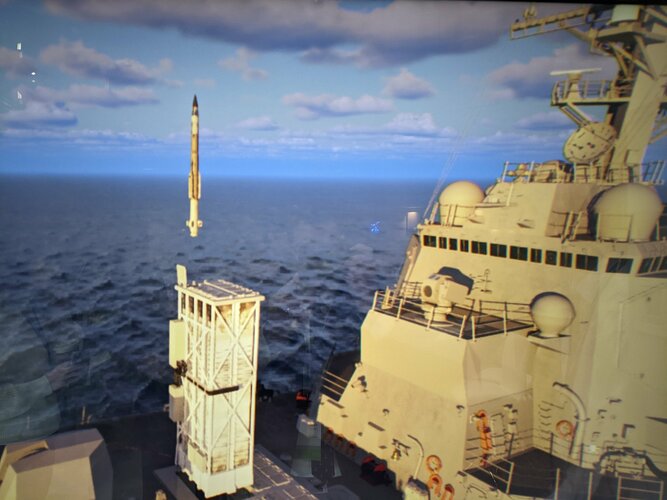
12, which is testing
PAC-3 MSE. A PAC-3 was fired using a virtualized AEGIS system
last year. The current MK-41 layout would have only one MSE per cell. The MSE
should be able to be dual-packed given its dimensions, which would be fantastic for magazine depth on any ship carrying it. A quad pack would require the PAC-3 CRI, which is no longer in production,
Lockheed has said.
Assuming the remaining 1,194 missiles from this multi-year order are for FMS customers would make sense, as there have been reports of very large buys from the likes of Poland and Germany.
Lockheed is currently producing 600 MSEs per year. They should be at 650 per year within the next year.
The company is also looking at “the efficiencies and streamlining and doing everything we can to stretch those dollars actually to take that to a higher capacity, upwards of around 750 per year by 2027,” Reynolds said.
The government has not yet officially released the number for a top production level, but “if you take that trajectory and you project it forward into the future years, you will see as well north of 1,000 and then even much higher after that,” he said.
750 per year, or even 1,000 per year, likely still isn't enough. Assuming the dollars and euros are allocated to actually buy what the objective is, we can estimate what the purchases
should be.
Army:
The Army has purchased 2,811 MSEs so far, including FY26. They recently increased their acquisition objective from 3,376 to 13,773, leaving 10,962 to procure from FY27 onwards. At their current rates, they would have completed the MSE program after about 15 years of procurement. However, that included the lower-buy LRIP years and the pre-Ukraine years. Prior to 2022, the Army was purchasing less than 200 per year in most years.
If the acquisition objective of 13,773 means anything and isn't just a fairytale, they should aim to achieve that within 10 to 15 years. If they do achieve their AO within the next 10-15 years, I would be shocked and pleasantly surprised. Lockheed cannot produce enough yet, so the numbers would have to drastically increase in the latter years. We can assume that 20 years would be more likely given production and budgeting constraints. That gives us the Army's required annual procurement:
548 - 1,096 per year.
FMS:
The recent MYP included about 400 missiles per year for FMS customers. However, Lockheed cannot yet build all of these missiles. Presumably some will be late. We could assume the buying frenzy remains high for the upper bound, and assume souring relations with the US for the lower bound, and get:
100-400 per year
Navy:
The Navy has an interceptor shortage and a magazine depth issue. The MSE is not really an "affordable" missile, but could fill certain gaps for the USN, assuming funding is provided. Let's look at their current interceptors:
SM-6: production is being increased to 200 per year by 2028. 139 were purchased for FY26 at a cost of $5.3M per.
SM-2: The SM-2 block IIIC had a very short production run of only a few dozen units.
Block IIICU is in the works, with IOT&E in FY27. Block IIIC cost about $2M per. We can assume the IIICU will not be cheaper, as it is only an upgrade to the guidance section to address obsolete parts.
Both missiles are modifications to legacy SM-2 Block III/IIIA/IIIB missiles. The most significant modification is replacement of the legacy semiactive missile seeker with a dualmode semi-active and active missile seeker based on SM-6 Block I technology. The SM-2 Block IIIC and Block IIICU additionally have a new dorsal fin design and a thrust vectoring jet tab assembly to control trajectory as the missile egresses the launcher.
The other problem with the SM-2 IIIC/U is that these old SM-2 missiles do not have an infinite shelf life. The SM-2 IIIC/U is essentially an active SM-6 but without the booster.
ESSM Blk II: 305 purchased in FY26, $1.35M per. These missiles also have an active seeker.
Where does that leave the PAC-3 MSE? Well, the Navy clearly doesn't see much value in semi-active seekers. New procurement (SM-6, ESSM) all have active seekers. Upgrades (SM-2 IIIC/U) have active seekers. The threat environment is also getting more threatening. The Navy clearly believes they need these higher-end interceptors to be higher-end. Capacity issues are being addressed via things like HVP, other Mk-45 solutions, and Coyote/Roadrunner. I believe the Navy has a need for an affordable, SM-2-range, quad-packable interceptor.
The PAC-3, however, fills a high-end niche that the Navy doesn't currently have. It has SM-6-like performance but with a much shorter minimum engagement range. It will have superior performance for some intercept geometries. It is a high-end interceptor for TBMD, cruise missiles, supersonics, and even hypersonics to an extent. Considering the relative costs and performance metrics, I could see the Navy purchasing 50 per year in the interim to fill the MSE's niche that is currently unfilled, and 100-200 per year a decade from now to make up some of the capacity/shelf life issues of the SM-2.
50-200 per year
Therefore,
assuming the various customers actually purchase according to their stated and signaled needs, we get the following yearly production needs for PAC-3 MSE:
698-1696 per year
We can also estimate what this would do to the cost. The current cost per MSE is $3.8M per, $4.1M per when including things like advanced procurement, obsolescence, and other fixed costs. Assuming a 15% reduction in costs if the upper bound of that production target is reached (1600-1700 per year) and assuming improved amortization of fixed costs, we could see the cost per AUR decrease to as low as
$3.3M marginal, $3.5M total when including fixed/ancillary costs.
Army spend on PAC-3 MSE might then look like this:
- 320 per year, $1.3B total, $4.1M per (current actual)
- 548 per year, $2.1B total, $3.8M per
- 1096 per year, $3.8B total $3.5M per
Navy spend would likewise become $200-800M per year for their 50-200 missiles, depending on Army-driven pricing.
The point is: these are certainly significant numbers, but the economies of scale help, and these aren't unacheivable quantities if the DOD wants to prioritize this.