Back in the 1950s and early 1960s nuclear power seemed to offer an alternative to hydrocarbons. That was the era of nuclear powered car and plane designs.
The reality of complex and heavy reactors needing skilled engineers to babysit them plus no way of disposing safely of the spent fuel has ensured that they are used only where there is no alternative.
More efficient engines to power large ships using hydrocarbons seem the direction of travel. Wind turbines and solar power may augment but not replace them.
If we want an example of a modern fast Cargo Ship, the 37-knot, diesel-powered Maersk B class proved to be so useful that they spent several years after the Global Financial Crisis moored together as a raft in Lock Striven, only being used as a film set for a children's television series.
More efficient engines to power large ships using hydrocarbons seem the direction of travel. Wind turbines and solar power may augment but not replace them.
https://books.google.com/
TITLE: PROCEEDINGS OF THE MERCHANT MARINE COUNCIL
DATE: OCTOBER 1958
PAGE: 189
- ARTIST'S CONCEPTION "UNDERWATER CARGO VESSEL OF TOMMOROW" by
AEROJET-GENERAL CORPORATION
Popular Science - JULY 1959
"What the Enginners Are Dreaming Up"
Page: 80
AEROJET-GENERAL CORPORATION
SEMI-SUBMERSIBLE UNDERWATER CARGO VESSEL
Page:82
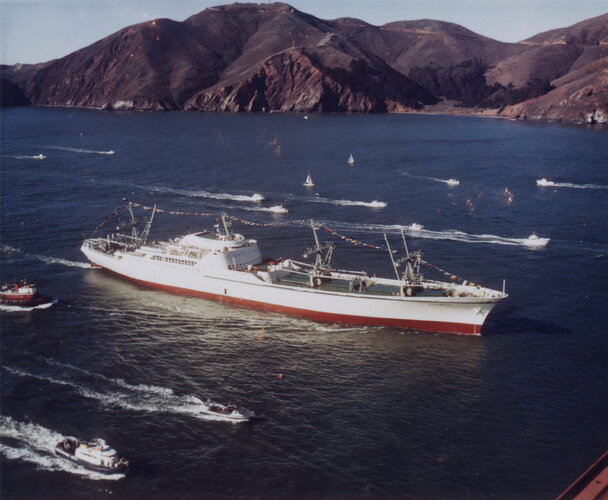
N/S SAVANNAH WITH NUCLEAR POWERED PISTON ENGINE
The thing is, the big Marine diesels currently burn the sludge that is left over after you refine all the more-valuable hydrocarbons out of petroleum. Which is great in terms of fuel costs (Bunker C is cheap), but terrible in terms of pollution emitted.
Back in the 1950s and early 1960s nuclear power seemed to offer an alternative to hydrocarbons. That was the era of nuclear powered car and plane designs.
The reality of complex and heavy reactors needing skilled engineers to babysit them plus no way of disposing safely of the spent fuel has ensured that they are used only where there is no alternative.
More efficient engines to power large ships using hydrocarbons seem the direction of travel. Wind turbines and solar power may augment but not replace them.
reprocessing and recycling the fuel is the answer to minimize the spent fuel problem. And once it's no longer useful for ship fuel, you can stick it into a shore side reactor to burn it down to a low mass of stuff that only has a 30-year halflife. Which means only 300 years of storage.
The initial focus of the project was approved designs with a power of 25-55 MW. Stage one studies the feasibility of different Generation IV nuclear reactor concepts. Concepts from 99 companies were studied before three reactor types were selected for future study. These were:
Kairos Power (USA): Fluoride high-temperature molten salt reactor using TRISO (TRI-structural ISOtropic) fuel particles, designed for robust and efficient operation.
Ultrasafe (USA): Helium-cooled gas reactor, also employing TRISO fuel particles, known for their resilience and safety in extreme conditions.
Blykalla (Sweden): Lead-cooled fast reactor concept utilising uranium oxide as fuel, offering high efficiency with advanced cooling mechanisms.
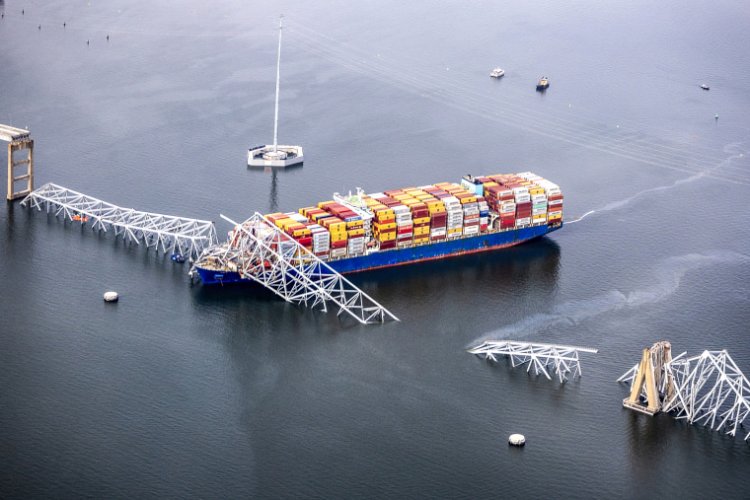
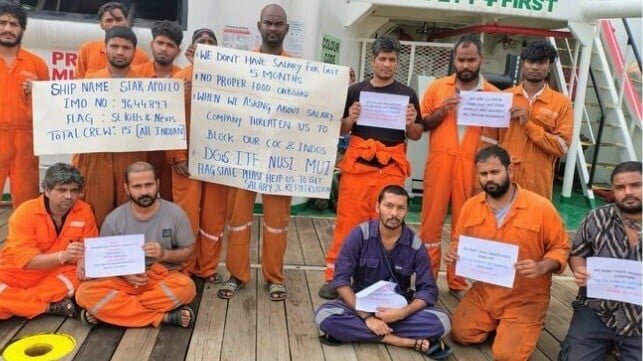
Every couple years Venture Crap-italists come along and say why dont have nuclear civil vessels and show em this Pic. Crew third worlders abandoned ship after doing best could and failed.
2nd: what drydock/port facilities access lend to vessel with nuclear plant.
Biggest deterent to vessel is P&I and insurance, who is gonna insure the vessel, provide security for reactor in duration its life. Vessel requires such looking after even off in port.
Worse if the vessel strikes environmentally sensitive area like reef/marine sanctuary. Whose compensating nations affected. Or bad if the vessel sinks in deep water and is unrecoverable. Shipping firms care more about Low operating costs, that often exploits third world labor, poorly paid and poorly treated some instances as near slavery or hostages aboard.
Many large vessel disposed of ashore in 3rd world shipbreaking. In nuclear boat dumping a potentially contaminated vessel wothout proper disposal, is out of the question.
--------
As for pleasure craft namely motor Yachts, however cool is unlikely. Most yachts are chartered meaning many boats owned singular entity, company. This would be advantageous over many hundreds individual owners.
Logistically yachts often never leave their home waters and even large ones rarely sail across the sea. Instead anchor themselevsles for events and parties or sail up and down coastal areas. Since require flagging fornspecific nation what nation would permit the vessel access to harbor? But conceptually while power core density of nuclear reactor fuel is very high, the core density varies depending on conversion and specific type. More so power conversion equipment takes up More space than reactor. Most motoryachts are between 30-120 meters (98 to 390 feet) so as the yacht shrinks so does the vessels habitable interior volume declines exponentially. Navy uses classified often very unique technology most likely CERMET fuels (ceramic-metal composite matrix)
US/Soviet navies tried metal cooled reactor designs. US sodium, which had teething and corrosion issues. Soviets tried Lead alloys, which led many at sea incidents and 4 subs decommissioned due fuel freeze ups and one catastrophic loss coolant accident.
Molten salt reactor at sea is loveable croc namely it costly, experimental, has high neutron flux. The MSRE required meter thickness magnetite concrete radiation shield for reactor no bigger refrigerator.
High temperature gas reactor has lower core density but can be addressed faster coolant rate flow or hybridization seawater intercooler steam generator.
Option 2 Heat Pipe reactor. Which in hypothetical sense is backward compatibility with classic steam turbine or gas turbine setup.
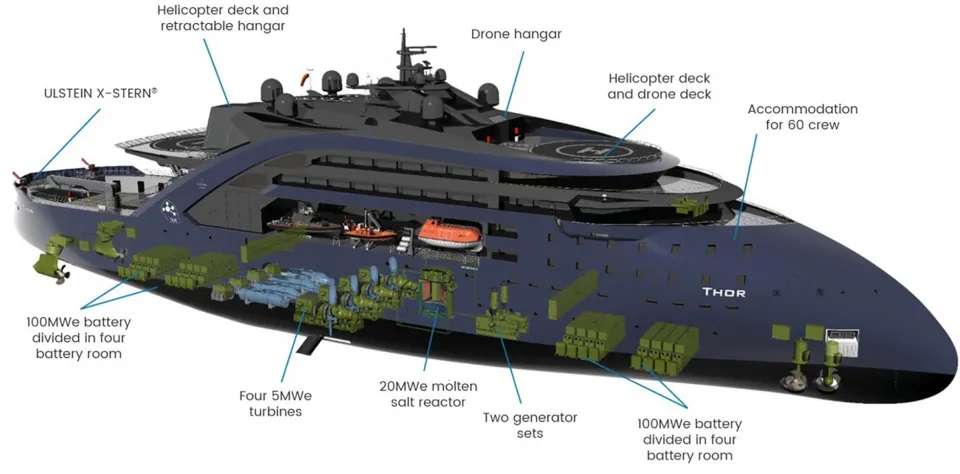
This leaves a Hybrid propulsion unit wjere reactor doesnt need huge power output instead a very small unit 1 Megawatt would generate electricity and charge batteries. Which run electric pod units.
Case point Ulstein (Norway) Thor explorer.
ThietyC studio Ion (UK)
Admittedly, it's always a bit silly to see how nuclear marine propulsion for civilian vessels seems to be some forbidden fruit to the west and other countries at large, with no such vessels existing as of now. Meanwhile Russia's Atomflot operates 8 nuclear icebreakers and has operated such ships for decades with basically zero issues. But the Russians always valued nuclear science and engineering much more than their western counterparts. So there's little surprise that there is no infrastructure, no personelle, no equipment and no suitable yard in place to even support the thought of civilian nuclear shipping. I suspect, which goes with repeatedly surfacing rumors over the years, that China will venture into civilian nuclear marine propulsion. In large part I expect that effort will be related to their CVN program. Either to serve as a testbed in a way, or to benefit from the operation, maintenance and infrastructure for such a large nuclear powered vessel instead.
Admittedly, it's always a bit silly to see how nuclear marine propulsion for civilian vessels seems to be some forbidden fruit to the west and other countries at large, with no such vessels existing as of now. Meanwhile Russia's Atomflot operates 8 nuclear icebreakers and has operated such ships for decades with basically zero issues. But the Russians always valued nuclear science and engineering much more than their western counterparts. So there's little surprise that there is no infrastructure, no personelle, no equipment and no suitable yard in place to even support the thought of civilian nuclear shipping. I suspect, which goes with repeatedly surfacing rumors over the years, that China will venture into civilian nuclear marine propulsion. In large part I expect that effort will be related to their CVN program. Either to serve as a testbed in a way, or to benefit from the operation, maintenance and infrastructure for such a large nuclear powered vessel instead.
The Russian nuclear icebreaker program started with the bizarre Soviet goal of forcing Inuits into collectivized fur farms. The fur bearing animals would be fed with protein from the Soviet high seas whaling fleet and nuclear icebreakers were necessary to enable year around navigation. Embarrassingly, the Soviets needed Finland for icebreaking hull construction. The whole thing was an expensive exercise that failed with the Soviet Union. The irony is that Russian Inuit communities returned to local open boat whaling but suffered tremendous casualties as they relearned the traditional skills lost in the Soviet era.
America already had a well funded civilian registered nuclear freighter which was a well known economic failure and a lesser known technical flop. The Savannah didn’t just fail because it was a break bulk ship in an era of containerization or that the lines were so to fine for cargo capacity. Japan and Germany’s efforts were even more dismal.
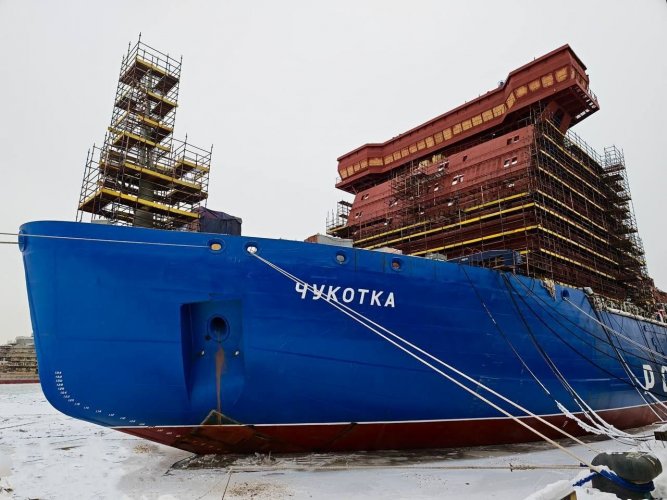
I'm not going to lie, I'm incredibly impressed at the sheer amount of confidently wrong assertions being made. The first nuclear Icebreaker was 'Lenin' which was constructed to assist Soviet shipping year round along the northern coast of the USSR, namely the Northeast Passage. It was constructed in Leningrad. Only Taymyr and Vaygach saw finnish participation, which are experienced icebreaker builders in their own right. Meanwhile Lenin, the entire Project 10520, Project 10521 and Project 22220 classes were all designed, constructed and operated by the USSR and later Russia. Together they form a sizeable fleet of nuclear powered civilian vessels which are crucial and quite extraordinary in their mission, which sees them break through extremely thick ice sheets, paving the way and escorting shipping, conducting rescue operations and operating with unprecedented autonomy for ships of their kind.
By the way, this is the second largest fleet of nuclear surface ships in the world, only behind the CVNs of the United States Navy. Just that the Icebreakers belong to a civilian entity, operate in the most hostile environment on earth and have really good readiness on top of that.
So the tl;dr is, you muttered absolute nonsense and everyone vaguely familiar with the Soviet and Russian nuclear icebreaker program or civilian nuclear ships in general is immediately aware of it.
Edit: and to add insult to injury, nuclear icebreakers "failed" so hard with the USSR that Russia will complete construction of the fifth Project 22220 icebreaker by the end of this year, with at least two more after that, amounting to 7 ships in this class alone. Which represents the most capable icebreakers in the world btw.
The strength of a navy comes from the fishing fleet and merchant fleet; Mahanian logic would be to develop a nuclear commercial shipping industry to ensure a strong navy.
The strength of a navy comes from the fishing fleet and merchant fleet; Mahanian logic would be to develop a nuclear commercial shipping industry to ensure a strong navy.
Hey folks, I recently came across the Twitter account of a Chief Nuclear Officer employed at a company developing nuclear power solutions for maritime applications.
Source (X fka twitter) :
Hey folks, I recently came across the Twitter account of a Chief Nuclear Officer employed at a company developing nuclear power solutions for maritime applications.
The issue of civilian and commercial nuclear shipping (i.e. not government funded or vaguely civilian research assets) is one with many facets. The cost is ultimately tremendous, that includes development, construction, acquistion of material, establishment and upkeep of the fleet and dedicated infrastructure, the training and employment of certified nuclear engineers and keeping them up to the task, legal work to be able to acquire the necessary assets, material and personelle, having your facilities, vessels and reactors regularly inspected and approved by the responsible agency/government body.
In that sense I unfortunately view statements as above as unrealistic dreams. The only three entities in the world that operate nuclear powered ships are state-owned and funded, being the United States Navy and their fleet of super carriers, the Russian Navy and their Kirov-Class nuclear powered guided missile cruiser and Rosatom's Atomflot of nuclear icebreakers. An entity that enjoys government budgets, government support and can overcome the hurdles listed above because of that. Material, personelle, infrastructure, money and certification become more accessible with state backing, as most of these things are already available in some shape or form and could be expanded upon within government contracts.
While the private sector would have to overcome some of the toughest hurdles imaginable while shouldering staggering costs with uncertain returns. Because nuclear shipping at a competitive international level has never been truly tested, not even with ships like Savannah or Sevmorput. The CVNs and CGNs of the US and Russian Navy are warships and are thus handled differently from other ships anyway and usually not entering commercial ports with plenty of containers, each of which could be rigged in a way that could ultimately lead to an accident involving nuclear fallout. While the icebreakers of Rosatom are not really leaving Russian seas and operate in a way that primarily sees them supporting shipping and off shore operations at high seas. Point being that the nuclear ships that operate right now have very specific use cases, which sees them and their environment under minimal risk. Thus even state backed nuclear cargo or tanker fleets would have to overcome undeniable challenges with regards to cost, legislation and safety. For the private sector it is, as far as I believe, boderline impossible to overcome these hurdles.
Which is ultimately why I'm not holding my breath for any private ventures that pledged themselves to nuclear shipping to succeed. Honestly, my biggest bet would be on a limited fleet of chinese, state backed, tankers or extra large cargo ships that utilize some form of nuclear propulsion. But even that is a big if and possibly decades away. Rumor has it they are looking into nuclear icebreakers too. Either way, nuclear merchant fleets would have to be at least partially state backed, in my eyes. Everything else just seems very unlikely to materialize.
The issue of civilian and commercial nuclear shipping (i.e. not government funded or vaguely civilian research assets) is one with many facets. The cost is ultimately tremendous, that includes development, construction, acquistion of material, establishment and upkeep of the fleet and dedicated infrastructure, the training and employment of certified nuclear engineers and keeping them up to the task, legal work to be able to acquire the necessary assets, material and personelle, having your facilities, vessels and reactors regularly inspected and approved by the responsible agency/government body.
In that sense I unfortunately view statements as above as unrealistic dreams. The only three entities in the world that operate nuclear powered ships are state-owned and funded, being the United States Navy and their fleet of super carriers, the Russian Navy and their Kirov-Class nuclear powered guided missile cruiser and Rosatom's Atomflot of nuclear icebreakers. An entity that enjoys government budgets, government support and can overcome the hurdles listed above because of that. Material, personelle, infrastructure, money and certification become more accessible with state backing, as most of these things are already available in some shape or form and could be expanded upon within government contracts.
While the private sector would have to overcome some of the toughest hurdles imaginable while shouldering staggering costs with uncertain returns. Because nuclear shipping at a competitive international level has never been truly tested, not even with ships like Savannah or Sevmorput. The CVNs and CGNs of the US and Russian Navy are warships and are thus handled differently from other ships anyway and usually not entering commercial ports with plenty of containers, each of which could be rigged in a way that could ultimately lead to an accident involving nuclear fallout. While the icebreakers of Rosatom are not really leaving Russian seas and operate in a way that primarily sees them supporting shipping and off shore operations at high seas. Point being that the nuclear ships that operate right now have very specific use cases, which sees them and their environment under minimal risk. Thus even state backed nuclear cargo or tanker fleets would have to overcome undeniable challenges with regards to cost, legislation and safety. For the private sector it is, as far as I believe, boderline impossible to overcome these hurdles.
Which is ultimately why I'm not holding my breath for any private ventures that pledged themselves to nuclear shipping to succeed. Honestly, my biggest bet would be on a limited fleet of chinese, state backed, tankers or extra large cargo ships that utilize some form of nuclear propulsion. But even that is a big if and possibly decades away. Rumor has it they are looking into nuclear icebreakers too. Either way, nuclear merchant fleets would have to be at least partially state backed, in my eyes. Everything else just seems very unlikely to materialize.
the french also operate a single CVN so if the russian navy counts with the kirov so should the french. the Chinese will also probably have by 2030 ish post trials and validation and all that
the french also operate a single CVN so if the russian navy counts with the kirov so should the french. the Chinese will also probably have by 2030 ish post trials and validation and all that
Admittedly I forgot about CdG, my bad. The point remains though, all nuclear ships are operated by state backed entities. The Charles De Gaulle is no exception.
the french also operate a single CVN so if the russian navy counts with the kirov so should the french. the Chinese will also probably have by 2030 ish post trials and validation and all that
They’re in an interesting position, their cgn experience seems to have gone well but they only have the institutional experience of operating one nuclear surface ship (albeit safely for decades) compared to the fleets from either cold war power.
They’re in an interesting position, their cgn experience seems to have gone well but they only have the institutional experience of operating one nuclear surface ship (albeit safely for decades) compared to the fleets from either cold war power.
Biggest issue that France doesn't really have a demand or use case for nuclear civilian shipping. The case for the Russian icebreakers is clear. The case for oversized tanker or container ships from China is less clear but the idea is sound (proof of concept, only yards able to produce such vessels, flexing economic and industrial might, being fuel independent), and let's not forget that they are also interested in nuclear icebreakers too. The US has no strong case to make for nuclear civilian vessels, unless we think about Alaska and Greenland in the same way we think about northern Russia, which isn't a proper comparison.
I doubt France would want to enter the great Arctic game against the likes of Russia, China and the US. So nuclear icebreakers are not sensible for France.
Thus the only applications of nuclear maritime propulsion for France are of a military nature.
Trying to keep the focus on surface ships and their specific use cases and cost effectiveness. Submarines have different circumstances and rationale. Operating a civilian nuclear fleet as only Russia does is the only way to really know the economics of doing that, as the US navy knows cvn cost effectiveness better than anyone. There have been plenty of one off vessels, but unique ships are by definition not industry moving. The Kirovs are controversial but have and continue to provide data on the use of a whole class of nuclear surface vessels, the interpretation of which is outside the scope of this thread, in a way that unique vessels by nature can not.
Trying to keep the focus on surface ships and their specific use cases and cost effectiveness. Submarines have different circumstances and rationale. Operating a civilian nuclear fleet as only Russia does is the only way to really know the economics of doing that, as the US navy knows cvn cost effectiveness better than anyone. There have been plenty of one off vessels, but unique ships are by definition not industry moving. The Kirovs are controversial but have and continue to provide data on the use of a whole class of nuclear surface vessels, the interpretation of which is outside the scope of this thread, in a way that unique vessels by nature can not.
But the rest of French nuclear design is what I think would be ideal for civilian cargo-hauler use. LEU = minimal proliferation risk, and designing around simplified refueling operations means those refueling operations take less time, which means they cost less.
If Russia, Canada, and the U.S. all became friends today, would there be a commercial case for buying a small fleet of any of Rosatomflot's 3 classes of nuclear vessels they're building currently to operate in the Northwest Passage? I'm not sure what their ability to transit the equator is, but would a nuclear icebreaker of the Arktika or Lider class meaningfully affect Antarctic exploration/rescue, or is the demand for heavy icebreakers low enough to not justify it?
If Russia, Canada, and the U.S. all became friends today, would there be a commercial case for buying a small fleet of any of Rosatomflot's 3 classes of nuclear vessels they're building currently to operate in the Northwest Passage? I'm not sure what their ability to transit the equator is, but would a nuclear icebreaker of the Arktika or Lider class meaningfully affect Antarctic exploration/rescue, or is the demand for heavy icebreakers low enough to not justify it?
If Russia, Canada, and the U.S. all became friends today, would there be a commercial case for buying a small fleet of any of Rosatomflot's 3 classes of nuclear vessels they're building currently to operate in the Northwest Passage? I'm not sure what their ability to transit the equator is, but would a nuclear icebreaker of the Arktika or Lider class meaningfully affect Antarctic exploration/rescue, or is the demand for heavy icebreakers low enough to not justify it?
Given the fact that at least two of these three arctic powers hold deep animosity towards each other I'm not really sure how worthwhile this is to even discuss. But yeah if a joint fleet of Project 22220 icebreakers would be operated you'd probably see the fleet size grow from 7 ordered to at least 14, possibly as high as low 20s to cover the arctic passages of all 3 countries. At that fleet size you can certainly afford to have one vessel rotate in and out to aid in antarctic exploration in the southern regions of the globe. Added benefit is that these ships can act as miniature power plants, so their usefulness in such an endeavour extends beyond simply being able to break ice.
Added benefit is that these ships can act as miniature power plants, so their usefulness in such an endeavour extends beyond simply being able to break ice.
Biggest issue that France doesn't really have a demand or use case for nuclear civilian shipping. The case for the Russian icebreakers is clear. The case for oversized tanker or container ships from China is less clear but the idea is sound (proof of concept, only yards able to produce such vessels, flexing economic and industrial might, being fuel independent), and let's not forget that they are also interested in nuclear icebreakers too. The US has no strong case to make for nuclear civilian vessels, unless we think about Alaska and Greenland in the same way we think about northern Russia, which isn't a proper comparison.
I doubt France would want to enter the great Arctic game against the likes of Russia, China and the US. So nuclear icebreakers are not sensible for France.
Thus the only applications of nuclear maritime propulsion for France are of a military nature.
At the 14-18 November 1960 IAEA-IMCO conference on various aspects civilian nuclear propulsion held in Taormina, CEA made a presentation on a research programme for such a reactor, an enriched uranium graphite-C02 reactor. CEA quickly came the conclusion that it would never be competitive with fossil fuel propulsion systems and the programme had ended by 1962. West Germany, Italy, Denmark, Belgium, Japan, Norway and England also made presentations at the time.
At the 14-18 November 1960 IAEA-IMCO conference on various aspects civilian nuclear propulsion held in Taormina, CEA made a presentation on a research programme for such a reactor, an enriched uranium graphite-C02 reactor. CEA quickly came the conclusion that it would never be competitive with fossil fuel propulsion systems and the programme had ended by 1962. West Germany, Italy, Denmark, Belgium, Japan, Norway and England also made presentations at the time.
Yet when the US was designing the America-class, they did the math and came to the conclusion that oil would need to be at or above $140/barrel for the life of the hulls for Navy Nuclear to make sense.
And that is with a very large crew of reactor techs. If you can design a low-manning reactor system, something that doesn't need a dozen personnel per watch, the break-even cost goes down.
Given the fact that at least two of these three arctic powers hold deep animosity towards each other I'm not really sure how worthwhile this is to even discuss.
Politically, it's totally infeasible. The U.S. and Canada wouldn't cancel their 5 heavy icebreakers currently in early stages of construction for Russian-built ones now that people are invested, workers would have to be transferred to Russia and fitting out done in North America just to limit the domestic backlash, and that wouldn't make it go away. Plus, countries like to give their heavy icebreakers room for self defense capacity given their nature as high capability, high cost national assets, and in the U.S. and Canada they're operated by military Coast Guards. Russia building strategic militarizable assets for NATO isn't feasible, as is NATO members leasing or employing Atomflot for maintaining a North American waterway.
But the International Space Station was a pipe dream 10 years before the first module was launched! It seems possible that Russia could undergo a regime change in some form soon, either from Putin dying, as an aftershock of the Russo-Ukrainian war, or both. The war being the drain it's been could lead to a cash strapped, diplomatically isolated new regime choosing to form an International Polar Fleet with former foes, cooperating and leveraging each member's strengths to exploit resources and routes more effectively and build mutual prosperity. Asia and Europe could be brought in on a comparatively small scale and conditionally like the ISS.
If Canada and the U.S. had had such an "alliance" with Russia 10 years ago in 2016 before the North American new gen heavy icebreakers began construction, building a class of slightly modified Pr. 22220 Arktika instead seems possible.
I'm wondering at lost opportunity costs due to diplomatic failures, the 60mw power and draught changing of the Arktikas could have worked over 2 continents, and the Lider and Akademik Losmonov might have sold more copies as well... I could see America ordering a (maybe slightly larger) Lider in order to maintain a strategic phallic object parity, as is our tradition.
Let's look at the 7 unique nuclear civilian vessels that began construction whose careers we have seen play out. The Ocean Explorer never got her power plant and was finished conventionally, and Mutsu never carried a cargo under nuclear power, giving a failure to begin service a 28.57% likelihood. The Otto Hahn, Savannah, MH-1A, and Sevmorput were all useful but ultimately disappointing in service, with a 57.14% likelihood of such a scenario the most likely outcome of such a venture. The lone star that succeeded in prototyping further classes was of course the famous Lenin, giving the construction of an unproven nuclear civilian ship a 14.28% chance of viability. That being said, let's consider now the futures of the newly commissioned Akademik Losmonov and the under-construction Lider.
This site uses cookies to help personalise content, tailor your experience and to keep you logged in if you register.
By continuing to use this site, you are consenting to our use of cookies.