Bomiwriter

ACCESS: Confidential
Joined
8 October 2008
Messages
58
Reaction score
12
Greetings Chaps:

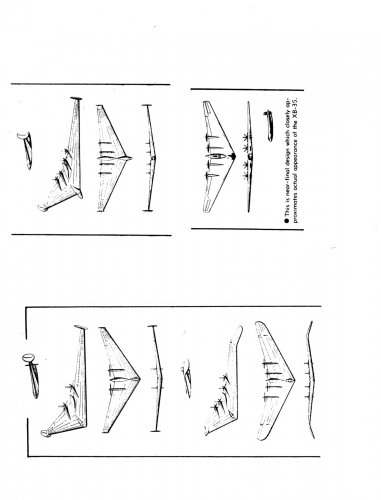
I saw artwork on fly-wings, so here is a fly-wing montage I located that is roughtly 70 or so years old on the Northrop XB-35 Bomber Project.

I had to enlarge slightly, cut n' paste and make up this simplistic display. I don't have tools to clean it up so take it as it is ok?

Also, someone on one of the forums (I was knocked out of several sights like 10 times last evening), and had nmerous unfinished messages, so please exuse them..."updates" kept coming in although I had it taken care of locally, but doo-doo happens anyway, on top of this it is a brand new NB with different keyboard from my old Gateway of 2005 vintage with old XP Home, so here we go again. One way or another, this should get through and let me know that I sanely attached the drawing correctly. Thanks and hang Tuff.
Bomiwriter
 

Attachments

  • Northrop XB-35 Bomber designs.jpg
    Northrop XB-35 Bomber designs.jpg
    206.6 KB · Views: 649
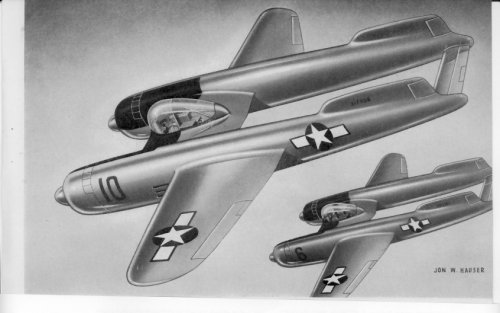
Here are some images from the "never happened" CD-just artwork material dating from either the end of WW II or post WW II. Look at the Bell image of a huge air-cushionb C-5 type transport. Can you spot the artist's serious mistake?

The rest are a cross-section of items that might be of interest. Did this work accoprding to attachment instructions?
 

Attachments

  • 1944. twin engine-boom 20mm cannon.jpg
    1944. twin engine-boom 20mm cannon.jpg
    99.3 KB · Views: 584
Bomiwriter said:
Greetings Chaps:

I saw artwork on fly-wings, so here is a fly-wing montage I located that is roughtly 70 or so years old on the Northrop XB-35 Bomber Project.

Those are all Northrop patent drawings. Jack Northrop did love to patent every damned thing.
 
Bomiwriter: I can only see one pic, and it's a twin-boom fighter... :-[
 
Stargazer2006 said:
Bomiwriter: I can only see one pic, and it's a twin-boom fighter... :-[

Same here. Image is '1941, twin-engine boom, 20mm cannon'.
 
The XB-35 designs came from my Dad's very old and literally "flaky" Air Trails Magazine from end of or immediately after WW II ended. The paper is really getting quite ancient! I perused the various monthly "aviation" and model airplane news rags, while he, sitting on the other side of the table, was building concenser-microfilm paper rubber models and me...gliders and those great Top Flight rubber powered Stinson Sentinel in Marine Corps markings. I seemed to vacuum up airplane stuff from very early on.

I found a local source of these old mags that my Dad's collection missed, and believe me, they had loads of some unique historical items, but some old projected stuff...the twin boom cannon fighter, being one of them. The prices per copy are extremely high too!

The other images are elsewhere but are now insidwe this site.
 
Hey Bomi,

I know we have a pretty good selection of "future past" stuff on here to look at.

But lately I've been thinking of that twin boom fighter you posted and wondering which company that concept originated from? The Northrop stuff's pretty cool too, BTW. Do you know if there's another site (besides us) that would shows a good selection of WW2-era concepts for "up-and-coming" designs, such as that twin-boom?

I'm very intrigued.
 
XP67_Moonbat said:
I've been thinking of that twin boom fighter you posted and wondering which company that concept originated from? (...) I'm very intrigued.

Check this link: http://www.moaaad.org/artist.php?pageNum_RSartist7=64&totalRows_RSartist7=167

I know it doesn't give a definite answer as to what company the design originated from, but at least the artist is identified, and we know he worked for Philco and General Motors, which both had aviation branches at some point. Of course the page says he worked for "many more" companies, but at least this is a good starting point.
 
Also: "From 1935 to 1943, Jon W. Hauser worked in Detroit as an auto designer at General Motors and Chrysler and then was hired by Morgan to design for Sears. He worked for consultants Dave Chapman, Barnes & Reinecke, and Raymond Loewy before opening his own office in 1952, where he designed aviation and construction equipment as well as consumer products."'

Source: http://encyclopedia.chicagohistory.org/pages/637.html
 
And:

Jon W. Hauser was born June 8, 1916, in Sault Sainte Marie, Michigan. Following his graduation from Cooley High School in Detroit in 1934, he went to work for General Motors, becoming the youngest designer employed by the company. After working in the automotive industry, he moved to Oak Park and became director of design for Sears. He then became a consultant for other design firms before starting his own company, Jon W. Hauser Inc. Hauser was also a licensed pilot and a member of the Experimental Aircraft Association. During the late seventies, he worked as a visiting professor at the University of Illinois at Champaign-Urbana. He died on March 20, 1999 in Geneva at the age of 82.

Summarized from: http://www.newspaperarchive.com/SiteMap/FreePdfPreview.aspx?img=101122502
 
Sorry for "flooding" this topic with info, but I just found this:

The August 1943 issue of Skyways featured an article entitled "Jon W. Hauser Future Fighter and Light Bomber Designs."

This says two things: 1°) Hauser was involved in aircraft design much earlier than biographical elements suggest, and 2°) the painting at the top of this page is likely to be the artist's own invention rather than something done for an aviation company.

Source: http://www.worthpoint.com/worthopedia/skyways-aug-1943-navy-dive-bomber-76161495
 
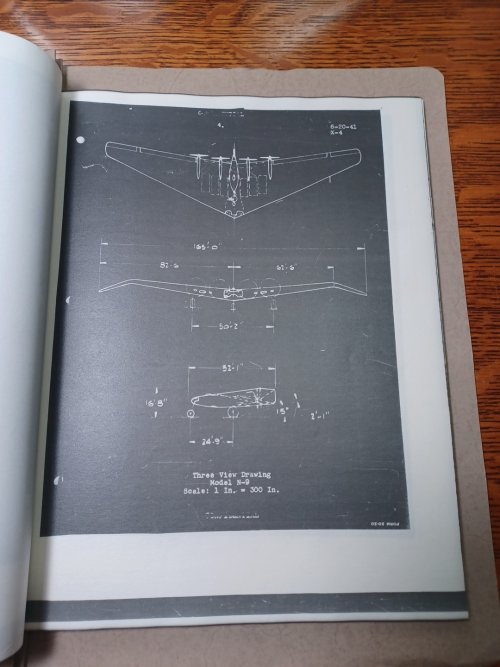
I've never seen downturned wingtips on a full-sized XB-35 design before. At what point were they removed and the wings straightened ?

cheers,
Robin.
Explanation here:

Flying Wings & Radical Things: Northrop's Secret Aerospace Projects & Concepts 1939-1994 by Tony Chong

https://www.amazon.com/Flying-Wings-Radical-Things-Northrops/dp/1580072291
Pages 10 to 12 and Pages 25 to 27

Jack Northrop early studies for N-1 medium bomber featured downturned wingtips. The early N-9 designs were an upscaled N-1 derivative. Downturned wingtips should have been short lived. N-1 is from 1937 while N-9E (the XB-35 selected design is from 1941)

The XP-56 fighter also featured downturned wingtips
 
Didn't the Nazi bomber in Indiana Jones have downturned wings like this?


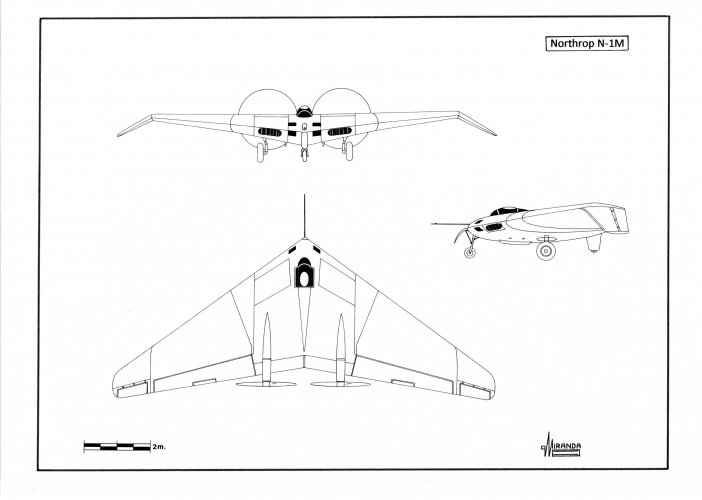
Northrop N-1M​


It was a technology demonstrator aircraft built in the early 1940s to provide that a flying wing would fly.

The prototype was a 45 per cent scaled down version of the Northrop N-1 medium bomber project. It was built in wood/plywood and powered by two 65 hp. Lycoming 0-146 engines.

The N-1M had drooped wingtips to improve directional stability and elevons which combined the functions of elevators and ailerons.

The wing swept could be varied (in the ground) from 6 to 12 degrees and the wing tips anhedral angle from 0 to 30 degrees.

Between July 1940 and December 1941 the prototype conducted 200 flying tests that showed that, in a gentle dive, the Northrop flying wing would accelerate at a much faster rate than any other contemporary aircraft.

During testing it was determined that the wings with 30 degrees wing swept and the wing tips with 0 degrees anhedral were the most effective aerodynamic configuration.

Technical data

Wingspan: 11.80 m (38.7 ft), length: 5.47 m (18 ft), height: 1.50 m (4.9 ft), wing area: 20.10 sq. m (223 sq. ft), max weight: 1,769 kg (3,905 lbs), max speed: 232 kph (373 mph), ceiling: 1,200 m (3,936 ft), range: 480 km (772 mls).
 

Attachments

  • 090.jpg
    090.jpg
    470.8 KB · Views: 54
Thanks, Gents. Have said book, will re-read . . .

cheers,
robin.
 

Similar threads

Back
Top Bottom