Scott Kenny
ACCESS: USAP
- Joined
- 15 May 2023
- Messages
- 19,511
- Reaction score
- 27,958
If you'll go halves on the hotel room I'll help...I need holidays. And a new shovel.

If you'll go halves on the hotel room I'll help...I need holidays. And a new shovel.

oh noThe 705 model was cut up a number of years ago and the pieces were buried in the desert at White Sands.
 (.. Why would they do that? I need a excavator now
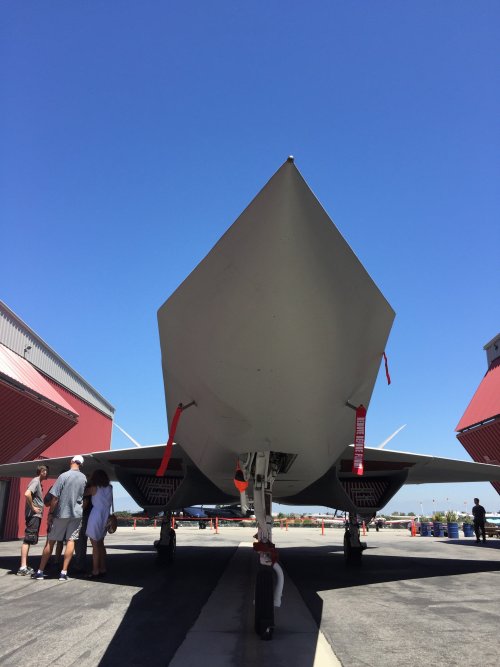
YF-23 AESA radar I found the on https://yf-23.webs.com/radar.html few years ago but unfortunately the website is death
View attachment 749518View attachment 749519





Looks very familiar... Is NGAD... NATF-23!?


The F-4 Phantom had a sliding vent ring at the airframe duct/engine interface allowing excess/overpressure air to vent into the engine bay. Cooled the engine/afterburner too. No external doors needed for this system.I am wondering why, is there some aspect of the F-23 design that makes the overpressure spill doors unnecessary, but necessary for the F-22? Or could the BLC spill doors also be used for this purpose?
And I'd bet that MDD told N about that, just so that they didn't need to use an exterior door and have to mess with stealth.The F-4 Phantom had a sliding vent ring at the airframe duct/engine interface allowing excess/overpressure air to vent into the engine bay. Cooled the engine/afterburner too. No external doors needed for this system.

F-23 RCS test model:


The F-22 spill doors allow the engines to reduce its airflow below mil/intermediate power in order to decelerate at supersonic Mach numbers while maintaining inlet airflow to prevent subcritical conditions and buzz instability. I think it's plausible that the BLC vents on the F-23 can serve the same purpose, although I'm not sure they would have enough flow rate. Paul Metz's book did not mention the BLC vents having this purpose. The book also mentioned that the vents on the F-23 were simplified compared to the YF-23. Some have mentioned an internal venting mechanism, which again is plausible although I don't see indications of that in the drawings (which to be fair may not have them since they're just the general basic layout), or any kind of downstream vent such as an annular one near the nozzle.I am wondering why, is there some aspect of the F-23 design that makes the overpressure spill doors unnecessary, but necessary for the F-22? Or could the BLC spill doors also be used for this purpose?

I've seen some articles characterizing the F-23 inlet design as a "DSI", but I don't think that's the case based on the geometry and also the presence of the BLC vents. Those bumps are compression surfaces similar to a shock cone, and another mechanism is still needed for removing the turbulent boundary layer.

Shame they didn't get a family photo in the air.
Hopefully we learned some lessons about that after the XB-70

AAP / AAPS patent
https://patents.google.com/patent/US5318018A/


did never happen thoughAre they simply discarded, scrapped without further interest?
NASA also wanted to explore YF-23 (PAV-2) supercruise, that put the nail in the coffin for NASA, the USAF said no-way since to this day PAV-2 supercruise is still classified but only if you read between the lines. In any published works about YF-23 and PAV-2, they always mention the max speed flown was mach 1.8 and supercruise classified, see the point.did never happen though
That at least leads me to think that they either 1) never did a full-burner top speed run or 2) Supercruise speed wasn't quite M1.8.NASA also wanted to explore YF-23 (PAV-2) supercruise, that put the nail in the coffin for NASA, the USAF said no-way since to this day PAV-2 supercruise is still classified but only if you read between the lines. In any published works about YF-23 and PAV-2, they always mention the max speed flown was mach 1.8 and supercruise classified, see the point.