YF-23 AESA radar I found the on https://yf-23.webs.com/radar.html few years ago but unfortunately the website is death
View attachment 749518View attachment 749519


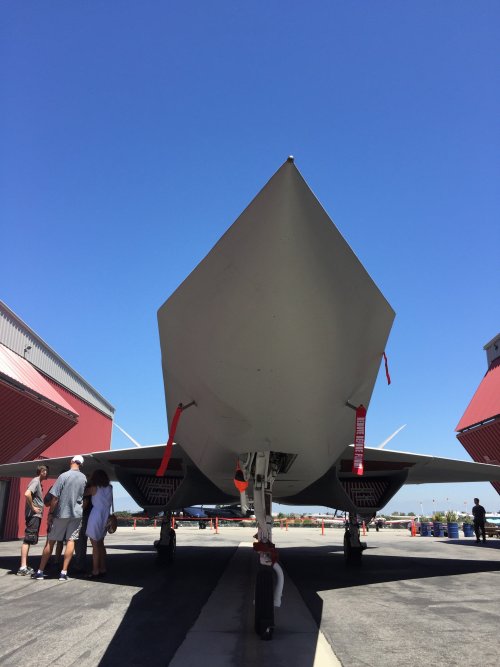
From what I understand the YF-23 never flew with a radar but it was supposed to use the AN/APG-77, perhaps I’m misunderstanding? Anyone knows how large the random housing in the YF-23 is? It looks like a larger random than what the F-22 has. Theoretically it looks like it may have been able to house a larger radar with more TR modules.

It’s been said a thousand times but the YF-23 was one of the nicest looking aircraft and had a much lower RCS compared to the YF-22 with it omitting horizontal stabilizers thus reducing a corner reflector, no intake tunnels which also also redced the RCS, thinner wings, nozzles being shielded by the “ruddervaders” giving it lower IR. The nozzles were also further back and the top half open which allowed for even better IR reduction especially with cool air mixing in with the hot gasses. The nozzles also had less seems compared to the YF-23 or even F-22 further reducing RCS.

This aircraft was way ahead of its time, plus it had better range and was very similar to maneuverability to the YF-22. I can imagine how much better it would have been with modern flight control computers and engines. The YF-23 looks more like a 6th generation aircraft than a 5th generation, this aircraft would be perfect with its long range and stealth to operate in the South China Sea.
 
An F-23 with 3-stream engines, avionics & sensors from an F-35 and modern durable RAM would be a sight to behold. Wasn't too crazy about their weapons bay design though.
 
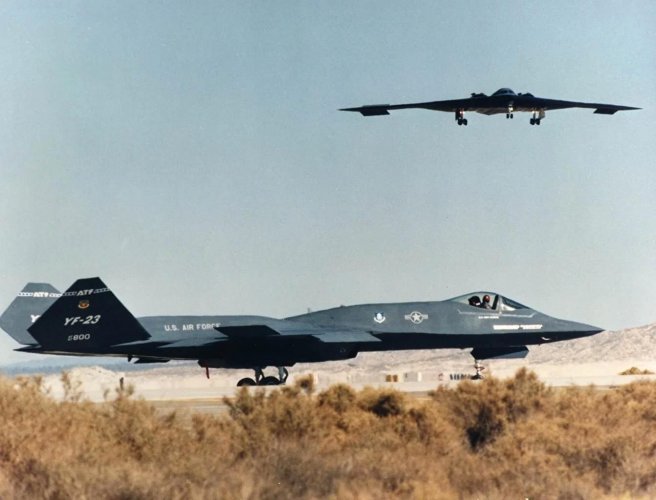
I watched and old YF-23 documentary and an interesting thing was mentioned….YF-23 and B-2 were in development in the late 1980s so they share some similar DNA. I gave it some thought and the similarities were striking; some things i noticed is the YF-23 and B-2 share similar philosophies with the exhaust, intakes, narrow fuselage, large serrated trailing edges and a high lift fuselage. It kind of blew my mind, a high speed agile fighter took a page from a heavy strategic bomber.


I took some screenshots, first two pictures really illustrate the point, the last picture of the simulator cockpit was just rare so I thought I would post it:

IMG_2234.png IMG_2230.png IMG_2232.png
 
Hello! I have been searching through this entire thread for some pictures of what an F-23 cockpit and MFDs would look like. I found some interesting pictures and wonder if there are anymore like this one? Perhaps more MFD action?
 

Attachments

  • YF-23CockpitBetter.png
    YF-23CockpitBetter.png
    614.9 KB · Views: 173

Attachments

  • 499536228_1097337795759438_8551886761326351327_n.jpg
    499536228_1097337795759438_8551886761326351327_n.jpg
    521.3 KB · Views: 255
  • 499222271_1097338825759335_8670762559261674246_n.jpg
    499222271_1097338825759335_8670762559261674246_n.jpg
    495 KB · Views: 242
  • 500005046_1097338822426002_6969672350853765266_n.jpg
    500005046_1097338822426002_6969672350853765266_n.jpg
    528.3 KB · Views: 232
  • 499786752_1097338819092669_2627914506627979921_n.jpg
    499786752_1097338819092669_2627914506627979921_n.jpg
    439.4 KB · Views: 223
  • 499680318_1097338795759338_3042626185794792943_n.jpg
    499680318_1097338795759338_3042626185794792943_n.jpg
    442.5 KB · Views: 244
Last edited:
Hi everyone,

I am currently working on a 3d model of the F-23 EMD version.
Since the EMD (DP231) was never build I have to make some assumptions about certain aspects.
In the schematics the the design only shows BLC spill doors, but no overpressure spill doors, like the F-22 has.
I am wondering why, is there some aspect of the F-23 design that makes the overpressure spill doors unnecessary, but necessary for the F-22? Or could the BLC spill doors also be used for this purpose?

So far I have not yet found any answer to this question. Any help or pointers would be appreciated.
 
I am wondering why, is there some aspect of the F-23 design that makes the overpressure spill doors unnecessary, but necessary for the F-22? Or could the BLC spill doors also be used for this purpose?
The F-4 Phantom had a sliding vent ring at the airframe duct/engine interface allowing excess/overpressure air to vent into the engine bay. Cooled the engine/afterburner too. No external doors needed for this system.
 
The F-4 Phantom had a sliding vent ring at the airframe duct/engine interface allowing excess/overpressure air to vent into the engine bay. Cooled the engine/afterburner too. No external doors needed for this system.
And I'd bet that MDD told N about that, just so that they didn't need to use an exterior door and have to mess with stealth.
 

Attachments

  • IMG_3585.jpeg
    IMG_3585.jpeg
    59.2 KB · Views: 217
  • IMG_3586.jpeg
    IMG_3586.jpeg
    41.6 KB · Views: 203
  • IMG_3587.jpeg
    IMG_3587.jpeg
    57.4 KB · Views: 184
  • IMG_3588.jpeg
    IMG_3588.jpeg
    34.5 KB · Views: 171
  • IMG_3589.jpeg
    IMG_3589.jpeg
    41.1 KB · Views: 184
  • IMG_3590.jpeg
    IMG_3590.jpeg
    41.9 KB · Views: 200
Last edited:
I am wondering why, is there some aspect of the F-23 design that makes the overpressure spill doors unnecessary, but necessary for the F-22? Or could the BLC spill doors also be used for this purpose?
The F-22 spill doors allow the engines to reduce its airflow below mil/intermediate power in order to decelerate at supersonic Mach numbers while maintaining inlet airflow to prevent subcritical conditions and buzz instability. I think it's plausible that the BLC vents on the F-23 can serve the same purpose, although I'm not sure they would have enough flow rate. Paul Metz's book did not mention the BLC vents having this purpose. The book also mentioned that the vents on the F-23 were simplified compared to the YF-23. Some have mentioned an internal venting mechanism, which again is plausible although I don't see indications of that in the drawings (which to be fair may not have them since they're just the general basic layout), or any kind of downstream vent such as an annular one near the nozzle.

I've seen some articles characterizing the F-23 inlet design as a "DSI", but I don't think that's the case based on the geometry and also the presence of the BLC vents. Those bumps are compression surfaces similar to a shock cone, and another mechanism is still needed for removing the turbulent boundary layer.
 
I've seen some articles characterizing the F-23 inlet design as a "DSI", but I don't think that's the case based on the geometry and also the presence of the BLC vents. Those bumps are compression surfaces similar to a shock cone, and another mechanism is still needed for removing the turbulent boundary layer.
5542803831_5d405064e7_o.jpg
 
Right, the YF-23 used a porous bleed system rather than a splitter plate for removing the boundary layer. The F-23 likely has a similar bleed system, but a DSI (diverterless supersonic inlet) removes the boundary layer entirely using a bumped surface and forward-swept cowl, which isn’t the case with the F-23 given the overall cowl geometry and the presence of BLC vents.
 
Last edited:
AAP / AAPS patent
 

Attachments

  • US5318018.pdf
    2.6 MB · Views: 57
AAP / AAPS patent
View: https://www.youtube.com/watch?v=Ijh_uDcL0_o


I believe at some point he says that with this suit 11Gs were tolerated as easily as 9 in normal G suits.
 
I created a separate topic for the 35 year first flight anniversary release of YF-23A by Top Mach Studios for Microsoft Flight Sim.

https://www.secretprojects.co.uk/th...os-for-microsoft-flight-simulator-2020.49210/

The level of detail is definitely worth a look.


For the production version, they made a decision to not model the EMD F-23A due to cost. I can understand that.

Still, I now wish they create a (insert preferred crowdfunding platform) page just to see how much interest there is from people with wallets to see the same level of details applied to the EMD version.
 
This may have been mentioned but I must have missed it. Does the 'loser' in these competitions get flown for research after the even? Are they simply discarded, scrapped without further interest?

If so it seems to be a waste of resources.

Sorry, my smelling is going AWOL again. More water with the coffee, or less.
 
Last edited:
I don’t believe the YF-23 airframes flew again after the completion of the Dem-Val flight program. The YF-22 / YF119 did resume flying for additional risk reduction data collection for a short duration after F-22 / F119 decision until the PIO landing event damaged the airframe beyond economic repair.
 
did never happen though
NASA also wanted to explore YF-23 (PAV-2) supercruise, that put the nail in the coffin for NASA, the USAF said no-way since to this day PAV-2 supercruise is still classified but only if you read between the lines. In any published works about YF-23 and PAV-2, they always mention the max speed flown was mach 1.8 and supercruise classified, see the point.
 
NASA also wanted to explore YF-23 (PAV-2) supercruise, that put the nail in the coffin for NASA, the USAF said no-way since to this day PAV-2 supercruise is still classified but only if you read between the lines. In any published works about YF-23 and PAV-2, they always mention the max speed flown was mach 1.8 and supercruise classified, see the point.
That at least leads me to think that they either 1) never did a full-burner top speed run or 2) Supercruise speed wasn't quite M1.8.

Of those two, I lean more towards option 1, since the EMD was going to have notably different aerodynamics than the YF there wasn't much point in doing a top-speed blast with the YF-23s.
 
The other possibility is that Northrup knew that their YF-23 inlet design did not function well above M1.8, possibly resulting in excessive inlet distortion and engine stall. I don't know if this is true, but there may have been a reason that they did not demonstrate a Mn higher than the YF-22, and there was a significant inlet redesign for the EMD F-23.
 
Back
Top Bottom