Today, rockets become more sizable even as drones shrink…the opposite of the era when Delta IIs shared the skies with 747s and A380s.

From the 1950s to the 1970s, anything seemed possible for awhile, so we can forgive the enthusiasm of that era, at least.
Huh??? Rockets have *ALWAYS been sizable, from fireworks to SLS, but perhaps you mean to refer to either SRBs (very sizeable indeed!) or to whole space launch vehicles, so ***PLEASE*** provide the *concrete/representative* as well as *extreme* examples you have in mind, ok???
 
Last edited:
Which the launch aircraft plays no part of.
Now from extensive online experience I have gathered that you have a shall we say somewhat warped sense of reality, but claiming that a launch aircraft as an *integral* *major* launch system element plays *NO* part in coming "back to earth and reusability" is a stretch even for you...
 
Last edited:
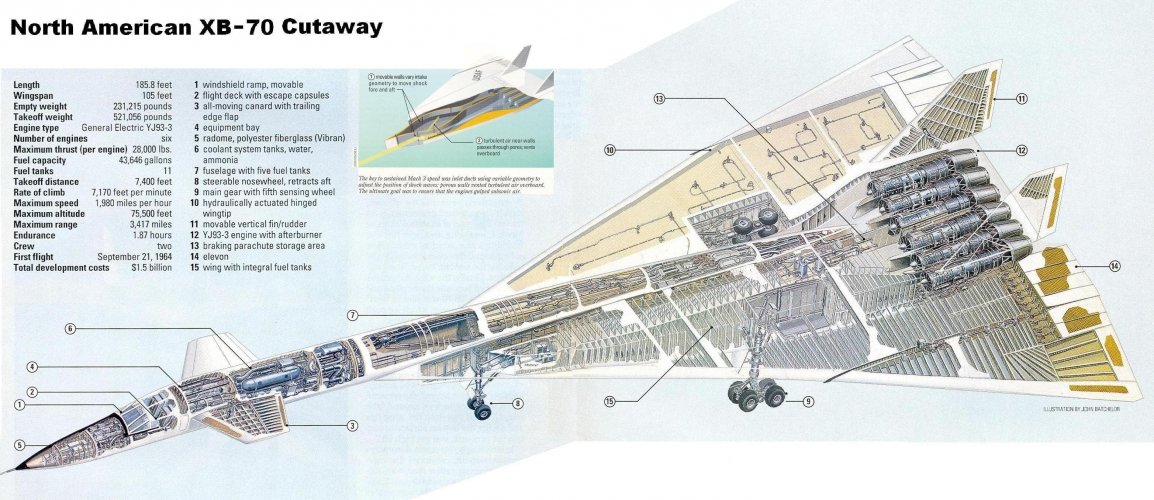
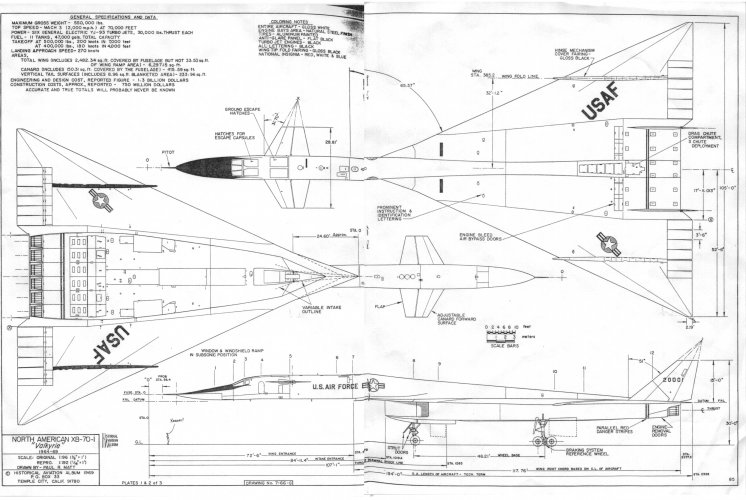
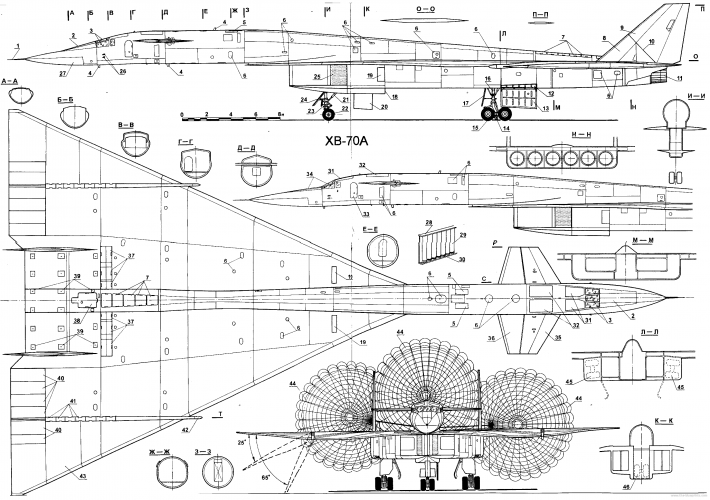
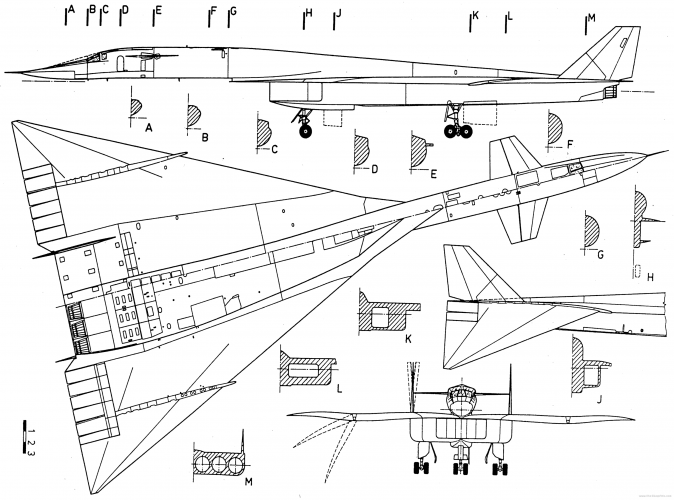
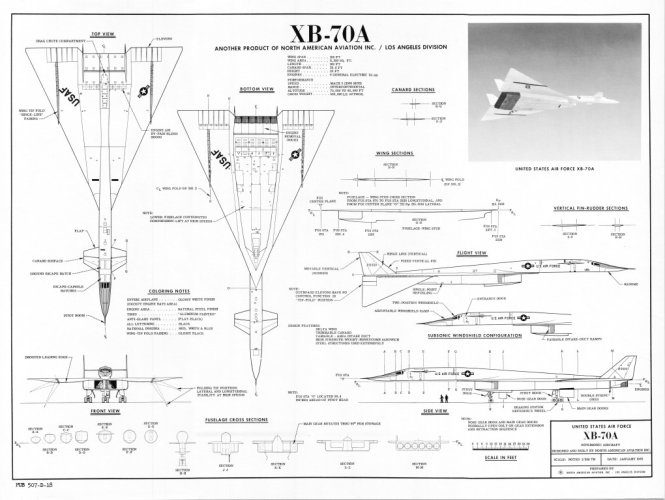
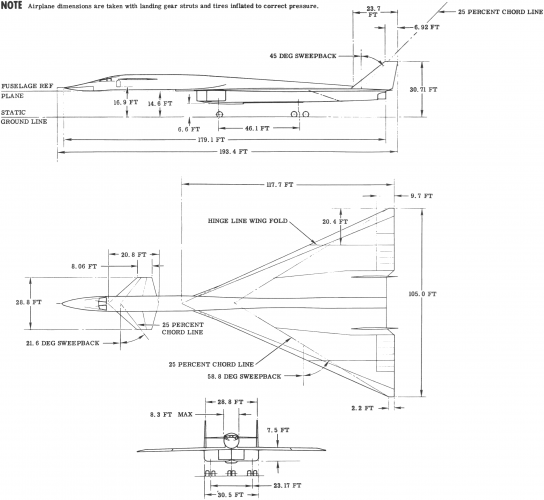
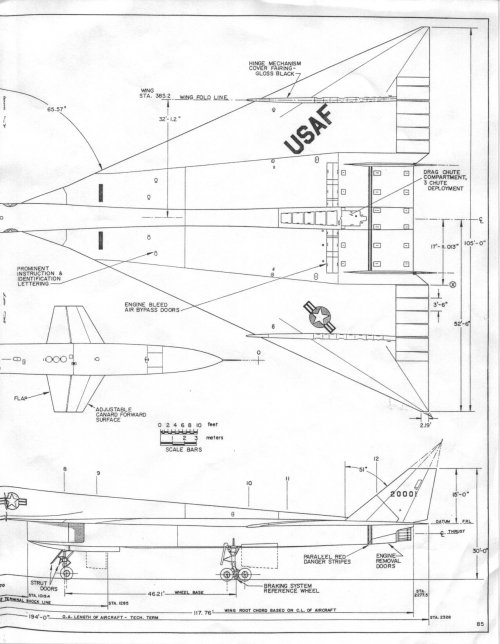
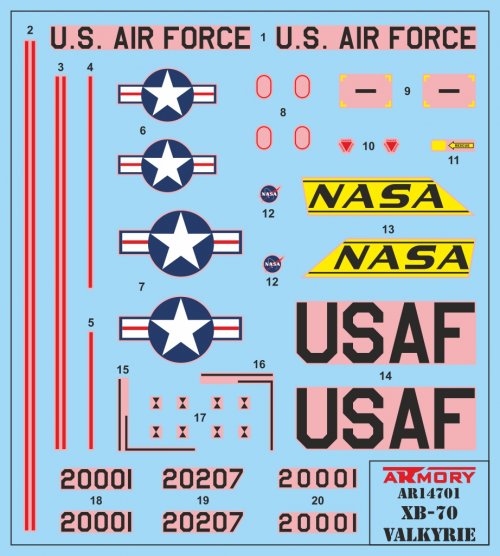
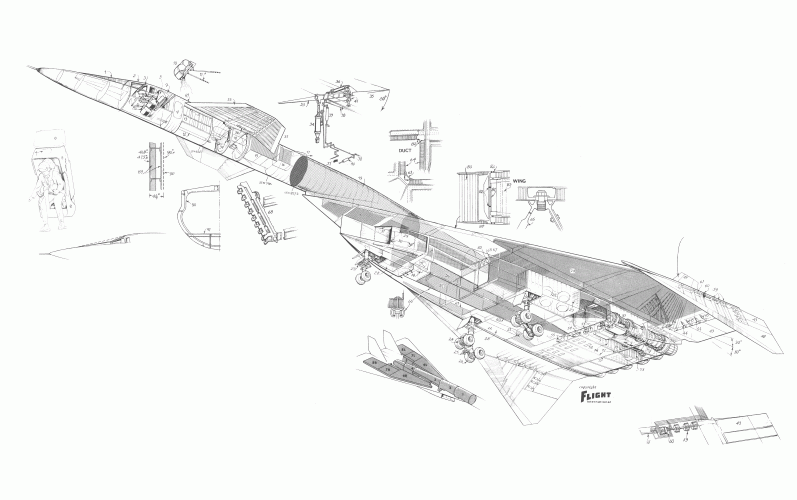
More Data . . .
 

Attachments

  • XB70-Valkyrie-views.jpg
    XB70-Valkyrie-views.jpg
    880.4 KB · Views: 100
  • notth-american-xb-70a-valkyrie.png
    notth-american-xb-70a-valkyrie.png
    313 KB · Views: 90
  • north-american-xb-70a-valkyrie-2.png
    north-american-xb-70a-valkyrie-2.png
    360.7 KB · Views: 89
  • North-American-XB-70A4.jpg
    North-American-XB-70A4.jpg
    177.6 KB · Views: 87
  • North_American_XB-70A_Valkyrie_3-view_line_drawing.png
    North_American_XB-70A_Valkyrie_3-view_line_drawing.png
    480.7 KB · Views: 87
  • ee18373949a9388ff82e781772c70186.jpg
    ee18373949a9388ff82e781772c70186.jpg
    231.6 KB · Views: 82
  • AR14701-1-144-XB-70-Valkyrie-decal.jpg
    AR14701-1-144-XB-70-Valkyrie-decal.jpg
    366.5 KB · Views: 107
Last edited by a moderator:
A reminder of what a beautiful aircraft the XB-70A was, it's a pity it didn't see even limited production. I wonder if the US never got involved in the Vietnam war we might've seen limited production of the B-70A?
No, it had been cancelled by Eisenhower, and only kept as a research project. LeMay tried to bring it back but Kennedy kept it killed as a weapons program, and that was all before Vietnam. McNamara was big on ICBMs and SLBMs, which was the right call, as cool as the XB-70 was. I'd have like to have built AV/3, but there we are.
 
By 1964 the Soviets already possessed small nuclear warheads capable of extending the kill ratio of the SA-2 to 19,680 ft and the ceiling to 80,000 ft.

The Valkyrie program suffered numerous delays due to inexperience with the new heat-resistant materials, as well as political and budgetary reasons. When the prototype XB-70 AV-1 was flown on September 21, 1964 the Soviet air defense system was already so consolidated that the WS110A specification was meaningless and the B-70 was cancelled by the Kennedy Administration.

In August 1958, the North American project office submitted the proposal Defensive Antimissile System (DAMS) using air-to-air missiles launched by the Valkyrie.

The Defense Feasibility Study was completed in March 1959 and published by the Air Proving Ground Center-Eglin AFB the same month the U-2 incident occurred.

In 1948 the first experimental AAM-A-2 air-to-air missile was launched and entered in service with the USAF in 1955 as the Hughes AIM-4 Falcon.

The original purpose of the Falcon was a Mach 3.8 self-defense weapon for the B-52 bomber and was shortly revived during the B-70 development. The rail-launched missile was not a particularly maneuverable and needed to be pointed in the right direction of the target.

Due to the B-70 speed the Falcon could just be used against any threat coming from its forward hemisphere, but the Valkyrie would have to defend itself against threats from all direction with spherical coverage.

The Falcon was a cylindrical rocket with four delta wings. Would it have been thrown sideways from a B-70 flying to Mach 3 it would have been destroyed by the crosswind shock waves.

North American proposed the Weapons System WS-740A, a wingless lenticular-form rocket with omnidirectional launch capabilities, capable of engaging incoming missiles at relative speeds of Mach 10 and being able to survive and maneuver at 250g accelerations.

The project was awarded to the Convair Division of General Dynamics Corporation, under the codename Pye Wacket, in June 1959.

The B-70 had been cancelled as a weapons program by Eisenhower before the 1960 Election. SAMs were already known (from the U2), and ICBMS were clearly the way forward. There was no real "missile gap". This was all well understood way before 1964. The XB-70 program was only kept for research (and jobs), despite USAF saying they still wanted it.
 
In retrospective, we can argue that cancelling the B-70 on the basis of early SAM availability was the wrong choice. A-12/SR-71 as Mig-25 proved that intercepting a Mach3 airplane was not that straightforward and required more that solely having SAM. A fleet of B-70 could certainly have pierced the defensive screens of the USSR nearly as easily as B-2 would do today until late in the era.
 
From a logistics view the B-70 program was unsustainable. It is nothing like the B-2A where you could build specialized hangars across the globe to maintain it. The aircraft required huge base improvements just to operate it. And individual aircraft costs would have afforded perhaps a similar purchase of a couple dozen while necessitating the retirement of most previous bombers just to afford to operate them. You could afford a half dozen or more B-52s for one B-70. The real kicker was that the B-70 was an edge case on which ordnance could be carried. It just was not a multipurpose proposition like the B-52.

Such a sweet and savory dish with a bitter aftertaste.
 
From a logistics view the B-70 program was unsustainable. It is nothing like the B-2A where you could build specialized hangars across the globe to maintain it. The aircraft required huge base improvements just to operate it. And individual aircraft costs would have afforded perhaps a similar purchase of a couple dozen while necessitating the retirement of most previous bombers just to afford to operate them. You could afford a half dozen or more B-52s for one B-70. The real kicker was that the B-70 was an edge case on which ordnance could be carried. It just was not a multipurpose proposition like the B-52.

Such a sweet and savory dish with a bitter aftertaste.
Readily agree. http://xb70.interceptor.com/
This website (which I like very much) show how much unreliable PITAs were the two XB-70s. The first one was such a flawed plane, it ended redlined to Mach 2.5. Second one was much less a lemon but still was somewhat tricky to fly in many areas. One example is the undercarriage and its massive hydraulics, that regularly leaked and refused to retract.
 
This website (which I like very much) show how much unreliable PITAs were the two XB-70s. The first one was such a flawed plane, it ended redlined to Mach 2.5. Second one was much less a lemon but still was somewhat tricky to fly in many areas. One example is the undercarriage and its massive hydraulics, that regularly leaked and refused to retract.

You do realise that those two aircraft were prototypes and that such unreliability was not uncommon? If the preproduction YB-70A had been completed I suspect it would've been more reliable.
 
In retrospective, we can argue that cancelling the B-70 on the basis of early SAM availability was the wrong choice. A-12/SR-71 as Mig-25 proved that intercepting a Mach3 airplane was not that straightforward and required more that solely having SAM. A fleet of B-70 could certainly have pierced the defensive screens of the USSR nearly as easily as B-2 would do today until late in the era.
Hard to tell tbh.
Both S-200 and mig under combat conditions would had been firing nuclear missiles;
Soviet Union produced quite a lot.

Vietnam probably wouldn't appreciate barely vulnerable bombers, but then again - B-58s were there, and they weren't deployment at all.
 
Hard to tell tbh. Both S-200 and mig under combat conditions would had been firing nuclear missiles.

While the SA-5 Gammon no doubt had a nuclear armed variant is there any evidence that the AA-6 Acrid had a version equipped with a nuclear-warhead?
 
While the SA-5 Gammon no doubt had a nuclear armed variant is there any evidence that the AA-6 Acrid had a version equipped with a nuclear-warhead?
Tbh, as a rule of thumb, anything Soviet and large enough had a "special warhead" variant.

And while there's little information available, same is understood to be broadly true for modern Russia, just at a far lesser deployment scale.
 
Tbh, as a rule of thumb, anything Soviet and large enough had a "special warhead" variant.

And while there's little information available, same is understood to be broadly true for modern Russia, just at a far lesser deployment scale.
If it was anything like the US, well, 2,550 W31s were produced just for the Nike Hercules force.
 
Why? Didn't use special fuel like the Blackbirds. No astronaut suits, etc. As for, "edge case on which ordinance could be carried" it was no different than the B-52 or B-58 in that regard for the nuclear mission.
See alert pod. It could not self start. Also, cockpit access was not standard equipment.
 
See alert pod. It could not self start. Also, cockpit access was not standard equipment.
Which is why it had the alert pod. With it it could self start. (Or they could have developed a cartridge system like the B-52 and proposed F-12B.) Cockpit access was a trivial issue they could have solved.
 
Of course not. The B-58 was special weapons only.
Well SAC's 58s hold the wall against the Soviet block while the US DoD had its foot in the beehive (foot and head, in fact).

Look at Linebacker raids and the amount of strategic assets it required a mere ten years only after the Cuba crisis.
 
But how good XB-70 would have been for conventional bombing?

Pretty difficult to assess when none were built. And they probably wouldn't have built very many, so I don't think SAC would have been too keen to equip them with conventional stores and avionics, let alone risk them bombing some trees in Vietnam.
 
IIRC, I think from a doc @RyanC posted on Alternate Wars, the inventory target in the late 1950s was around 200 aircraft. Had they been built, I’m certain they would have been 100% dedicated to SIOP. They were not intended to be 1-for-1 B-52 replacements.
 
Some raw numbers
- 2042 B-47s built, medium bombers, of which 1341 were B-47E (plus a few hundred more B-47B converted into -E)
https://www.aircraftinformation.info/JB_AIF/usaf_bombers/b47_3.html

- only 116 Hustlers, supersonic medium bombers

- 744 B-52s, of which 295 were B-52G / B-52H: 193 and 102 respectively

-Retirement of the B-47s (plus KC-97s) in 1966 send a thousand B-47s to the Davis Monthan boneyard.
 
Last edited:

Similar threads

Back
Top Bottom