No German V-2

Haha, I’ve never put forward any fallacies—and even if I did, I certainly wasn’t the first. Defining whether a country "needs" a certain technology based solely on its ability to independently develop it is, in itself, absurd.

Without German technology, could the Soviets not have developed their own ballistic missiles or SAM? The Soviets were no less intelligent than anyone else; they had the talent and sufficient resources, so I believe they could have. But does that mean they didn’t "need" German technology? I don’t think so either. German technology helped them progress faster.

I think this applies to the vast majority of technologies in the world—some advance faster, some slower, but with enough resources and talent, they will eventually be developed. However, if they "need" the achievements of others, they will gladly accept them.

The Americans adopted German turbopump technology, and the fact that they could have independently developed similar or equivalent turbopumps doesn’t change the reality that they "needed" German technology. They accepted it and used it to achieve many great things.

The British in 1917, during WW 1, invented and built the first operational class of high underwater speed submarines, the R Class. These boats could reach 14 knots submerged, about triple the average underwater speed of a submarine at the time.
The Japanese in WW 2 independently of the Germans came up with a high underwater speed submarine (the I 201 class) and used them operationally.
Are you still trying to claim that other countries couldn't come up with inventions on their own without German technology?

In the field of radar, the German leadership admitted that by 1943 they were at least a decade behind the Western Allies.

My point is, the US and Britain didn't need, nor did they want, a large ballistic missile. They saw no military value in one and therefore didn't bother to develop one.

At the end of WW 2, the Soviets and French both facing a situation where their nation had lost any R&D effort towards many advanced weapons systems saw using German technology as a short cut to get those technologies in place. Oddly, in both cases, they wasted nearly 5 years trying to get German SAM technology to work for them only to realize it was all just crap other than a few specific bits like engines. At that point both dumped the German technology in favor of home-grown designs.
I don't deny America's capabilities.

Yes, you do.
But starting ballistic missile development in 1942 was too late for the Americans. By that time, the Germans already had the A4 rocket—all they needed was more testing to refine it. If the Americans were to begin development in 1942, they would essentially be starting from scratch. Did they have a proven aerodynamic design? A verified propulsion system? A tested thrust-vector control system? No. The Americans would have to complete all of this first just to reach the level the Germans had achieved by 1942.

The Americans weren't interested in that technology. They saw no viable use for it, so they ignored it.
The Americans weren’t smarter than the Germans, nor did they necessarily have more resources (bomber forces would compete for those). The time the Germans had spent on their path of development, the Americans would also have to spend. Perhaps American progress would be faster, but from the outset, they were already behind in time. Had the U.S. begun ballistic missile research in 1939, they might have outpaced Germany. But in 1942? For America, it was simply too late.

The Americans had far greater resources than the Germans. They also made much of what they invented available to any corporation or entity working in that field. There were no monopolies. In Germany, companies often worked as monopolies. Information was held closely as a valuable commodity to be traded only for profit. For example, at Peenemunde, the Heer and Luftwaffe had completely separate facilities built and there was only limited cooperation between the two.

The US, again, simply saw ZERO need for a ballistic missile in the early years of WW 2. Let's say, for sake of argument, the US comes up with, builds, and can deploy a V-2-like missile by early 1944. What does that buy them? Does spending the equivalent of another Manhattan Project or more on this get them something valuable militarily?
First, he received funding from the German military very early, before the war broke out.

The army was very reluctant to fund v. Braun at all. Only Walter Dornberger the head of rocketry for the army showed any interest. v. Braun tried to pitch other uses for rockets with only limited success at the time.
 
Not true. The Germans had one solid fuel available, Diglykol, a 1920's - 30's double base nitrocellulose propellant. The US had a selection of much better fuels like GALCIT 53, 61, Thiokol, and the like to use. In liquid fuels, the US had knowledge of virtually all of the same ones the Germans had access to except possibly ones based on hydrogen peroxide.
So, do you have a better rocket engine than the V-2's?

What the US wanted out of their missiles was a weapon that met specific requirements and was sufficiently accurate enough to perform the task it was meant to do.

The US had no need for a ballistic missile, so they didn't develop one. Again, you keep making a false dilemma here by arguing that because the US didn't do something they couldn't do that thing.
Alright, the U.S. didn’t need ballistic missiles—it needed AAMs and SAMs. Surely that counts as "America chose to do something, America was capable of doing something," right? So in 1945, for the AAM and SAM projects that the U.S. both had the capability and the will to pursue—did they advance further than the Germans?

Yes, they did have them. The J32 was an operational jet engine by 1945, the problem was Westinghouse botched the series production of it. It first flew in a TD2N Gorgon IIB in June 1945 with development starting in November 1944.

This is all part of Bumblebee:
In ramjets, the first Cobra ramjet missile test occurred near NAS Cape May NJ, on June 13th 1944 with a missile running on carbon disulfide at Island Beach NJ. By February 1945, telemetered Cobra shots were occuring there, the first on 16 Feb 1945. These used 4 5" HVAR rocket motors to drive the ramjet to supersonic speed where it ignited.
By June 1945, the larger 12" Burner Test Vehicle (BTV) was being tested at Topsail Is. N. Carolina flying at Mach 2 to 20,000 feet and over 10 NM ranges.

The US copied the V-1 because it was so simplistic that it was easy to do so. It took the US just 60 days from capturing wreckage to duplicate the V-1 as the JB-2. Hardly some massive feat there.
In 1945, they were not yet mature engines. Like I said.

Rheintochter suffered from having nothing in the way of a sufficiently energetic solid fuel resulting in the range and altitude being so poor that the Luftwaffe rejected the missile initially. Enzian's specificized engine the HWK 109-739 wasn't available, and Walther never got it working right, so initially, an HWK 109-500 JATO rocket motor was substituted for airframe testing.
Wasserfall had all sorts of issues in early testing too such that by January 1945 of 16 shots only 4 were considered successes and none had been made with any form of guidance.
You left out Schmetterling that wasn't doing much better...

Thus, by January 1945, yes the Germans were testing SAM missiles with poor success and underwhelming performance while having no viable guidance system in place or close to being ready for testing as a system.
Did the Americans have a more mature surface-to-air missile program than theirs (Germany's) by then?

The X-4 was a pathetic joke as an AAM. The JB-3 started development in February 1944 by Huges Aircraft. It was intended to have, variously as the guidance systems weren't fully tested yet, either a semi-active radar homing, active radar homing, beam riding radar, or television MCLOS guidance system used. The guidance systems were streets ahead of anything the Germans had at the time.
Were those fancy guidance methods of theirs even mature or viable by 1945?

And, it was cost ineffective, ineffective as anything but a terror weapon, and not worth the cost to produce and fire it.
These systems accomplished the missions assigned to them by the German high command. Therefore, they were not ineffective.

The US didn't particularly need missiles as they were winning the war with the weapons they had. You keep trying to ignore that fact.
If the U.S. didn't need missiles, why did it have so many missile programs? If America truly didn't need them, then its investment of resources and talent must have been less than Germany's—which did need missiles. This naturally led to Germany's rocket technology surpassing America's. Isn't this obvious?

And in terms of their guidance system years ahead of Hs 293 and Fritz X. The Douglas LBD Gargoyle guided AShM was under test at the Salton Sea in California by the beginning of 1945. 400 were ordered in the summer of 1944 for testing. It used the proven guidance system that Pelican and Bat used.
So they were still guided bombs after all.

Trivial objections fallacy on your part. The US was being more thorough in their programs, not trying to rush some half assed, incomplete system into service like the Germans were. None of the German SAM systems were anywhere close to being really viable operationally. So, even as they rushed ahead with missile development, they didn't have something that would work in service and were years from getting one.
You criticize me for unfairly comparing postwar America to wartime Germany, yet you comfortably pit mature 1950s technology against Germany's wartime technology.

If you want to prove that American rocket (or missile) technology was superior to Germany’s, you’ll need to provide projects that actually existed in 1945.
The Germans, also, weren't even trying a ramjet SAM design out by the end of the war.
Was ramjet SAM technology truly advanced? Are there still ramjet SAMs in service today? Liquid-rocket SAMs and solid-rocket SAMs have far longer service lives than ramjet SAMs ever did.

The problem was, in 1946 the state of the art in ballistic missiles was a SRBM with 200 to 300 miles range. This was nearly worthless as a military weapon. Even projected IRBMs that were ten years out didn't offer a suitable range for many applications. It would take nearly two decades of steady development to get to a point where a viable ICBM was in service with any nation.

By comparison, the B-36 was going into production by the beginning of 1947 and more intercontinental bombers were in the works. Even the B-29/50 (B-29D) could hit targets deep inside the Soviet Union from bases in the UK, Middle East, or Japan. Bombers made more sense than missiles in 1946 to 1950. Yes, the US and others could see the potential value of ballistic missiles for nuclear bomb delivery and worked to develop such a delivery system. They also recognized it wasn't going to be a year or two to getting to something viable.

In 1947, a B-36 flying at 35,000 feet and 350 mph was all but immune to AA gun fire and un-interceptable by anything the Red Air Force had flying with the possible exception of a handful of jets. To make matters worse for the defense, the Soviet Union lacked a viable air defense early warning and control system to put defending aircraft in a position to intercept. On top of that, they lacked a viable nightfighter force and the necessary radar and control system to vector the planes--that barely existed--to an intercept.

So, the Soviet Union was all but defenseless while they had no means to retaliate against the US. Bombers made sense, missiles didn't.
The MX 774 C "Manhattan," demonstrated that some still recognized the potential of ballistic missiles for long-range nuclear capabilities at the time. Soviet jet aircraft and radar systems were only going to become more numerous and advanced (as indeed they did). Investing in ballistic missiles in 1945 was not at all unreasonable.


When I'm discussing U.S. and German rocket technology, you insist on bringing up numerous non-rocket-powered missiles. Do you not understand what a "rocket" actually is?
 
That compares apples to automobiles. The US in 1945 had many solid fuel motors more powerful than any solid fuel engine the Germans had.
Well, they aren't as different as apples and cars—more like, say, apples and bananas. Solid rocket engines and liquid rocket engines are both still rocket engines. They're fundamentally different from other aircraft propulsion systems. Despite their differences, they belong to the same category.

As for the V-2 engine, it produced between 50,000 and 60,000 lbf of thrust. Early Nike missile boosters in the 46-program produced 88,000 lbf of thrust on solid fuel. So, yes, the US had solid fuel rocket engines that had more thrust than a V-2 engine.
" Early Nike missile boosters in the 46-program", what specific model are you referring to, and how long can it sustain combustion?

Remember when I mentioned "greater and more sustained thrust"—the V-2's propulsion system wasn't just about more power, but also its extended burn duration. If we judged purely by thrust magnitude alone, then strapping three Tiny Tim rockets together would outperform the V-2's thrust.
 
th


https://www.amazon.com/Intercept-19...phy=78600&hvtargid=pla-4584345016209494&psc=1
OK. I'm looking for the specific page that mentions "the S-25 Berkut SAM system got developed at an insane cost of about 10% of the GDP" —not the cover page. I may not have explained this clearly earlier. My apologies.
 
Titan? Atlas?
Titan 1 - development started in 1955 using the same LOX/RP1 fuel as Saturn V, declared operational in 1960, and withdrawn from service in 1965.
Titan 2 - Development started in 1960 using N2O4/hydrazine hypergolic fuel, declared operational in 1963, and lingered operational until 1987. Though they were only planned to be operational until 1965, because they carried high-megaton warheads the USAF was unwilling to retire the throw weight until it was too dangerous to leave them in service.
Atlas - Development started in 1946, declared operational in 1959, and withdrawn from service in 1965.

What happened in 1965? Solid rocket Minuteman came online. As did Polaris.


OMG, "war crimes."

Bombing others with nuclear weapons is a war crime, and the same goes for using chemical weapons or biological weapons. During the early Cold War, both the U.S. and the Soviet Union were testing, producing, and stockpiling chemical and biological weapons. Do you really think they wouldn’t use them? Do you believe the main reason they refrained was to avoid committing war crimes?
No, it is not.

Nuclear weapons are not part of those treaties, while chemical and biological weapons are.

Biological weapons weren't deployed because as we saw with COVID it's a little hard to control the spread.
Chemical Weapons are on the list of "if you use them the entire rest of the civilized world stomps on you" (words struck because anyone using chemical weapons just demonstrated their uncivilized nature)
 
Are you still trying to claim that other countries couldn't come up with inventions on their own without German technology?
Did I say that?

At the end of WW 2, the Soviets and French both facing a situation where their nation had lost any R&D effort towards many advanced weapons systems saw using German technology as a short cut to get those technologies in place.
The Americans also took the German "groundbreaking or unique" technology shortcut, just like the Soviets and the French.

Oddly, in both cases, they wasted nearly 5 years trying to get German SAM technology to work for them only to realize it was all just crap other than a few specific bits like engines. At that point both dumped the German technology in favor of home-grown designs.
Good that you acknowledge the engine isn't crap. The engine is crucial in missiles, isn't it?

The engine technology derived from the V-2 ultimately enabled the SA-2 missile. It was an indigenous design, yet also an evolution of German achievements. Just like the Atlas, Titan, and other missiles.

The Americans weren't interested in that technology. They saw no viable use for it, so they ignored it.
The US, again, simply saw ZERO need for a ballistic missile in the early years of WW 2. Let's say, for sake of argument, the US comes up with, builds, and can deploy a V-2-like missile by early 1944. What does that buy them? Does spending the equivalent of another Manhattan Project or more on this get them something valuable militarily?
When I stated that U.S. rocket technology lagged behind Germany's in 1945, you argued that lack of intention doesn't equate to lack of capability. Fine, then you should demonstrate your rocket capabilities rather than reinforcing the 'no intention' argument or bringing up numerous examples of non-rocket-powered missiles. What I want to see is America's accumulated rocket technology before 1945. In my view, pre-1945 America simply didn't have sufficient rocket technology accumulation.

Therefore, in the post-1945 period, if America had no rocket technology accumulation and no access to German technology (or say, if German rocket technology had never existed), then naturally it would have taken Americans longer to develop rockets. Because the path the Germans took (in our worldline), the Americans would have had to walk as well (in a worldline where German rocket technology never existed).


The army was very reluctant to fund v. Braun at all. Only Walter Dornberger the head of rocketry for the army showed any interest. v. Braun tried to pitch other uses for rockets with only limited success at the time.
If the German Army had no interest in von Braun's rockets, why did they construct a massive test facility at Peenemünde for his rocket program as early as 1936?
 
Last edited:
The DTIC document doesn't support your claim. Just says Goddard pump was based on steam turbine pumps which was a given.

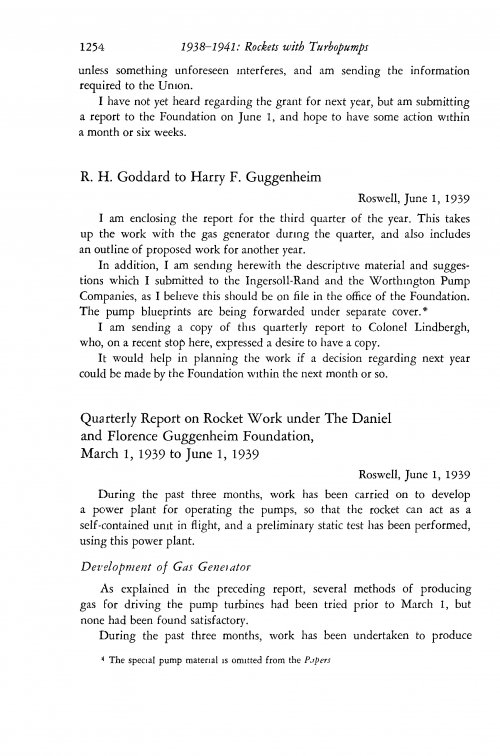
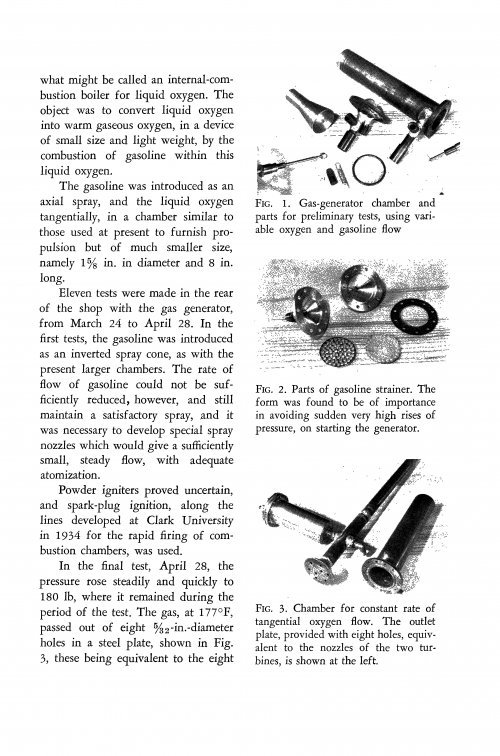
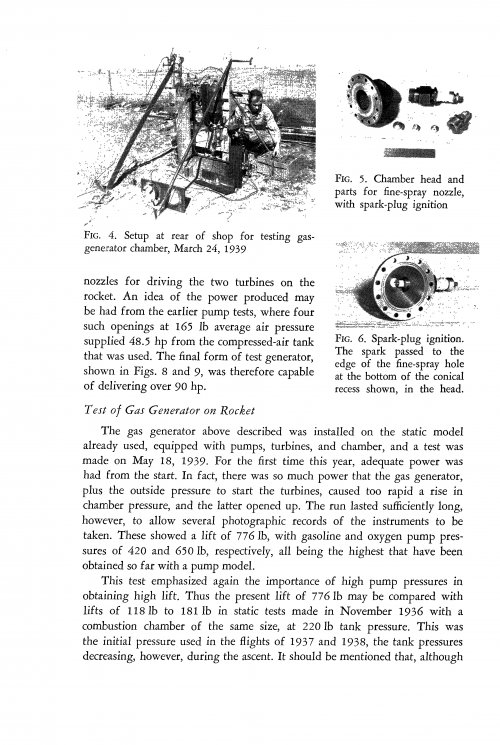
And in Goddard papers from the other link, the June 1, 1939 diary entry is about creating a gas generator using fuel and LOX combustion (see attachments) and not "the expansion of gases produced by fuel vaporization through heat absorption".* Now go and retract all your previous incorrect statements that US rockets engines were not based on Goddard engines but only German.

......and the coup de grâce: the Goddard turbopump "cycle" (using main propellants in the gas generator, which most current engines do) was actually better than the German "cycle" that used different fluids/propellants in the gas generator.

* The fact that combustion was used to provide heat to expand the LOX is meaningless. The gas generator wasn't constrained by the limits of LOX expansion. More fuel could always be added to provide more power.
 

Attachments

  • Pages from vol-3-1938-1941-2.jpg
    Pages from vol-3-1938-1941-2.jpg
    651.6 KB · Views: 18
  • Pages from vol-3-1938-1941-3.jpg
    Pages from vol-3-1938-1941-3.jpg
    2.9 MB · Views: 17
  • Pages from vol-3-1938-1941-4.jpg
    Pages from vol-3-1938-1941-4.jpg
    3.1 MB · Views: 18
Last edited:
So, do you have a better rocket engine than the V-2's?

The US had rocket engines. They didn't have a need for one as large as that on a V-2 so they didn't develop one. You still can't grasp that difference.
Alright, the U.S. didn’t need ballistic missiles—it needed AAMs and SAMs. Surely that counts as "America chose to do something, America was capable of doing something," right? So in 1945, for the AAM and SAM projects that the U.S. both had the capability and the will to pursue—did they advance further than the Germans?

By 1945 the US (and to a lesser extent the UK) was pulling ahead of Germany in SAM and AAM development. Had the war continued, by 1946 that lead would have been massive.

First, the US had far, far better guidance systems and technologies to use in guidance systems than the Germans did. This is the most important part of those systems. Any reasonable missile will work so long as you have a good guidance system. On the other hand, the best missile with a crap guidance system is worthless.

The US had SCR 584, the microwave radar that was able to lock onto a target and automatically track it. That was coupled to a fire control computer that could turn the track into a firing solution all done automatically with just operator supervision. The Germans had nothing close to it.
Bell labs had just discovered how to build a monopulse radar, a huge step forward as these were difficult to jam compared to conical scan radars in use. Their first set was on a modified SCR 525.
The US was well ahead of Germany in television technology and was actively using it for guidance of drones and glide bombs at a time when Germany was still just experimenting with such a system using inferior television components.
The US led in using FM radio technology.

The X-4 was a joke as AAM's go. Even the Germans admitted that MCLOS wasn't going to work for guidance and that the missile using such a system couldn't be fitted to and operated by a single-seat fighter plane.

The USAAF had the JB-3 in testing mostly to find the best aerodynamic configuration along with some control options at the time. This was followed by the Ryan Firebird. Hughes Aircraft was looking at the next generation missile after the JB-3 dubbed "Dragonfly" at the time. This eventually became the AIM 4 Falcon.

Little Joe was on par with German subsonic SAMs like Enzian or Schmetterling. Lark was from the outset a better design than any subsonic missile that Germany designed. The British Brakemine was on par with those German missiles too and the British did manage to operate it was beam rider, something the Germans never got to the point of doing with any of their systems.

Nike, and Bumblebee were on a whole different level from where Germany was even in 1945. These systems were far better thought out and being more carefully designed as systems than with the Germans who were focused on missile development while only giving passing thought to a guidance system lashed up from mostly, if not entirely, existing bits of electronics.
In 1945, they were not yet mature engines. Like I said.

So?
Did the Americans have a more mature surface-to-air missile program than theirs (Germany's) by then?

Another trivial objection on your part.
Were those fancy guidance methods of theirs even mature or viable by 1945?

The US ones were far more mature and better than anything the Germans had in 1945.
These systems accomplished the missions assigned to them by the German high command. Therefore, they were not ineffective.

They were marginal but accepted because the Germans were desperate. The Allies weren't.
If the U.S. didn't need missiles, why did it have so many missile programs? If America truly didn't need them, then its investment of resources and talent must have been less than Germany's—which did need missiles. This naturally led to Germany's rocket technology surpassing America's. Isn't this obvious?

They saw a future need and were addressing the problem in a timely fashion, something the Germans didn't do. Missiles became a subject for development only when it was apparent that what was in service was no longer cutting the mustard so-to-speak.
So they were still guided bombs after all.

Gargoyle was a powered missile based in part on Pelican and Bat.
You criticize me for unfairly comparing postwar America to wartime Germany, yet you comfortably pit mature 1950s technology against Germany's wartime technology.

I also pit wartime Allied technology against German and the Germans come up short in most fields.
If you want to prove that American rocket (or missile) technology was superior to Germany’s, you’ll need to provide projects that actually existed in 1945.

I have. You just argue in return that because the US or British didn't deploy that technology operationally it somehow was inferior.
Was ramjet SAM technology truly advanced? Are there still ramjet SAMs in service today? Liquid-rocket SAMs and solid-rocket SAMs have far longer service lives than ramjet SAMs ever did.

Yes, ramjets were that advanced. In fact, I'm surprised the Germans didn't bother to develop a ramjet missile as it would have been superior to anything they actually did develop.

At the time (1945 to about 1960) ramjets offered the best solution to a long-range SAM. As solid fuel technology advanced, it caught up and overtook ramjets. Liquid fuel rocket SAMS were limited pretty much to first generation missiles. Navies rejected them out of hand due to the inherent dangers they posed with their fuel aboard ship. By the second generation of SAM's everybody was going to solid fuels both for ease of handling and because these were now totally outperforming liquid fuels in that application.
The MX 774 C "Manhattan," demonstrated that some still recognized the potential of ballistic missiles for long-range nuclear capabilities at the time. Soviet jet aircraft and radar systems were only going to become more numerous and advanced (as indeed they did). Investing in ballistic missiles in 1945 was not at all unreasonable.

The US recognized that delivery of a nuclear weapon by a standoff missile, be it air launched, a ground launched cruise missile, or a ballistic missile was desirable and that development should go forward on all three until it became clear which was the superior means. The ground launched cruise missile lost out in that while air launched and ballistic missiles were desirable.

In 1945, everybody saw the bomber as the most serious threat and the expected means for nuclear bomb delivery. With jet bombers, AA guns became all but totally worthless as these could fly higher and faster to a point where an AA gun either took on absurd size and cost or was completely ineffective against them. Thus, the need for a SAM.
 
The DTIC document doesn't support your claim. Just says Goddard pump was based on steam turbine pumps which was a given.

And in Goddard papers from the other link, the June 1, 1939 diary entry is about creating a gas generator using fuel and LOX combustion (see attachments) and not "the expansion of gases produced by fuel vaporization through heat absorption".*
OK. Thank you for correcting my mistake.

Now go and retract all your previous incorrect statements that US rockets engines were not based on Goddard engines but only German.
Given that the Germans were indeed the first to develop the rocket technology of gas-generator-driven turbopumps (rather than Goddard), it would be factually correct to state that any rocket engines employing this technical approach were influenced by German innovations.

......and the coup de grâce: the Goddard turbopump "cycle" (using main propellants in the gas generator, which most current engines do) was actually better than the German "cycle" that used different fluids/propellants in the gas generator.

* The fact that combustion was used to provide heat to expand the LOX is meaningless. The gas generator wasn't constrained by the limits of LOX expansion. More fuel could always be added to provide more power.
Still later than Germany. "Using main propellants in the gas generator, which most current engines do", the Germans had already tested such technology as early as 1937. The "cold" Walter R 202 engine underwent aircraft testing in 1937. This propulsion system utilized a C-Stoff/T-Stoff propellant combination, where T-Stoff decomposed in a gas generator to produce gas. The resulting gas flow drove a turbopump that delivered both C-Stoff and T-Stoff into the combustion chamber for thrust generation.
 
Last edited:
My point was, and is, the US had extant liquid fuel rocket engine technology in 1945 prior to obtaining German tech in that field. The Germans went further at that point because they saw a need to where the US didn't push it because they saw no benefit from developing large liquid fuel rocket engines.
You're right. The United States had both the technological foundation and yet lacked the strategic motivation to develop ballistic missiles during the pre-war period. As Byeman's documents, America had already established critical technical groundwork in propulsion systems—the core technology for ballistic missiles—prior to World War II.

However, regarding whether the U.S. actually used and needed German technology, I still maintain my reservations on this matter.
 
Now you are back pedaling
Given that the Germans were indeed the first to develop the rocket technology of gas-generator-driven turbopumps (rather than Goddard), it would be factually correct to state that any rocket engines employing this technical approach were influenced by German innovations.
Source please
Still later than Germany. "Using main propellants in the gas generator, which most current engines do", the Germans had already tested such technology as early as 1937. The "cold" Walter R 202 engine underwent aircraft testing in 1937. This propulsion system utilized a C-Stoff/T-Stoff propellant combination, where T-Stoff decomposed in a gas generator to produce gas. The resulting gas flow drove a turbopump that delivered both C-Stoff and T-Stoff into the combustion chamber for thrust generation.
No, that is just a monopropellant gas generator
 
Source please
Was there any rocket engine gas generator earlier than the Germans in 1937? Perhaps your sources are waiting for me.

No, that is just a monopropellant gas generator
Monopropellant gas generator is gas generator, this monopropellant gas generator is "using main propellants in the gas generator, which most current engines do".
 
Monopropellant gas generator is gas generator, this monopropellant gas generator is "using main propellants in the gas generator, which most current engines do".
No, current engines combust main propellants in the gas generator and not decompose one of them. So, not the same and much lower power.
 
Was there any rocket engine gas generator earlier than the Germans in 1937? Perhaps your sources are waiting for me.
you made the claim, so the onus is on you to provide the data. You have already made several unsupported claims.
 
You're right. The United States had both the technological foundation and yet lacked the strategic motivation to develop ballistic missiles during the pre-war period. As Byeman's documents, America had already established critical technical groundwork in propulsion systems—the core technology for ballistic missiles—prior to World War II.

However, regarding whether the U.S. actually used and needed German technology, I still maintain my reservations on this matter.
I can speak on US SAM systems from 1944 to say, 1950 were there was essentially zero German technological input into those systems. In fact, I'd say the British had more influence on early USAF SAM's (MX 606 GAPA) than the Germans did. On that system, Boeing who had a working relationship with Bristol adopted the British twist-steer system for use in the their Model 601 GAPA missile.
 
No, current engines combust main propellants in the gas generator and not decompose one of them. So, not the same and much lower power.
Still gas generator. It's just an improvement from single-component fuel to dual-component fuel.

you made the claim, so the onus is on you to provide the data. You have already made several unsupported claims.
What source do you want me to provide? Is it "the Germans were the first to invent gas-generator-driven turbopump technology" or "as early as 1937, the Germans were already testing rocket engines with gas-generator-driven turbopumps"?
 
You're right. The United States had both the technological foundation and yet lacked the strategic motivation to develop ballistic missiles during the pre-war period. As Byeman's documents, America had already established critical technical groundwork in propulsion systems—the core technology for ballistic missiles—prior to World War II.

However, regarding whether the U.S. actually used and needed German technology, I still maintain my reservations on this matter.
I would add here that in the summer of 1943, Issac Lubbock, a Shell engineer who was working in England on a liquid fuel rocket motor, visited Cal Tech / GALCIT, he found the US already had working turbopumps in use on their rocket engine designs and found them far superior to using compressed gas to feed a liquid fuel rocket engine. The Ground-Air-Projectile (GAP) committee--tasked with development of a SAM system in England--rejected their use at the time as they thought adoption would slow their program far too much.

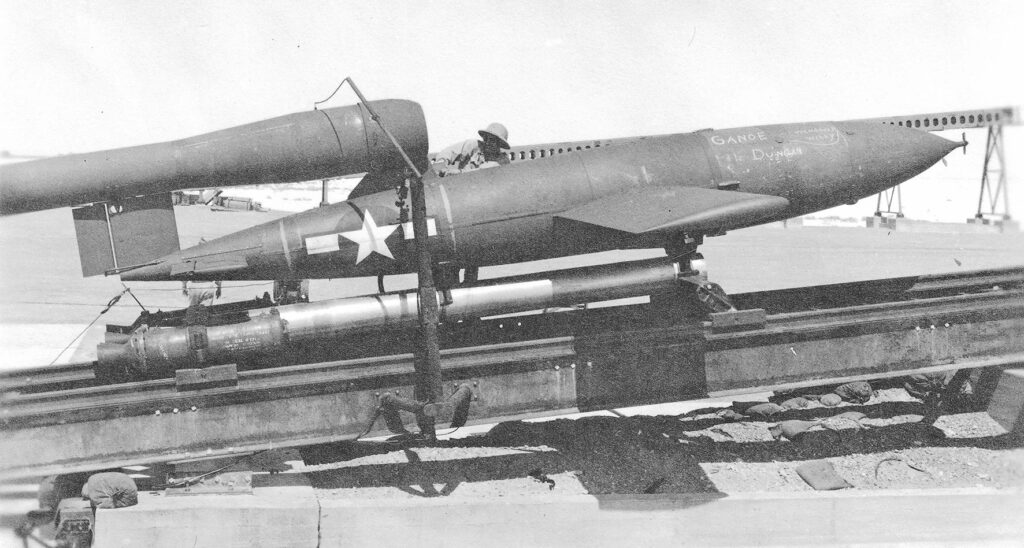
It is clear that the US had turbopump technology already developed. What they weren't doing is running theirs on HTP like the Germans. One likely reason was HTP was not widely available in the US. The USAF, likewise, switched the launch trolly for the JB-2 from HTP like the Germans were using (the US had examples by late 1944 that had been captured) to a solid fuel unit instead for the same reason.

Seen here at Elgin Field in the Florida panhandle:

JB-2-missile-1024x548.jpg


This used 4 x Aerojet 14AS1000 JATO boosters.
 
Last edited:
I would add here that in the summer of 1943, Issac Lubbock, a Shell engineer who was working in England on a liquid fuel rocket motor, visited Cal Tech / GALCIT, he found the US already had working turbopumps in use on their rocket engine designs and found them far superior to using compressed gas to feed a liquid fuel rocket engine. The Ground-Air-Projectile (GAP) committee--tasked with development of a SAM system in England--rejected their use at the time as they thought adoption would slow their program far too much.
Do you have a specific article?
 
Still gas generator. It's just an improvement from single-component fuel to dual-component fuel.


What source do you want me to provide? Is it "the Germans were the first to invent gas-generator-driven turbopump technology" or "as early as 1937, the Germans were already testing rocket engines with gas-generator-driven turbopumps"?
They weren't

"The earliest prototype of a turbopump of any kind appears from the historical record to be by the American Robert Goddard and his team, circa 1934.[6] These early turbopump tests were not successful, as it ran straight into the fundamental problem of turbopumps: the turbine was driven directly off of the main combustion chamber gas, and it quickly melted. Using this knowledge, Goddard iterated and gradually invented the gas generator cycle, culminating in a new turbopump that successfully propelled his "P-Series" (pump series) rocket on a flight in 1940 using liquid oxygen and gasoline. This flight however was already preempted by a successful one in Germany (albeit monopropellant; Goddard's turbopump would have been the first bipropellant one to fly)."
 
They weren't

"The earliest prototype of a turbopump of any kind appears from the historical record to be by the American Robert Goddard and his team, circa 1934.[6] These early turbopump tests were not successful, as it ran straight into the fundamental problem of turbopumps: the turbine was driven directly off of the main combustion chamber gas, and it quickly melted. Using this knowledge, Goddard iterated and gradually invented the gas generator cycle, culminating in a new turbopump that successfully propelled his "P-Series" (pump series) rocket on a flight in 1940 using liquid oxygen and gasoline. This flight however was already preempted by a successful one in Germany (albeit monopropellant; Goddard's turbopump would have been the first bipropellant one to fly)."
Source, pls
 
They weren't

"The earliest prototype of a turbopump of any kind appears from the historical record to be by the American Robert Goddard and his team, circa 1934.[6] These early turbopump tests were not successful, as it ran straight into the fundamental problem of turbopumps: the turbine was driven directly off of the main combustion chamber gas, and it quickly melted. Using this knowledge, Goddard iterated and gradually invented the gas generator cycle, culminating in a new turbopump that successfully propelled his "P-Series" (pump series) rocket on a flight in 1940 using liquid oxygen and gasoline. This flight however was already preempted by a successful one in Germany (albeit monopropellant; Goddard's turbopump would have been the first bipropellant one to fly)."
My bet--without reading that paper you cited--is that Goddard was at least somewhat aware of Sanford Moss's work at GE on turbochargers. The two work on the same principle, only the turbocharger pumps a gas while the turbopump a liquid. That would have given him knowledge of the use of high temperature metals and turbine design as GE had one of the largest blade profile libraries in the world at the time. If this happened before the US Army classified Moss's work a secret, it would have been a shortcut to a working turbopump.
 
My bet--without reading that paper you cited--is that Goddard was at least somewhat aware of Sanford Moss's work at GE on turbochargers.
Nah. No mention of GE or Moss in any Goddard notebook, diary or paper. He talks about placing a turbine in the rocket blast in 1931.
 
Nah. No mention of GE or Moss in any Goddard notebook, diary or paper. He talks about placing a turbine in the rocket blast in 1931.
Maybe not, but given how ubiquitous Moss was in that field from about 1919 on, I'd say there's a good chance Goddard took his cue from there.

https://www.geaerospace.com/news/ar...rcharger-saved-ges-fledging-aviation-business
https://www.airplanesandrockets.com...ft-turbocharger-popular-science-june-1941.htm
I think it'd be hard for Goddard not to have noticed what Moss was doing.
 
I think it'd be hard for Goddard not to have noticed what Moss was doing.
Not really. Goddard was a loner and like to come up with his own ideas.
In addition to searching for GE or Moss, I search for the occurrence of the word "turbine" in his documents. He mostly looked at steam turbines.
 
Not really. Goddard was a loner and like to come up with his own ideas.
In addition to searching for GE or Moss, I search for the occurrence of the word "turbine" in his documents. He mostly looked at steam turbines.
At the time, steam turbines were the basis for developing gas turbines. All the really successful early jet engine manufacturers were companies involved in manufacturing steam turbines. In Germany, companies like BMW and Junkers turned to Brown Bovari in Switzerland for help with turbine blade profiles because that company had the largest library of these in Europe.

In England, companies like Vickers took the lead on axial turbojets for the same reason. Westinghouse and GE, major steam turbine manufacturers, did the same thing.

I can see Goddard using this sort of information to develop turbopumps for his rocket motors for the same reason. It gave him a shortcut to getting the blade profiles correct without lots of expensive and time intensive research to do it on his own. He likely wouldn't have had to really do more than just look this stuff up through the patent office and published papers. Just because he was something of a hermit doesn't mean he wasn't aware of what others in fields of interest to him were doing.

The Germans simply did the same thing.
 
I included it, click on the "6"
I can't read it because I'm not a member or haven't purchased the article, but it's no big deal.

They weren't

"The earliest prototype of a turbopump of any kind appears from the historical record to be by the American Robert Goddard and his team, circa 1934.[6] These early turbopump tests were not successful, as it ran straight into the fundamental problem of turbopumps: the turbine was driven directly off of the main combustion chamber gas, and it quickly melted.
It seems the pump cycle Goddard developed in 1934 was more like a combustion tap-off cycle, extracting gas from the combustion chamber to drive the turbopump. But he wasn't the first, nor were the Germans—who was it? The Soviets.


Source: https://web.stanford.edu/~cantwell/AA283_Course_Material/AA283_Resources/Glushko, Development of Rocketry and Space Technology in the USSR.pdf Page: 10-11(12-13)
In the following year, 1931, introduced gimbal mounting of liquid-propellant rocket engines as a method of flight path control; proposed the idea, which was put into practice in 1933, of using a hypergolic ignition system and a hypergolic propellant for liquid-propellant rocket engines. From 1931 to 1933 developed a piston double-acting pumping unit driven by gas from the combustion chamber for a liquid-propellant rocket engine with a thrust of 300 kg, and in 1933, a turbopump assembly with centrifugal pumps;
The Soviets began developing a pump cycle driven by combustion chamber gas as early as 1931, although at that time the pump driven was not a turbopump but a piston pump. However, in 1933, the Soviets developed a turbopump assembly with centrifugal pumps.

While it was not specified what powered this turbopump, the combination of "combustion chamber gas driving the pump" and "turbopump" meant that the technology possessed by the Soviets was already quite similar to the pump cycle you described for Goddard.


Source: https://epizodsspace.airbase.ru/bibl/glushko/rak-dv/text/03.html
Source: http://www.astronaut.ru/bookcase/books/glushko/text/03.htm
В этом же году мною впервые были предложены самовоспламеняющееся топливо и химическое зажигание, а также карданная подвеска двигателя с насосными агрегатами. В 1931 - 32 гг. были разработаны и испытаны экспериментальные поршневые топливные насосы, приводимые двигателем, питаемым газом, отбираемым из камеры сгорания ракетного двигателя. В 1932 г. были разработаны и испытаны конструкции экспериментальных двигателей (от ОРМ-4 до ОРМ-22 включительно) для изыскания типа зажигания, метода запуска и систем смешения при испытании на различных компонентах топлива. При 53 огневых стендовых испытаниях этих двигателей в качестве окислителей использовались жидкий кислород, азотный тетроксид, азотная кислота, растворы азотного тетроксида в азотной кислоте, а в качестве горючего — бензин, бензол, толуол, керосин. В 1933 г. были разработаны и испытаны на стенде двигатели (от ОРМ-23 до ОРМ-52 включительно) с пиротехническим и химическим зажиганием на азотнокислотно-керосиновом топливе. Опытные двигатели ОРМ-50 тягой 150 кг и ОРМ-52 тягой 300 кг прошли в этом же году официальные стендовые испытания. В то время это были самые мощные жидкостные ракетные двигатели. В 1933 г. была разработана конструкция турбонасосного агрегата с центробежными насосами для подачи жидких компонентов топлива в двигатель с тягой 300 кг.
Several sources from Russian space enthusiasts also confirm the Soviet achievements between 1931 and 1933. Their references come from "АКАДЕМИЯ НАУК СССР РАКЕТНЫЕ ДВИГАТЕЛИ ГДЛ - ОКБ" (Academy of Sciences of the USSR, Rocket Engines GDL-OKB). Although I do not have the PDF version of this book, cross-referencing suggests that their accounts are likely not far from the truth.
 
Last edited:
He likely wouldn't have had to really do more than just look this stuff up through the patent office and published papers.
because he kept meticulous notes and diaries, such as search would be reflected in them and there is little of it.
 
It seems the pump cycle Goddard developed in 1934 was more like a combustion tap-off cycle, extracting gas from the combustion chamber to drive the turbopump. But he wasn't the first, nor were the Germans—who was it? The Soviets.
Deflection and not relevant to the discussion.
The point is that you were wrong here
https://www.secretprojects.co.uk/threads/no-german-v-2.48092/post-816924and every point after related to the Germans rocket technology vs Goddard
 
Deflection and not relevant to the discussion.
If you post it, then I'll discuss it.
"The earliest prototype of a turbopump of any kind appears from the historical record to be by the American Robert Goddard and his team, circa 1934.[6] These early turbopump tests were not successful, as it ran straight into the fundamental problem of turbopumps: the turbine was driven directly off of the main combustion chamber gas, and it quickly melted. Using this knowledge, Goddard iterated and gradually invented the gas generator cycle, culminating in a new turbopump that successfully propelled his "P-Series" (pump series) rocket on a flight in 1940 using liquid oxygen and gasoline.
The Soviet combustion tap-off cycle predates Goddard's, and the German gas-generator cycle also predates Goddard's.

The Germans had already conducted the first flight of an aircraft equipped with a gas-generator cycle rocket engine as early as 1937: https://web.archive.org/web/2022102...e/dok/heinkel-he-112-jaeger-jagdeinsitzer.pdf

The pump, Goddard did use a pump to deliver fuel, but the driving force for his pump came from the expansion of gases produced by fuel vaporization through heat absorption. Compared to the Germans' approach, this was indeed less "strong." (If you know of a better pump cycle developed in the U.S. before 1943, please let me know.)
Alright, alright, I was wrong. Thank you for telling me. Goddard indeed mastered the technology of the gas-generator-driven pump cycle at that time.
 
wrong on both counts
The Soviet combustion tap-off cycle predates Goddard's, and the German gas-generator cycle also predates Goddard's.
Nope, my source, Sutton, is the definitive source.
The Germans had already conducted the first flight of an aircraft equipped with a gas-generator cycle rocket engine as early as 1937: https://web.archive.org/web/2022102...e/dok/heinkel-he-112-jaeger-jagdeinsitzer.pdf
Need better sources, It just says pump delivery and nothing else.
 
Need better sources, It just says pump delivery and nothing else.
Source: https://repository.si.edu/server/api/core/bitstreams/8392f4ad-c258-4c52-ba28-5632fffd87de/content Page: 7(219)
In spite of this success, the safety of the V4's nitrogen-pressurized tankagesystem was doubtful, so the RLM, Ordnance, and Heinkel decided to rebuild theaircraft. The propellants would instead be pumped, using a turbopump poweredby catalyzed hydrogen peroxide from a "steam generator." The Ordnance rocketgroup had begun developing turbopumps in 1935, because of the need for themin large rocket engines, and had contracted with Hellmuth Walter for a steamgenerator in spring 1936. The He 112 V4 system was to be derived from the preliminary design for a Heinkel pure rocket aircraft, as well as from the turbopump/steam generator in the Walter-engined version of the He 112. Again, noconcrete data is available, but Warsitz piloted the He 112 V3 before the endof 1937. Flights continued into 1938, culminating in takeoffs solely under"cold" hydrogen peroxide rocket power, with the piston engine turned off.
Source: https://scispace.com/pdf/hydrogen-peroxide-for-power-and-propulsion-6sucjjng95.pdf Page: 6
The Walter engine as flown in the He 112 was the first to incorporate controllablethrust with the utilisation of a steam driven turbopump for the T Substance.
Source: https://www.rand.org/content/dam/rand/pubs/papers/2009/P3154.pdf Page: 12-13(10-11)
Walter's next rocket drive was a controllable thrust unit employingan 80 per cent concentration of hydrogen peroxide. (In its greater strengths the hydrogen peroxide was known as "T-Stoff.") T-Stoff wasforced into the reaction chamber by a pump coupled to a steam turbine.The steam generator was merely a pot into which T-Stoff and Z-Stoff(an aqueous solution of sodium or calcium permanganate) were sprayedby compressed air. Z-Stoff for the main combustion chamber, where itreplaced the paste as a catalyst, was also delivered by compressed air.Only the T-Stoff for the main unit was pumped. This motor, known asthe TP-1, was the type installed in the He.112 aircraft. The fighterwas flown at Neuharderberg in November 1937, the purpose of the experiment being to study the effect of jet propulsion on aircraft aerodynamics in the hope that an all-rocket-power fighter could be developed.


Nope, my source, Sutton, is the definitive source.
Well... About "АКАДЕМИЯ НАУК СССР РАКЕТНЫЕ ДВИГАТЕЛИ ГДЛ - ОКБ" (Academy of Sciences of the USSR, Rocket Engines GDL-OKB), I don't have a PDF version of the book, only two webpages version from the Russian space enthusiast. However, there are English materials that can attest to the reliability of these webpages.

Like this:
This material belongs to an emeritus professor from the Department of Aero&Astro at Stanford University's School of Engineering, and it is part of his course materials. Although he is not George P. Sutton, I believe citing the materials of a professor who has dedicated over fifty years to the field of Aero&Astro can be considered reliable, if not "authoritative."
 
Last edited:
wrong on both counts

Nope, my source, Sutton, is the definitive source.

Need better sources, It just says pump delivery and nothing else.
Definitive source?

That is a childish statement.

No source is definitive, and even less so on matters of secret weapons.

You should publish a book and expose yourself to criticism instead of attacking the contributions of the other members.
 
No, that is just a monopropellant gas generator
OK. This is a bipropellant gas generator.
Walter's next rocket drive was a controllable thrust unit employingan 80 per cent concentration of hydrogen peroxide. (In its greater strengths the hydrogen peroxide was known as "T-Stoff.") T-Stoff wasforced into the reaction chamber by a pump coupled to a steam turbine.The steam generator was merely a pot into which T-Stoff and Z-Stoff(an aqueous solution of sodium or calcium permanganate) were sprayedby compressed air.
Besides the fact that the two propellants are not combusted but "decomposed" — oh, a "decomposition" at several hundred degrees — it already closely resembles a modern gas generator.
 
Last edited:
Definitive source?

That is a childish statement.

No source is definitive, and even less so on matters of secret weapons.

You should publish a book and expose yourself to criticism instead of attacking the contributions of the other members.
I do publish articles

And Sutton is the the definitive source on rocket engines and their history.
 
OK. This is a bipropellant gas generator.

Besides the fact that the two propellants are not combusted but "decomposed" — oh, a "decomposition" at several hundred degrees — it already closely resembles a modern gas generator.
Alright, I was wrong again. Although T-Stoff and Z-Stoff are two different substances, they actually were a monopropellant.
 
Back
Top Bottom