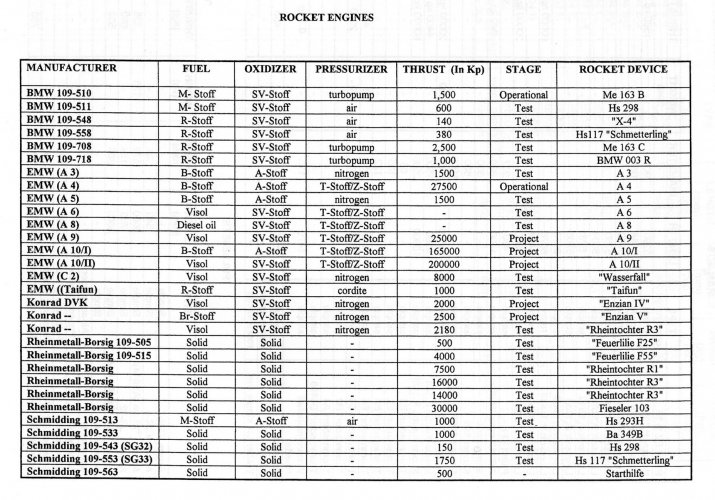
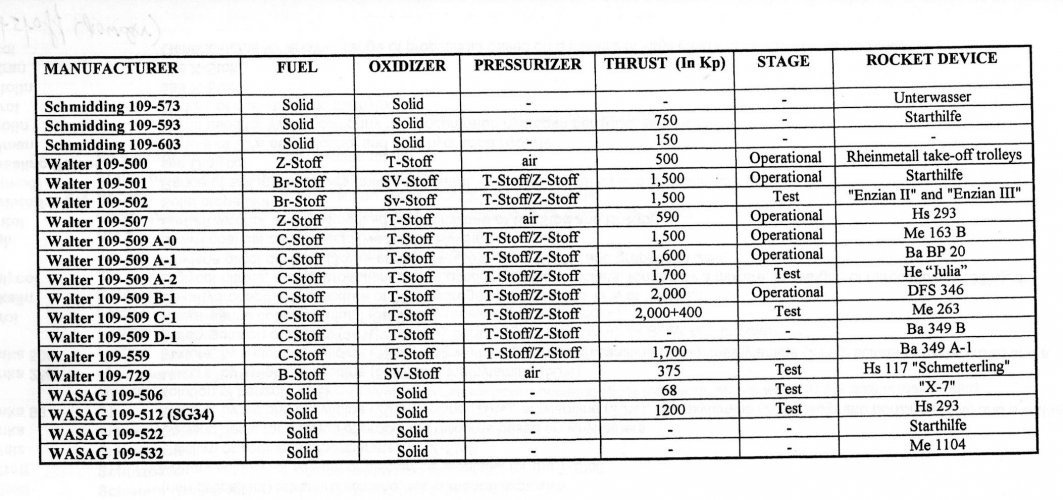
German rockets comparative
Solid-propellants rockets
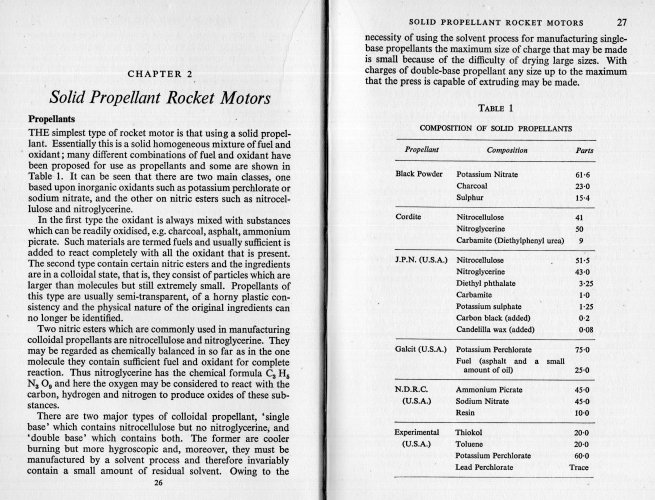
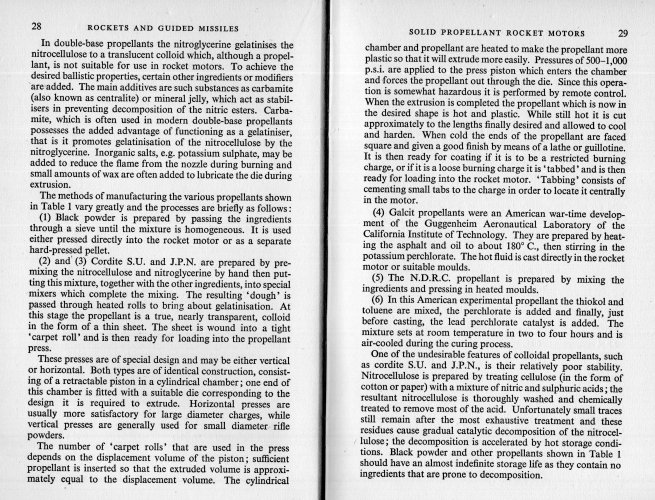
All three German manufacturers of RATO rockets used the same solid propellant produced by Westfählische-Anhalt Spengstoff (WASAG):
Diglycoldinitrat formed by a mixture, by weight, of nitrocellulose (63%), diethylene glycol nitrate (35%), carbamite (0.5%), wax (0.2%) and graphite (1.2%).
Schmidding 109-513, 1,000 kg peak thrust, 2,220-mm length and 350-mm diameter, used in the Henschel Hs 293H and Hs 298 gliding bombs.
Schmidding 109-533, 1,000-1,200 kg peak thrust, 1,540-mm length and 255-mm diameter, used in the Bachem
Natter, the Heinkel He 162 A-10/A-11, Heinkel P. 1077
Romeo I & II, Heinkel P.1077
Julia, Junkers EF 126
Elli, DFS
Eber II and DVL
Jagdsegler II rammers, in the Zeppelin
Fliegende Panzerfaust and in the Zeppelin Rammer.
Schmidding 109-543, 150 kg peak thrust, 810-mm length and 178-mm diameter, used in the air-to-air missile Henschel Hs 298.
Schmidding 109-553, 1,750 kg peak thrust, 2,370-mm length and 168-mm diameter, used in the anti-aircraft missile Henschel Hs 117.
Schmidding 109-563, 500 kg peak thrust, 990-mm length, 168-mm diameter, used in the Messerschmitt P. 1103 rammer.
Schmidding 109-573, underwater launch tests.
Schmidding 109-593, 750 kg peak thrust, 990-mm length, 168-mm diameter, RATO.
Schmidding 109-603, 150 kg peak thrust, designed for the Ruhrstahl-Kramer X-4 air-to-air missile, project only.
Rheinmetall-Borsig 109-502, 600-900 kg peak thrust, 1,270-mm length, 178-mm diameter, RATO.
Rheinmetall-Borsig 109-505, 500 kg peak thrust, 1,270-mm length, 178-mm diameter, used in the anti-aircraft missile Rheinmetall-Borsig
Feuerlilie 25.
Rheinmetall-Borsig 109-515, 4,000 kg peak thrust, 1,470-mm length, 324-mm diameter, used in the anti-aircraft missile Rheinmetall-Borsig
Feuerlilie 55.
Rheinmetall-Borsig 109-525, 7,500 kg peak thrust, 1,300-mm length, 510-mm diameter, used in the anti-aircraft missile Rheinmetall-Borsig
Rheintochter R1.
Rheinmetall-Borsig 109-535, 16,000 kg peak thrust, used in the anti-aircraft missile Rheinmetall-Borsig
Rheintochter R1.
Rheinmetall-Borsig 109-545, 14,000 kg peak thrust, used in the anti-aircraft missile Rheinmetall-Borsig
Rheintochter R3.
WASAG 109-506, 69 kg peak trust, used in the Ruhrstahl-Kramer X-7 anti-tank missile.
WASAG 109-512, 1,200 kg peak trust, used in the Hs 293 gliding bomb.
WASAG 109-522, RATO.
WASAG 109-532, 69 kg peak trust, RATO used in the Messerschmitt P 1104.
Bi-propellant rocket engines
-Walter RI-203 (June 1939), T-
Stoff + M-
Stoff, 400 kg thrust, used in the Heinkel He 176 experimental airplane and in the Messerschmitt
Enzian E-1 anti-aircraft missile.
-Walter RII-203 (October 1941), T-
Stoff + Z-
Stoff, 750 kg thrust, used in the Messerschmitt Me 163 V4 prototype.
-Walter HWK 109-500 (summer 1937), T-
Stoff + Z-
Stoff, 500 kg thrust, used in DFS 194 prototype.
-Walter HWK 109-501, T-
Stoff + Z-
Stoff, 1,000 kg thrust, used in Junkers 287 prototype.
-Walter HWK 109-502, T-
Stoff + Z-
Stoff, 1,500 kg thrust, used in the Messerschmitt
Enzian E-2 and E-3 anti-aircraft missiles.
-Walter HWK 109-507, T-
Stoff + Z-
Stoff, 590 kg thrust, used in the Henschel 293 V3-V5 gliding bomb.
-Walter HWK 109-509 A-0, (May 1943), T-
Stoff + Z-
Stoff, 1,500 kg thrust, used in the Messerschmitt Me 163 B-0.
-Walter HWK 109-509 A-1, (August 1944), T-
Stoff + Z-
Stoff, 1,600 kg thrust, used in the Messerschmitt Me 163 B-1.
-Walter HWK 109-509 A-2, T-
Stoff + Z-
Stoff, two combustion chambers with 1,700 and 200 kg thrust, used in the Messerschmitt Me 163 B-1a, Messerschmitt Me 262 C-1a, Messerschmitt P. 1104, Junkers EF 127 and Heinkel P. 1077
Julia.
-Walter HWK 109-509 B-1, (March 1944), T-
Stoff + C-
Stoff, two combustion chambers with 2,000 and 300 kg thrust, used in the Messerschmitt Me 163 V18 and Bachem Ba 349 B
Natter.
-Walter HWK 109-509 C-1, (August 1944), T-
Stoff + C-
Stoff, two combustion chambers with 2,000 and 400 kg thrust, used in the Messerschmitt Me 163 C and Messerschmitt Me 263.
-Walter HWK 109-509 C-3, (August 1944), T-
Stoff + C-
Stoff, two combustion chambers with 2,000 and 400 kg thrust, used in the Junkers 248.
-Walter HWK 109-509 D-1, (January1945), T-
Stoff + C-
Stoff, 1,700 kg thrust, used in DFS 346.
-Walter HWK 109-509 E, (January1945), T-
Stoff + C-
Stoff, 1,700 kg thrust, used in the Ba 349 C
Natter.
-Walter HWK 109-509 S-1, (January1945), T-
Stoff + C-
Stoff, 1,700 kg thrust, used in the Messerschmitt Me 262 C-1.
-Walter HWK 109-509 S-2, (January1945), T-
Stoff + C-
Stoff, 1,993 kg thrust, used in the Messerschmitt Me 262 C-3 and Messerschmitt P. 1106 R.
-Walter HWK 109-509 S-3, (January1945), T-
Stoff + C-
Stoff, 1,993 kg thrust, used in DFS 229.
-Walter HWK 109-559, (August 1944), T-
Stoff + C-
Stoff, two combustion chambers with 1,700 and 150 kg thrust, used in the Ba 349 A
Natter.
-Walter HWK 109-739, 1,500 kg thrust, SV-
Stoff + Ergin-Benzene, used in the Messerschmitt
Enzian E-3 anti-aircraft missile.
-BMW 109-510 A, M-
Stoff + SV-
Stoff, 1,500 kg thrust used in the Messerschmitt Me 163 B-0.
-BMW 109-510 B, M-
Stoff + SV-
Stoff, 1,500 kg thrust used in the Messerschmitt Me 163 B-1.
-BMW 109-510 C, M-
Stoff + SV-
Stoff, 1,500 kg thrust used in the Messerschmitt Me 163 C.
-BMW 109-511, M-
Stoff + SV-
Stoff, 600 kg thrust used in the Henschel Hs 298 air-to-air missile.
-BMW 109-548, R-
Stoff + SV-
Stoff, 140 kg thrust used in the Ruhrstahl-Kramer X-4 air-to-air missile.
-BMW 109-558, R-
Stoff + SV-
Stoff, 380 kg thrust used in the Henschel Hs 117
Schmetterling anti-aircraft missile.
-BMW 109-708, (November 1944), R-
Stoff + SV-
Stoff, 2,500 kg thrust used in the Messerschmitt Me 163 C.
-BMW 109-718, (1943), R-
Stoff + SV-
Stoff, 1,800 kg thrust mounted in the mixed power plant BMW 003 R, used in the Messerschmitt Me 262
Heimatschützer II, the Heinkel He 162.01-42 and the Horten Ho XIIIb.
-DVK Konrad VfK Zg.613-A01, (February 1945), SV-
Stoff + Visol, 1,000 to 2,000 kg thrust, used in the Messerschmitt
Enzian E-4 anti-aircraft missile.
-DVK Konrad VfK Zg.613-A02, (February 1945), SV-
Stoff + Visol, 1,800 to 2,180 kg thrust, used in the Rheinmetall-Borsig
Rheintochter III (R-3f) anti-aircraft missile.
-DVK Konrad VfK Zg.613-A03, (February 1945), Br-
Stoff + SV-
Stoff, 1,500 to 2,500 kg thrust, used in the Messerschmitt
Enzian E-5 anti-aircraft missile.
FUELS AND FLUIDS
Between October 1935 and February 1939, Germany imported large quantities of petroleum through the companies IG Farben and Wifo, but the country was not prepared for a long war and in the end its accumulated fuel reserves were not enough.
The oil extracted from the German subsoil was only usable as a lubricant because of its high wax content but coal was abundant and could be transformed into low-quality fuel using the FT (Fisher Tropsh) process.
Huge hydrogenation plants were built next to coal mines to manufacture synthetic fuel, lubricants and rubber using the Bergius system.
These strategic substances were stored in seven gigantic reservoirs with a capacity of 1,250,000 cubic meters.
Large quantities of aviation fuel, petroleum essences, chemical additives and the manufacturing patent for the anti-knock agent tetraethyl lead (TEL) were also imported from the United States.
Thanks to these imported additives, LAEDA Grade A3 (80-octane) standard gasoline could be enriched to obtain the LAEDB Grade B4 (87-91-octane) fuel used by bombers.
The LAEC Grade C3 (92-97-octane) fuel used by fighters was obtained by mixing B4 with high-octane U.S. fuel, hydro-gasoline (synthetic fuel butyl-isooctane), alcohol, butane, benzol or toluol.
With the addition of TEL at a rate greater than 4.75 cc per gallon, a special variety of 110-125-octane fuel used by elite fighter units could be obtained, but its use destroyed the engines within 42 hours.
The production of C3 never exceeded 10 per cent of the production of B4.
In 1943 the war was not over, and German industry began to suffer from the shortage of rare metals used in alloys: copper, chromium, cobalt, iridium, nickel, silver and tungsten.
The shortage of raw materials in Germany meant it was not possible to produce a suitably heat-resistant alloy before the war ended. The turbo-superchargers experimented failures at 16,500 rpm and the pipes of engine-exhaust gases proved to be unable to withstand the high temperatures of 980º C. At this time, the average lifespan of these turbo-superchargers did not exceed 20 hours.
The turbo-supercharger was a product of enormous technical and manufacturing resources that was not available in Germany. The 1,500 ºC temperatures reached by exhaust gas and the high rotation speeds of turbines (26,000 rpm) required the use of austenitic stainless-steel chrome-molybdenum alloys, ‘17 W’ chrome-nickel alloys and the development of work-hardening techniques that enabled the turbocharger to withstand stresses for centrifugal forces. The precision machining of turbines and impellers was made possible by sophisticated machine tools and surplus of raw materials.
After the failures obtained with the TK and HMZ turbo-superchargers, the OKL decided to use high-altitude supercharged engines (Jumo 213 E-1, BMW 323 R, DB 603 G, DB 603 LA, DB 603 U, DB 605 AS, DB 627 B and DB 632) fitted with GM 1 (
Göring Mischung 1) power boost system.
The Nitrous oxide (
Ha-ha gas) was retained under pressure in liquid form and injected, at a rate of 60 kg/min, into the supercharger air intake by means of compressed air, providing the engine with additional oxygen for 50 minutes.
At emergency boost pressure, the GM 1 increasing power above 10,000 m altitude, but it could not be used below 7,000 m to avoid engine damage.
When the Luftwaffe discovered that American bombers were flying at altitudes between 6,000 and 8,000 meters, the system fell into disuse.
The risk of pre-ignition/knocking increases with higher ambient air temperature and higher boost levels.
Availability of 100/130-octane fuel let the Allied engines run hotter without suffering premature explosions, but the 87-octane used by the
Luftwaffe should use forced-air cooling fans and water-injection to avoid the overheating of their supercharged engines.
At low altitude the low-pressure stage of Allied engines would be used to prevent excessive boost levels. At higher altitudes the high-pressure stage would be normally engaged or disengaged by the pilot.
Pure water injection was used by the Germans (only with temperatures over 0º C) in the Jumo 213A and BMW 323R engines. A greater increase in power was obtained when the boost pressure was also increased. This system produced internal corrosion in the engines and was dropped by the RLM.
In the BMW Zborowski Verfahren injection system the water was replaced by the MW 30 mixture consist of 69.5 parts (by volume) of water, 30 parts of Methanol (Methyl alcohol) and 0.5 parts of anti-corrosion fluid
Schutzöl 39.
MW30 was carried in a tank pressurized by the supercharger and injected into the compressor air intake at a rate of 2.2 lt/min.
The flow rate was controlled automatically by means of a solenoid valve.
The MW 50 mixture consist of 49.5 parts (by volume) of water, 50 parts of Methanol (Methyl alcohol) and 0.5 parts of anti-corrosion fluid
Schutzöl 39.
The EW 50 mixture consist of 49.5 parts (by volume) of water, 50 parts of Ethanol (Ethyl alcohol) and 0.5 parts of anti-corrosion fluid
Schutzöl 39.
These emergency power boost systems disrupted normal combustion, the mixture air-fuel did not burn completely, and the exhaust contained black smoke.
The water-injection could be used only for brief periods of time (ten minutes at a time) such as take-off or emergency combat boost below 10,000 meters altitude.
In May 1944 the Allies began a massive bombing campaign against the Reich's chemical industry.
Between May and September 1944, the US Eighth Air Force made eleven attacks on Leuna-Merseburg, the main production plant for petrol
ersatz (synthetic hydrocarbons), stopping its activity. In November the Allies launched a bombing offensive against the hydrogenation plants of Nordstern-Gelsenkirchen, Nordstern-Wesserling, Scholven, Homberg, Wanne-Eickel, Sternkrade, Gastrop, Kamen, Bottrop, Dortmund, Hannover, Hamburg, Misburg, Bohlen, Zeitz and Lützendorf. The RAF Bomber Command launched 13,000 tons of bombs and the Eighth Air Force 14,000 tons. The US Fifteenth Air Force based in Italy attacked the plants located south of the Reich in Florisdorf, Moosbierbaum, Blechhammer South, Korneuberg, Vienna-Lubau and Linz.
By December, German fuel production fell to 151,000 tons of first grade gasoline (Grade C3, 96-octane), aviation base gasoline (Grade B4, 87-octane), gasoline-middle oil (B4 + motor oil) and J2 heavy kerosene for turbojets. Mostly affected production was that of the C3 and B4, that was used in piston engines of the fighters, with 25,000 tons only, compared to the anticipated 107,000 tons. Many small plants, also dedicated to the production of Benzol, were destroyed during the bombing attacks by zone, randomly made by the Bomber Command over industrial areas. During the last year of war in Europe, the RAF attacked 42 hydrogenation plants with 63,000 tons of bombs and the Eighth with 45,000 tons, finally achieving the collapse of the production system.
There was also a shortage of special metals platinum, palladium, and rhodium used in the manufacture of high-temperature spark plugs for aircraft engines.
The piston engine fighters were most affected.
This situation affected specially to conventional piston engines. Poor ratings of the 87- octane B4 fuel and poor quality of
Schmiertoff lubricant, that obliged to run at high revolutions to deliver the required horsepower, were the cause of all the problems suffered. Rather deficient
Kühlsotff (50% glycol, 50% water) cooling, vibration fractures and disintegration of bearings, due to shortage of tin during its manufacturing, caused corrosion and piston seizure.
Another factor that negatively affected the performance of the engines was the low quality of rubber and synthetic lubricants, whose composition varied frequently, causing all kinds of breakdowns, especially in arctic climates.
To avoid these deficiencies, some engines were redesigned with bigger cylinders and twin (three speed) superchargers, due to the poor performance (just 30 minutes) of the one stage superchargers of first generation.
The lack of oil suffered by Germany, during the last year of the war, induced scientists and engineers to experiment with alternative fuels.
The BMW 003, Jumo 004 and Heinkel HeS 011 turbojets worked with J2 and K1 heavy kerosene.
The Argus pulsejet of the V-1 worked with crude oil.
The Peenemünde engineers designed a V-2 that worked with diesel oil and S-
Stoff.
The Dr. Pabst, from the Gas Dynamics section of the Focke-Wulf Company, suggested that the ramjets of the future
Triebflügel fighter burned even less volatile fuels at pitch oil or lignite tar.
To that purpose, they had to design a compact evaporating plant that could be installed onboard.
The German industrial capacity had been irreversibly eroded by the long naval blockade and continued bombardment.
The shortage induced aircraft manufacturers to compete for available turbojets and rocket engines but only two firms had access to the scarce number of ‘Class I’ turbojets Jumo 004. One of them was Messerschmitt to power the Me 262 jet fighter and the other was Arado, for the Ar 234 jet bomber.
Despite of all these issues, the reliability of the new BMW 003 and Jumo 004 turbojets and the HWK 109 rocket engine was so low that the
Oberkommando der Luftwaffe allowed the development of some piston engines to continue until February 1945!
FUELS AND FLUIDS
B4 + motor oil
Benzin | Substitute for J2
Br-Stoff |
| Braunkohle (Coal dust) | For Lippisch ramjets |
Br-Stoff (E-1)
Glykol | Non-refined petrol for Argus As 014 pulsejet
Triethylene for cooling systems |
| Glykol-Wasser 50/50 | Glycol-Water mixture for cooling (50% glycol, 50% water) |
| GM 1 | Nitrous oxide (liquid) for power boosting |
| J2 | Heavy kerosene for Jumo 004 turbojet |
| K1 | Heavy kerosene for HeS 011 turbojet |
| Kühlstoff | Glycol |
| LAEDA Grade A3 | Gasoline, Rated at 80-octane (Light blue color) |
LAEDB Grade B4
LAEDC Grade C3
Lignitteeren (Lignite tar)
MW 50
Öl
Optol
Rohöl
Schaumkohle + J2
Schmiertoff
Schutzöl 39
Schweröl (Diesel oil)
S3 Flugöl
Teertuchöl (Pitch oil) | Gasoline, Rated at 87-91-octane (Dark blue color)
Gasoline, Rated at 92-97-octane (Dark green color)
For Pabst ramjets
Methanol-Water mixture for power boosting (50% methanol, 49.5% water, 0.5%
anticorrosion fluid).
Oil
Lignite tar
Crude oil
Coal dust + J2 for Sänger ramjets
Lubricant
Anti-corrosion fluid for MW 50
For Jumo 205 and EMW A10/II
Lubricant for BMW 018 turbojet
For Pabst ramjets
|
ROCKET PROPELLANTS
The German chemical industry produced four basic liquid fuel systems:
-
Katergol, mono-propellant Class: Hydrogen peroxide (82-83 % concentration) + catalyst permanganate or Nitrous oxide + catalyst cobalt.
-
Hypergol, self-igniting mixtures Class: Hydrogen peroxide + B-
Stoff (hydrazin hydrate) or Hydrogen peroxide + M-
Stoff (Methanol) or Nitric acid + aniline, triethylamine or m-xylidines.
-
Monergol, mono-propellant Class: liquid DEGN, Myrol or Methyl nitrate.
-Non-self-igniting mixtures Class: Oxygen + hydrocarbons (oil, benzol or methanol).
(Sonderkraftstoff)
| A-Stoff | Liquid oxygen (Heyland method LOX) at -183º C, also called “Sauerstoff” |
| B-Stoff | Hydrazinhydrat (Hydrazyne hydrate), a catalyst for the T-Stoff and the M-Stoff |
| Br-Stoff | Non-refined petrol (benzine) |
| C-Stoff | Mixture of M-Stoff (57%), B-Stoff (30%), a watery solution (100 cc/lt) of
potasium cupro-cyanide (13%) |
| F-Stoff | (non-propellant) titanium tetrachloride for smoke generators |
| M-Stoff | Methanol (Methyl alcohol) |
| R-Stoff | (see “Tonka”) |
| S-Stoff | Mixture of nitric acid (96%) and ferrous chloride (4%), also called “Salbei” |
| SV-Stoff (Salbei) | Mixture of nitric acid (94%) and nitrogen dioxide (6%), also called “Red
fuming nitric acid” or 90-98% nitric acid and 2-10% sulfuric acid. |
T-Stoff
TN-Stoff
TS-Stoff | Hydrogen peroxide (80%), oxyquinoline or phosphoric acid (20%) as stabilizer
Aurol
Ingolin |
| X-Stoff | (non-propellant) tetranitromethane, experimental explosive |
Z-Stoff
Z-Stoff-N
Z-Stoff-C
SK-Stoff | Watery solution of sodium or calcium as a catalyst for the T-Stoff
Sodium permanganate catalyst for warm climates
Calcium permanganate catalyst for cold climates
HNO3 catalyst (Salbei K) |
| Z-Salz | Calcium or sodium permanganates for Z-Stoff |
| Tonka | Generic name for a range of propellant mixtures based on vinyl ethers |
| Tonka 93 | Mixture, by weight, of xylidine (20%), aniline (20%), ethylaniline (20%),
isquexylamine
(20%), sulphate benzine (10%) and a watery solution of benzol (10%) |
| Tonka 250 | Mixture, by weight, of xylidine (50%) and triethylamine (50%) |
| Tonka 500 | Mixture, by weight, of xylidine (12%), aniline (15%), monomethylamiline
(22%), triethylamine (21%), sulfate benzine (16%) and a watery solution of
benzol (14%) |
| Aurol | Kriegsmarine codename for TN-Stoff |
| Dekalin | Dekahydronapthalene mixture of 83% hydrogen peroxide and 17% of “Helman” |
Diglycol
| Diglycol nitrate, a solid propellant mostly used for auxiliary rockets, formed by
a mixture, by weight, of nitrocellulose (63%), di-ethylene glicol dinitrate (35%),
carbamite (0.5%), wax (0.2%) and graphite (1.2%) |
| Ergin | Brown coal benzene as additive for the SV-Stoff |
| Fantol | Furfuril alcohol, self-igniting fluid for the mixture of SV-Stoff and Br-Stoff |
| Feststoff | Solid propellant |
| Flammöl | Range of self-igniting fluids (mixtures of petrol, kerosene, diesel oil and
phosphorus) |
| Giessling Pulver | see Diglycol |
| Helman | Mixture of 20% ethyl alcohol and 80% hydrazine hydrate |
Ingolin
Kühlstoff
Lignitteeren | Name used for Walter company for concentrated hydrogen peroxide, see
TS-Stoff
50% glycol + 50% water
Lignite tar |
| Myrol | Mixture of methanol and methyl nitrate |
Optolin
Teertuchöl | see R-Stoff
Pitch oil |
| Tetran | see X-Stoff |
| Visol | Generic name for another range of propellants based on a mixture of vinyl
ethers (isobutyl-vinyl compounds) |