The Americans did not necessarily have to wait until after the war or Operation Paperclip to "learn" Germany's rocket technology. Spy, wreckage recovered from crashes in Britain or friendly nations (like Sweden), and debris retrieved by partisans from enemy territory—all provided the Allies with valuable technical details.
If we want to argue that U.S.
liquid rocket engine technology was not inferior to Germany's, we should examine American liquid rocket engine technology
before 1943, when the U.S. had no possibility of obtaining physical intelligence.
So, what kind of liquid rocket engine technology did the U.S. have before 1943?
The
pump,
Goddard did use a pump to deliver fuel, but the driving force for his pump came from
the expansion of gases produced by fuel vaporization through heat absorption. Compared to the Germans' approach, this was indeed less "strong." (If you know of a better pump cycle developed in the U.S. before 1943, please let me know.)
As for the
Germans, their pumps were driven by
high-temperature, high-pressure gas generated from the
violent chemical reaction between hydrogen peroxide and potassium permanganate—almost identical to how later liquid rocket engines used combustion (oxidizer + fuel) to power the pump. (After all, combustion is also a form of "violent chemical reaction.")
The Germans' pump cycle design was better suited for
high-thrust liquid rocket engines.
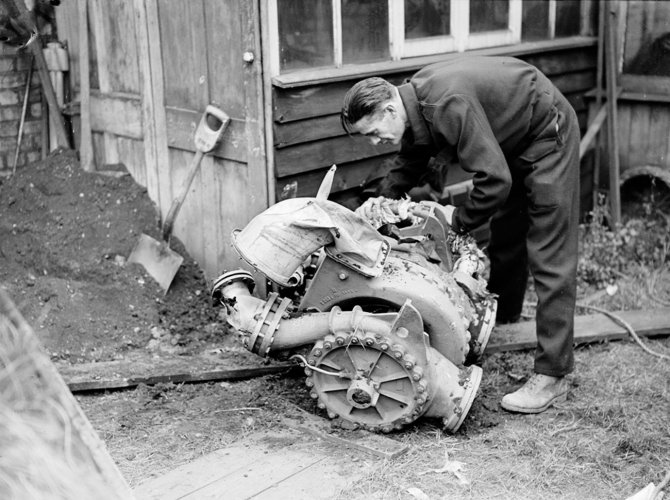
View attachment 779729
The V2 turbopump recovered in Britain.
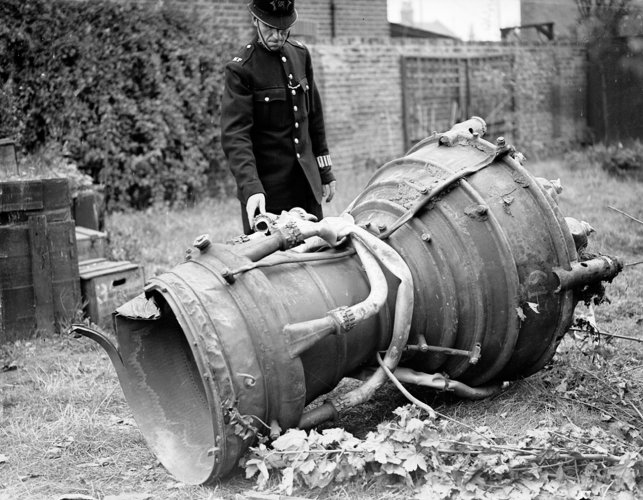
View attachment 779730
The V2 combustion chamber recovered in Britain.
Yes, the Americans initiated many rocket/missile programs toward the end of the war.
But they either differed from the V-2's liquid rocket engine technology path: Terrier→
Solid rocket motor, Talos & Navaho→
Ramjet, Matador & Snark→
Jet engine…
Or, even when following the liquid rocket engine approach, they lagged behind or were influenced by German technology: X-1 rocket plane→ still using a simple pressure-fed cycle, RTV-A-2 Hiroc (MX-774 B)→ derived from German technology.
From my understanding, German liquid rocket technology accelerated American technological progress by 4 to 5 years. Looking at the historical development of German rockets, their first large-scale rocket, the A3 , began development in 1935, and the A4 (the prototype of the V-2) made its first flight in 1942—a span of 7 years. Considering that the U.S. had made own advancements during WWII (such as in guidance technology), even without German influence, the Americans likely would have taken less time. Reducing that development from 7 years to 4 or 5 years seems possible.
If the Americans had not acquired German
liquid rocket technology and had to start from scratch, it would have meant that the deployment of the
liquid-fueled Atlas ICBM would have been
delayed until 1963 or 1964. By that time, the
solid-fueled Minuteman I would have already begun deployment (assuming Minuteman was unaffected and not delayed, like our timeline). The Atlas ICBM would have been obsolete by then, leading to the termination of the program. The idea of repurposing the Atlas rocket for space missions might also have been severely impacted—perhaps the legendary Atlas family would never have been born, the Atlas rocket would either have remained unremarkable or faded into obscurity.
The Titan I program would also have faced delays, leading to its rapid cancellation. However, Titan II would have continued, as it was capable of delivering larger warheads than Minuteman. The Titan rocket family would still have progressed.
As for the XB-70—no, it wouldn’t lose the "X." The best-case scenario would have been the procurement of additional test aircraft, but the chances of it entering active service were slim. Even if ICBM deployment had been delayed by five years or more, the U.S. would still have entered the ICBM era before the XB-70 was ready. The XB-70 made its first flight in 1964 and would have needed about three more years to enter service—meaning 1967. By then, even without German technology, America would have already transitioned into the ICBM age, rendering the XB-70 obsolete.
At that point, ICBMs might still have been somewhat immature, and some might have argued for procuring more XB-70s for further research. But the story of the XB-70 wouldn’t have progressed much further—its fate wouldn’t have been much different from that in our timeline.