No German V-2

The other factor behind Operation Paperclip is that it ensures proportion of the German boffins are working for the US and thus unavailable to be lured/snatched behind the Iron Curtain, or enable Britain or France or other nations to take advantage of that knowledge - look at Argentina, Kurt Tank, one of the Horten Bros and other German engineers arrive and suddenly they're tinkering with V-1 clones, flying wings and transonic jet fighters, Herr Messerschmitt develops jet trainers for Franco and then attempts to give Nasser a Mach 2 fighter.

The information in their heads was too important to be left on the open market.
 
Last edited:
The J32 was developed starting towards the end of 1942 and the first deliveries were in mid 1944. The primary user was the US Navy as part of Project Gorgon, to develop cruise missiles for various purposes. Westinghouse's slow development and delivery of this engine, along with rising costs on Westinghouse's part, caused development and manufacture to be cancelled in 1946.

At the time, the 9.5-inch diameter J32 represented the smallest operational jet engine in the world. Its advantage was it could be used in missiles and other smaller airframes.

The problem was the manufacturer chosen was a crap one. Had the J32 design been given to GE or Allison, they'd have quickly sorted out the issues and started production in quantity. The same thing happened in Great Britain with Whittle's engine. It was given to Rover to produce, and Rover screwed the pooch diddling around with the design and never quite getting to production. Once it was taken away from them and given to Rolls Royce, production started in short order and the engines were available in reasonable quantities.

The reason the Navy chose Westinghouse was GE and Allison were 'taken' by the USAAF and there was some inter-service rivalry going on at the time, just like in other countries.

With regard to the V-1, given the US had a flying copy of the V-1 by the fall of 1944, if the J32 were more readily available and in production, it could have been used as an alternative to the Argus pulse jet. I'd think if that were the case, the US installs the engine in the tail of the fuselage an air intake as appropriate, adding a rudder to the design. That means this modified V-1 is more aerodynamic and has roughly equal thrust at about the same weight, so it flies slightly faster.

With some additional development, it could easily break 500 mph in flight.
The aerodynamic drag of the V-1 airframe was higher than anticipated, due to low standards of manufacturing, decreasing from projected 900 km/h to the real 640 km/h.

Fortunately for the Allies this made the new missile susceptible to be intercepted by conventional fighters.

The simplest solution to the problem of short range missile was to improve the effectiveness of the pulsejet, originally designed for only 20 minutes of operation. The DFS, FKFS, AVA and LFA Institutes took care of this study to search for different systems to improve the performance and durability of the valves.


They also proposed replacing the E-1 Br-Stoff fuel by the other so-called E-2, of higher heat capacity, with which it was expected to increase the range by 7 per cent.

The capacity of the fuel tank was successively expanded to 810 and 1,025 litters, but the limit continued to be the time of operation of the pulsejet valves system.


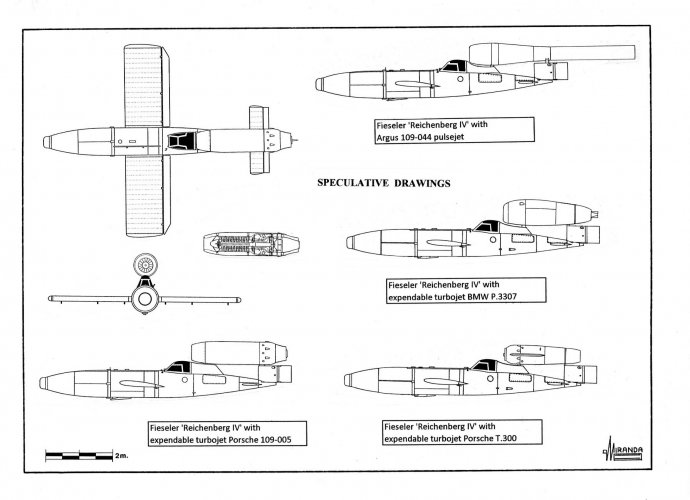
The most elegant solution would have been to replace the Argus for an expendable turbojet with 1,102 lb (500 kg) static thrust. The German industry was working on three different models since October 1944: the BMW P.3307, the Porsche 109-005 and the Porsche T.300, but none reached the production stage.


The BMW P.3307 was an 80% scaled-down version of the classic BMW 109-003 A. It was a very simplified design that only required 100 man-hours to be built. It was 2.85 m long and 0.69 m in diameter and weighted 650 kg. The P.3307 was producing 500 kp static thrust, with a consumption rate of 1.5 and 2 hours of expected life. The Porsche 109-005, with the same length and thrust, required a manufacturing time of 140 man-hours, but only weighed 180 kg. It could power a V-1 to 700 km the launch site, with 4,000 m ceiling and a flight level 1,000 m higher than that obtained with the pulsejet Argus.


The simplified version Porsche T.300, with 400 kp thrust, used numerous hollow, stamped and welded parts. Its diameter was reduced from 0.65 to 0.57 m and was only 2.33 m long. Mass production was scheduled for June 1945. The extended range also increased the inaccuracy of the missile, reaching a situation in which its use would only be profitable by increasing the number and frequency of launches far beyond the ability of the manufacturer. The 'robot war' had been reduced to a matter of statistics and production capacity, a game that Germany could only lose.


Powered by one of these turbojets, the V-1 missile could fly 311 miles (500 km) from the launch point at a top speed of 497 mph (800 km/h).


The Fi 103 B-1 version was built with the purpose of extending the range to 275 km, fitted with a new fuel tank containing 689 liters of Br-Stoff.

The Fi 103 E-1 was a long-range variant with 810 liters of fuel, 8.87 m length, 5.74 m wingspan and 2,932 kg weight.

The E-1 proved too heavy and was replaced by the F-1, with 530 kg warhead and 1,025 liters of fuel, 8.87 m length, 5.74 m wingspan and 2,270 kg weight, but its maximum range was limited by the operating time of the pulsejet's valve system.

For the attack on Washington, proposed on July 24, 1943, it would have been necessary to modify a number of U-boats Type XXI with a Reichenberg IV housed in a watertight container located on the rear deck behind the conning tower.

The problem with Type XXI is that they were not big enough to use the same system of steam catapults installed on Japanese submarines of the Sen-Toku series. Nor was it possible to use the catapult Madelung KL 12, designed for launching unmanned missiles, because its length was 42 meters and its terminal speed of 105 m/s would make the pilot lose consciousness.

The solution proposed by the Dipl. Ing. Willy Fiedler consisted of a folding ramp, only 10 m. length, which was originally designed to launch the Natter. With the use of two RATO rockets of the Schmidding 109-533 type, a softer thrust would be obtained until reaching the starting speed of the pulsejet. The article entitled 'Robot bombs attacks here held probable' published on January 9, 1945 in the New York Times showed that the Allied intelligence services considered such attacks feasible.

After the war, the mastermind of the plan worked designing several U.S. Navy submarine launch systems for the Loon and Regulus missiles.

 

Attachments

  • xc1.jpg
    xc1.jpg
    329.2 KB · Views: 27
So, what I'm seeing here from some is that the Germans were useless. The Americans were well on their way so the Germans were useless.

That is, of course, why Paperclip brought over hundreds of rockets scientists and technicians courtesy of the U.S. taxpayer. Followed by their families. They were given free room and board in exchange for, well, nothing.
 
No. The V2 rocket may have been obsolete by 1947. However, the design and technology associated with the V2 were not outdated at that time. The Redstone rocket, whose engine technology was derived from the V2 and also used hydrogen peroxide decomposition to drive its turbopump, had its final launch in 1967. Moreover, the technical concept of using a “gas generator” to drive turbopumps remains in use to this day.

I'll give you that there were certain parts of German technology that got used beyond the end of the war. That goes without argument. Again, my point is, that virtually none of it was so groundbreaking or unique that other countries couldn't have come up with it themselves. German tech simply provided a shortcut.

In rocket engines, German tech made a bigger difference for France and Russia both of whom had done nothing on rocket technology research during the war. France fell, and Russia couldn't afford that luxury. So, for them German tech was used to make up the difference. But even they dumped most of it PDQ simply because there was better out there when they weren't rushed to get something now into service.
I don’t mean to deny the history or capability of the U.S. in independently developing liquid-fuel rockets. But what I want to say is that before the end of World War II, American liquid rocket engine technology truly behind Germany’s, and learning from German technology greatly benefited the U.S. .
Only because the US saw little value in liquid fuel rockets. Had the US military expressed a greater interest, more would have been done towards developing them. On the other hand, the US went far further than Germany did in developing better solid fuels. In that sense, the Germans were behind in solid fuels at least as far as the US was in liquid fuels by 1945. The advantage the US had was they were at least aware of the various fuel / oxidizer combinations that were available for use in liquid fuel rockets while the Germans had nothing to match asphalt / tar bound and sulphonated rubber solid fuel compounds the US had developed. I suspect one major reason was these were petroleum and rubber based, and those materials were in critically short supply in Germany meaning that experimentation, let alone production, of them wasn't something they could afford to do.
 
I'll give you that there were certain parts of German technology that got used beyond the end of the war. That goes without argument. Again, my point is, that virtually none of it was so groundbreaking or unique that other countries couldn't have come up with it themselves. German tech simply provided a shortcut.

In rocket engines, German tech made a bigger difference for France and Russia both of whom had done nothing on rocket technology research during the war. France fell, and Russia couldn't afford that luxury. So, for them German tech was used to make up the difference. But even they dumped most of it PDQ simply because there was better out there when they weren't rushed to get something now into service.

Only because the US saw little value in liquid fuel rockets. Had the US military expressed a greater interest, more would have been done towards developing them. On the other hand, the US went far further than Germany did in developing better solid fuels. In that sense, the Germans were behind in solid fuels at least as far as the US was in liquid fuels by 1945. The advantage the US had was they were at least aware of the various fuel / oxidizer combinations that were available for use in liquid fuel rockets while the Germans had nothing to match asphalt / tar bound and sulphonated rubber solid fuel compounds the US had developed. I suspect one major reason was these were petroleum and rubber based, and those materials were in critically short supply in Germany meaning that experimentation, let alone production, of them wasn't something they could afford to do.

Nonsense. A shortcut? To what? What was the pressing need at the time?
 
So, what I'm seeing here from some is that the Germans were useless. The Americans were well on their way so the Germans were useless.

That is, of course, why Paperclip brought over hundreds of rockets scientists and technicians courtesy of the U.S. taxpayer. Followed by their families. They were given free room and board in exchange for, well, nothing.
That's what Air Force guys want you to think:
"ABMA--what's that?"
MSFC bashing, pure and simple
 
Nonsense. A shortcut? To what? What was the pressing need at the time?
A research shortcut. For example, the Germans had a working turbopump design. A US company could take that design and then improve it rather than starting from scratch. That saves time and effort.

With the V-2, the German gyro guidance system was reworked by US manufacturers to improve its reliability and accuracy. They found some of the design features being outdated and poorly executed. That improved the launch success rate significantly. This shouldn't be something unexpected. The US was well ahead in gyro technology having implemented successfully lead computing gunsights, remote control turrets with centralized fire controls (B-29, A-26 etc.) and placed these into mass production.
 
A research shortcut. For example, the Germans had a working turbopump design. A US company could take that design and then improve it rather than starting from scratch. That saves time and effort.

With the V-2, the German gyro guidance system was reworked by US manufacturers to improve its reliability and accuracy. They found some of the design features being outdated and poorly executed. That improved the launch success rate significantly. This shouldn't be something unexpected. The US was well ahead in gyro technology having implemented successfully lead computing gunsights, remote control turrets with centralized fire controls (B-29, A-26 etc.) and placed these into mass production.

Again, "the U.S. was well ahead..."

So, after a few minor improvements in German equipment, why wasn't the lot sent back? Why keep them for decades?
 
Again, "the U.S. was well ahead..."

So, after a few minor improvements in German equipment, why wasn't the lot sent back? Why keep them for decades?
The US is a free country. Many decided to immigrate permanently, especially given the often-dire straits the German economy was in immediately after WW 2. The aircraft and advanced weapons industry there was shut down completely until 1955. Other famous German engineers and scientists left for other countries too. Kurt Tank went to Argentina. Hermann Oberst went to Italy. The Horten brothers went to Argentina.

Many German POW's decided to stay in the US too. The Paperclip scientists, etc., weren't held beyond 1950 and could have left but they chose not to.
 
The US is a free country. Many decided to immigrate permanently, especially given the often-dire straits the German economy was in immediately after WW 2. The aircraft and advanced weapons industry there was shut down completely until 1955. Other famous German engineers and scientists left for other countries too. Kurt Tank went to Argentina. Hermann Oberst went to Italy. The Horten brothers went to Argentina.

Many German POW's decided to stay in the US too. The Paperclip scientists, etc., weren't held beyond 1950 and could have left but they chose not to.

Not a very credible response. The Germans were required for the space program. Have you heard of Ernst Stuhlinger? He wrote Astronautical Engineering and Science. How about the "Ernst Stuhlinger Medal for Outstanding Achievement in Electric Propulsion"?
Kurt Debus, the first director of NASA's John F. Kennedy Space Center or Eberhard Rees, the second Center Director of NASA's Marshall Space Flight Center? The latter managed the Apollo program and implemented Skylab.

These men were hand-picked by U.S.military intelligence. The Soviets also got their share. President Truman was not happy about this arrangement since some were suspected or accused of war crimes. Arthur Rudolph left for West Germany in 1984 to avoid prosecution. Rudolph had been the technical director of the Redstone missile project.

 
Again, my point is, that virtually none of it was so groundbreaking or unique
“that virtually none of it was so groundbreaking or unique”, What are your criteria for judgment? Your biases? Just like I said:
the technical concept of using a “gas generator” to drive turbopumps remains in use to this day.
Well, actually it's not just "used to this day"—currently, most of high-thrust rocket engines utilize the "gas generator" to drive turbopumps: Raptor (Starship), BE-4 (Vulcan & New Glenn), RS-25 (SLS & Shuttle), RD-107 & 108 (Soyuz), RD-253 (Proton), YF-20 (Long March 2, 3 & 4), YF-100 (Long March 5, 7, 8 & 10)... And historically significant high-thrust rocket engines: F-1 & J-2 (Saturn V), RD-170 (Energia)... If this German-originated technology wasn't "groundbreaking or unique," why has it remained in use to this day? Why has it been applied to so many rocket engines?

German technology launched the first American satellite into space and propelled Alan Shepard beyond the Kármán line... Americans have accomplished so many monumental feats using German technology—you can't just casually brush off the importance of German technology.

that virtually none of it was so groundbreaking or unique that other countries couldn't have come up with it themselves.

If that's your standard, then wouldn't the first airplane also be something where "virtually none of it was so groundbreaking or unique that other countries couldn't have come up with it themselves"?

The French, Brazilians… many teams from many nations were developing aircraft. If not for the Wright brothers, would humanity never have achieved flight? Would the French or Brazilians not have accomplished the first-ever manned flight instead? But does that mean Wright brothers's contribution wasn’t "groundbreaking or unique"?

Karl Benz wasn’t the first to invent the combustion engine, nor the first to put one in a vehicle—he was an inventor "standing on the shoulders of giants." Other inventors too had made progress; other inventors just as well could have been the first to create a practical automobile. But does that mean Karl Benz’s contribution wasn’t "groundbreaking or unique"?

Only because the US saw little value in liquid fuel rockets. Had the US military expressed a greater interest, more would have been done towards developing them.

The ability to foresee the future of a technology also reflects a nation's level of advancement in that technological field.

On the other hand, the US went far further than Germany did in developing better solid fuels. In that sense, the Germans were behind in solid fuels at least as far as the US was in liquid fuels by 1945.

The U.S. dominance in solid-fuel rockets does not alter the fact that America lagged behind Germany in overall rocket technology. As 1944, Germany had already achieved guided delivery of one-ton warheads to targets over 300 kilometers away. America? What was its most powerful rocket at the time? Tiny Tim?
 
Last edited:
Not a very credible response. The Germans were required for the space program.
Wrong. The Germans had nothing to with the Atlas, Titan, Thor, Minuteman, Polaris, Agena, Centaur, Vanguard, Ranger, Lunar Orbiter, Surveyor, TIROS, Mercury or Gemini spacecraft, Apollo CSM and LM, Mission Control, CORONA, GAMBIT, etc.

Again, the US was only behind (less than 5 years) in turbo pumps and were ahead in the rest of rocketry in the 50's,

Even the S-II, S-IV and S-IVB were built by industry and not Marshall.
 
Wrong. The Germans had nothing to with the Atlas, Titan, Thor, Minuteman, Polaris, Agena, Centaur, Vanguard, Ranger, Lunar Orbiter, Surveyor, TIROS, Mercury or Gemini spacecraft, Apollo CSM and LM, Mission Control, CORONA, GAMBIT, etc.

Again, the US was only behind (less than 5 years) in turbo pumps and were ahead in the rest of rocketry in the 50's,

Even the S-II, S-IV and S-IVB were built by industry and not Marshall.

"built by industry"? Air Materiel Command held all of the relevant captured German documents. Some were translated, some were not. The various manufacturers were discreetly informed about most of these documents. They were required to make a formal request on letterhead to get any of them.

The Wright Air Development Center developed projects in-house. Captured Me 262s were tested there, along with captured German ejection seat technology.

It may interest you to know that during the war, captured German aircraft were evaluated there.

Based on my research, the U.S. was behind in every technology. That is why hundreds of Germans were brought over and utilized by the Americans. The Americans were far behind. Your opinion contradicts a warning issued at the end of the war.

The Joint Intelligence (Sub-) Committee issued the following warning at the end of the war.

"Unless the migration of of important German scientists and technicians into the Soviet zone is immediately stopped, we believe that the Soviet Union within a relatively short time may equal United States developments in the fields of atomic research and guided missiles and may be ahead of U.S. development in other fields of great military importance, including infra red, television and jet propulsion. In the field of atomic research for example, we estimate that German assistance already has cut substantially, probably by several years, the time needed for the USSR to achieve practical results."

Source: The Paperclip Conspiracy by Tom Bower, page 161. Original document: JIC 317/10, RG 218 JCS CCS 471-9 (1/5/45) Sect. 3, 1/5/45.
 
“that virtually none of it was so groundbreaking or unique”, What are your criteria for judgment? Your biases? Just like I said:

Well, actually it's not just "used to this day"—currently, most of high-thrust rocket engines utilize the "gas generator" to drive turbopumps: Raptor (Starship), BE-4 (Vulcan & New Glenn), RS-25 (SLS & Shuttle), RD-107 & 108 (Soyuz), RD-253 (Proton), YF-20 (Long March 2, 3 & 4), YF-100 (Long March)... And historically significant high-thrust rocket engines include: F-1 & J-2 (Saturn V), RD-170 (Energia)... If this German-originated technology wasn't "groundbreaking or unique," why has it remained in use to this day? Why has it been applied to so many rocket engines?

German technology launched the first American satellite into space and propelled Alan Shepard beyond the Kármán line... Americans have accomplished so many monumental feats using German technology—you can't just casually brush off the importance of German technology.


If that's your standard, then wouldn't the first airplane also be something where "virtually none of it was so groundbreaking or unique that other countries couldn't have come up with it themselves"?

The French, Brazilians… many teams from many nations were developing aircraft. If not for the Wright brothers, would humanity never have achieved flight? Would the French or Brazilians not have accomplished the first-ever manned flight instead? But does that mean Wright brothers's contribution wasn’t "groundbreaking or unique"?

Karl Benz wasn’t the first to invent the combustion engine, nor the first to put one in a vehicle—he was an inventor "standing on the shoulders of giants." Other inventors too had made progress; other inventors just as well could have been the first to create a practical automobile. But does that mean Karl Benz’s contribution wasn’t "groundbreaking or unique"?

Just as Edison didn't "invent" the lightbulb--there were dozens of previous attempts that worked to a degree--what he did do was find the correct material by brute force, trial and error, to make the filament out of and do so in a vacuum creating the first durable lightbulb.

There were others before the Wright brothers who had found ways to fly and invented aircraft, powered or unpowered. What the Wright brothers did was get a combination correct that made powered flight possible with reasonably good control of the aircraft.

There's invention, then there's application. Applying an invention in a practical way is just as important as the invention itself. With liquid fuel rockets, Germany didn't invent them, they simply developed an application (a large ballistic missile) first. That is something the US, Britain, or Russia, among other countries, could have done but didn't because they saw no practical application for one. Werner v. Braun's true genius was in selling the V-2 program to the Nazi leadership and getting funded. That's equally true of him at NASA.

I'm not belittling that in the least. v. Braun's ability to sell the program to get a result is a critical part of the process. Bill Gates selling DOS to IBM was a critical move in the PC / micro computer revolution. Gates didn't invent operating systems. He didn't invent small computers. What he did do was bring a necessary component--a critical one--to the table and the result was a revolution in computing.

Without v. Braun and a Nazi ballistic missile program, one would have still been invented simply because the need for a nuclear weapons delivery system became necessary and one of the best ways to do that was with a ballistic missile.
The U.S. dominance in solid-fuel rockets does not alter the fact that America lagged behind Germany in overall rocket technology. As 1944, Germany had already achieved guided delivery of one-ton warheads to targets over 300 kilometers away. America? What was its most powerful rocket at the time? Tiny Tim?
Actually, I'd say the US was ahead or on par with the Germans in most areas of rocketry besides ballistic missiles in 1945. They were well ahead of Germany in SAM design and development and much closer to a practical guidance system than the Germans--the critical part of a SAM system. So were the British. The US had Little Joe, Lark, Bumblebee, Nike, and MX 606 /JB-8 GAPA all going by the time Germany surrendered.

They were ahead on AAMs too. The X-4 Ruhrstal was a pathetic joke. The US was testing the JB-3 Tiamat and Gorgon. The US was looking at having this radar guided, either beam riding, onboard radar, or semi-active homing, MCLOS with television or line-of-sight using radio command control, and possibly using IR technology. The USN went so far as to actually test their Gorgon II against a live drone aerial target in late 1944--unsuccessfully but they tried.

The US use of battlefield tactical rockets was on par with German use even if the US didn't make as widespread a use of them. The US Army's 4.5" rocket was as good as any design the Germans were using.

The USN had rockets applied to ASW warfare (the Retrorocket / bomb and Mousetrap).

The USAAF and USN both used a variety of aerial rockets on planes, more widespread than the Germans did. Most of the Luftwaffe's rockets were adaptations of Heer designs. The R4M was about the only uniquely German air to air rocket developed and that came about because of their unique need for a bomber killer, something the Allies didn't need.

Across the board, the US and Britain were on par with Germany in rocketry, or ahead, with the exception of ballistic missiles. That they didn't go that path is due to their leadership seeing no viable need for that technology. They could bomb the snot out of a city using their air forces at lower cost and with better results, something the Germans by 1944 could no longer manage.

When the need for a nuclear weapon delivery system became a necessity, the US started developing ballistic missiles starting with MX 774 HIROC. They looked at a weapon that could deliver a then weight nuclear bomb to a range of 300 miles (a 30% increase on the V-2). The one thing that came out of that program that had a lasting effect on follow-on programs was Hughes Azusa guidance system. It was a much better (independently invented), if similar, system to Ruse that the Germans were using.
 
Last edited:
"built by industry"? Air Materiel Command held all of the relevant captured German documents. Some were translated, some were not. The various manufacturers were discreetly informed about most of these documents. They were required to make a formal request on letterhead to get any of them.

The Wright Air Development Center developed projects in-house. Captured Me 262s were tested there, along with captured German ejection seat technology.
Yes. Saturn V second and third stages, Atlas, Titan, Thor, Centaur (which the Germans hated), Agena, Minuteman, etc were all built by industry, with no German involvement or in-house projects.
Based on my research, the U.S. was behind in every technology. That is why hundreds of Germans were brought over and utilized by the Americans. The Americans were far behind. Your opinion contradicts a warning issued at the end of the war.
You are so wrong. I am not posting an opinion. The US was ahead in electronics, nuclear engineering, etc.
 
Yes. Saturn V second and third stages, Atlas, Titan, Thor, Centaur (which the Germans hated), Agena, Minuteman, etc were all built by industry, with no German involvement or in-house projects.

You are so wrong. I am not posting an opinion. The US was ahead in electronics, nuclear engineering, etc.

See my previous post. At the end of the war, the Joint Intelligence (Sub-) Committee stated the exact opposite of what you're saying.
 
The date of that document is instructive however - 1st May 1945, i.e. before the Allies had time to corral all the German experts, sift through all the wrecked design offices and factories, load up the trucks with scientific booty and gain access to previously unknown sites.

While the committee might have been over-awed by what they had come up against - Me 262s, TV-guided HS 293s, some IR-equipped tanks and rifle sights (those these were very rare), they hadn't had a chance to actually evaluate German kit and know-how, it was all based on reputation at that stage.
And of course the realpolitik is simply dripping from that quote - grab everything we can to deny the Russians getting it.

As I said before, every German item, paper or brain safely in US custody was denied to a potential enemy or rival. Whether the US made full use of them or not, at least they couldn't be helping anyone else who might gain more from their knowledge.
 
See my previous post. At the end of the war, the Joint Intelligence (Sub-) Committee stated the exact opposite of what you're saying.
no, that doesn't say that. It just says if the Soviets get Germans they can catch up. And they were not ahead in TV, IR and nuclear.
 
The date of that document is instructive however - 1st May 1945, i.e. before the Allies had time to corral all the German experts, sift through all the wrecked design offices and factories, load up the trucks with scientific booty and gain access to previously unknown sites.

While the committee might have been over-awed by what they had come up against - Me 262s, TV-guided HS 293s, some IR-equipped tanks and rifle sights (those these were very rare), they hadn't had a chance to actually evaluate German kit and know-how, it was all based on reputation at that stage.
And of course the realpolitik is simply dripping from that quote - grab everything we can to deny the Russians getting it.

As I said before, every German item, paper or brain safely in US custody was denied to a potential enemy or rival. Whether the US made full use of them or not, at least they couldn't be helping anyone else who might gain more from their knowledge.

That is not how it worked at all. That picture is highly inaccurate. The British T-Force was a highly trained commando unit. They would go into locations where the bullets were still flying. Unlike 30-AU, they weren't risking their lives to save others, they were doing it before someone else like the U.S. and Soviets secured Target sites for themselves.

The dispersal of scientific and production sites to barns and nondescript buildings was highly effective. The Allies could not bomb them all. None had any outward signs of what was going on within. There is this cartoon idea that the Allies bombed every square inch of German occupied territory, which would have to include Austria and Czechoslovakia. The Americans instructed G.I.s to collect and return any "unusual" German equipment they found to collection sites in the final months. But, because of security concerns, this unusual equipment was uniformly things that were already known. The G.I.s were given little in the way of what this "unusual" equipment might actually look like. This idea had been spurred on by U.S. intelligence teams finding hidden sites but with obviously missing or destroyed equipment.

British intelligence had gone in with Black Books. These contained photos and descriptions of Target sites to be located and secured. Other "books" included photos of scientists and technical personnel to be located for interrogation. If interrogation or documents revealed unknown sites, these were listed in intelligence documents as Targets of Opportunity.

Reading through BIOS and CIOS reports shows a high degree of skepticism and negative remarks concerning anyone who was interrogated. The same critical eye was brought to any equipment found, and bland statements towards electronic components included "within the state of the art," "inferior to existing equipment," and the rare, "novel" and similar.

There is also this very strange idea that the U.S. would hire people who did not know how to do the work. People who may have seen something being done but who never did it themselves.

At the end of the war, scientists and technical personnel were found in refugee camps. Others had relocated by using actual or counterfeit travel documents. One American scientist wrote a book about his attempts to locate such persons. He had the authority to remove and question anyone. It was common practice for American scientists to be placed in uniform so as to be blend in with other G.I.s and appear as just other soldiers to foreign intelligence agents who were looking for the same people. This was further complicated by the Counter-Intelligence Corps learning that an original machine for producing travel papers was being used to generate new documents. This had been caught through the unique numbers used on each going beyond the known sequence.

There was little that was neat and tidy about this period. The CIC was amassing a file of color coded cards listing the names and particulars of persons being sought and those located. In one instance, they had assisted T-Force. (Source: Weekly Intelligence Summary for 16 July 1945 in my possession.)

Great Britain was bankrupt. Massive aid from the United States was provided. Rationing was the norm. Anything that could help British industry was sent over. Unfortunately, very little survives that gives details about what T-Force did during the war. In the useless book, T-Force by Sean Longden, extremely vague references to important finds can be found. Like a new explosive that was immediately sent off to London. What was the nature of this new explosive? Who made it? Such answers cannot be found.

Soviet intelligence teams were going everywhere. German personnel were being offered jobs with good pay, good housing and ample food. They could avoid any hardships if they agreed to go to the Soviet Union. Others were simply kidnapped.

The idea that the U.S. or the British were denying the Soviets anything is fiction. The rocket scientists who were brought over did highly valuable work. If they were not actually useful, then the Soviets could have them.
 
It was common practice for American scientists to be placed in uniform so as to be blend in with other G.I.s and appear as just other soldiers to foreign intelligence agents who were looking for the same people.
This isn't true. American, or for that matter, Soviet, engineers and scientists were often put in uniform and given officer rank to give them authority in a war zone commensurate with that rank. That allowed them to travel in areas under military control, get through checkpoints, and use military facilities for berthing and food. It wasn't to "blend in," but rather to make things easy for specialist personnel to work in a military occupation zone.

Earlier in the war, this same practice in the US was carried out to keep critical personnel who might otherwise be drafted from that fate simply by inducting them, putting them in uniform, and sending them immediately back to work. It wasn't uncommon to see military officers of middle to high rank or NCO's with the highest rank, with uniforms sporting zero medals or other awards on university campuses across the US during the war for that reason.

The US did this in a number of fields, not just with persons in highly technical jobs either. For example, when the Army need railway engineers and operators they simply drafted / hired railway personnel who already did the needed jobs. These men were instantly promoted to ranks equivalent to their civilian positions and put in uniform.

The idea that the U.S. or the British were denying the Soviets anything is fiction. The rocket scientists who were brought over did highly valuable work. If they were not actually useful, then the Soviets could have them.
And yes, this is the case in part. But denial not just to the Soviets, but to other allied powers. For example, the British pretty much denied the French access to anything in their sector of control while the US limited the French to observing or touring facilities while strictly prohibiting the removal of any materials or recruiting any personnel from them.

The Soviets initially sought to bring engineers, scientists, and technicians onboard simply by offering them a place to continue their work and a stipend. This would later change to a forced work policy when Operation Osoaviakim took place in October 1946. With that, all German scientists, engineers, and technicians in Soviet employ in Germany were forcibly arrested and then shipped to Russia to work in "closed" (eg., forced labor / secure) facilities there.

The French, desperate to get their own cut of the action weren't against theft and even kidnapping to obtain materials and personnel.

So, yes, the US and British were in part trying to keep key scientists and engineers out of the hands of rivals as much as they might also employ them.
 
This isn't true. American, or for that matter, Soviet, engineers and scientists were often put in uniform and given officer rank to give them authority in a war zone commensurate with that rank. That allowed them to travel in areas under military control, get through checkpoints, and use military facilities for berthing and food. It wasn't to "blend in," but rather to make things easy for specialist personnel to work in a military occupation zone.

Earlier in the war, this same practice in the US was carried out to keep critical personnel who might otherwise be drafted from that fate simply by inducting them, putting them in uniform, and sending them immediately back to work. It wasn't uncommon to see military officers of middle to high rank or NCO's with the highest rank, with uniforms sporting zero medals or other awards on university campuses across the US during the war for that reason.

The US did this in a number of fields, not just with persons in highly technical jobs either. For example, when the Army need railway engineers and operators they simply drafted / hired railway personnel who already did the needed jobs. These men were instantly promoted to ranks equivalent to their civilian positions and put in uniform.


And yes, this is the case in part. But denial not just to the Soviets, but to other allied powers. For example, the British pretty much denied the French access to anything in their sector of control while the US limited the French to observing or touring facilities while strictly prohibiting the removal of any materials or recruiting any personnel from them.

The Soviets initially sought to bring engineers, scientists, and technicians onboard simply by offering them a place to continue their work and a stipend. This would later change to a forced work policy when Operation Osoaviakim took place in October 1946. With that, all German scientists, engineers, and technicians in Soviet employ in Germany were forcibly arrested and then shipped to Russia to work in "closed" (eg., forced labor / secure) facilities there.

The French, desperate to get their own cut of the action weren't against theft and even kidnapping to obtain materials and personnel.

So, yes, the US and British were in part trying to keep key scientists and engineers out of the hands of rivals as much as they might also employ them.
In accordance with the Yalta agreements, the manufacture of weapons was not allowed in Germany, consequently, on October 22, 1946, all the captured German engineers, material and tools were transferred to the USSR.
 
Solids were where the United States well and truly had a sizable lead. The USSR fielded more liquid fuel development up until New Space at least. Parsons was quite a character…was there ever a solid vs liquid schism on the level of interservice rivalry?
 
Solids were where the United States well and truly had a sizable lead. The USSR fielded more liquid fuel development up until New Space at least. Parsons was quite a character…was there ever a solid vs liquid schism on the level of interservice rivalry?
No, but the Army and Navy had two parallel programs going with minimal cross talk between them. The lack of a solid fuel program in Germany beyond diglycol (a double base nitrocellulose) crippled much of Germany's missile development outside of the V-2 program.
 
No, but the Army and Navy had two parallel programs going with minimal cross talk between them. The lack of a solid fuel program in Germany beyond diglycol (a double base nitrocellulose) crippled much of Germany's missile development outside of the V-2 program.
Actually, the Army and Navy did little. It was JPL/Aerojet and Thiokol. And the USAF took the lead with the Navy following.
 
Tangential...
As I understand it, following an exceptionally snarky write-up by a reporter who 'could not see the woods for the trees', Goddard shunned publicity.
Other rocketeers lacked access to his work, had to independently invent a lot of things...

FWIW, didn't one of the German torpedo designs run on peroxide / dichromate driving a swash-plate steam-engine ??

In UK, the British Interplanetary Society knew not of liquid fuels, but designed a respectably practicable Moon Mission using umpteen solid fuel units for 'nigh infinite' staging.

'Tis said that when those famous pics of a V2's wreckage appeared in local news, BIS members sorta-chorused 'Turbo-Pump !!!' and, over a long weekend, re-designed their Moon Mission to use liquid fuels....
 
Actually, the Army and Navy did little. It was JPL/Aerojet and Thiokol. And the USAF took the lead with the Navy following.
Of course. Commercial companies and public universities were generally tasked by the Army and Navy to research and develop various things for them. GALCIT (later JPL) was a leader in solid fuel technology and some of its top researchers formed Aerojet to commercialize solid rocket fuels and engines. Thiokol (part of Goodyear) researched and developed rubber derived solid fuels.

The USAAF / USAF is an interesting case in that they wanted to be the big fish in the pond when it came to all things rockets and missiles. In the end, they ended up with just "strategic" ones along with aircraft carried designs being, in a sense, kicked to the curb by the Army and Navy. Their two SAM programs, GAPA then BOMARC were too ambitious in terms of the expected outcomes and then further done in by the Key West Agreement and the Soviets failing to build an intercontinental bomber force.

The US Army's designs usually succeeded because they took a more conservative approach to their systems while the USN was successful because they took a long view to development thoroughly researching and testing systems before deploying them. Even then, both faced issues with reliability that took years in service to work through.
 
Tangential...
As I understand it, following an exceptionally snarky write-up by a reporter who 'could not see the woods for the trees', Goddard shunned publicity.
Other rocketeers lacked access to his work, had to independently invent a lot of things...
That and he was also thin skinned about the US military and government telling him what to research for them rather than letting him largely decide. He also didn't want them sharing his research for them with potential rivals. His published works were gobbled up by rocket researchers in Russia and Germany at the time and became the basis for a lot of their early developments.
 
Based on my research, the U.S. was behind in every technology. That is why hundreds of Germans were brought over and utilized by the Americans. The Americans were far behind. Your opinion contradicts a warning issued at the end of the war.
You should read:

51SL-sTKTlL._SY425_.jpg


Exceptionally well researched and not some quasi-conspiracy nutter book. O'Reagan puts to lie the idea that the Germans were well ahead of the Allies in a variety of fields. If anything, they were even or behind in most areas of technology. For example, US machine tool manufacturers were surprised that the Germans hadn't invented or were using chip breaking tooling on their machines like the US was. That seems minor but it's an important detail in manufacturing.

When it came to all things electronic or electro-mechanical, the Germans weren't even in the race. The US and Britain had completely eclipsed German technology in this field so completely that they were at least a decade, if not more, ahead of the Germans.
 
You should read:

51SL-sTKTlL._SY425_.jpg


Exceptionally well researched and not some quasi-conspiracy nutter book. O'Reagan puts to lie the idea that the Germans were well ahead of the Allies in a variety of fields. If anything, they were even or behind in most areas of technology. For example, US machine tool manufacturers were surprised that the Germans hadn't invented or were using chip breaking tooling on their machines like the US was. That seems minor but it's an important detail in manufacturing.

When it came to all things electronic or electro-mechanical, the Germans weren't even in the race. The US and Britain had completely eclipsed German technology in this field so completely that they were at least a decade, if not more, ahead of the Germans.

You are proving once again that all of the German scientists that were brought over were useless. They should have been sent back the moment everyone realized their monumental error.

Instead, the facts show their involvement in everything from Redstone to Apollo to Skylab. Those are the facts.
 
No, because there was no USSR around when New Space started and Russia did little except for mod existing engines.
O/T
There are two CharlieXMurphees at Space Review...I think someone is trying to impersonate you (different spelling).
 
You are proving once again that all of the German scientists that were brought over were useless. They should have been sent back the moment everyone realized their monumental error.

Instead, the facts show their involvement in everything from Redstone to Apollo to Skylab. Those are the facts.
The US Army initially brought the Paperclip scientists, engineers, and technicians over for the express purpose of assembling captured V-2 missiles since they were familiar with the process and for little more. They were sequestered on Ft. Bliss near El Paso with little outside contact. Eventually, they were moved to Redstone Arsenal in Alabama to continue to work on US Army ballistic missiles.

Some subsequently went to NASA as they had difficulty getting security clearances to work on military projects outside ones the Army assigned them.
 
The US Army initially brought the Paperclip scientists, engineers, and technicians over for the express purpose of assembling captured V-2 missiles since they were familiar with the process and for little more. They were sequestered on Ft. Bliss near El Paso with little outside contact. Eventually, they were moved to Redstone Arsenal in Alabama to continue to work on US Army ballistic missiles.

Some subsequently went to NASA as they had difficulty getting security clearances to work on military projects outside ones the Army assigned them.

So, can you make up your mind? The lot of them should have been sent back the moment they showed the Americans how the V-2s worked. Am I right or not?

Actual historical accounts show you are quite wrong.
 
So, can you make up your mind? The lot of them should have been sent back the moment they showed the Americans how the V-2s worked. Am I right or not?

Actual historical accounts show you are quite wrong.
They had their choice usually on being repatriated. Most simply chose to stay in the US, as did many POW's simply because the standard of living at the time was so much higher than in Europe. Why would a rocket engineer want to return to Germany when there was no work there for them and the standard of living was on the edge of starvation?

Unlike the Soviet Union, the US generally wasn't using force to determine what these people would do or where they'd go other than in the immediate aftermath of Germany's surrender when that country was still under martial law.
 
Messerschmitt made cars and sewing machines right after the war. A number of Germans went to France for employment. The British and Australians were looking to set up a rocket program. The Employment of Scientific and Technical Enemy Aliens program (ESTEA) sought to set up Woomera as a test site.

You appear to be missing some details regarding the important contributions made by the Germans.

https://www.nasa.gov/people/dr-kurt-h-debus/
 
Some subsequently went to NASA as they had difficulty getting security clearances to work on military projects outside ones the Army assigned them.
Not true. They didn't need "clearances". They worked on Redstone, Jupiter, Corporal and Sergeant. It was gov't that made the move. ABMA Operations Division (Von Braun's group) was split off and formed NASA's Marshall Space Flight Center in July 1960. It was about 4,670 Army civilian employees and most of the V-2 Paperclip (150) personnel.
 
You are proving once again that all of the German scientists that were brought over were useless. They should have been sent back the moment everyone realized their monumental error.

Instead, the facts show their involvement in everything from Redstone to Apollo to Skylab. Those are the facts.
Wrong. They helped but the US was not behind in everything as you say.
They were involved with Redstone, Jupiter and Saturn, but not spacecraft or other vehicles like Atlas, Titan, Thor, Minuteman Agena, or Delta. They wanted to stay.

The biggest help was just NAA getting a V-2 engine to reverse engineer.
 
Last edited:
Not true. They didn't need "clearances". They worked on Redstone, Jupiter, Corporal and Sergeant. It was gov't that made the move. ABMA Operations Division (Von Braun's group) was split off and formed NASA's Marshall Space Flight Center in July 1960. It was about 4,670 Army civilian employees and most of the V-2 Paperclip (150) personnel.
It is true. Because of the clearance issues, they couldn't easily move to other companies involved in defense work. They instead stayed at Redstone working for the Army or went to NASA a civilian agency where security clearances weren't needed. v. Braun went to NASA in part because he saw it as a chance to fulfill his dream of a rocket going to the Moon. This is why they were involved in only a small number of defense missile projects and those specifically by NASA like Saturn.
 
It is true. Because of the clearance issues, they couldn't easily move to other companies involved in defense work. They instead stayed at Redstone working for the Army or went to NASA a civilian agency where security clearances weren't needed.
They were needed and they got therm. And they could have gone to work industry like some of the non rocket scientists did (or post NASA careers).
Being an immigrant does not prevent one from getting a clearance. Even non Paperclip Germans like Gunter Wendt got jobs in US industry.
 
Back
Top Bottom