The J32 was developed starting towards the end of 1942 and the first deliveries were in mid 1944. The primary user was the US Navy as part of Project Gorgon, to develop cruise missiles for various purposes. Westinghouse's slow development and delivery of this engine, along with rising costs on Westinghouse's part, caused development and manufacture to be cancelled in 1946.
At the time, the 9.5-inch diameter J32 represented the smallest operational jet engine in the world. Its advantage was it could be used in missiles and other smaller airframes.
The problem was the manufacturer chosen was a crap one. Had the J32 design been given to GE or Allison, they'd have quickly sorted out the issues and started production in quantity. The same thing happened in Great Britain with Whittle's engine. It was given to Rover to produce, and Rover screwed the pooch diddling around with the design and never quite getting to production. Once it was taken away from them and given to Rolls Royce, production started in short order and the engines were available in reasonable quantities.
The reason the Navy chose Westinghouse was GE and Allison were 'taken' by the USAAF and there was some inter-service rivalry going on at the time, just like in other countries.
With regard to the V-1, given the US had a flying copy of the V-1 by the fall of 1944, if the J32 were more readily available and in production, it could have been used as an alternative to the Argus pulse jet. I'd think if that were the case, the US installs the engine in the tail of the fuselage an air intake as appropriate, adding a rudder to the design. That means this modified V-1 is more aerodynamic and has roughly equal thrust at about the same weight, so it flies slightly faster.
With some additional development, it could easily break 500 mph in flight.
The aerodynamic drag of the V-1 airframe was higher than anticipated, due to low standards of manufacturing, decreasing from projected 900 km/h to the real 640 km/h.
Fortunately for the Allies this made the new missile susceptible to be intercepted by conventional fighters.
The simplest solution to the problem of short range missile was to improve the effectiveness of the pulsejet, originally designed for only 20 minutes of operation. The DFS, FKFS, AVA and LFA Institutes took care of this study to search for different systems to improve the performance and durability of the valves.
They also proposed replacing the E-1
Br-Stoff fuel by the other so-called E-2, of higher heat capacity, with which it was expected to increase the range by 7 per cent.
The capacity of the fuel tank was successively expanded to 810 and 1,025 litters, but the limit continued to be the time of operation of the pulsejet valves system.
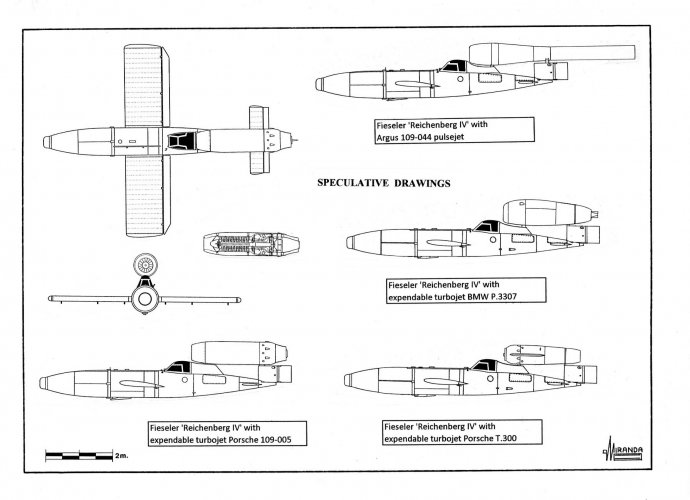
The most elegant solution would have been to replace the Argus for an expendable turbojet with 1,102 lb (500 kg) static thrust. The German industry was working on three different models since October 1944: the BMW P.3307, the Porsche 109-005 and the Porsche T.300, but none reached the production stage.
The BMW P.3307 was an 80% scaled-down version of the classic BMW 109-003 A. It was a very simplified design that only required 100 man-hours to be built. It was 2.85 m long and 0.69 m in diameter and weighted 650 kg. The P.3307 was producing 500 kp static thrust, with a consumption rate of 1.5 and 2 hours of expected life. The Porsche 109-005, with the same length and thrust, required a manufacturing time of 140 man-hours, but only weighed 180 kg. It could power a V-1 to 700 km the launch site, with 4,000 m ceiling and a flight level 1,000 m higher than that obtained with the pulsejet Argus.
The simplified version Porsche T.300, with 400 kp thrust, used numerous hollow, stamped and welded parts. Its diameter was reduced from 0.65 to 0.57 m and was only 2.33 m long. Mass production was scheduled for June 1945. The extended range also increased the inaccuracy of the missile, reaching a situation in which its use would only be profitable by increasing the number and frequency of launches far beyond the ability of the manufacturer. The 'robot war' had been reduced to a matter of statistics and production capacity, a game that Germany could only lose.
Powered by one of these turbojets, the V-1 missile could fly 311 miles (500 km) from the launch point at a top speed of 497 mph (800 km/h).
The Fi 103 B-1 version was built with the purpose of extending the range to 275 km, fitted with a new fuel tank containing 689 liters of Br-
Stoff.
The Fi 103 E-1 was a long-range variant with 810 liters of fuel, 8.87 m length, 5.74 m wingspan and 2,932 kg weight.
The E-1 proved too heavy and was replaced by the F-1, with 530 kg warhead and 1,025 liters of fuel, 8.87 m length, 5.74 m wingspan and 2,270 kg weight, but its maximum range was limited by the operating time of the pulsejet's valve system.
For the attack on Washington, proposed on July 24, 1943, it would have been necessary to modify a number of U-boats Type XXI with a
Reichenberg IV housed in a watertight container located on the rear deck behind the conning tower.
The problem with Type XXI is that they were not big enough to use the same system of steam catapults installed on Japanese submarines of the
Sen-Toku series. Nor was it possible to use the catapult Madelung KL 12, designed for launching unmanned missiles, because its length was 42 meters and its terminal speed of 105 m/s would make the pilot lose consciousness.
The solution proposed by the Dipl. Ing. Willy Fiedler consisted of a folding ramp, only 10 m. length, which was originally designed to launch the
Natter. With the use of two RATO rockets of the Schmidding 109-533 type, a softer thrust would be obtained until reaching the starting speed of the pulsejet. The article entitled 'Robot bombs attacks here held probable' published on January 9, 1945 in the New York Times showed that the Allied intelligence services considered such attacks feasible.
After the war, the mastermind of the plan worked designing several U.S. Navy submarine launch systems for the
Loon and
Regulus missiles.