@WatcherZero : thank you.

You are using an out of date browser. It may not display this or other websites correctly.
You should upgrade or use an alternative browser.
You should upgrade or use an alternative browser.
NEWS ONLY: France-Germany-Spain Future Combat Air System (FCAS / SCAF / FSAC)

Titus K
ACCESS: Top Secret
- Joined
- 6 September 2025
- Messages
- 817
- Reaction score
- 2,778
Chief of staff of the French Navy at the Senate
https://www.senat.fr/compte-rendu-commissions/20251103/etra.html#toc7
https://www.senat.fr/compte-rendu-commissions/20251103/etra.html#toc7
In other words, the new generation aircraft carrier does not constrain the mass of the next generation fighter - we will be able, thanks to the Emals (ElectroMagnetic Aircraft Launch System), to catapult up to 40 tonnes.
Last edited:

snne
ACCESS: Top Secret
- Joined
- 3 July 2022
- Messages
- 2,408
- Reaction score
- 8,848
View: https://x.com/FlightGlobal/status/2002016280010698800?s=20A lack of suitable European-built small turbofan engines for ‘loyal wingman’ applications that are also free of export restrictions has pushed the EU to consider funding the development of a new powerplant.
Titus K
ACCESS: Top Secret
- Joined
- 6 September 2025
- Messages
- 817
- Reaction score
- 2,778
This would be sized in the 5,620-7,870lb (25-35kN)-thrust range as research has shown this will “meet all necessary performance requirements for thrust and electric power”, it says.
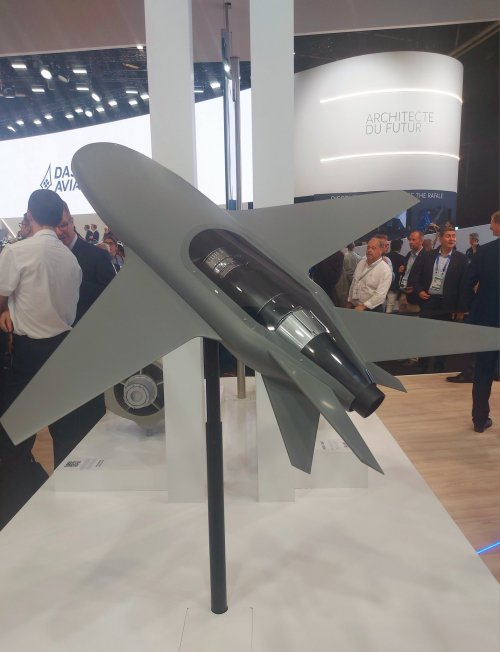
Safran is working on a family of lower cost engines for CCA's
M15 : ~15 kN
M30 : ~30 kN
M50 : ~50 kN
https://mars-attaque.blogspot.com/2025/07/safran-une-feuille-de-route-sur-les.html
From all these studies will emerge a family of military-use engines for the various applications, with the future M15, M30 and M50 (i.e. engines with 1.5, 3 and 5 tonnes of thrust), notably to power drones, including those accompanying manned aircraft for future Rafale standards and the post-Rafale era (or Combat Collaborative Aircraft, CCA). The aim is to reuse modules as much as possible, with, for example, the M50 adopting the architecture of the M88 but without afterburner, in order to power the future stealth UCAS (Unmanned Combat Air System), which is expected to weigh around 15 tonnes.
There is therefore a technological roadmap to support this family-based engine development, making it possible to align with the plan for managing skills already held or still to be developed within the design offices of the propulsion ecosystem working on this topic (with Safran in the lead, but also its subcontractors, notably in forging, sub-assemblies, etc.). Through this incremental approach, which goes via T-REX, the aim is to de-risk—by means of an intermediate step—the achievement of the specifications expected for the NGF, while at the same time ensuring the retention of human-resource skills (by providing new, engaging projects) and good knowledge transfer between generations of engineers, some of whom are nearing retirement.
Attachments
Last edited:
Titus K
ACCESS: Top Secret
- Joined
- 6 September 2025
- Messages
- 817
- Reaction score
- 2,778
Safran CEO on SCAF yesterday
The "best athlete" principle that Dassault is asking for is working on the engine side at least ...
View: https://www.youtube.com/watch?v=DyYmOOaXD8U
The "best athlete" principle that Dassault is asking for is working on the engine side at least ...
About FCAS, I don’t really know much more than you do. There is a strong political will at the highest level of the State, from the President of the Republic and the Chancellor, to keep moving forward. Today there is, I would say, an almost complete breakdown — you can clearly see it — at the level of the industrial partners, the aircraft manufacturers, on the aircraft pillar. They obviously haven’t found a way to work together and to define, more or less, how they should operate together.
What I can tell you is that we are responsible for the engine pillar, and on the engine side, we had a negotiation that was difficult at the time, around 2019, with our German partner. But we clarified things, we went into detail about who does what, and we adopted the principle of what we call the “best athlete.” So the best athlete means the best performer, etc. We said that the division of work would be based on clearly recognized competencies.
And so it is not about allowing the weaker partner to catch up in terms of competence compared to the stronger partner. That is not the principle of cooperation. The principle of cooperation is : you look at the cards that the partners have in their hands, and, you do something that fits the strengths of each of them.
And so since we went into the details of who does what with our German partner in 2019, we have had a system that works perfectly. And in fact, we are regularly cited as an example, both in France and in Germany, as proof that a Franco-German partnership can work in the defense domain. But after that, it really comes down to company-to-company relations. State-level political will is not enough. The industrial players have to be able to work together, because these are projects that will last 15 to 20 years in the development and industrialization phases.
So, what will happen? I can’t predict it. What I can tell you is that there is a short-term priority for all of us: the combat aviation roadmap for France, and that is the Rafale F5 standard, with its increased-thrust engine called T-Rex. And today, what makes me happy is that at the highest level of the Ministry of the Armed Forces — notably the Chief of the Defence Staff, who spoke before the Senate Defence Committee — he clearly said that the F5 standard is his priority in a short-to-medium-term horizon, and that he absolutely needs an increased-thrust engine, provided by us, and that we call T-Rex.
Last edited:

vikmto999
ACCESS: Confidential
- Joined
- 3 September 2025
- Messages
- 82
- Reaction score
- 320
Some news from the French armed forces minister, that basically says it is up to Dassault and Airbus to decide, not the politicians.
That doesn't sound great as Dassault would love to go it alone.
https://www.bfmtv.com/economie/entr...s-de-trouver-la-solution_AN-202601230525.html
That doesn't sound great as Dassault would love to go it alone.
https://www.bfmtv.com/economie/entr...s-de-trouver-la-solution_AN-202601230525.html
vikmto999
ACCESS: Confidential
- Joined
- 3 September 2025
- Messages
- 82
- Reaction score
- 320
On top of the Spanish getting miffed with it all and saying it is stalled due to people at logger heads, Airbus are now saying 2 fighters is a better solution instead.
A potentially “good” solution to the conflict that is holding up the development of Europe’s next-generation fighter jet would be to create separate jets for France and Germany, Airbus Defence and Space CEO Michael Schöllhorn told Euractiv.
https://www.euractiv.com/interview/...seperate-fighter-jets-for-fcas-a-good-option/
My last post on this from the Spanish defence ministry was deleted for not being News, so I'm unsure who deleted it or what news on FCAS is. Possible only talk on the hardware, rather than the political side.
So, I apologise to the Mod/Admin if I've done the same again with this!
A potentially “good” solution to the conflict that is holding up the development of Europe’s next-generation fighter jet would be to create separate jets for France and Germany, Airbus Defence and Space CEO Michael Schöllhorn told Euractiv.
https://www.euractiv.com/interview/...seperate-fighter-jets-for-fcas-a-good-option/
My last post on this from the Spanish defence ministry was deleted for not being News, so I'm unsure who deleted it or what news on FCAS is. Possible only talk on the hardware, rather than the political side.
So, I apologise to the Mod/Admin if I've done the same again with this!
Last edited:
So, despite all the hush-hush dogfighting that occurred in the secret alcoves of our brilliant diplomat's palaces to avoid it, competition at last?*
*I know that competition is apparently deemed to be a dirty word in this European (continental - sorry Italy) endeavor but this will result inherently in budget rivalry and further-on commercial contests, what is roughly 75% of a competition
*I know that competition is apparently deemed to be a dirty word in this European (continental - sorry Italy) endeavor but this will result inherently in budget rivalry and further-on commercial contests, what is roughly 75% of a competition
Last edited:
vikmto999
ACCESS: Confidential
- Joined
- 3 September 2025
- Messages
- 82
- Reaction score
- 320
Also hot off the press, we have the German chancellor today stating a two fighter focus could be the way forward.
So we're hearing from the politicians now and industry for a split. It could just be brinkmanship..
Germany's Merz: remains to be seen whether FCAS will yield joint aircraft
https://www.reuters.com/business/ge...er-fcas-will-yield-joint-aircraft-2026-01-29/"There will definitely be joint systems," Merz said in Berlin. "We are currently in intensive talks with France about the extent to which we will continue to develop and build joint aircraft, and I expect that we will reach a joint decision on this within the next few weeks."
So we're hearing from the politicians now and industry for a split. It could just be brinkmanship..

From earlier this month, about Saab joining the show in place of Dassault :
And :
In case anyone doubts that Saab would not have the same problems selling off its IPs and expertise for cheap as Dassault.
Saab Open to Airbus Defense Partnership as FCAS Next Generation Fighter Program Stalls.
Swedish defense company Saab has said it would consider teaming with Airbus Defence and Space on a new combat aircraft if the Future Combat Air System remains deadlocked. The remarks highlight growing frustration with FCAS and underscore the risk that Europe’s next-generation fighter effort could fragment further.
Saab is keeping its options open as Europe’s flagship next-generation fighter program struggles to move forward. In an interview with the Frankfurter Allgemeine Zeitung published December 21, 2025, Saab CEO Michael Johansson said the company would be willing to explore cooperation with Airbus Defence and Space on a new combat aircraft should the Franco-German-Spanish FCAS program fail to break out of its prolonged industrial and technical stalemate. His comments come as disagreements over workshare, system architecture, and leadership roles continue to slow progress on one of Europe’s most ambitious defense projects.
FCAS is not limited to replacing France’s Rafale and Germany’s and Spain’s Eurofighter fleets around 2040. It is structured as a “system of systems” composed of several interdependent pillars. At its core is the New Generation Fighter (NGF), a manned combat aircraft intended to operate in highly contested environments. The NGF is to be supported by unmanned collaborative combat platforms, referred to as Remote Carriers, designed to conduct reconnaissance, electronic warfare, saturation, or strike missions. These elements are to be interconnected through a combat cloud responsible for data fusion, mission coordination, and integration with land, naval, space, and cyber forces.
From an industrial perspective, FCAS relies on a highly sensitive division of responsibilities. Dassault Aviation was designated as prime contractor for the NGF, reflecting its experience as the designer of the Rafale. Airbus Defence and Space represents German and Spanish interests across several pillars of the program, including collaborative systems, combat architecture, and selected mission functions. Safran and MTU are tasked with joint development of the propulsion system, while Thales, Indra, and Airbus are involved in sensors and avionics. Additional industrial players contribute to connectivity, effectors, and support systems.
This allocation of roles has become the central point of contention. Since 2021, Airbus has challenged the governance model proposed by Dassault for the NGF, arguing that the “best athlete” principle restricts access to critical technologies for the German industrial base. Dassault, in turn, maintains that the development of a next-generation combat aircraft requires a clearly identified industrial authority responsible for overall architecture, technical decisions, and performance accountability. These disagreements have delayed the transition to demonstration phases intended to validate key technologies such as low observability, propulsion, mission systems, and human-machine integration.
In this context, Johansson’s comments carry broader implications. Asked by the FAZ about a possible partnership with Airbus Defence in the event FCAS were abandoned, he stated that Saab possesses the capabilities required to develop a next-generation fighter aircraft. He emphasized, however, that any cooperation would depend on maintaining core industrial competencies and technological independence, a concern that mirrors several of the issues currently affecting FCAS.
Johansson also outlined a phased approach to future air combat development. He estimated that designing a fully new manned fighter would require approximately ten years, with operational entry not expected before the late 2030s. By contrast, he identified unmanned capabilities as a more immediate priority. Collaborative combat drones, which could be fielded within four to five years, are seen as complementary assets to existing platforms such as the Gripen and the Eurofighter. Saab and Airbus Defence are already engaged in preliminary discussions in this area, although these remain at an early, exploratory stage.
This perspective highlights one of FCAS’s structural challenges: the difficulty of aligning priorities among the manned aircraft, unmanned systems, combat cloud, and sensor architecture. While Saab advocates an incremental development path focused on deployable technological building blocks, FCAS remains organized around a comprehensive and tightly integrated architecture that has proven difficult to govern and synchronize among partners.
As Sweden continues national studies on a future air combat system led by Saab, the prospect of a German-Swedish industrial framework has emerged as a potential alternative for Berlin. Such an option would rest on a narrower industrial structure than FCAS, but it would also represent a departure from a program conceived as a cornerstone of European strategic autonomy. Whether European governments are prepared to reconsider this approach remains an open question, as FCAS continues to face unresolved technical, industrial, and governance challenges.
And :
[Analysis] SCAF: Saab Sets Its Conditions For Airbus To Launch A Joint Program
Since The Summer Of 2025, The Future Combat Air System (FCAS) Has Seen Its Trajectory Seriously Jeopardized, To The Point That The Demise Of A New Joint Fighter Jet Seems Already Written In Both Berlin And Paris. Recent Statements By The Head Of Saab, Reported After An Interview With A German Daily Newspaper, Have Added An Unexpected Element To The Debate, By Setting Strict Conditions For Any Cooperation With The German Industry. This Stance Comes As Germany Explores Alternatives, Including Closer Ties With Sweden, And As Several Media And Political Voices Now Consider The End Of The NGF As Envisioned In 2017 Inevitable.
In This Context, Saab's CEO's Proposal To Cooperate Without Massive Technology Transfers, While Preserving The Swedish Company's Full Aircraft Manufacturing Capabilities, Reflects Existing Tensions Between European Partners. The Issue Extends Beyond The Industrial Sphere To Encompass The Operational Timeline And Political Balance, As Berlin Seeks A Way Out While The SCAF Program Stalls, And Each Option Raises Technical And Diplomatic Constraints That Could Exacerbate Capability Vulnerabilities Over The Coming Decade.
...
In case anyone doubts that Saab would not have the same problems selling off its IPs and expertise for cheap as Dassault.
Last edited:

I'm just hoping there's a long enough pole to keep them away from GCAP.
vikmto999
ACCESS: Confidential
- Joined
- 3 September 2025
- Messages
- 82
- Reaction score
- 320
Some extra info from the FT
https://www.ft.com/content/6f65417d-8e4c-48ff-a2c3-4437d881ae1c
So a decision by the end of Feb.
https://www.ft.com/content/6f65417d-8e4c-48ff-a2c3-4437d881ae1c
“We are trying to resolve this. In any case, there will be joint systems.’’ Merz said. ‘‘We are currently engaged in intensive dialogue with France on the extent to which we will also continue to develop and build joint aircraft, and I expect that we will reach a joint decision on this within the next few weeks.”
The German leader’s comments came after Michael Schoellhorn, chief executive of Airbus Defence and Space, said that his company had given up on manufacturing a joint fighter aircraft.“We have come to the conclusion that . . . Dassault just has a completely different set-up in mind that is not fitting to a co-operative European project, and that’s why it’s better that we part ways on the fighter,” he told Politico.
A person inside Merz’s Christian Democratic Party, said: “The project is deadlocked but no one wants to be the first to say it is dead.”
Dassault put forward a new proposal to the governments of how it envisioned its leadership, two people familiar with the matter said. It included explicitly calling Airbus a subcontractor, one of the people said, and requested that the French military procurement agency oversee the works, rather than a more international committee.
The two nations had agreed on a deadline of the end of 2025 to resolve the dispute. But one person close to the matter said the decision was postponed until the end of February, after French President Emmanuel Macron and Merz met in Paris on January 6.
So a decision by the end of Feb.
Dassault [...] requested that the French military procurement agency oversee the works, rather than a more international committee.
Is that an error in translation because it sounds oddly awkward?! Surely they said that the French and German military procurement agencies oversee etc...
I mean it would sound like some odd thing out of a Versailles treaty copy otherwise...
Last edited:
Titus K
ACCESS: Top Secret
- Joined
- 6 September 2025
- Messages
- 817
- Reaction score
- 2,778
For me this was agreed on from the start. Sounds more like media noise and an attempt to frame it as new information.Surely they said that the French and German military procurement agencies oversee etc...
The DGA is the sole contracting agency for the whole FCAS program, not just the aircraft.
MGCS was the program under German leadership.
https://www.senat.fr/rap/r19-642-2/r19-642-2_mono.html?utm_source=chatgpt.com
3. Ad-hoc governance and an innovative organisation of government/industry relations
A) A SPECIFIC ORGANISATION
A specific governance has been implemented for the FCAS programme. In France, a working group (GTSCAF) was set up between the DGA and the air force staff working on delegation from the armed forces staff. The DGA intervenes through certain divisions or sub-divisions. Internationally, a project team under General Jean-Pascal Breton has been set up in Arcueil with GTSCAF for France and counterparts from Spain and Germany, with a programmatic division and an operational division.The DGA is the contracting agency for the entire project on behalf of all partners: French, German and Spanish.
Try to stay on topic.I mean it would sound like some odd thing out of a Versailles treaty copy otherwise...
Prefer a good collaboration ?Is that an error in translation because it sounds oddly awkward?! Surely they said that the French and German military procurement agencies oversee etc...
I mean it would sound like some odd thing out of a Versailles treaty copy otherwise...
Try to stay on topic.
I think you are talking to the wrong guy. See better above...
Jackonicko
ACCESS: Secret
- Joined
- 4 February 2009
- Messages
- 476
- Reaction score
- 1,201
Some extra info from the FT
https://www.ft.com/content/6f65417d-8e4c-48ff-a2c3-4437d881ae1c
So a decision by the end of Feb.
You did a lot better than me in getting past the paywall!
Well done!

alberchico
I really should change my personal text
- Joined
- 14 January 2014
- Messages
- 1,018
- Reaction score
- 2,541

vikmto999
ACCESS: Confidential
- Joined
- 3 September 2025
- Messages
- 82
- Reaction score
- 320
Sometimes it never rains but it pours.
https://www.euractiv.com/news/german-union-urges-homegrown-fighter-jet-in-blow-to-european-plan/German union urges homegrown fighter jet in blow to European plan
Accusing French planemaker Dassault Aviation of trying to dictate terms on the Future Combat Air System (FCAS) project, Juergen Kerner, deputy head of the IG Metall union, and Marie-Christine von Hahn, head of the German Aerospace Industries Association, said Germany should make its own jet.
https://www.hartpunkt.de/fcas-bdli-und-ig-metall-fordern-zwei-kampfjets/
Industry and the union are convinced that the two-aircraft solution is clearing the way for clear conditions and perspectives, according to a statement published today by the BDLI.
“A two-aircraft solution is not a failure, but the growing up of FCAS. It allows different national priorities and reduces friction losses because cooperation takes place where it makes economic and technological sense,” says Marie‐Christine von Hahn, Managing Director of BDLI.

dark sidius
ACCESS: Top Secret
- Joined
- 1 August 2008
- Messages
- 1,618
- Reaction score
- 1,710
This is what I said time ago DEAD
German industry sources pushing for a 2 jet solution, retaining "everything that works in FCAS"... I interpret that to mean that they know they need the EUMET engine and Safran's expertise in hot engine sections for their solution to work.
https://rp-online.de/politik/auslan...nte-eigenen-kampfjet-entwickeln_aid-143827341
https://rp-online.de/politik/auslan...nte-eigenen-kampfjet-entwickeln_aid-143827341
Airbus could develop its own fighter jet
According to industry sources, Airbus is prepared to develop its own fighter jet in light of the delays to the planned Franco-German FCAS air combat system. "If it ultimately comes down to two aircraft, it wouldn't be the end of the world," German industry sources said on Friday on the sidelines of the Munich Security Conference.
"That would make FCAS even more resilient," the statement continued, referring to the Franco-German air combat system, which includes drones and communication systems in addition to the fighter jet. It was conceivable, the statement added, "to retain everything that works in FCAS."
Last edited:
Kurapika444
ACCESS: Confidential
- Joined
- 23 October 2024
- Messages
- 64
- Reaction score
- 124
Calm down people or you'll get this thread locked again.
One of the best German articles on the underlying incentives and motivations of each player involved in FCAS. (Click link for translation)
https://www-telepolis-de.translate...._sl=de&_x_tr_tl=en&_x_tr_hl=en&_x_tr_pto=wapp
The conclusion is quite interesting, as it highlights how this isn’t just about Dassault’s behavior, but also driven by German industry’s new appetite to lead projects and take advantage of the increased German defense budget, meaning they have less of a reason to collaborate with France:
https://www-telepolis-de.translate...._sl=de&_x_tr_tl=en&_x_tr_hl=en&_x_tr_pto=wapp
The conclusion is quite interesting, as it highlights how this isn’t just about Dassault’s behavior, but also driven by German industry’s new appetite to lead projects and take advantage of the increased German defense budget, meaning they have less of a reason to collaborate with France:
It is quite striking that those who would benefit most from building their own jet are now the ones complaining most loudly about the French side.
The following passage from the joint article by the BDLI lobbyist and the union vice-chairman is revealing:
"Combined with a robust federal budget, we are in a position to invest confidently and thus pursue bold industrial policy paths: We are no longer joining multinational projects, but are setting up our own program and then looking for partners who want to participate. Taking responsibility for the security of Europe also means leading from a position of industrial strength."
Marie-Christine von Hahn / Jürgen Kerner, Handelsblatt , February 9, 2026
In other words, the two are saying the following: While in previous years in-house development would have been far too expensive due to a lack of know-how, today it is affordable – and, to put it bluntly, one can ignore the French.
Titus K
ACCESS: Top Secret
- Joined
- 6 September 2025
- Messages
- 817
- Reaction score
- 2,778
View: https://x.com/MichaelaWiegel/status/2022635683622556054All arguments very plausible, but why does it take the Bundeswehr more than 8 years to notice this? France has clearly stated its needs from the very beginning

kqcke for you
PUMA PUMA PUMA
- Joined
- 3 November 2022
- Messages
- 1,866
- Reaction score
- 2,702
The answer is as simple as allways. The FCAS & MGCS combo deal at that time was just better than anything else while developing 2 aircrafts wasn't really in the budget.
Now with a budget thats mutch healthier for the Bundeswehr something like this will have to be redone as they can actualy afford what they need.
Anyway Quantum systems is offering to use it rat targeting drones for CCA developments
https://www.hartpunkt.de/quantum-systems-zeigt-jet-zieldarstellungsdrohne-rat/
And Helsing is working with Hensoldt together on ther UCAV. If everything is going right we can probaly see them being used as proper CCAs for testing in FCAS development
https://defence-network.com/ca-1-europa-hensoldt-helsing-buendeln-kraefte/
From Belgium:
https://breakingdefense.com/2026/02...er-negotiations-all-but-dead-industry-source/
Not everyone is sold on the prospect of Europe potentially investing in three future fighter jets, as Italy, the UK and Japan are also developing a platform under the Global Combat Air Programme (GCAP).
“It’s crazy. [We] have to stop this idea,” Theo Francken, Belgium’s Defense Minister told Breaking Defense today. “I think that’s too expensive to make three [different aircraft]. “It’s better to have one huge program” that includes a cloud network and Collaborative Combat Aircraft (CCA),” he added.
Brussels holds FCAS observer status, but “we don’t have a lot of information,” about the latest political and industrial developments relating to the troubled project,” stressed Francken. “It is between the key players. … I’m not certain it will end up well. It will be problematic, I assume.”
https://breakingdefense.com/2026/02...er-negotiations-all-but-dead-industry-source/
BS what is too expensive is to remove competition.
Titus K
ACCESS: Top Secret
- Joined
- 6 September 2025
- Messages
- 817
- Reaction score
- 2,778
Who could have known France needed a nuclear capable and a carrier capable aircraft …
So for the past 6 years, Germany has been pushing France to give up both its airborne nuclear deterrent and its carrier based aviation ?
https://www.deutschlandfunk.de/merz-aeussert-zweifel-an-zukunft-von-fcas-100.html
So for the past 6 years, Germany has been pushing France to give up both its airborne nuclear deterrent and its carrier based aviation ?
https://www.deutschlandfunk.de/merz-aeussert-zweifel-an-zukunft-von-fcas-100.html
Merz said in the podcast Power Change that France had different demands on a fighter aircraft than the Bundeswehr. The air combat system jointly planned by Germany, France and Spain is to replace the Eurofighter used by Germany and the French Rafale fighter aircraft from 2040. According to Chancellor Merz, France needs a nuclear-capable and aircraft-capable aircraft in the next generation of combat aircraft. The Bundeswehr doesn't need that right now. He brought into play the option to build a new fighter plane with Spain and other countries.
The decision on FCAS, which stands for Future Combat Air System, has already been postponed twice. Now it should fall by the end of the month. French President Macron had recently emphasized that he did not see FCAS as endangered. He warned that many synergies could be lost if the development is stopped

Aegrotare
ACCESS: Confidential
- Joined
- 2 November 2025
- Messages
- 69
- Reaction score
- 129
Everybody knows the reason for the problem in FCAS, thats just for political cover.Who could have known France needed a nuclear capable and a carrier capable aircraft …
So fot the past 6 years, Germany has been pushing France to give up both its airborne nuclear deterrent and its carrier aviation ?
https://www.deutschlandfunk.de/merz-aeussert-zweifel-an-zukunft-von-fcas-100.html

Dreamflyer
'Senior Something'
- Joined
- 13 July 2008
- Messages
- 555
- Reaction score
- 918
Who could have known France needed a nuclear capable and a carrier capable aircraft …
So for the past 6 years, Germany has been pushing France to give up both its airborne nuclear deterrent and its carrier based aviation ?
https://www.deutschlandfunk.de/merz-aeussert-zweifel-an-zukunft-von-fcas-100.html
https://breakingdefense.com/2026/02...r-is-all-but-over-officials-and-analysts-say/
"During an interview with German politics podcast Machtwechsel, Merz said “The French need, in the next generation of fighter jets, an aircraft capable of carrying nuclear weapons and operating from an aircraft carrier,” before adding “That’s not what we currently need in the German military,” strongly hinting that Berlin is soon to walkaway from the New Generation Fighter (NGF) aspect of FCAS, if not the entire deal altogether."
...
Citing Merz’s comments, Belgian defense minister Theo Francken — whose country has been an official observer in the program to potentially join in the future — said on X “SCAF is dead”
“There will be no Franco-German sixth-generation fighter jet,” Francken wrote. “Belgium was an observer in the program. We will reassess our position.”
...
Merz’s comments are likely to raise eyebrows in Paris, which has tried to play down any differences of opinion among decision makers in recent weeks. France’s Elysee Presidential Office had not responded to a request for comment at press time."
Here's a French article from a defense journalist who is well connected in gov. and industry circles and is often used to share talking points that can't be attributed officially.https://breakingdefense.com/2026/02...r-is-all-but-over-officials-and-analysts-say/Merz’s comments are likely to raise eyebrows in Paris, which has tried to play down any differences of opinion among decision makers in recent weeks."
https://www-latribune-fr.translate....sl=fr&_x_tr_tl=en&_x_tr_hl=en&_x_tr_hist=true
The Future Combat Air System (FCAS), spearheaded by Germany, Spain, and France, is clearly brain-dead in its current form. The German Chancellor was very clear on Wednesday about the future of this program, which has been stalled for several months . "The question now is: do we have the strength and the will to build two aircraft (...) or just one?" Friedrich Merz asked in rather bad faith on the German podcast Machtwechsel. He pointed out, in a particularly disingenuous manner, that Paris and Berlin are "in disagreement on the specifications and profiles " of the future combat aircraft that the three countries are supposed to develop together.
The failure of this program, launched with great fanfare but without any industrial consultation in July 2017 in Paris with Chancellor Angela Merkel, would be an admission of a terrible defeat for Emmanuel Macron. Most of the programs announced that day have been progressively torpedoed by Berlin (modernization of the Tiger helicopter, the MAST-F tactical missile, and the maritime patrol aircraft), while Paris wants to withdraw from the Eurodrone project. What remains is FCAS, which is practically nonexistent, and MGCS, the future tank system, which is also in poor condition.
The problem seems almost insurmountable: the French presidency appears to have no leverage left to compel Airbus and Dassault Aviation to cooperate on the SCAF (Future Combat Air System). Why are Dassault Aviation and Airbus so opposed? "The central issue is the 'lead share' between Dassault and Airbus: who has the power to decide what, who will be included in a decision. On these points, there is a fundamental disagreement" between the two groups, explains a source close to the matter.
Chancellor Merz's arguments for halting the SCAF program are very surprising and rather misleading. The Élysée Palace felt compelled to respond on this point: "The military needs of the three participating states have not changed; these needs included, from the outset, French deterrence as well as the other missions of the future aircraft ." The Germans seem to be rediscovering this now.
vikmto999
ACCESS: Confidential
- Joined
- 3 September 2025
- Messages
- 82
- Reaction score
- 320
Airbus are now suggesting 2 airframes for FCAS.
I think at this point with the German government, german industry and Dassault all basically saying the same thing, that we're hearing an orchestrated breakup of the project with the least amount of damage.
https://www.theguardian.com/busines...on-for-europe-faltering-fighter-jet-programme
I'd suggest there is no possibility Germany will build their own plane, it would be economically unviable for them as they would have no real export market, plus of course the technical difficulties.
So where now for Germany?
I think at this point with the German government, german industry and Dassault all basically saying the same thing, that we're hearing an orchestrated breakup of the project with the least amount of damage.
https://www.theguardian.com/busines...on-for-europe-faltering-fighter-jet-programme
I'd suggest there is no possibility Germany will build their own plane, it would be economically unviable for them as they would have no real export market, plus of course the technical difficulties.
So where now for Germany?
kqcke for you
PUMA PUMA PUMA
- Joined
- 3 November 2022
- Messages
- 1,866
- Reaction score
- 2,702
First step will likely be exactly that what they deny the whole time mostly more F-35 (rumours say likely another 35).Airbus are now suggesting 2 airframes for FCAS.
I think at this point with the German government, german industry and Dassault all basically saying the same thing, that we're hearing an orchestrated breakup of the project with the least amount of damage.
https://www.theguardian.com/busines...on-for-europe-faltering-fighter-jet-programme
I'd suggest there is no possibility Germany will build their own plane, it would be economically unviable for them as they would have no real export market, plus of course the technical difficulties.
So where now for Germany?
View: https://x.com/reuters/status/2024503043845148689?s=46
Next step would be finding possible partners also its still likely not all of FCAS will be gone ....


- Joined
- 11 February 2007
- Messages
- 4,132
- Reaction score
- 8,872
Interesting piece in the Guardian:
"“Dassault is not easy,” said the former senior French official. “They have got amazing engineers … but on the political side they behave how they want. And now they don’t even need this programme, they have many export sales coming from Rafale. So they are very comfortable, and their collaborative spirit is not good. They piss me off."
"Bertrand de Cordoue, Airbus’s former head of EU and Nato public affairs, said tensions had existed between the two companies from the start, with Airbus engineering teams regarding Dassault as the competition.
“For the German part of Airbus, it was not natural to accept coming out of the existing Eurofighter scheme,” said de Cordue, who is now an adviser at the Jacques Delors Institute, a thinktank. “The teams working on Eurofighter were not spontaneously accepting the idea to totally change their mindset and work with a French company that, on the export market, was a competitor, not a partner.”
Dassault, in turn, has resisted handing over its fighter-building know-how to Airbus, fearing a competitor would acquire French expertise. De Cordoue argued that since the technology was funded by French taxpayers, it should be “more the ownership of the French authorities” – and that Dassault should cooperate."
"Germany’s more assertive approach is partly a result of a shifting power dynamic. When the FCAS programme started in 2018, its defence spending was modest. Now, after the decision to rearm following Russia’s invasion of Ukraine, Berlin expects to spend €150bn by 2029 – nearly twice France’s budget.
“France has 60 years of being the accepted leader,” said [Francis] Tusa. “Suddenly Germany is saying: ‘We don’t have to be deferential.’”
“I think they should have kept going with a single aircraft,” Tusa said. “They [Airbus and Dassault] need to go to counselling and basically be told: ‘Come on guys, play nice.’”
Dassault declined to comment."
"Macron, meanwhile, has continued to insist publicly that the project can be saved, telling the Munich Security Conference this month: “It’s hard for me to understand how we will build new common solutions if we destroy the few ones that we have.”
The former French official was more downbeat, pointing to Macron’s presidency ending in May 2027. His possible successor, Marine Le Pen’s far-right National Rally party, is softer on Russia and may abandon the project entirely.
“My feeling is that this project was born with Macron,” the official said, “and could die with Macron.”"
Apart from the comments from Francis Tusa (who is a British defence analyst), this all seems sourced from the French side, and it's the first significant criticism of Dassault's behaviour I think I've seen from French sources.
France and Germany agreed to build the fighter jet of the future. Now they can’t agree who is in charge
"A former senior French official, who asked to remain anonymous, said the project appeared to have been conceived “at a very high political level”, without wider discussions in the ministry of defence about whether the countries had the same needs. “We do not have the same way of doing war, Germany and France,” they said. “I was quite troubled by this.”""“Dassault is not easy,” said the former senior French official. “They have got amazing engineers … but on the political side they behave how they want. And now they don’t even need this programme, they have many export sales coming from Rafale. So they are very comfortable, and their collaborative spirit is not good. They piss me off."
"Bertrand de Cordoue, Airbus’s former head of EU and Nato public affairs, said tensions had existed between the two companies from the start, with Airbus engineering teams regarding Dassault as the competition.
“For the German part of Airbus, it was not natural to accept coming out of the existing Eurofighter scheme,” said de Cordue, who is now an adviser at the Jacques Delors Institute, a thinktank. “The teams working on Eurofighter were not spontaneously accepting the idea to totally change their mindset and work with a French company that, on the export market, was a competitor, not a partner.”
Dassault, in turn, has resisted handing over its fighter-building know-how to Airbus, fearing a competitor would acquire French expertise. De Cordoue argued that since the technology was funded by French taxpayers, it should be “more the ownership of the French authorities” – and that Dassault should cooperate."
"Germany’s more assertive approach is partly a result of a shifting power dynamic. When the FCAS programme started in 2018, its defence spending was modest. Now, after the decision to rearm following Russia’s invasion of Ukraine, Berlin expects to spend €150bn by 2029 – nearly twice France’s budget.
“France has 60 years of being the accepted leader,” said [Francis] Tusa. “Suddenly Germany is saying: ‘We don’t have to be deferential.’”
“I think they should have kept going with a single aircraft,” Tusa said. “They [Airbus and Dassault] need to go to counselling and basically be told: ‘Come on guys, play nice.’”
Dassault declined to comment."
"Macron, meanwhile, has continued to insist publicly that the project can be saved, telling the Munich Security Conference this month: “It’s hard for me to understand how we will build new common solutions if we destroy the few ones that we have.”
The former French official was more downbeat, pointing to Macron’s presidency ending in May 2027. His possible successor, Marine Le Pen’s far-right National Rally party, is softer on Russia and may abandon the project entirely.
“My feeling is that this project was born with Macron,” the official said, “and could die with Macron.”"
Apart from the comments from Francis Tusa (who is a British defence analyst), this all seems sourced from the French side, and it's the first significant criticism of Dassault's behaviour I think I've seen from French sources.
vikmto999
ACCESS: Confidential
- Joined
- 3 September 2025
- Messages
- 82
- Reaction score
- 320
Some new from the Belgium Defence Minister. It's not exactly "This is dead" but it looks like Belgium believe this so now. More information on Wednesday then.
View: https://x.com/FranckenTheo/status/2024736936745746770
Translation:
A French-German-Spanish sixth-generation fighter jet will not be coming. The water is too deep for that, as has been apparent for months and is now confirmed by Chancellor Merz. Belgium is an observer in this program.
We will reassess our position in consultation with our allies. We will continue to invest in air combat capability with the F35 jet fighters, of which we are ordering 11 more. We will make these as European as possible with production in Cameri, Italy and with ever more economic return for our own companies. A European sixth-generation aircraft remains a dream.
Hopefully it will still come true. We are looking at all options. I will provide more explanation in the Defense Committee of the House on Wednesday.
Theo
View: https://x.com/FranckenTheo/status/2024736936745746770
Translation:
A French-German-Spanish sixth-generation fighter jet will not be coming. The water is too deep for that, as has been apparent for months and is now confirmed by Chancellor Merz. Belgium is an observer in this program.
We will reassess our position in consultation with our allies. We will continue to invest in air combat capability with the F35 jet fighters, of which we are ordering 11 more. We will make these as European as possible with production in Cameri, Italy and with ever more economic return for our own companies. A European sixth-generation aircraft remains a dream.
Hopefully it will still come true. We are looking at all options. I will provide more explanation in the Defense Committee of the House on Wednesday.
Theo

- Joined
- 29 November 2010
- Messages
- 2,275
- Reaction score
- 5,186
Similar threads
-

-

-
'Neuron 2.0' - New Dassault UCAS launched at Saint-Dizier, 8 October 2024
- Started by Jackonicko
- Replies: 20
-

-
 What if, France never left the Eurofighter consortium
- Started by helmutkohl
- Replies: 57