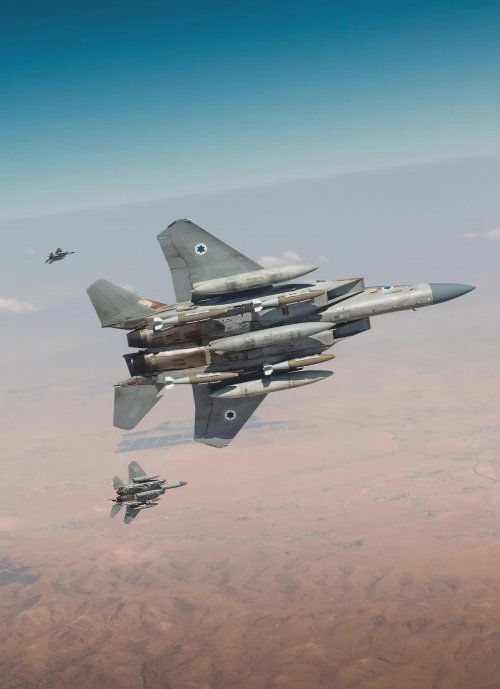
To start, the "Western Alliance" has a huge, gaping, F-111/A-6 sized hole in its Air Forces, something that can carry 2-4 JASSM class missiles >1000 mi unrefueled. Imagine how much more damage the IAF could have done if it could carry a meaningful bomb-load to Iran?

This aircraft need not be exceptionally stealthy, if it only needs to launch stand-off cruise missiles from outside the main defended area. In fact, the high potential for rapid development in low-cost cruise missiles (Anduril Barracuda, among others) means the cost over an entire campaign may be acceptably low.

The trade is now low-stealth (forward hemisphere?) airframe with lower-cost standoff (Anduril Barracuda and similar missiles, Castelion air-launched hypersonic strike) versus all-aspect penetrating stealth aircraft, which likely have to launch stand-off strike anyway, albeit from a much shorter distance.

I could see someone arguing "why not both?" so long as the hypothetical non-stealthy version is substantially cheaper.

If the budget line item reflects a real program, then maybe someone has realized that there is room for something like this. Also, being less stealth, it should be easier to develop and have more room for upgrades throughout its lifespan.

That's also why it won't be the X-47B, as that isn't sized for carrying cruise missiles. Now I think X-47B ought to be resurrected for long-range reconnaissance/strike, but not for this mission.

The proposed X-47C variant was much larger. Something more fitting for this role.
 
There’s a lot of imagination in this thread but not much fact or research.

I’ll sit this one out too.
Gatekeeping information is just strange. If you know something, why not mention it?
 
Gatekeeping information is just strange. If you know something, why not mention it?
Because some people who are making money on information without mentioning sources are reading this forum. This is just an attempt to force you use own brains with some leading clues (those money are not for a new fancy aircrafts).
 
To start, the "Western Alliance" has a huge, gaping, F-111/A-6 sized hole in its Air Forces, something that can carry 2-4 JASSM class missiles >1000 mi unrefueled. Imagine how much more damage the IAF could have done if it could carry a meaningful bomb-load to Iran?
LOL! The F-15I has far more range/payload capability than the A-6. And they already tried sticking an F-111 on a carrier and it fell on its face. As for payload to Iran an F-111 isn't going to be carrying more than 4 2,000lb bombs. Which the F-15I did.

76gwk6pvj99f1.jpeg

And if you're carrying JASSM you don't need the X-47 to do that for you. Any aircraft could. Thing is, you get a whiff there might be a little money for an attack aircraft and you want another F-111, but better, when they'd be lucky to get a production X-47.
 
Because some people who are making money on information without mentioning sources are reading this forum. This is just an attempt to force you use own brains with some leading clues (those money are not for a new fancy aircrafts).
The latest version of the bill deleted $1 billion in spending for classified programs and inserted $600 million for an Air Force long range strike aircraft and $500 million for a Navy long range strike aircraft — two efforts that do not seem to be associated with a publicly-known program of record.
If not associated with a publicly known program it is for something new so a new aircraft , we know for sure Lockheed is making a classified something in production may be related.
https://www.airandspaceforces.com/trump-signs-reconciliation-bill-air-force-space-force/
 
Last edited:
There’s a lot of imagination in this thread but not much fact or research.

I’ll sit this one out too.
Indeed. I thought it was common knowledge that the MQ-25 was going to get a long range strike capability. It already can carry two LRASM missiles under the wings. The USAF also plans to use the same platform. Boeing even displayed an MQ-25 without the wing folds and extra wing span. This perfectly explains the funding from both services.

The land based MQ-25 version should be able to carry 4 JASSM sized missiles to a combat radius of 1,000nm. That's a fair bit of payload for a single 10,000lb thrust engine. That long and straight wing has a massive advantage in fuel efficiency.
 
Boeing Unveils MQ-25's Land-Based Variant
https://theaviationist.com/2024/09/16/boeing-unveils-mq-25s-land-based-variant/
MQ-25 Stingray’s Extreme Range Gives It Massive Potential Far Beyond A Tanker
https://www.twz.com/air/mq-25-stingrays-range-gives-is-massive-potential-far-beyond-a-tanker
MQ-25 Stingray Tanker Drone Armed With Stealthy Anti-Ship Missiles Makes Perfect Sense
https://www.twz.com/air/mq-25-sting...ealthy-anti-ship-missiles-makes-perfect-sense
Looks Like the Navy's Stingray Drone Is Going From Tanker to Terminator
https://www.popularmechanics.com/military/aviation/a60501858/refueling-drone-navy/
There is a reasonable chance that once highly automated the MQ-25 will have an extremely low hourly operating cost. When paired with the new affordable standoff missiles under development the MQ-25 platform could provide the lowest cost per target destroyed.
 
LOL! The F-15I has far more range/payload capability than the A-6. And they already tried sticking an F-111 on a carrier and it fell on its face. As for payload to Iran an F-111 isn't going to be carrying more than 4 2,000lb bombs. Which the F-15I did.

View attachment 777049

And if you're carrying JASSM you don't need the X-47 to do that for you. Any aircraft could. Thing is, you get a whiff there might be a little money for an attack aircraft and you want another F-111, but better, when they'd be lucky to get a production X-47.

Interesting that this F-15I does not carry any AAM. Confident that no Iranian fighter would dare to intervene?
 
To start, the "Western Alliance" has a huge, gaping, F-111/A-6 sized hole in its Air Forces, something that can carry 2-4 JASSM class missiles >1000 mi unrefueled. Imagine how much more damage the IAF could have done if it could carry a meaningful bomb-load to Iran?

This aircraft need not be exceptionally stealthy, if it only needs to launch stand-off cruise missiles from outside the main defended area. In fact, the high potential for rapid development in low-cost cruise missiles (Anduril Barracuda, among others) means the cost over an entire campaign may be acceptably low.
It is crazy how you perfectly described the MQ-25 in every detail in terms of payload, range and being moderately stealthy.

The MQ-25 seems to have flown under your radar.
 
There is a reasonable chance that once highly automated the MQ-25 will have an extremely low hourly operating cost.
All automation does is add different systems that need maintenance. Operating costs are down to 1) fuel and 2) required post-flight maintenance. There's little difference between an MQ-25 and an MQ-4C in terms of flight hardware, so likely little difference in operating costs.

The big operating cost gains for drones such as CCAs come when you don't need to fly them regularly and can leave them in the box until needed. That doesn't work for an aerial refueler.
 
Expectations: A/F-X II: stealthy Boogaloo

Reality: flying fuel tank with ALCMs

It's not bad, but also not particularly fancy or exciting
This is just an attempt to force you use own brains with some leading clues (those money are not for a new fancy aircrafts).
As accurately put into text by flateric.
 
Here is a YT clip of BA discussing the latent strike capabilities of the Stingray (now that I write that, the name of the a/c is a dead giveaway). Relevant comments start at 2:35, discussing a scale model armed with two LRASMs.

The choice of LRASMs seemingly suggests quite a large variety of third party cued standoff weapons should be possible - JASSM, AIM-174B. If the USN threw some money at Marvin Engineering (or whoever) for an updated triple ejector rack, a Stingray could haul quite a few JATMs or hell even SDBs, with new degrees of freedom in terms of range and/or persistence.

Imagine strapping on a couple of rocket pods to really take advantage of that sensor turret - you’d have a MALE UAV and/or USV picket or hunter. Subs your thing? Two MK54s should be possible.

Edit: I know all of these ideas will take time and money to develop, but hopefully MOSA minimizes the brain damage. And all of this and a lot more in the UCLASS thread.
 
Last edited:
All automation does is add different systems that need maintenance. Operating costs are down to 1) fuel and 2) required post-flight maintenance. There's little difference between an MQ-25 and an MQ-4C in terms of flight hardware, so likely little difference in operating costs.
Economy of scale plays a big part in terms of production cost, infrastructure cost and and maintenance cost. If the USAF and USN share 500 MQ-25 I think the cost will be much lower than the MQ-4C.

In terms of fuel cost the MQ-25 burns around a quarter of the fuel of the Super Hornet.

If the cost of the MQ-25 doesn't start to trend downwards then the US can just order more manned platforms. The US doesn't lose either way. The software and infrastructure to add capability to the MQ-25 will be highly valuable with other drone programs.

The land based MQ-25 variant could reach 10% of the cost of a B-21 in terms of flyaway price and hourly operating cost. 10 MQ-25 could take off from Guam with 40 JASSM sized missiles and hit the Chinese coast. The B-21 could carry less than 10 JASSM sized missiles for the same mission cost.

The MQ-25 could also take on the EW role by fitting the Growler jamming pods under the wings. Add a podded sonobuoy dispenser under the wings and it could supplement the P-8 fleet in the anti-sub role.
 
Economy of scale plays a big part in terms of production cost, infrastructure cost and and maintenance cost.
The first two yes, the last one, not so much. You'll get some advantage in the cost of your spares holdings, but maintenance costs are still overwhelmingly driven by costs per flight hour.
 
Is there any evidence that these programs are Some sort of MQ-25 variant? Or evidence of the contrary? Private ventures and concepts written by TWZ “journalists” isn’t quite selling me.
While I could be wrong, I'd think that any MQ-25 Sray monies would be referred to as "MQ-25 Stingray" or similar in budget documents, given its a fully acknowleged PoR at this poiny. These "new" items "strike" me as completely separate (manned or unmanned) programs, whose existance had gone undisclosed until now...
 
While I could be wrong, I'd think that any MQ-25 Sray monies would be referred to as "MQ-25 Stingray" or similar in budget documents, given its a fully acknowleged PoR at this poiny. These "new" items "strike" me as completely separate (manned or unmanned) programs, whose existance had gone undisclosed until now...
I completely agree.
 
It is crazy how you perfectly described the MQ-25 in every detail in terms of payload, range and being moderately stealthy.

The MQ-25 seems to have flown under your radar.

Since when are bare external stores "stealthy"?

MQ-25 should have just been a UCLASS and carried some SDBs honestly.
 
Since when are bare external stores "stealthy"?

MQ-25 should have just been a UCLASS and carried some SDBs honestly.
The post I quoted used the words. "not be exceptionally stealthy". I used the words "moderately stealthy".

The MQ-25 has planform alignment, hidden air intake and a square exhaust to reduce IR signature. It is moderately stealthy.

The F-22 and F-35 are both extremely stealthy and they plan to have stealthy external pylons.

The MQ-25 with JASSM sized weapons under the wings could have a front radar cross section that is a tiny fraction of the B-52 and lower than the B-1B, Super Hornet, Strike Eagle.

A flying fuel tank with air launched cruise missiles is a great solution.
 
Is there any evidence that these programs are Some sort of MQ-25 variant? Or evidence of the contrary? Private ventures and concepts written by TWZ “journalists” isn’t quite selling me.

There is not. There is no indication this is some new program of record.

“Breaking defense”etc are creating new programs out of pure conjecture and circumstance.
 
All this reminds me of how the Aurora myth was born in 1985. Long-range strike aircraft is a very vague definition: aircraft doesn't necessarily mean airplane and can also be a drone or any kind of flying machine. Not much can be learned from such a definition; in my opinion, it doesn't yet exist in the form of hardware or even as a defined project, but only as a study on which to base a requirement. But at this point, my opinion is no more valid than any other.
Regarding Aurora, however, I'd like to ask the forum something I've been meaning to do for some time. We know that it all started with an article in Aviation Week and, even before that, on February 9, 1985, in the Los Angeles Times. I have a vague memory of the AWST page with the list of budget items for FY '86, but the entire year of the magazine, on a shelf on the ground floor of my office, was swept away in a flood. Since then, I've always read the reference to AWST but have never seen a page clipping, nor have I ever found any document showing the Air Force's wish list. Was I too hasty in searching our blog threads? Sorry if this is a bit off-topic, but I suspect we'll soon see reports here and there of new long-range strike aircraft...
 
While I could be wrong, I'd think that any MQ-25 Sray monies would be referred to as "MQ-25 Stingray" or similar in budget documents, given its a fully acknowleged PoR at this poiny. These "new" items "strike" me as completely separate (manned or unmanned) programs, whose existance had gone undisclosed until now...
The F-15E is a great comparison. The budget documents referred to it as the
"Enhanced Tactical Fighter". The budget documents did not call it the "F-15 Eagle". The result final result saw the USAF take a single role F-15D and added ground attack capability.

Today we have a budget document listing "long range strike aircraft" for both the USAF and USN. There will no doubt be competing aircraft for this program just like the F-16XL. In this comparison the MQ-25 is the lower risk F-15E.

A cleansheet manned aircraft is highly unlikely. If we are talking very very low possibilities then it could be a cruise missile carrier based off the P-8 Poseidon to be operated by both the USAF and US Navy. Or the F-47 will have strike capability added under a seperate budget item. The initial F-47 is strictly air-to-air to speed up development.
 
Read it again. LONG. RANGE. STRIKE
What part of X-47B/C J-UCAS/UCAS-D is not "LONG. RANGE STRIKE."?


Imo "long range strike aircraft" could be indicative of something like an F/B-47 and F/B-XX.

And while the former makes sense, I don't really see how the latter would make much sense, as it's to be assumed that F/A-XX is already scratching the upper limits of size and weight for carrierborne aircraft.

Or it really is an "F-35XL" kind of deal, but I just can't see that happening so many years later.
If the USAF was smart, they designed the weapons bays in the F-47 to be deep enough to take 2000lb weapons, so that a Strike NGAD is already an option with an MTOW increase to allow full fuel load and ~12,000lbs of boom.


To start, the "Western Alliance" has a huge, gaping, F-111/A-6 sized hole in its Air Forces, something that can carry 2-4 JASSM class missiles >1000 mi unrefueled. Imagine how much more damage the IAF could have done if it could carry a meaningful bomb-load to Iran?

This aircraft need not be exceptionally stealthy, if it only needs to launch stand-off cruise missiles from outside the main defended area. In fact, the high potential for rapid development in low-cost cruise missiles (Anduril Barracuda, among others) means the cost over an entire campaign may be acceptably low.

The trade is now low-stealth (forward hemisphere?) airframe with lower-cost standoff (Anduril Barracuda and similar missiles, Castelion air-launched hypersonic strike) versus all-aspect penetrating stealth aircraft, which likely have to launch stand-off strike anyway, albeit from a much shorter distance.

I could see someone arguing "why not both?" so long as the hypothetical non-stealthy version is substantially cheaper.

If the budget line item reflects a real program, then maybe someone has realized that there is room for something like this. Also, being less stealth, it should be easier to develop and have more room for upgrades throughout its lifespan.

That's also why it won't be the X-47B, as that isn't sized for carrying cruise missiles. Now I think X-47B ought to be resurrected for long-range reconnaissance/strike, but not for this mission.
I still suspect that the F/A-XX was/is/will be designed to carry 4x JASSM-sized weapons internally. Or 4x AIM-174s. Or 4x ASALMs or whatever the USN ends up with for a high-supersonic/hypersonic air launched missile.

And if USAF was smart they would have designed the F-47's weapons bay around 2000lb sized weapons, not AMRAAMs/1000lb weapons.


I'll survive if it's just the MQ-25 with external JASSMs, but an X-47C is something that should be built.


Expectations: A/F-X II: stealthy Boogaloo

Reality: flying fuel tank with ALCMs

It's not bad, but also not particularly fancy or exciting
A/F-X II Stealthy Boogaloo is the F/A-XX.

MQ-25 is not a bad option.


All this reminds me of how the Aurora myth was born in 1985. Long-range strike aircraft is a very vague definition: aircraft doesn't necessarily mean airplane and can also be a drone or any kind of flying machine. Not much can be learned from such a definition; in my opinion, it doesn't yet exist in the form of hardware or even as a defined project, but only as a study on which to base a requirement. But at this point, my opinion is no more valid than any other.
Regarding Aurora, however, I'd like to ask the forum something I've been meaning to do for some time. We know that it all started with an article in Aviation Week and, even before that, on February 9, 1985, in the Los Angeles Times. I have a vague memory of the AWST page with the list of budget items for FY '86, but the entire year of the magazine, on a shelf on the ground floor of my office, was swept away in a flood. Since then, I've always read the reference to AWST but have never seen a page clipping, nor have I ever found any document showing the Air Force's wish list. Was I too hasty in searching our blog threads? Sorry if this is a bit off-topic, but I suspect we'll soon see reports here and there of new long-range strike aircraft...
Thread is here: https://www.secretprojects.co.uk/threads/aurora-a-famous-speculative-project.7886/
 
If the USAF was smart, they designed the weapons bays in the F-47 to be deep enough to take 2000lb weapons, so that a Strike NGAD is already an option with an MTOW increase to allow full fuel load and ~12,000lbs of boom

You actually said the exact opposite to this in the F/A-XX thread. I said the USAF and US Navy weapon bay requirements are pretty much identical and you then said:
No, they are NOT.

The USAF is unlikely to have specified a weapons bay deep enough for even a 2000lb weapon or B61 nuke, because they want an Air Dominance fighter.

The USN is likely to have specified a weapons bay able to carry at least 2x AGM-158s and quite possibly 4x. Because the USN wants a strike fighter that can fly BARCAP

It is almost like the smartest idea would be for the USAF to purchase the F/A-XX design and use it initially for air dominance. Then a strike NGAD can appear later.

Air-to-air is the most simple mission as it just needs the radar to work in air-to-air mode with no sensor fusion needed. It only requires one long range air-to-air missiles and ideally a short range air-to-air missile linked to a basic helmet mounted cueing system.

Air-to-ground requires much further development. It needs advanced EOTS system and a radar with a multiple ground radar modes. It needs sensor fusion paired with a fancy display inside the helmet. It also needs half a dozen air-to-ground bombs and missiles cleared. This takes many additional years.
 
You actually said the exact opposite to this in the F/A-XX thread. I said the USAF and US Navy weapon bay requirements are pretty much identical and you then said:
Read what I said again:

"The USAF is unlikely to have specified a weapons bay deep enough for even a 2000lb weapon or B61 nuke, because they want an Air Dominance fighter."

That I also said that if the USAF was smart they would have designed NGAD with 2000lb weapons bays does not contradict the first statement.
 
Read what I said again:

"The USAF is unlikely to have specified a weapons bay deep enough for even a 2000lb weapon or B61 nuke, because they want an Air Dominance fighter."

That I also said that if the USAF was smart they would have designed NGAD with 2000lb weapons bays does not contradict the first statement.
The specifications for the depth of the NGAD weapon bays has never been made public.

You are basically saying that the USAF would be smart to not follow your made-up specification of NGAD having shallow weapon bays. Your idea of NGAD having shallow bays is entirely made-up by you.

The most logical solution is that the USAF is smart and would have specified deep weapon bays from the very start. Every air superiority fighter from the F-15, F-14, F-22, Su-27, Eurofighter etc has gained air-to-ground capability. It is almost guaranteed that the F-47 will perform strike missions during its lifetime.

The most obvious reason to bake in a very large weapon bay into a 6th gen fighter is it allows a extra fuel tank to carried internally. This completely solves the drop tank problem while maintaining stealth. Extra internal tanks has been standard practice for almost every bomber aircraft. The V-22, C-390 and almost every passenger aircraft fit fuel tanks in the cargo bays.
 
The specifications for the depth of the NGAD weapon bays has never been made public.

You are basically saying that the USAF would be smart to not follow your made-up specification of NGAD having shallow weapon bays. Your idea of NGAD having shallow bays is entirely made-up by you.

The most logical solution is that the USAF is smart and would have specified deep weapon bays from the very start. Every air superiority fighter from the F-15, F-14, F-22, Su-27, Eurofighter etc has gained air-to-ground capability. It is almost guaranteed that the F-47 will perform strike missions during its lifetime.

The most obvious reason to bake in a very large weapon bay into a 6th gen fighter is it allows a extra fuel tank to carried internally. This completely solves the drop tank problem while maintaining stealth. Extra internal tanks has been standard practice for almost every bomber aircraft. The V-22, C-390 and almost every passenger aircraft fit fuel tanks in the cargo bays.
The F-22 does not have 2000lb sized weapons bays. I am assuming that the F-47 has the same depth weapons bays as the F-22.
 
The F-22 does not have 2000lb sized weapons bays. I am assuming that the F-47 has the same depth weapons bays as the F-22.
You have based your guess on the F-22 that had it's weapon bay size determined 40 years ago. The F-22 was designed with zero intention of ever having air-to-ground capability.

Since then every air superiority only fighter has added air-to-ground capability. Since then a huge number of air-to-ground weapons have been built in the 2,000lb class size range. It is guaranteed the F-47 bays will be future proofed to fit these slightly larger weapons.

To suggest the USAF NGAD requirement specified shallow bays is crazy. Nearly as crazy as you suggesting using plastic strapping to hold the fins together on the AIM-174 missile. You are the only person that suggested shallow bays.
 
You have based your guess on the F-22 that had it's weapon bay size determined 40 years ago. The F-22 was designed with zero intention of ever having air-to-ground capability.

Since then every air superiority only fighter has added air-to-ground capability. Since then a huge number of air-to-ground weapons have been built in the 2,000lb class size range. It is guaranteed the F-47 bays will be future proofed to fit these slightly larger weapons.

To suggest the USAF NGAD requirement specified shallow bays is crazy. Nearly as crazy as you suggesting using plastic strapping to hold the fins together on the AIM-174 missile. You are the only person that suggested shallow bays.
What does NGAD stand for again?
Next​
Generation​
Air​
Dominance​

What part of "Air Dominance" suggests that the bays would be sized for 2000lb air-to-ground ordnance?
 
If the USAF wants it could always ask primes to price up a batch 2 NGAD with 2klbs bays. That's the point of the constantly competing approach.
 
  • The recent history of initially pure air superiority fighters eventually evolving strike capabilities is something I too have pointed out more than a few times in the past on this forum; this empiric observation has apparent limitations as a line of reasoning when it comes to those who insist that F-47 will have a F-22 -sized main weapons bay. Perhaps they know something not knowable or obvious to us, beyond the typical arguing past each other because it's the internet.

    This may be because of a very rigorous reading and strict interpretation of government documents, testimony and company commentary about the F-47 program itself and its requirements (as well as predecessor programs). Alternatively, it could be conviction that the USAF really is looking at a radical, future aircraft procurement model. Perhaps this model is sufficiently powerful that developing a new or deeply modified strike aircraft is faster, cheaper, better or more likely than replacing or adding a limited set of sensor or avionics hardware, updating software and developing new weapon racks for an F-47 that was (in my fantasy) purpose built to have reasonably "oversized" weapons bay and built from the outset with a modular, government-owned and defined open systems architecture that was designed to make sure updates and improvements could flow through to field units as quickly as possible.

  • Modern air combat comes at you fast - as the USN has found out sometimes you just want as many missiles as you can put on any airframe you can get into the air. While the USAF may not think the F-47 needs to carry more missiles than the F-22 at the outset - especially given the emerging role of CCAs as missile carrying adjuncts for F-22 and presumably the F-47 - I also would like to think the USAF generally takes the view that room for future growth should be a key element for the design and architecture of ALL of the F-47's critical mission systems, especially the weapon/payload bays, even if the initial F-47 configuration leaves a lot of unused volume. MAKE THE MOST OF MOSA!

  • For most of us that are not in the know or hard core enough, this is all completely speculative until we have a better idea of the F-47 planform and volume. In that speculative spirit, here's what I would like to see in terms of weapons bay capacity:
    • Realistic configuration
      • Side bays (2x):
        • baseline - one AIM-9X each
        • future - two HALFRAAM/CUDA each
      • Main bay, slightly enlarged from F-22 MWB dimensions:
        • baseline - six AIM-120D3 or AIM-260 with room for 1:1 replacement with MALD for missile
        • future - initially unused MWB vertical volume will eventually be cleared to accommodate larger stores, such as larger next-generation MALD decoys as well as larger missiles (yes, this bay would be big enough for 2000lb sized munitions)
      • Additional armament:
        • baseline - one M61
        • future - one M61 that shoots straight
      • External store stations (2x):
        • plumbed for 600 gallon sized LO drop tanks and designed for carriage of very large weapons
    • Fantasy configuration
      • Side bays, lengthened and slightly widened from F-22 SWB dimensions (2x):
        • baseline - one AIM-9X or AIM-120D3/AIM-260 each
        • future - four HALFRAAM/CUDA each
      • Main bay, lengthened, slightly widened and deepened with a door system designed for Sidekick type missile racks
        • baseline - eight 120/260 sized missiles or MALDs
        • future - at least four AGM-88G or two LRASM sized weapons, plus two AAMs
      • Additional armament:
        • baseline - ballast
        • future - a dual offensive/defensive DEW system
      • External store stations (2x):
        • baseline - same as Realistic
        • future - retractable stores pylons that restore low observability when tanks have been dropped or weapons released/fired and pylons are retracted
 
  • Modern air combat comes at you fast - as the USN has found out sometimes you just want as many missiles as you can put on any airframe you can get into the air. While the USAF may not think the F-47 needs to carry more missiles than the F-22 at the outset - especially given the emerging role of CCAs as missile carrying adjuncts for F-22 and presumably the F-47
This for me is a key distinguisher. If CCA are the way, and it appears the USAF thinks that, then I actually agree with suggestions for a slimmer bay. Leave the payloads to the CCAs or longer range missile platforms (B-52s, C-17 pallet etc) and spend the cash on weapons that can be retargeted in flight via the combat cloud while also optimising the F-47 for its key mission set.

  • I also would like to think the USAF generally takes the view that room for future growth should be a key element for the design and architecture of ALL of the F-47's critical mission systems, especially the weapon/payload bays, even if the initial F-47 configuration leaves a lot of unused volume. MAKE THE MOST OF MOSA!
I expect the outer mold line to probably stay relatively the same through iterations but sensors, avionics and engines to change via common interfaces and open architecture. That to me means what weapons bays the platform comes with are what bays it is retired with.
  • For most of us that are not in the know or hard core enough, this is all completely speculative until we have a better idea of the F-47 planform and volume. In that speculative spirit, here's what I would like to see in terms of weapons bay capacity:
    • Realistic configuration
      • Side bays (2x):
        • baseline - one AIM-9X each
        • future - two HALFRAAM/CUDA each
      • Main bay, slightly enlarged from F-22 MWB dimensions:
        • baseline - six AIM-120D3 or AIM-260 with room for 1:1 replacement with MALD for missile
        • future - initially unused MWB vertical volume will eventually be cleared to accommodate larger stores, such as larger next-generation MALD decoys as well as larger missiles (yes, this bay would be big enough for 2000lb sized munitions)
      • Additional armament:
        • baseline - one M61
        • future - one M61 that shoots straight
      • External store stations (2x):
        • plumbed for 600 gallon sized LO drop tanks and designed for carriage of very large weapons
I just cannot see additional bay depth reserved that is not usable from day one. Yes there might be an IOC with A2A weapons only and then an FOC that has some A2G capability. The jury is out on whether the KF-21 does this effectively.

Why side bays? With a potentially wider flatter planform I'd suggest side bays won't be a thing.

Personal preference, move to the GAU-22 for future platforms if at all.

  • Fantasy configuration
    • Side bays, lengthened and slightly widened from F-22 SWB dimensions (2x):
      • baseline - one AIM-9X or AIM-120D3/AIM-260 each
      • future - four HALFRAAM/CUDA each
    • Main bay, lengthened, slightly widened and deepened with a door system designed for Sidekick type missile racks
      • baseline - eight 120/260 sized missiles or MALDs
      • future - at least four AGM-88G or two LRASM sized weapons, plus two AAMs
    • Additional armament:
      • baseline - ballast
      • future - a dual offensive/defensive DEW system
    • External store stations (2x):
      • baseline - same as Realistic
      • future - retractable stores pylons that restore low observability when tanks have been dropped or weapons released/fired and pylons are retracted
I'd like to see something a bit more novel around wing mounted weapons. Perhaps some type of conformal attachment to the wings that increase thickness but don't change the camber and could host AAMs leaving the bays available for larger heavier weapons.
 
  • The recent history of initially pure air superiority fighters eventually evolving strike capabilities is something I too have pointed out more than a few times in the past on this forum; this empiric observation has apparent limitations as a line of reasoning when it comes to those who insist that F-47 will have a F-22 -sized main weapons bay. Perhaps they know something not knowable or obvious to us, beyond the typical arguing past each other because it's the internet.

    This may be because of a very rigorous reading and strict interpretation of government documents, testimony and company commentary about the F-47 program itself and its requirements (as well as predecessor programs). Alternatively, it could be conviction that the USAF really is looking at a radical, future aircraft procurement model. Perhaps this model is sufficiently powerful that developing a new or deeply modified strike aircraft is faster, cheaper, better or more likely than replacing or adding a limited set of sensor or avionics hardware, updating software and developing new weapon racks for an F-47 that was (in my fantasy) purpose built to have reasonably "oversized" weapons bay and built from the outset with a modular, government-owned and defined open systems architecture that was designed to make sure updates and improvements could flow through to field units as quickly as possible.
I honestly think that the USAF went all-in on CCAs during the "pause", so decided that they don't need bays deep enough to carry 2000lb-class weapons in the F-47.

I also think this decision is stupid.

But notice that the F-22 was designed with the main bay only deep enough for 1000lb weapons. So there is precedent for a fighter design that could have, arguably should have but didn't have bays designed around 2000lb weapons.


  • For most of us that are not in the know or hard core enough, this is all completely speculative until we have a better idea of the F-47 planform and volume. In that speculative spirit, here's what I would like to see in terms of weapons bay capacity:
    • Realistic configuration
      • Side bays (2x):
        • baseline - one AIM-9X each
        • future - two HALFRAAM/CUDA each
      • Main bay, slightly enlarged from F-22 MWB dimensions:
        • baseline - six AIM-120D3 or AIM-260 with room for 1:1 replacement with MALD for missile
        • future - initially unused MWB vertical volume will eventually be cleared to accommodate larger stores, such as larger next-generation MALD decoys as well as larger missiles (yes, this bay would be big enough for 2000lb sized munitions)
      • Additional armament:
        • baseline - one M61
        • future - one M61 that shoots straight
      • External store stations (2x):
        • plumbed for 600 gallon sized LO drop tanks and designed for carriage of very large weapons
I'm honestly expecting F-22-sized bays for the F-47. Not even stretched enough to hold a pair of HalfRAAMs in the side bays.


  • [blank bullet needed due to autoformatting]
    • Fantasy configuration
      • Side bays, lengthened and slightly widened from F-22 SWB dimensions (2x):
        • baseline - one AIM-9X or AIM-120D3/AIM-260 each
        • future - four HALFRAAM/CUDA each
      • Main bay, lengthened, slightly widened and deepened with a door system designed for Sidekick type missile racks
        • baseline - eight 120/260 sized missiles or MALDs
        • future - at least four AGM-88G or two LRASM sized weapons, plus two AAMs
      • Additional armament:
        • baseline - ballast
        • future - a dual offensive/defensive DEW system
      • External store stations (2x):
        • baseline - same as Realistic
        • future - retractable stores pylons that restore low observability when tanks have been dropped or weapons released/fired and pylons are retracted
Point of order, AGM-88G AARGM-ERs are more or less the same width as LRASMs. If your plane can carry 4x AARGM-ER in the weapons bay, it can carry 4x AGM-158s.


This for me is a key distinguisher. If CCA are the way, and it appears the USAF thinks that, then I actually agree with suggestions for a slimmer bay. Leave the payloads to the CCAs or longer range missile platforms (B-52s, C-17 pallet etc) and spend the cash on weapons that can be retargeted in flight via the combat cloud while also optimising the F-47 for its key mission set.
This is what I am thinking as well. USAF going all-in on CCAs so deliberately not making the bay deep enough for 2000lb weapons.

Which I believe is a mistake in planning, and they should be speccing the bays to be deep enough for 2000lb weapons.


Why side bays? With a potentially wider flatter planform I'd suggest side bays won't be a thing.
Because there's still the side of the inlet structure that you could use for a weapons bay.


Personal preference, move to the GAU-22 for future platforms if at all.
Agreed here. The GAU-22 is the same weight as the M61 and has a much better time of flight as well as better effective range, plus a tighter grouping/dispersion. Downside is that the ammunition is significantly heavier.
 
I think anyone who wants next gen striker with deep bays and loads of A2G capabilities has to wait for the F/A-XX. The F-47 will most likely be an A2A thoroughbred like the F-22, just leaning ever so harder into the sensor fusion and battlefield management side of things.

On the matter of weapons bays, I think it makes most sense to look at the current stock of AAMs and upcoming ones. The AIM-260 will most likely not be the end all be all, something larger with more range is in order. After all the AIM-260 is matching the likes of the PL-15, R-37M and Meteor, but they're all not exactly new and in case of the chinese missiles it's almost certain that a superior follow up is coming soon

So that bird gets probably stuffed with VLRAAMS, leaving strike duties and lesser AAMs like the AIM-120 and AIM-260 to the CCA component which gets deployed much further forward and thus doesn't need +300km Mach 5 telephone poles to joust with J-36s. Luckily CCAs will provide plenty of guidance for such missiles to increase their overall effectiveness.
 
This is what I am thinking as well. USAF going all-in on CCAs so deliberately not making the bay deep enough for 2000lb weapons.

Which I believe is a mistake in planning, and they should be speccing the bays to be deep enough for 2000lb weapons.
Leave that to the F-35s and other platforms. Use the F-47 and B-21 accompanied by CCAs to open the door and then the flood of other platforms come in afterwards. Doctrinally the USAF probably doesn't expect to maintain Air Supremacy over a 2035 China but would seek Air Superiority, so temporary control of the air for a given space and time.

Because there's still the side of the inlet structure that you could use for a weapons bay.
Without seeing an actual graphic of the proposed aircraft I'm not sure we can say that yet can we? Also why introduce that additionally complexity if you don't have to?
 

Similar threads

Back
Top Bottom