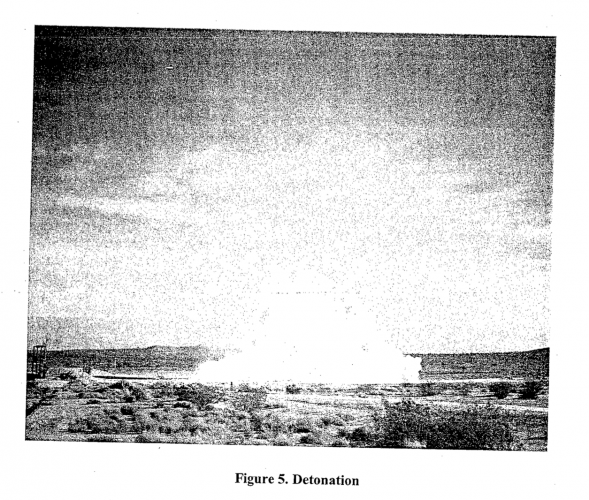
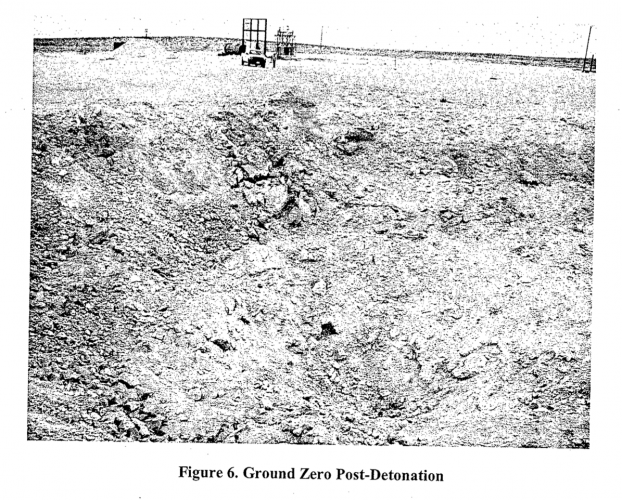
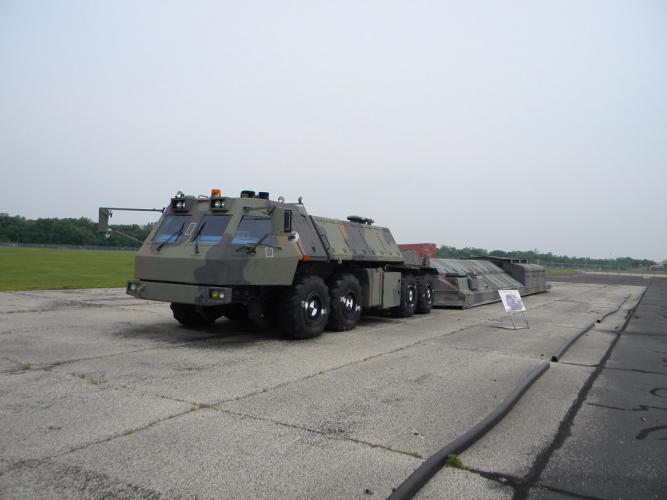
Our land based missiles do serve an important purpose: to absorb large numbers of warheads that would otherwise be used on cities. That's fine enough, but hardened silos would have to be groundburst and create enormous amounts of fallout. Mobile launchers would need to be destroyed by airbursts, which produce no fallout
The "sponge" effect is theoretical rather than practical, and large parts of it have been discredited. The only real tangible product of the "sponge" lies in its deterrent effect. It exists to make the cost of a first strike insurmountably expensive for any adversary, to such an extent that nuclear deterrence is ensured to be maintained under all conceivable conditions.
This effect is not created by the "absorption" effect – it is created by the "arsenal" effect, ie the fact that we have 400 land based missiles on continuous alert with their guidance systems spun up which can be launched in a matter of minutes. Because we have coupled these missiles with a global early warning IR satellite constellation, we have the luxury of obtaining early warning the instant an attacker lights off the first missile's first stage motor, which is shortly followed by trajectory projections based on computational analysis of IR track data. This can give us early warning of attack fast enough to prepare to act on launching missiles pending final confirmation. Because we have an extensive early warning radar system, we can obtain dual-phenomenology confirmation of attack beyond any reasonable doubt swiftly enough to allow for a launch decision to be made with confidence rapidly enough to ensure our land based missiles fly well before the inbound missiles strike their targets.
The critical factor is that if we launch the land-based missiles, it costs us virtually nothing. We can afford to expend the entire land based missile force with minimal damage to our capability to fight a nuclear war. We can afford to perform our choice of counterforce or countervalue strikes. We can even afford to perform a limited strike. In the worst case, even if we fail to launch under attack, enough missiles are likely to survive to offer a guaranteed limited deterrent capability. What the land based missile force gives is us a luxury – the luxury to choose how we want to respond to an attack, the luxury to offer ambiguity about our response to an attack, the luxury of options.
The point that most people miss is that the primary mission of these weapon systems is not to be used. Their entire existence is justified on the basis that these weapon systems guarantee the nuclear deterrence of the United States and its allies by their very existence.
In the event that these weapons systems were to actually be used, we would not be seeing enemies targeting US missile silos. They would target US cities. Don't worry, these would be nice clean tidy airbursts. Sure, they'd kill off a sizable percentage of the population of the United States, and set the country back by 100+ years, ensuring that much of the remaining population succumbs to famine in short order. But don't worry, they'd do it nice and cleanly!
My point is, who cares about airburst vs groundburst? If nukes are hitting US ICBM silos, then deterrence has failed, and the US will swiftly cease to exist as a world power, as there is no scenario where the silos get hit but the cities get preserved. In fact, it is extremely unlikely that the silos would ever get targeted in the first place.