Here are some photos of the Mk3 RB. The first two are museum exhibits, and therefore may have some differences vs production aeroshells. The last is from a declassified report, and should be more representative of a production aeroshell.Okay, so counter value use only. What I meant was the RV a sphere/cylinder/flare (Like the Polaris A3's Mk-2 RV) or sphere/cone type RV (Like the Mk-4/5 RVs)?
The design is somewhat similar to the Mk4 in terms of external appearance, but scaled down, and with a blunter nosetip.
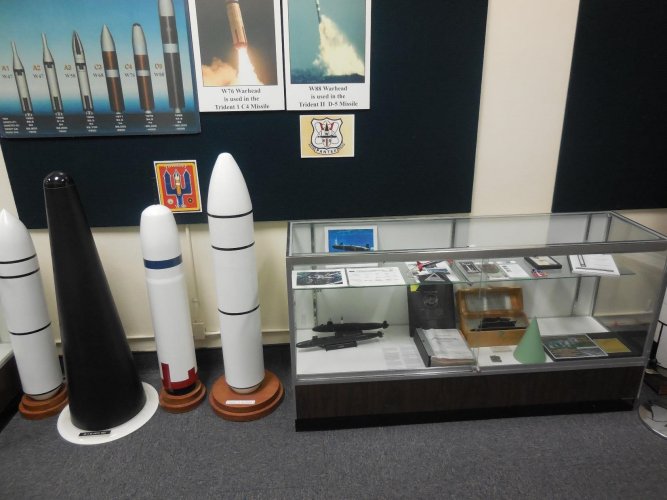
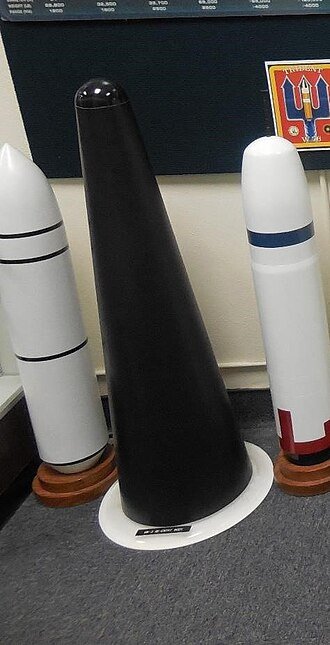
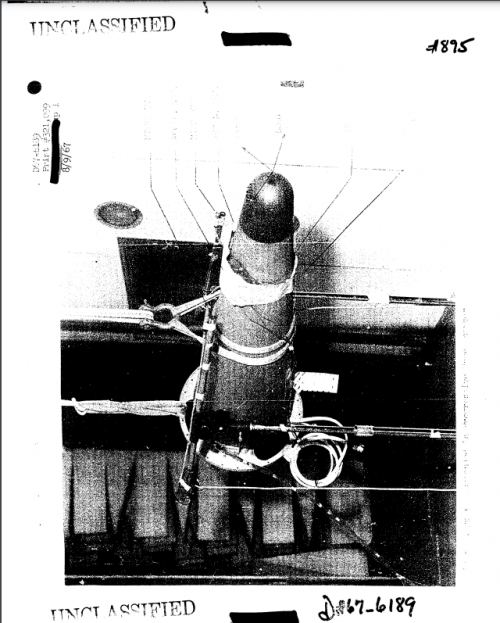
Originally, the Mk3 was planned to be much closer to the Mk4 or Mk12 in terms of nosetip design and (in particular) aeroshell beta. This seems to have fallen apart during the later phases of development, although technically speaking, the beta of the final Mk3 design has never been directly disclosed. I suspect it is probably slightly lower than the Mk4, which has a beta of 1800.
For more detailed information on the clusterfuck around the Mk3/W68 and how LLNL blew their shot at the Mk4/W76 contract, Tracing the Origins of the W76 is an excellent (if fairly lengthy and heavily overly redacted) read.
It's worth reading no matter if you're interested in the Mk3/W68, Mk4/W76, or just in general nuclear weapon developments, as there is a ton of unique information in there. For example, there are fascinating tidbits about the development process of the W78 scattered throughout there, as well as some interesting hints about the origins of B77/B83 programs. It also touches on many other systems from similar eras ranging from the W68 through the B83.
There is discussion about the alternate versions of MM III, C3, and C4 payloads, discussion about the many transient design variants of the C3/C4 and how they evolved into the final version, discussion about the ULMS (aka the earliest concept of what eventually became the Trident/Ohio class submarine and Trident I/II missiles), discussions about abandoned designs, discussions about designs that were repeatedly dropped, picked back up, dropped again, then finally merged into final programs, and so much more.
It is pretty painful to see how much of the document was redacted, but don't skip over the redacted sections entirely, as if you do, you'll miss the scattered blocks of unredacted text interspaced between long chunks of redacted pages, many of which contain fascinatingly useful and interesting tidbits.
And of course, it is basically the definitional source on the origins of the W76. It doesn't cover the W68 in as much detail as I'd like, but it mentions enough to explain many of that design's weaknesses and some of the lore of its origins, even if the whole W68 yield clusterfuck is almost completely redacted in this particular document (some limited mention of it is alluded to in some of the surviving unredacted text, but most discussions of it are not covered in here – it's unclear if this is because it was viewed as out of scope, or if it was originally covered but then had almost all mentions of the issue completely excised by the (clearly at least somewhat over-zealous) censor that handled the redactions for declassifying this document).
The programs which evolved into the Mk4/W78 include the: Mk18, advanced ballistic concept (ABC), EXPO warhead, ULMS warhead, and Mk400. You can see that the SPO originally (as per tradition) advocated for reuse of the Mk3/W68 to some extent in the missile that eventually became the C4, but as usual (again per tradition) this quickly fell apart and a whole new warhead and aeroshell design was ultimately used for the C4. Admittedly there was some initial consideration of using a heavily modified variant of the Mk3/W68 at one point to economize on costs, but this also fell apart quickly enough, in no small part due to LLNL's foolish arrogance.
You can read this report on Wikimedia commons via this link: https://upload.wikimedia.org/wikipe...rkins_2003_Tracing_the_Origins_of_the_W76.pdf