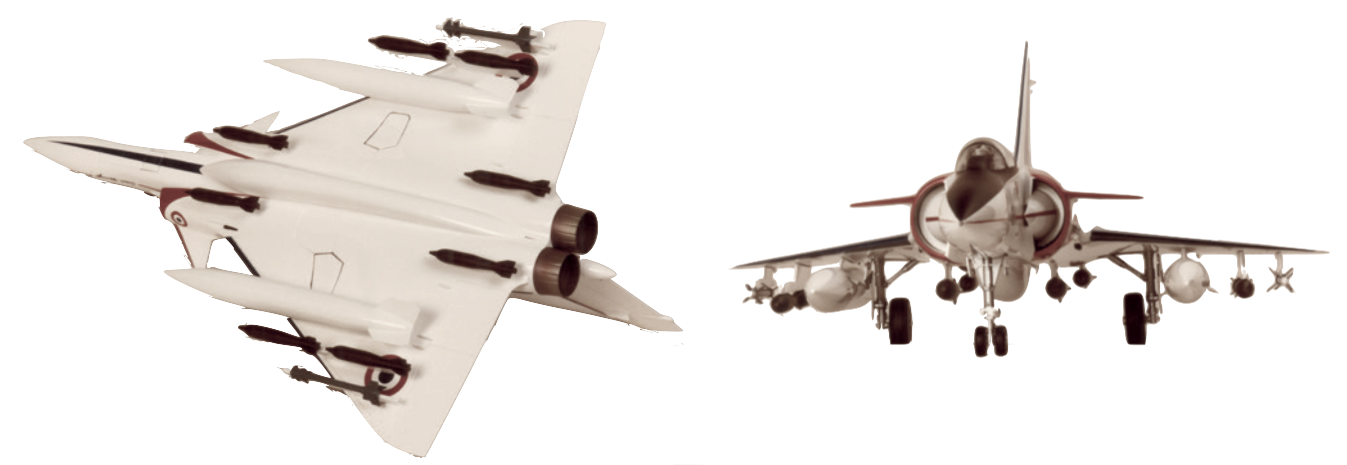
Mirage 4000

Why wasn't the Mirage 4000 as it was put into production instead of the Dassault Rafael?
 
Why wasn't the Mirage 4000 as it was put into production instead of the Dassault Rafael?
Dassault requested 4000 for France and 2000 for export. The French government decided on the 2000, less expensive, for France and the 4000 for export...
Three countries showed interest. The revolution stopped the Iranian prospect, the costs of the war did not allow the Iraqi prospect and the refusal of the French government to acquire a pre-series put an end to the Saudi prospect...
The French government then made the choice of the Rafale, newer, cheaper and navalizable...

But perhaps the new book will teach us more about these topics.
 
Why wasn't the Mirage 4000 as it was put into production instead of the Dassault Rafael?

Too big, too expensive. Think of the 4000 as a F-15, and the Rafale as a F-18. Australia, Canada and a few others initially wanted F-15s but went for cheaper F-18s. Same for the engines: M53 is closer from a F100 when M88 is akin to a F404. Smaller engines allowed the airframe to shrink.
The Armée de l'Air repeatedly tried to get a french Phantom (Mirage IVC, 1958) then multiple F-111s or Tornados (VG strike: AFVG, G4, G8) then a F-15 (ACF, 4000): to no avail. The advent of the F-18, plus F404 and RB199 mid-size turbofans, provided a solution at least.

Rafale can be seen as a shrunk 4000 with a few additional goodies: different air intakes, more efficient canard, digital rather than analog FBW, a touch of stealth, plus a naval variant. Smaller size, more efficient engines.
Also (in theory at least) lower acquisition cost: because spread over more airframes: through arm-twisting of the Aéronavale and also a takeover of the full and entire fast jet fleet of the AdA (took 30 years since 1993, but we are getting closer: only the 2000 presently survives, all the others types have been send to scrap or museums).

 
Last edited:
Why wasn't the Mirage 4000 as it was put into production instead of the Dassault Rafael?

Too big, too expensive. Think of the 4000 as a F-15, and the Rafale as a F-18. Australia, Canada and a few others initially wanted F-15s but went for cheaper F-18s. Same for the engines: M53 is closer from a F100 when M88 is akin to a F404. Smaller engines allowed the airframe to shrink.
The Armée de l'Air repeatedly tried to get a french Phantom (Mirage IVC, 1958) then multiple F-111s or Tornados (VG strike: AFVG, G4, G8) then a F-15 (ACF, 4000): to no avail. The advent of the F-18, plus F404 and RB199 mid-size turbofans, provided a solution at least.

Rafale can be seen as a shrunk 4000 with a few additional goodies: different air intakes, more efficient canard, digital rather than analog FBW, a touch of stealth, plus a naval variant. Smaller size, more efficient engines.
Also (in theory at least) lower acquisition cost: because spread over more airframes: through arm-twisting of the Aéronavale and also a takeover of the full and entire fast jet fleet of the AdA (took 30 years since 1993, but we are getting closer: only the 2000 presently survives, all the others types have been send to scrap or museums).
Plus the Rafale was a generation more advanced and thus promised a longer service life and better export possibilities.
 
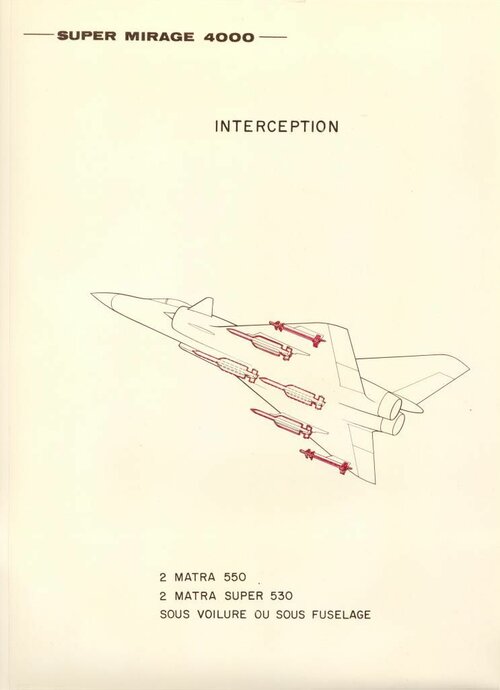
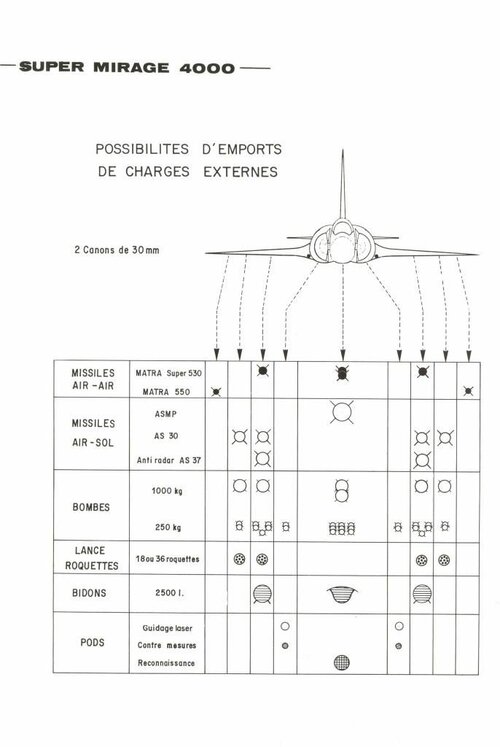
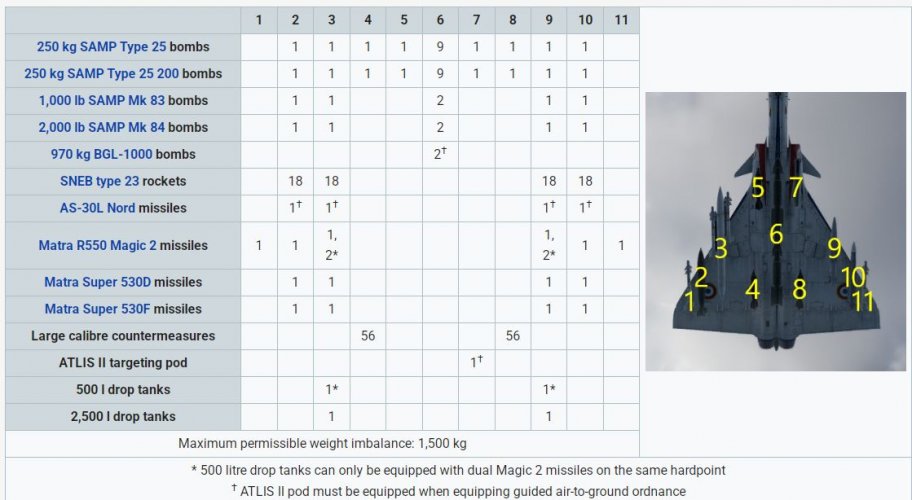
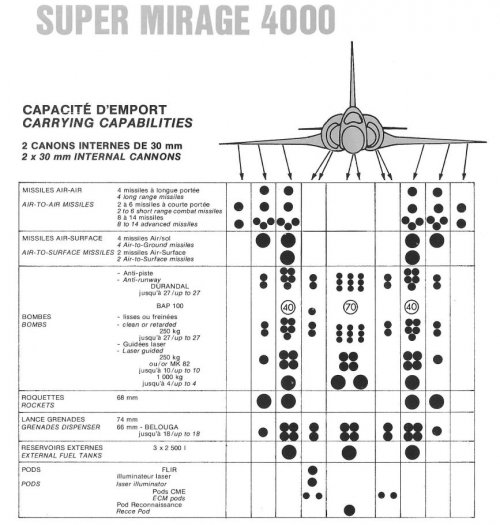
If we combine all of these photos, it should mean that the theorical max air to air load (fox 1 and 2 only, no 3) was 6 Magic and 4 Super 530 (I assumed the "long range missiles" on the 5th picture were Super 530). With room to spare for various pods and jammers. Truely a beast.
Hello, I hope you're doing well!
I'm looking for sources regarding the armament of the (Super) Mirage 4000. I was wondering what was the sources of those two images that you posted, thanks.
 

Attachments

  • M4000_schemaarmementinterception_58011_zpsf62856ba.jpg
    M4000_schemaarmementinterception_58011_zpsf62856ba.jpg
    33.9 KB · Views: 528
  • M4000_schemaemportschargesexternes_58052_zps25982a04.jpg
    M4000_schemaemportschargesexternes_58052_zps25982a04.jpg
    55.9 KB · Views: 362
The Armée de l'Air repeatedly tried to get a french Phantom (Mirage IVC, 1958) then multiple F-111s or Tornados (VG strike: AFVG, G4, G8) then a F-15 (ACF, 4000): to no avail. The advent of the F-18, plus F404 and RB199 mid-size turbofans, provided a solution at least.
Don't forget this Armée de l'air proposal for Mach 3 interceptor in 1960-1970s.
but i don't known how far that program interfere with the others: AFVG, G4, G8, AFC etc.
 
I finished the Super Mirage 4000 book a little while ago, and it left me with a couple of thoughts, namely that the 4000 was both too early and too late.

Too late in two ways.

First, If it had flown as a demonstrator in 1976 when the ACF was supposed to, when the F-14 and F-15 were having teething problems, it might have been able to translate potential into development funds and sales.

Second, it never flew with a full avionic kit. It was a flight demonstrator, but not a full production prototype. It always needed development money to get it up to combat standards, which it never received. If it had flown in 1980 or so with a full sized radar, ECM, extra fuel tanks in the empty spaces, and had launched missiles and dropped bombs it may have gotten sales.

Too early, in that it was built with technology that was outdated by the mid to late 80s. If it had flown mid to late 80s with Rafale like engines and avionics (and perhaps fully moving canards too), it might have proved attractive to Su-27 and F-15 adopters, with the big potential prize being India in place of the Su-30 buy since they already had Mirage 2000s.

The only development path I see for the aircraft as it was would be for a Mirage IV replacement contract which would result in a finished product that could be had "off the shelf" rather than needing additional funding by a potential foreign customer.
 
Last edited:
The 4000 was only ever flown with M53-2s, not M53-P2s, right? Lots of sources use the specs of the M53-P2 for some reason.
 
The 4000 was only ever flown with M53-2s, not M53-P2s, right? Lots of sources use the specs of the M53-P2 for some reason.
The Mirage 4000 flew with different mixes of M53-2, M53-5 and M53-P2. I had the immense privilege of making the only dual M53-P2 flight of its career. It was the best performing configuration but also the most representative of what the series could have been. The first flights were made with hybrid configurations of the M53-2 and M53-5, depending on availability. These engines had flown extensively on the F1-E and Mirage 2000, their characteristics were well known, and their development cycle was complete. It was out of the question to take the slightest risk, on a new aircraft. They took a number of precautions to ensure that they functioned properly, behind new air intakes, and particularly during tests that could put their air supply to the test, such as high-incidence tests, for example. Low-altitude display flights are also critical, as ‘virile’ transients are frequent to keep within the tight confines of the demonstration. Subsequently, in the latter part of the programme, the state of development of the P2 and its availability meant that it was often flown in a hybrid configuration, with the M53-2 or M53-5 on one side and the M53-P2 on the other.
Source: Alexis Rocher Super Mirage 4000 - the unrealised dream

https://www.skyshelf.be/m4000
It was always intended to use M53-P2 for production Mirage 4000.
 
Last edited:
Yes, Mirage 4000 in english soon.
There may be "good" news about the English language edition of the book?
Not yet available from the publisher

Sir, congratulations on your new book about the big Mirage 4000 fighter. I remember this project when it was active in my youth in the early 1980's, and I remain interested in it, and in French industry more generally. My high school proficiency in French has since evaporated, alas, but I look forward to the promised English-language edition of this book, if it is indeed detailed, truthful, and well illustrated. Please keep us informed.
 
Sir, congratulations on your new book about the big Mirage 4000 fighter. I remember this project when it was active in my youth in the early 1980's, and I remain interested in it, and in French industry more generally. My high school proficiency in French has since evaporated, alas, but I look forward to the promised English-language edition of this book, if it is indeed detailed, truthful, and well illustrated. Please keep us informed.
PDF

https://www.skyshelf.eu/collections...000-the-unfulfilled-dream-paper-edition-copie
Paper

https://www.skyshelf.eu/products/ro...0-the-unfulfilled-dream-paper-edition-copie-1
You can buy it from the link above in English.
 
Last edited:
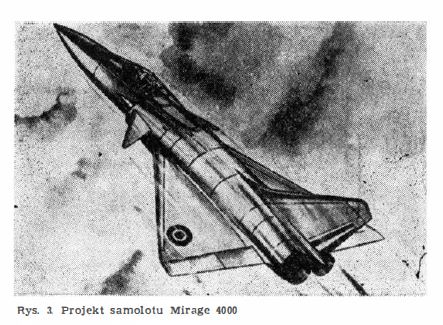
Just for fun,from Technika Lotnicza 1977
 

Attachments

  • 1.png
    1.png
    167.9 KB · Views: 221
My effort to this magnific airplane,the Mirage 4000 B, two seater
Do you have a source or is it just an artistic speculation?
I got some information directly from Le Fana team about the features for the 2 seats version, so that (I hope) my profile were not so far away from the original engineering version.
This is right. A mock-up was realized for a potential 2-seater version:
 

Attachments

  • Mirage 4000 maquette d'aménagement et prototype (PhR).JPG
    Mirage 4000 maquette d'aménagement et prototype (PhR).JPG
    56.6 KB · Views: 173
  • Mirage 4000 biplace (PhR).jpg
    Mirage 4000 biplace (PhR).jpg
    89.8 KB · Views: 227
It began in 1979 with the M-53-2. It got M-53-P2 engines in 1986.
Hi Deltafan.
You are right, it began with two M-53-2.
First flight with M-53-5 on November 29th, 1979 (Flight 48)
Then it flew with mix of M-53-2 and M-53-5
Able to use combintion of M-53-2, -5 and -P2 from December 19th, 1985 (Flight 200)
Unfortunately, I do not have the date for first flight with P2.
 
Hello everybody
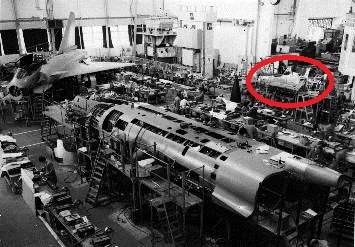
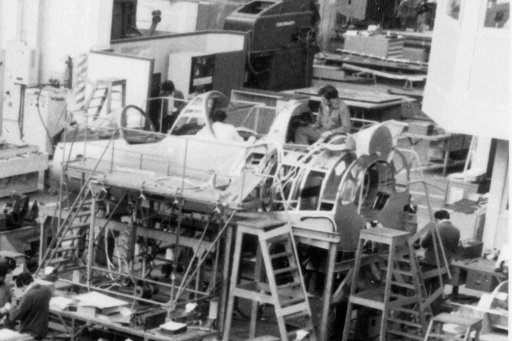
By looking carefully at the twin seat fuselage, I see only one circular hole on the right (back) side.
Furthermore in Alexis Rocher Super Mirage 4000 book (see post 219), there are several drawings of the twin seat M 4000 and the canopy looks totally different, more like a Mirage 3 canopy.
So my guess is the Mirage 2000B forward fuselage. (ordered in 1977 and first flight october 11, 1980)
Mirage 4000 developpment was launched in september 1976 and first flight march 9, 1979.
So both may have been in ST Cloud prototype shop at the same time.
 
Interesting thread. Is there any information on the Centrline fuel tank?
 
Regarding delta wings not liking slow speeds, ISTR reading about the good old F-106. The way the author put it was something like 'not getting in a dogfight with an old stick in an F-106' and 'slow' being relative I guess, but the inference was if an experienced pilot knew the F-106, he could make it do things it wasn't expected to do. And it wasn't FBW. I wonder if the Mirages were the same, especially the 2000 and 4000. Thanks for all of the pics, I've always admired the 4000.
Absolutely.

A pilot who really knows the plane can do things that an average pilot cannot. For example, the Blue Angels flying 18" or less away from each other on a regular basis.


Interesting insert page 59 of the article. Saudi Arabia was ready to buy 300 Mirage 4000 if France built at least 5 pre-series planes. The new French Government of François Miterrand did not want to build these 5 pre-series planes and the project did not go further…
Talk about shooting yourself in the foot on sales.


Can't see how a Mirage 4000 would be less expensive to operates from either a Tornado or F-15. Even if Dassault sold them at bargain prices...
A single-type fleet would be less expensive to operate than a mixed fleet.


Why wasn't the Mirage 4000 as it was put into production instead of the Dassault Rafael?
It was too expensive for France to afford. Also, it was too big to operate off carriers.
 
The Mirage 2000 and Mirage 4000 were developed in parallel and were both available at the same time. If a carrier-based variant of the Mirage series had been produced, it would have been the Mirage 2000. However, none of the Mirages were suitable as carrier-based aircraft. But honestly, if they had wanted to sell the Mirage 4000, they could have simply ordered the six aircraft as a pre-production batch. That would have secured a huge contract. Later, they could have sold the six again. It was politically short-sighted. But that's how history goes—it's full of bad decisions.
 
It was not just a question of "buying 6, selling 300".
Some high rank officers in France knew that we weren't able to have a strong M4000 fleet for ourselves, and they weren't very happy with the idea that other countries in MENA could operate it. They consider it as a potential threat to our carrier strike groups (that were quite weak at the time, let's be honest), and some of our nuclear power plant locations in southern France.
And considering that some of our best customers at the time were, let's say, Irak or Libya. Well, maybe those officers weren't exactly wrong !

But I think that was just a (small?) part of the decision process.
To be honest, even if we have bought a few planes for the Armée de l'Air, the Mirage 4000 would still be a less mature and "nationally supported" design that the F-15 and Tornado who were already mass produced. So no big export contract would have been assured, I suppose.
 
The way I remember it, what really killed the Mirage 4000 was a customer-side problem. It was a heavy long range fighter, for what they colloquially called then "gaining air superiority over Hanoi when flying from Saigon".

France was never going to realistically dispute air superiority over Kiev when flying from Colmar, so Armée de l'Air had no use for it. The customers for the 4000 were the Saudis.
Unfortunately there was a hiccup in the price of oil at the wrong time, and suddenly Saudi Arabia had budget problems. End of the line for the M4k.

The M2k was more within France's needs and budget, and a reasonable evolution proposal for the then-existing customers of Mirage III, 5, and F1. It carried on.

Even super-rich air forces experience budget problems once in while. It happened to the USAF, VVS, RSAF too.
 
@dan_inbox That oversimplifies what happened IMHO and ignores the long-standing French requirement for a long range dual role interdiction/strike aircraft and fighter, which was expressed though various programs including AFVG, the Mirage F2/F3 and later G4/G8, and ACF. All which led to the Mirage 4000.
 
Last edited:
That oversimplifies ... and ignores the long-standing French requirement for a long range dual role interdiction/strike aircraft and fighter
That my summary oversimplifies, yes of course.

That France had a need for a "long range dual role interdiction/strike aircraft", I do not believe. Of course the Grands Fromages™ have a Xmas wish list, like every other brass. But let's look at the context: at that time, Armée de l'Air had two jobs:
1- protect the Holy National Territory Sanctuary against the Soviet hordes. And protect the Army grunts, if there's any plane left;
2- defend (and police) Françafrique. (Marketing department will re-word this into Politikorrectics, someday)

For job one, AdA is not going to fight "long range strike" into a WarPac assault. Not after the first hour anyway. If it manages to defend Colmar and Paris it is a hero. The nuclear dissuasion job is Pluton/Hadès, Albion and the subs. Long range air superiority is not even realistic.

For job two, Mirage F1s were more than good enough to spank Muammar Giddyfool and disable his Wadi Dum air base. At probably a quarter or a tenth of the realistic cost of a M4k deployment to Chad. Finance Ministry will remind everyone.

Whatever the Air Chief says, lack of a demonstrable need and budget realities will deny him the M4k, not even six of them (logistically nonsensical idea anyway).
The customer who had a demonstrable need for "long range dual role interdiction/strike " was Saudi Arabia, with their huge desert territory and restricted infrastructure. And bottomless budget.
At least, until it was no longer bottomless...

And @H_K, we can agree to disagree on this reason for M4k stop. It's all water under the bridge, now.
 
Last edited by a moderator:
I remember hearing the French really wanted more range in Gulf War I. Kind of interesting to think how the 4000 would have done. Of course Iraq also probably wished they had the 4000 too.
 
I remember hearing the French really wanted more range in Gulf War I. Kind of interesting to think how the 4000 would have done. Of course Iraq also probably wished they had the 4000 too.
For Iraq it was pointless, E-3 was an effectively unbeatable advantage. In a way, ARH returned some chances to unequal air combat.
 
For Iraq it was pointless, E-3 was an effectively unbeatable advantage. In a way, ARH returned some chances to unequal air combat.
E-3, F-4G Wild Weasels, and F-117s. Wild Weasels and Nighthawks took down the Iraqi GCI radars so the Iraqi pilots were flying without controller support, while allied/UN forces had controllers on scene.
 
That France had a need for a "long range dual role interdiction/strike aircraft", I do not believe. Of course the Grands Fromages™ have a Xmas wish list, like every other brass. But let's look at the context: at that time, Armée de l'Air had two jobs:
1- protect the Holy National Territory Sanctuary against the Soviet hordes. And protect the Army grunts, if there's any plane left;
2- defend (and police) Françafrique. (Marketing department will re-word this into Politikorrectics, someday)

For job one, AdA is not going to fight "long range strike" into a WarPac assault.
Ok I see, just your random opinion.

The COMAERO has published an extensive history detailing the 12+ years of staff work and requirements development that went into trying to procure a French "Tornado". The need was for a two-seat low level strike / penetration aircraft (400-600nm lo-lo-lo radius) initially to replace the short-legged Mirage IIIE in its tactical nuclear role, later to replace the Mirage IV. This aircraft would also take over strategic reconnaissance missions flown by Vautour IIBs and more generally low-altitude conventional strikes flown by Mirage IIIEs and Vautour IIB, including the Martel anti-radar mission.

So that's quite a comprehensive requirement - two-seater, low-altitude penetration, tactical nuclear, strategic reconnaissance, anti-radar. With also a desire to make it somewhat dual-role as a high altitude supersonic interceptor (with this interceptor role sometimes taking precedence depending on shifting programs).

This was an enduring requirement from 1963 to 1975+ leading to 4 different aircraft programs supported by multiple defence ministers and air force chiefts. The resulting aircraft ranged from 11t empty (Mirage F2) to ~15t empty (Mirage G4), with AFVG somewhere in between (13-14t empty).

The ~14t empty Mirage 4000 was the latest expression of this requirement, in an increasingly budget constrained environment that made it harder and harder to buy a dedicated large fighter. Perhaps ill advised financially, but the requirement itself was hardly a passing fancy.

Sources: Chapter 18 - "PROGRAMMES D’AVIONS DE COMBAT DESTINÉS À L’ARMÉE DE L’AIRLANCÉS DE 1961 À 1975"
[Combat Aircraft Programs for the Air Force from 1961 to 1975]

https://theatrum-belli.com/wp-content/uploads/2026/04/Bonnet_Avions_militaires_II.pdf
 

Similar threads

Back
Top Bottom