- Joined
- 1 April 2006
- Messages
- 12,282
- Reaction score
- 15,103
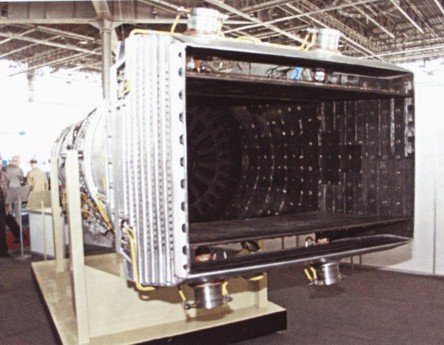
Scale of this model was 1/4.5Actually one of 5.12 iterations always was here...
https://www.secretprojects.co.uk/threads/mig-mfi-i-90-mig-1-44-mig-1-42.422/post-34999

Scale of this model was 1/4.5Actually one of 5.12 iterations always was here...
https://www.secretprojects.co.uk/threads/mig-mfi-i-90-mig-1-44-mig-1-42.422/post-34999

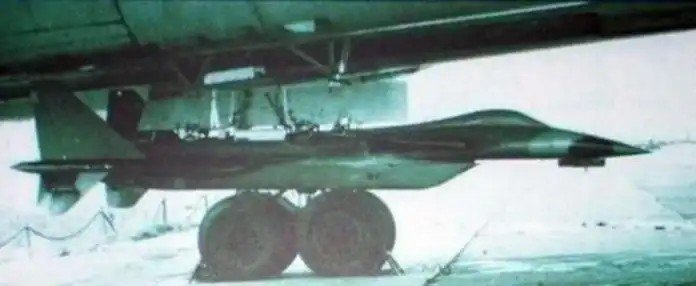
Well… first let’s clarify one thing…Also thus is the mig 1.42 with serpentine intakes and internal bay not the aerodynamic demonstrator mig 1.44 that most pictures are of.

I believe this is the right forum for this do to other threads about the su-57s stealth also being on here.
Also thus is the mig 1.42 with serpentine intakes and internal bay not the aerodynamic demonstrator mig 1.44 that most pictures are of.
https://www.secretprojects.co.uk/attachments/e6ufcapwybq5f_u-jpg.664533/
https://www.secretprojects.co.uk/attachments/e6ufcapwybq5f_u-jpg.664533/
https://www.secretprojects.co.uk/attachments/e6ufd7gwybydvyt-jpg.664534/
Pictures thanks to @Empire
None.
Ahhh... I never noticed the Russian Wiki...My bad...Taken from Wiki


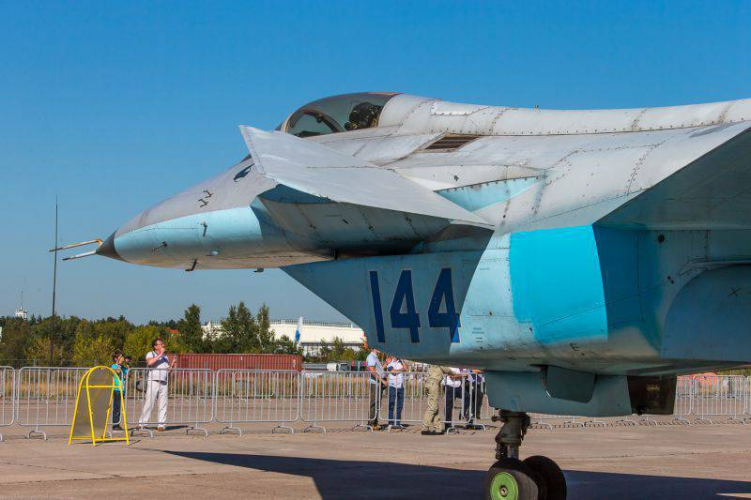
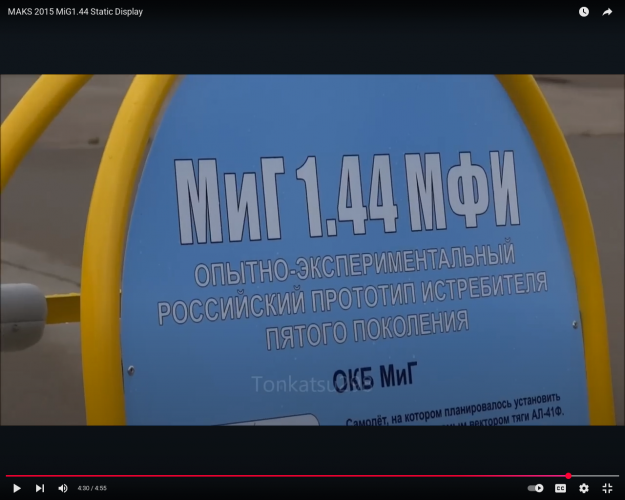
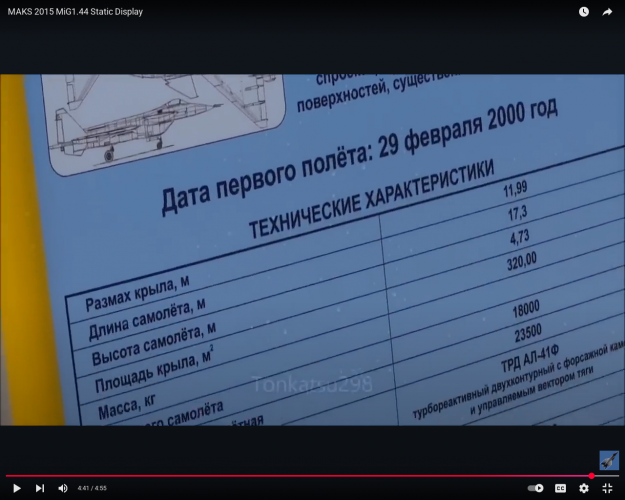

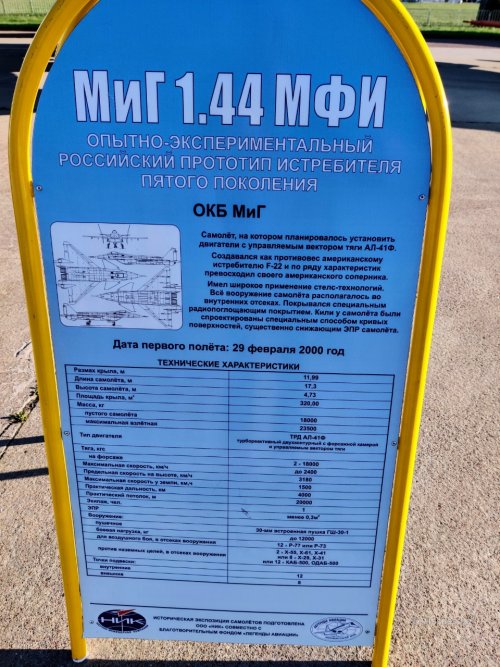
one question since you like the MiG 1.44 why the data says 17.3 meters length? it seems bigger but that board was from 2015 MAKS, do you think it was a mistake or indeed it is the length?Calculated values according to the simplified methodology
MiG 1.42 (not 1.44)
Minimum RCS 3.1 m2
The maximum RCS is 13.1 m2
Su-57
the minimum RCS is 0.43 m2
the maximum RCS is 6.43 m2
F-22
the minimum RCS is 0.35 m2
the maximum RCS is 4.35 m2
What does it change?The data might be wrong but it was from the airshow of Moscow, in front of it was a board that said that data.
I do not understand you well so I will guess, the MAKS board says 17.3 meters length, but it seems bigger, the canopy seems very similar to the one of MiG-29, so it seems bigger, if the data from MAKS is wrong well it changes the accuracy of the data, only that.What does it change?
Maybe,when the Mig MFI was finally completed(Well, this is related to What if),the RCS of Mig MFI can be controlled to a considerable degreeCalculated values according to the simplified methodology
MiG 1.42 (not 1.44)
Minimum RCS 3.1 m2
The maximum RCS is 13.1 m2
Su-57
the minimum RCS is 0.43 m2
the maximum RCS is 6.43 m2
F-22
the minimum RCS is 0.35 m2
the maximum RCS is 4.35 m2

Hint - MiG-29K length is 17.3m. MiG-29K span is 11.99m.I do not understand you well so I will guess, the MAKS board says 17.3 meters length, but it seems bigger, the canopy seems very similar to the one of MiG-29, so it seems bigger, if the data from MAKS is wrong well it changes the accuracy of the data, only that.
It was supposed to be 'stealthy' as Mikoyan understood the technology in mid 80s which was some kind of reduced observables. Conformal/internal weapons carriage, avoid showing compressor faces, await magical RAM development.I always thought this aircraft was more like a Eurofighter equivalent, I didn’t know it was meant to become stealthy.
Well, The Russians noted that the MFI project took “stealth” into account during its development; however, constrained by the Soviet Union’s shortcomings in related technologies, from today’s perspective the MFI can hardly be a "comprehensive stealth design"——They can only implement some basic designsI always thought this aircraft was more like a Eurofighter equivalent, I didn’t know it was meant to become stealthy.
— снижение заметности в радиолокационном, электромагнитном, тепловом и оптическом спектрах в определенных ракурсах (в первую очередь в переднюю полусферу), но не за счет летных данных, которые являются главным средством достижения победы в воздушном бою;
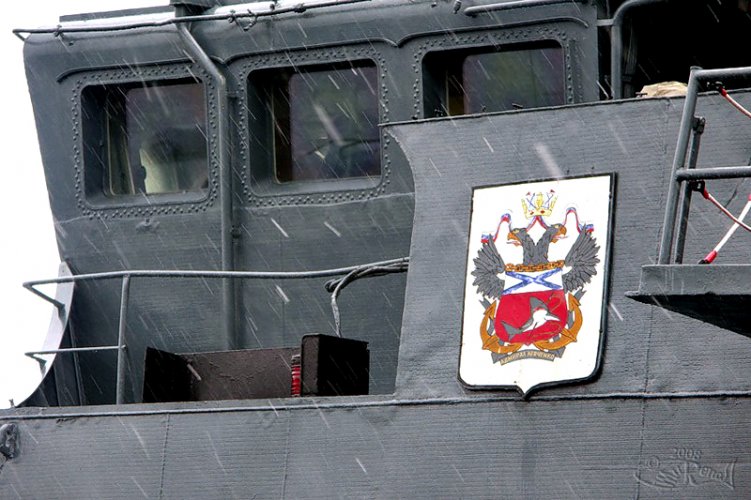
In the 1970s, the Russians carried out work to reduce the visibility of ships. Serial Soviet ships after 1985 had a radio-absorbing coating.Well, The Russians noted that the MFI project took “stealth” into account during its development; however, constrained by the Soviet Union’s shortcomings in related technologies, from today’s perspective the MFI can hardly be a "comprehensive stealth design"——They can only implement some basic designs

I think before the ATF was a stealth program some of the design concepts were similar to both aircraft.I always thought this aircraft was more like a Eurofighter equivalent, I didn’t know it was meant to become stealthy.
Once more, RAM/RAS was used in series as early as 1970 on Tu-143 Reis.As long as the enemy did not have stealth aircraft, this option was not used on production aircraft.
Thank you, that was what I wanted to know 20.7 meters, I know about the satellite pictures, I did my estimates but I never really payed much attention into a concrete number.In the 1970s, the Russians carried out work to reduce the visibility of ships. Serial Soviet ships after 1985 had a radio-absorbing coating.
As long as the enemy did not have stealth aircraft, this option was not used on production aircraft.
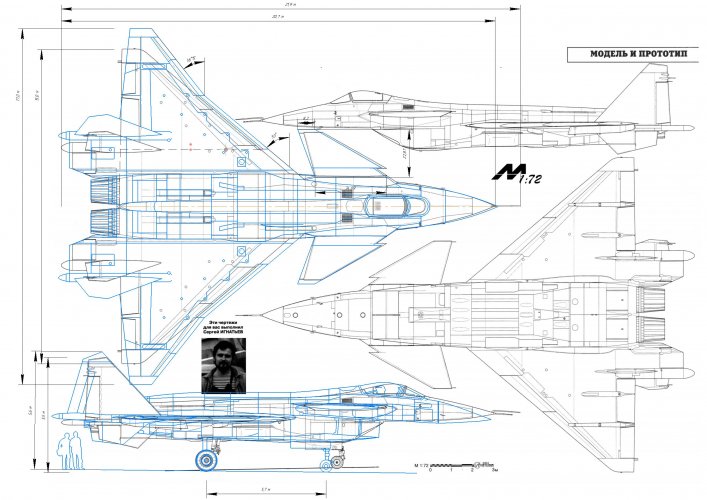
MiG sizes 1.44 and 1.42
thank you, kind of nostalgic the MiG 1.44 had a lot of potential, it was a 4.5 generation fighter
From my personal perspective, I tend to view the MiG 1.44 as a 5th fighter. Or...more strictly, a demonstrator prototype for a 5th fighter.definitively that generation of fighters were a response to the Eurofighter and Gripen
From my personal perspective, I tend to view the MiG 1.44 as a 5th fighter. Or...more strictly, a demonstrator prototype for a 5th fighter.
Well… on the information I’ve seen in Russian sources, the MFI project saw the Soviets exploring the concept of "future air combat" with an unprecedented approach — fundamentally different from aircraft like the Eurofighter or the Gripen
Besides the traditional goal of "achieving air superiority," "penetration" was also given a high priority. Of course, unlike the Americans, the Soviets weren’t able to achieve VLO in their design...
Oh well, back to the point, your model is really great, nice job ;-)
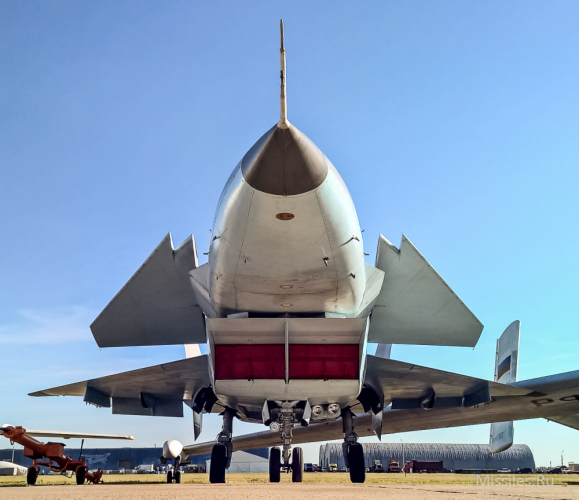
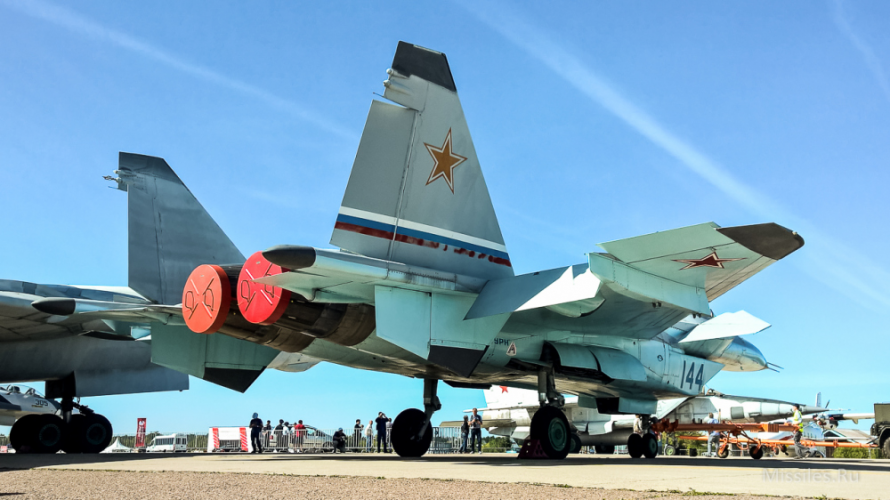
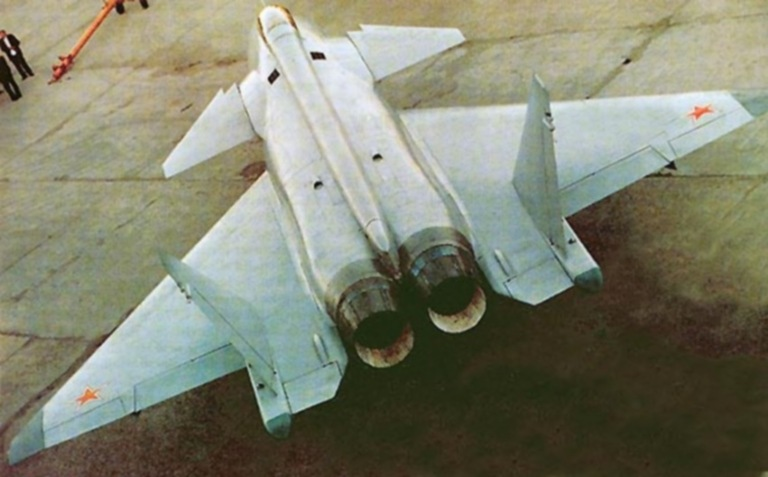
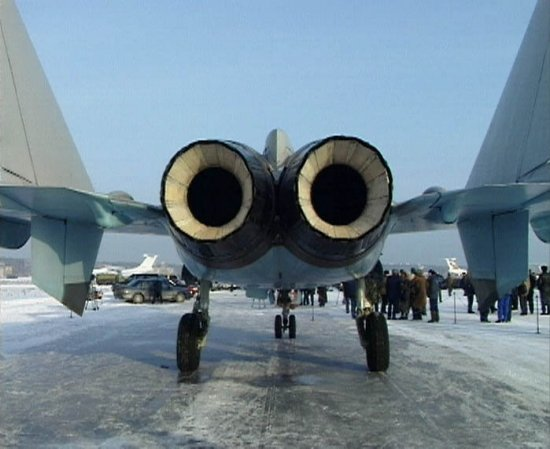
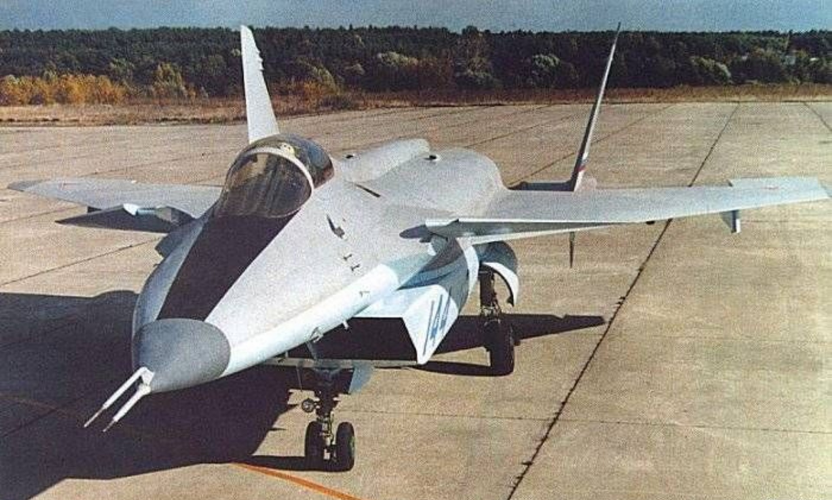
To be fair, performance steroids were quite significant - eurofighter was more directly comparable to what LFI (4.12) was meant to be in size and probably performance.I love the design one of my favorite aircraft but it was no more than an Eurofighter on steroids
A lot has to do with the air intakeTo be fair, performance steroids were quite significant - eurofighter was more directly comparable to what LFI (4.12) was meant to be in size and probably performance.
Plus way more money and resources was poured into MFI components (engines, radar, etc). This leaves it somewhat in the middle - as individual parts of this aircraft appear to be more on ATF rather than on Eurofighter level.
But parts don't fight, aircraft does. And conceptually / overall, 1.42 (4.12, s-37) are effectively unborn Russian eurocanards.
Which is probably why all got canned halfway - F-22 first flight was their collective doom.
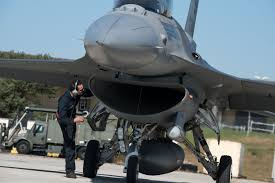
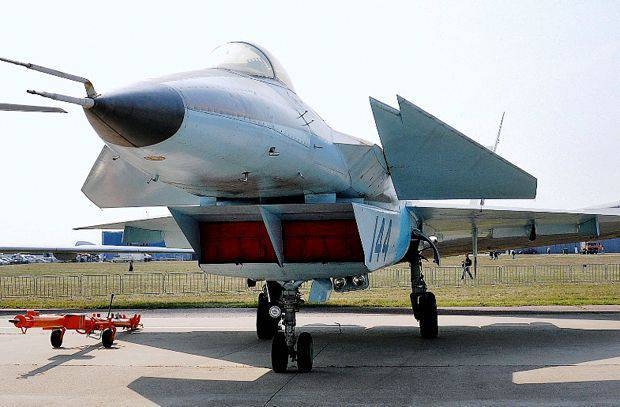
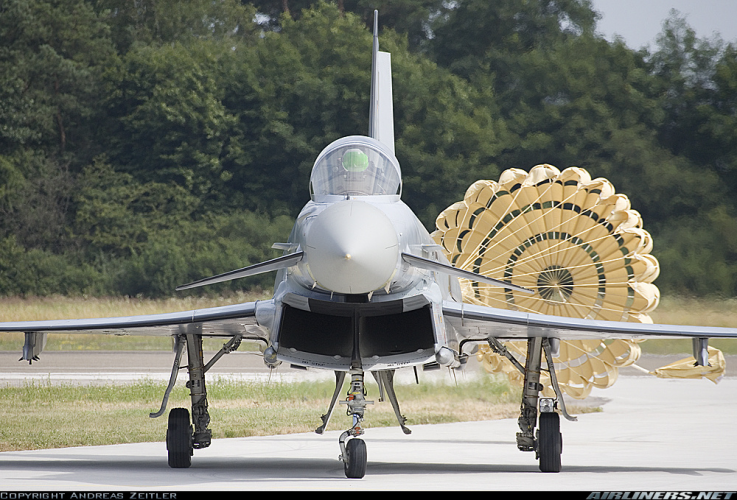
Oh, BTW, regarding the canard, MiG engineers once said:The air intake is too boxy on MiG-1.44, it has radar corner reflectors, the canards had dog teeth good for diffraction, the MiG-1.44 was no stealth, but definitively was a more ambitious aircraft than the Eurofighter.
Современные истребители 5 поколения обычно не имеют ПГО. Как ПГО влияет на малозаметность? Отвечая на это вопрос Генеральный конструктор отметил: «Главный принцип любого авиационного конструктора заключается в компромиссе и еще раз компромиссе. Когда вы учитываете один фактор, другие факторы в большей или меньшей степени могут ослабнуть, и невозможно достичь идеала по всем направлениям. Что касается малозаметности, то что есть стандарт?
Oh, BTW, regarding the canard, MiG engineers once said:
“Modern 5th generation fighters usually do not have a canard. How does a canard affect stealth? Answering this question, the General Designer noted: "The main principle of any aircraft designer is compromise and compromise again. When you take into account one factor, other factors can be weakened to a greater or lesser extent, and it is impossible to achieve the ideal in all directions. As for stealth, is there any standard?”
Ambiguous view ;-)
“The PMC used on the outer surface of the fuselage of the flight test platform 1.44 (ЛЛ 1.44)”Oh, BTW, regarding the canard
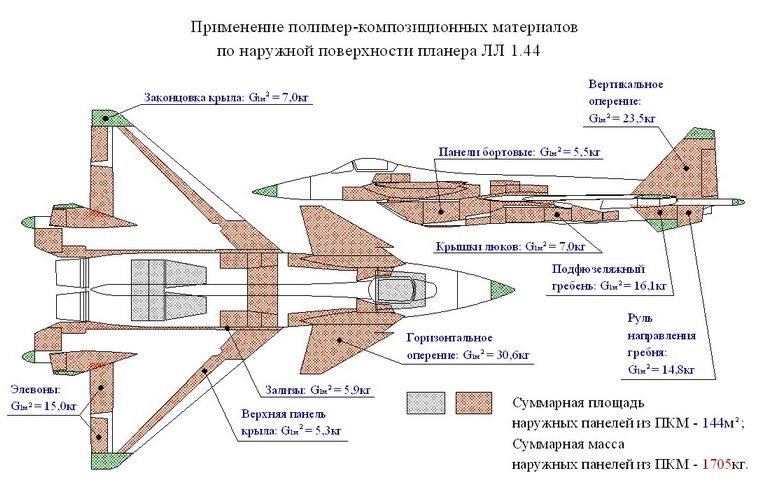
a designer must know that every solution has advantages and disadvantages, add that what today works, tomorrow might be rendered obsolete or useless.Oh, BTW, regarding the canard, MiG engineers once said:
“Modern 5th generation fighters usually do not have a canard. How does a canard affect stealth? Answering this question, the General Designer noted: "The main principle of any aircraft designer is compromise and compromise again. When you take into account one factor, other factors can be weakened to a greater or lesser extent, and it is impossible to achieve the ideal in all directions. As for stealth, is there any standard?”
Ambiguous view ;-)
Tbh I don't think they did, otherwise it would've been shaped differently.The MiG engineers pinned their hopes on the miraculous RAM/RAS, supplemented by limited stealth shaping ;-)
In Chinese materials, I saw this explanation, about the canards had dog teeth:Tbh I don't think they did, otherwise it would've been shaped differently.
Just like other eurocanards, there was probably a limited requirement for forward RCS reduction, which they complied with.
不过有一种观点认为该设机对隐身性能有极大影响,实际上影响不可能完全没有,不过倘若是经过严格计算的设计,这种回波实际上仍然可以通过锯齿间的多次反射而导向其他威胁性较小的方向

That's an overly simplistic way to think about it. If radar returns from aircraft could be modeled with ray optics, Sir Isaac Newton could have designed a stealth aircraft.basically is optics of light applied to other electromagnetic waves frequencies,
it is simple, the problem is power density, most airborne radars set on fighters are not powerful enough to detect stealth aircraft at practical ranges, because BVR missiles can be fired at longer ranges now.That's an overly simplistic way to think about it. If radar returns from aircraft could be modeled with ray optics, Sir Isaac Newton could have designed a stealth aircraft.
I respect your opinion, however they are not over simplistic, they are facts however light and electromagnetic waves have different features, reflection, diffraction, absorption, emission, reception, it is not a single phenomenon , thus to calculate the exact shape using aerodynamics, flight path and radar location within the power density of the radar makes more complex the design of an aircraft.@F-14ATomcat my point was that the analogies to optics above are too simplistic and not particularly instructive (also what's with all the random bolded sentences?).
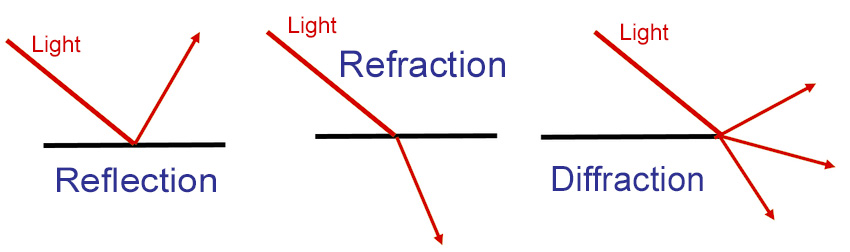
I have a physics degree, and I don't understand the relevance (the random bolding and italics does not make anything clearer). You don't need to invoke attenuation (by the atmosphere, presumably) to explain why radar returns decrease in intensity as the distance between the aircraft and the radar increases; that can to first order be explained simply by spherical spreading (i.e., the inverse square law).The general formula for an electromagnetic wave's amplitude as it attenuates over distance z is A(z) = A₀e⁻<binary data, 1 bytes><binary data, 1 bytes><binary data, 1 bytes>z
In physics, attenuation is the gradual loss of flux intensity through a medium.
If the point you are trying to make is that an aircraft will reflect more radar energy the closer it is to the radar, that's rather obvious. What point you're trying to make with regard to stealth I frankly have no clue. No one considers an F-16 that is 1,000 miles away from a radar "stealth" because that radar can't detect it.Aircraft are designed upon tactics, which means how far you want to fire the missile, stealth is not black arts or magic, you experience stealth with your own eyes, at distance objects lose details simple like that and with distance they disappear it means they become stealth in few words your eyes can not see them despite they are there and at shorter distance you can see them..