
You are using an out of date browser. It may not display this or other websites correctly.
You should upgrade or use an alternative browser.
You should upgrade or use an alternative browser.
Me P.1073A
- Thread starter SpicyJuan
- Start date


Johnbr
ACCESS: Top Secret
- Joined
- 6 May 2007
- Messages
- 753
- Reaction score
- 385
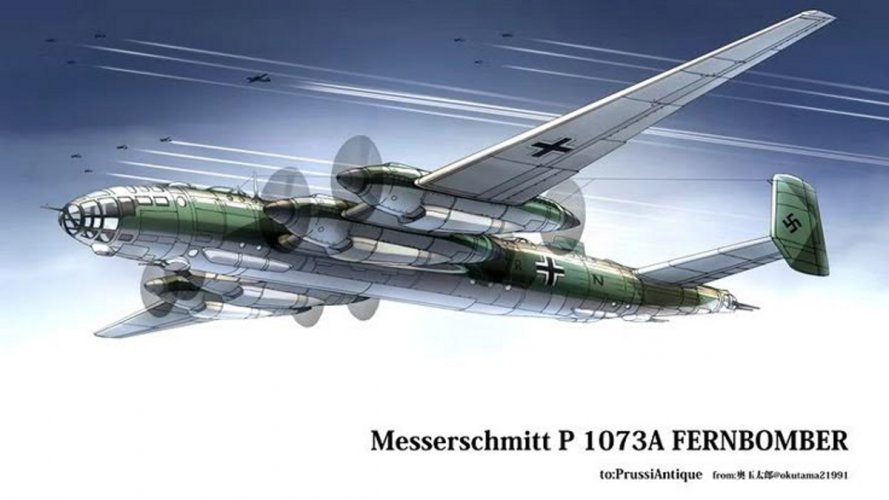
The Me P.1073 was actually a two airplane type project. The Me P.1073A was a huge 128 ton transatlantic bomber with 63 meters wing span, powered with eight Jumo 223 engines. This monster was to carry 6.000kg of bombs up to 16.000km. The defensive armament included three small jet fighters with folding wings, armed with two 20mm guns. The small airplane was called Me P.1073B." https://de.wikipedia.org/wiki/Messerschmitt_P.1073
http://discaircraft.greyfalcon.us/Mecklenburg Atomic Plane.htm
http://discaircraft.greyfalcon.us/Mecklenburg Atomic Plane.htm
Last edited:

Bazinga
I really should change my personal text
- Joined
- 14 December 2012
- Messages
- 377
- Reaction score
- 545
http://discaircraft.greyfalcon.us/M...W5XKQUS3Bru9AxWctml3Y_6sh4_lZnm4u6OzL6IAYny2UOriginal poster is John Breitenbach in this group
https://www.facebook.com/groups/166522410918203/
https://www.facebook.com/groups/166522410918203/
Hi, I am asking about the 8 engine bomber.The Me P.1073 was actually a two airplane type project. The Me P.1073A was a huge 128 ton transatlantic bomber with 63 meters wing span, powered with eight Jumo 223 engines. This monster was to carry 6.000kg of bombs up to 16.000km. The defensive armament included three small jet fighters with folding wings, armed with two 20mm guns. The small airplane was called Me P.1073B." https://de.wikipedia.org/wiki/Messerschmitt_P.1073
http://discaircraft.greyfalcon.us/Mecklenburg Atomic Plane.htm
I couldn't find any illustrations or GA drawings in the group.http://discaircraft.greyfalcon.us/M...W5XKQUS3Bru9AxWctml3Y_6sh4_lZnm4u6OzL6IAYny2UOriginal poster is John Breitenbach in this group
https://www.facebook.com/groups/166522410918203/

Thank you, I have been searching in vain for years. According to Messerschmitt Geheimprojekte by Willy Radinger "Während vom Trägerflugzeug P1073 A keine Zeichnung erhalten blieb..." (While no illustration of the P1073 has survived...)You are right SpicyJuan,no drawing for it,but I will search.
However, if there is no illustration existent, how did Dieter Herwig and Heinz Rode create their illustration of the plane (which you can see at the top of the page). Did they make it up?

- Joined
- 11 March 2006
- Messages
- 8,538
- Reaction score
- 5,023
However, if there is no illustration existent, how did Dieter Herwig and Heinz Rode create their illustration of the plane (which you can see at the top of the page). Did they make it up?
Don't want to be a killjoy, but they probably just extrapolated the Me 264/P.1075 variants and applied some modifications. And one of them, to my
opinion, isn't even very plausible in the shown form. The P.1073A is shown as a low wing design, but the bomb bay/bay for the paraste fighters directly
runs through the part, were quite probably the wing spars would be. Maybe that should have stayed with the high wing of the Me 264 ?

blackkite
Don't laugh, don't cry, don't even curse, but.....
- Joined
- 31 May 2007
- Messages
- 9,515
- Reaction score
- 9,661
Attachments
Last edited:
blackkite
Don't laugh, don't cry, don't even curse, but.....
- Joined
- 31 May 2007
- Messages
- 9,515
- Reaction score
- 9,661
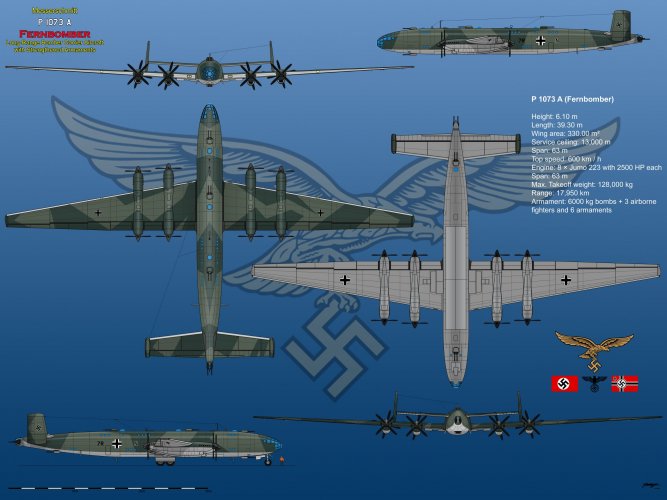
"As is well known, during World War II , the Third Reich lacked strategic aviation. Those very same Flying Fortresses that terrified Germany itself. Of course, Germany produced Focke-Wulf Fw 200 Condor strategic bombers , but due to their extremely limited production, they had no impact on the course of the war.
Even before the war, and then throughout it, Germany developed various aircraft designs that could be considered flying fortresses or simply strategic bombers . Some of these aircraft reached prototype stage, but most never left the drawing board and are little known to aviation history buffs. We will examine one such design below.
This aircraft belongs to a subclass of German bombers known collectively as the "Amerika-Bomber ." This class included aircraft designs developed for the purpose of striking the United States. Specifically, bombers with a long range, capable of crossing the Atlantic and bombing North America.
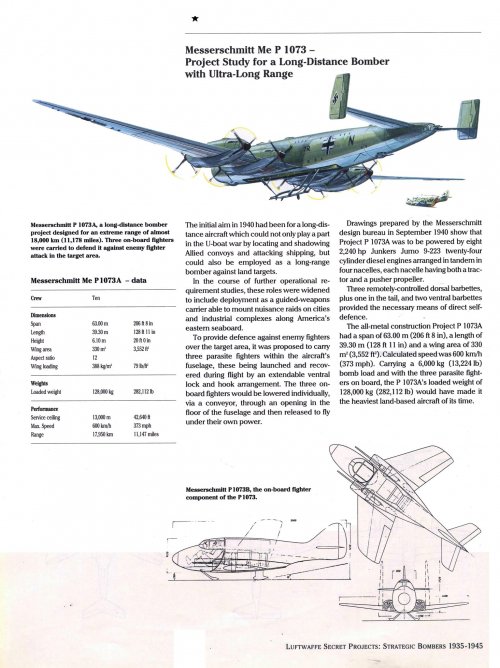
This aircraft's design was created in 1940. Its development was inspired by a Soviet project from the 1930s known as the "Vakhmistrov Circus ." This bomber was to be powered by eight Junkers Jumo 223 engines producing 2,500 hp each. The Messerschmitt P.1073 (Me 328) jet fighters, specially developed for this project, were to serve as the basic fighters; three of them were to be carried on the aircraft. However, unlike the Soviet design, the German mother aircraft was to carry its fighters not on external slings, but inside the fuselage. A special large hatch was provided underneath the aircraft for their release.
Messerschmitt P.1073 (Me 328).
Most interestingly, the aircraft were also designed to be re-landed on the mother aircraft. For this purpose, the Messerschmitt P.1073A had a special system similar to a modern aerial refueling system. A special cable was released from the aircraft, which the landing fighter would then use to tie it back into the aircraft's fuselage.
The purpose of creating such mothership aircraft was to provide cover for bomber squadrons carrying out strikes on US territory. These squadrons were to consist of Messerschmitt P.1073As, built as traditional bombers, and capable of carrying approximately 10 tons of bombs. It's also worth noting that the mothership itself was to carry a small bomb load of approximately 6 tons.
Technical characteristics of P.1073A:
Even before the war, and then throughout it, Germany developed various aircraft designs that could be considered flying fortresses or simply strategic bombers . Some of these aircraft reached prototype stage, but most never left the drawing board and are little known to aviation history buffs. We will examine one such design below.
This aircraft belongs to a subclass of German bombers known collectively as the "Amerika-Bomber ." This class included aircraft designs developed for the purpose of striking the United States. Specifically, bombers with a long range, capable of crossing the Atlantic and bombing North America.
This aircraft's design was created in 1940. Its development was inspired by a Soviet project from the 1930s known as the "Vakhmistrov Circus ." This bomber was to be powered by eight Junkers Jumo 223 engines producing 2,500 hp each. The Messerschmitt P.1073 (Me 328) jet fighters, specially developed for this project, were to serve as the basic fighters; three of them were to be carried on the aircraft. However, unlike the Soviet design, the German mother aircraft was to carry its fighters not on external slings, but inside the fuselage. A special large hatch was provided underneath the aircraft for their release.
Messerschmitt P.1073 (Me 328).
Most interestingly, the aircraft were also designed to be re-landed on the mother aircraft. For this purpose, the Messerschmitt P.1073A had a special system similar to a modern aerial refueling system. A special cable was released from the aircraft, which the landing fighter would then use to tie it back into the aircraft's fuselage.
The purpose of creating such mothership aircraft was to provide cover for bomber squadrons carrying out strikes on US territory. These squadrons were to consist of Messerschmitt P.1073As, built as traditional bombers, and capable of carrying approximately 10 tons of bombs. It's also worth noting that the mothership itself was to carry a small bomb load of approximately 6 tons.
Technical characteristics of P.1073A:
- Maximum takeoff weight: 128,000 kg
- Height: 6.10 m
- Length: 39.30 m
- Wing area: 330.00 m²
- Service ceiling: 13,000 m
- Maximum speed: 600 km/h
- Engine: 8 × Jumo 223 × 2500 hp,
- Flight range: 17,950 km
- Bomb load: 6000 kg of bombs,
- Air wing: 3 Messerschmitt P 1073B (Me 328) fighters,
- Defensive armament: 6 × 13 mm MG 131 heavy machine guns.
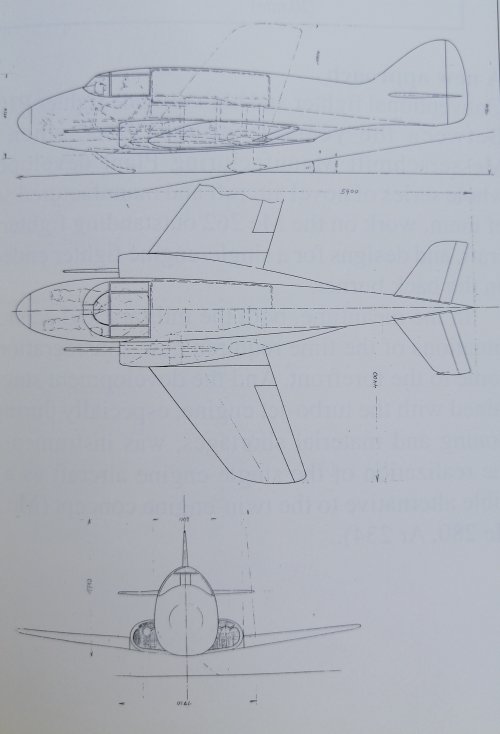
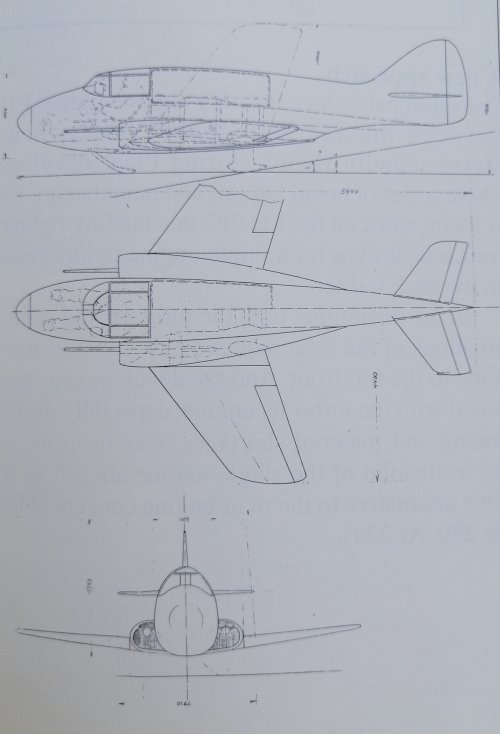
- Maximum takeoff weight: 1620 kg,
- Width: 4.4 m,
- Length: 5.9 m,
- Height: 1.81 m,
- Wing area: 6.5 m²,
- Maximum speed: 935 km/h (theoretical),
- Armament: 2 × MG 151 × 15 mm,
- P.S. Although this aircraft never left the drawing board, the design for this bomber was used in the development of the American Convair B-36. The option of using this aircraft as a mothership for McDonnell XF-85 fighters was also explored."
Similar threads
-
-

-

-
 Messerschmitt Bf/Me 210/410 Projects, Prototypes & Derivatives
- Started by hesham
- Replies: 74
-