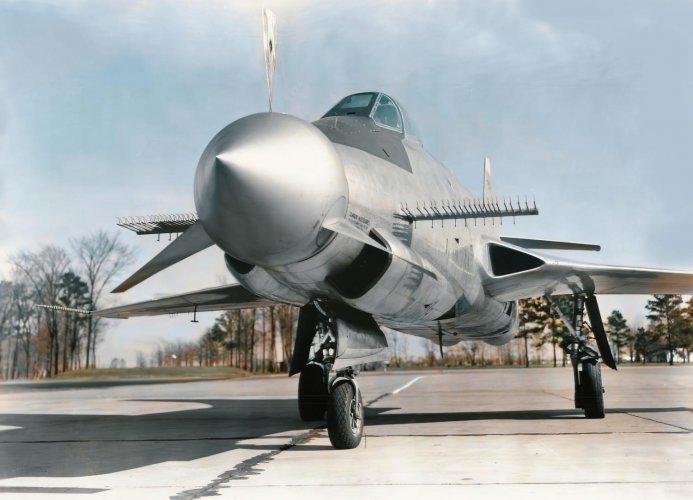
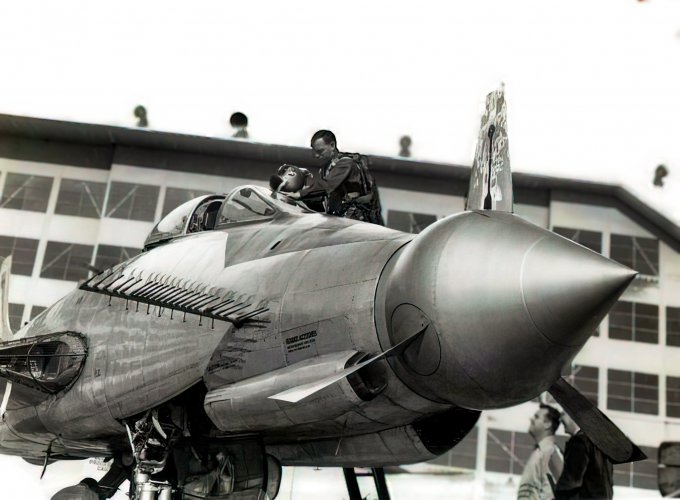
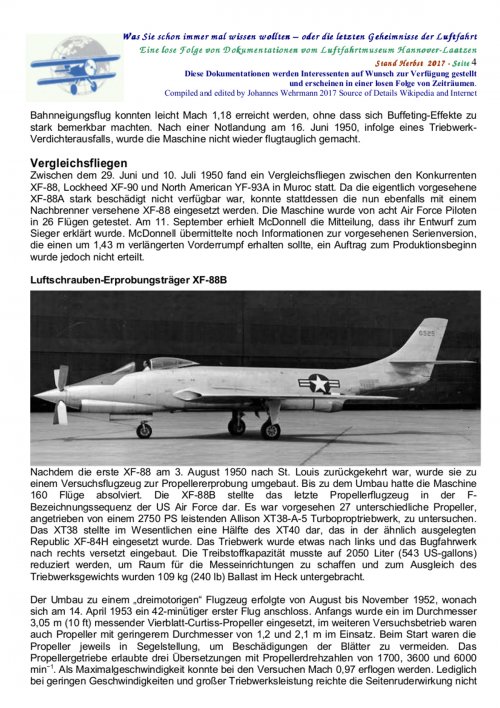
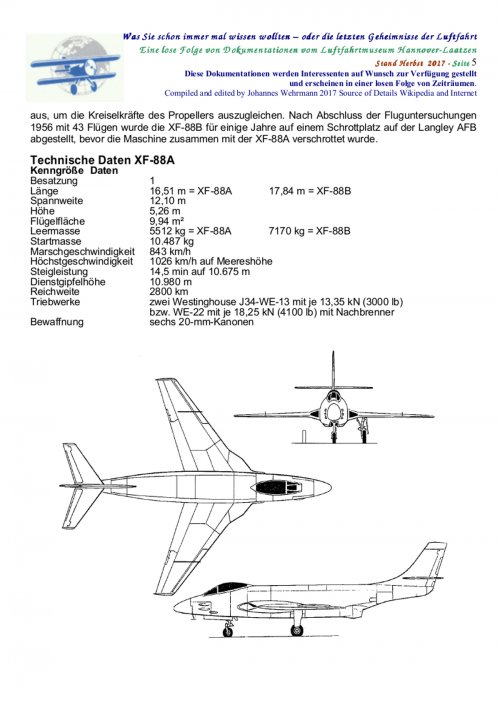
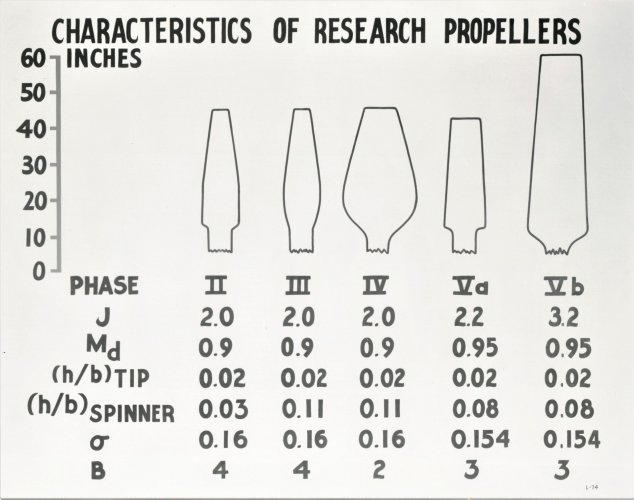
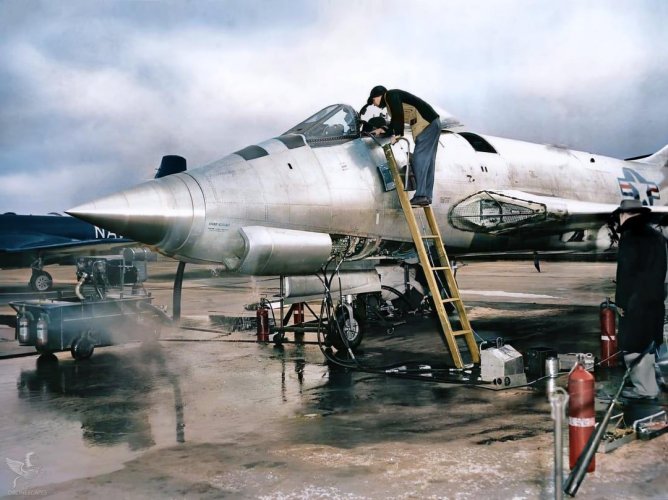
In an attempt to attain the desired Mach 0.95 design point and reduce noise levels to a range comparable with that of conventional propellers, the XF-88B was tested with a new supersonic propeller design mated with the conical spinner, the Phase Vb. A four-blade design that would have been ten feet in diameter, it was tested in a three-blade configuration that was 9.8 feet in diameter and optimized for the same flight speed of Mach 0.95 as the preceding Phase Va blade design. Also using a NACA 16-series section and SAE 4340 steel construction, the new blades varied in section thickness from 8-percent at the root to 2-percent at the tip. Blade chord was 16.1 inches at the spinner surface and 11.6 inches at the tip. The conical spinner had a base radius of 17.5 inches and had an included nose angle of 41 degrees. In this configuration, the propeller operated at 1,710 rpm. Despite the greater length and similar overall configuration to the preceding Phase Va blade design, the slower rotational rate of the 1,700 rpm gearbox produced a tip speed of Mach 1.3 for the Phase Vb blades. This reduced rotational speed greatly aided noise reduction efforts. These tests continued into the early summer of 1957. Final tests with the Phase Va blades used a new non-rotating elliptical spinner16.57 inches in diameter and 55.1 inches long to evaluate flow conditions and result in less interference with the propeller. As with the other configurations tested, both the propeller designs and the XF-88B gave good results. However, the noise and vibration produced by the supersonic propellers was often difficult for ground personnel to endure.
An attempt to overcome the very high noise levels of previous propeller designs was tested in the XF-88B with the elliptical spinner matched to a new transonic blade design, the Phase VIIb, which was 6.85 feet in diameter and optimized for a lower flight speed of Mach 0.82. As with the Phase Vb propeller, the Phase VIIb used the 1,700 rpm gearbox for the Allison turboprop engine. With a tip speed of Mach 1.1, the new design provided a modest decrease in noise levels but also exhibited reduced efficiency.
In a 6 January 1981 letter to author Richard Koehnen, Jack Reeder offered his recollection of the XF-88B program:
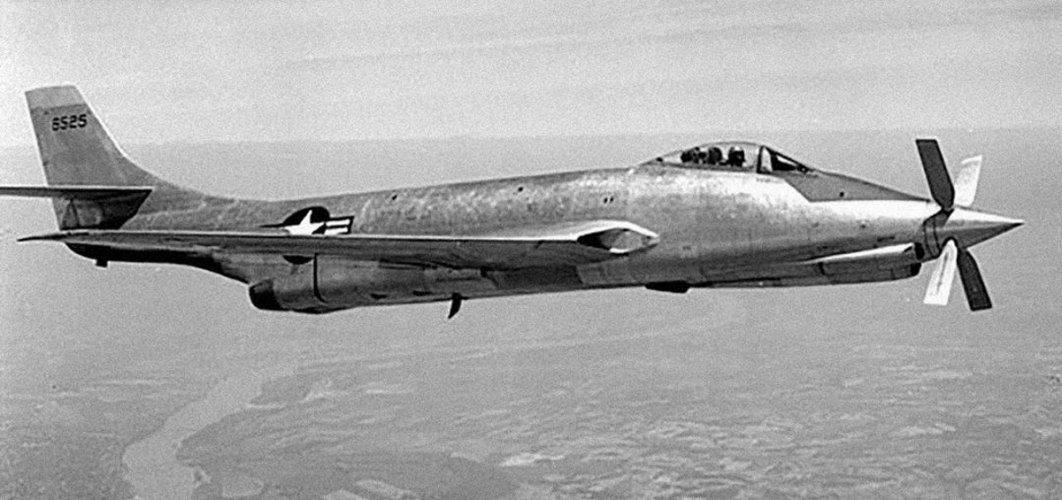
The supersonic propeller program was a joint effort of the Air Force, Navy, and NACA to explore the design and practicability of propellers for economic propulsion of aircraft to cruise at Mach numbers of up to 0.95. The NACA considered both the B-45 and B-47 as candidate test beds, but the Air Force volunteered the XF-88 number 46-525, which was excess to their needs, and this was modified to become the XF-88B. The Air Force contributed the required modifications to the aircraft (a 62-gallon fuselage fuel tank was removed for installation of the T-38 power plant), a conventional 4-blade propeller (Curtiss) and the research propellers (built by Curtiss to the requirements of the NACA research program), the propeller gearbox and a spare, which could accommodate three propeller rotational speeds through internal gear changes, whirl tests of the research propellers at WPAFB and acceptance tests and reports of the modifications accomplished. The Air Force Project manager at WPAFB was Charles Beinnaman.
The Navy contributed the engines to the program. These included two Allison XT38-A-5 turboprop engines (one spare) to drive the propellers, and four Westinghouse J34-WE-34 jet engines (two of these were in the XF-88A [sic?] airframe. The afterburners were of McDonnell design.
The NACA was responsible for the research instrumentation, the program and its conduct, the data and reporting of research results.
Acceptance tests were conducted by the Air Force after aircraft modifications at McDonnell in June and early July of 1953. NACA personnel were in attendance to take part and for familiarization with the final product including flight and operating characteristics of the aircraft….
The XT-38 drive shaft and gear box had torque and thrust sensors, respectively. The thrust meter did not function well and was not used. The torque meter strain gauges were on the shaft between engine and gear box. The actual torque absorbed by the propeller was, however, determined from the wake survey rake as was the thrust. Although provisions for the research instrumentation were made during the conversion work on the aircraft, the actual installation (including the momentum survey rakes) was completed after delivery to NACA Langley.
The XF-88B was ferried, after acceptance, by Capt. Fitzpatrick to Langley with a stopover at WPAFB where it was flown by other Air Force personnel. It arrived at Langley on July 13, 1953. The XF-88A, number 46-526, was later delivered to NACA Langley, also, where it served for spare engine and parts support….
In research like this a great deal of work goes on between flights to reduce and examine data so as to decide what should be done on the next flight, and what changes and corrections must be made to the instrumentation, propellers, and propeller governing, gear boxes, etc., as well as to perform required maintenance on the one-of-a-kind equipment from airplane to propellers. The research proceeds slowly, but not because of a lack of effort.
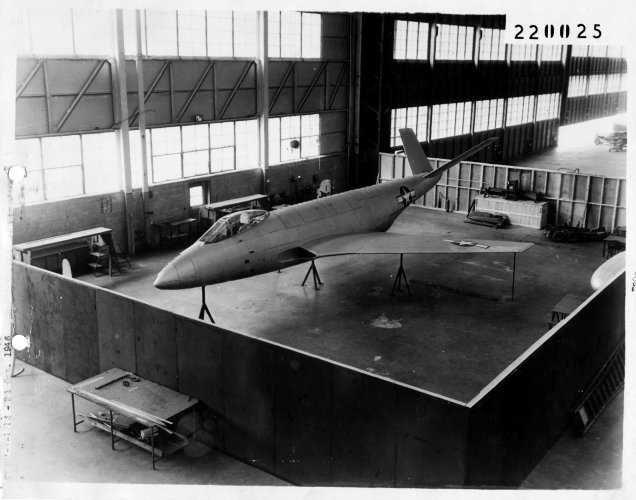
The XF-88A, which had an all-moving horizontal tail, in contrast to the fixed stabilizer and elevator of the XF-88B, was not flown by NACA because of lack of resources for operating both aircraft. It was used for spare engines and airframe spares, primarily. However, the aircraft was used briefly for evaluating a takeoff performance meter concept, but no lift offs were made. Taking account of weight, temperature, and runway length the takeoff meter indicated whether, upon brake release, the longitudinal acceleration was adequate for safe takeoff under the prevailing conditions.
When acquired, the XT-38’s were limited to 25 hours before scheduled overhaul, but before such time was acquired it had been extended to 50 hours. However, at between 6-7 hours of operation foreign object damage was suffered which required compressor blade replacements.... Of course, the spare engine was installed while repairs were made on the first engine. It’s not surprising that foreign object damage did occur because of the numerous and lengthy ground runs for noise measurements and the vulnerable position of the XT-38 engine air intake.
The XT-38 propeller gear box ratios for 1700 and 3600 rpm were used in the research, but not that for the 6,000 rpm. A disintegration of the propeller brake (for-feathered operation) required rebuilding of one gearbox. Only three propeller blade designs were flown and reported on, the phases Va, Vb and VIIb…. The program was discontinued when it was felt that maximum payoff had been achieved. An important factor was the rapid swing to jet power (with its speed and productivity potential) for military and commercial use. Actually, the program was a little late, for the times, in implementation.
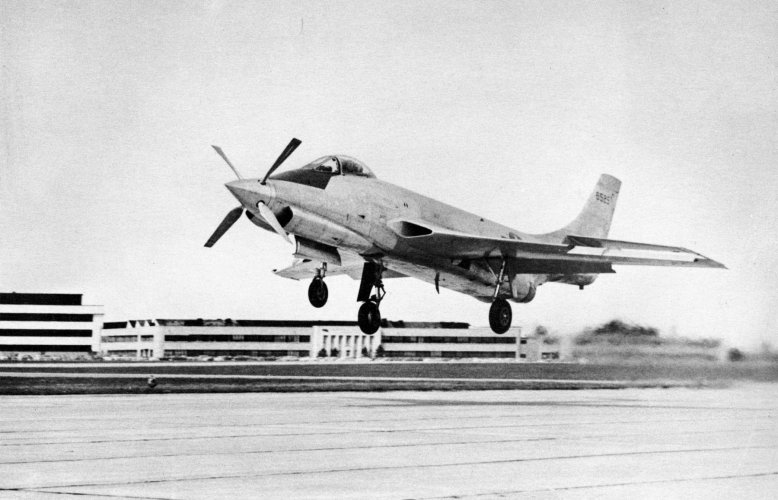
The XF-88B aircraft performance for this testbed role was marginal. Thrust-to-weight ratio for takeoff was 0.3 or less. Takeoff run, with afterburning, to 155 mph was generally 5000 feet or more (8000-foot runway at Langley at that time). Fuel limitations with the performance prevailing made the whole operation time critical. Flight time could not exceed 40 minutes, and usually only one high speed run at altitude could be achieved. As soon as familiarity was achieved the XT-38 was started at 5000 feet (blade stall flutter was a limitation for takeoff) and the test propeller configuration was used for climb. Engine nozzles in non-afterburner operation were manually adjusted by rheostats in the cockpit for maximum temperature to obtain military thrust, which was the power used in climb. Sometimes at full throttle the nozzles would not close in response to rheostat adjustment until the throttles were retarded. Then they could be advanced again.
The afterburners did not perform satisfactorily. The thrust augmentation with afterburning was estimated to be about 1.41 in design. However, ground static tests at Langley assured only 1.12 to 1.19 in actuality. Furthermore, the tailpipe nozzles, automatically controlled by temperature in afterburning operation, would frequently hunt, causing large fluctuations in thrust which damped poorly or not at all. The problem lay in the friction in the Arends’ controls (flexible wire enclosed in flexible, anchored guide tubes) used to move the nozzles and did not seem to be amenable, for any length of time, to maintenance steps or lubrication. Afterburning light off could not reliably be achieved above 20,000 feet, if used. However, blowout of one or both afterburners frequently occurred above 20,000 to 25,000 feet. This was hard to detect at times, and a rapid loss of fuel would occur before recognition. Re-lights were not generally possible without descending. We eventually did away with the afterburners and replaced them with straight tailpipes.
The aircraft was usually towed to the head of the runway where assurance of prompt takeoff clearance was obtained before engines were started. Engines were run up with the brakes on and turbine outlet temperature limits set with the cockpit rheostats. Generally, both afterburners were lit, one at a time, and checked for temperature and steady operation before brake release. However, one day I was startled by the aircraft sliding down the runway. I thought the brakes weren't holding. Actually, the afterburners were putting out their best. After takeoff, the afterburners were shut down as soon as 230 mph in the clean configuration was obtained. The XT-38 was started at 5,000 feet and 250 mph and used in climb. During all operation with the propellers the cockpit noise was similar to that with a reciprocating engine, such as the Merlin or the Allison. Climb was made with the aircraft position with respect to the airbase in mind so that, when the fuel state dictated, the data run could be started with the aircraft heading toward home.
For a speed over about Mach 0.85, the climb was continued to as high an altitude as the fuel state would permit, generally 30-35,000 feet. The highest altitude obtained during the NACA program was 39,000 feet over Wallops Flight Center during an airspeed static source calibration using ground radar. At the highest altitude achieved for a test run the aircraft was accelerated in level flight, data system running, as long as practical. It was then dived to obtain the speed desired by 30,000 feet, if possible, but not so steeply that the rate of speed change might lead to large off-speed conditions of the propeller or oscillations in rpm. The governor time constant was adjustable to obtain to obtain good performance, but its setting was only an estimate for each propeller configuration. The governor never did cause a problem but such dives to obtain the high speeds were not made often enough with a given propeller configuration to become thoroughly familiar with governing limitations.
On one flight, following the installation of a more elaborate XT-38 fire detection and warning system, which sensed temperature rate as well as temperature, the fire warning light came on during a dive. The throttle of the XT-38 was pulled back, but to no avail. Finally, the propeller was feathered in the dive at a Mach number of 0.95 at 30,000 feet…. No major adverse effects were noted (or remembered) in this case. Also, the fire warning proved to be false and adjustment of the warning system sensitivity took care of the problem.
The elevator control of the aircraft was adequate to achieve the limit load factor or maximum usable lift coefficient throughout the subsonic operational envelope. At a Mach greater than 1.0, however, full back stick could develop only 0.75 “g” increment, or a load factor of 1.75 “g” for recovery, an indication of the increased degree of longitudinal stability and the loss of elevator effectiveness caused by Mach number effects. This was of no consequence operationally in this case, however.
The general handling characteristics were adequate, and the drag rise and trim changes (tuck) in achieving supersonic speeds were mild and posed no difficulties. Buffet at 1 “g” in transonic flight was non-existent, to the best of my memory. The highest Mach reached was 1.2 by Fitzpatrick in the acceptance tests at St. Louis. Many public complaints were received from the resulting sonic boom, however, which caused McDonnell authorities to prohibit further supersonic tests. Therefore, this kind of operation was minimized at Langley.
The control forces were manageable with boost off in up-and-away flight. However, one day after I had just made a high-speed, high-propeller-power pass over some high-ranking visiting observers at Langley the hydraulic control system failed. Although lateral control could be handled below 200 mph with one hand without major problems away from the ground, I found it a different story on the approach. I carried more speed (about 180 mph) to avoid the lateral trim changes during landing…and also to avoid a “settling” situation if forced to use two hands on the stick, leaving none for throttle operation. Actually, two hands were required on the stick continually to keep the the aircraft lined up with the runway (it was a real sweat). I was beginning to be deeply concerned about flaring while keeping the aircraft aligned when, just about at flare height, the boost came back in, allowing me to land decently. The nose-down attitude during the approach apparently allowed remaining fluid into the system.
By late 1957, it was clear that turbojet and newer turbofan engines would represent the wave of the future in both the military and civilian spheres, and the NACA supersonic propeller research program was concluded with its final research flight on 17 January 1958. Over the course of its research career with NACA, the XF-88B accrued 28 hours of flight time with 43 research flights and three familiarization flights over a period nearly 50 months at Langley. Jack Reeder had conducted 30 research flights, while Bill Alford had 13 XF-88B flights in his logbook. NACA pilot Robert Champine had two familiarization flights for a total of 0.6 hours in the aircraft, while J. B. Whitten had one. While Jack Reeder continued in a long career with NASA, Bill Alford was killed the following year in England during a pitch-up event while landing a prototype Blackburn NA.39 Buccaneer. With the end of the supersonic propeller evaluation, the XF-88B was turned over the base salvage at Langley Field for disposition on 16 September 1958. The XF-88B was then transferred to Eglin AFB, Florida for ordnance testing. The XF-88B was tested to destruction at the proving grounds and removed from the USAF inventory in February 1959. Thus was the end to the distinguished career of the first Voodoo.


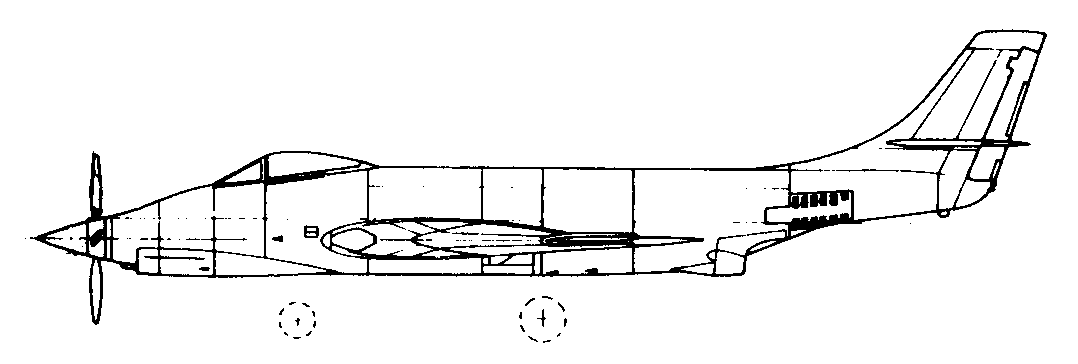 mcdonnell_xf-88b.gif6 KB · Views: 69
 xf-88b 3.jpg974.2 KB · Views: 54
 xf-88b prop.jpg600.6 KB · Views: 50
 kjseo6i8y6x91.jpg390 KB · Views: 55
 xf-88b three side view.JPG219.1 KB · Views: 68
 515934478_769270035613841_5602122945476591614_n.jpg131.3 KB · Views: 39
 1376.jpg398.3 KB · Views: 36
 XF-88 MOCKUP.jpg1.3 MB · Views: 41
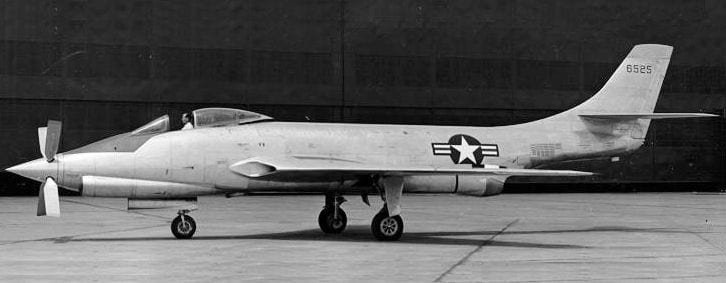 xf88_voodoo.jpg25 KB · Views: 24
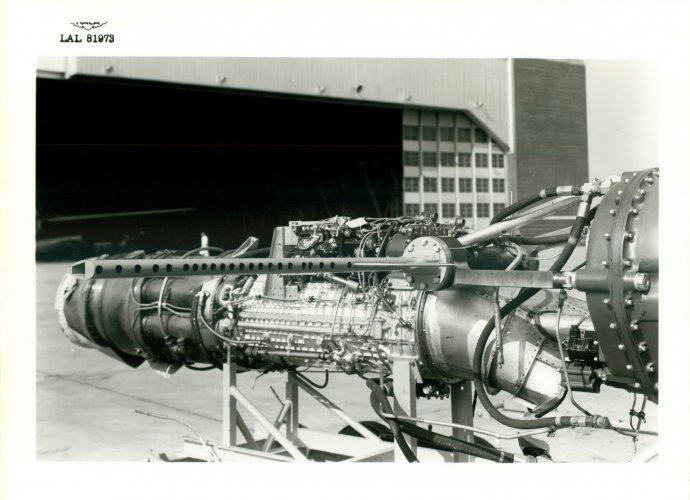 XT-38 engine.jpg235.4 KB · Views: 25
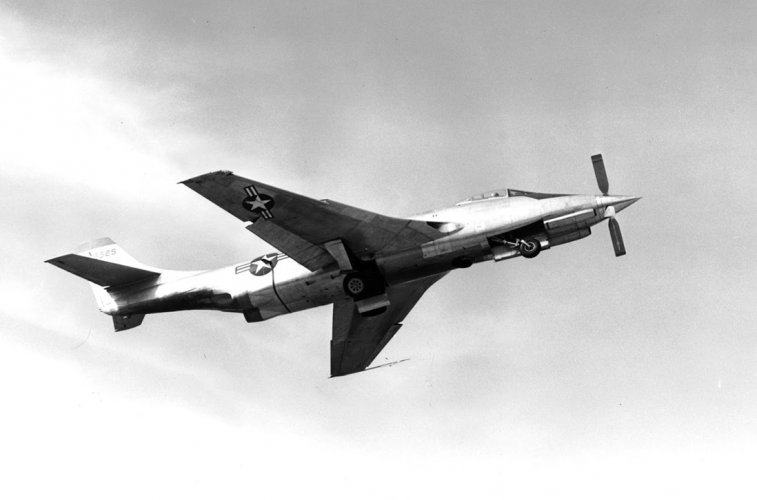 00040221.jpg155.9 KB · Views: 18
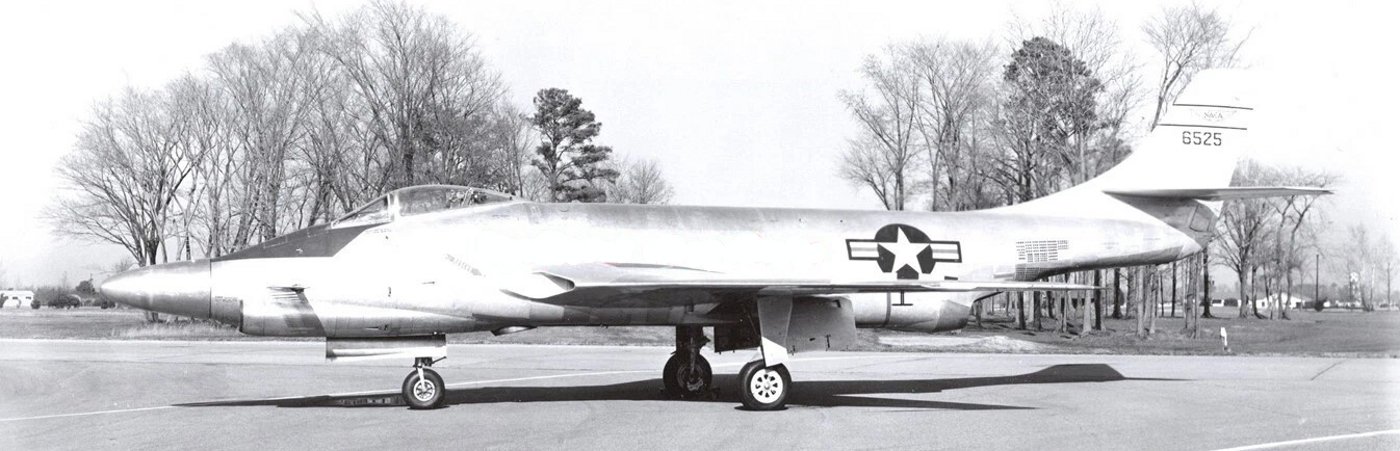 XF-88B without propeller.jpg401.3 KB · Views: 24