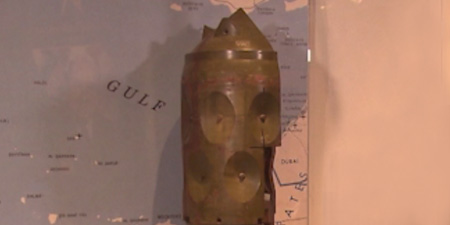
MEPHISTO's shaped Charge for example has a dedicated fragmentation sleeve around the shape charge against soft targets. Yes any warhead that explodes creates fragmentation but one is intentional / designed the other not.

I'm not sure you'd need a fragmentation sleeve with an exploding BROACH warhead inside a submarine as it's detonating inside tightly confined compartments containing the blast and therefore amplifying the damage inflicted (Catastrophic damage in this this case, I shudder to think what it would do to any crewmen inside or close to the effected compartments).

Edit: Since you used to be a submariner, @Scott Kenny, what's your informed opinion?​
 
Last edited:
https://www.mbda-systems.com/products/deep-strike/stratus
  • STRATUS RS:
    • Long Range
    • High Supersonic & High Manoeuvrability
    • Active Sensor with ATR
    • Multipurpose Warhead (Antiship & SEAD)
    • Connected
  • STRATUS LO:
    • Very Long Range
    • Stealthy High Subsonic & Nap-of-the-Earth
    • Passive Multimode Sensor Suite with ATR
    • Multipurpose Warhead (Bunker Killer & Surface Target)
    • Connected
 
Last edited:
Which is my point, that strike hit in the correct orientation to the target to guarantee it would be effective.

Planning or fluke?
We know that even 1980s Soviet AShM such as P-700 and P-800 were able to aim themselves to hit head-on and go down the length of a ship, so I suspect that this is a fairly straightforward capability.
 
Uh oh... this paragraph buried in the UK DIP doesn't look good. Potential review of the UK's Stratus purchases?

The DIP confirms a £1.5bn investment in Stratus over 4 years, with continued investment in 2030-35. However... see page 54:
https://assets.publishing.service.g...c951a27d80e87/The_Defence_Investment_Plan.pdf

Learning the lessons from Ukraine, we are now pivoting to the next generation of low-cost cruise missiles, meaning we will get significantly more missiles at a reduced overall cost. Alongside these types of weapons, Stratus missiles will be the future of the UK’s complex weapons programme, delivering long range strike against complex targets for both the Royal Navy and Royal Air Force, in cooperation with France and Italy.

The UK is a leader in complex weapons, a position we will retain to grow our industry, empower our Armed Forces and deliver best-in-class munitions to allies. Given the scale of the £6.5bn, ten-year Portfolio Management Agreement, we will work with industry partners to ensure that the most valuable capabilities are delivered on time and on budget. To begin this, we will launch a STRATUS long range strike programme review, to be concluded by 1 September 2026. This review will look at all options regarding the future of the programme.
 
Some rebalancing between Stratus, and the new Deep Precision Strike and OWE programmes looks likely, and sensible. Things have changed in the 10 years since the programme launched.

Suspect we won't need 900+ Stratus LO for air launch if we also have other options like Brakestop, PrSM, Nightfall etc etc...

Plus I think its a useful shot across MBDA's bows to get the cost down on Stratus LO....hopefully the MoD will choose one of the other companies Brakestop candidates to really drive the message home...after all we could have been operating Fireshadow (a Ukrainian Firepoint FP-1 or 2 is the modern equivalent) for the last 15 years...one of the reasons for its failure was the ludicrous cost that MBDA was proposing....

Hopefully someone in MBDA UK is really looking into and understanding what always on manufacturing entails...not just for themselves but for customers expectations around price....
 
Last edited:
Plus I think its a useful shot across MBDA's bows to get the cost down on Stratus LO
How does cutting order quantity and thus reducing economies of scale and spreading development costs over fewer weapons help lower costs? From first principles it would do the opposite.
 
How does cutting order quantity and thus reducing economies of scale and spreading development costs over fewer weapons help lower costs? From first principles it would do the opposite.
Ah you're assuming that the cost to produce it is linked to the price that MBDA will charge...:rolleyes:
 
Ah you're assuming that the cost to produce it is linked to the price that MBDA will charge...:rolleyes:
It is linked at some level.

Now, there may be a 10x mark-up MBDA is employing over the cost of materials and cost of development (plus cost of business overhead). But there is still a floor at which the comment is "we spent 15 billion dollars developing this missile. If you only buy 100 of them, the development cost per missile is 150mil."
 
Brakestop must be going well and it's raising some questions.
The speed of the programme and it's results imply there is scope to field higher performance systems at more modest cost.
MBDA itself was one of the three to make it to trials. Likely triggering questions....

Factor in that the Ukrainian War and the Iranian war show how mass of systems depletes defensive interceptors to the point of making hard choices.
Storm Shadow's limited numbers and stop-start production.

Factor in as well Deep Precision Strike Likely lifts out certain requirements away from legacy programs.

Factor in Nightfall will yield similarly interesting results.
 
Storm Shadow's limited numbers and stop-start production.

I think we can be critical of many things but Storm Shadow numbers isn't one. For a complex LO cruise missile it was available in colossal numbers at the start of the war. 1500+ in NATO alone is a serious number. Even the total production ofJASSM variants wouldn't exceed the total Storm Shadow/SCALP/Black Shaheen numbers until c2019/2020, and it had been in production for close to 20 years then.

As for Stop Start they needed orders, and the gradual wind down of production made sense as the MLU was planned and underway which used the same facilities and was quite extensive,.
 
2028 for Royal Navy testing of the Stratus missile? It depends on what missile is manufactured first I think.
 
That is crazy timmymagic, I would have thought that the UK would have ordered both missiles especially for the GCAP, I would think that they would complement each other.
 
Stratus RS will arrive significantly later than Stratus LO anyway, so the UK isn't in a hurry to decide tbf.
 
Last edited:
UK is only interested in Stratus LO at present.
The two are interesting in naval use against a heavy frigate or cruiser :
RS to strike speedily, but with an average warhead, to put the ship out of combat.
LO in a second time, once the foe vessel is out of combat, with a heavy warhead to finish the job.
 
So what type of warhead would they fit inside of the Stratus LO? Something along the lines of the BROACH warhead of the Storm Shadow?
 
BROACH is made to destroy bunker, not frigate or destroyer.
Maybe 2 warheads : BROACH for air to ground, another, more classical, for air to sea ?
Could you add a frag sleeve to the precursor HEAT warhead, then add a mode to the fuzing that detonates both warheads simultaneously for anti-ship use?

Obviously less effective than a single, larger HE warhead, but it does avoid the logistical complications of two different missile types.
 
IDK, BROACH really did a number on that Russian submarine. Imagine the second charge flying through into a VLS silo.
All modern warship has nearly no armor : no need of a BROACH to hit vertical silos.
And if a BROACH hit for exemple the crew carter, the effet will be less potent.
 
All modern warship has nearly no armor : no need of a BROACH to hit vertical silos.
And if a BROACH hit for exemple the crew carter, the effet will be less potent.
The ability to precisely set the depth of the secondary to detonate is the key thing. The initial charge as you say would go easily through unarmoured ships so it would be possible to selectively destroy e.g. the machinery spaces and flood the ship.
 
The ability to precisely set the depth of the secondary to detonate is the key thing. The initial charge as you say would go easily through unarmoured ships so it would be possible to selectively destroy e.g. the machinery spaces and flood the ship.
Why not.
I don't know what is the yield of the secondary warhead.
 
The ability to precisely set the depth of the secondary to detonate is the key thing. The initial charge as you say would go easily through unarmoured ships so it would be possible to selectively destroy e.g. the machinery spaces and flood the ship.
Here's the fuze from Storm Shadow....its used on JSOW as well. Next tweet illustrates the the variable delay settings.

View: https://x.com/FRHoffmann1/status/1690731911100940288
 
How would they go about modifying the BROACH warhead for anti ship work? I had thought that it was only designed for bunkers? The only real option is for a dedicated anti ship missile with an appropriate warhead.
 
How would they go about modifying the BROACH warhead for anti ship work? I had thought that it was only designed for bunkers? The only real option is for a dedicated anti ship missile with an appropriate warhead.
A unitary, explode-on-impact warhead would honestly cover a lot of things well. Add a delay fuse if you want some flexibility maybe.
 
The optimal warhead for anti ship is probably a SAP (hardened cap) with radial EFPs that fire slugs at right angles to the direction of impact. Tears up a lot of the ship interior all at once.

The Exocets that hit USS Stark had warheads like that. It was arguably fortunate that one fuzed early (just at the hull plating) and the other didn't function at all (though the leftover fuel was possibly just as bad).

1787839489450.png
Now, Exocet was interesting because the fuzing was not impact, it was pseudo-proximity. The radar seeker would give a time-to-go estimate just before impact, and the fuze would set that plus a few milliseconds as the actuation time. Other designs use actual impact-plus-delay fuzing or void-counting fuzes to get a detonation properly inside the hull.
 
How would they go about modifying the BROACH warhead for anti ship work? I had thought that it was only designed for bunkers? The only real option is for a dedicated anti ship missile with an appropriate warhead.
Something with a smaller diameter following charge, since the shaped charge doesn't open up a large hole in steel.
 
Kh-22 is deigned to destroy aircraft carrier. In my opinion the EFP is to penetrate deep into the ship and to make as much damage as possible in addition to the explosion of the warhead. On smaller ships, this might not be as practical.
 
Kh-22 is deigned to destroy aircraft carrier. In my opinion the EFP is to penetrate deep into the ship and to make as much damage as possible in addition to the explosion of the warhead. On smaller ships, this might not be as practical.
They used the same design of warhead on Styx (Termit) and up to much more recent munitions.
 

Similar threads

Back
Top Bottom