Mod: Sales pitch not news but probably the most appropriate thread for this

Our mission is to deliver innovative solutions to help our customers keep people safe. Our products have been doing just that in Latin America for more than 50 years. Our presence on the continent is growing as we strengthen partnerships in the region. Now, as the Fuerza Aérea del Perú (FAP) prepares to transform its fighter fleet, we are confident the F-16 Block 70 will deliver the advanced capabilities and performance needed to address Peru’s pressing defense requirements now and decades to come.  ​


F-16 Block 70: Advanced Air Defense Capability​

The F-16 is the most advanced 4th generation fighter and brings a new level of combat capability to air forces around the world. With a global fleet of over 3,100 F-16s currently in operation across 29 countries, Peru would become an integral part of a robust and expansive international network, both now and in the future. Anytime, day or night, there is a good chance an F-16 is serving a critical mission somewhere in the world, and to ensure the F-16's continued role in enabling peace through strength, we maintain a forward-looking technology roadmap, driving innovation and upgrades that address emerging challenges.


Allied & Industrial Partnerships​

The F-16 is a symbol of enduring partnerships and industrial collaboration. With the F-16 Block 70, Peru is not just procuring an aircraft - it’s building a decades-long strategic relationship with the United States. Joining the F-16 Block 70 program brings the FAP additional military cooperation opportunities and allied partnerships, not only with the U.S., but with many other countries. Furthermore, the F-16 fosters industrial base cooperation, which increases interoperability between allied defense forces, drives resilience in supply chains and creates economic growth for all partners.

Cutting-Edge Radar Technology​

The F-16 Block 70 is equipped with Northrop Grumman’s advanced SABR APG-83 AESA fire control radar and has 5th Generation fighter radar capabilities, delivering unparalleled situational awareness and all-weather targeting precision. Its technology provides pilots with detailed digital map displays that are customizable with slew and zoom features. Of added benefit, the radar’s commonality with the F-35’s radar is a remarkable 95% for software and 70% for hardware.

Life-Saving Safety Features​

A standout addition to the F-16 Block 70 is Lockheed Martin’s Automatic Ground Collision Avoidance System (Auto GCAS), which earned a Collier Trophy® for helping eliminate a leading cause of fatalities in military aviation. Designed to mitigate incidents of controlled flight into terrain, Auto GCAS has already saved 13 pilots and 12 F-16s since entering service in 2014. Its integration into the F-16 underscores the aircraft’s superior safety and performance capabilities.

Unrivaled Weapon Integration
Lockheed Martin has more than 40 years of weapon integration experience with the F-16, which no other company can match. Our experience as a weapon integrator has enabled the F-16 to develop into one of the most versatile multirole fighters.
f-16 block 70

Integrated Sustainment​

F-16 operators benefit from economies of scale based on the sheer number of jets flying today and expected to be flying for years to come. We are a full lifecycle partner, across development and engineering, production and sustainment, and are focused on delivering integrated sustainment capabilities to ensure our customers’ aircraft are mission ready anytime and anywhere.

F-16 peru stats

Enhanced Situational Awareness​

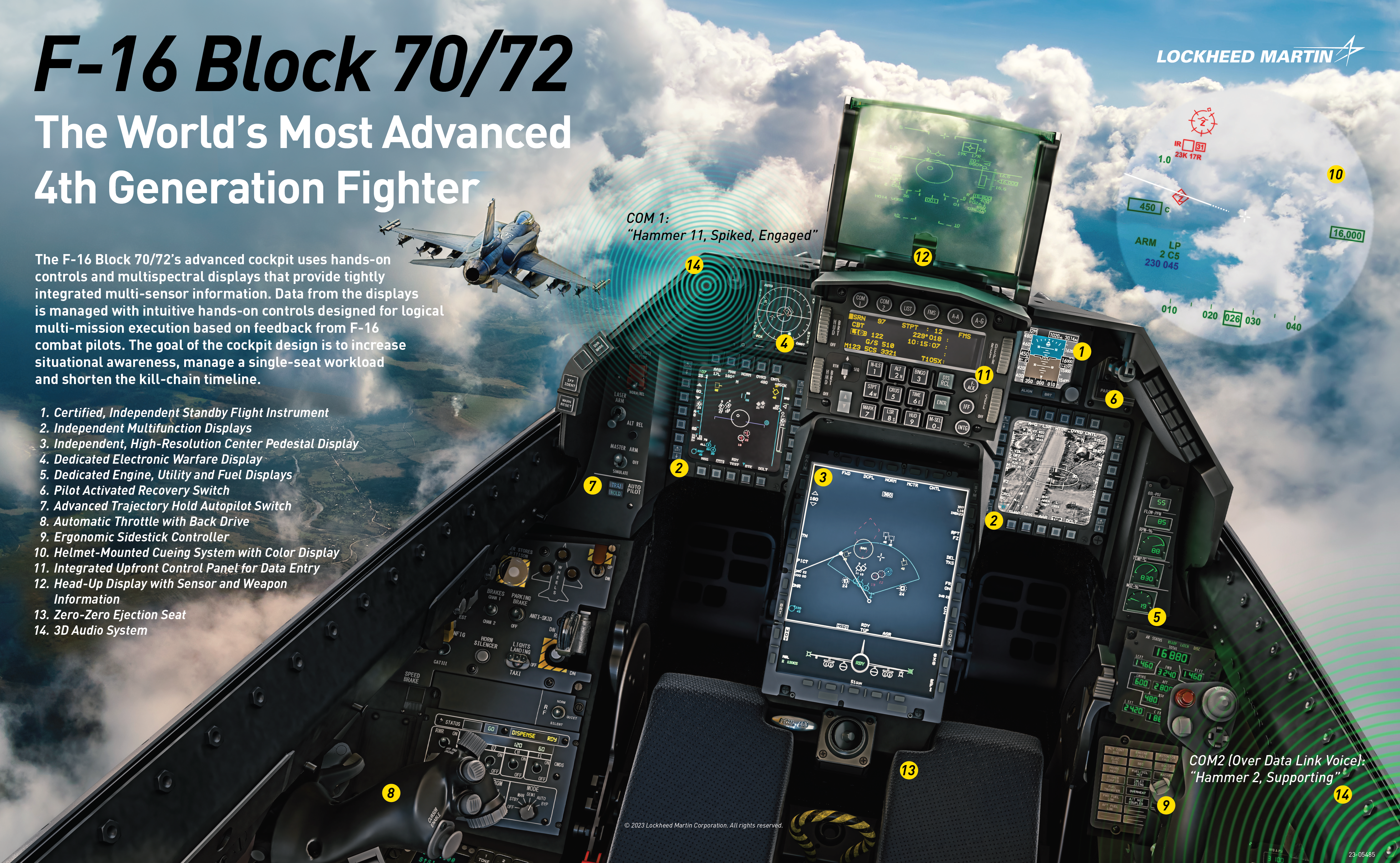
The F-16 Block 70’s high-resolution center pedestal display provides critical tactical imagery and seamlessly integrates AESA and targeting pod data. Pilots receive enhanced awareness from the pedestal’s color moving maps, enlarged air-to-air situation displays and zoom functionality. Their capabilities are augmented by digital flight instrument data displays and a color/night helmet-mounted display.

f-16 cockpit

Extended Structural Life​

The F-16 Block 70 boasts an extended structural life of 12,000 hours, equivalent to over 40 years of service for most air forces, with minimal structural repairs required. This longevity, coupled with greater inspection intervals, significantly reduces maintenance costs.

Enhanced Operational Flexibility​

The inclusion of conformal fuel tanks enhances the aircraft’s operational flexibility and increases its fuel capacity and mission range — without compromising its aerodynamic efficiency.

https://www.lockheedmartin.com/en-us/products/f-16/f-16-peru.html
 
Last edited by a moderator:
Quite noteworthy that another Air Force turns away from the Mirage lin. The lack of an open manufacturing line and real upgrades in the last decade certainly weighted heavily.
I wouldn’t necessarily read this as an indication that Peru is going for the F-16, it had been pretty widely reported in the press that they were pursuing the Gripen.

You’ll get a DSCA arms sale notification like this whenever a proposed export that is Congressionally-notifiable based on dollar amount gets requested and goes through the FMS and Export Licensing process, and that approval will get posted regardless of whether the deal is actually going to happen.

A lot of times these notifications get reported as though XYZ country is definitely going to by the approved items, but many times the sales don’t eventuate (Indonesia V-22s, Colombia F-16s, etc.)
 
Based on what has been written in the news..
Peru has selected and expressed intent on purchasing the Gripen, but it does not seem like any contract was signed yet.
sounds like the US side is trying to make one last effort to get the F-16 through
 
@HaveVoid : Yes, that's absolutely true. But my remark stands for both reported winners (F-16 and Gripen).

Notice that with Peru political situation being a bit in shamble for now, we might hear claims from both sides for some times.
 
The Peruvian Air Force prefers the F16 over the Gripen, and this is understandable since the American fighter has combat experience, has global users, doesn't depend on third parties who can veto the engine, avionics, or armament, has a mega factory, and fulfills its customers orders.

The problem with Saab Gripen is that it has a small factory in Sweden, few customers, no combat experience, and relies on other countries, such as the engine, which is American, and parts from the UK and Brazil.

Production of the Gripen E for export to Latin America has been commissioned to Brazil through Embraer, but this Brazilian company doesn't deliver, not even to the FAB, much less will it deliver to Peru on the dates stated in a hypothetical contract.
 
Well if Turkey wants to get its' F-35As then it needs to get rid of its' SA-21 Growler missile batteries first.
This again?

Frankly, aren't you tired of bringing up the S-400 political excuse all the time?

They're quite literally collecting dust in storage and have never been deployed since the initial performance test. They've never been integrated with NATO or any national network either. Even U.S. insiders have admitted since then that it was never really about the S-400.

Every time you or others bring this up, I have to clear up the misinformation. I literally have 36 different posts in the F-35 thread, where I try to present both sides' views and debunk misinformation:

https://www.secretprojects.co.uk/th...ii-joint-strike-fighter-jsf.17732/post-756676

https://www.secretprojects.co.uk/search/1529853/?t=post&c[thread]=17732&c[users]=snne&o=relevance

It's clear that no matter what Turkey does, even if it bends over backwards, the U.S. will never deliver the impounded aircraft or provide production slots, regardless of the reason; whether it’s due to foreign lobbying (particularly Israeli) or strained relations with Turkey.

These people will keep demanding more and more as you try to please them for something that isn’t entirely your fault. There's no middle ground to be found with them.

U.S. lawmakers have introduced amendments to the 2026 National Defense Authorization Act (NDAA) that would block F-35 fighter jet deliveries and other arms sales to Türkiye unless Ankara meets specific political and security conditions, including certifications regarding Hamas, Israel, and defense cooperation with U.S. adversaries.

A bipartisan amendment introduced by Republican Rep. Gus Bilirakis and Democrat Rep. Brad Schneider would prohibit F-35 sales to Türkiye unless the White House certifies that Ankara is not "materially supporting Hamas or any of its affiliates."

The proposed legislation would also require certification that Türkiye is not "engaging in military threats to Israel" and is not conducting military cooperation, including drone sales, with Russia, China, Iran, and North Korea.

Another amendment calls for the State, Defense, and Treasury departments to conduct detailed investigations and submit a joint report to Congress examining whether Türkiye is harboring Hamas members or financial assets, or otherwise permitting the group's officials to operate from its territory.

The report, requested within 180 days, would assess security risks to the U.S. and allies, activities of groups including Hamas, Hezbollah, and Iran's Revolutionary Guards, terrorism history, threats to U.S. personnel and bases, and Türkiye's responses to these threats.

Additional amendments submitted to the House Armed Services Committee by Representatives Dan Goldman of New York and Josh Gottheimer of New Jersey target Türkiye's military presence in Turkish Cyprus and its regional activities, according to Greek Reporter.

These proposals would require Türkiye to stop alleged violations of Greece and Greek Cyprus, avoid defense cooperation with U.S. rivals like Russia, and ensure U.S.-made weapons are not used in Turkish Cyprus. The restrictions would remain in effect for five years unless these conditions are met.

The amendments also require Türkiye to disclose to the U.S. all American-origin systems used in Turkish Cyprus.

Nobody trusts the U.S. anymore; you make promises all the time, yet never follow through. The whole Good Cop - Bad Cop routine between the President and Congress has really grown tiresome for many countries already.
 
Last edited:
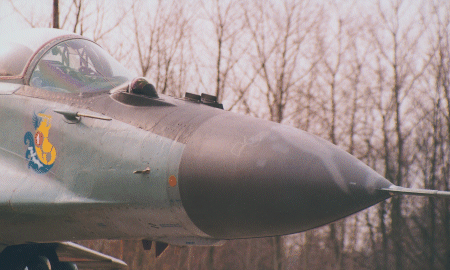
I hope I can ask this question without going completely Crazy Ivan on the thread but... how many fighter jets have the bird slicer IFF arrays in front of the windscreens like the F-16s do? I've seen them, I believe, on the IDF Chung Kuo light fighter out of Taiwan, but I don't think I've seen them anywhere else.
Mig-29. The "defected" ones.
https://www.flightglobal.com/first-nato-modified-polish-mig-29-makes-its-debut/25692.article
2597gif_2597.gif
 

The negotiations are ongoing, recent news according to Turkish sources say that Turkey is pushing for sovereignty over the Block 70, allowing for integration of Turkish mission computers and munitions. This isn't farfetched request by the Turkish side, Turkey previously leveraged it's Veto power for the admittance of Finland and Sweden to NATO in exchange for sovereignty over block 40/50 (block 30 not binding, due to them being out of contract) - hence why Turkey dropped 78 viper modernisation kits for indigenous modernisation kits.

It's fairly complex, the negotiations likely include F-35 and F110 engines as well, US leveraging Turkey to drop Russian Oil and Gas, which geographically isn't an easy task and likely to increase energy prices in Turkey.
 
The negotiations are ongoing, recent news according to Turkish sources say that Turkey is pushing for sovereignty over the Block 70, allowing for integration of Turkish mission computers and munitions. This isn't farfetched request by the Turkish side, Turkey previously leveraged it's Veto power for the admittance of Finland and Sweden to NATO in exchange for sovereignty over block 40/50 (block 30 not binding, due to them being out of contract) - hence why Turkey dropped 78 viper modernisation kits for indigenous modernisation kits.

It's fairly complex, the negotiations likely include F-35 and F110 engines as well, US leveraging Turkey to drop Russian Oil and Gas, which geographically isn't an easy task and likely to increase energy prices in Turkey.
The problem with negotiating with the current US hegemony is that it doesn’t offer much of value beyond some F-35s and the promise not to 'geopolitically challenge you too much' (i.e., threaten you with a stick) if you comply with everything they demand; and even then, they just keep asking for more.

Its allies (e.g., the EU, larger Asian tigers, etc.) are often direct competitors in export markets as well, meaning any hinderence their economies face really benefits the U.S. .

Moreover, any "deal" you reach with one of its political institutions don’t necessarily bind the others, meaning you may make a compromise without ever reaping the intended benefits. In these uncertain times, none of this provides significant economic advantages.

If the US genuinely wants to maintain its alliances and compete with China, the entire American system needs to change.
 
Last edited:
Here's what a reliable, Tier-1 Turkish source/~insider says about the future of the F-16V (and F-35) in the TurAF:

The number of Eurofighter Typhoons will be 20+20+24 in the medium term. Whether additional aircraft will be purchased is still uncertain. If Qatar had completely abandoned the EF, the number would have been 20+20+36. For now, the first batch has been ordered. The contract also includes an option for +20 more aircraft. Additionally, unless there’s a change of mind, there will be at least a purchase of 20 F-16Vs. The number of F-16Vs could increase depending on the fate of the F-35 program, but two squadrons of F-35s will likely be acquired with a 90% probability.

The points highlighted by DENO are very valid. The current F-16 fleet will not remain the same forever. Our flight hours are high. However, internal balance will be considered in this matter over the next five years. Some of the F-16's air-to-ground roles will be transferred to the Kızılelma. Most of the existing fighter jets will focus on air-to-air roles. Baykar, being dissatisfied with the orders, has stepped on the gas. The Kızılelma will quickly enter service. There is intensive work on the production infrastructure. Similarly, there is also work on the engine.
https://www.trmilitary.org/viewtopic.php?p=425809#p425809
https://x.com/Fatih_MehmetK

After the last meeting with Trump, I guess they changed their minds and are going to move forward with a small F-16V order to convince the Americans to allow the Turkish F-35s to return home and to order an additional 34 aircraft?
 
Last edited:

Greece's F-16 Viper fleet to reach 121 jets with the upgrade of 38 more F-16 Block 50 fighters.​


Greece has approved a program to upgrade 38 F-16 Block 50 fighters to the Viper configuration, aligning them with the modernization already underway for 83 Block 52+ aircraft.

As reported by OnAlert on December 1, 2025, Greece has authorized the upgrade of 38 F-16C/D Block 50 aircraft to the latest F-16 Viper configuration, following an Air Staff recommendation and cost adjustments that brought the program within national planning limits. The package, aligned with the 83 F-16 Block 52+ jets already in the upgrade process, is scheduled for review by the parliamentary defense committee in early 2026 before the Letter of Request is sent to the United States.

https://www.armyrecognition.com/new...the-upgrade-of-38-more-f-16-block-50-fighters

Probably, the budget didn’t allow for more F-35 orders, so it will be limited to 20 units for now unless stated otherwise...
 
EmoBirb -

Howdy !

I am likely on the Autism spectrum, and from time-to-time…. even wax Lexdisic.
None-the-less…. I do not at all understand your statement, above.

I am not aware of “deep strikes “ being quantified or qualified by range/distance, as an( example ) USAF practice. It is a concept of operations, and notionally… these strikes might be prosecuted by those missiles, bombers, fighters; et al….suitable for the task at hand.

We also note:
F-16s were used by the IAF to attack Iraq’s Osirak reactor in 1981, and also during the
2007 attack on the Syrian Al-Kibar nuclear construction site.

Israel’s attack on Iran in 2025 also included use of some F-16I Sufa’s.
“ The National Interest “ website has an article about the attack, that includes a caption above a pic of an Israeli Sufa which states….
“ Israel’s F-16I Sufa Can Strike Deep Inside Iran “.
Hey 357Mag,

I'll reply in this thread, as the F-16 News thread has already been muddled enough and the Ukrainian F-16 thread is still locked.

When I said that the F-16 (in this context especially Ukrainian F-16s) are unable to conduct 'deep strikes', I was referring to their inability to reliably drop bombs on adversary troops or infrastructure behind the immediate line of contact as they cannot get past the established air defense network and the aerial patrols of the VKS (including but not limited to Su-35S, MiG-31BM and Su-57S, armed with R-77-1, R-77M and R-37M air to air missiles). Furthermore UAF F-16s lack any meaningful stand off capability, as Ukraine doesn't have access to AGM-158 ALCMs and their Storm Shadow/SCALP missiles are launched from their remaining Su-24 bombers. This is why actual deep strikes into Russian territory are carried out by ballistic or cruise missiles (ATACMS, Storm Shadow) or via low flying, long range, drones which exchange payload for increased potential travel distance. JDAM-ER or AASM Hammer utilized by Ukrainian aircraft simply don't offer enough stand off range to be viable for attacks significantly behind the front line, especially as the aircraft using them cannot even get anywhere near to the potential range of the bombs due to having to remain at low altitude, as otherwise the threat of SAM systems or fighters engaging them would be too great. This means that their F-16s are completely incapable of conducting deep strikes.

And to make a short excursion towards the F-16I you mentioned, not only is it a much more capable version of the aircraft, it's foes also lacked any meaningful countermeasures, be it airborne or ground based, to deal with them. Still one F-16I was shot down over Syria by obsolete air defense systems in 2018.
 
Last edited:
The Ukrainians could get an inexpensive stand-off short-range cruise-missile if Boeing's PJDAM proposal is put into production.
 

Similar threads

Back
Top Bottom