
FighterJock
ACCESS: Above Top Secret
- Joined
- 29 October 2007
- Messages
- 7,227
- Reaction score
- 8,538
That is right Forest Green. Stealth was never about being totally invisible to sensors like radar or infrared.


Safe to say at this point I was wrong about everything, lol. This is definitely a 7" airframe.https://theaviationist.com/2024/09/12/aim-120d-amraam-complementary-to-aim-260-jatm/ This is what I've seen.
https://www.airandspaceforces.com/raytheon-amraam-jatm-complementary/
Up to you what to make of that.
If I was designing a modern missile, decreasing time to active would be extremely high on my list.AIM-260 pretty clearly is more than just a range increase. I suspect it also shortens time of flight out to a given range, increases kinetic performance and maneuvering across all ranges, and has a very sophisticated guidance and fusing system to maximize lethality against a broader collection of target types and velocities. Probably the warhead is non standard too, either something like the PAC3 lethality enhancer mentioned up threat (small charge with a handful of large oblong shrapnel objects from what I understand) or something 3D printed where precise fragment sizes and geometry are printed as a single casing that can accept an HE filler.

Integration could happen decades down the line, missiles are not always immediately adopted across an entire air force. And the F-35 is primarily a strike fighter anyway. While the F-22 as a dedicated air superiority fighter would benefit greatly from it, especially as it's meant to also operate with unmanned platforms. The upgraded F-22 is meant to go head to head with the J-20 and the J-20A/S, which also boast manned/unmanned teaming and the PL-15 as well as the 'PL-16' (successor to the PL-15).Probably that F-35 doesn´t need a long range expensive missile to score a kill.
Anything that increases lethality and survivability is a welcome addition, whether the carrier is LO or not.I very much doubt that the Raptor will be detected by any J-20 at PL-15/16 stated range. Idem for the F-35. Hence, the priority for conventional platforms is straightforward to understand.
A long range missile for a VLO Air dominance fighter is just needed to reach targets without having to lose fuel to actually go there closing-in or to get after hyper velocity targets (ballistic missiles, Supersonic/hypersonic threats). It would be interesting to see how this capability is integrated in the missile.
Any indication of cost/missile? At an assumed $4mil each, that's ~300 for the USN and 400 for USAF.FY27 PB requests:
- $1.2B JATM procurement for the USN
- $1.6B JATM procurement for the USAF
They didn't list quantities, just dollar amountsAny indication of cost/missile? At an assumed $4mil each, that's ~300 for the USN and 400 for USAF.

interesting.Guys, help me out here...
There were digital photos of AIM260 floating Around of it being 2 stage. The second stage being a dart. It has 4 control surfaces. Possible side thrusters, but not sure. Wouldn't this design be better than what AIM260 ended up being? I mean, if you jettison all the spent motor, wouldn't it go further, and turn better?
Approximately:
L=3.8m (2.5m motor + 1.3m second stage)

interesting.
but what a long missile to carry.


Barely longer than AIM-120 or ESSM. (But wouldn't surprise me if it was too long for the F-22s bays.)interesting.
but what a long missile to carry.

nah, the AIM 260 was developed to fit in a F22 bay(not sure abt F35) and future NGAD bay as well. No way they dont fit.Barely longer than AIM-120 or ESSM. (But wouldn't surprise me if it was too long for the F-22s bays.)
This is what I was replying to:nah, the AIM 260 was developed to fit in a F22 bay(not sure abt F35) and future NGAD bay as well. No way they dont fit.
No, 3.8m is 6"/15cm longer than an AMRAAM.interesting.
but what a long missile to carry.
How did you calculate the length out of interest? If Scott's right you only need to be out by 4% to match his 3.65m. Thx.This is what I was replying to:
Edwoooo said:
Guys, help me out here...
There were digital photos of AIM260 floating Around of it being 2 stage. The second stage being a dart. It has 4 control surfaces. Possible side thrusters, but not sure. Wouldn't this design be better than what AIM260 ended up being? I mean, if you jettison all the spent motor, wouldn't it go further, and turn better?
Approximately:
L=3.8m (2.5m motor + 1.3m second stage)

Guys, help me out here...
There were digital photos of AIM260 floating Around of it being 2 stage. The second stage being a dart. It has 4 control surfaces. Possible side thrusters, but not sure. Wouldn't this design be better than what AIM260 ended up being? I mean, if you jettison all the spent motor, wouldn't it go further, and turn better?
Approximately:
L=3.8m (2.5m motor + 1.3m second stage)
I think some wires got crossed. Are you suggesting an AIM-260 sized missile, or variant, with a 1500km range?AIM260 is unlikely to have multi stages for the range it's required for.
The other existing concepts are due to the need for half-AMRAAM size as well as the desire for modularity, hence, leveraging mass production, too.
I do expect beyond AIM260 range requirement to need multistages for similar modular reason like the difference between internal and eternal carriage. And for extreme long ranges (1000 - 1500 km) it's likely to have a smaller sub caliber vehicle which would make it possible to engage even fighters. I suspect the chinese might be using something like this for PL16 and beyond.


Ofc not. its L/D ratio is already to the limit. A longer range missile has to have a larger diameter unless we get another revolutionary heavy loaded grain with at least 50% improvement.I think some wires got crossed. Are you suggesting an AIM-260 sized missile, or variant, with a 1500km range?
https://www.navair.navy.mil/nawcwd/...ocument/[filename]/NAWCWD Fact Sheet 2023.pdfOfc not. its L/D ratio is already to the limit. A longer range missile has to have a larger diameter unless we get another revolutionary heavy loaded grain with at least 50% improvement.
I'm asuming the AIM260 is already using all these improvement.https://www.navair.navy.mil/nawcwd/...ocument/[filename]/NAWCWD Fact Sheet 2023.pdf
states 1.5x increase in range which isnt the same as impulse but its being worked on. and aim260 has about 35% more fuel compared to aim120 assuming the same diameter
What's special about it? What are they using that isn't your typical HTPB / AP & spices?No I'm talking about squezzing an amount of energy worth that is found in Israel's (Blue) Sparrow ballistic missile.
From earlier in the thread:I still think a second stage dart design would have been better. Maybe a 6 inch diameter with a Ka-band AESA seeker. With such maneuverability, the warhead could be even smaller. Essentially it would be a hit-to-kill second stage. It could even be helpful against ballistic missile defense. But I'm not an expert.
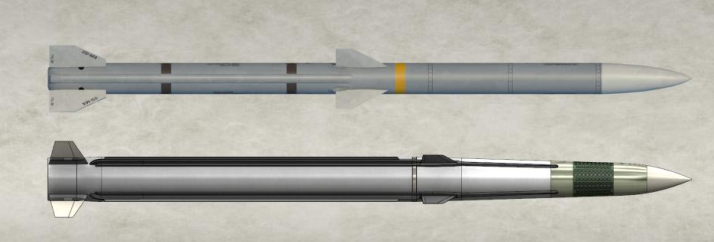


From earlier in the thread:
View attachment 808510
Or you could do what they did in DCS. Looks like they modified the one above to a 7" dia. (Both the one above and the one below have side thrusters for the KV.)
View attachment 808513
View attachment 808514
Got it. Sry to disrupt.This is real project thread. This is not what-if, "it would have been better" thread. Please create separate topic in appropriate section.

AARGM-ER/AGM-88G wasnt confirmed to fit inside F-35s bays? And its a big missile, 4.06m long and 292mm widenah, the AIM 260 was developed to fit in a F22 bay(not sure abt F35) and future NGAD bay as well. No way they dont fit.
Not sure about AGM-88G, SiAW the -88J does.AARGM-ER/AGM-88G wasnt confirmed to fit inside F-35s bays? And its a big missile, 4.06m long and 292mm wide
Nothing in particular. I choose it for the range and for a simplified energy comparison for ease of imagination of what's "needed".What's special about it? What are they using that isn't your typical HTPB / AP & spices?
R = (V/TSFC) × (L/D) × ln(W₀/W₁)


