Never seen any USVs even tested for that kind of mission.
We’re likely a decade early on anything close to that happening.
Yeah....they will have to get a lot smarter. Not there yet. Tough mission for anything, manned or unmanned.

Never seen any USVs even tested for that kind of mission.
We’re likely a decade early on anything close to that happening.

It's 21 miles wide, they don't need the AIS ID, all they need is a guy with a pair of binoculars and a phone line.Iran was tracking transponders because they lack presence on the Hormiz Strait. Ships have been sneaking through by turning off their transponders.
Ukraine's USVs have been doing kinetic strikes regularly, including sinking the Arctic Metagaz last week in the Med off Malta.Never seen any USVs even tested for that kind of mission.
It's 21 miles wide, they don't need the AIS ID, all they need is a guy with a pair of binoculars and a phone line.
Which is exactly how we lost millennium challenge iircIt's 21 miles wide, they don't need the AIS ID, all they need is a guy with a pair of binoculars and a phone line.
Which isn’t an escort mission.Ukraine's USVs have been doing kinetic strikes regularly, including sinking the Arctic Metagaz last week in the Med off Malta.
I misread the preceding quote. OTOH it's not USVs doing escort missions that are the immediate issue in the Strait, but USVs doing kinetic strikes.Which isn’t an escort mission.

You put the mines close enough in to the ports so that they only affect Iranian ships.They’re not an island…
They’ve made the decision to give the MCMs there the 30s, not sure if they also gave them the hellfires or not.I misread the preceding quote. OTOH it's not USVs doing escort missions that are the immediate issue in the Strait, but USVs doing kinetic strikes.
An LCS with the surface warfare module might actually be reasonably capable for interdicting those, but would likely need a Burke nearby doing missile defence.
Take out the bridges and rail lines.They’re not an island. They have land routes of supply with friendly nations on their borders.
First of all, I would strongly suggest this goes far beyond the scope of SPF and moderation should act.and bombing hospitals or something.
Ok, let us have a serious conversation about this:LCS has been designed for litoral operations in the Gulf region and yet it fails to have any impact,
A few points.First of all, I would strongly suggest this goes far beyond the scope of SPF and moderation should act.
Ok, let us have a serious conversation about this:
First, LCS is not designed for independent operations within the gulf, they act in concert with other assets such as Arleigh Burkes and airpower to fulfill secondary roles, including MCM, maritime interdiction, and counter boghammar duties. They cannot penetrate these areas by design without the support of air defense vessels. In this way purported criticisms in this vein should instead be directed towards Burkes.
Second, they have a rigorously tested MCM package that the navy have been developing operational procedures for over the last 10 years, and conceptually for 10 before that. With the mine threat on the rise they will evidently soon be battle tested.
Third, the USN has reported that the LCS flotilla based out of Bahrain has been operating during the conflict. Given their integration with LUCAS OWA drones, I would suspect (and rumours have stated) that they have been slinging those.
So with this in mind, how exactly have they failed in the conflict thus far? The Iranian and the Revolutionary Guards Corp navies have been effectively decimated and the ability to impede shipping has been confined to a single chokepoint. Yes, that chokepoint is extremely significant and we are witnessing the impact on global shipping every single day but reopening that is not as simple as "escort ships and sweep for mines". Not LCS, nor Burkes, nor combat airpower can be blamed for this issue.
I would urge everyone to engage with genuine discussion and not just consistently bemoan programs without relevant proof. It is not productive and adds nothing to the conversation, especially when it is backed up nothing but incomplete evidence, blatant falsehoods, and reactionary opinion.
More broadly, this is not the Iran War thread! Stop treating it as such. Bomb inventory speculation (and it is speculation) does not belong here, nor does analysis of strategy, especially when we know so little
I didn't know this but that's really cool.Second LCSes were already assisting the avengers in sweep operations in the Red Sea during that conflict.
The ambitions weren’t that extreme.I didn't know this but that's really cool.
I think a key distinction which isn't made with the LCS program is ambition vs reality. The ambition for LCS was really extreme and centered around FFTS, an idea which fell out of favor about the same time the first LCS was launched, if not sooner. It took a long time to reorient the ships toward a modern mission set but they have indeed done it. It's reductive to deny this
I would argue the speed ambitions (50-60 knots at some points) compromised the design to a not insignificant degree which created structural problems down the line for arguably little utility. Although on the flipside they can operate essentially with impunity in periods of LIC and peacetime as they can't seriously be tailed by anything short of aircraft.The ambitions weren’t that extreme.
The most ambitious part was the swappable modules which was already something that existed with STANFLEX.
Disagree. The speed ambition was way over the top. 40+knots is pretty absurd. And it's caused the most problems with both classes, but most of all the Freedom class combining gears. The trimarans did a lot better there due to different drive design.The ambitions weren’t that extreme.
The most ambitious part was the swappable modules which was already something that existed with STANFLEX.
STANFLEX is an inferior module system, at least in theory. Power, cooling, etc. connections are not integrated which means cables have to be ran through passageways and bulkheads have to be kept open. The modules themselves would’ve also been very different to meet USN requirements.I'm still not satisfied with any explanation for why the USN didn't use STANFLEX modules, other than "the USN wanted to do something different". Still could have used STANFLEX for the weapons systems, since both involve the weapon coming out the top of the module just like STANFLEX. This version of LCS would have involved two different modules: the in-hull modules (like MCM or ASW) with side or top access and the STANFLEX weapons modules just with top access.
Would this mean different modules in the USN versus Danish Navy? yes. Probably 57mm instead of the Danish 76mm, and there's nothing equivalent to either the Hellfire or 30mm modules.
To be fair the littoral ASW strategy makes this a somewhat moot point. It prioritised manoeuvre to avoid being able to be targeted with interspersed periods of listening over creeping along and listening persistently. Ultimately the gear couldn’t be incorporated into the hulls and the envisioned littoral SSK threat never emergedOne point the USN and designers completely failed was to ensure sufficient quieting for ASW as standard to the ships.
A containerised system used by the Danish Navy that allows for modular payloads and would use standard power and cooling attachments. A reasonable explanation here, https://seaforces.org/wpnsys/SURFACE/STANFLEX-modules.htmWhat exactly is STANFLEX? This is the first time I've heard of it.
Wait, WHAT?!?STANFLEX is an inferior module system, at least in theory. Power, cooling, etc. connections are not integrated which means cables have to be ran through passageways and bulkheads have to be kept open.
Granted.The modules themselves would’ve also been very different to meet USN requirements.
But when the base hull is so loud that they cancel the ASW gear entirely...To be fair the littoral ASW strategy makes this a somewhat moot point. It prioritised manoeuvre to avoid being able to be targeted with interspersed periods of listening over creeping along and listening persistently. Ultimately the gear couldn’t be incorporated into the hulls and the envisioned littoral SSK threat never emerged
STANFLEX also, ironically, ran into issues with the module replacement system. It was prohibitively difficult from what I’ve heardWait, WHAT?!?
Were they not going to sprint and drift to hunt littoral submarines? I get that this is effectively useless in open ocean (where the modern submarine threat is) but from what I’ve read the hull noise should have a minimal impact on the CONOPS which LCS was designed aroundBut when the base hull is so loud that they cancel the ASW gear entirely...

You still have the main engines and your generators running. If not properly sound-mounted, you can hear those big diesels from miles and miles away even just idling.Were they not going to sprint and drift to hunt littoral submarines? I get that this is effectively useless in open ocean (where the modern submarine threat is) but from what I’ve read the hull noise should have a minimal impact on the CONOPS which LCS was designed around
The combining gears had nothing to do with speed.Disagree. The speed ambition was way over the top. 40+knots is pretty absurd. And it's caused the most problems with both classes, but most of all the Freedom class combining gears. The trimarans did a lot better there due to different drive design.
I'm still not satisfied with any explanation for why the USN didn't use STANFLEX modules, other than "the USN wanted to do something different". Still could have used STANFLEX for the weapons systems, since both involve the weapon coming out the top of the module just like STANFLEX. This version of LCS would have involved two different modules: the in-hull modules (like MCM or ASW) with side or top access and the STANFLEX weapons modules just with top access.
Would this mean different modules in the USN versus Danish Navy? yes. Probably 57mm instead of the Danish 76mm, and there's nothing equivalent to either the Hellfire or 30mm modules.
One point the USN and designers completely failed was to ensure sufficient quieting for ASW as standard to the ships.
The base hull was not the reason for the cancellations.Wait, WHAT?!?
Granted.
But when the base hull is so loud that they cancel the ASW gear entirely...
undeniably but there’s no such thing as a perfect system. The bigger issues if memory serves was SQS-26 had a nasty habit of being unstable while towed and was unreliable when operated. On top of this the role of littoral ASW just went away. Constellation with CAPTAS IV was far better suited to projected USN missions.You still have the main engines and your generators running. If not properly sound-mounted, you can hear those big diesels from miles and miles away even just idling.
The solution was Sierras and Romeos with a weapons package. If we’re feeling exotic, my favourite choice would be Sea ApacheAnd 40kts was not absurd. The mission of interdicting attacks by small boats that can move a 35+ kts means they needed to be fast.
That’s part of the equation but not the whole equation. Since pretty much every ship in our fleet has helos onboard, clearly helicopters are not the answer. Especially if those FIAC have dudes with MANPADs on them.undeniably but there’s no such thing as a perfect system. The bigger issues if memory serves was SQS-26 had a nasty habit of being unstable while towed and was unreliable when operated. On top of this the role of littoral ASW just went away. Constellation with CAPTAS IV was far better suited to projected USN missions.
The solution was Sierras and Romeos with a weapons package. If we’re feeling exotic, my favourite choice would be Sea Apache
I could see some trying to put these on container ships even with the ship's crew not knowing, or paid under the table.A thread on Danish STANFLEX designs over in Naval Projects that may also be of interest:
https://www.secretprojects.co.uk/threads/the-danish-standard-flex-designs.28738/
Couple TLAMs and she’ll be goldenOh, I see MAERSK Foghorn Leghorn is nearing the Cape of Good Hope---in a couple of days, launch on that Nigerian data center with the honey pot scams
To which real scenario do you refer? The only advantage LCS has really been given by her speed is that no PLAN warship in the SCS can tail them. Thus far they haven’t needed it for anything else that I can recallThat’s part of the equation but not the whole equation. Since pretty much every ship in our fleet has helos onboard, clearly helicopters are not the answer. Especially if those FIAC have dudes with MANPADs on them.
And coming from this administration not surprised.
https://www.twz.com/sea/u-s-navy-minesweepers-assigned-to-middle-east-have-been-moved-to-pacific
And coming from this administration not surprised.
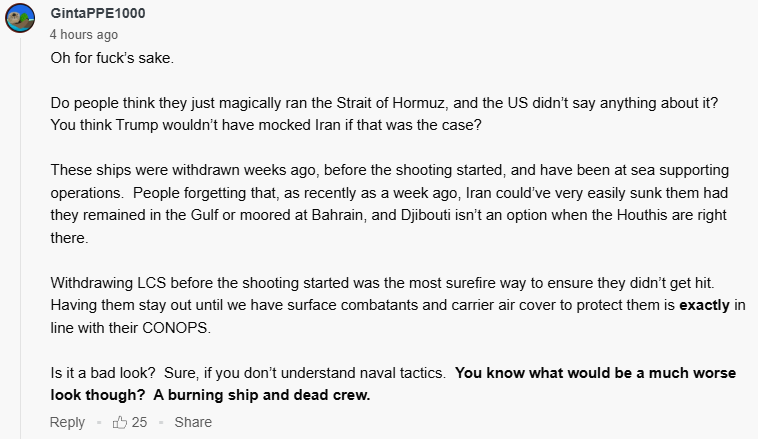
I actually disagree. Before MCM (and escort) operations can begin there are a lot more combat ops to take place so that Iranian activity can be subdued. This is explicitly the phase of operations LCS is bad for. So what's the point of keeping crews and equipment at sea waiting? You just end up with tired ships and crews. Given their exceptional sustained speeds you might as well keep them safe until such times as they can be put to work and then surge them back to the theatre.Not a smart move as they're needed in the strait of Hormuz.
Yes a lot more needs to happen, but they should be there prepared to begin demining the second it is safe, and they can still provide added protection from USV or FAC/FIAC as well as USVsI actually disagree. Before MCM (and escort) operations can begin there are a lot more combat ops to take place so that Iranian activity can be subdued. This is explicitly the phase of operations LCS is bad for. So what's the point of keeping crews and equipment at sea waiting? You just end up with tired ships and crews. Given their exceptional sustained speeds you might as well keep them safe until such times as they can be put to work and then surge them back to the theatre.
Edit: for once some common sense in the comments
Huh? Old good Grisha class concept.To be fair the littoral ASW strategy makes this a somewhat moot point. It prioritised manoeuvre to avoid being able to be targeted with interspersed periods of listening over creeping along and listening persistently. Ultimately the gear couldn’t be incorporated into the hulls and the envisioned littoral SSK threat never emerged
Given how conflict develops, frankly speaking, it's better to consider how to conduct these ops from available shore of Oman.Yes a lot more needs to happen, but they should be there prepared to begin demining the second it is safe, and they can still provide added protection from USV or FAC/FIAC as well as USVs
Eh, they're 5-6 days away and available for presence missions in INDOPACOM if need be in the meantime. I'm not sure which ports would be better?there are safe ports a lo closer to the theater
How is the US going to figure out how to demine from shore when we never developed that capability?Huh? Old good Grisha class concept.
(though to be fair those were suprisingly succesful and impressive during their best days; ironically, main metric which forced their aging was indeed insufficient speed v LA onwards).
Given how conflict develops, frankly speaking, it's better to consider how to conduct these ops from available shore of Oman.
LCS MCMs are unnecessary layer of problems and risks, especially since available units aren't even SEWIP ones.
Use other LCSes for those missions thenEh, they're 5-6 days away and available for presence missions in INDOPACOM if need be in the meantime. I'm not sure which ports would be better?
Not a smart move as they're needed in the strait of Hormuz.