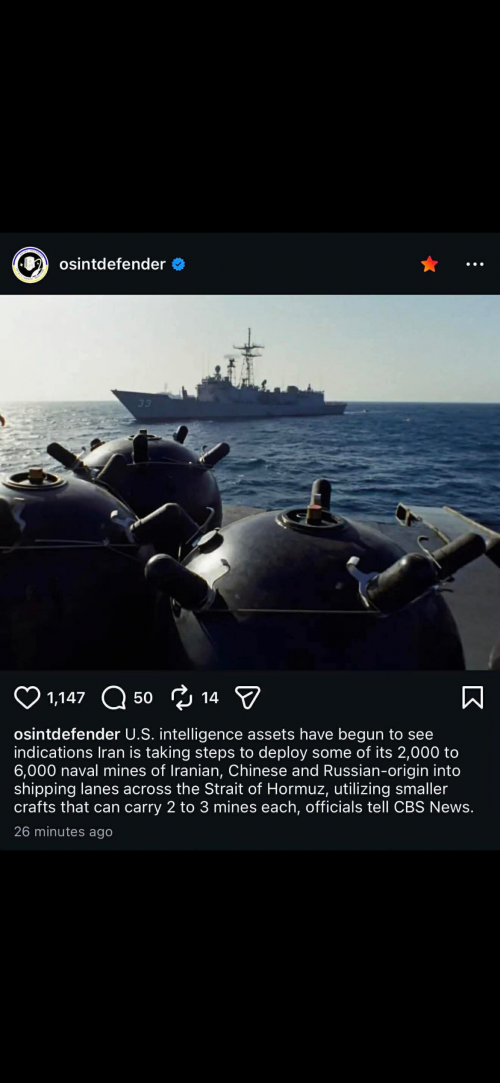
We did have a few set up for MCM, I was using that example to preempt the LCS haters who would undoubtedly come in to say “well if they can’t survive doing their job they shouldn’t have been built” or something.

I’ve not seen anyone transiting for the last week.

According to Sal Mercogliano of "What's Going On With Shipping" fame, there are still ships transiting the Straight. Obviously, it's a fraction of normal traffic volume.
 
I fully agree that it is not normal for generalist modern navy - but military is not ritualistic combat from pre-modern central america.
But heck, US was clearly trying to position intself to do that - and it was established as a geopolitical need. LCS were meant to be part of that. But part is just part - as a result, money were spent, no definitive capability was established.

Should USN have procured what they actually planned - with it as a core, POTUS could've mustered allied force from EU frigate forces(italians more than others perhaps) to do close protection/close blockade of Iranian coast. Could've.
We never intended to make contested transits of the strait though.
LCS was never intended to do that.

Once the shore batteries of ASMs and now drones we mostly neutralized we would force transit, with LCSes and aircraft protecting larger ships from FIAC, which generally have shorter ranged and unguided weapons.

Europe is pretty uniformly against this operation how was POTUS going to ‘summon’ them to fight a war they want no part of ?
 
We never intended to make contested transits of the strait though.
LCS was never intended to do that.
Original fast&stealthy design, intended to outrun targeting loop, as well as generations of NLOS failures(and solutions), stealthy original Zumwalts with long range guns suggest otherwise.
It was an inshore blockade force.

When inshore blockade force failed, USN tried to develop an inshore escort force. Frigates with mark 110s, significant rearline AA/ABM capability, oversized AASCM banks replaceable with hellfire batteries - all of this is very contextual, Iran-centric.

Now it is done through attempt to bomb out millions of square miles of rugged terrain and coastline. Whatever was done for Iran for the last two decades - nothing is necessary for that. USN could've done exact thing in 1988 - and does in 2026, as if 2 decades of adoptations didn't happen. In fact, back then, it could force strait perfectly well, simply b/c it had a huge force of generalist escort frigates.

 
We never intended to make contested transits of the strait though.
LCS was never intended to do that.

Once the shore batteries of ASMs and now drones we mostly neutralized we would force transit, with LCSes and aircraft protecting larger ships from FIAC, which generally have shorter ranged and unguided weapons.

Europe is pretty uniformly against this operation how was POTUS going to ‘summon’ them to fight a war they want no part of ?

Do you remember those early LCS PowerPoints of LCS zipping around, engaging shore batteries with NLOS, swapping modules, clearing mines and engaging midget submarines, all the while sweeping the water of boghammers?

Don't forget the stealthy Zumwalts entering the fray with their might cannon.

That original concept of operations wasn't very realistic.

The future will belong to USVs doing the close to shore work as the environment is just too dangerous/risky for manned ships.
 
According to Sal Mercogliano of "What's Going On With Shipping" fame, there are still ships transiting the Straight. Obviously, it's a fraction of normal traffic volume.
Yeah when ever I look at a traffic app the strait is empty. Maybe there’s one or two running the gauntlet at night with their transponders off.
 
Original fast&stealthy design, intended to outrun targeting loop, as well as generations of NLOS failures(and solutions), stealthy original Zumwalts with long range guns suggest otherwise.
It was an inshore blockade force.

When inshore blockade force failed, USN tried to develop an inshore escort force. Frigates with mark 110s, significant rearline AA/ABM capability, oversized AASCM banks replaceable with hellfire batteries - all of this is very contextual, Iran-centric.

Now it is done through attempt to bomb out millions of square miles of rugged terrain and coastline. Whatever was done for Iran for the last two decades - nothing is necessary for that. USN could've done exact thing in 1988 - and does in 2026, as if 2 decades of adoptations didn't happen. In fact, back then, it could force strait perfectly well, simply b/c it had a huge force of generalist escort frigates.
Yes escort force, escorting against FIAC.

Not escorting against missile barrages, FIAC and UAVs.

If that was the goal or intent, LCS would have a more robust AAW capability.

I’ve deployed to the region twice post introduction of LCS, we never trained to escort ships under missile barrages, we never trained to provide overwatch for LCSes escorting under missile barrages.

Please find actual documentation to support your claim instead of your interpretation of what has been said, and done.
 
Original fast&stealthy design, intended to outrun targeting loop, as well as generations of NLOS failures(and solutions), stealthy original Zumwalts with long range guns suggest otherwise.
It was an inshore blockade force.

When inshore blockade force failed, USN tried to develop an inshore escort force. Frigates with mark 110s, significant rearline AA/ABM capability, oversized AASCM banks replaceable with hellfire batteries - all of this is very contextual, Iran-centric.

Now it is done through attempt to bomb out millions of square miles of rugged terrain and coastline. Whatever was done for Iran for the last two decades - nothing is necessary for that. USN could've done exact thing in 1988 - and does in 2026, as if 2 decades of adoptations didn't happen. In fact, back then, it could force strait perfectly well, simply b/c it had a huge force of generalist escort frigates.

The proliferation of cheap, guided weaponry makes it more difficult today.

Cheap, fairly intelligent weaponry exist in bulk today in a way it didn't back in the 1980s.

The operating environment is challenging to say the least.

I am not against a generalist frigate, but think any manned ship is going to have problems operating close to shore these days.
 
Do you remember those early LCS PowerPoints of LCS zipping around, engaging shore batteries with NLOS, swapping modules, clearing mines and engaging midget submarines, all the while sweeping the water of boghammers?

Don't forget the stealthy Zumwalts entering the fray with their might cannon.

That original concept of operations wasn't very realistic.

The future will belong to USVs doing the close to shore work as the environment is just too dangerous/risky for manned ships.
I do not remember any PowerPoints like you describe, but zumwalts with their guns would have been used to engage shore batteries long before LCSes got near the strait.

Maybe an opportunistic launch against a shore battery that got missed…but even then Iran would be negligent to have a launcher that close the coast line lol.
 
I do not remember any PowerPoints like you describe, but zumwalts with their guns would have been used to engage shore batteries long before LCSes got near the strait.
You don't need 80 mile guns to engage shore from 80 miles from shore.
You need it to engage target 50 miles inland from 30. Which is reasonable safety and use of stealth, and ability to immediately engage any light ASCM battery the moment it lights up. Basically, armed overwatch over entire threat area. This capability set is obviously lost, as there's no comparable persistance among available weapon systems.

Hormuz strait itself isn't that narrow, even in its narrowest, as to prevent full AA engagement. It isn't like Black sea straits.
But you need an AA/light ABM combatant, with significant C-UAS/ASuW against swarms.

US approached this capability set so, so, so many times. It isn't undoable. It just always failed in one way or another.
 
To be honest though unless something external to the situation happens to force our hand, I do not expect any forced transits of the strait.


When I say forced transit I mean while Iran still has more than 30% of their shore batteries operational.
 
To be honest though unless something external to the situation happens to force our hand, I do not expect any forced transits of the strait.


When I say forced transit I mean while Iran still has more than 30% of their shore batteries operational.

I agree with you on this. We are going to obliterate anything that looks remotely threatening from the air before tasking our ships with escort missions.
 
The war will be decided on the Strait. If the US can't open it fast, the US can't win.
 
The war will be decided on the Strait. If the US can't open it fast, the US can't win.

The main challenge is overcoming the financial anxieties of ship owners, rather than the military threat. Subsidized war risk cover will do more to get ships moving than escorts, IMO.
 
The war will be decided on the Strait. If the US can't open it fast, the US can't win.

Define fast.

How long did it take for the bombing campaign in Serbia to work?

How long to the US and Allies bomb Iraq from the air before they cracked.

Takes some time.
 
The main challenge is overcoming the financial anxieties of ship owners, rather than the military threat. Subsidized war risk cover will do more to get ships moving than escorts, IMO.
Assuming crews want to take those risks themselves.
 
We did have a few set up for MCM, I was using that example to preempt the LCS haters who would undoubtedly come in to say “well if they can’t survive doing their job they shouldn’t have been built” or something.

I’ve not seen anyone transiting for the last week.
Iran was tracking transponders because they lack presence on the Hormiz Strait. Ships have been sneaking through by turning off their transponders.
 
The way you force the Straits is to 1) find all the AShM batteries and 2) let the two Ohio SSGNs in the area unload their tubes. ~300 Tomahawks should deal with the shore batteries.

Drone swarms are going to be a pain in the ass, mostly since there's no obvious launch source.
 
The way you force the Straits is to 1) find all the AShM batteries and 2) let the two Ohio SSGNs in the area unload their tubes. ~300 Tomahawks should deal with the shore batteries.

Drone swarms are going to be a pain in the ass, mostly since there's no obvious launch source.

Or...a few bomber runs with B1s and B52s. No need to use valuable stocks of Tomahawks on this.
 
Iran was tracking transponders because they lack presence on the Hormiz Strait. Ships have been sneaking through by turning off their transponders.
And yet they just hit another in the last 24 hours so they must have some presence
 
The way you force the Straits is to 1) find all the AShM batteries and 2) let the two Ohio SSGNs in the area unload their tubes. ~300 Tomahawks should deal with the shore batteries.

Drone swarms are going to be a pain in the ass, mostly since there's no obvious launch source.
I mean shahed launchers are about the size of an ASM launcher so I imagine they’d be just as easy to find.
 
Seeing people claim this is the time to shine for the LCS is hilarious, given that the strait has been mined, is mostly closed off to vessels except the ones permitted by Iran to transit (like Chinese, Russian, Bangladeshi and other ships). And when shipping companies requested escorts by the USN, they have been rejected over supposed risks.

So how is the terribly vulnerable LCS supposed to alleviate a blockade that keeps fully fledged destroyers at bay through mines, USVs, UUVs, AShMs and long range drones?

I see a lot of "it was designed to do this mission" hurr durr, but very little actual explanation on how the LCS could safely fulfill this mission profile. Being unable to deploy these vulnerable vessels directly into theater is the result of procurement planning after the high induced by Desert Storm. These things were never meant to deal with a large volumes of munitions and threats with varying approach vectors.

In short: LCS remains comparatively useless and the US should have invested into a proper frigate or corvette instead.
 
Seeing people claim this is the time to shine for the LCS is hilarious, given that the strait has been mined, is mostly closed off to vessels except the ones permitted by Iran to transit (like Chinese, Russian, Bangladeshi and other ships). And when shipping companies requested escorts by the USN, they have been rejected over supposed risks.

So how is the terribly vulnerable LCS supposed to alleviate a blockade that keeps fully fledged destroyers at bay through mines, USVs, UUVs, AShMs and long range drones?

I see a lot of "it was designed to do this mission" hurr durr, but very little actual explanation on how the LCS could safely fulfill this mission profile. Being unable to deploy these vulnerable vessels directly into theater is the result of procurement planning after the high induced by Desert Storm. These things were never meant to deal with a large volumes of munitions and threats with varying approach vectors.

In short: LCS remains comparatively useless and the US should have invested into a proper frigate or corvette instead.

I was being facetious. LCS would be vulnerable as would be a Burke.

Littoral combat in the Gulf WAS the rational for the LCS class. Back then, the expected threats were boghammers, mines and midget subs.

The proliferation of cheap, modern USVs, UAVs and antiship changed the equation.
 
Seeing people claim this is the time to shine for the LCS is hilarious, given that the strait has been mined, is mostly closed off to vessels except the ones permitted by Iran to transit (like Chinese, Russian, Bangladeshi and other ships). And when shipping companies requested escorts by the USN, they have been rejected over supposed risks.

So how is the terribly vulnerable LCS supposed to alleviate a blockade that keeps fully fledged destroyers at bay through mines, USVs, UUVs, AShMs and long range drones?

I see a lot of "it was designed to do this mission" hurr durr, but very little actual explanation on how the LCS could safely fulfill this mission profile. Being unable to deploy these vulnerable vessels directly into theater is the result of procurement planning after the high induced by Desert Storm. These things were never meant to deal with a large volumes of munitions and threats with varying approach vectors.

In short: LCS remains comparatively useless and the US should have invested into a proper frigate or corvette instead.

Seeing people claim this is the time to shine for the LCS is hilarious, given that the strait has been mined, is mostly closed off to vessels except the ones permitted by Iran to transit (like Chinese, Russian, Bangladeshi and other ships). And when shipping companies requested escorts by the USN, they have been rejected over supposed risks.

So how is the terribly vulnerable LCS supposed to alleviate a blockade that keeps fully fledged destroyers at bay through mines, USVs, UUVs, AShMs and long range drones?

I see a lot of "it was designed to do this mission" hurr durr, but very little actual explanation on how the LCS could safely fulfill this mission profile. Being unable to deploy these vulnerable vessels directly into theater is the result of procurement planning after the high induced by Desert Storm. These things were never meant to deal with a large volumes of munitions and threats with varying approach vectors.

In short: LCS remains comparatively useless and the US should have invested into a proper frigate or corvette instead.
The LCS was never intended to clear mines while there were hundreds or even several dozens of active shore batteries within Iran.

No one with 2 brain cells ever thought LCSes were going to go in under fire to clear mines. Last time the US was stupid enough to do that 2 minesweepers were destroyed.

Once the shore batteries are mostly neutralized with assistance from aircraft the LCSes can fend off any attempted FIAC attacks while their drones work on clearing mines.
 
Time for USVs and UUVs to shine I would say.

It's easy to see that's where war is evolving to and why.

I don't know if USVs are ready for escort missions yet though.

Mine warfare, surveillance and kinetic strikes have been demonstrated from USVs.

The kind of situational awareness needed to defend a convey in the narrow waters of the Gulf is a tough ask for a USV, at least currently.
 
It's easy to see that's where war is evolving to and why.

I don't know if USVs are ready for escort missions yet though.

Mine warfare, surveillance and kinetic strikes have been demonstrated from USVs.

The kind of situational awareness needed to defend a convey in the narrow waters of the Gulf is a tough ask for a USV, at least currently.
Never seen any USVs even tested for that kind of mission.

We’re likely a decade early on anything close to that happening.
 

Similar threads

Back
Top Bottom