Tzoli

ACCESS: Top Secret
Senior Member
Joined
1 February 2011
Messages
3,345
Reaction score
5,030
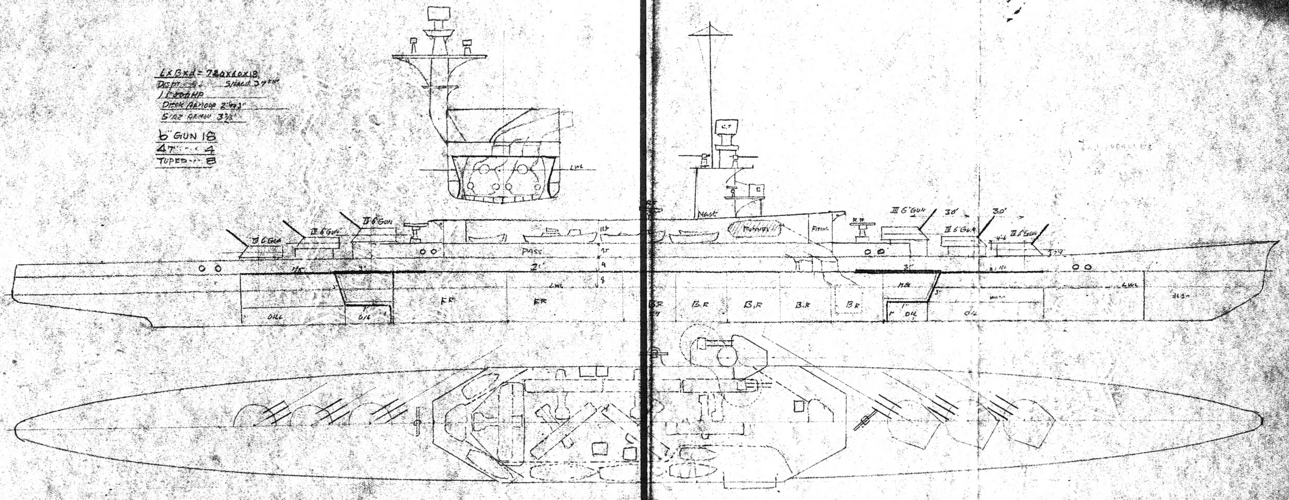
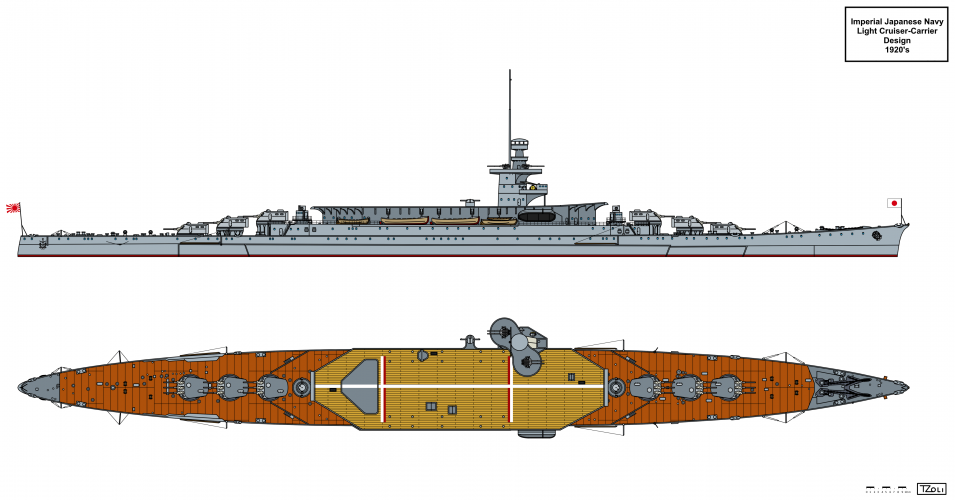
I've recently found this pretty interesting Japanese Project at the Hiraga Archive.
It looks like a hybrid cruiser-carrier warship from 1920's era. There seems to be a few variants mostly by how large the hanger should be and where to locate the conning tower and AA guns.
Apart from the unique look of this ship design the stats are even more interesting!

Dimensions: 231,65m x 18,3m x 5.5m
Displacement: 10,000tons standard
Engine Power: 60.000shp, 4 shafts
Maximum Speed: 53km/h (29knots)
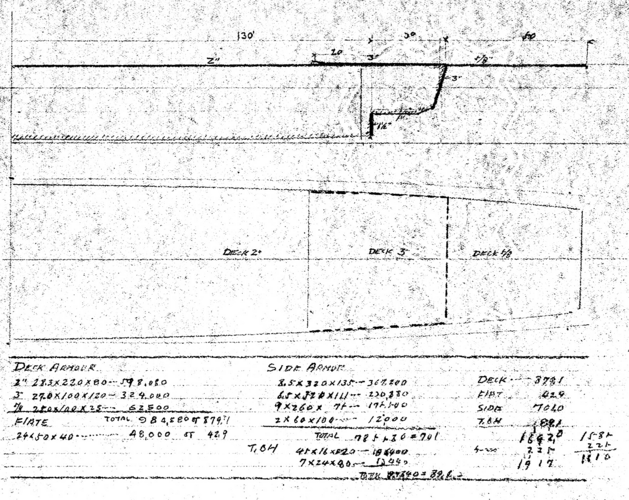
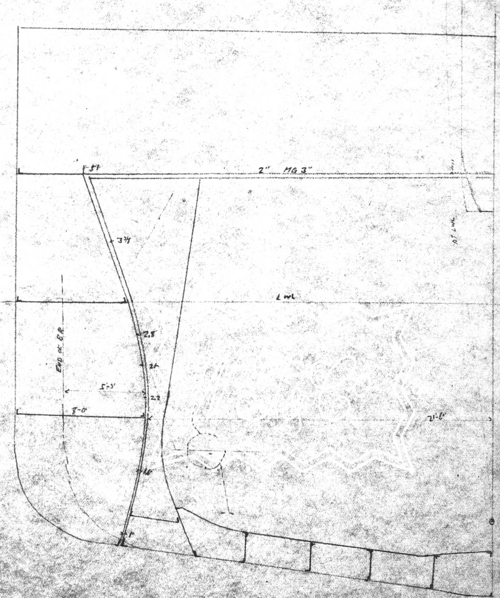
Armour: Belt: 51-76mm, Deck: 51-76mm
Armaments:
6x3 152mm Guns
2x2 120mm AA Guns
8x1 610mm Torpedo tubes
5-9 Aircraft

4JB2b8D.jpg

GtPfn6n.png

vwGB6lI.png

FqKqXQ0.png

oeDQQEp.png

OJR7i9F.png

OCGSt3k.jpg

9mGXxrD.png
 
Last edited:
A very interesting. Certainly compares well against the similar designs pursued elsewhere during the late 1920s-mid-30s. Actually this is perhaps one of the more plausible hybrids I've seen, though the short flightdeck would have posed problems. The lip at the end could either be to smooth the airflow over the flight deck, or indeed to inpart a little extra vertical momentum to make sure the aircraft clears the turrets.

What was the obsession with mounting heavy DP guns so high up in the ship. The Hiraga 1930 battleship has the same style.
 
Hood said:
What was the obsession with mounting heavy DP guns so high up in the ship. The Hiraga 1930 battleship has the same style.

To provide clear firing arcs and excellent line of sight.

As for the design others suggest not a good one because of it's hybrid nature and heavy armament on only 10.000tons.
 
All the image links in the original post are broken.
That's a forum bug. If you press "reply" on the post, the images will be visible in the quote.
But just in case the links  do fail, I'll double the images here.
(Sorry for a little necro)
 

Attachments

  • unknown-22.png
    unknown-22.png
    2.1 MB · Views: 480
  • unknown-32.png
    unknown-32.png
    1.5 MB · Views: 390
  • unknown-37.png
    unknown-37.png
    2 MB · Views: 275
  • unknown-31.png
    unknown-31.png
    1.4 MB · Views: 249
  • unknown-41.png
    unknown-41.png
    2.2 MB · Views: 226
  • unknown-38.png
    unknown-38.png
    2.8 MB · Views: 235
  • unknown-33.png
    unknown-33.png
    533.9 KB · Views: 403
The Tone class was designed in 1934/35 shortly after Mogami. It started as an Improved Mogami on 50 tons less displacement (8.450 rather 8.500tons).

I presume you do not mean the 1910 Tone class scout cruiser.
 
I've recently found this pretty interesting Japanese Project at the Hiraga Archive.
It looks like a hybrid cruiser-carrier warship from 1920's era. There seems to be a few variants mostly by how large the hanger should be and where to locate the conning tower and AA guns.
Apart from the unique look of this ship design the stats are even more interesting!

Dimensions: 231,65m x 18,3m x 5.5m
Displacement: 10,000tons standard
Engine Power: 60.000shp, 4 shafts
Maximum Speed: 53km/h (29knots)
Armour: Belt: 51-76mm, Deck: 51-76mm
Armaments:
6x3 152mm Guns
2x2 120mm AA Guns
8x1 610mm Torpedo tubes
5-9 Aircraft

4JB2b8D.jpg

GtPfn6n.png

vwGB6lI.png

FqKqXQ0.png

oeDQQEp.png

OJR7i9F.png

OCGSt3k.jpg

9mGXxrD.png
While an interesting design I do question the ability of the IJN to fit 18 six-inch guns and a flight deck/ hangar on 10000 tons.

Granted, the Brooklyns managed 15 guns and I believe there was a 16-gun Town-class study, but regardless the estimated displacement seems optimistic to say the least.

Thoughts?
 
The 6 triple turrets would weight 1.000tons based on the 180tons on the 155mm triples. Armour was rather thin 76mm max so that saves weight considerably. So it is very much possible.
 
Only the turrets but I never knows on navweaps if it includes the guns or not.
Magazines protection and ammo are different weights.
Ammo should be 150 shells per gun and weights 45,36kg so 18*150*45,36 = 122,5tons for the 6" guns only
 
As long as its only deployed on a boating lake.....in good weather?
 
Why?
It is indeed narrower than Mogami or Brooklyn but much longer.
 
I mean, clearly this is merely a sketch design, there's no way the magazines can fit under that side armor, and that destroyer-looking hull form is questionable.
And of course, it would suffer even more than the Mogamis from topweight + structure strength issues.
 
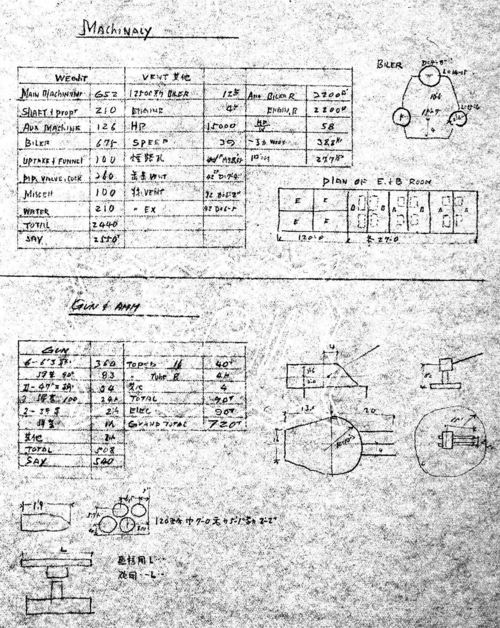
I think the blueprints say 39 knots, not 29. This is one outrageously fast ship. One drawing seems to say 37knots, it's hard to read. I suppose it must have sacrificed range for these specs? I don't see it listed anywhere, I imagine it would have been quite poor.
 
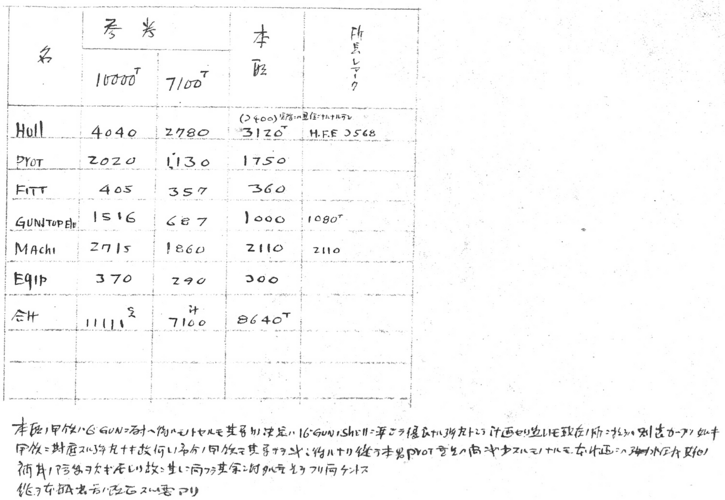
This plan is most likely Yuzuru Hiraga's initial private idea, and he made quite a few mistakes in the data he filled in, for example:
1. The total tonnage calculated according to the tonnage allocation table is only 8640-8860 tons, which is less than 10,000 tons
2. The main gun tonnage is incorrect; the closest match is an unknown model of a 120-ton, triple 152mm main gun, which means the total main gun tonnage of 360 tons only actually accounts for the weight of the three main guns
3. The speed was too high, reaching an astonishing 39 knots. At the same time, no power-speed curve was provided
Also, it's worth noting that although she has a flight deck, she actually doesn't take on aviation combat roles. In the era this drawing comes from (probably 1929), Hiraga did this just to further boost the cruiser’s reconnaissance abilities.
 
A few notes on this one:

1/ Hull weight for the 10,000-ts CLs (Myoko class) is given as 4,040 ts in the benchmark table. Wells & Lacroix cite this as the weight of Nachi upon completion in April 1929; the design figure was 3,803 ts. So these were not Hiraga’s early scribbles, but a design dating from 1929 or later, produced by an established naval architect.

2/ It is a 10,000-ts ship. Machinery weight in the summary is given as 2,110 ts, while the detailed sheet shows 2,550 ts. The same applies to armour: 1,917 ts rather than 1,750 ts. The higher figures would probably bring the total up to the Washington limit.

3/ Total power should read 150,000 shp (12 boilers, at 12,500 hp each). On a ship this long, that might be enough for 39 knots.

4/ But then there is the hull. The Myokos required 4,040 ts of hull structure despite being some 25 m shorter. This design allows 3,400 ts (I took the higher figure) and its hull girder is no deeper, probably around 8.4–8.6 m from the bottom to the strength deck. Stresses in heavy seas would have been awful.

5/ The machinery parameters are ambitious, but not completely unrealistic. The machinery space is 270 ft ×, say, 42 ft, giving about 143 hp/sqm. The Myokos were slightly wider, with 118 hp/sqm achieved. So this design is about 20% higher. The same applies to power-to-weight ratio: 58 hp/ts versus 48 hp/ts, again +20%.

6/ The gun weights are totally unrealistic, as AMAYA has already pointed out. With the actual weights so much up, the stability curve would have been, well, interesting. 90 rpg if I read correctly.

7/ Most likely 16 torpedoes in 16 (or 8) fixed tubes. Wow.

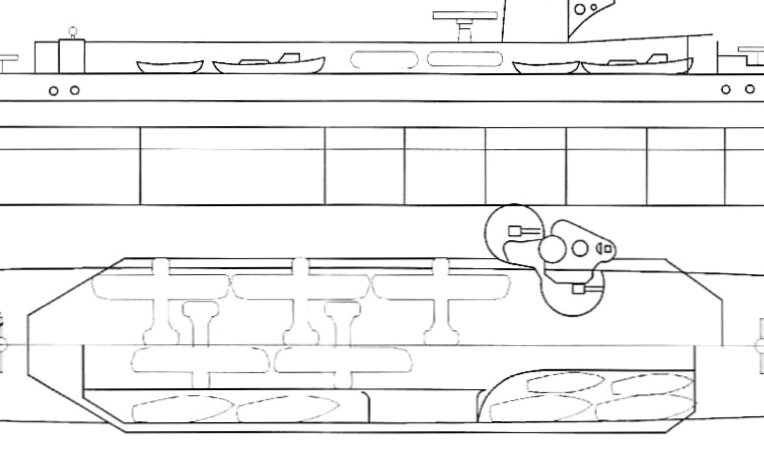
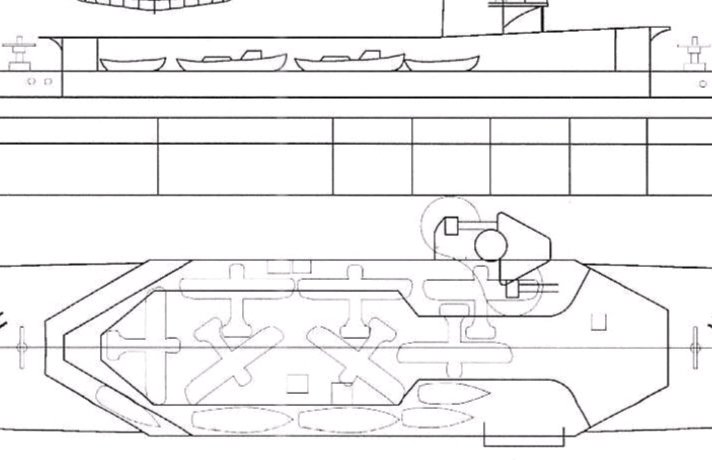
8/ Two hangar arrangements are shown, neither would work unless the aircraft could be moved sideways.
 
Last edited:
The diagram shows the arrangement of a set of torpedo launchers with dashed lines, from which it can be inferred that the front launchers fire to the port side and the rear launchers fire to the starboard side, with four available on each side. Each launcher is allocated two torpedoes, making a total of 16.
 

Attachments

  • 23c38b92869caca8ec3d38d6a01aa77f85158049_raw.jpg
    23c38b92869caca8ec3d38d6a01aa77f85158049_raw.jpg
    136.3 KB · Views: 35
The situation of the hangar is shown in the picture, there are a total of three types
 

Attachments

  • 2996a01d8f70604f3ddbe77b95b9b56485158049_raw.jpg
    2996a01d8f70604f3ddbe77b95b9b56485158049_raw.jpg
    108.3 KB · Views: 27
  • b261fc19e9289f10fc66f605200ac46885158049_raw.jpg
    b261fc19e9289f10fc66f605200ac46885158049_raw.jpg
    121.7 KB · Views: 26
  • c8ba211973b019986ead6922d58de5cd85158049_raw.jpg
    c8ba211973b019986ead6922d58de5cd85158049_raw.jpg
    177 KB · Views: 28
Aircraft could be moved sideways via trolleys.
Armament is indeed the most problematic part of the design, having 6 triple 15cm turrets in super and super-super firing positions on such a hull is a weird choice, 6 twins would had been more realistic.
Armour seems light but realistic for a ship intended to fight WW1 era cruisers or only destroyers:
76m Belt, and 51mm Deck. It is on Furutaka/Aoba level except for the thicker deck armour.
 
Hi again,
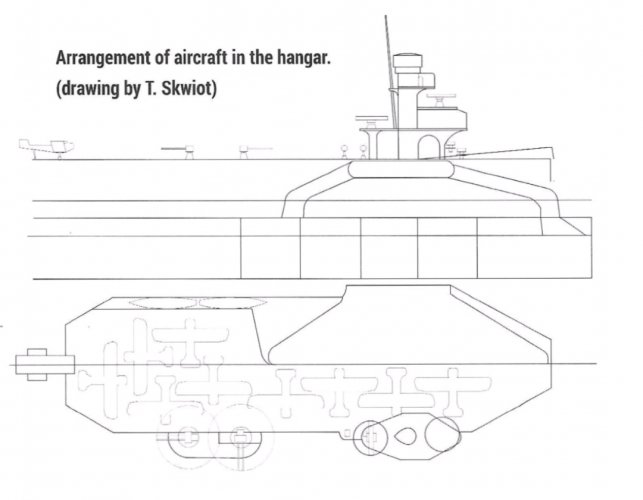
1/ The drawings are by Mirek Skwiot - which publication are they from?
2/ Some of these layouts would require not only trolleys to move the aircraft sideways, but also a high-wing configuration, allowing one aircraft’s wing to pass over the stabiliser of the aircraft next to it. The GA drawing, however, shows a biplane resembling a Breguet XIX.
3/ The aircraft on deck has a peculiar support beneath its tail skid. A catapult? Unlikely in 1929, and especially in Japan. But with the ship steaming at 35 knots (65 km/h) and the Breguet XIX having a take-off speed of around 90–100 km/h, an unexpected gust might lift it into the air. So this appears to be a means of reducing the wing’s angle of attack until everything is ready for launch. Pretty fascinating.
4/ It is a flush-decker, so we cannot rule out the possibility that the upper deck is actually the strength deck. That would make the hull approximately 10.5 m deep. That might work.
 
Hi again,
1/ The drawings are by Mirek Skwiot - which publication are they from?
2/ Some of these layouts would require not only trolleys to move the aircraft sideways, but also a high-wing configuration, allowing one aircraft’s wing to pass over the stabiliser of the aircraft next to it. The GA drawing, however, shows a biplane resembling a Breguet XIX.
3/ The aircraft on deck has a peculiar support beneath its tail skid. A catapult? Unlikely in 1929, and especially in Japan. But with the ship steaming at 35 knots (65 km/h) and the Breguet XIX having a take-off speed of around 90–100 km/h, an unexpected gust might lift it into the air. So this appears to be a means of reducing the wing’s angle of attack until everything is ready for launch. Pretty fascinating.
4/ It is a flush-decker, so we cannot rule out the possibility that the upper deck is actually the strength deck. That would make the hull approximately 10.5 m deep. That might work.
No, not catapult but likely support for aircraft on the elevator. Aircrafts are likely the first generation carrier planes of the IJN used on Hosho, Akagi and Kaga so Mitsubishi B1M torpedo bomber, C1M scout plane and Nakajima A1N fighter
 
Hi again,
1/ The drawings are by Mirek Skwiot - which publication are they from?
2/ Some of these layouts would require not only trolleys to move the aircraft sideways, but also a high-wing configuration, allowing one aircraft’s wing to pass over the stabiliser of the aircraft next to it. The GA drawing, however, shows a biplane resembling a Breguet XIX.
3/ The aircraft on deck has a peculiar support beneath its tail skid. A catapult? Unlikely in 1929, and especially in Japan. But with the ship steaming at 35 knots (65 km/h) and the Breguet XIX having a take-off speed of around 90–100 km/h, an unexpected gust might lift it into the air. So this appears to be a means of reducing the wing’s angle of attack until everything is ready for launch. Pretty fascinating.
4/ It is a flush-decker, so we cannot rule out the possibility that the upper deck is actually the strength deck. That would make the hull approximately 10.5 m deep. That might work.
In fact, this design is mainly to enhance reconnaissance capabilities, so it should be equipped with wheel-based shipborne reconnaissance aircraft, not bombers or torpedo planes
 
Regarding catapults:

In reality, the Imperial Japanese Navy never developed a carrier catapult. As far as I know, among their carrier designs, only the W105 second design and the Kaga plan were to be equipped with catapults, but the former was rejected and the latter never actually had one installed.

In earlier years, because carrier aircraft had lower takeoff weights and shorter takeoff runs, the Japanese Navy did not consider catapults very necessary. As carrier aircraft grew increasingly larger, the Japanese Navy tried to develop a compressed-air catapult, but the project was cancelled in 1943 because progress was too slow.

It should be noted that although the Ise-class battleships were equipped with Suisei after their conversion and planned to launch them by catapult, those two catapults were essentially gunpowder-type catapults used for launching seaplanes. The failure to develop a carrier catapult was one of the reasons the Japanese Navy continued to use obsolete aircraft types in the later stages of the war. Their small carriers could not launch new carrier aircraft, and ultimately the Japanese Navy decided to use rocket assistance on the aircraft carrier Ibuki to enable it to launch large carrier aircraft.
 
Regarding catapults:

In reality, the Imperial Japanese Navy never developed a carrier catapult. As far as I know, among their carrier designs, only the W105 second design and the Kaga plan were to be equipped with catapults, but the former was rejected and the latter never actually had one installed.

In earlier years, because carrier aircraft had lower takeoff weights and shorter takeoff runs, the Japanese Navy did not consider catapults very necessary. As carrier aircraft grew increasingly larger, the Japanese Navy tried to develop a compressed-air catapult, but the project was cancelled in 1943 because progress was too slow.

It should be noted that although the Ise-class battleships were equipped with Suisei after their conversion and planned to launch them by catapult, those two catapults were essentially gunpowder-type catapults used for launching seaplanes. The failure to develop a carrier catapult was one of the reasons the Japanese Navy continued to use obsolete aircraft types in the later stages of the war. Their small carriers could not launch new carrier aircraft, and ultimately the Japanese Navy decided to use rocket assistance on the aircraft carrier Ibuki to enable it to launch large carrier aircraft.
Do any of the projected carriers of 1942/43 was to feature steam catapults in their design phase? Like the Shinano, Taiho Kai (Both the 50.000ton flush decked one or the final one?) or the various full carrier conversion proposals? (Myoko, Takao, Mogami, Tone, Kongo, Fuso, Ise, Nagato)?
 
I have not found them in any of the blueprints or reconstructed/conceptual illustrations I can find. There are probably two reasons:

1. The Imperial Japanese Navy considered the flight deck dimensions to be sufficiently long. Among these, the shortest—the Mogami-class flight deck—was 195 m long, and at that time neither the Suisei nor the Ryusei had entered mass production.
2. Catapult development was simply too slow, and the Imperial Japanese Navy urgently needed to replenish its carriers at the time, so it did not plan to wait for catapult development to be completed.

In addition, Taihō and the Taihō-Kai design were indeed very large, and they were indeed capable of launching the Suisei and Ryusei by rolling takeoff alone.
 
Do any of the projected carriers of 1942/43 was to feature steam catapults in their design phase? Like the Shinano, Taiho Kai (Both the 50.000ton flush decked one or the final one?) or the various full carrier conversion proposals? (Myoko, Takao, Mogami, Tone, Kongo, Fuso, Ise, Nagato)?
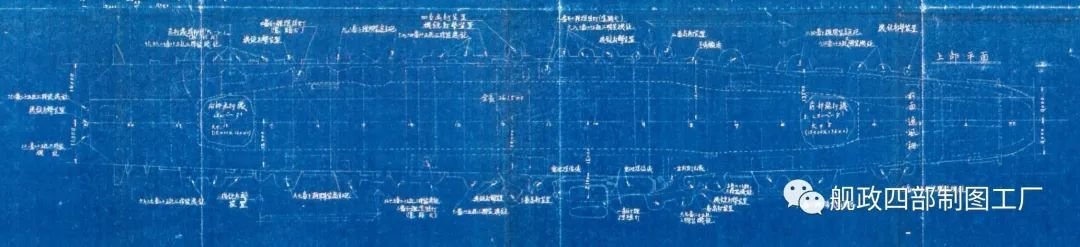
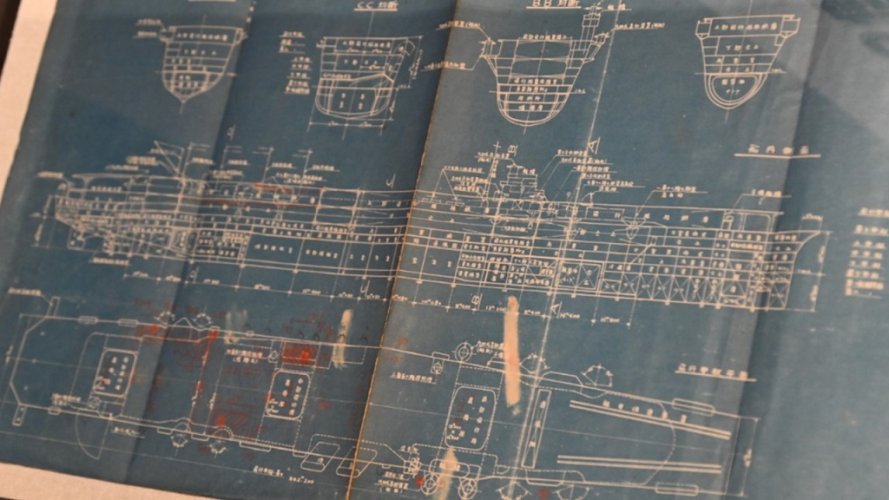
To my knowledge, G15 didn't have any sort of catapults intended for her, at least in her blueprint (and seemingly G14 as well? But her information is either too vague or mixed to work with, which is less than ideal). I do have a blueprint of a carrier design that is unknown to me which features 2 catapults of unknown type
 

Attachments

  • 07F9F33994A33ED5DE441330CFD098D10FC65129_size53_w1080_h247.jpeg
    07F9F33994A33ED5DE441330CFD098D10FC65129_size53_w1080_h247.jpeg
    53.2 KB · Views: 0
  • 20251203_210139.jpg
    20251203_210139.jpg
    156.5 KB · Views: 0

Similar threads

Back
Top Bottom