How can a "better" Kriegsmarine be built?

Zepellin won't be ready until mid-to-late 1941, even in very optimistic circumstances; more likely later than that. Carrier has to operate as a coherent unit (even with a certain generosity of mind giving a discount to the significant surface firepower of this ship).
Exactly. That's why I consider all those ideas "Germany JUST NEED TO BUILD CARRIERS from 1936" to be... doubtftul at best. By the time of war, they would still be grasping the basics of carrier operations.
 
Exactly. That's why I consider all those ideas "Germany JUST NEED TO BUILD CARRIERS from 1936" to be... doubtftul at best. By the time of war, they would still be grasping the basics of carrier operations.
Admiral Graf Zepellin in our lifetime was laid down on ... 28 December 1936. :) There's no change in timeline. It couldn't be started earlier, Gneisenau was juuuust launched from the same dock on December 8th.
By the time she was killed by Raeder in 1940 (due to the need to fortify Norway ASAP), she wasn't finished, and some carrier equipment still wasn't delivered (i.e. she couldn't be finished yet). Later it indeed arrived, but in any case, the ship won't start trials until summer 1940.

Then there will be a training cycle for the crew, several months long, and it can't be expedited. Then we(they) start the airwing learning process on the ship (first ever for them), and only after that can they (probably in summer 1941 in the western Baltics), do some evolutions and get a mini-CSG (carrier and a couple heavy cruisers...probably with rushed Seydlitz).

Or, throw her as is with Tirpitz on a sortie into the Atlantic, hoping Tirpitz and her own 5.9" guns will manage somehow.
 
Last edited:
Once again, keep in mind that in 1940 there were very few naval Bofors operational anywhere. Mostly a few Dutch runaway ships (many - with half-experimental mountings), neutral Swedish ships...and that's it.
Germany was 1st in many things wrt. military tech. Going 1st with 37-40mm automatics would not be out of ordinary.
 
IIRC the invasion of Norway was the Navy's baby. They certainly counted the Norway under Germany a boon.

Yes, you're right.

Brushing up on the history the Navy pushed for Norway invasion and successfully lobbied Hitler to have naval objectives included in the early planning for 1939 Fall Gleb specifically to fight Britain. After the Mechelen incident of 10 Jan 1940, the Navy started thinking on more grandiose lines, however they did not insist on naval objectives in the 'Manstien plan' as their (limited) objectives remained locked in from 1939 Fall Gleb.

A few things stand out to me from this.
Firstly, the Navy has learned their lesson from WW1 that breaking out of their geography was highly important and when war loomed, they were successful at getting naval aims recognised and included in Army/national planning.
Arising from this it is reasonable to structure a pre-war fleet building programme around the assumption that at least to an extent they weren't going to be constrained by peacetime geography, they can build to a more expansive plan.
Thirdly, while the Navy began to think more broadly in 1940 when the plans changed, they didn't aim to secure huge (to the point of unimaginable) naval objectives, the remained fixed on Norway and the Low Countries.

As a result, I think planning purely for a North and Baltic Sea Fleet is short sighted, it is perfectly reasonable for the pre-war Navy to build a fleet able to access the Channel and 'high' North Atlantic. However, it is unreasonable for the interwar navy to build a fleet for the 'central' Atlantic war as the Navy didn't even start thinking along those lines until forced to in 1940, didn't insist on 'central' Atlantic objectives and was surprised that they got the geography they did.

How does Plan Z meet the requirements of a North and Baltic Sea, Channel and 'high' North Atlantic Fleet?
 
Germany was 1st in many things wrt. military tech. Going 1st with 37-40mm automatics would not be out of ordinary.
In theory, yes, but you'll need to move around weapon development cycles. It has to begin a couple of years later.
Sk c/30 wasn't some sort of outlier, after all; she was absolutely similar to, say, CAIL Mle 1933.

If it was a 1936 weapon, it probably could've ended up automatic. But how good? It depends. For example, Italy was ahead of its time with early automatics. But being automatic doesn't mean you're a Bofors, and Italian ships and even entire squadrons with multiple 37mm guns were screrwed on multiple occasions by Swordfishes in broad daylight - something that sk c/30 rarely allowed (it only really failed on Bismarck, but in very difficult conditions).
 
The ammo update for the 37mm Flak would've been one of the ways to improve it. The BK 3,7, that started as a spin-off from the Flak, ended up firing the ammo with 260g of propellant, vs. the Flak's 185g. Several other ammo types were being designed for the Flak, with 200 to 220g of propellant, so there is a lot of elbow room there.
Bugger that you bring that up, because Im pretty sure that was only for the APCR round, which is lighter and thus barrel pressure even with more propellant doesnt necessarily become excessive. Unfortunately APCR is pretty useless on a ship. You could go for a really light HE round, but then you traded in your range for shell velocity.
 
If it was a 1936 weapon, it probably could've ended up automatic. But how good? It depends. For example, Italy was ahead of its time with early automatics. But being automatic doesn't mean you're a Bofors, and Italian ships and even entire squadrons with multiple 37mm guns were screrwed on multiple occasions by Swordfishes in broad daylight - something that sk c/30 rarely allowed (it only really failed on Bismarck, but in very difficult conditions).
Same as Germans, Italians also needed carrier vessels. Even if only to keep the enemy snoopers away, and to provide the 1st layer of air defense, the heavier guns being the second layer, and guns of 40mm and under the 3rd layer.

Bugger that you bring that up, because Im pretty sure that was only for the APCR round, which is lighter and thus barrel pressure even with more propellant doesnt necessarily become excessive. Unfortunately APCR is pretty useless on a ship. You could go for a really light HE round, but then you traded in your range for shell velocity.
260g for the APCR, max pressure of 2600 at. The normal pressure seem to be 2400 at, at least it is listed for the Mine shell (that was a rarity on the 37mm). 200g was for the incendiary & explosive shell (644g) with shortened tracer for 820 m/s, while there was also the Mine shell (550g) for the BK 3,7 with 220g of propellant, for 914 m/s.
Mine shell should probably grow in length and be at about 600g, and coupled with 200g it should still be both fast and rangy.

Granted, going with 37mm automatic that uses the ammo from the single-shot 37mm will see a major increase in ballistics here.
 
IIRC the invasion of Norway was the Navy's baby. They certainly counted the Norway under Germany a boon.
The invasion of Norway was a disaster for the KM. They lost most of their surface fleet either sunk or damaged as a result of it. For the Luftwaffe it contributed heavily to the pilot shortage they had during the French campaign and then the BoB. Pilots in training and their instructors were heavily used to fly transport missions to Norway.

As an interesting aside here, the RN lost the HMS Glorious in a surface action against the Scharnhorst and Gneisenau. This marks the only time a carrier was sunk by battleship fire in a surface action. That loss can be almost entirely attributed to the incompetent command of Glorious by Captain Guy D'Oyly-Hughes. Hughes' views on carriers and air defense were very much in line with the pre-war Admiralty. That is, he felt that the primary air defense of a ship was the AA battery, so he ignored the advice of the FAA officers aboard and didn't order a standing CAP or even a ready CAP on deck. Planes were kept in the hanger for use in offensive strikes.

That resulted in the Glorious being surprised by the German battleships which made short work of it.
 
Last edited:
I am sorry to ask, but you're an American, aren't you?
It's honestly an impressive level of ignorance of European geography.
In real life, French destroyers raided Skagerrak at least once. And no, they weren't sunk.

A one-off destroyer raid really shows nothing.
Real German carriers were laid down in late 1936 and 1938, respectively. Earlier L/D is impossible per your conditions.
As you know, even the unit laid down in 1936 wasn't finished. Here goes your entire revolution.

Yes, they were. They were in competition for construction capacity with battleships that take far longer to complete. Here, the battleships are not built. Building a single carrier starting in 1936 would take about 24 months to complete. If we assume another is completed every 12 months thereafter, that's 4 by 1940.
There's a reason Churchill (and RN) were so shocked after the Japanese raid into the Indian Ocean. RN combatants were under German air attacks on many occasions, and despite rather sorry state of RN air defenses and dozens of losses, this was not their experience.
British air threat was generally lower; German AAA and early war coastal air screens were generally better. Which is why, in the end, only one ship was disabled at sea, in very specific conditions.

The Luftwaffe was a poor measure to use. Luftwaffe pilots had little or no experience attacking naval targets underway. The IJN pilots on the other hand were very skilled at this. RN losses off Crete were significant, and even if many of the ships were only heavily damaged, they were still out of the war for months on end. On the other hand, RN AA defenses proved to have little deterrent effect and didn't shoot down that many aircraft.
The RN also didn't practice using effective formations for air defense relying instead on every ship maneuvering to avoid attacks and firing at attacking aircraft on their own.
 
My question: would a task force comprising light cruisers and ocean-going destroyers perform better than battleships/Panzerschiffs in the role of commerce raiding?

Equipped with 150/155mm guns (on light cruisers) and 128mm guns (on destroyers), capable of carrying several seaplanes for long-range reconnaissance missions, operating in the North Sea and Arctic regions while maintaining effective coordination with land-based aircrafts.
 
My question: would a task force comprising light cruisers and ocean-going destroyers perform better than battleships/Panzerschiffs in the role of commerce raiding?

Equipped with 150/155mm guns (on light cruisers) and 128mm guns (on destroyers), capable of carrying several seaplanes for long-range reconnaissance missions, operating in the North Sea and Arctic regions while maintaining effective coordination with land-based aircrafts.

The response to the PBs was Task Forces consisting of 2 x 8" gun cruisers, often accompanied by 6" gun cruisers. A task force of light cruisers and ocean destroyers would be no better able to withstand such 8" cruiser forces than the PBs, and probably worse.
 
A one-off destroyer raid really shows nothing.
How so? It happened. It would've happened more, but France didn't last much longer; even that was enough.
Basic concern was valid - you can end up in a brawl/intercepted anywhere in North sea, in worst case you can encounter hostile destroyers - or worse (Warspite) - in restricted waters. That happened multiple times.
You just can't apply tropical pacific lessons to Northern/arctic fjords. Against RN, with it's dozens of cruisers, highly aggressive destroyers(hundreds) and remaining battle cruisers, it'll end up either Gloriously, or Courageously.
Yes, they were. They were in competition for construction capacity with battleships that take far longer to complete.
Not much competition, built as fast as possible. Same bottlenecks (development and manufacturing of carrier equipment) will apply no matter how much you force it. Keep in mind that while Zepellin waited it's building dock for a year, development and manufacturing of carrier equipment - didn't, and it still was very barely on time in 1940.
I.e. you won't get a single carrier completed before 1940, and you won't get anything operational before 1941. Not unless you throw off Versailles restrictions before Hitler even comes to power, which is somewhat unrealistic.
There's an industrial ecosystem in Germany to build battleships (constrained before reoccupation of the Ruhr and especially Czechoslovakia, but it's there). Carriers, not really; it all more or less begins with Hitler, in 1934.

Furthermore, keep in mind you're removing the most useful, threatening, and successful KM ships from 1939-1940 equation entirely. Most likely result is that by the time you're getting carriers, the force will already be discouraged and paralyzed, ala 1943. Starting in 1941 - sometimes bombed in harbors, which is a much more serious issue for carriers.

There are two main constraints in somehow changing German performance in WW2 - lack of time, industrial constraints(temporary, but vital), and the fact that Kriegsmarine already overperformed, significantly so, for the size of the force they ever possessed.
The Luftwaffe was a poor measure to use. Luftwaffe pilots had little or no experience attacking naval targets underway. The IJN pilots on the other hand were very skilled at this.
We're talking about Germans. As of 1940-41, Luftwaffe is without a doubt a single most proven anti-ship force on planet; Japanese are a black horse.
But 1940 is not the same as 1942, much less 1944; there are significant changes every year. More importantly, North sea is not the same as Mediterranean or, god forbid, Southwestern Pacific.
Even during the Cold war, carrier operations on this theater are very unusual.
 
Last edited:
Yes, they were. They were in competition for construction capacity with battleships that take far longer to complete. Here, the battleships are not built. Building a single carrier starting in 1936 would take about 24 months to complete. If we assume another is completed every 12 months thereafter, that's 4 by 1940.
That's simply and plainly absurd. German shipyards never could build 20.000+ ton ships that fast. The average time for much smaller cruisers was 1.5-2 years just to complete the hull enough for launching. The larger carrier would took at very least 2 years just to be launched and at least two years to be completed. So no, the first carrier would be ready for EXPERIMENTS no early than 1940.
 
My question: would a task force comprising light cruisers and ocean-going destroyers perform better than battleships/Panzerschiffs in the role of commerce raiding?
Rather doubt that. Destroyers aren't exactly good for surface actions in heavy seas, and real experience of convoy actions involving German destroyers illustrated that.
 
Not unless you throw off Versailles restrictions before Hitler even comes to power, which is somewhat unrealistic.
Weeeeeel, in pure theory - and I do not think it is very probable - the Reichsmarine could start covert experiments with flat deck ships under the civilian pretext. German merchant marine operated a number of ocean liners, equipped with catapults to quickly transport mail from/to the ship, and Deutsche Lufthansa have a fleet of dedicated catapult ships to assist their trans-Atlantic flying boats flights.

So it just MIGHT be plausible, that German civilian services would start careful experiments with launching & landing planes from ship deck, ostensibly "for a next generation of ocean liners, which would not need to stop to recover a flostplane, if they would have just a small landing deck". It would be stretching the plausibility, but not to the point of completely breaking it for Chamberlain & Co (who were interested in looking the other way, since they wanted a naval treaty with Germany).

And it's plausible that a small training carrier could be quickly converted from suitable hull in mid 1930s, as soon as 1936 Treaty would allow that. Kriegsmarine might have all plans prepared for such conversion "just in case", and immediately put them into motion. So they would at least have small training carrier as early as 1938, and would be able to train pilots and run experiments before the war.
 
I could not agree more: indeed, no secondary batteries.
Start with DP 105mm stuff, and move on the 127-128mm stuff by the mid-1930s. Anything that is a light cruiser or smaller will suffer that wall of fire, and the anything above destroyers will be attacked by the main battery anyway. Of course, the KM cruisers get the 150 or 210mm stuff as the main guns.
DP secondaries only, you mean.

Something like the US 5"/38 mounts. So, 127mm/45 SK C-34 guns in a high angle mounting, 128mm/45 KM41 if designed ~4 years earlier, or maybe the 128mm/61 KM40 in a DP mount.

Problem is, the KM never really pushed for a good DP mount like the US 5"/38. The 15cm secondary guns in a twin turret weighed in at about 110-116 tons, while the twin 10.5cm AAA ran around 44 tons in the fully enclosed turret versions. So by weight you could put 2.5 10.5cm SK C33 turrets for every 15cm turret. Instead of 6x 15cm twins plus 8x 10.5cm twins the Bismarks could have ~28x 10.5cm twin turrets.

For that matter, the 15cm/48 TBtS KC36T twin DP mounts used on the Narvik-class destroyers were about 60 tons each, so the Bismarks could have gone with ~16-18 of those turrets for the same weight as what they were designed with. Let the gatling secondary memes commence!


Even twin mounts of automatic 37mm guns beat the combo of single-shot 37mm guns and 20mm mounts; I'd favor the 37mm above the 20mm, that should be only installed on the places where the 37mm cannot fit.
Remember that for the US at least, one of the purposes of the single or twin 20mm pedestal mounts was to have guns that could still shoot back in the event of completely losing ship's electrical power.

There's more reasons to choose a smaller gun over a larger one than "the larger gun doesn't fit there"


Because of that Id be careful saying something about the 3.7cm Flak replacing 2cm mounts entirely, they have very different jobs, and the 3.7cm cant be made to do a 2cm guns job. Especially as the KM employed single and twin 2cm mounts that were shoulder-aimed, and the Flakvierling also outputs a ton of tracer fire in a short time, adding a great deal to the psychological effect.

This argument only gets more important when coupled with my suggestion of using 5cm autocannons, which deal even more target tracking capability for effective range. By the way, the cyclic rate of fire on the 5cm gun is 180rpm, while the 3.7cm Flak 36 only gets up to 160rpm, the later Flak 43 gets 240rpm. So you wouldnt lose much in terms of shell output, most difference would come from 5cm 5-round clips being heavy.
yes, the 5.5cm/77 Gerat 58 developed off the Flak 41 would have been a spicy defensive AA weapon. And I think the 5.5cm beats the Flak43 in weight of shell delivered, too. The 5rd ammo clips would be 65-70lbs each, which is an unpleasant load as a one-man lift.

Of course, this would require the KM to realize that their 37mm guns were grossly inadequate sometime before the fall of France.
 
The FAA, assuming the RN makes the assumption that what they have is "good enough" so they're roughly historical in 1940, is woefully unprepared for a carrier war. The Germans send a strike of say 8 to 10 Stuka, 8 to 10 He 70 torpedo bombers, escorted by 6 to 8 He 112 against a British carrier. Both are operating singly.

The RN carrier has puts up say, 4 Sea Gladiator and some Skuas. The Henkels make short work of the British CAP and then dive bomb and torpedo the carrier. The Skua strike with say 6 planes and another 6 or so Swordfish approach the German carrier. The Henkels on CAP have their way with the British planes that are all but defenseless against them. Between the CAP and AA fire most of the strike is shot down and what isn't is shot to pieces. They might get lucky and score a hit on the German carrier.
Whoa, whoa... seriously?
First be so kind to google what a He 70 is!
And then your numbers and types are 100% wishful thinking:
Even if Germany had a carrier operational by 1940 it would still have to do with the 1st gen planes Fi 167 and Ar 197 - Ju 87C and Bf 109T were produced only in 1941.
On the British side, on the other hand, a modern (if not perfect) single plane fighter, the Fairey Fulmar, was becoming operational during 1940. And the FAA had experienced crews by then, let's not forget (and a Sea Gladiator was a tough cookie in the hands of an experienced pilot!).
And then your numbers - why do think the Brits can field a mere four against 6 to 8 German fighters? FYI: GZ was always planned with a fighter complement of 12 planes. If the FAA has four fighters on CAP you have to assume the same for the German side. Actually it's rather 2 CAP on station, 2 CAP in transfer and 2 CAP onboard refuelling. That leaves you with a mere six fighters, but only if you intend to fly one single sortie (and spend a few hours completely inoperable due to refuelling and maintenece afterwards). Keep two in the backhand for a second sortie and you're down to four.
Oh, you have one of these elusive 50-60 plane carriers? Sorry, no, you haven't: If you decide to go for such a ship you need about two years of design and preparation before you can start the actual construction. I.e., they get layed down in 1938 earliest and completed not before 1941 (s. below)

...The (in)famous North Sea Battle of March 1940 is well-known as the worst example of carrier operations in history. It all started when patrol German He 70 from 1st Flugzeugträgerdivision was engaged by British "Gladiator" from HMS Glorious. Noting the presence of British carrier nearby, Grossadmiral von Dummkopfen ordered 1st Flugzeugträgerdivision to engage, while 2nd Flugzeugträgerdivision be ready to press the attack.
[...]
:D

[...] As an interesting aside here, the RN lost the HMS Glorious in a surface action against the Scharnhorst and Gneisenau. This marks the only time a carrier was sunk by battleship fire in a surface action. [...]
No it wasn't. (Technically, the Japanese cruisers were NOT battleships but, well, cruisers. But that's no difference: Carriers are f'ing vulnerable to gunfire, and even if you have much better forces than your opponent and the best radar in existence it's not a good idea to leave carriers without a proper guard against surface raiders.)

Not much competition, built as fast as possible. Same bottlenecks (development and manufacturing of carrier equipment) will apply no matter how much you force it. Keep in mind that while Zepellin waited it's building dock for a year, development and manufacturing of carrier equipment - didn't, and it still was very barely on time in 1940.
I.e. you won't get a single carrier completed before 1940, and you won't get anything operational before 1941. Not unless you throw off Versailles restrictions before Hitler even comes to power, which is somewhat unrealistic.
Let's for once be nice:
We actually can shift resources a bit. Bismarck and Tirpitz get cancelled immedeately and the slips can be cleared quickly (if construct has already begun at all). I.e., carriers A and B don't have to wait for Scharnhorst/Gneisenau to be launched. Which, of course, doesn't help the fact that design work on the carriers (42 plane Graf Zeppelins, not 50-60 plane "super" carriers!) isn't finnished yet.
We might even optimistically assume that we can relocate a bit of Germany's design capacities from the battleships to the carriers, though don't expect miracles here, either. The Bismarcks were laid down in 1936, which means that their design teams were becoming available at that time, anyway. This might buy us a few month speed up at most, but nothing more.
The biggest effect probably will come into being in the fall of 1939 when the war is started and all military projects will be revised. IRL on oct 2nd 1939 it was decided to pause work on GZ as far as possible in favour of (amongst other) the battleships. Without two almost completed battleships in the pipeline, the navy might have continued work on the first carrier(s) and completed some by 1940 (though, on the other hand, they might have paused the carriers anyway and finished the remaining two cruisers instead).

Nonetheless, a completed carrier is far away from being an operational carrier, even more so when it's the very first one your nave has ever laid its hands on. So, no carrier ops before 1942.

 
Guys, it was very possible to subsidise some prestigious civilian liner ships with speeds of 25 kts (not enough to escape cruisers or battlecruisers, but enough to avoid battleships) during all the time 1919-1939. The budgeting would have been the biggest issue, at least until about 1935 (afterwards the Nazis dove deep into deficit anyway).

A liner with many watertight compartments (due to "icebergs"!) could have been rebuilt into a carrier (even with motor or ballistite-powered catapults) within about a year, useful within two years. Much could have been learned from the IJN regarding carriers, maybe even exchange of personnel. Japan was keen to get German aircraft technology in the mid-30's (beginning with He 70, but Dornier flying boats were respected world-wide as well), so there were bargaining chips.
Keep in mind rebuilding into something else could have been taken into account in the original design, though more likely a rebuild to a replenishment ship or auxiliary cruiser commerce raider.

Aircraft carriers were not very practical for Germany past 1942, though. By 1943, B-24 MPA versions were able to scout (and bomb) the entire North Atlantic. Blockade running in the north was about using the endless winter nights (and made impractical by RDF/radar). Western France was within bomber range. Even an occupation of Morocco wouldn#t have helped much, for there was no drydock for capital ships.

Germany's reach into the North High Atlantic was best with type VII/IX submarines early on, by 1942 it could have been by the fantastic Ju 288B bombers and by mid-war it could have been by fast submarines (XXI was largely possible much sooner than it arrived; V-80 shape and stronger e-motor and battery equipment => potential fast submarine in service in quantity by 1943).
 
Aircraft carriers were not very practical for Germany past 1942, though. By 1943, B-24 MPA versions were able to scout (and bomb) the entire North Atlantic. Blockade running in the north was about using the endless winter nights (and made impractical by RDF/radar). Western France was within bomber range. Even an occupation of Morocco wouldn#t have helped much, for there was no drydock for capital ships.
And not exactly very practical before 1940, since North Sea and Channel aren't good areas for carrier operations. They are narrow, with often adverse weather conditions and Atlantic-dominated winds. For German carriers to operate there, they would need a massive screen of battleships, capable of keeping them safe from British surface forces.

So essentially there is a very narrow 2-year gap, when German carrier force might actually make a difference by itself.
 
Weeeeeel, in pure theory - and I do not think it is very probable - the Reichsmarine could start covert experiments with flat deck ships under the civilian pretext. German merchant marine operated a number of ocean liners, equipped with catapults to quickly transport mail from/to the ship, and Deutsche Lufthansa have a fleet of dedicated catapult ships to assist their trans-Atlantic flying boats flights.
They did - see postal Katapultschiffe. It's that line of sneaky engineering that led them to compressed air catapults.
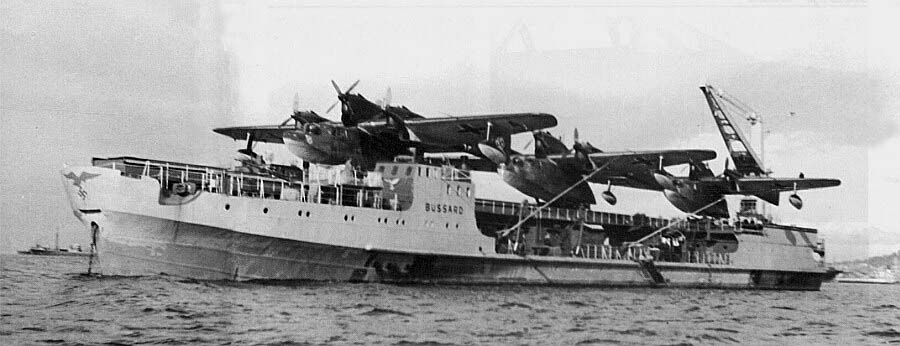
Remember these lil fellas and their direct ancestors?
BV138-Seaplane-Tender-31f.jpg

But there are limits of what you can do with a direct prohibition of aircraft carriers and French occupation of the Ruhr. You can cheat only so much when you're at a gunpoint.

I.e. the problem is that Germany already did everything humanly possible to sneak around operational experience. And i don't think it's possible to make these roundabout, sneaky studies more successful than they are IRL. When you hide your experiment and throw out details (like it happened with Katapults or with high pressure boilers) - you are just bound to find out the validity of your experiment later on.
Nonetheless, a completed carrier is far away from being an operational carrier, even more so when it's the very first one your nave has ever laid its hands on. So, no carrier ops before 1942.
More or less, yes - and it's the same with IRL. Which is why the best Germany could realistically do is honestly cancel a couple less heavy ships, thus sustaining the Atlantic threat into 1942, and the Arctic one - into 1944. It's just impossible to achieve more than that.
Naval power is investment x time. Third Reich didn't have time, Weimar Republic didn't have investment freedom.

It's possible to do major alterations for Japan or Italy, for example, where they had both time to do things right, and major/avoidable high-level mistakes. With Germany, things are rather tactical.
 
Last edited:
But there are limits of what you can do with a direct prohibition of aircraft carriers and French occupation of the Ruhr. You can cheat only so much when you're at a gunpoint.
Of course. But theoretically, they could experiment with launching land planes from shipborne catapults & landing them on (separate) shipborne landing platforms, under guise of "experimenting with mail delivery planes". And plans for conversion of liners into carriers could actually be covertly prepared by Marineamt to quickly boost the fleet in case of war with France (to support the "pocket battleships" operations).
 
Of course. But theoretically, they could experiment with launching land planes from shipborne catapults & landing them on (separate) shipborne landing platforms, under guise of "experimenting with mail delivery planes". And plans for conversion of liners into carriers could actually be covertly prepared by Marineamt to quickly boost the fleet in case of war with France (to support the "pocket battleships" operations).
They sort of did that too, but even nazi experiments had to be remade due to the rapid escalation of aircraft weights and speeds.
Keep in mind that in the mid-1930s, arrestor wires weren't strictly necessary to land, they were a safety measure to prevent sliding.
By 1940-41(Bf.109T/Ju-87T), either they stop you, or into the safety barrier you go.

Even for the big 3, carrier as of early WW2 is an experimental, not very well understood, weapon. British carrier operations in 1939-41 are very much "trial and error" (and even american/japanese ops in 1942 are, as they're done on a completely different scale).
Germany jumps into that pond with more determination than others, actually (the cult of the air power was strong there in the 1930s). But there's no substitute for lack of time.

P.s. and that's why Aquila, IMHO, was absolutely a dead waste in the WW2 context.
 
I believe Germany was not in a position to pursue large naval vessels. While this does not mean they did not need any of them, Germany should have pursued only a select few designs instead of spreading its efforts too thin.

I do not have a clear picture of Germany's shipbuilding capabilities (such as the number of shipyards and dry docks, the capacity of those dry docks, etc.) or their steel production capacity at the time; therefore, the following observations are merely speculative:
  • Do not build the Bismarck or Graf Zeppelin, basically abandon any impractical and ineffective ambitions regarding super-dreadnoughts, aircraft carriers or anything larger. On the other hand... I would like to build more Panzerschiffe, could I construct three more? Should I build another Scharnhorst? - in that case, I would try to upgunned them to 380mm gun as soon as I can. I am not entirely sure about my vision for the cruisers, however; perhaps I will try to see if I can modify the light cruisers to improve their seaworthiness.
  • Build as many additional destroyers and destroyer escorts as practicable; I regard them as the "workhorses" - the backbone of any potential future campaign. And also because I cannot bear the thought of sending out my capital ships without some form of escort... perhaps I should fast-track the design and construction of the Spähkreuzer.
  • The development and production of U-boats will proceed as in real life, but I also want to begin early on the design of a coastal submarine - one that would excel in the Baltic and Mediterranean.
  • As I pointed out at the beginning of this thread, Hilfskreuzers and E-boats have been underrated. Increase the number of Hilfskreuzer and the production output of E-boats. Dispatch the Hilfskreuzers to the Indian Ocean and South Atlantic just before the outbreak of war and let them wreak as much havoc as possible.
  • Embark on a program to train and organize marine forces - they will prove useful in the Baltic, in Norway and in the Mediterranean, especially for dealing with that festering sore known as Malta. The potential of this Marine force when employed in conjunction with Hilfskreuzers and E-boats is also highly promising...
  • Slap Goering on his face and force him to cede some authority to Raeder (or whoever holds power in this timeline), enabling me to organize a land-based Naval Air service centered on medium bombers (capable of launching torpedoes) and long-range maritime patrol aircrafts, supplemented by escort fighters whenever possible.
  • Given that Italy and Japan possessed superior naval forces, might Germany have benefited more from cooperating and exchanging technical expertise with them? I am particularly fond of Japan’s cruiser submarines and those light cruisers that-turned-out-to-be-the-heavy.
=> The Kriegsmarine would serve as an effective force for commerce raiding and amphibious operations, with mine warfare and naval aviation acting as asymmetric, anti-access capabilities against the British and American navies. Better coordination with the Regia Marina will also be required.
 
Last edited:
Given that Italy and Japan possessed superior naval forces, might Germany have benefited more from cooperating and exchanging technical expertise with them? I am particularly fond of Japan’s submarine cruisers and those light cruisers that-turned-out-to-be-the-heavy.
Italy was perfectly willing to sell Littorio plans for export - and this battleship was way more advanced than Bismark.
 
Italy was perfectly willing to sell Littorio plans for export - and this battleship was way more advanced than Bismark.
But will I have to build it myself, or will Italy build it at their shipyard? Both options seem bad in different ways.
 
I do not have a clear picture of Germany's shipbuilding capabilities (such as the number of shipyards and dry docks, the capacity of those dry docks, etc.) or their steel production capacity at the time; therefore, the following observations are merely speculative:
Germany, had iirc 5 battleship slipways and construction dry docks, plus several more heavy ones, capable of building at least heavy cruisers.
It's the same infrastructure and the same facilities that built HSF. Some of them were out of touch, leading to quality issues with their first ships after a long slumber (very prominent on both Scharnhorst and Hipper classes). But it's Germany, ffs.
On the other hand... I would like to build more Panzerschiffe, could I construct three more?
There are two big problems with all these ideas:
- lesser heavy ships aren't all that much cheaper, as they have more or less same expensive components. They are less bottlenecked with high end/time intensive procedures, such as heavy cemented armor plating (which is a German forte, especially after occupying Czechoslovakia - i.e., the former Austro-Hungarian industrial heart).
- smaller ships' effectiveness is directly tied to the existence of capital ships. Is there any obstacle to hunting smaller ships down?
It's very visible how easier allied ASW efforts become after the Channel dash, and it is one of the reasons that led to victory in the Battle of the Atlantic. The only way to squeeze more effectiveness out of raiding and submarine operations is to extend surface fleet presence in the Atlantic into 1942. The only way to do it is to add more heavy ships.
Build as many additional destroyers and destroyer escorts as practicable; I regard them as the "workhorses" - the backbone of any potential future campaign. And also because I cannot bear the thought of sending out my capital ships without some form of escort... perhaps I should fast-track the design and construction of the Spähkreuzer.
Germany was building absolutely as many as it was humanly possible. It's again crushing lack of time and facilities.
To somehow work their way around this lack of numbers, all their destroyers ("zerstorers") were effectively superdestroyers in size - and that too was their downfall(lack of experience, as smaller torpedo boat experience was only partially applicable).
Slap Goering on his face and force him to cede some authority to Raeder (or whoever holds power in this timeline), enabling me to organize a land-based Naval Air service centered on medium bombers (capable of launching torpedoes) and long-range maritime patrol aircrafts, supplemented by escort fighters whenever possible.
Goering will slap anyone in Germany himself. Navy had some of their units before Goering won. But frankly speaking, the Luftwaffe did X.flieg much better than KM did.
Italy was perfectly willing to sell Littorio plans for export - and this battleship was way more advanced than Bismark.
Littorio was, at most, somewhat less conservative in layout; calling it more advanced is a major overstatement. But Italy is a much weaker industrial/shipbuilding power.
 
Littorio was, at most, somewhat less conservative in layout; calling it more advanced is a major overstatement. But Italy is a much weaker industrial/shipbuilding power.
Well, she was compact, fast, very well protected, and adequatedly armed for her intended job. Her range might be lacking, true.
 
Much could have been learned from the IJN regarding carriers, maybe even exchange of personnel. Japan was keen to get German aircraft technology in the mid-30's (beginning with He 70, but Dornier flying boats were respected world-wide as well), so there were bargaining chips.
But that's what actually did happen - the German navy had an intimate and detailled knowledge of the Japanese carriers that was provided by the IJN! This shortcut was already taken.

I'm pretty sure, Germany has done pretty much anything conceivable to get an aircraft carrier except building an actual one before the Anglo-German Naval Agreement. And afterwards the last, missing step was taken immedeately.
 
Well, she was compact, fast, very well protected, and adequatedly armed for her intended job. Her range might be lacking, true.
It's "outside metrics"(like comparing modern fighters by speed, size, range, and number/size of their missiles). Advancedness is "inside"(sometimes outside, like radars), in the end.
German WW2 ships, while very conservative on the outside, are very(arguably, too much) advanced inside. Partially, they represent a more advanced/powerful manufacturing country; partially, they are later (and start off a higher baseline) than almost all Italian ships.

Keep in mind that Littorio is the first of the treaty fast battleships; she was laid down in 1934. German battleships are from 1936. These years matter a lot back then. That doesn't mean that ships themselves are weaker/stronger just because of that, but the pace of evolution was fast.
 
Last edited:
On the other hand... I would like to build more Panzerschiffe, could I construct three more? Should I build another Scharnhorst? - in that case, I would try to upgunned them to 380mm gun as soon as I can.
Don't!
The Panzerschiff concept was killed off by the French Dunkerque class, which was a dedicated Panzerschiff-killer and outmatched them in any aspect.
The Scharnhorst class, in turn, was far outmatched by the fast Battleship (littorio, Richelieu, Bismarck, King-George-V) in terms of firepower and armour and simultaneously lost it's ability to run away. So this is a dead end, too.

And yes, Germany up-gunned them, as soon as possible. Which was never due to the ongoing war...
 
Since people are into surface raiders (from another thread), a defense of 'flying deck' hybrid-cruisers:
[...] However, the one exception might be a scout cruiser or surface raider, operating at long ranges with little or no destroyer escort.

Under such conditions the ability to carry aircraft allows:
- Increased scouting ability (including increased likelihood of evading the enemy).
- An ability to harass attacking enemy aircraft (if carrying fighters).
- Ambushing ships at anchor (especially in smaller less defended ports).
- Potentially attacking a much larger warship by surprise.

At the same time the 2"-4" of armour and quick firing light cruiser armament allows a degree of self-defence against enemy destroyers in conditions of low visibility or if destroyers try to run down the hybrid-cruiser.

There are still engineering issues though - questions about the effectiveness of the protection scheme (even against destroyer equipped guns), and the relatively small air group (which would be ineffective against larger formations of enemy ships, larger ports, or a large number of attacking enemy aircraft). There are probably situations where they'd make excellent raiders though, especially against smaller colonial holdings. If one looks at the success of SMS Wolf for example... then imagine such a ship with twenty aircraft, close to thirty knots and nine six inch guns... I'm not sure such a ship would be a worse choice than, say, the Admiral Hipper class.

So, in a sense, I've always seen the USN Flying-Deck cruisers as the most hybrid practical designs - just perhaps for a smaller country than the U.S. (i.e. one which might want a ship on station somewhere, but not be able to afford more than one).
 
When I was younger I also used to wonder about the possibility of a fast low-profile high-seas torpedo boat with a very heavy torpedo armament (>12) and possibly even carrying pattern running torpedoes. The idea would be to draw off escorts or conduct night attacks - firing a large spread of torpedoes into the convoy from long range... which would then break up the convoy for the U-Boats to attack.
 
When I was younger I also used to wonder about the possibility of a fast low-profile high-seas torpedo boat with a very heavy torpedo armament (>12) and possibly even carrying pattern running torpedoes. The idea would be to draw off escorts or conduct night attacks - firing a large spread of torpedoes into the convoy from long range... which would then break up the convoy for the U-Boats to attack.
That's Spahkreuzer. Once again, conceptualized and even tried. Couldn't be built within realistic time limits.
 
Since people are into surface raiders (from another thread), a defense of 'flying deck' hybrid-cruisers:
A very foul compromise but one that's worth reconsidering again and again.

I've read an extensive article on the 1930's US hybrid cruiser, including the results of the US Navy's contemporary wargames. Surprisingly, at the time of its concepption it would have been a perfectly sound ship for the navy, if only because it had the single responsibility of a fleet scout and the US Navy was actually big enough to accomodate a single purpose fleet scout. Of course, only a few years later the airplanes would have grown so much in size to render he ship's aviation facilities completely useless. Which in turn would have provided the US with a nice set of hulls for CVL conversion just in time for the demise of the Washington treaty...

The German navy was indeed looking into hybrid "cruisers" during the war, only that those have grown in size to some 35000 - 45000 tons - so no chance of ever building one.

And at last, one might even argue that Graf Zeppelin was indeed a hybrid cruiser, if a very unballanced one. The installation of those much criticized 15cm casemate guns, after all, was a direct consequence of the Kriegsmarine's dire lack of screening cruisers and destroyers. I.e., the carrier had to have also some (very limited) cruiser capabilities in case of a surprise encounter with an enemie's surface forces...
 
And at last, one might even argue that Graf Zeppelin was indeed a hybrid cruiser, if a very unballanced one. The installation of those much criticized 15cm casemate guns, after all, was a direct consequence of the Kriegsmarine's dire lack of screening cruisers and destroyers. I.e., the carrier had to have also some (very limited) cruiser capabilities in case of a surprise encounter with an enemie's surface forces...
I think it was more or less belts problem. What do you do when you get out into Skaggerrak and meet countretorpilleurs head on. I mean, these guns can in principle be used to, say, sink a civilian ship faster, but I don't think anything more than that, other than perhaps desperate point-blank self-defense in some misty GIUK encounter with a light cruiser on patrol.
But realistically you won't win any 6" gunfire duel when you're a 260m long, 7-store high building, with explosive and flammable stuff stored here and there. Even in a gun duel against destroyers, it can end ugly.

Plus, it was the result of that famous funny miscommunication anyway (they invented double casemates to save space and weight, but installed the same number anyway, achieving the opposite). Though it wasn't seen as a waste completely for naught (2 equal 4-gun groups on both banks, sharp ahead or astern, is very useful for that very Skaggerrak case).
 
Absolutely!
That's why I wrote "very unballanced" and "very limited" - with a very, VERRRRY big "VERRRRY". ;)
 
For my 2 cents on Kriegsmarine carriers, they couldn't do it from their post WW1 starting point, but if they had won WW1, they certainly would have had carriers by WW2, assuming WW2 occurred in that scenario which is unlikely.
 
I believe Germany was not in a position to pursue large naval vessels. While this does not mean they did not need any of them, Germany should have pursued only a select few designs instead of spreading its efforts too thin.

I do not have a clear picture of Germany's shipbuilding capabilities (such as the number of shipyards and dry docks, the capacity of those dry docks, etc.) or their steel production capacity at the time; therefore, the following observations are merely speculative:
  • Do not build the Bismarck or Graf Zeppelin, basically abandon any impractical and ineffective ambitions regarding super-dreadnoughts, aircraft carriers or anything larger. On the other hand... I would like to build more Panzerschiffe, could I construct three more? Should I build another Scharnhorst? - in that case, I would try to upgunned them to 380mm gun as soon as I can. I am not entirely sure about my vision for the cruisers, however; perhaps I will try to see if I can modify the light cruisers to improve their seaworthiness.
=> The Kriegsmarine would serve as an effective force for commerce raiding and amphibious operations, with mine warfare and naval aviation acting as asymmetric, anti-access capabilities against the British and American navies. Better coordination with the Regia Marina will also be required.
I'd say replace B&T with another pair of S&G but with 15" guns, upgun S&G as well. Use S&Gs guns on 3 additional PBs. That should give you 4 x 15" S&G and 6 x PBs. If possible skip the Hippers entirely and build another 3 x PBs. War winning? No. But would definitely give the Royal Navy far more heartburn
 

Similar threads

Back
Top Bottom