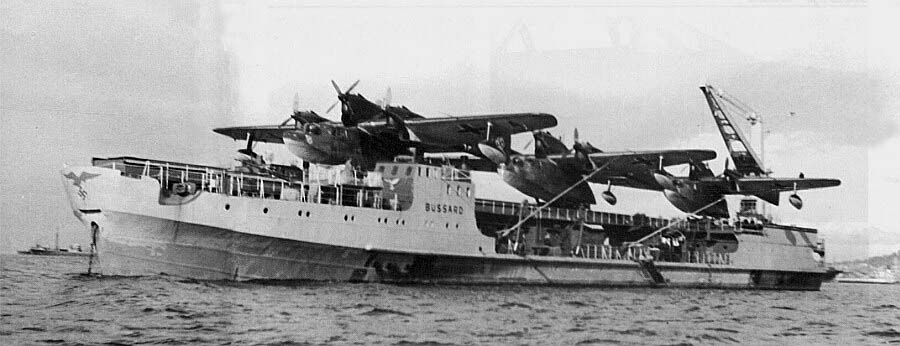
The FAA, assuming the RN makes the assumption that what they have is "good enough" so they're roughly historical in 1940, is woefully unprepared for a carrier war. The Germans send a strike of say 8 to 10 Stuka, 8 to 10 He 70 torpedo bombers, escorted by 6 to 8 He 112 against a British carrier. Both are operating singly.
The RN carrier has puts up say, 4 Sea Gladiator and some Skuas. The Henkels make short work of the British CAP and then dive bomb and torpedo the carrier. The Skua strike with say 6 planes and another 6 or so Swordfish approach the German carrier. The Henkels on CAP have their way with the British planes that are all but defenseless against them. Between the CAP and AA fire most of the strike is shot down and what isn't is shot to pieces. They might get lucky and score a hit on the German carrier.
Whoa, whoa... seriously?
First be so kind to google what a He 70 is!
And then your numbers and types are 100% wishful thinking:
Even if Germany had a carrier operational by 1940 it would still have to do with the 1st gen planes Fi 167 and Ar 197 - Ju 87C and Bf 109T were produced only in 1941.
On the British side, on the other hand, a modern (if not perfect) single plane fighter, the Fairey Fulmar, was becoming
operational during 1940. And the FAA had experienced crews by then, let's not forget (and a Sea Gladiator was a tough cookie in the hands of an experienced pilot!).
And then your numbers - why do think the Brits can field a mere four against 6 to 8 German fighters? FYI: GZ was always planned with a fighter complement of 12 planes. If the FAA has four fighters on CAP you have to assume the same for the German side. Actually it's rather 2 CAP on station, 2 CAP in transfer and 2 CAP onboard refuelling. That leaves you with a mere six fighters, but only if you intend to fly one single sortie (and spend a few hours completely inoperable due to refuelling and maintenece afterwards). Keep two in the backhand for a second sortie and you're down to four.
Oh, you have one of these elusive 50-60 plane carriers? Sorry, no, you haven't: If you decide to go for such a ship you need about two years of design and preparation before you can start the actual construction. I.e., they get layed down in 1938 earliest and completed not before 1941 (s. below)
...The (in)famous North Sea Battle of March 1940 is well-known as the worst example of carrier operations in history. It all started when patrol German He 70 from 1st Flugzeugträgerdivision was engaged by British "Gladiator" from HMS Glorious. Noting the presence of British carrier nearby, Grossadmiral von Dummkopfen ordered 1st Flugzeugträgerdivision to engage, while 2nd Flugzeugträgerdivision be ready to press the attack.
[...]

[...] As an interesting aside here, the RN lost the HMS Glorious in a surface action against the Scharnhorst and Gneisenau. This marks the only time a carrier was sunk by battleship fire in a surface action. [...]
No it wasn't. (Technically, the Japanese cruisers were NOT battleships but, well, cruisers. But that's no difference: Carriers are f'ing vulnerable to gunfire, and even if you have much better forces than your opponent and the best radar in existence it's not a good idea to leave carriers without a proper guard against surface raiders.)
Not much competition, built as fast as possible. Same bottlenecks (development and manufacturing of carrier equipment) will apply no matter how much you force it. Keep in mind that while Zepellin waited it's building dock for a year, development and manufacturing of carrier equipment - didn't, and it still was very barely on time in 1940.
I.e. you won't get a single carrier completed before 1940, and you won't get anything operational before 1941. Not unless you throw off Versailles restrictions before Hitler even comes to power, which is somewhat unrealistic.
Let's for once be nice:
We actually can shift resources a bit. Bismarck and Tirpitz get cancelled immedeately and the slips can be cleared quickly (if construct has already begun at all). I.e., carriers A and B don't have to wait for Scharnhorst/Gneisenau to be launched. Which, of course, doesn't help the fact that design work on the carriers (42 plane Graf Zeppelins, not 50-60 plane "super" carriers!) isn't finnished yet.
We might even optimistically assume that we can relocate a bit of Germany's design capacities from the battleships to the carriers, though don't expect miracles here, either. The Bismarcks were laid down in 1936, which means that their design teams were becoming available at that time, anyway. This might buy us a few month speed up at most, but nothing more.
The biggest effect probably will come into being in the fall of 1939 when the war is started and
all military projects will be revised. IRL on oct 2nd 1939 it was decided to pause work on GZ as far as possible in favour of (amongst other) the battleships. Without two almost completed battleships in the pipeline, the navy
might have continued work on the first carrier(s) and completed
some by 1940 (though, on the other hand, they might have paused the carriers anyway and finished the remaining two cruisers instead).
Nonetheless, a completed carrier is far away from being an operational carrier, even more so when it's the very first one your nave has ever laid its hands on. So, no carrier ops before 1942.