German WWII Flakmine

moin1900

ACCESS: Top Secret
Joined
28 January 2008
Messages
875
Reaction score
1,061
Hi everybody

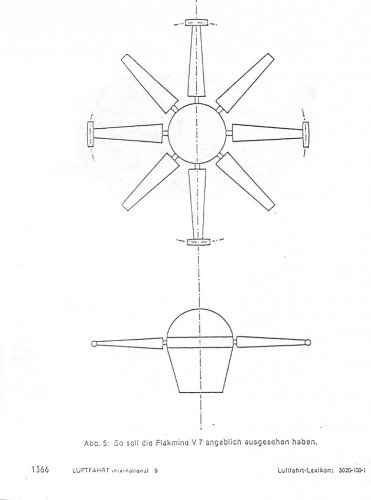
I'm looking for a drawing of the Zeppelin Kugelblitz. It should be a manned/unmanned Flakmine.
There is a picture of the Zeppelin Feuerball Flakmine (little version of Kugelblitz)
http://www.geocities.com/unicraftmodels/germ/v7/v7.htm

Thanks in advance
 
Flakmine...

This seems to be just another part of the good old nazi UFO mythology. I would recommend this website:

http://www.german-discs.net/saucers/feuerball.php

I would say that this "Flakmine" is completely fictional.
 
V-7 Feuerrad aka Zeppelin Kugelblitz
this is completely fictional

V number end at V-3 a Supergun
 
I am guilty of that drawing.
The original information, probably false, comes from Lufthart
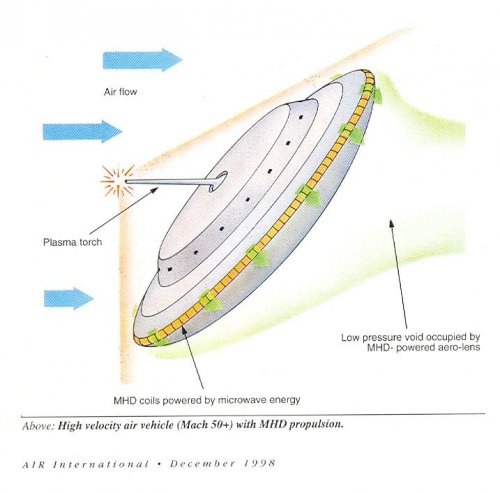
It can certainly be thought that the publication dealing on these subjects is not serious. But I do have here a Flying Saucer illustration from Air International.
 

Attachments

  • V-7.jpg
    V-7.jpg
    47.2 KB · Views: 453
  • Mach 50.jpg
    Mach 50.jpg
    53.9 KB · Views: 432
The first picture shows the Feuerball! Thanks for the picture! Justo
Is that all fiction ?

Thanks
 
FAIK the second picture showed, how a plasma torch could work (could !)
and how it could be used. It wasn't a real project, just a drawing to explain
the principles .
 
Interesting. The flak mine at least is a possible design. I wouldn't have guessed...
 
i do remember that read somewere about german manned flak mine... Is it Feuerball ar another thing?
 
Luftmine - Flakmine

August 19, 1943
Flak E-1 Anti-Aircraft Development Meeting
(Flakentwicklungsbesprechung)

Major Wallersbrunn discusses a promising invention: the "Luftmine."
The aerial mine is designed to reach an altitude of 8–10 km with an operational endurance of 5 hours. The model was explained using drawings. The GL/C-E department was immediately brought in and assumed responsibility for the mine's propulsion system. To evaluate the viability of the concept, a working group was established at the Schlipen company in Adlershof, including representatives from Flettner and the DVL. The Generalfeldmarschall considers it necessary to involve the Forschungsführung and desires close cooperation with Prof. Seewald.

Source: Bundesarchiv
Signatur: RL 3/57; Page: 175 - 177
Direct Link:
https://invenio.bundesarchiv.de/invenio/direktlink/3a122d0a-a629-4b60-9210-ee962aca7259/


The Luftmine was designed to prevent or disrupt the approach to a target through continuous ascent and descent. Once the fuel was exhausted, the mine was intended to land near its launch site. A wind-compensation mechanism combined with a gyroscope was meant to prevent drifting. Plans also included the possibility of ground-based control and detonation. Work on the project was halted in the autumn of 1944 following an air raid on the factory.

Source: Bundesarchiv
Signatur: ZA 3/836; Page: 428
Direct Link:
https://invenio.bundesarchiv.de/invenio/direktlink/f9c815d3-e4b2-4640-bda3-ccf84dff8919/


In a post-war report, the "Luftmine" is also referred to as a "Flakmine".
Source:
https://www.secretprojects.co.uk/threads/german-ww2-unknown-flak-projects.6981/post-79494


Sidenote:
Regarding the so-called "Zeppelin V-7 Flakmine", note the similarity to the Walter Wiesske air scooter model.
https://www.secretprojects.co.uk/threads/walter-wiesske-air-scooter-anybody.39329/

 
Last edited:
Luftmine - Flakmine

August 19, 1943
Flak E-1 Anti-Aircraft Development Meeting
(Flakentwicklungsbesprechung)

Major Wallersbrunn discusses a promising invention: the "Luftmine."
The aerial mine is designed to reach an altitude of 8–10 km with an operational endurance of 5 hours. The model was explained using drawings. The GL/C-E department was immediately brought in and assumed responsibility for the mine's propulsion system. To evaluate the viability of the concept, a working group was established at the Schlipen company in Adlershof, including representatives from Flettner and the DVL. The Generalfeldmarschall considers it necessary to involve the Forschungsführung and desires close cooperation with Prof. Seewald.

Source: Bundesarchiv
Signatur: RL 3/57; Page: 175 - 177
Direct Link:
https://invenio.bundesarchiv.de/invenio/direktlink/3a122d0a-a629-4b60-9210-ee962aca7259/


The Luftmine was designed to prevent or disrupt the approach to a target through continuous ascent and descent. Once the fuel was exhausted, the mine was intended to land near its launch site. A wind-compensation mechanism combined with a gyroscope was meant to prevent drifting. Plans also included the possibility of ground-based control and detonation. Work on the project was halted in the autumn of 1944 following an air raid on the factory.

Source: Bundesarchiv
Signatur: ZA 3/836; Page: 428
Direct Link:
https://invenio.bundesarchiv.de/invenio/direktlink/f9c815d3-e4b2-4640-bda3-ccf84dff8919/


In a post-war report, the "Luftmine" is also referred to as a "Flakmine".
Source:
https://www.secretprojects.co.uk/threads/german-ww2-unknown-flak-projects.6981/post-79494


Sidenote:
Regarding the so-called "Zeppelin V-7 Flakmine", note the similarity to the Walter Wiesske air scooter model.
https://www.secretprojects.co.uk/threads/walter-wiesske-air-scooter-anybody.39329/
Nice info, thank you for sharing. With so much available documents from BA/MA, it's always a bonus to have more eyes browsing. The Zeppelin Flakmine was dismissed already as a fake, but Flettner's involvement sure is a good research guideline.
 

Similar threads

Back
Top Bottom