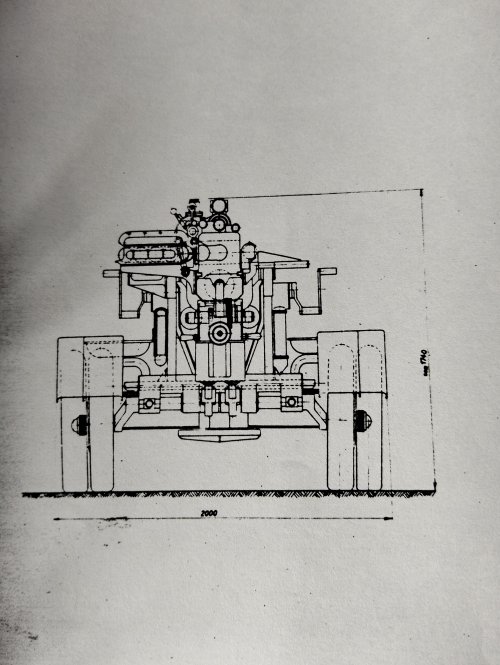
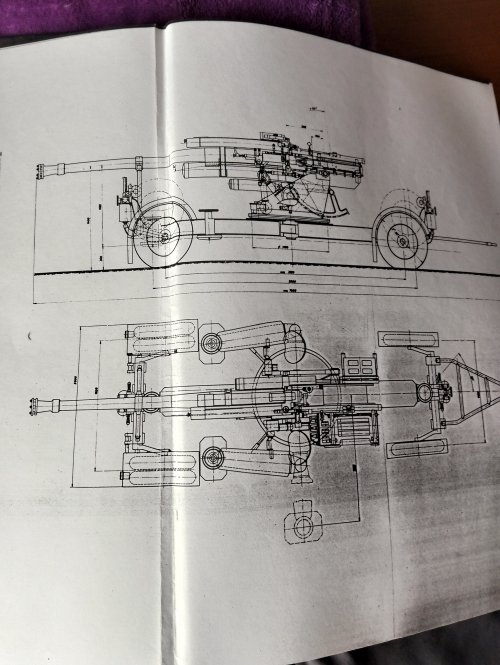
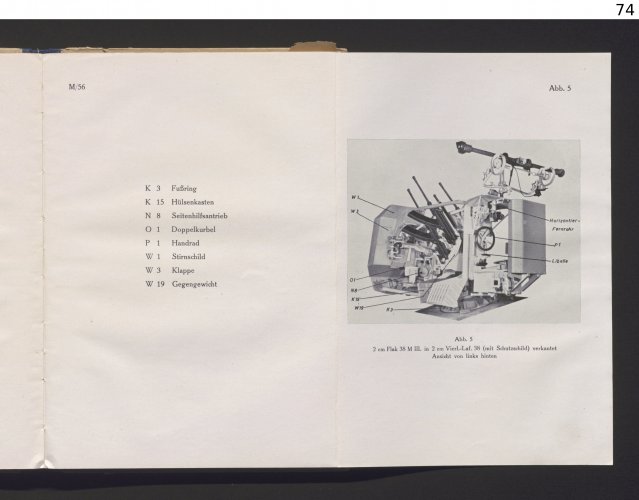
German WW2 unknown Flak Projects

Wow, that's fast for a 75mm. I suspect that it would have slowed down to about 60rpm for reliability. (See the US M51 Skysweeper 75mm)

The 3"/70 N1 and Mk36 ran at 70rpm for reliability, and they took ~15 years to develop.
It is a different mechanism (basically akin to the postwar Soviet 57mm naval mounts, ZIF-71 and ZIF-75) and benefits from feeding from a single side.

That however probably brings up a more practical limitation of sustaining the rate of fire. The 3”/50 automatic is designed that way so you have two people are feeding each gun. Clipping pairs of 75mm rounds together might increase what a single loader can feed without causing undue physical stress but it’s still operating at higher RPM.

Circling back to the Soviet 57 as an example they could only perform short bursts (Navweaps says 50 rounds/gun) before they stuck hoses in the breech and cooled for 90 seconds. This doesn’t seem to be water cooled (an approach the ill fated 3”/70 took and even that suffered from notoriously bad barrel life) and with the trend of large guns overheating faster I suspect you could probably only fire it for 25-30 rounds before risking serious damage.

It’s an interesting gun but ultimately limited as a practical air defense system.
 
It is a different mechanism (basically akin to the postwar Soviet 57mm naval mounts, ZIF-71 and ZIF-75) and benefits from feeding from a single side.

That however probably brings up a more practical limitation of sustaining the rate of fire. The 3”/50 automatic is designed that way so you have two people are feeding each gun. Clipping pairs of 75mm rounds together might increase what a single loader can feed without causing undue physical stress but it’s still operating at higher RPM.

Circling back to the Soviet 57 as an example they could only perform short bursts (Navweaps says 50 rounds/gun) before they stuck hoses in the breech and cooled for 90 seconds. This doesn’t seem to be water cooled (an approach the ill fated 3”/70 took and even that suffered from notoriously bad barrel life) and with the trend of large guns overheating faster I suspect you could probably only fire it for 25-30 rounds before risking serious damage.

It’s an interesting gun but ultimately limited as a practical air defense system.
To be fair the 3"/62 Oto Melaras are water cooled
 
PROXIMITY FUSES FOR FLAK SHELLS
- Rheinmetall Borsig - Kuhglöckchen - electrostatic proximity fuze
- Radio proximity fuze - Pinscher ?
- Acoustic proximity fuze
https://www.secretprojects.co.uk/threads/german-special-air-air-anti-bomber-weapons.6945/post-734025

ROCKET ASSISTED FLAK SHELLS
- Source: Bundesarchiv
Signatur: RH 8/1431
Zusatzantrieb für 8,8 cm Flak - 1942
(rocket assisted 88mm shell)
https://invenio.bundesarchiv.de/invenio/direktlink/fb0d0334-53a7-4e91-af51-0938fb76a3c4/
[Click "DIGITALISAT ANZEIGEN" TO VIEW THE FILE]

- Rocket-assisted Projectiles
10,5cm Flak 38/39 - 12,8cm Flak 40
https://en.wikipedia.org/wiki/Rocket-assisted_projectile

REMOTE CONTROLLED FLAK
Rheinmetall-Borsig Werke, Unterluss
Artillery and Weapons - 1945
by J.W. Simpson & G.W.R. Taylor
Report No.319
- remote-controlled 8.8cm Flak
- 5 cm Gerät 56
- 5,5 cm Gerät 58 & Gerät 59
[Page: 4
"Gerät 58"
Remote Power Control was apparently being developed by Siemens of Berlin.]
[Page: 6
"88 m.m. Flak Remote Power controlled Mounting"
This equipment was located and examined. It appears to be an unduly heavy mounting.]
(The report is available on Google Books.)


Remote-controlled Flak 18
- The "8,8cm Flak J. SAM" was developed by Krupp, Rheinmetall and Siemens Apparate und Maschinen in 1935.
Source:
The German 88: The Most famous Gun of the Second World War by Terry Gander


Remote-controlled 5cm FlaK 41 battery
https://www.secretprojects.co.uk/threads/remote-controlled-5cm-flak-41-battery.44292/
It sounds like the Germans were trying to do what the US accomplished with the M3 90mm gun and SCR 584 radar / fire control system.
 
Last edited:
Anti-aircraft artillery for future threats - Part 1

December 1944
Engagement of fast-moving targets and its influence on the development of light anti-aircraft artillery: correspondence regarding sighting equipment for high target speeds

Anti-aircraft defense against high-speed targets such as:
- Jets
- V-1-type weapons
- Glide bombs

Weapons:
- 3.7 cm Flak 43
- 5.5 cm Gerät 58
- 5.5 cm/4.1 cm (conical)
- Increase rate of fire, e.g., using the MG 213 C
- Increase traverse/elevation speed, e.g., by adding a third axis to the mount
- Sight development


1.) Short projectile flight times
(Geringe Geschossflugzeiten)

Projectile flight times can be reduced through measures involving internal and external ballistics. External ballistic measures play a negligible role at ranges up to 5,000 m. This leaves increasing the initial velocity as the primary option.

Increasing the muzzle velocity can be achieved by raising the gas pressure. However, this solution is not feasible for an automatic weapon for various reasons; for instance, while maintaining the current gas pressure, the barrel length increases rapidly as the muzzle velocity rises. To illustrate: achieving a muzzle velocity of 1,300 m/s (1,350 m/s) requires a barrel length of 165 (180) calibers. For the 3.7 cm anti-aircraft gun, this translates to a barrel length of 6.10 m (6.65 m), and for the 5.5 cm anti-aircraft gun, a length of 9.05 m (9.90 m).

The solution inevitably points to sub-caliber projectiles (sabot, fin-stabilized, or flanged projectiles) or over-caliber barrels "Überkaliberrohre". Sabot and fin-stabilized projectiles are ruled out because the sabots are jettisoned after leaving the barrel; combined with the desired high rate of fire, this poses a significant hazard to the surrounding area. The arrow projectile will only demonstrate its superiority at longer firing ranges. This leaves only the flanged projectile for firing from a conical barrel.

It can therefore be stated as a general rule that, in order to increase the initial velocity while maintaining acceptable barrel service life, dimensions, and moments of inertia, only a sub-caliber projectile is a viable option.

Regarding hit probability, the conical barrel offers the prospect of doubling the probability of a hit compared to the Gerät 58.

2.) High rates of fire
(Hohe Feuergeschwindigkeiten)

Increasing the rate of fire must also be a goal. The Mauser MG 213 C revolver cannon offers one way to achieve this. Since no other solution is currently available, this weapon system—originally intended for aircraft—must be adapted for use in an anti-aircraft role.

3.) Minimal dead zones of the traverse/elevation speed
(Kleine Toträume der Richtgeschwindigkeiten)

Reducing the weapon's dead space and increasing its traverse/elevation speed must also be development objectives. To this end, the incorporation of a third axis is to be investigated. However, a third axis is likely to present design and operational challenges; in particular, the control mechanism for the sighting system remains unresolved.


Further reading
Source: Bundesarchiv
Signatur: RH 8/665
Direct Link:
https://invenio.bundesarchiv.de/invenio/direktlink/c823c48f-2625-4259-b1bd-c7562c60e66f/
 
Last edited:
Enhancing the Performance of Anti-Aircraft Artillery (1944–1945)
("Leistungssteigerung der Flakartillerie")

In Search of the Ultimate Anti-Aircraft Weapon - Part 1

[1] Arbeitskreis "High Muzzle Velocity"
To increase the muzzle velocity—and thus the probability of a hit—Major Hoffmann (GL/Flak E-1) called for an extremely high muzzle velocity of 10,000 m/s.
Various proposals were put forward to achieve this high muzzle velocity:
1.) High-pressure barrel (Hochdruckrohr Basset)
2.) Hydrogen as a propellant
3.) Progressive acceleration propellant charges
4.) Propellant charges made of high explosives
- Acceleration via detonations within a gun barrel
5.) Propellant charges made of high explosives
- Acceleration via detonations without a gun barrel

Source:
Bundesarchiv
[1] Meetings Arbeitskreis
19 April 1944 – 31 October 1944
Signatur: RH 8/670; Pages: 444–476
Signatur: R 26-III/52; 22, 84 - 85

Direct Links:
RH 8/639
https://invenio.bundesarchiv.de/invenio/direktlink/64e548f8-7dbd-43a2-ac33-f2d0137eeeb2/

RH 8/670
https://invenio.bundesarchiv.de/invenio/direktlink/16296ba5-eabd-4f02-b5e1-725df510131e/

R 26-III/52
https://invenio.bundesarchiv.de/invenio/direktlink/63ed1c57-c855-4c5d-b005-8c7a0793f2d2/


Further reading:
Bundesarchiv Files "Hohe Mündungsgeschwindigket"

Signatur: RL 39/268
Fundamentals of Increasing Projectile Muzzle Velocity – Technical Report No. 1 (Author: H. Pfriem)
Direct Link:
https://invenio.bundesarchiv.de/invenio/direktlink/9ee27d04-419a-4727-a966-0b2f748f7f31/

Signatur: RL 39/269
Increasing the Muzzle Velocity of Projectiles – Technical Report No. 1 (Authors: H. Pfriem and W. Ernsthausen)
Direct Link:
https://invenio.bundesarchiv.de/invenio/direktlink/b3c8e60c-496d-4ebc-991a-868334d8f9fb/

Signatur: RL 39/876
Calculations regarding current problems concerning the shooting down of aircraft by heavy anti-aircraft artillery – DLF Investigations and Reports No. 845 (Prepared by: Braunbek)
Direct Link:
https://invenio.bundesarchiv.de/invenio/direktlink/fd21550b-580b-4741-a89e-94928899b754/

Signatur: RL 39/78
Directional Mines (Fernwirkende Minen)
(Authors: Krüger, Thomer, and Schulz)
Direct Link:
https://invenio.bundesarchiv.de/invenio/direktlink/4624239f-2564-4ccc-9de7-4d638a0ae545/

Signatur: RL 39/261
On the shock damping of plane gas waves. – Research Report No. 9 (Author: Pfriem)
Direct Link:
https://invenio.bundesarchiv.de/invenio/direktlink/0234fd3b-4781-46ea-8b60-3e9f85edfb3c/
 
Enhancing the Performance of Anti-Aircraft Artillery (1944–1945)
("Leistungssteigerung der Flakartillerie")

In Search of the Ultimate Anti-Aircraft Weapon - Part 2

Further informations from the documents (RH 8/670 & R 26-III/52) regarding the above mentioned proposals.


1.) High-pressure barrel
(Hochdruckrohr Basset)

June 20, 1944
A proposal for a high-pressure barrel previously submitted by Basset via Krupp specifies insufficient performance (muzzle velocity of 1,350 m/s). GL/Flak-E rejects trials with barrels of such low performance.


2.) Hydrogen as a propellant
(Wasserstoff-Geschütz - Wasserstoff Treibladung)

August 22, 1944
As early as the first meeting on April 19, 1944, attention was drawn to the inefficient utilization of energy from propellant gases due to low molecular velocity. The most effective gas is the one with the lowest molecular weight—namely, hydrogen. The representative of the Forschungsführung (Staff Engineer Büchen) reports that the "Technische Akademie der SS" in Brünn has since initiated experiments to use hydrogen as a propellant charge. The intended method involves firing a piston into a hydrogen-filled chamber to highly compress the gas contained within, allowing it to subsequently expand into the gun barrel. However, due to complex preparatory work, the experiments are not expected to begin for another six months.

October 31, 1944
The use of hydrogen as a propellant must currently be regarded as purely a matter of research. Application in existing guns does not appear feasible; a completely different design for the barrel and ammunition would be required. Consequently, further development of this firing method is being abandoned. Only the Reichsforschungsrat will continue to examine the problem theoretically, with minimal expenditure of resources.


3.) Progressive acceleration propellant charges
(Progressive Beschleunigungsladungen - Geschoss mit unterteilter Ladung)

January 18, 1945
Waffenakademie der SS
Projectile with cascaded propellant charges
An artillery projectile is fitted with multiple propellant charges that are ignited sequentially within the gun barrel. The first charge is ignited in the standard manner; the subsequent charges—which travel along with the projectile—must be ignited through the gun barrel wall. Tests have shown that reliable ignition through the barrel wall is possible using an induction current.

Further reading:
Projectile with segmented propellant charge
Signatur: R 26-III/52; Page: 22, 56–58


4.) Propellant charges made of high explosives - Acceleration via detonations within a gun barrel
(Sprengstoff-Detonationen im Rohr - Treibladungen aus Sprengstoff)

June 20, 1944
Dr. Pfriem has so far only been able to perform calculations; he believed that, at best, a muzzle velocity of 3,000 m/s could be achieved.

August 22, 1944
Preliminary tests regarding explosive propellant charges have been initiated by WA F and Dr. Pfriem. The fundamental question is: What is the maximum permissible quantity of explosive that can be used without damaging the gun barrel upon detonation?

October 31, 1944
Propellant charges made of explosive
Some preliminary tests have been conducted at Kummersdorf. Detonations within gun barrel blanks with an internal diameter of 67 mm resulted in destruction when using explosive cylinders with diameters of 20 mm or greater. Detonation tests using an old gun barrel are currently underway. Dinitroanisole, or other explosives with an aluminum additive, are proposed as suitable options. Flak E-1 is procuring the test specimens.


5.) Propellant charges made of high explosives - Acceleration via detonations without a gun barrel
(Sprengstoff-Detonationen ohne Rohr)

June 20, 1944
Status:
TAL Gatow has accelerated iron shells (Eisenschalen) to 4,000 m/s using parabolic-shaped explosive charges (schalenförmige Sprengstoffkörper)
Program:
TAL Gatow
a.) Iron plates made of superior material; high-quality steel plates are being provided by OKM, A Wa A I.
b.) Fitting a cap onto the iron shells (Eisenschalen) to achieve a better external ballistic shape.
c.) Utilizing the shell (Schale) as a sabot to accelerate projectiles (possibly bundled ones). Fin-stabilized projectiles are being procured by GL/Flak-E 1/IV.

August 22, 1944
Regarding the problem of explosive-driven firing—that is, the acceleration of projectiles solely through the detonation of explosives—TAL reports: Trials involving precise measurements yielded initial velocities of 1,800 m/s for the accelerated metal shells (Metallschalen). These velocities depend heavily on the ratio of explosive to metal shell (Metallschale). Furthermore, as expected, deceleration due to air resistance was very high.
TAL is planning the following tests:
a.) A model test involving the assembly and firing of a metal shell (Metallschale) made up of numerous 20g arrow projectiles.
b.) Lining the cavities of the shell (Schale) with aluminum or Elektron to provide a cushion for an embedded projectile.

Since the explosive charge within the projectile must weigh approximately 500 g to ensure sufficient effect at the target, applying principle (a.) would allow a large number of effective arrows to be fired using a very large quantity of explosive. Arrows for principle (a.) have been ordered from the Maibauern company.

In principle, the difficulty of accelerating projectiles using a metal shell (Metallschale) is highlighted; the projectiles are likely to punch through the shell (Schale), or they may become deformed. Stabilization fins that protrude beyond the projectile are particularly vulnerable. Therefore, it is proposed to design the fins to fit within the caliber and, alternatively, to fire inherently stable projectiles positioned horizontally within the shells (Schalen). The aforementioned principle (b.) is intended to enhance the mechanical durability of the projectiles.

October 31, 1944
Firing tests involving explosives were extended to include the firing of small arrow projectiles. The arrows were placed flat—and also vertically—upon the explosive shell casing (Sprengstoffschale) and embedded in plaster; however, some became severely deformed. Small incendiary projectiles also suffered some deformation. Based on this experience, the problem associated with this firing method is divided into two tasks:

a.) Small incendiary projectiles weighing approximately 50 g are sufficient for engaging low-flying aircraft. If manufactured as cubes, they can fill the area of an explosive shell casing (Sprengstoffschale) 1,000 incendiary projectiles would require an estimated 100 kg of explosive. The dispersion cone will have an opening angle of 6°, resulting in a fragment density of 0.5 fragments per m² at a range of 500 m. Muzzle velocity is estimated at 1,800 m/s, with a flight time of approximately 1 second to reach 500 m.
TAL Gatow is attempting to determine the effects of detonation pressure on humans.
b.) Engaging high-altitude aircraft requires firing self-stabilizing arrow projectiles carrying an explosive charge of at least 500 g. Firing such projectiles at high muzzle velocities necessitates a significantly larger quantity of propellant. The precise shape of these arrow projectiles has not yet been determined; the design of the arrows—hitherto fired from tubes—will likely have to become less aerodynamically efficient to ensure sufficient structural integrity for launch. However, the ballistic requirement remains that the flight time to a range of 10 km must be less than 10 seconds. A short, self-stabilizing projectile was handed over to Dr. Badstein for the determination of its drag coefficient.

January 18, 1945
Waffenakademie der SS
Significant increase in the initial velocity of projectiles
Assignment from the RLM
- Propulsion via detonation gases.
Replacement of gunpowder with explosive charges for propulsion. The velocity of the detonation gases is 4,000–5,000 m/s. The experiments are very difficult; however, a solution appears possible using hollow-charge explosives.
 
Enhancing the Performance of Anti-Aircraft Artillery (1944–1945)
("Leistungssteigerung der Flakartillerie")

In Search of the Ultimate Anti-Aircraft Weapon - Part 3

[1] Unterkaliber-Pfeil-Geschoss

November - December 1944
One proposal involved increasing muzzle velocity through the use of sub-caliber projectiles.
An example:
- 11.5 cm/4.3 cm sub-caliber fin-stabilized projectile, fired from a smoothbore 12.8 cm Flak 40 barrel (Rohling)* / Flak 45**; projectile mass 6.5 kg without sabot; explosive charge: 500 g; muzzle velocity: 1,500 m/s; maximum firing altitude: approx. 35 - 38 km*

(*It is pointless to engage aircraft at ranges exceeding 20 km, as target tracking is too imprecise and dispersion is too great.)

Source:
Bundesarchiv
[1] Signatur: RH 8/670; Page: 384 - 405, 482, 484**, 486, 526 - 535
[1] Signatur: RH 8/639; Page: 26*
 
Anti-aircraft artillery for future threats - Part 2
December 1944
Engagement of fast-moving targets and its influence on the development of light anti-aircraft artillery: correspondence regarding sighting equipment for high target speeds

Anti-aircraft defense against high-speed targets such as:
- Jets
- V-1-type weapons
- Glide bombs

Heavy revolver cannons
(Neue Trommelwaffen)


[1] To engage high-speed targets (up to 1,080 km/h), there were apparently plans to apply the revolver cannon principle (e.g., Mauser MG 213) to heavier weapons, such as the:
- 5.5 cm Gerät 58
- 5.5 cm/4.1 cm (conical)
- 4 cm
- 3.7 cm

- 3.7 cm
Muzzle velocity: 1,000 m/s
Current design: 370 rpm
New revolver-type weapon: 540 rpm

- 4.0 cm
Muzzle velocity: 1,000 m/s
Current design: 370 rpm
New revolver-type weapon: 490 rpm

- 5.5 cm "Gerät 58"
Muzzle velocity: 1,000 m/s
Current design: 200 rpm
New revolver-type weapon: 290 rpm

- 5.5 cm/4.1 cm (conical)
Muzzle velocity: 1,350 m/s
Current design: 200 rpm
New revolver-type weapon: 290 rpm

Source:
[1] Reports on Increasing Muzzle Velocity for Anti-Aircraft Guns
- November 20, 1944; Page: 58–91
- February 16, 1945; Page: 142–205

[1] Increase in Muzzle Velocity for Anti-Aircraft Guns – Nov. 1944 - Feb. 1945
Source: Bundesarchiv
Signatur: RH 8/647
Direct Link:
https://invenio.bundesarchiv.de/invenio/direktlink/f4a6a7b9-c977-4c8a-b4b1-3d9388001d62/

Conical barrels for anti-aircraft guns –
November 10, 1944
Source: Bundesarchiv
Signatur: RH 8/662
Direct Link:
https://invenio.bundesarchiv.de/invenio/direktlink/2a5db306-8a72-4c4a-b832-af771e0d6845/
 
Last edited:
Rheinmetall`s "Bericht Nr.1", dated from February 13th and published in "Waffen Revue", Nr.113, refering to the 5,5cm Gerät 58, particularly the VG3 prototype, states that the "belt transport tests were conducted, which were satisfactory. Three shots were fired with a partially discharged and a full charge; after the third shot, the gas port was torn off the barrel. The connection between the port and the barrel is being handled". I guess the "guttransportversuche" was the belt feed, corresponding with the "trommelwaffe".
 
Elektrische 4 cm Flak
Electric 4 cm antiaircraft gun -
1944 - 1945 by Joachim Hänsler, Gesellschaft für Gerätebau m.b.H.
- 4 cm six-barrel gun mounted on 12,8cm Flak 40 gun carriage
Very interesting, what is the source about this electric gun?
This is the first time I've heard of it.
What are its characteristics?
Is there a picture of this gun?
I would be grateful.
 
Rheinmetall`s "Bericht Nr.1"
@Wurger
Many thanks for the information about the belt-fed Gerät 58. Sounds interesting. Perhaps there is indeed a connection between the "revolver-type weapon" and the "belt-feed trials."
 
Very interesting, what is the source about this electric gun?
The original report mentions a single battery comprising six guns. The report mentioned below does not indicate whether all six barrels were to be mounted on a single carriage or on six separate carriages. Each of these guns had a barrel length of 10 meters and was designed for a rate of fire of 12 rounds per minute.
(6 guns × 12 rounds per minute = 72 rounds per minute for a battery) Several sources claim that the "Elektrische 4 cm Flak" was intended to be mounted on the carriage of the 12,8 cm Flak 40 anti-aircraft gun.
For example:
- Ian V. Hogg "German Artillery of World War Two"
- https://en.wikipedia.org/wiki/Railgun

Original report:
https://www.secretprojects.co.uk/threads/german-ww2-unknown-flak-projects.6981/post-846742
 
The original report mentions a single battery comprising six guns. The report mentioned below does not indicate whether all six barrels were to be mounted on a single carriage or on six separate carriages. Each of these guns had a barrel length of 10 meters and was designed for a rate of fire of 12 rounds per minute.
(6 guns × 12 rounds per minute = 72 rounds per minute for a battery) Several sources claim that the "Elektrische 4 cm Flak" was intended to be mounted on the carriage of the 12,8 cm Flak 40 anti-aircraft gun.
So it's not a six-barrel gun. I thought the Germans were developing electric Gatling-type guns. I'm disappointed.
For a 4 cm caliber, the rate of fire of 12 rounds per minute is pathetic for the time.
Did the Germans not think of developing multi-barrel Gatling-type guns, with such a variety of developments in the field of weapons?
 
So it's not a six-barrel gun. I thought the Germans were developing electric Gatling-type guns. I'm disappointed.
For a 4 cm caliber, the rate of fire of 12 rounds per minute is pathetic for the time.
Did the Germans not think of developing multi-barrel Gatling-type guns, with such a variety of developments in the field of weapons?
As far as I know, the Germans went the other direction, a single barrel with a rotating breech assembly that was multi-chamber like the 20mm MG 213 and the C model that was going to be 30mm.
 
So it's not a six-barrel gun. I thought the Germans were developing electric Gatling-type guns. I'm disappointed.
For a 4 cm caliber, the rate of fire of 12 rounds per minute is pathetic for the time.
Did the Germans not think of developing multi-barrel Gatling-type guns, with such a variety of developments in the field of weapons?

Well, if the information presented on the forum is correct, we're talking about a weapon with 2 metre longer barrel (10 metres vs. 7.8 metres) as the 12.8cm, and a similar rate of fire (10-12 rpm), and on the same gun mount as the 12.8 cm FLAK 40... so it is the same size as the 128mm but seeking to achieve a 2000 m/s muzzle velocity. This clearly isn't comparable to the 40mm Bofors.
 
As far as I know, the Germans went the other direction, a single barrel with a rotating breech assembly that was multi-chamber like the 20mm MG 213 and the C model that was going to be 30mm.

The exception were some multiple shot systems along the lines of the Sondergerät 113, Sondergerät 500, Fliegerfaust and some related projects (Sondergerät SG117 is worth looking up). But these are mainly recoilless single shot systems, rather than guns capable of cycling from a magazine. These systems were also very short range - hence their use from aircraft (with the exception of the Fliegerfaust), rather than as Flak.
 
The exception were some multiple shot systems along the lines of the Sondergerät 113, Sondergerät 500, Fliegerfaust and some related projects (Sondergerät SG117 is worth looking up). But these are mainly recoilless single shot systems, rather than guns capable of cycling from a magazine. These systems were also very short range - hence their use from aircraft (with the exception of the Fliegerfaust), rather than as Flak.
Those are more akin to the Mitrailleuse volley gun-type weapon or the Nordenfelt organ guns.
 
Those are more akin to the Mitrailleuse volley gun-type weapon or the Nordenfelt organ guns.

Yes, or something even more primitive. That is the closest I can think of a multi-barrel design from wartime Germany (other than the MG-81Z). The only exceptions are the Fokker-Leimberger and the Gast guns - but both were WWI era designs.
 
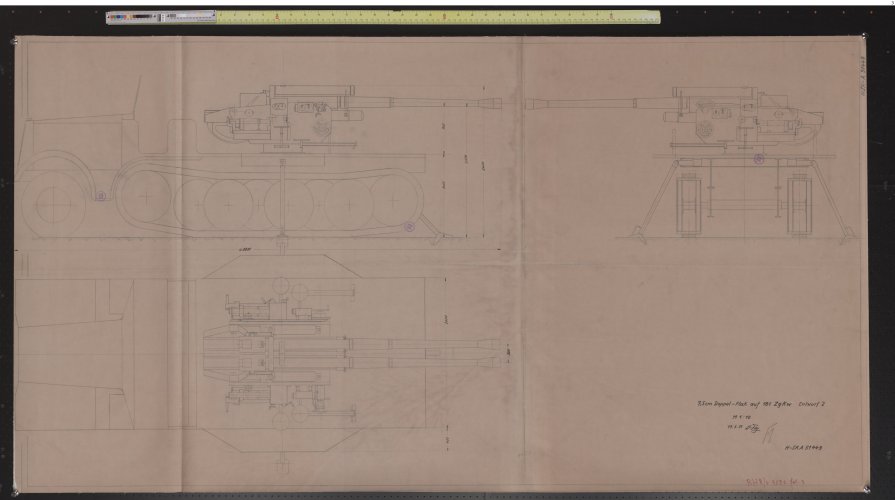
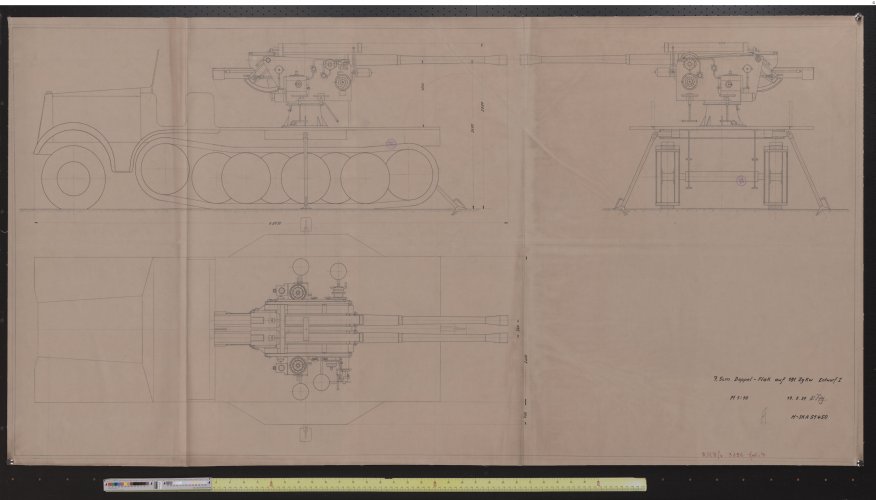
Other oddities would be the 20,3cm Doppelfalk für Küste, RH 8/3039K; the 7,5 cm Doppelflak auf 3 (t) Zugkraftwagen Halbketten-fahrzeug ( two variants, #1 published in Panzer Tracts No.20-2), RH 8/3126K, or the doppelflak 10,5cm, referenced in RH 8/5112. The Gerät 342, with parallel 3,7cm barrels cited in RH 8/639, isn`t expressly stated to be used on a Flakpanzer. It may well be also a land mounting.
 
24cm Super Heavy Flak
(Überschwere Flak 24cm Flak - Luftwaffe - Kriegsmarine - Krupp, Rheinmetall & Skoda)

The 24cm Flak was developed in cooperation with the Kriegsmarine. Development contracts were awarded to Krupp and Rheinmetall, and—at the request of the Waffenkommission —to Škoda as well.

These guns were primarily intended for the defense of high-priority targets such as Hamburg, Berlin, or the Ruhr region. The Kriegsmarine was to deploy these guns on land rather than on ships.

The 24 cm Flak was to be developed primarily for use with remote-controlled, rocket-assisted projectiles. The rate of fire was at least 8 rounds per minute, or 16 rounds per minute for the twin version. Since the projectile was required to weigh at least 200 kg, an automatic loading system was necessary. Great importance was attached to the remote control of the projectiles. Remote control of the projectiles was considered difficult (due to the stresses to which internal components were subjected during firing) it was not deemed impossible.

The lifespan of the gun barrels will be approximately 250 rounds. In a report dated November 13, 1942, Rheinmetall also considered integrating a water-cooling system for such high-performance guns.

At most, 24 guns could be produced per year—though only if a corresponding number of guns fewer were manufactured for the Army and Navy.

Generalfeldmarschall Milch questioned whether it would be better to focus exclusively on anti-aircraft missile projects from the outset and skip the development of the super-heavy anti-aircraft gun entirely. The Führer expressed reservations regarding the development of a super-heavy anti-aircraft gun—albeit under the assumption that the concept was purely ballistic, without remote control. Speer also had concerns regarding the manufacturing aspects.

September 18, 1942, the topic of
engaging enemy aircraft at high altitudes was discussed. The 24cm anti-aircraft gun was also mentioned in this context; regarding remote control, L FLAK is to contact Dr. Brey.

November 9, 1942, it was decided that expert reports from the companies, the Forschungsführung, and the Waffenkommission regarding the 24cm anti-aircraft gun should be obtained.
On December 7, 1942, the reports from Krupp, Rheinmetall, the Forschungsführung, and the Waffenkommission regarding the super-heavy anti-aircraft gun were available.

Due to a shortage of personnel, it was anticipated on January 19, 1943, that the first prototype units of the 24cm anti-aircraft gun could not be completed until January 1948, rather than October 1945.

On April 5, 1943, it was decided to defer the further development of the 24cm anti-aircraft gun in favor of anti-aircraft missiles. Should difficulties arise in the development of the anti-aircraft missiles, the development of the 24cm anti-aircraft gun is to be continued to the extent possible.

On September 30, 1943, the decision was made to halt the development of the 24 cm anti-aircraft gun.

Source:
"Berichte über die Flak-Entwicklungsbesprechungen"
Bundesarchiv
Signatur: RL 3/57
Page: 161, 251, 301, 317 - 319, 339, 367
Direct Link:
https://invenio.bundesarchiv.de/invenio/direktlink/3a122d0a-a629-4b60-9210-ee962aca7259/

Further reading:
State of Development and Development Plans for Anti-Aircraft Artillery
June 22, 1942

Source: Bundesarchiv
Signatur: RL 16-4/11; Page: 8 & 26
Direct Link:
https://invenio.bundesarchiv.de/invenio/direktlink/d1acd55d-606d-498a-a6e3-847d800f5c5f/


Flak-Entwicklungsbesprechung:
Anti-aircraft artillery development meeting on December 7, 1942
Discussion among Milch, von Renz, Löhr, von Axthelm, Steinkopf-Hartig, and Polte regarding the operational potential and development of the super-heavy 24cm anti-aircraft gun.

Source:
Bundesarchiv
Signatur: RL 3/1362; Page: 65 - 121
Direct Link:
https://invenio.bundesarchiv.de/invenio/direktlink/3ee21637-cfd3-4b74-8cdd-8ba4a6500cba/

24cm Rocket-assisted projectile
A rocket-assisted projectile was envisaged for the 24 cm gun. The rocket motor was designed to ignite 1,000 meters after leaving the gun barrel and to maintain a speed of 750 m/s until reaching the target. In addition, the use of a proximity fuze or a self-homing warhead was considered.

Source:
Bundesarchiv
Signatur: ZA 3/836; Page 454
Direct Link:
https://invenio.bundesarchiv.de/invenio/direktlink/f9c815d3-e4b2-4640-bda3-ccf84dff8919/

 
Last edited:
The 24 cm Flak was to be developed primarily for use with remote-controlled, rocket-assisted projectiles. The rate of fire was at least 8 rounds per minute, or 16 rounds per minute for the twin version. Since the projectile was required to weigh at least 200 kg, an automatic loading system was necessary. Great importance was attached to the remote control of the projectiles. Remote control of the projectiles was considered difficult (due to the stresses to which internal components were subjected during firing) it was not deemed impossible.
Do we know what control system was intended? Manual Control?

The USN certainly pulled off a command-deflected shell with the SAM-N-8 Zeus just after the War.
 
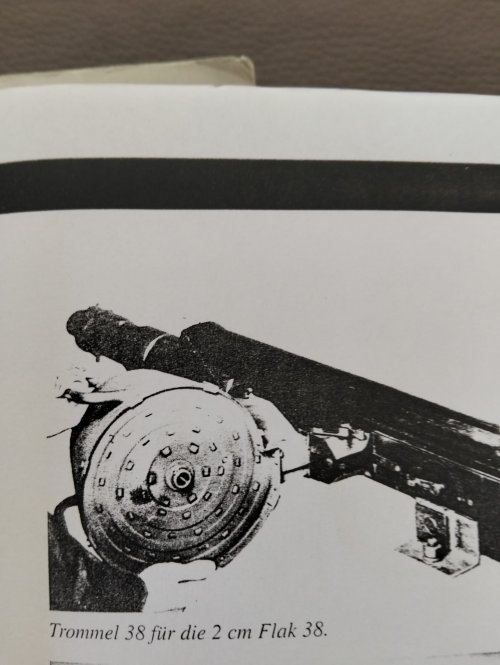
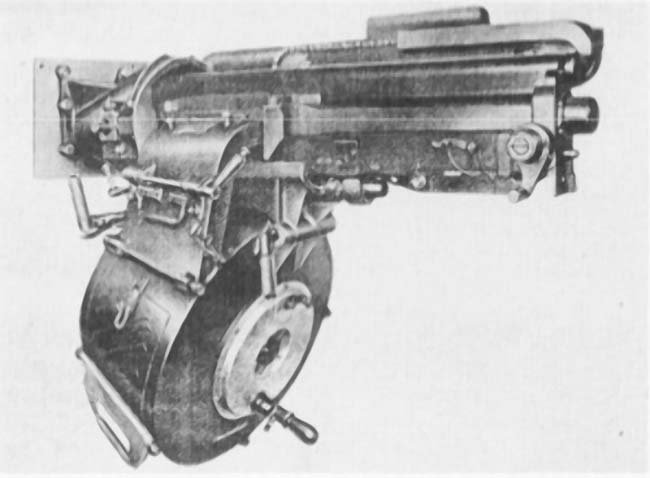
I don't know if this is the right thread, but does anyone know if 40 round magazines ever existed for the 20mm Flak 30 and Flak 38? Some old sources seem to reference them, but this might have been in error since I haven't seen any physical evidence of them. I would imagine the Germans must have looked into larger magazines or alternative feed systems for their 20mm Flak at some point, having to swap out magazines every 20 rounds could be quite a limitation against a fast-moving air target.
 
They developed a drum magazine, but also a belt-fed C/35 automatic cannon.
 
I don't know if this is the right thread, but does anyone know if 40 round magazines ever existed for the 20mm Flak 30 and Flak 38? Some old sources seem to reference them, but this might have been in error since I haven't seen any physical evidence of them.

Two types of drum magazines were developed very late in the war, by Mauser and Keller u. Knappich, and successfully tested. They were approved for production in late February 1945 and delivery of the first batch was scheduled for April 1 only. So most probably they never reached the troops, even if the production was started at all.
 
Do you happen to know the capacities of these drum magazines? I believe the anti-air variant of the 30mm MK103 used a drum magazine though I don't know the capacity of that one.
 
Gerät 342
The Gerät 342 / Flakzwilling 44 was apparently intended to be transported on the Sonderanhänger Sd.Ah.58. During testing, the smaller "Störkreis" -relevant for self-propelled carriages and tank installation (Selbstfahrlafette und Panzereinbau)-was noted as an advantage of the Gerät 342 over the Flakzwilling 43.

Source:
Bundesarchiv
Signatur: RL 3/2576; Page: 135
Signatur: RL 3/2577; Page: 10
Signatur: RL 3/2569; Page: 305
 
Last edited:
Ways to Increase Performance in Weapons Manufacturing - Rheinmetall-Borsig AG - 1942

This report contains, among other things, drawings of the following high-performance guns:

"Comparison of various designs employing an over-caliber barrel (Überkaliberrohr) for the high-performance gun."

12.8 cm Flak 40 with 8.8 cm barrel
Standard 8.8 cm projectile - Muzzle velocity: 1500 m/s
Barrel length: approx. 12000 mm

12.8 cm Flak 40 with conical barrel 12.8 cm/8.8 cm
Flange-projectile - Muzzle velocity: 1440 m/s
Barrel length: 8665 mm

12.8 cm Flak 40
Rocket-assisted projectile - Muzzle velocity: 900 m/s
Sabot projectile - Muzzle velocity: 1390 m/s
Barrel length: 7835 mm


Source: Bundesarchiv
Signatur: RH 8/5210
Page: 104 - 106
Direct Link:
https://invenio.bundesarchiv.de/invenio/direktlink/dda94fcf-517a-41b3-bc3e-c6f2dc89ed27/
 
Rheinmetall-Borsig - Remote-controlled 3,7cm M-Flak 18
Document RH 8/164 lists, on page 6, a 3,7 cm M-Flak 18 with remote control and cruciform type mount carried on two bogies.

Source: Bundesarchiv
Signatur: RH 8/164
Direct Link:
https://invenio.bundesarchiv.de/invenio/direktlink/a9a23258-e3b4-4c2e-b630-395faad08cd1/


Remote-controlled 15cm Flak
October 13, 1942
Development status of L FLAK 2
Remote controlled 15cm Flak (Gerät 60 & 65).
Source: Bundesarchiv
Signatur: RL 3/54; Page: 224
Direct Link:
https://invenio.bundesarchiv.de/invenio/direktlink/2d44bf1f-d65f-4c2d-9604-a511075aa997/

April 29, 1943 – April 30, 1943
Krupp - SAM 15cm Flak Gerät 60 F with armor in circular pit (Kesselbettung).
Source: Bundesarchiv
Signatur: RH 8/2868; Page: 36 - 41
Direct Link:
https://invenio.bundesarchiv.de/invenio/direktlink/d145beaf-918b-467e-a61a-c992376a4235/
 
Remotely ignitable fuze for heavy and super-heavy Flak

October 10, 1942
Development status of L FLAK 1
Developments that will not be completed until the distant future:

8.) Ground-controlled remote fuze:
(Ferngesteuerter Zünder vom Boden)
Detonation is triggered from the ground via transmitted waves. Use of heaviest and super-heavy calibers.
Advantage: Elimination of loading lag time. Simple determination of fuze running time. Reduction of fuze dispersion. Simplification of the gun.
The time still required for development cannot be even approximately estimated at present.

9.) Transmitter for ground-controlled remote fuze:
(Sender für ferngesteuerten Zünder vom Boden)
Generation and transmission of energy for the operation of the ground-controlled remote fuze.
The time still required for development cannot be even approximately estimated at present.


Source: Bundesarchiv
Signatur: RL 3/54; Page: 199
Direct Link:
https://invenio.bundesarchiv.de/invenio/direktlink/2d44bf1f-d65f-4c2d-9604-a511075aa997/
 
Two types of drum magazines were developed very late in the war, by Mauser and Keller u. Knappich, and successfully tested. They were approved for production in late February 1945 and delivery of the first batch was scheduled for April 1 only. So most probably they never reached the troops, even if the production was started at all.
The first mention I can trace of a drum magazine for the Flak 38 is in a Mauser Aktennotiz from October 1943. Further internal reports tell that the drum held 50 rounds, and was tested along a 40 round box magazine, which was, at least, tested in the naval vierling (find attached, taken from BA/MA RM6/2635). I find no hint that Mauser had a in-house drum magazine, only the Keller & Knapich/Augsburg (Kuka) drum is mentioned. Musgrave (see attached) calls it the Trommel 38, the KTB-Chef-TLR as Trommelmagazin 38. This last source mentions two competing designs (Mauser & Kuka) on how to insert the magazines in the receiver, apparently the Mauser support spring prevailing. BTW , the MG C/35G was an updated belt-fed Flak 30, not to be confused with the drum-fed C/30L.
 

Attachments

  • RM_6_2635_0074.jpg
    RM_6_2635_0074.jpg
    1.5 MB · Views: 98
  • Trommel 38.jpeg
    Trommel 38.jpeg
    168.1 KB · Views: 87
  • MG C_30L MG102.jpg
    MG C_30L MG102.jpg
    40.9 KB · Views: 109
Guided 8,8cm anti-aircraft shell
(Lenkbare Flak-Granate, Funkgesteuerte Granate, Ferngesteuerte Granate)

In "FLAK: Die Geschichte der deutschen Flakartillerie und der Einsatz der Luftwaffenhelfer", Horst Adalbert Koch claims there was a project for an 8,8 cm anti-aircraft shell designed to be remote-controlled in flight. The shell was tested in the spring of 1945 at Rheinmetall’s Unterlüss proving ground. Work was undertaken to simplify the control unit and reduce the weapon's heavy weight; however, these experiments did not lead to any practical results.

In "Die deutschen Waffen und Geheimwaffen des 2.Weltkriegs und ihre Weiterentwicklung", Rudolf Lusar mentions "Radio-controlled 8,8 cm shells."


Radio-Measuring Grenade
(Funkmessgranaten, Funkmessgeschoss)

November 1, 1944 - February 10, 1945
Bundesarchiv document RH 8/639 mentions only a so-called "Funkmessgeschoss" on pages 30 and 54.
- Verification of the B.W.E. by measuring the detonation point.
- Signals detectable on the radar up to 8,000 m.


The CIOS report "I.G. Farbenindustrie A.G. Höchst am Main, Germany – Wehrmacht Items, 7–15 May 1945, Page: 4" also mentions "Funkmessgranaten - Dir. Dr. Winnacker – no information was obtained."

Source:
Google-Books
 
Other oddities would be the 20,3cm Doppelfalk für Küste, RH 8/3039K; the 7,5 cm Doppelflak auf 3 (t) Zugkraftwagen Halbketten-fahrzeug ( two variants, #1 published in Panzer Tracts No.20-2), RH 8/3126K, or the doppelflak 10,5cm, referenced in RH 8/5112. The Gerät 342, with parallel 3,7cm barrels cited in RH 8/639, isn`t expressly stated to be used on a Flakpanzer. It may well be also a land mounting.
That unusual anti-aircraft gun—7,5 cm Doppelflak auf 18t Zugkraftwagen Halbketten-fahrzeug—is now available.
I wonder what kind of anti-aircraft gun this is and what its ballistic characteristics are.
 

Attachments

  • RH_8_3126_K_0003.jpg
    RH_8_3126_K_0003.jpg
    924.5 KB · Views: 60
  • RH_8_3126_K_0004.jpg
    RH_8_3126_K_0004.jpg
    979.2 KB · Views: 62
That unusual anti-aircraft gun—7,5 cm Doppelflak auf 18t Zugkraftwagen Halbketten-fahrzeug—is now available.
I wonder what kind of anti-aircraft gun this is and what its ballistic characteristics are.
I`m also not sure, but it looks like a modernised Krupp L/60. "Entwurf 1" has the old Übertragungsgerät 30/36 data transmission system, using concentric light bulbs, which I`ve never seen in a L/60 (but probably in the Rheinmetall L/59). The L/60 balancing springs are present at both developments, but the recoil and recuperator mechanisms are slightly different. The "boxed" body is modern, and "Entwurf 2" has much after trunnions and side fuze setters. All in all, a nice subject. Thanks for sharing!
 
Back
Top Bottom