ALQ-99 and the NGJ jamming prod from Prowler and Growler were RAT powered (albeit one per pod), so it’s certainly not unheard of; equally it could be a powered generator/APU.
 
Last edited:
(facepalm)
Why DF are the Crowsnest retired ? harsh lessons from the Falklands forgotten once again ?
https://www.iiss.org/online-analysi...-airborne-early-warning-little-to-crow-about/Okay... it has become an helicopter Nimrod AEW3 or MR.4, sweet geez.
Just be a bit careful with this. Under British military planning policy, every item of equipment, even if bought that very same day, has to have a stated Out of Service Date (OSD) for budgetary and accounting purposes, especially for things like maintenance contracts.

While Crowsnest currently has a set OSD of 2029, that doesn’t mean it won’t be pushed back and an extended 5 year service contract tendered. There absolutely is a desire to move on to another platform (and get the cabs backs for ASW) but I wouldn’t be surprised to see some flex on 2029.
 
Last edited:
https://warontherocks.com/2025/06/flying-but-not-fused-closing-the-drone-gap-in-the-marine-corps/
Article on the way MQ9s are being used with the USMC.

Highlights that current mission planning surrounding a T5 ISR drone doesnt sufficiently utilize it to the fullest potential yet. More specifically, its the lack of an ISR / sensor centric planning as opposed to the current usage which is using the MQ9 as an asset tangential to mission planning.

Nothing terribly concerning as its part of the USMCs doctrinal shift and getting used to a new type of warfare, but interesting in terms of how MQ9s are envisioned to be used and how it changes the way planning is carried out.
 
'Trainwreck' keeps coming to mind with regards as to the USMC's new 'doctrine'.
 
'Trainwreck' keeps coming to mind with regards as to the USMC's new 'doctrine'.
It's the type of thing that should be trialed at brigade level to see how it works, and what it would take to fix it when you run into the inevitable problems. It's not something to shift the entire force to untested.
 
It's the type of thing that should be trialed at brigade level to see how it works, and what it would take to fix it when you run into the inevitable problems. It's not something to shift the entire force to untested.
Remember how small the USMC actually is. It's only 4 Divisions, and one of those is the reserves. So 3 active divisions total. 9 active brigades. There are currently 3 Littoral Regiments. How many regiments to a Brigade again?
 
I wonder how long it will be before they start equipping MQ-9s with Sidewinders?
That was first done years ago:

https://www.twz.com/23694/heat-seek...reaper-shot-down-target-drone-during-exercise
mq-9-1.jpg
 
https://japannews.yomiuri.co.jp/politics/defense-security/20250915-280951/
The Yomiuri Shimbun

8:00 JST, September 15, 2025

The Defense Ministry is considering the use of unmanned aerial vehicles (UAVs) instead of scrambling Self-Defense Forces aircraft in response to Chinese drones, according to sources.

The ministry plans to use the MQ-9B SeaGuardian, a U.S.-made UAV that the Maritime Self-Defense Force plans to introduce and which can fly for an extended time. The Air Self-Defense Force will conduct tests over three years starting next fiscal year.

The aim is to reduce operation costs of fighter jets.

The MSDF plans to introduce SeaGuardians in fiscal 2027 to enhance its intelligence and surveillance capabilities in the East China Sea and elsewhere. The ASDF is expected to use the UAVs to verify whether it can track and monitor other drones and assess how much it can be used in place of scrambling. The ministry has appropriated about ¥1.1 billion in related costs in its budget request for next fiscal year.

In fiscal 2024, a total of 30 Chinese drones, including those assumed to be Chinese ones, were confirmed by the ministry to be flying around the Nansei Islands and elsewhere, prompting the scrambling of ASDF fighter jets. This was more than triple the nine seen in fiscal 2023.

As of the end of August this fiscal year, 16 Chinese drones had already been spotted.

Two fighter jets are scrambled, in principle, when aircraft or drones posing a risk of airspace incursion are detected by surveillance and control radar or other means. However, each fighter jet is extremely expensive, and fuel expenses and personnel costs for pilots are also significant.

Some in the ministry speculate that China is increasingly flying drones, which involve a low cost per aircraft, thereby waging a war of attrition against Japan and Taiwan.

The SeaGuardian is not only equipped with optical and infrared sensors but also with radar capable of observation at night and in bad weather. Its surveillance capabilities are high, leading the ministry to believe that the UAV will be able to replace fighter jets’ scrambling to a certain degree.

In the event of an airspace violation, fighter jets issue warnings demanding that the other side withdraw. The jets also send out signal flares, and in a worst-case scenario, they launch missiles. However, the SeaGuardian is not equipped with such warning and attack functions.

A key issue in using UAVs instead of fighter jets’ scrambling will be how the drone can respond to airspace incursions.

I fear that this will not work out the way they hope.
 
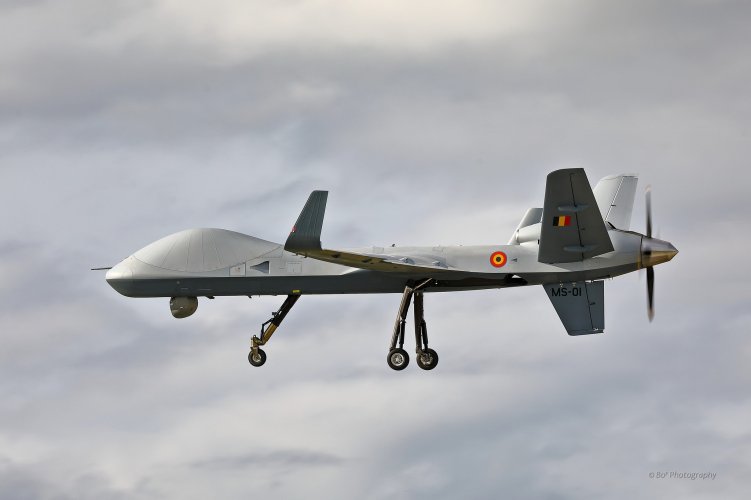
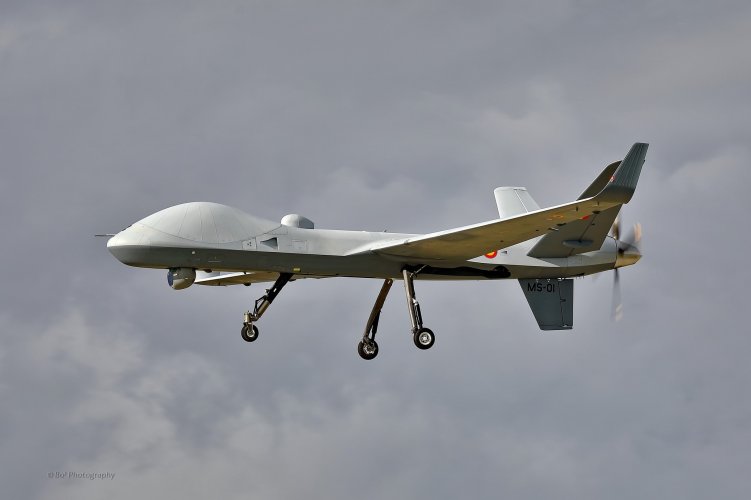
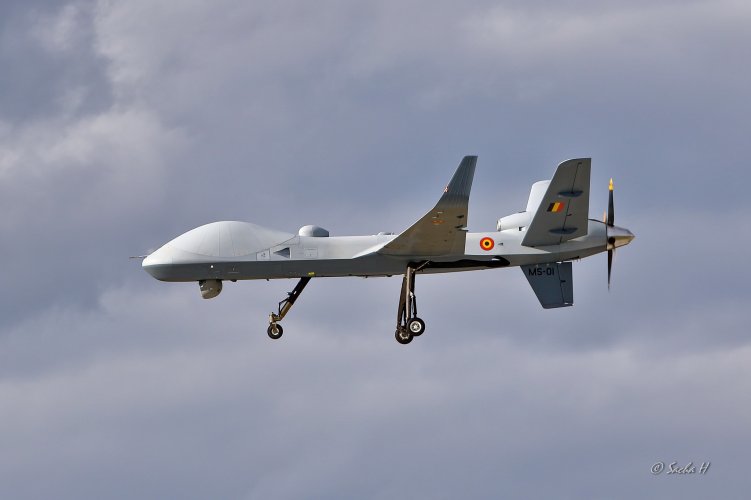
First Belgian MQ-9B SkyGuardian has been presented to the Press today at Florennes Air Base.
the aircraft has recieved full color markings and roundels.
 

Attachments

  • 550866199_10163258254884280_4110397431946719143_n.jpg
    550866199_10163258254884280_4110397431946719143_n.jpg
    294.7 KB · Views: 30
  • 553326655_10163258253814280_1209216478408267747_n.jpg
    553326655_10163258253814280_1209216478408267747_n.jpg
    265.2 KB · Views: 23
  • 552715149_10163258221934280_1976430451617523698_n.jpg
    552715149_10163258221934280_1976430451617523698_n.jpg
    339.8 KB · Views: 34
https://www.army.mil/article/288719...n_integrated_into_mq_9_at_yuma_proving_groundhttps://www.ga-asi.com/ga-asi-and-a...-air-launch-of-switchblade-600-from-mq-9a-uas View: https://x.com/ypg_az/status/1972660203444138028
YPG testers recently evaluated the integration of the Switchblade 600 Block 1 into the MQ-9, often referred to as the Reaper when equipped with a munition.

The Switchblade 600 Block 1 (SB 600) is a state-of-the-art anti-armor loitering munition, featuring the potent warhead employed by the renowned Javelin anti-tank missile. The system excels in range, achieving an impressive distance of up to 175 kilometers when launched from an MQ-9 at an altitude of 30,000 feet.

In the test, the Switchblade was successfully launched twice—once with an inert warhead and once with a high-explosive round—targeting a T-72 tank from YPG's target collection. These tests evaluated the system’s components, from the launcher to its long-range antennas. Control of the SB600 through the MQ-9 Reaper Ground Control Station (GCS) involved an advanced integration of Satellite Communications (SATCOM) and Data Link (DDL) relay, which enabled precise operation over long distances.

Following launch, the SB600 was maneuvered by an operator using SATCOM for over-the-horizon communication, ensuring continuous command and telemetry exchange. The MQ-9 acted as a relay station using DDL to manage real-time video feeds and enhance the munition’s precision during reconnaissance and target engagement. During the test, the SB600 was orbited around the target for confirmation before performing a high-speed attack dash, documented by a UH-60 helicopter and ground-based Kineto Tracking Mounts for comprehensive mission analysis.
 
Last edited:
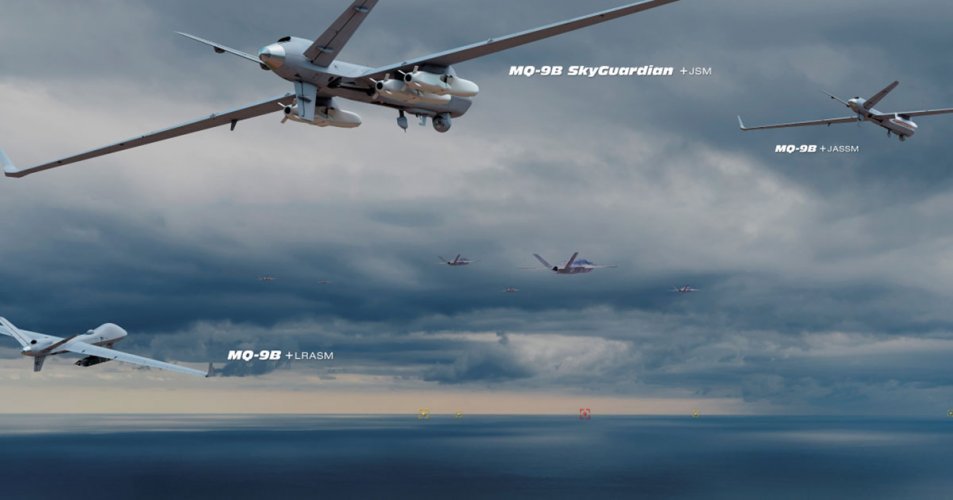
https://www.ga-asi.com/ga-asi-develops-long-range-weapons-capabilities-for-mq-9b

…….LRASM? :oops:

So far, GA-ASI has performed all the performance analytics and is confident in MQ-9B’s ability to carry long-range weapons over long distances, while providing a measure of persistence and endurance. Company engineers and others continue to refine the technical aspects of this integration and potential concepts of operation, eyeing weapons such as the Lockheed Martin Joint Air-to-Surface Standoff Missile and Long-Range Anti-Ship Missile, as well as the Kongsberg/Raytheon Joint Strike Missile.
 

Attachments

  • IMG_0608.jpeg
    IMG_0608.jpeg
    69.8 KB · Views: 18
…….LRASM? :oops:
It's possible, LRASM is just barely within the total weight limit for a Reaper. Not sure how the load is getting carried, unless it's somehow split across the two inner pylons. Officially, those pylons are 1500lbs each. Though it's certainly possible that the Bravo pylons are reinforced up to 3000lbs each.
 
It's possible, LRASM is just barely within the total weight limit for a Reaper. Not sure how the load is getting carried, unless it's somehow split across the two inner pylons. Officially, those pylons are 1500lbs each. Though it's certainly possible that the Bravo pylons are reinforced up to 3000lbs each.
It's confirmed here:

General Atomics Is Turning The MQ-9 Reaper Family Of Drones Into “Cruise Missile Trucks”​

https://www.twz.com/sponsored-conte...r-family-of-drones-into-cruise-missile-trucks
As it sits now, Lockheed Martin’s stealthy AGM-158 JASSM and its anti-ship variant, LRASM, as well as Kongsberg-Raytheon’s Joint Strike Missile are being looked at as weapons options.
 
Given the relatively poor performance of the Reaper in the current conflict, that may be tough to get past Congress.
The entire purpose of this modification would be to circumvent that. It would allow the MQ-9 to launch a recover UASs beyond the reach of hostile SAMs.
 
Given the relatively poor performance of the Reaper in the current conflict, that may be tough to get past Congress.

Relatively poor performance by what metric? Because some were shot down? The only way to measure how effective they are is to compare losses to what they operationally enabled. The full details of that is obviously not public, but clearly they were being used heavily against a threat that is probably the most difficult outside Russia and China.
 
You mean because nobody is smart enough to insist on LO shaping the airframes.

Imagine a Reaper II that is the shape of the TACIT BLUE.
It’s always a trade off and never a sure thing LO is better. Part of the advantage of the MQ-9 is their relatively low cost and extremely low operating cost based on DoD/DoW reimbursement rates.

Part of how it is so cheap (relatively) to build and operate is how simple the design is without needing to design to LO requirements. Just off the top of my head the signature payload of the MQ-9, the MTS-B camera ball, will need significantly more design effort, cost, and performance penalty, to integrate into the aircraft to give it the same field of regard that it currently has by just sticking it out in the flow field. It has no landing gear doors. A plethora of weapons and pods have been integrated on to the MQ-9 because it is easy to do without LO considerations. It is essentially the USAF’s Ford F-150 pick up truck.

Better by being cheap means you can field them in quantity and quantity has a quality of its own. Having 10 MQ-9s available means you can be at 10 places at once collecting ISR. The trade off of losing 3 or 4 could well worth it if they are reasonably cheap to replace. Even if you have a Klingon cloaking device but you can only put it on one plane, you can still only be at one spot collecting intelligence or do whatever it needs to do.

Having it be low cost also have a psychological effect of allowing commanders and operators to take risk that they otherwise wouldn’t. I would wager that is at least a partial reason why the US lost a relatively large number of MQ-9 in the Iran war. They were considered attritible, especially MQ-9As that are due to be replaced by MQ-9Bs. Operators would be willing to send them into high risk high reward scenarios because the cost of failure is low but the payout can potentially be high.

This is why a good force mix is a high-low mix in many situations. You have relatively low cost aircraft like MQ-9s that can give you numbers and volume to handle 85% of all conceivable mission types and be everywhere. At the same time you have a few very expensive but highly specialized VLO aircraft like RQ-180s that can do that remaining 15% of mission that MQ-9s can’t do. In short the answer isn’t a stealthy MQ-9, it’s not either MQ-9 or RQ-180; the answer is both MQ-9s and RQ-180s.
 
It’s always a trade off and never a sure thing LO is better. Part of the advantage of the MQ-9 is their relatively low cost and extremely low operating cost based on DoD/DoW reimbursement rates.
Thing is, you can do a whole lot of stealth with nothing but shaping. No exotic RAM or RAS.


Part of how it is so cheap (relatively) to build and operate is how simple the design is without needing to design to LO requirements. Just off the top of my head the signature payload of the MQ-9, the MTS-B camera ball, will need significantly more design effort, cost, and performance penalty, to integrate into the aircraft to give it the same field of regard that it currently has by just sticking it out in the flow field. It has no landing gear doors. A plethora of weapons and pods have been integrated on to the MQ-9 because it is easy to do without LO considerations. It is essentially the USAF’s Ford F-150 pick up truck.
Yes, internal weapons bays greatly complicate things.

Oddly enough, it'd be easier to replace the Army-operated and generally unarmed Predators with a bunch of TACIT BLUE drones than the USAF-operated armed Reapers.

It wouldn't quite be the same shape as the F-35 EOTS, but you absolutely could set up the angles differently to align with whatever the TACIT BLUE needed to get all your spikes in the same line. If it needs to be bigger than the F-35 you make it bigger. Assuming that the MTS-B eyeball is larger than the Sniper-derived ball, of course.


Better by being cheap means you can field them in quantity and quantity has a quality of its own. [...]

Having it be low cost also have a psychological effect of allowing commanders and operators to take risk that they otherwise wouldn’t.
Agreed. But that's the thing. Stealth doesn't have to be expensive.


This is why a good force mix is a high-low mix in many situations. You have relatively low cost aircraft like MQ-9s that can give you numbers and volume to handle 85% of all conceivable mission types and be everywhere. At the same time you have a few very expensive but highly specialized VLO aircraft like RQ-180s that can do that remaining 15% of mission that MQ-9s can’t do. In short the answer isn’t a stealthy MQ-9, it’s not either MQ-9 or RQ-180; the answer is both MQ-9s and RQ-180s.
And I'm not talking VLO here, I'm talking LO. Maybe F-117 level stuff. Or rather, JASSM level.

What I'm talking about for a "stealthy Reaper" is basically a JASSM with landing gear and a good LPI ground-search SAR/ISAR/GMTI radar installed. If you can find a way to install a stealthy parachute system and a JATO bottle we can skip the landing gear.
 
Haven't Reapers became already de-facto attritables?!
They are so beyond obsolete, if they aren't attritable they should be. What a 'put more expensive lipstick on pig program' that congressional capture is. When a eye drop's worth of a real creative advancement drips out of that place the world is aghast.

When did Kareem first fly what became the Gnat 750 and it has changed how much in this amount of time?
 
Last edited:

Similar threads

Back
Top Bottom