Elan Vital

ACCESS: Secret
Joined
6 September 2019
Messages
391
Reaction score
1,107
Hi everyone,

I noticed that no thread seemingly existed on French artillery projects. I am thus creating this one so that we can eventually gather everything we know.

I will start with some of the projects I identified in my archive research on interwar-1940 work, for now >155 mm calibers as for 155 and below, the number of official projects and private ventures gets really high:

Railway artillery projects:

Many of these projects came from the program of August 24th, 1927. They are discussed in the summaries of French artillery projects from January 1st, 1934 to July 1939, linked here:
https://drive.google.com/drive/u/1/folders/1rFcNwjQAXYVnnvoovAWnXNpXcspLSGX9
The general trend is the modification of existing types of heavy railway artillery (ALVF in French) towards greater ranges, whether with new ammo only or through retubing to smaller calibers.

240 mm Schneider Mle 1929 (Japan type):

This was the result of a study done by the artillery design bureau of the FAMH (Saint-Chamond) company, which was taken over by Schneider in 1924, on the request of the ALVF Committee. Development started in November 1918. This was a new carriage, more modern than the previous Mle 1918, which was tested at Saint-Pierre-Quiberon in 1927. Schneider quickly developped the Mle 1929 from it, and sold it to Japan as the Type 90 railway gun. The 240mm L51 barrel had a range of 59 km.

In the 1930s, France wanted to acquire one or two of these guns, with more modern ammunition and some modifications to the barrel.

370/400 mm calibers:
New ammunition was developped and tested in December 1933 to extend the range of these howitzers to 20 km. The 370 mm used a new, lighter 396 kg round which went a little beyond 20 km, the 400mm would be extrapolated from it.

305 mm caliber:

This involved the 305 mm Mle.1906-1910. The goal was to increase max range from 31 km to 58 km (retubed in 270 mm caliber) or 70 km (retubed in 224 mm). 270 mm was abandonned. Later on, when the Marine Department ceded 12 Skoda 305 mm guns to the War Department, it was decided to keep the Mle 1906-10 as they were (due to the fact they were new and not worn) and to instead retube the Skoda guns to 224 mm L80. The Skoda guns would be fitted on carriages that previously carried unusable (240/155) or worn (305 Mle 1893-96) guns.

Schneider studied the matter and showed that a modern solution could be found, using the same oscillating mount principle as the 150-caliber 240 mm TLP (Very Long Range) gun. The Tarbes workshops (ATS) studied a transformation of the Skoda gun with a screw breech instead of a sliding breech. In 1930, Schneider left due to disagreements in the contract, and Tarbes took over in 1931.

By 1935, it appears that the 224 mm caliber was changed again to 220 mm.

Suspended by 1936.

340 mm Mle 1912 with sliding mount:

The project aimed at increasing the range of this gun to as close to 40 km as possible. In the end a new projectile FATO-31-4° was designed and achieved 37 km.

340 mm Mle 1912 with cradle mount:

Ditto, but the new round was FATO-32-6°

240 mm Mle 1893-96 M (Colonial), 240 mm Mle 1884 (Batignolles) and 240 mm Mle 1876 (on Mle 1916 mount):

The target was 30 km (35 km for Colonial type) instead of respectively 18, 15 and 13 km. The project was led by the Tarbes workshops and involved new ammo and a retubing to 194 mm caliber. They also designed a platform and a quick loading system to allow its use in the Fortified Regions (e.g Maginot line and other fortifications). One prototype of each of the last models was to be delivered in 1934, the first model had already been designed on paper in 1926.

194 mm Mle 1878 on Mle 1916 mount:

This was to be retubed in 145 mm caliber with the same interior dimensions as the new 145 mm tube in development by the ATS to replace the 155 mm GPF. Range increased from 13 to 25 km. Suspended by January 1st, 1935.

305 mm Mle 1906 on Mle 1884 mount:

This transformation was suggested in December 1937, and would involve 2 to 4 guns.

Additionally, a request was made in March 1937 for a new towing railcar to bring railway guns up 9% slopes.

As of 1939, the modified 240 mm Mle 1929 and 240 mm --> 194 mm projects were still ongoing, with a prototype of retubed 240 mm Mle 93-96 not expected until the 2nd semester of 1940. So odds are that these projects were either cancelled after the outbreak of WW2, or were not yet complete when France fell in June 1940.
 
Many thanks for that new compendium about a rarely covered subject !
One question : Was that railcar meant to transport those guns over steep line sections and so to bring them to more remote areas via secondary railways, which often have steeper slopes ? 9% is quite a lot for an adhesion railway, and probably not to be found very often on main railways. Or should it use provisional tracks to increase range, similar to giving a ship or monitor artificial listing to increase the firing angle ?
 
9% is quite a lot for an adhesion railway
That's putting it mildly! In standard British usage, that's 1 in 11.1, the notoriously tough Lickey Incline is only 1 in 37.7. The steepest mainline in the US was the Saluda Grade at 4.24%/1 in 23.5 with a short segment of 4.9% /1 in 20.
 
Many thanks for that new compendium about a rarely covered subject !
One question : Was that railcar meant to transport those guns over steep line sections and so to bring them to more remote areas via secondary railways, which often have steeper slopes ? 9% is quite a lot for an adhesion railway, and probably not to be found very often on main railways. Or should it use provisional tracks to increase range, similar to giving a ship or monitor artificial listing to increase the firing angle ?
Unfortunately the report doesn't tell the motivation behind this project.
 
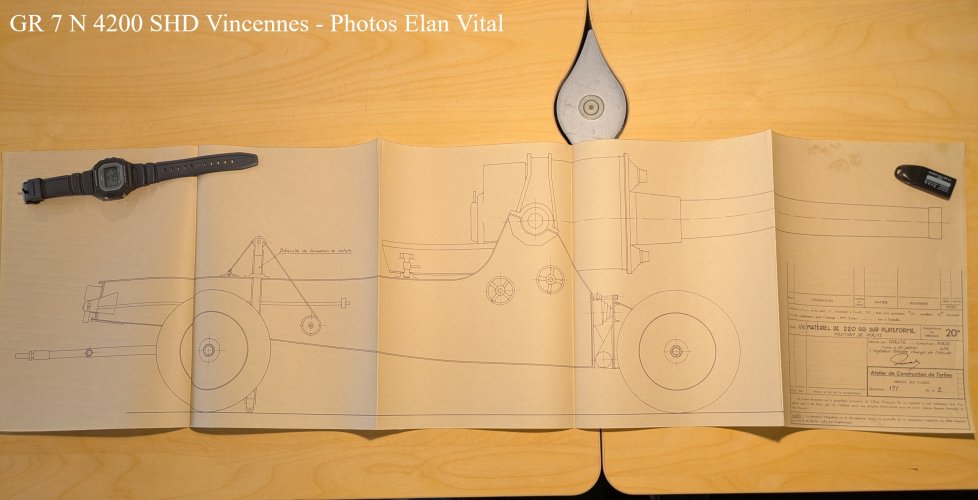
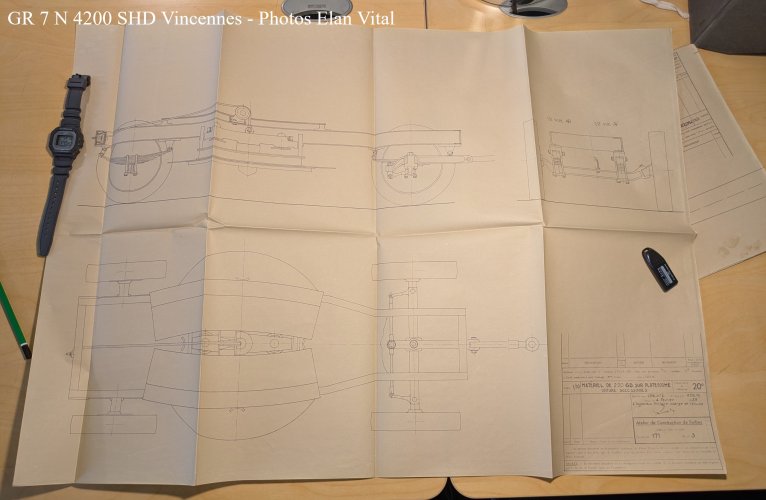
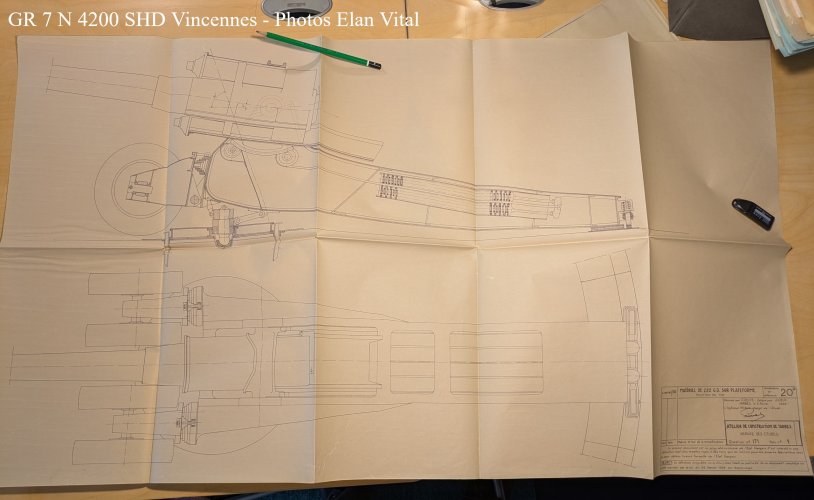
220 mm GD (Grande Destruction aka Great Destruction) howitzer:

The origin of this gun dates all the way back to 1924, with a program specifying:
- a range of 4 to 15 km
- ability to shoot the regular 100 kg Mle 1915 HE round with 20% explosive capacity
- 72° traverse and 10 to 78° elevation
- 2.7 m width, towed as a 13.5t weight or as a 15t tracked trailer.

A first design by the Tarbes workshops was showcased in 1925 on a reinforced 155 mm GPF carriage. The Bourges workshops also started work on a design the same year.

In 1929 the Tarbes design was approved, the Bourges design was shown in 1927 after delays to focus on more urgent works, but was suspended pending results from the Tarbes design's trials. Trials started in 1931 at the Bourges proving grounds and were quite satisfactory, but the reviewing committee found it too heavy (15.6 tonnes) and wanted to limit width to 2.45m.
A second prototype with a special carriage wa ordered in 1932 while the first prototype would be modified or improved. Additionally the 2nd proto was to use heavier rounds, 113 kg concrete-piercing rounds and 120 kg HE.
The 1st prototype with improvements was abandonned in late 1934 following trials.
The 2nd prototype was showcased in November 1935 but after firing trials, the cast steel carriage broke. 2 new carriages were designed and completed in July 1936 (one cast, one with plates).
Fine tuning at the ATS continued until April 1938, which confirmed that cast steel carriages wouldn't work for a powerful yet mobile gun like the 220 GD.

Meanwhile, in 1937, HQ grew uncertain that 220 mm would suffice as a caliber even with a heavier round than for the 2nd proto against permanent fortifications. It became apparent the design was not good enough by modern standards, lacking range, power and being too slow when towed.

A new project already started in April 1938 and was approved the next month, being presented in October 1938. From there, a new specification for a road-mobile split-trail design was decided, but had only a "2nd urgency" priority, behind the new 370mm road-mobile howitzer. In any case the French just wanted to have a complete design studied in peacetime, but that would only be produced in wartime.

The spec required:
- 13 tonnes ready to fire, 15 tonnes in moving order (in the end the project was closer to 17-18 tonnes)
- shot 120 kg concrete-piercing round (this became the 220 mm AC Mle 1939)
- 18 km range
- muzzle velocity: 600 m/s and 635 in the end.
- 20 kph average speed and 30-40 kph max speed

As of September 1939, construction of a prototype was undergoing and it was expected to present it in early 1941.

The 220 GD was fundamentally meant to be a replacement to the 220 mm Mle 1916 howitzer, which had been rushed to the front and was already obsolete when it arrived in service.
The primary benefits of the 1939 design were:
- a 65° horizontal traverse angle, much more convenient than the mere 6° of the Mle 1916, and in practice even less

- increased power: the range of the Mle 1915-D round and the new 220 -37- 2 was just 10.8 km, instead of 18 km. Perforation capability would be notably increased. It's worth noting that in 1939, the French requested experiments against concrete with similar properties to german ones to evaluate the usefulness of 220 mm howitzers. In fact, modern 220 mm mortars were designed abroad at the same time, like thee design by Skoda for Poland. The French mission to Czechoslovakia showed that this gun was weaker than the French design under development, yet worked against 1.35m-thick concrete.

- the increased power was obtained through a 50% weight increase, but the modern layout of the design and use of a single vehicle would notably reduce preparation delays (1 hour instead of 4). Tactical mobility was greatly improved, 20 kph instead of just 5, thereby quadrupling the length of each moving stage.

- Tests were undergoing to check how good explosive rounds would be against concrete. It was believed that satisfactory mortars for this role would be too heavy and fixed, with short range, so couldn't replace powerful howitzers. In any case, the attack of permanent concrete fortifications was a limited role of artillery.
Against hastily-built concrete field fortifications after a breakthrough of the permanent defenses, the 220 mm would become useful again.

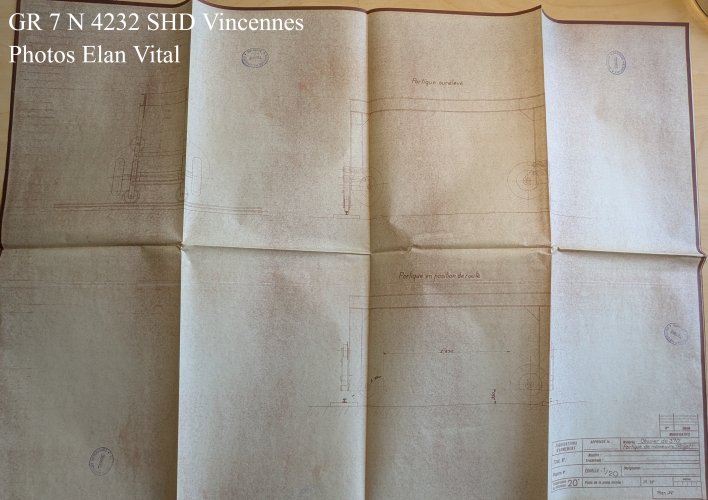
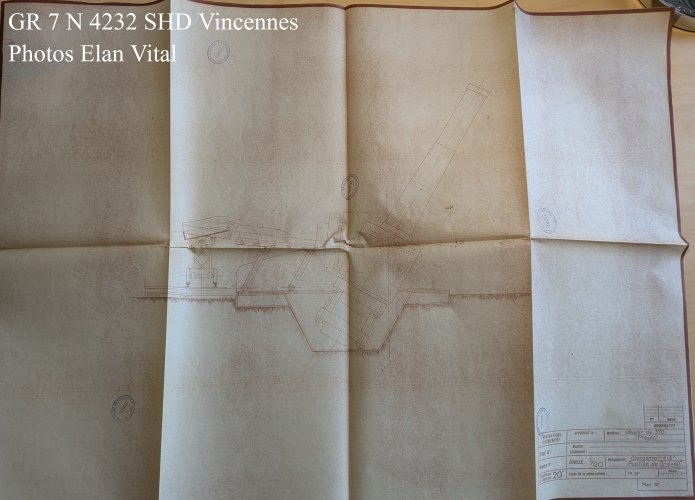
Pics below are for an abandonned platform design from 1939, but the gun part itself should be the same.

280/220 mm SPH:

Meanwhile, it was suggested and studied back in 1936 to convert the existing 280 mm tracked self-propelled howitzers (which didn't make it to WW1) to the original 220 GD concept, which would have extended range from 9 km to 15 km. This was suspended in May 1937 for the same reasons as the early 220 GD, and the SPH would go on as they were, although a concrete-piercing round of the same design as the 220 mm would be produced in WW2.
 

Attachments

  • 251-ink.jpeg
    251-ink.jpeg
    480.3 KB · Views: 178
  • 250-ink.jpeg
    250-ink.jpeg
    556.8 KB · Views: 145
  • 249-ink.jpeg
    249-ink.jpeg
    561.9 KB · Views: 139
Last edited:
Wow, I'm surprised - such a large-caliber howitzer is mobile. I wonder if it's possible to find its full drawings in the archive?

P.S.: Thanks for the interesting information and your work.
There is some info on it. Thanks, you're welcome.

370 mm powerful road-mobile howitzer:

This was requested by HQ in October 1937, with the following specs:
- 370 mm caliber with 15 km range
- can be split into 45 tonne loads (limit of road transport)
- 700 kg projectile with 70 kg of explosives

It was to be compatible with the service Mle 1915 shell.
Study was given to the Tarbes workshops and Schneider.

Tarbes showed a preliminary project in May 1938 that would fire on a platform. The Schneider design moved and fired on tracks. Both were reviewed by a committee led by Général Condé in June 1938.
It was recommended that Tarbes reduce the time to get out of battery to 30 minutes, if need be by abandonning the platform in place. The committee was unsure of the possibility to aim with the tracks for the Schneider design.

A new Tarbes project was shown in October 1938. It involved a system that could be split into 4 loads of 45 tonnes. It would use a tracked carriage that would stand on a platform set up on the ground, without requiring a ditch. The tracks would be lifted by jacks and the carriage linked to the platform with a pivot and aiming ring. When ready to fire, the system weighed 70 tonnes.

The tracked vehicle was designed by the AMX as the Tracteur A. The chassis and electric transmission were designed by Alsthom, the suspension by AMX. Panhard would provide the engines, the large and heavy sleeve-valve V12 KF4 used in rail coaches, providing 450 hp. AMX also requested a new Aster V12 2-stroke diesel engine which would provide 450-500 hp, but would be lighter and smaller.

2 of these equipments would be ordered after review by the Condé committee on December 6th, 1938. As of September 1939, some elements were completed and the complete guns and carriages were expected to be ready in early 1941.

The Schneider design was abandonned in 1940 given that Schneider was overloaded with other work.

Aside from the regular Mle 1915 projectile, the gun was to use a modified Mle 1915 with streamlined rear body to improve ballistic properties and increase range and accuracy. Trial rounds ordered at the same time as the guns were not yet ready when WW2 broke out, due to overload of the factories able to produce large caliber ammo.
A lighter projectile weighing 500 kg but with the same effectiveness as the 700 kg were designed, but no one knows if this was before or after September 1939. Trial rounds were being made in June 1940. This new round was to be compatible with both this new 370mm, but also the Mle 1915 railway mortar and the 370mm railway cannon.

Other 370 mm system:

This was a seemingly separate project, launched by Général Doumenc on April 15, 1940. It was to be a simple design able to fire a projectile with a 150 kg HE charge at 12 km at least.

The 370 mm caliber was found suitable as there existed a 516 kg steel shell with 143 kg of explosives, reaching a range of 13 km with a muzzle velocity of 430 m/s.
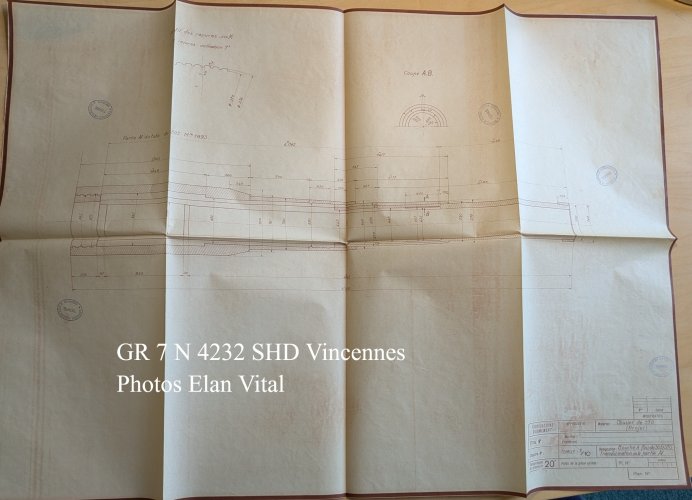
It was suggested to reuse the 8 worn 305 mm Mle 1913 tubes (the plans use Mle 1885 tubes instead), each tube being able to yield two 370 mm tubes.

Each gun would be cut at 6,195 mm away from the breech face. The part with the screw breech (retained) would see some of its frettes removed and diameter of the rear part reduced to 86 cm. The other part would see the excessively thin anterior end removed and replaced by a screwed extension, while a screw breech frette would be added.
They would be then rebored to 370 mm caliber with a 380 mm 80L capacity chamber.

Charge weight: 36 kg of BM9 powder for a 516 kg projectile, maximum pressure of 215 MPa, 439 m/s muzzle velocity achieving a 13.5 km range.
The muzzle velocity regularily coefficient Ia was 0.19 (satisfactory.

Compared to the 370 mm Filloux mortar, the muzzle energy was 5,074,000 instead of 2,579,000, requiring a recoiling mount with hydraulic brakes and a recuperator. Otherwise the carriage would be too large to transport easily. The sysem would be as easy to produce as the Filloux mortar.
The system would comprise a carriage and a platform. There would be a cavity in the median part of the platform descending down to 1.3m below ground level to accomodate the recoil (fire allowed at 45° or greater angles so the gun doesnt need to recoil on the platform itself). This requires removing 8 cubic meters of earth.

The weight of the recoiling part is 14.5 tonnes. Trunion distance to the breech face is 1.8m. Recoil length is 0.8m. Maximum recoil force is 300,000 kgf. The plaform should be 5 by 2.6m or 13 square meters.

Elevation will be from 30 to 65°, with a special device to bring the gun to -6° for loading. Horizontal traverse would be 30°.
The projectile would simply slide down a gutter with rollers.

The system would be split in 3 loads for transport, moving at 30-40 kph on roads. First the 17.5 tonnes of the gun and mount, fitting on a trailer with 4 wheels at the rear on 2-wheel bogies, and 2 steering wheels in front.
The carriage weighs 9 tonnes and would fit on the same trailer, but with 2 wheels at the rear only.
The platform weighs 11 tonnes.

A gantry sitting on rail tracks placed near the battery site would be used to move the three loads in position.

Pics below show this 2nd design.


Basically, both designs were meant to provide extremely powerful artillery fire without requiring railway tracks, in cases where the French offensive would outpace the railway network but would meet heavy fortifications.
 

Attachments

  • 7-ink.jpeg
    7-ink.jpeg
    587.9 KB · Views: 120
  • 10-ink.jpeg
    10-ink.jpeg
    2.4 MB · Views: 107
  • 11-ink(2).jpeg
    11-ink(2).jpeg
    2.1 MB · Views: 182
I think the most interesting projects and prototypes were the 155mm caliber. Elan tell will us more about that...
Correct.

The French desired the following improvements over the 155 GPF:
- a range of at least 25 km
- reduced times to set-up or get in moving order, mostly through the reduction or elimination of the ditch to accomodate the recoil length
- greater towing speeds

Acronyms for the different actors involved:
Ateliers de constructions
- de Tarbes: ATS
- de Bourges: ABS
- du Havre: AHE
- de Roanne: ARE

There were several avenues of development:

145 mm interdictor gun:

The new program for interdictor guns before 1934 called for a GPF replacement with:
- a range of 25 km
- using the 145 mm caliber on the grounds that it could achieve this range at a reduced weight (12 tonnes ready to fire and 13-13.5 tonnes on roads, towed by tractors) and there were beliefs that 155 HE might be a tad too powerful anyway.

This was developped by the ATS.

First trial fires started before 1934 and showed the need for new cases, firing trials were to restart in March 1934 with the complete system not to be showcased until 1935.
This also involved the rebuting of existing GPF guns into this new 145 mm. A new carriage allowing greater firing angles was also being completed. This was to be showcased in the 3rd trimester of 1935. An ABS design was to be showcased in August 1935, then delayed to February 1936.

Firing trials were to start in April 1937, but by then the French were interested in keeping the 155 caliber, the 145 gun being retained only for the study of liners.

155 mm GPF carriage and recoil system upgrades:

Recoil system upgrades:

Another way to reduce the size of the recoil ditch was to reduce recoil length using new recoil brakes and muzzle brakes.

Muzzle brakes were designed by the ATS, Schneider and the AHE.

Several recoil systems were tested, usually with an overcharged recuperator. The ATS tested a 1100 mm recoil length, the APX 800 mm and 800-850 mm by Schneider/AHE.

I do not know which solution was chosen.

ATS design:

In 1935, the ATS showed a new small mount allowing fire at 43° elevation without digging a ditch, but requiring a modified chassis.

The ATS studied improvements to reach 45° without a recoil ditch, to reduce total width, to use knife spades and a simplified set-up sequence. This was to use the split trails, the chassis and wheels of the 220 GD carriage. Before July 1935, 45° was achieved but without completely eliminating the recoil ditch. 24, then increased to 36 new mounts were to be built at the ARE.

A simpler upgrade only used the OG GPF barrel with a muzzle brake, knife spades and a special recoil system.
As of January 1938, the ATS carriage would also be lifted by 0.4 m when firing.

The completely improved ATS design was put in 2nd urgency after the Touzard chassis proved successful due to the long and difficult development period required.

Schneider design:

Through the SOMUA, they designed a system with hydraulic jacks to elevate the gun mount by 0.6 m, requiring no ditch. 15 cm tall anchor knife spades were also developped, and proved much more suitable to withstand the gun's recoil. The spades were built by the AHE. The Schneider system was abandonned owing to insufficient stability, but the spades were used in other designs.

ABS design:

This used two wheeled platforms with planks of 63 cm height, removing the need for a ditch until 33° elevation, and then only a 20 cm deep and 50 cm long ditch was required. Setup time was reduced from 3 hours to 1 h 5 min, getting ready to move took 55 min instead of 1 h 30 min. Original weight was expected to be 1 tonne, but was actually 2 tonnes.

When the Schneider spade box was added, weight grew to 3 tonnes. As a result it was suggested to use 35 cm tall platforms instead and reduce recoil length from 1.05 m to 0.79 m using the R2 Bis recuperator.

Touzard chassis:

This was a new chassis developped by Captain Touzard of the Automobile Vehicles Experimentation Committee, using 4 large diameter rubber-tyred wheels instead of the 2 wheels of the regular GPF axle, tested between August and December 1938.

In running trials in 220 km stages, the new carriage achieved an average speed of 29 to 36 kph and a max speed of 52 kph when towed by the Laffly S35T tractor. The weight supported by each wheel was 2250 kg instead of 3750 kg.

There was no need to release the suspension spring and place the pivot axle when setting up, nor to remove the firing platform when getting ready to move.

A ditch was only needed at 38° elevation due to the point where the gun reaches the rear of the carriage being 45 cm higher than before. As a result, setup time was shortened from over 3 hours to 1 h 55 min, and 1 h 10 min when fitted with the Schneider 0.15 m knife spades (at the cost of 400 m range due to slightly reduced elevation limit).
Total weight was 12,860 kg ready to move, and 11,320 kg setup, with an extra 500 kg for spades or 800 kg for trails.

It was possible to fire up to 36.5° elevation while reducing the recoil length from 6 cubic meters to 0.7 cubic meters. Since the problem of fast transport and high elevation was partially resolved, the development of the wheeled platform was suspended. The study of a 850 mm recoil length system by the ATS was continued to delete the ditch entirely.

The Touzard chassis was adopted for all GPF guns and saw service in WW2, in limited numbers.

155 mm GPAL or 25 km 155 mm:

In 1934, the French started looking at the possibility of achieving the requested 25 km range while retaining the 155 mm caliber.

This led to a new, longer barrel designed by the ATS which tested numerous liner solutions (close liner at the front and elastic liner at the end, autofrettaged monobloc liners by 1939). The interior geometry was identical to the 30 km range 194/155 mm discussed later, and the shell was also shared. In 1937 it was decided to run comparative trials with the same gun but with the rifling pattern of the 155 L Mle 1916 (later modified to test double conical rifling. The goal was throwing a 55 kg shell at 810 m/s using a pressure of 280 MPa.

The GPAL would fit on a small carriage designed by the ATS, to be installed on either the ATS' 220 mm GD chassis or any of the other chassis in development.

New ammo was also designed, with three patterns tested:
- the 57.8 kg STA n°2
- the 54.7 kg EFCA n°3
- the 51.5 kg 155-36-2, later modified to 36-2a which was later effectively adopted for all later trials and was set for adoption for all 155 mm long guns.
- a 55 kg shell with elongated rear base and a light alloy ballistic cap from the 194/155.

The former two shells exceeded 25 km range, the 155-36 exceeded 27 km, all at an elevation of 45°.

The regular GPF achieved a range of 18.4 km using service ammunition, and around 22 km at the GP's limit elevation of 36° using 155-36-2a. At the same angle with new ammo, the Mle 16 pattern achieved 24-25 km, and the GPAL 25-26 km. In fact the GPAL achieved 25 km even at 35° and a reduced pressure of 260 MPa.

At 45°, the GPAL achieved a range of 28 km with a dispersion of 1,020 m and a 17.8 kg charge.
The Mle 16 instead achieved 26.7 km with a dispersion of 940 m and a 16 kg charge.
Service rounds had a dispersion of 600 m. The Mle 16 handled these rounds well, the GPAL required strengthened driving bands to use the old ammo well, but this was acceptable.

The GPAL was deemed generally superior to the Mle 16 due to increased range and similar wear even with a bigger charge. Service life estimated at 1500 rounds. A new round of trials was intended in August 1939 and my archives end here. Presumably, the GPAL continued and would have been introduced in 1941 or later.
In peacetime, it was intended to upgrade General Reserve (Army level) guns to GPAL over several years, while lower level GPFs would be upgraded in a 2nd stage.

The GPAL was, all in all, somewhat analogous to the US 155 M1 Long Tom, though seemingly even longer-ranged. The Soviet 152 mm Br-2 and German 15 cm K 18 and K 39 had a similar range.

164/155 Colonial gun:

By January 1939, the GPAL also interested the colonies, requesting 20 guns and a study for their use as coastal guns and as railway guns on the metric gauge. GPAL guns couldn't be provided, so instead the Metropole envisionned 164 mm guns retubed to 155 mm caliber.

30 km 155 mm gun or 194/155 SP:

This was a pre-1934 project to turn the 155 mm GPC into a 155 mm gun with a range of 30 km. The first tube was destroyed during firing trials and a new one based on a retubed (6° rifling) 194 mm GPF self-propelled gun (again a late WW1 design) was to be ready in October 1935, delayed to April 1936. 1934 trials obtained a range of 28.9 km at 30° elevation, corresponding to 32 km at 37°. By July 1935, it was known a second gun with 8° rifling was being built.
The ammo was the same as the GPAL, on top of a 55 kg round with an elongated base shell and a light alloy ballistic cap.

A new gun with more appropriate steel for the liner was to be delivered in July 1939.

This gun is the only non-railway French gun that I know of that can match the range of the German 17 cm K 18 gun.

​

There is a lot more on the improved GPF/GPAL, and apparently, some plans at Châtellerault and they are among my priority targets for late 2025 or 2026.​
 
Last edited:
Anything on Divisional artillery, or Fortress artillery?

La Muraille de France briefly mentions projects for 90mm and 100mm Divisional Howitzers (the latter designed by the Bourges Arsenal), a 105mm Schneider weapon (in the context of howitzers, so I assume related to the Japanese Type 91 or 105C Model 1934 howitzers rather than the long Model 1913 or 1936 guns), and 75mm and 100mm Naval Guns being investigated as alternatives to derivatives of the 75mm Model 1897 for the flanking casemates of the Maginot line in the late 1920s.

For larger caliber turrets there were variety options considered around the same time, for long turret guns the options were a 105mm gun from Le Creusot, a 105mm gun derived from the 100mm Model 1925 naval gun, a 115mm gun under study, and the 130mm Model 1927 naval gun.

Short turret guns (or howitzers) included a 149mm Schneider Denmark weapon bored out to 155mm, the 155 L model 1877/14, and the 155 C Schneider Model 1917.

There was also a requirement for a very long range 145mm gun, probably related to the system you describe above, with a 138mm naval gun as an alternative.
 
Anything on Divisional artillery, or Fortress artillery?

La Muraille de France briefly mentions projects for 90mm and 100mm Divisional Howitzers (the latter designed by the Bourges Arsenal), a 105mm Schneider weapon (in the context of howitzers, so I assume related to the Japanese Type 91 or 105C Model 1934 howitzers rather than the long Model 1913 or 1936 guns), and 75mm and 100mm Naval Guns being investigated as alternatives to derivatives of the 75mm Model 1897 for the flanking casemates of the Maginot line in the late 1920s.

For larger caliber turrets there were variety options considered around the same time, for long turret guns the options were a 105mm gun from Le Creusot, a 105mm gun derived from the 100mm Model 1925 naval gun, a 115mm gun under study, and the 130mm Model 1927 naval gun.

Short turret guns (or howitzers) included a 149mm Schneider Denmark weapon bored out to 155mm, the 155 L model 1877/14, and the 155 C Schneider Model 1917.

There was also a requirement for a very long range 145mm gun, probably related to the system you describe above, with a 138mm naval gun as an alternative.
I believe I have seen mentions of nearly all of these weapons in the archives.

I will follow with smaller calibers than 155mm later. The fortification guns are all mentioned in the artillery and fortification project overviews, the latter being here: https://drive.google.com/drive/folders/1pMej0qZErDVVkFJC9Yaee2BrYLn6k1Ps

I will add a caliber I forgot, the 270mm coastal guns, but all that was studied for them were new mounts to replace the old (believed worn ) ones. But it was later found the old carriages were not so worn so they were simply refurbished starting in 1939. 93 such guns existed in the stocks.
 
There is more information on the GPF/GPAL improvements, and obviously some plans at Chatellerault, and they are among my priority goals for the end of 2025 or 2026.
Thank you very much, Mr. Vital.
It would be very interesting to see the plans of all these artillery systems.

Why was it such a problem for the French to create a carriage with an elevation angle of 45° without digging a trench? After all, they already had the Canon de 155mm Mle 1932 Schneider system ready, which fired at a distance of 27 km.
 
Last edited:
Thank you very much, Mr. Vital.
It would be very interesting to see the plans of all these artillery systems.

Why was it such a problem for the French to create a carriage with an elevation angle of 45° without digging a trench? After all, they already had the Canon de 155mm Mle 1932 Schneider system ready, which fired at a distance of 27 km.
Hard to say. It may be simple inter-service rivalry, or the Mle 1932 had some limitations that were unacceptable to the Army.
 
Elan Vital, i wonder what other prototypes and projects were smaller than 155 caliber? Thanks.
 
Elan Vital, i wonder what other prototypes and projects were smaller than 155 caliber? Thanks.

I will probably start writing about them tomorrow or Wednesday, not possible today.

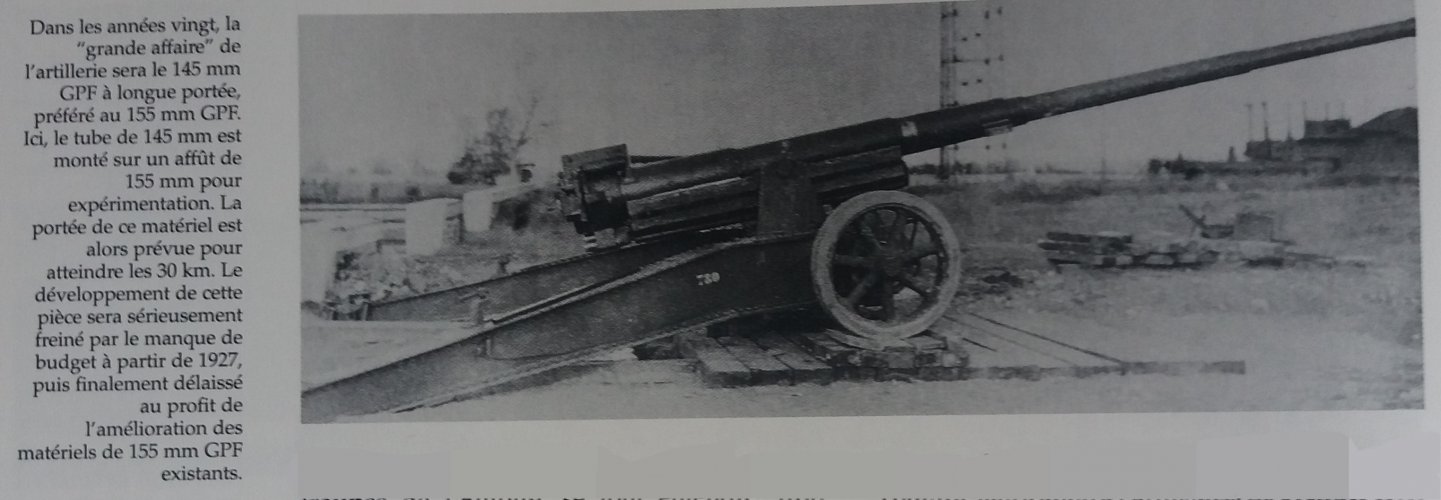
Regarding the long range 145 mm gun that @A Tentative Fleet Plan mentioned, the status reports of studies do mention one, a 30 km range type for the Maginot line.
Unfortunately, they only mention that the study did not yet start in the 1934-37 reports and it was abandoned in 38-39, without ever detailing the design.
 
Regarding the long range 145 mm gun that @A Tentative Fleet Plan mentioned, the status reports of studies do mention one, a 30 km range type for the Maginot line.
Unfortunately, they only mention that the study did not yet start in the 1934-37 reports and it was abandoned in 38-39, without ever detailing the design.
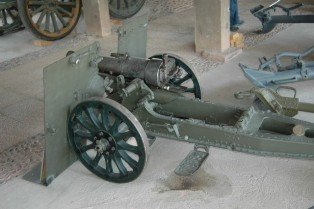
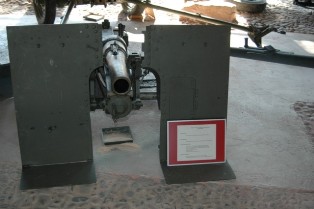
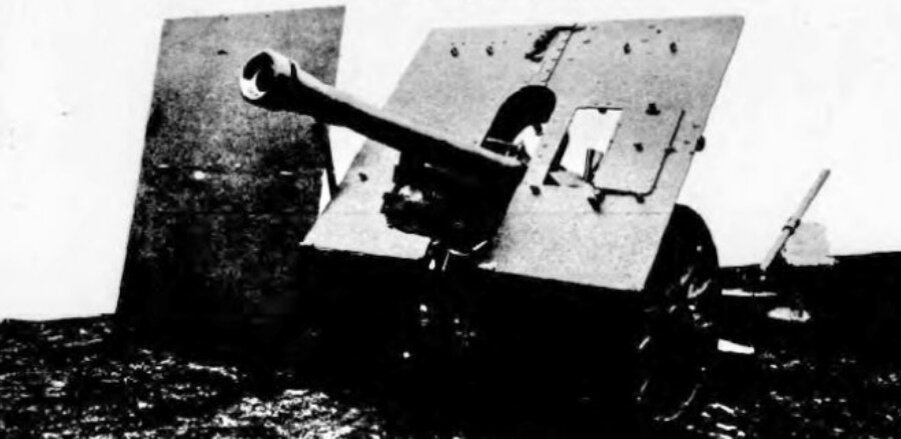
Here is a photo of this cannon, it was built.
 

Attachments

  • 20211012_141153.jpg
    20211012_141153.jpg
    835.3 KB · Views: 187
Regarding the 1920's-early 30's designs, most of what I will write is based on a presentation made at the 11th meeting of the Consultative Committee on Armaments from March 20th, 1934 here:
https://drive.google.com/drive/u/1/folders/1kVfGyxnmsOn4N3umA5c3PcHmRS_ByHjY
The main takeaways from WW1 and 1920's studies were:
- that the French lacked a light division-level howitzer
- that they lacked artillery to follow the infantry and tanks with low range but highly curved trajectories and high maneuverability. 12 km for the light cannon and 10 km for the light howitzer would suffice.
- that counterbattery and interdictor guns had insufficient performance: Army Corps level arty should have a range of 15-20 km and Army level arty should have a range of 25 km or greater.

The light howitzer concept led to the adoption of the Schneider system as the 105 C Mle 1934 S (already ordered by Japan), and of the Bourges arsenal system as the 105 C Mle 1935 B. The light cannon referred to the 75 mm Mle 1897 and its successors, preferably with a split-trail mount or at least a 360° platform like the Vickers system.

105 mm Mle 1913 field gun retubed to 95 mm:

This concept meant to increase the range of the old field gun from 11 to a more adequate 15 km. This would not go forward due to the reduction in explosive power, and instead the French focused on new ammo which did eventually extend range by some 2200 meters.

Bourges 75 mm extra light howitzer:

The program of December 28th, 1923 called for a light howitzer with high mobility to stay as close to the infantry as possible.
This required a weight of no more than 400 kg, with a range of 6 km using a 4.2 kg shell with 1 kg explosive charge. The horizontal arc was to be 125 decigrades at least. This was similar to the US Pack Howitzer or the German le.lG 18.

This led to a 75 mm "extra-light" howitzer designed by the ABS, firing a 4.48 kg shell with 0.9 kg of explosives out to 6.7 km, also able to shoot the service Mle 1915 shell out to 6.2 km. This used a split-trail carriage with a firing arc of 550 decigrades, with a total weight of 685 kg. It could be towed by horses.

It was tested during combined exercises in 1932 and in 1933 at the Committee for practical firing trials when towed by Renault UE tankettes or transported by trucks. The system was fully satisfactory, accuracy was very good up to 5000 meters. Only the shields, the aiming equipment and wheels needed modifications.

Schneider 75 mm extra light howitzer:

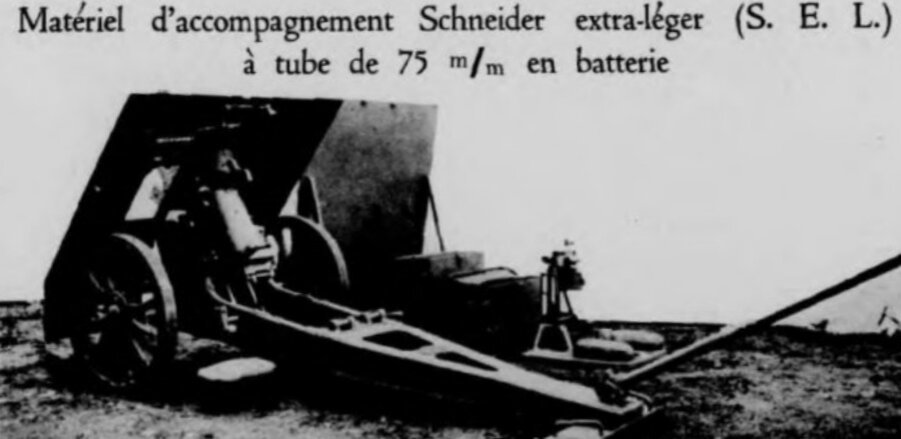
Schneider also had a design for this spec. This was a 75 mm firing a 4.5 kg projectile (1 kg HE) at 7 km. It was mounted on a split-trail carriage with the wheels acting as shields (like the 47 mm Mle 1936 sold to Romania). Firing arc also was 550 decigrades. Weight wouldn't exceed 400 kg.

The 75 mm piece could be swapped for a 47 mm antitank gun firing a 1.5 kg projectile at 800 m/s, corresponding pretty much to the 47mm mle 1936. So it is very likely that the carriage ressembled the 47's.

Pictures exist here: https://artillerie.asso.fr/basart/article.php3?id_article=458
1755779906875.jpeg
fr-75_extraleger-1_w.jpg


The program for light artillery of September 21st (1923 or 24?) called for a light howitzer weighing around 1500 kg ready to fire and 2200 kg ready to move with high horizontal and vertical firing arcs, with comparable max range to the 75 mle 97 (11 km). Indirect fire at an angle of 30° or greater should be possible at all ranges between 3 km and said 11 km. The HE projectile with a maximum weight of 11 kg should have at least equal performance to the 90 mm shell with 1.7 kg of explosives.

This led to:

Bourges 100 mm howitzer:

This was made in 1927 and could shoot at up to 11.5 km with good accuracy, but its weight ready to fire exceeded 2000 kg. It was mounted on the same carriage as the 14 km range 75 mm of this establishment.

Tarbes 100 mm howitzer:

Another 100 mm design, mounted on the same carriage as its 80 mm gun.

Bourges 90 mm and 75 mm howitzers:

Following trials, Bourges was asked to develop a 90 mm howitzer with a range of 11 to 12 km, not exceeding 1500 kg; and of a 75 mm light howitzer.

The 90 mm would end up weighing 1560 kg ready to fire. Its ballistic flexibility was insufficient, so it was rejected by the CCA during its meeting of January 29th, 1932.

The 75 mm mounted the Mle 97 piece to a new split-trail carriage, and became the Mle 97-33. Its ballistic flexibility was also insufficient as field light howitzer. This led to the 105 mm short howitzers discussed at the beginning.

The Bourges Mle 1935 B 105 mm would fire shells that can be obtained with empty 105 mm Mle 1913 and Schneider shells, of which 700 k existed, at full charge. At lower charge, it can shoot 105 mm shells from other models of which 1.3 million existed in storage.

As for the Schneider systems leading to the Mle 1934 S, two designs existed. One weighed 1480 kg and shot a 12 kg projectile at 9.6 km; the other weighed 1550 kg and shot a 15.64 kg projectile at 11 km.


Next uploads whenever I have time will adress the 75 mm field guns, the heavy/long range artillery and mountain guns. But if you can translate or read French, you will truly enjoy the folder I linked at the start of the post.
 
Last edited:
Sure seems like a heck of a lot of different calibers to have to produce shells for.

For example, why make 145mm guns if you can make a 155mm gun with the required range?
 
Sure seems like a heck of a lot of different calibers to have to produce shells for.

For example, why make 145mm guns if you can make a 155mm gun with the required range?
Because they already had 145mm guns in service (interestingly designed to be bored out to 155mm after the barrels were worn out), and stocks of 145mm ammunition. Would also be possible to put a longer ranged 145mm gun instead of a 155mm gun on the same carriage of a given weight.
 
Last edited:
Exactly. So the Canon de 145 L modèle 1916 Saint-Chamond had a slight range advantage. Once barrel wear dictated reboring to 155 mm, the French army was content to accept a somewhat-reduced range in exchange for a slightly increased HE content.

A few of those 145 mm pieces were actually created by boring out Canon de 138 mm Modèle 1910 contre-torpilleurs naval guns (with actual bores of France 138.6 mm but later referred to as the 14 cm Mle 10 L/55). That was a recurring story during WW1 ... unprepared armies adapting naval guns to ad hoc wheeled carriages

BTW, in the search for very long range, in 1918, trial firings were done with an experimental 145 mm gun for the TLP (Très Longue Portée) programme. Compared with the L/48.5 of the 145 L 16, the TLP gun had an L/60 barrel. As a result, the TLP 145 had half again the muzzle velocity of the 145 L 16 (1170 m/s versus 784 m/s).
 
Perhaps I will simply leave here links to Schneider guns, which were developed in the 1920s - 1930s, and were not used by the French army, but were in service in other countries - Greece, Norway, etc.:
75 mm field gun:
https://en.wikipedia.org/wiki/Canon_de_75_modèle_1922_Schneider85 mm field gun:
https://en.wikipedia.org/wiki/Canon_de_85_modèle_1927_Schneider105 mm filed gun (also, photos of 155 mm field gun):
View: https://www.facebook.com/story.php?story_fbid=925913614270687&id=100068320325127

149 mm howitzer:
https://en.wikipedia.org/wiki/Schneider_149_mm_Obusier_Modele_1929105 mm long-range gun:
https://en.wikipedia.org/wiki/Canon_de_105_modèle_1930_Schneider
 
Last edited:
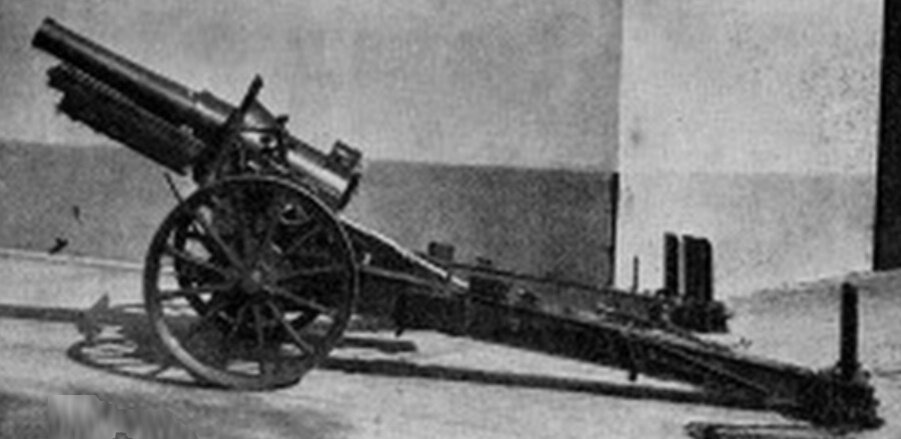
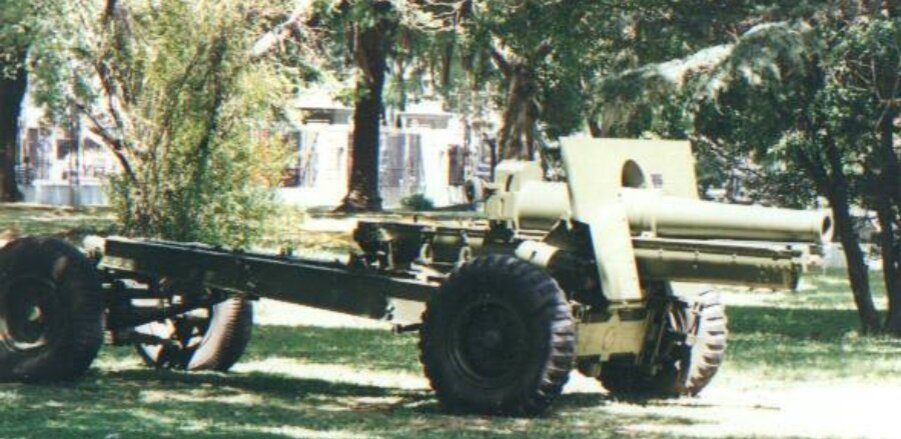
Schneider 155 mm Mle 1915/1917 field howitzer on split trail, used in Argentine
scale_1200 (6).jpeg
scale_1200 (5).jpeg
scale_1200 (7).jpeg
Similar carriages were developed for other artillery, but their use in France was very limited.
 
Last edited:
155 mm GPAL or 25 km 155 mm:

In 1934, the French started looking at the possibility of achieving the requested 25 km range while retaining the 155 mm caliber.

This led to a new, longer barrel designed by the ATS which tested numerous liner solutions (close liner at the front and elastic liner at the end, autofrettaged monobloc liners by 1939). The interior geometry was identical to the 30 km range 194/155 mm discussed later, and the shell was also shared. In 1937 it was decided to run comparative trials with the same gun but with the rifling pattern of the 155 L Mle 1916 (later modified to test double conical rifling. The goal was throwing a 55 kg shell at 810 m/s using a pressure of 280 MPa.

The GPAL would fit on a small carriage designed by the ATS, to be installed on either the ATS' 220 mm GD chassis or any of the other chassis in development.​
What does the "AL" in "GPAL" stand for?
 
Back
Top Bottom