Focke-Achgelis Fa 269
In the morning of October 7, 1939, a concentration of British warships were located in the North Sea by a Heinkel He 111 H-6 reconnaissance aircraft of the KG 26 photographic unit.
This powerful naval group was attacked by 127 Heinkel He 111 and 21 Junkers Ju 88 bombers from the X Fliegerkorps.
The Kriegsmarine staff was also ordered to co-ordinate an aerial attack of its naval air arm. Five Heinkel He 59 torpedo-bomber floatplanes and 23 Dornier Do 18 reconnaissance flying boats were deployed but, despite hours of searching, they failed to contact the enemy, and no concerted Luftwaffe attack was mounted.
On October 22, a new Luftwaffe-Kriegsmarine joint action was attempted against convoy FN24 from Methil to Orfordness.
The attack involved three Ju 88s of the 1.KG 30 and ten Heinkel He 115 floatplanes of the 1./Kü.Fl.Gr.406, but it turned out that the Ju 88s were faster and reached the convoy much earlier than the He 115, alerting the British defenses. When the naval planes began the attack, they were intercepted by Hawker Hurricane and Supermarine Spitfire fighters of the 46th and 72nd RAF squadrons that managed to shoot down four floatplanes and damaged others.
The disaster was used politically to benefit the Luftwaffe. In November 15, Reichsmarshall Hermann Göring ordered the reduction of the Küstenflieger units to just nine long-range reconnaissance and nine multipurpose Staffeln.
By that time, the Graf Zeppelin aircraft carrier was 85 per cent complete and the first carrier-borne wing Trägergruppe 186 (equipped with Junkers Ju 87C and Messerschmitt Bf 109 T-1) was formed at Kiel Holtenau.
Halting all work on the aircraft carrier was proposed on April 28, 1940, during a naval conference. In July, the ship was towed from Kiel to Gdnya and its guns and aircraft were transferred to Norway.
After the loss of its air arm, the Kriegsmarine was forced to operate under the protection of the Luftwaffe in an area comprising most of the Baltic Sea and the Norwegian coast, remaining within the range of the Messerschmitt Bf 110 heavy fighters.
The strategic situation changed in 1941 making it necessary for the German fleet to enter the Atlantic Ocean and raid Allied shipping from North America to Great Britain.
In May, the Bismarck battleship, along with the heavy cruiser Prinz Eugen, were detected off Scandinavia and dozens of Royal Navy combat units were deployed to block their route.
Both German ships were detected again successively by one Short Sunderland from No. 201 Sqn, one Lockheed Hudson from No. 269 Sqn and two Consolidated Catalina from Sqns. Nos. 209 and 240.
After being located by reconnaissance aircraft, the German naval formation was attacked by a squadron of Fairey Swordfish torpedo-bombers from the aircraft carrier Ark Royal.
In the rough sea the German anti-aircraft guns were unable to break up the attack and a torpedo managed to disable the steering system of the Bismarck. The damage delayed the ship enough for the slower British battleships to catch up and sink her.
None of this would have happened if the German naval formation had included an aircraft carrier. The slow biplanes of the Ark Royal would not have stood a chance against the formidable Messerschmitt interceptors, which could also have scared away the reconnaissance aircraft. But all available Bf 109 T-1 units, specially designed for carrier use, were used by the I./JG 77 as night fighters in Norway.
The efficiency demonstrated by British aircraft made it necessary to protect the few German warships that had survived from air strikes during the conquest of Norway. In December 1941, Admiral Erich Raeder, anxious to secure air protection for the Kriegsmarine’s heavy surface units, proposed Hitler that Graf Zeppelin could be finished in about a year and that the carrier could begin combat operations in June 1943.
By that time, it was considered that sufficient experience had been gained in the field of helicopters. A design study order was issued to Focke-Achgelis G.m.b. H, calling for a local defense fighter with extreme vertical-take-off-and-landing (VTOL) and hovering capabilities, able to operate from the rear decks of the warships.
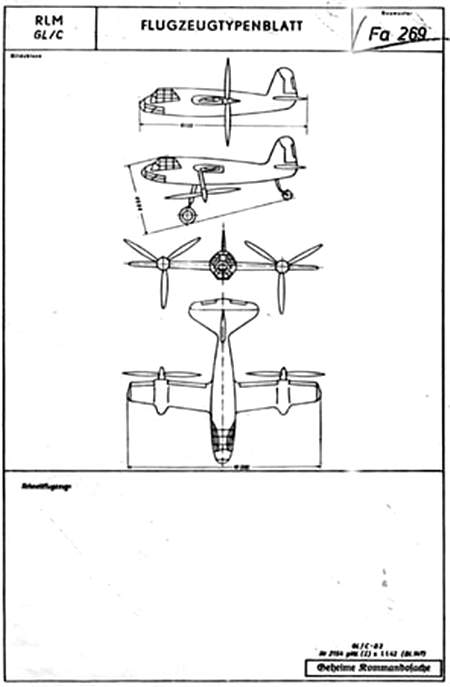
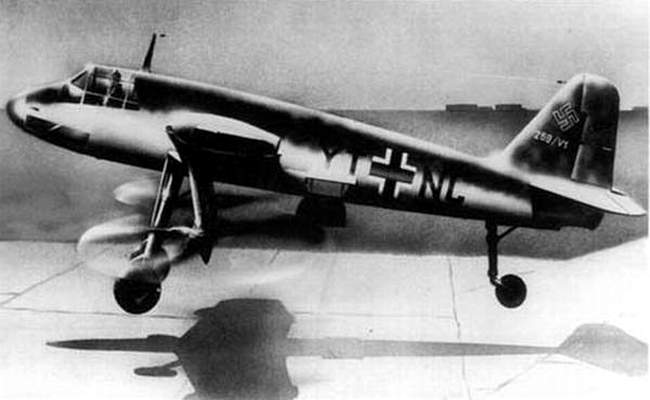
Early in 1942 the Delmenhorts design team proposed the Fa 269, a highly innovative project combining the VTOL capabilities of the helicopter with the speed of a fixed-wing aircraft.
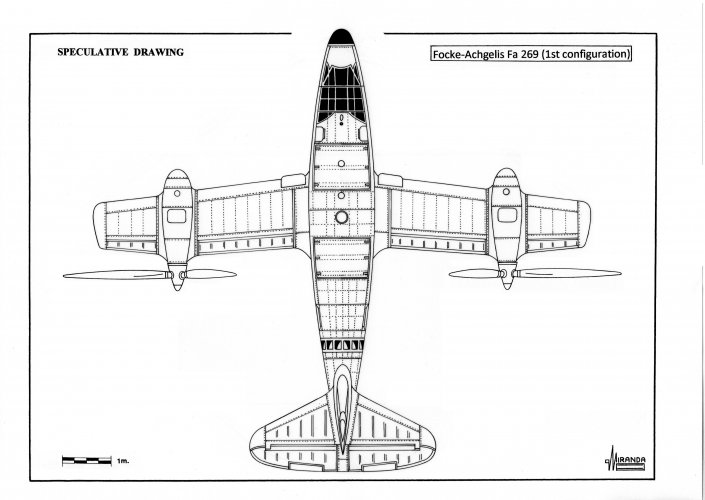
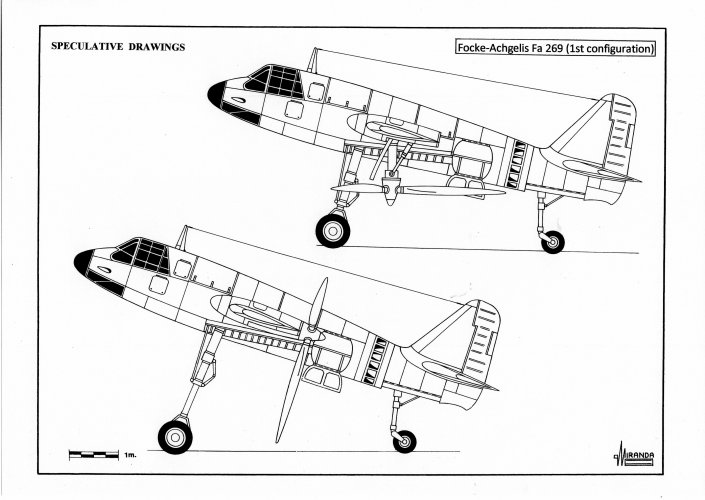
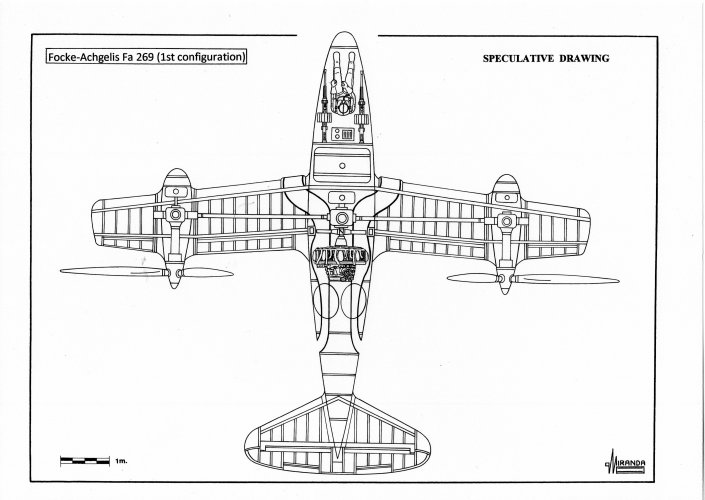
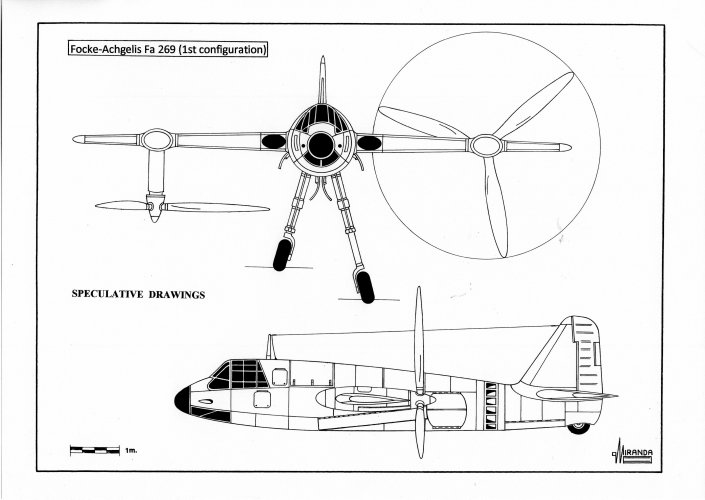
The mid-wing Fa 269 had conventional fuselage and tail surfaces, wing mounted pusher rotors and one radial engine buried in the fuselage, behind the cockpit.
The main drawback of this configuration was the cooling of the engine. It was necessary to design two wing mounted air scoops, two refrigeration air ducts and one forced cooling fan installed in front of the engine. The air circulating through the inner fuselage was expelled, together with the engine exhaust gases, through one annular nozzle located at the rear.
The power plant selected was a BMW 132, a very safe engine that was already being used in several types of naval aircraft such as the Heinkel He 115 and the Arado Ar 196.
Engine power was transferred to both tiltrotors by means of transverse drive shafts housed into the wings and three synchronized gearboxes.
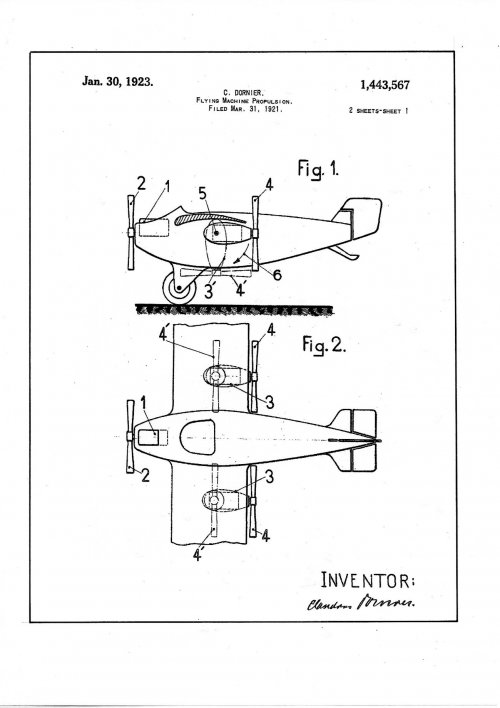
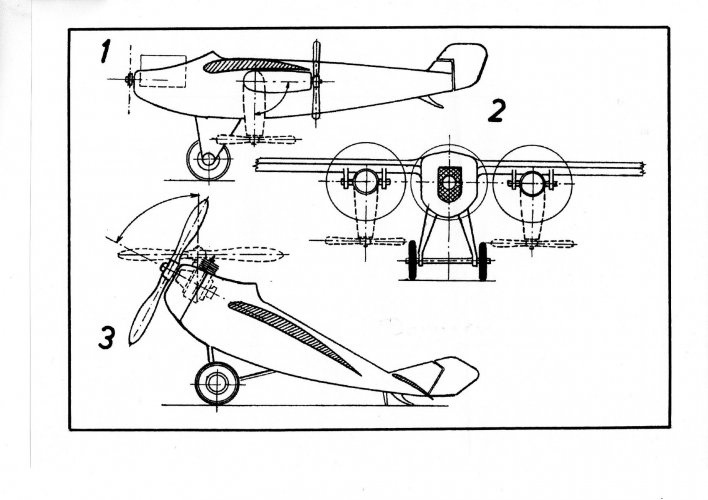
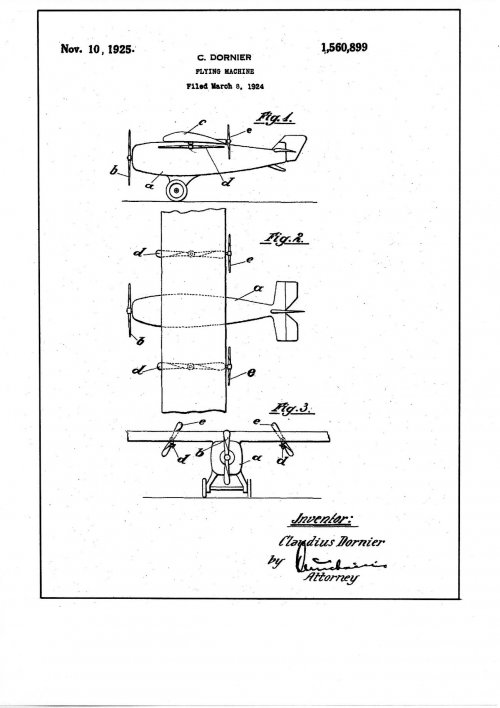
The three-bladed rotors would have pivoted downward and forward through about 85-degrees using the swiveling system patented in 1921 by Claudius Dornier.
Both rotors generated a great deal of torque. To compensate this effect, the starboard propeller rotated in clockwise direction and the port propeller rotated counterclockwise, producing symmetric slipstream effect over the wing areas behind the propellers and giving better airflow over the center portion of the wing.
During the transition the rotors forced air at high speed over the wings, keeping the wing lifting at low speeds and reducing the stall speed. This helped support aircraft weight.
Trailing edge flaps increased lift at partial tilt angles and pusher configuration provided downward thrust and enhance lift.
The length of the telescopic legs of the main landing gear could be varied from 2.06 m and 12-degrees incidence in VTOL mode, to 2.62 m and 18-degrees of incidence so that the Fa 269 could land as a conventional aircraft in case of emergency.
Considerable work was undertaken in the development of gearboxes and power drive shafts, using technologies tested in the Dornier flying boats Do 14 and Do 26.
Wind tunnel models were used to study transition problems and rotor motion at speeds between zero and six hundred kilometers per hour.
The full-scale mock-up was inspected early in 1942.
It was expected to start serial production of the combat version in 1943, but the entire project was delayed after the destruction of the Focke-Achgelis factory during the Allied bombing of Hoykenkamp on June 4, 1942.
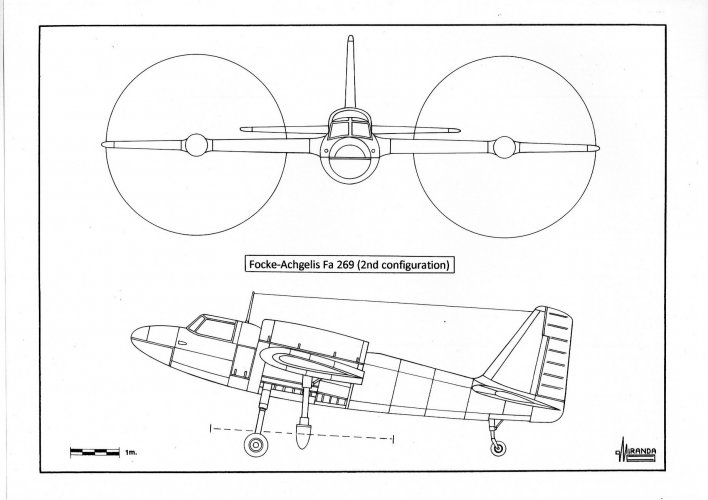
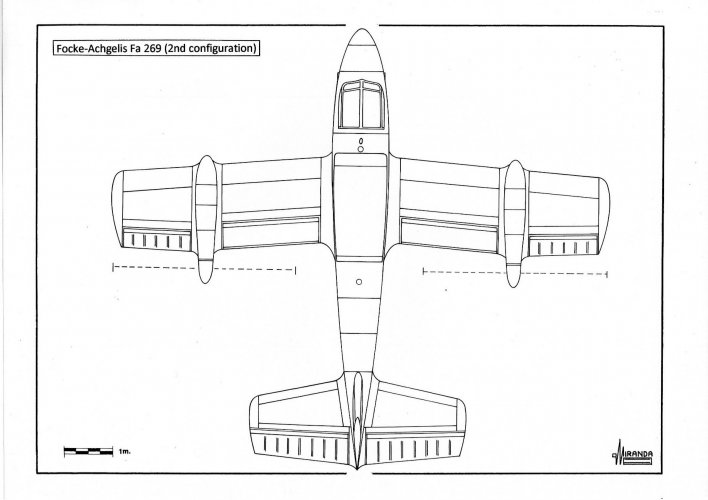
When the Allies began using Consolidated Liberator long-range bombers in the Battle of the Atlantic, the decision was made to replace the 20-mm guns with 30-mm guns. To compensate for the increase in weight the engine also had to be replaced by a BMW 801.
The design work continued until the end of the year, but all development was shelved by late January 1943 when Hitler ordered all its larger warships to be taken out of service and scrapped.
Focke-Achgelis Fa 269 (1st configuration) technical data
Wingspan: 10 m, length. 8.93 m, height (VTOL mode): 4.27 m, height (emergency landing mode): 4.83 m, estimated wing area: 10.77 sq. m, rotor diameter: 4.6 m, estimated max weight: 4,000-4,200 kg, estimated max speed: 570-600 km/h, power plant: one BMW 132 K nine-cylinder, air-cooled, radial engine rated at 947 hp, armament: two fuselage mounted 20-mm MG FF/M cannons, electronics: FuG 17 R/T, FuG 25 IFF, FuG 101 radio-altimeter, vertical speed indicator, turn and bank indicator, RPM rotor indicator and rotor pitch indicator.
Focke-Achgelis Fa 269 (2nd configuration) technical data
Wingspan: 10 m, length. 8.9 m, height: 3.2 m, rotor diameter: 3.76 m, estimated max speed: 570 km/h, power plant: one BMW 801 D-2 fourteen-cylinder, air-cooled, radial engine rated at 1,700 hp (2,100 hp with MW 50 boost), armament: two fuselage mounted 30-mm MK 108 cannons.