Focke-Achgelis projects

hesham said:
during the 1945,Focke-Achgelis worked on a heavy helicopter with an increased loading
capacity ?.


The source;

"X-planes - German Luftwaffe Prototypes 1930-1945" by Manfred Griehl, Casemate 2012
 

Attachments

  • 0-1.png
    0-1.png
    76 KB · Views: 266
  • 1.png
    1.png
    28.7 KB · Views: 135
  • F-A.png
    F-A.png
    5.5 KB · Views: 127
Jemiba said:
Maybe this one, found on http://paralympic-ph.com/germanvtol/fockeachgiles/284folder/233z.jpg ?
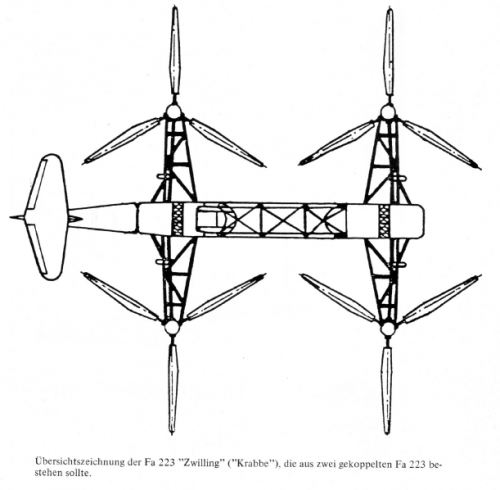
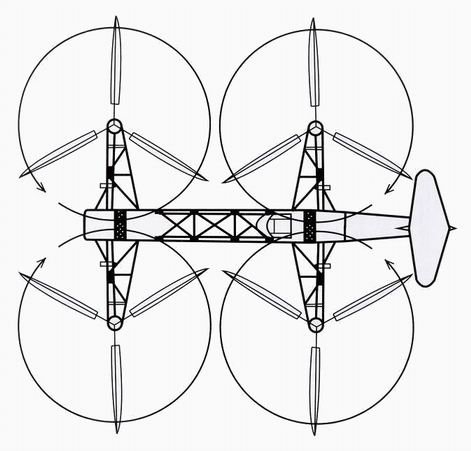
Not a "Zwilling in the sense of, say, the He 111Z, but more logical. And it's designated Fa 223Da
on that site (http://paralympic-ph.com/germanvtol/fockeachgiles/284folder/fa284.html, sorry, had
a typo in the file name), not sure what it meant, maybe "Doppel Antrieb", because it used two
complete dynamic systems, but it could as well have had no special meaning at all. At least, this
designation is mentioned in several sources, whereas "Fa 223Z" is unconfirmed, as Skyblazer correctly
pointed out.


From Waffen-Arsenal band 128.
 

Attachments

  • 223Z.png
    223Z.png
    101.4 KB · Views: 142
  • 223 Zwilling drawing.png
    223 Zwilling drawing.png
    115.9 KB · Views: 143
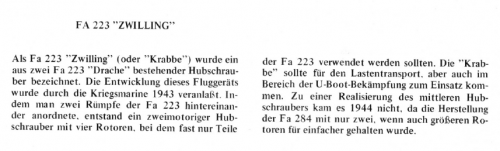
Also from the same source (Waffen-Arsenal band 128);


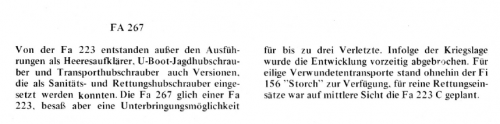
the Focke-Achgelis Fa.267 was developed from Fa.223 as anti-submarine and transport helicopter project,also used as an ambulance helicopter,but the development terminated.
 

Attachments

  • 267.png
    267.png
    77.6 KB · Views: 137
Last edited:
The zwilling project depicted above is called the Fa 325 Krabbe in other sources, and described as a 1943 project. Here is another picture of it.
 

Attachments

  • Fa 325 Krabbe (1943).jpg
    Fa 325 Krabbe (1943).jpg
    30.8 KB · Views: 169
As Maveric requested;

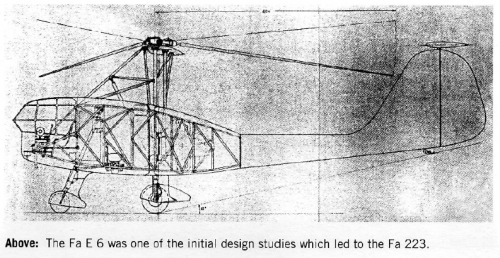
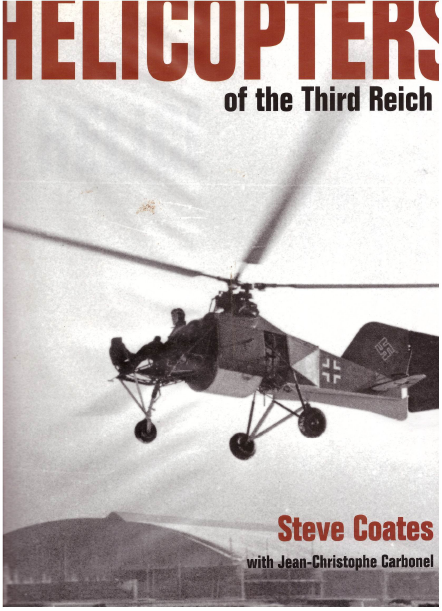
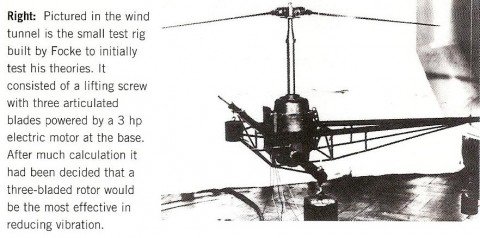
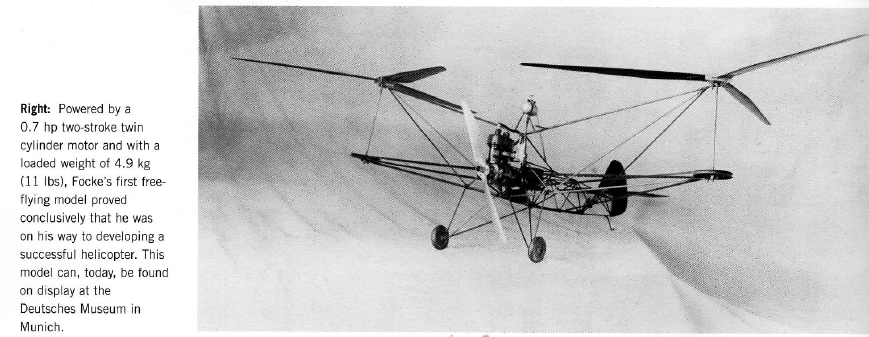
the source for Focke-Achgelis E.6 which led to develop Fa.223 is the book;
Helicopters of The IIIrd Reich
 

Attachments

  • E.6.png
    E.6.png
    378.7 KB · Views: 189
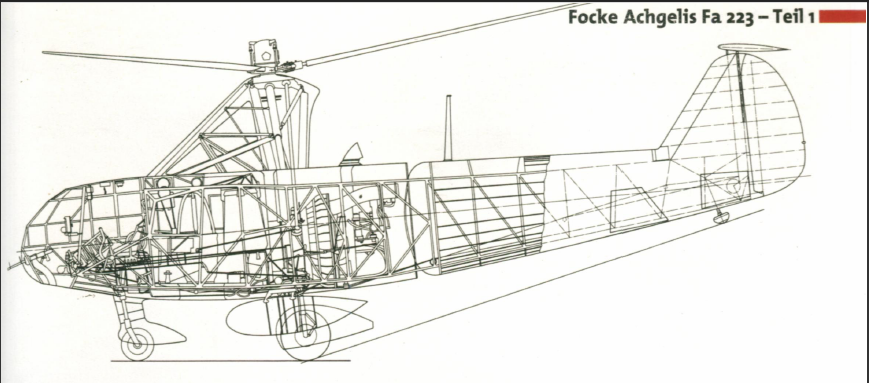
Focke-achgelis fa 223 A version:
Focke_Achgelis_Fa223-02-24.JPG

Focke_Achgelis_Fa223-02-25_0.JPG

Focke_Achgelis_Fa223-02-26.JPG

Focke_Achgelis_Fa223-02-27_0.JPG

Focke_Achgelis_Fa223-02-28_0.JPG

and here the focke-Achgelis fa 229:
fa269_08.jpg

fa269_04.jpg

Fa_269_wind_tunnel_375x219.jpg

the source: https://forum.warthunder.com/index.php?/topic/170730-focke-achgelis-fa-269/&page=2
https://forum.warthunder.com/index.php?/topic/221093-ai-helicoptersautogyro/&page=2
 
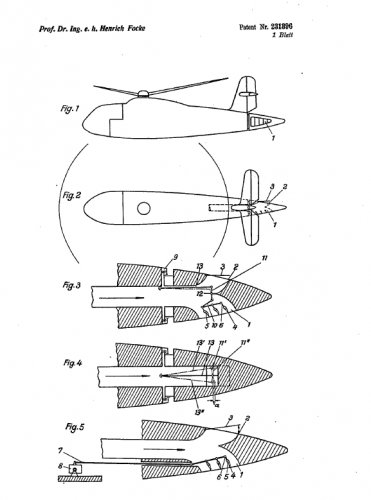
Patent Nr: CH231396
Title: Hubschrauber mit Einrichtung zum Ausgleich des Rückdrehmomentes.
Inventor: Heinrich Focke
Year: 16.06.1944
The patent shows a NOTAR concept.
Maybe the FA.283?
Direct link
https://depatisnet.dpma.de/DepatisNet/depatisnet?action=pdf&docid=CH000000231396A
 

Attachments

  • Patent_Henrich_Focke.jpg
    Patent_Henrich_Focke.jpg
    139 KB · Views: 203
BTW, I would recommend to attach drawings from such patents, additionally to a direct link.
In this case, the link gives a description, for the drawing, you have to choose "Volldokument
laden", probably not obvious to everybody.
 
sgeorges4 said:
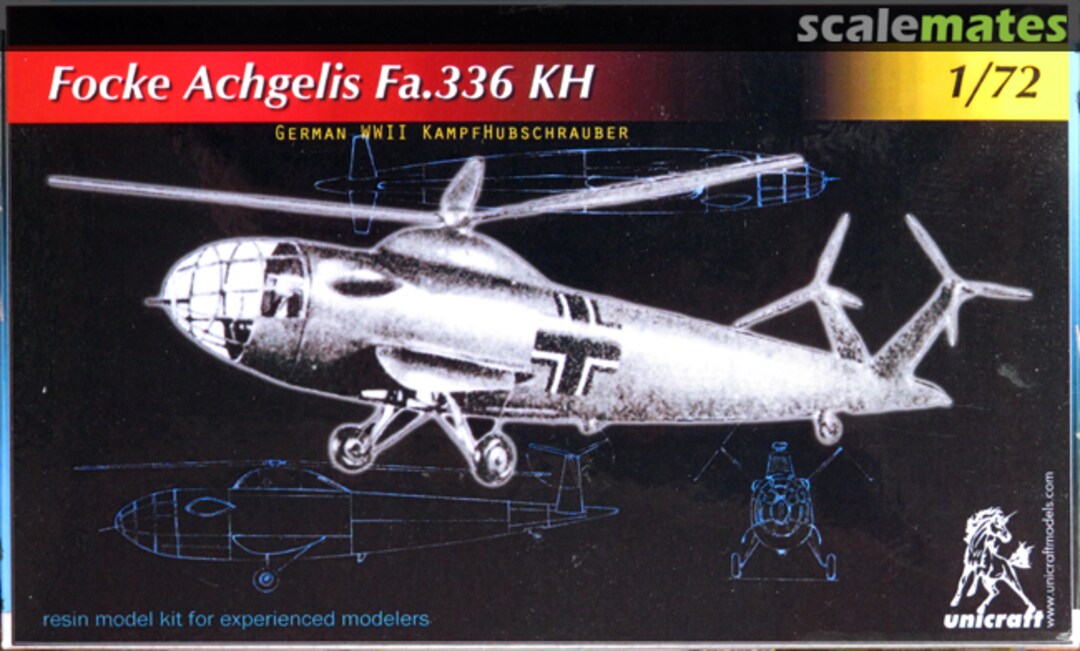
thank,now the focke achgelis fa 336 KH:
164910-16236-35-pristine.jpg

We have it here;

https://www.secretprojects.co.uk/forum/index.php/topic,4695.msg255026.html#msg255026
 
From, Flugzeug Classic Special 08. Kolbenmotor-Militarflugzeuge 1933-1945. Zerstorer, Transporter, Aufklarer, Hubschrauber - (2011),

Fa.223E.
 

Attachments

  • 1.png
    1.png
    331.5 KB · Views: 194
Hi everybody

I have a few questions about the Fa 223 / Krabbe.
Why is a helicopter a better torpedo carrier than an airplane ?
Where is this quad flak located ?
Why only one torpedo ? For such a big helicopter !

Where is the Cockpit located ? In the first fuselage or the second ?

Maybe someone can draw such a flying S-Boot with one torpedo or the flak ?

Many greetings and many Thanks in advance
Hi everybody

I have a few questions about the Fa 223 / Krabbe.
Why is a helicopter a better torpedo carrier than an airplane ?
Where is this quad flak located ?
Why only one torpedo ? For such a big helicopter !

Where is the Cockpit located ? In the first fuselage or the second ?

Maybe someone can draw such a flying S-Boot with one torpedo or the flak ?

Many greetings and many Thanks in advance

Modern navies use Helicopters for short-range, anti-submarine missions because helicopters can land on tiny flight decks. Torpedo carrying really only became practical when turbine engines were perfected during the 1950s.
Naval helicopters are also handy for cross-decking personnel and supplies (e.g. mail) medical emergencies, landing small raiding parties, search and rescue, etc.

Master Corporal (retired) Robert Warner, CD, BA, flight deck crew on HMCS Iroquois, etc.
 
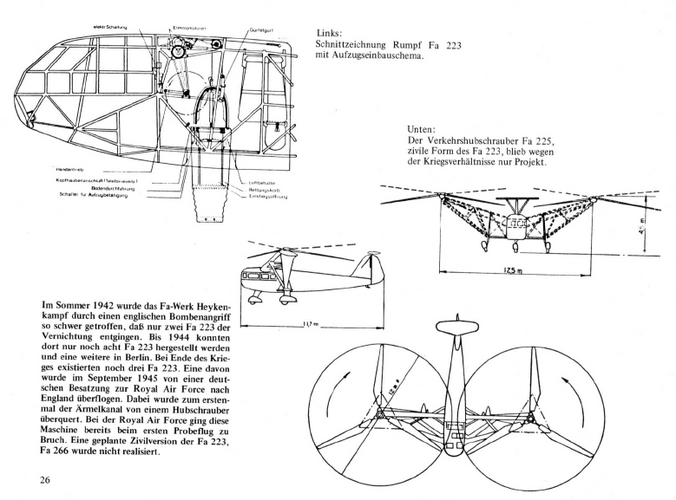
From, Waffen-Arsenal_065_Die_deutschen_Hubschrauber_1928-45.
 

Attachments

  • 1.png
    1.png
    188.8 KB · Views: 155
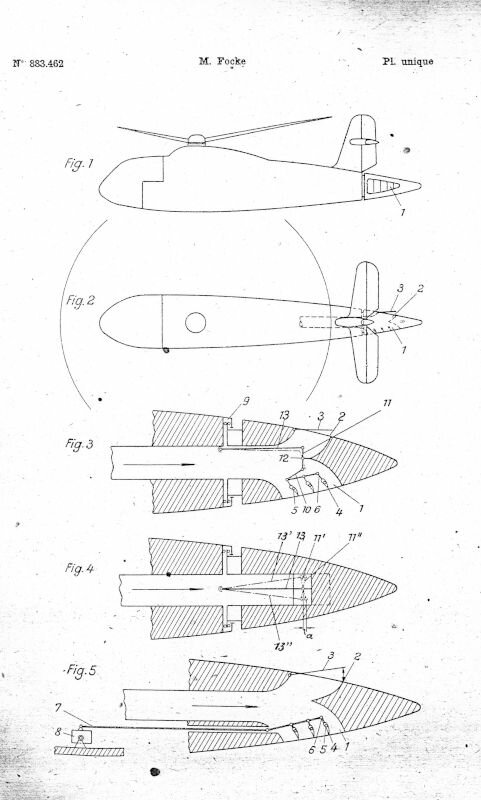
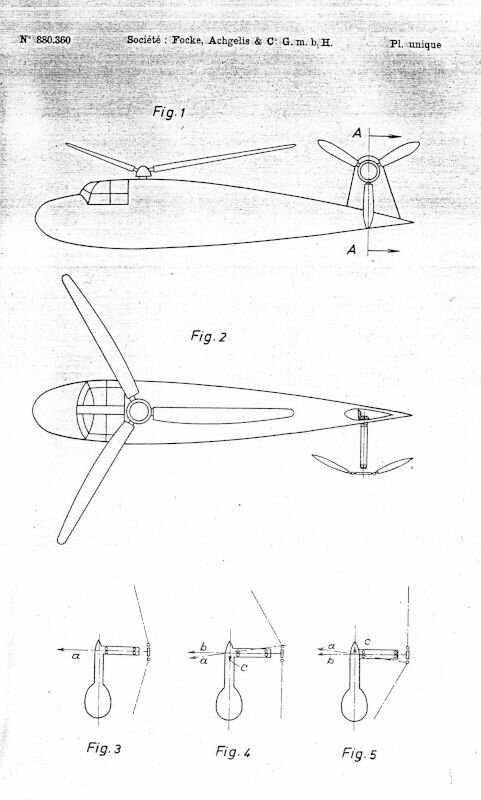
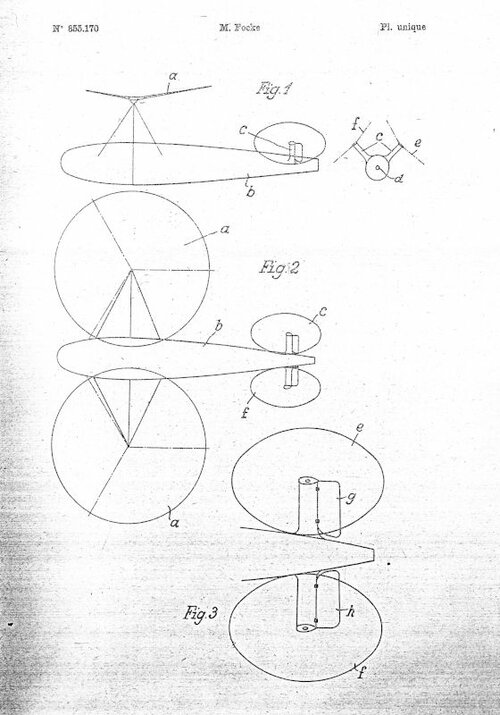
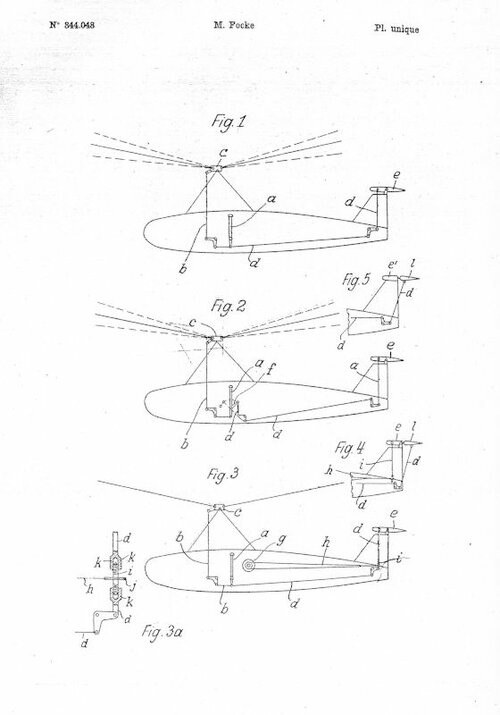
In addition to the side by side twin-rotor formula, Heinrich Focke have studied plenty of different solutions for anti-torque on helicopters, as shown by his patents:
 

Attachments

  • Focke 883.462.jpg
    Focke 883.462.jpg
    56 KB · Views: 98
  • Focke 880.360.jpg
    Focke 880.360.jpg
    55 KB · Views: 76
  • Focke 855.170.jpg
    Focke 855.170.jpg
    66.2 KB · Views: 77
  • Focke 844.048.jpg
    Focke 844.048.jpg
    41.1 KB · Views: 84
Last edited:
Hi moin 1900! I,ve information about this two proyects. FA 223 and Flettner "Kolibri", blueprints , pictures and more.
Hello! Are you still around here? Do you still have the original CAD model of the FA 223? I'm very interested in getting it, thanks!!
 
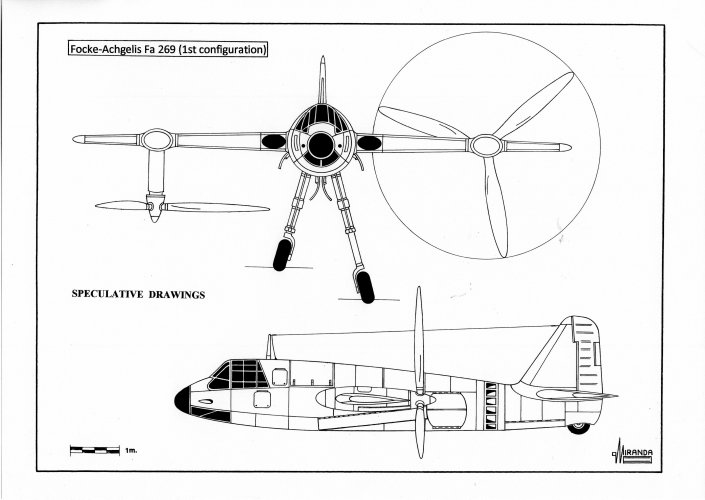
Focke-Achgelis Fa 269


In the morning of October 7, 1939, a concentration of British warships were located in the North Sea by a Heinkel He 111 H-6 reconnaissance aircraft of the KG 26 photographic unit.

This powerful naval group was attacked by 127 Heinkel He 111 and 21 Junkers Ju 88 bombers from the X Fliegerkorps.

The Kriegsmarine staff was also ordered to co-ordinate an aerial attack of its naval air arm. Five Heinkel He 59 torpedo-bomber floatplanes and 23 Dornier Do 18 reconnaissance flying boats were deployed but, despite hours of searching, they failed to contact the enemy, and no concerted Luftwaffe attack was mounted.

On October 22, a new Luftwaffe-Kriegsmarine joint action was attempted against convoy FN24 from Methil to Orfordness.

The attack involved three Ju 88s of the 1.KG 30 and ten Heinkel He 115 floatplanes of the 1./Kü.Fl.Gr.406, but it turned out that the Ju 88s were faster and reached the convoy much earlier than the He 115, alerting the British defenses. When the naval planes began the attack, they were intercepted by Hawker Hurricane and Supermarine Spitfire fighters of the 46th and 72nd RAF squadrons that managed to shoot down four floatplanes and damaged others.

The disaster was used politically to benefit the Luftwaffe. In November 15, Reichsmarshall Hermann Göring ordered the reduction of the Küstenflieger units to just nine long-range reconnaissance and nine multipurpose Staffeln.

By that time, the Graf Zeppelin aircraft carrier was 85 per cent complete and the first carrier-borne wing Trägergruppe 186 (equipped with Junkers Ju 87C and Messerschmitt Bf 109 T-1) was formed at Kiel Holtenau.

Halting all work on the aircraft carrier was proposed on April 28, 1940, during a naval conference. In July, the ship was towed from Kiel to Gdnya and its guns and aircraft were transferred to Norway.

After the loss of its air arm, the Kriegsmarine was forced to operate under the protection of the Luftwaffe in an area comprising most of the Baltic Sea and the Norwegian coast, remaining within the range of the Messerschmitt Bf 110 heavy fighters.

The strategic situation changed in 1941 making it necessary for the German fleet to enter the Atlantic Ocean and raid Allied shipping from North America to Great Britain.

In May, the Bismarck battleship, along with the heavy cruiser Prinz Eugen, were detected off Scandinavia and dozens of Royal Navy combat units were deployed to block their route.

Both German ships were detected again successively by one Short Sunderland from No. 201 Sqn, one Lockheed Hudson from No. 269 Sqn and two Consolidated Catalina from Sqns. Nos. 209 and 240.

After being located by reconnaissance aircraft, the German naval formation was attacked by a squadron of Fairey Swordfish torpedo-bombers from the aircraft carrier Ark Royal.

In the rough sea the German anti-aircraft guns were unable to break up the attack and a torpedo managed to disable the steering system of the Bismarck. The damage delayed the ship enough for the slower British battleships to catch up and sink her.

None of this would have happened if the German naval formation had included an aircraft carrier. The slow biplanes of the Ark Royal would not have stood a chance against the formidable Messerschmitt interceptors, which could also have scared away the reconnaissance aircraft. But all available Bf 109 T-1 units, specially designed for carrier use, were used by the I./JG 77 as night fighters in Norway.

The efficiency demonstrated by British aircraft made it necessary to protect the few German warships that had survived from air strikes during the conquest of Norway. In December 1941, Admiral Erich Raeder, anxious to secure air protection for the Kriegsmarine’s heavy surface units, proposed Hitler that Graf Zeppelin could be finished in about a year and that the carrier could begin combat operations in June 1943.

By that time, it was considered that sufficient experience had been gained in the field of helicopters. A design study order was issued to Focke-Achgelis G.m.b. H, calling for a local defense fighter with extreme vertical-take-off-and-landing (VTOL) and hovering capabilities, able to operate from the rear decks of the warships.

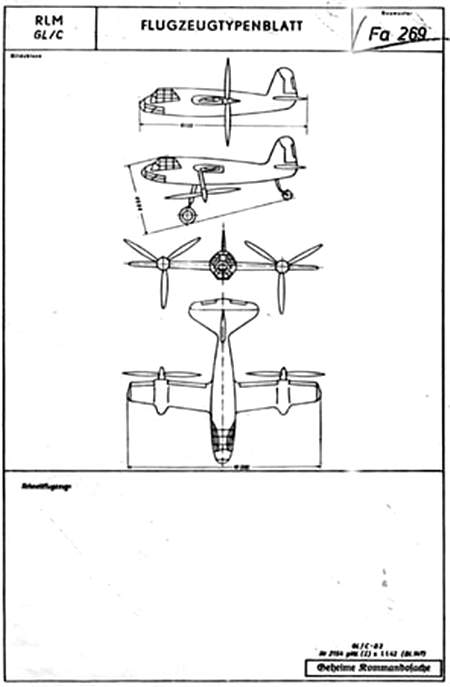
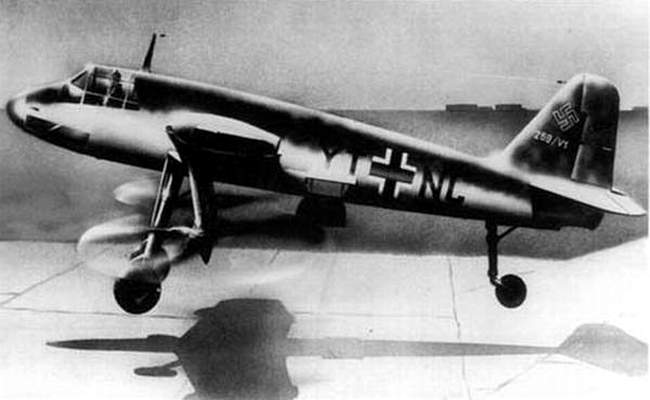
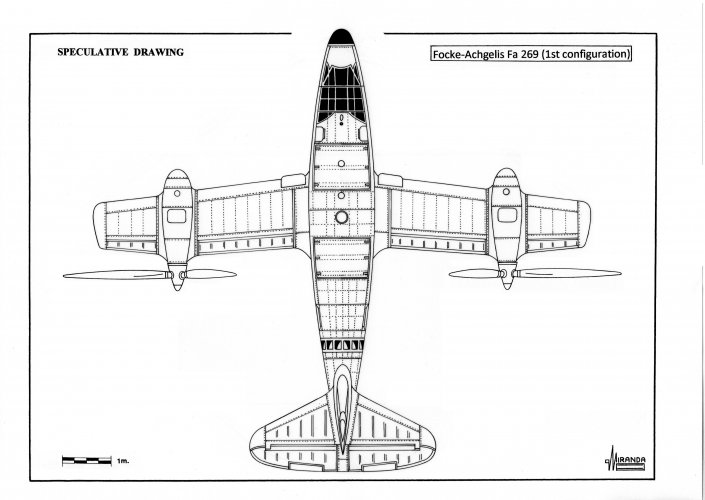
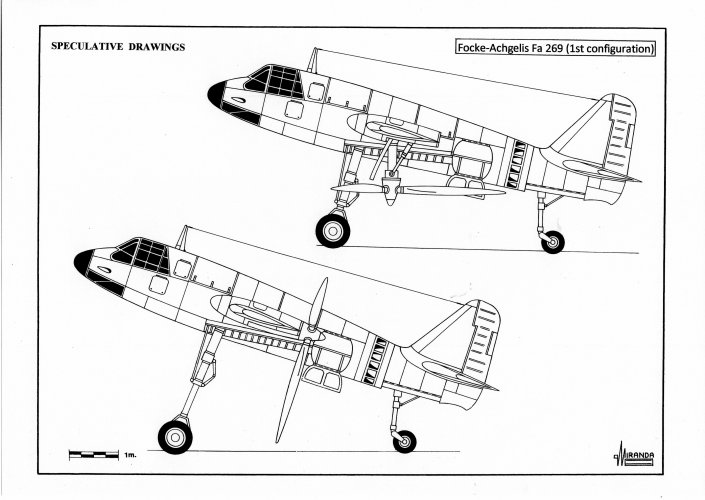
Early in 1942 the Delmenhorts design team proposed the Fa 269, a highly innovative project combining the VTOL capabilities of the helicopter with the speed of a fixed-wing aircraft.

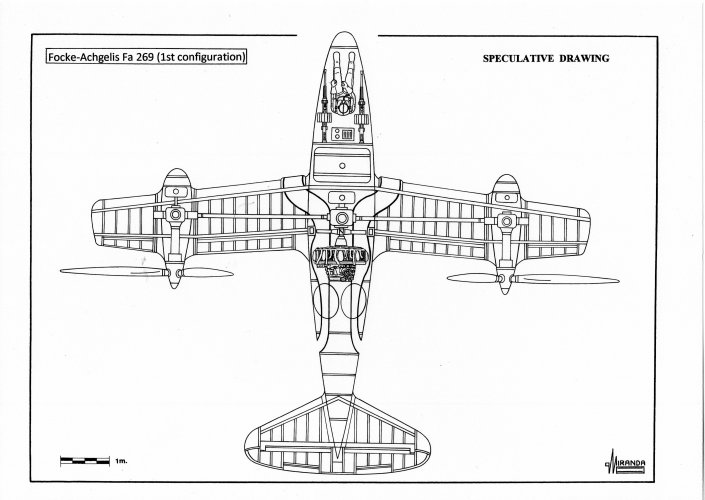
The mid-wing Fa 269 had conventional fuselage and tail surfaces, wing mounted pusher rotors and one radial engine buried in the fuselage, behind the cockpit.

The main drawback of this configuration was the cooling of the engine. It was necessary to design two wing mounted air scoops, two refrigeration air ducts and one forced cooling fan installed in front of the engine. The air circulating through the inner fuselage was expelled, together with the engine exhaust gases, through one annular nozzle located at the rear.

The power plant selected was a BMW 132, a very safe engine that was already being used in several types of naval aircraft such as the Heinkel He 115 and the Arado Ar 196.

Engine power was transferred to both tiltrotors by means of transverse drive shafts housed into the wings and three synchronized gearboxes.

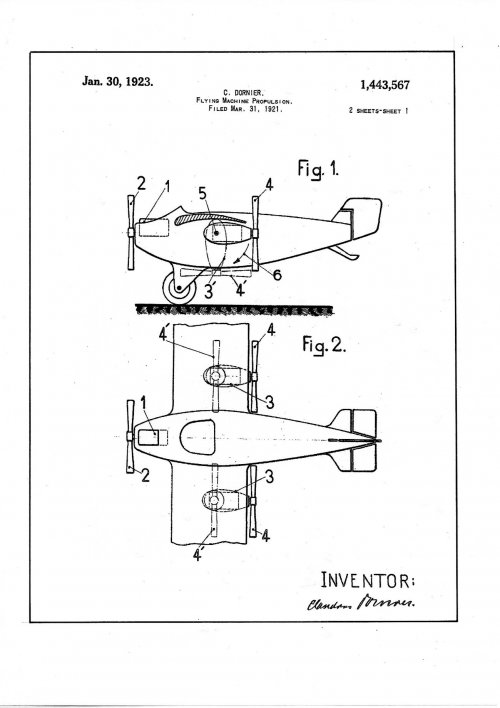
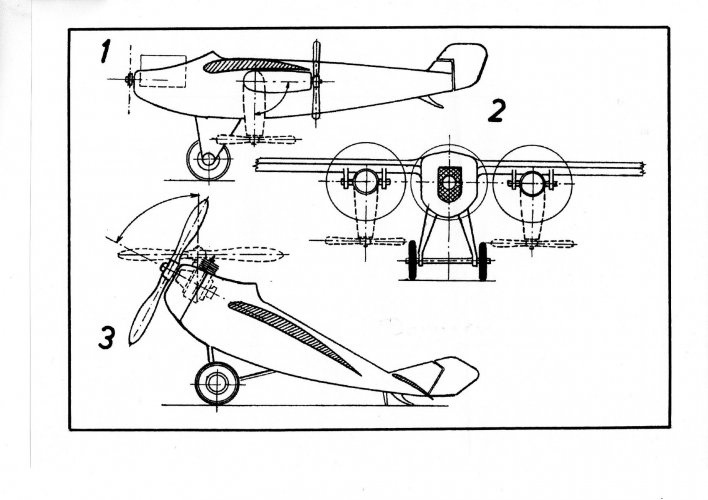
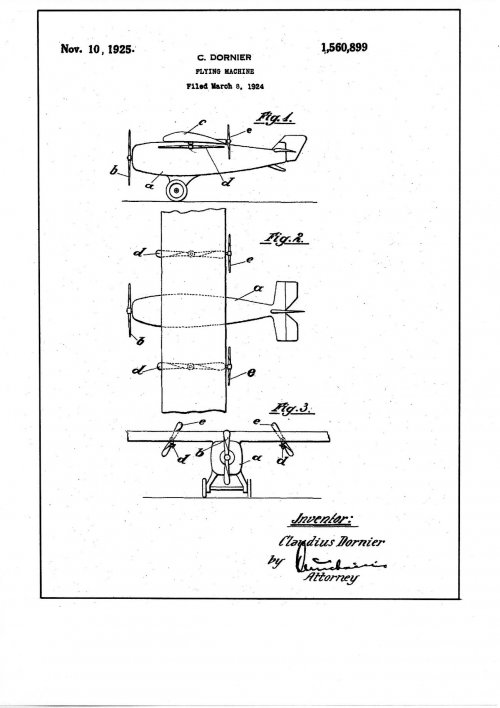
The three-bladed rotors would have pivoted downward and forward through about 85-degrees using the swiveling system patented in 1921 by Claudius Dornier.

Both rotors generated a great deal of torque. To compensate this effect, the starboard propeller rotated in clockwise direction and the port propeller rotated counterclockwise, producing symmetric slipstream effect over the wing areas behind the propellers and giving better airflow over the center portion of the wing.

During the transition the rotors forced air at high speed over the wings, keeping the wing lifting at low speeds and reducing the stall speed. This helped support aircraft weight.

Trailing edge flaps increased lift at partial tilt angles and pusher configuration provided downward thrust and enhance lift.

The length of the telescopic legs of the main landing gear could be varied from 2.06 m and 12-degrees incidence in VTOL mode, to 2.62 m and 18-degrees of incidence so that the Fa 269 could land as a conventional aircraft in case of emergency.

Considerable work was undertaken in the development of gearboxes and power drive shafts, using technologies tested in the Dornier flying boats Do 14 and Do 26.

Wind tunnel models were used to study transition problems and rotor motion at speeds between zero and six hundred kilometers per hour.

The full-scale mock-up was inspected early in 1942.

It was expected to start serial production of the combat version in 1943, but the entire project was delayed after the destruction of the Focke-Achgelis factory during the Allied bombing of Hoykenkamp on June 4, 1942.

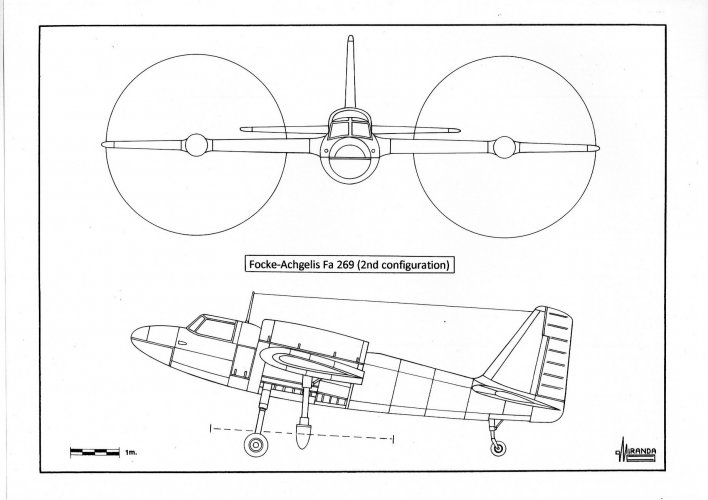
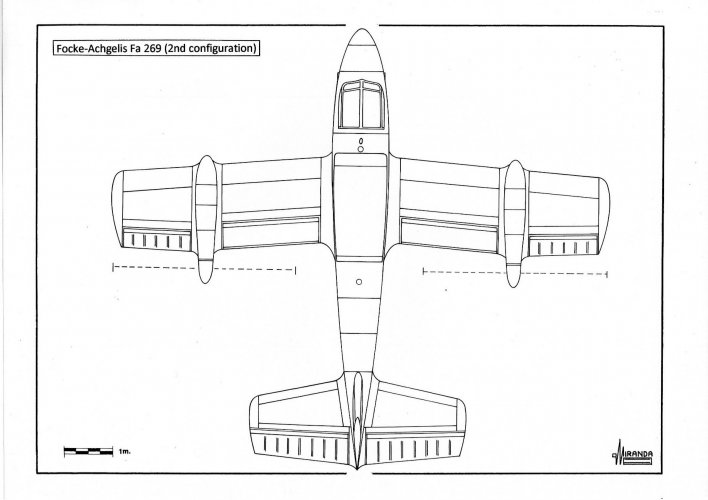
When the Allies began using Consolidated Liberator long-range bombers in the Battle of the Atlantic, the decision was made to replace the 20-mm guns with 30-mm guns. To compensate for the increase in weight the engine also had to be replaced by a BMW 801.

The design work continued until the end of the year, but all development was shelved by late January 1943 when Hitler ordered all its larger warships to be taken out of service and scrapped.


Focke-Achgelis Fa 269 (1st configuration) technical data

Wingspan: 10 m, length. 8.93 m, height (VTOL mode): 4.27 m, height (emergency landing mode): 4.83 m, estimated wing area: 10.77 sq. m, rotor diameter: 4.6 m, estimated max weight: 4,000-4,200 kg, estimated max speed: 570-600 km/h, power plant: one BMW 132 K nine-cylinder, air-cooled, radial engine rated at 947 hp, armament: two fuselage mounted 20-mm MG FF/M cannons, electronics: FuG 17 R/T, FuG 25 IFF, FuG 101 radio-altimeter, vertical speed indicator, turn and bank indicator, RPM rotor indicator and rotor pitch indicator.

Focke-Achgelis Fa 269 (2nd configuration) technical data

Wingspan: 10 m, length. 8.9 m, height: 3.2 m, rotor diameter: 3.76 m, estimated max speed: 570 km/h, power plant: one BMW 801 D-2 fourteen-cylinder, air-cooled, radial engine rated at 1,700 hp (2,100 hp with MW 50 boost), armament: two fuselage mounted 30-mm MK 108 cannons.

 

Attachments

  • fa-10.jpg
    fa-10.jpg
    215.8 KB · Views: 45
  • fa-11.jpg
    fa-11.jpg
    253.6 KB · Views: 46
  • fa-13.jpg
    fa-13.jpg
    216.2 KB · Views: 52
  • fa-1.jpg
    fa-1.jpg
    969.1 KB · Views: 53
  • fa..jpg
    fa..jpg
    843.5 KB · Views: 59
  • fa-4.jpg
    fa-4.jpg
    839.3 KB · Views: 55
  • fa-3.jpg
    fa-3.jpg
    698.1 KB · Views: 56
  • fa-6.jpg
    fa-6.jpg
    183.1 KB · Views: 57
  • fa-5.jpg
    fa-5.jpg
    161.2 KB · Views: 67
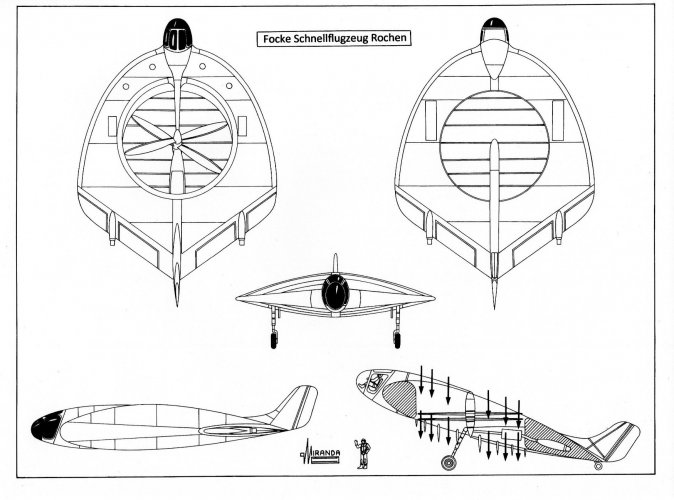
Focke-Achgelis Rochen

A demonstration of the first jet powered Heinkel He 178 before RLM officials on November 1, 1939, did not produce apparent enthusiasm but had an enormous impact on the aircraft industry. The Germans planned the development of the new technology in four phases, with increasing thrust, between 1,000 and 4,000 kp. The plan was to develop the first turboprops when reaching Phase II (1,300 to 1,700 kp) in 1941, but the Hungarian engineer György Jendrassik got ahead in 1939 patenting the first CS-1 turboprop.

In Germany, Heinrich Focke decided that the turboprop could be used to drive a helicopter rotor by means of an extension shaft. He was defining the working principle of what today we call turboshaft, a form of gas turbine that is optimized to produce shaft power rather than jet thrust.

The intention of Focke was to build a fast helicopter Schnell-Flugzeug using a ducted fan rotor installed, within a circular wing ringflügel, thus removing most of the drag generated by the conventional rotors.

In the original design patented in 1939, Focke used two huge propellers, with 6 m of diameter, spinning in opposite directions to avoid the torque effect. For more speed, the bifurcated jet exhaust pipe ended in two afterburning combustion chambers. At the ground, the disc would be raised by about 18 degrees while the rotors would be level with the ground.

The VTOL design was named Rochen (Sea Ray) in 1944 but the enormous workload of building 13,300 Focke-Wulf Fw 190 fighters during the war prevented the development of the project. In 1955 a 1/10 scale wind tunnel model was built in Bremen and subjected to aerodynamic testing, but the Rochen cancelled in 1957.
 

Attachments

  • rochen.jpg
    rochen.jpg
    280.2 KB · Views: 70
Sorry, these two pieces come across to me as pretty much fan fiction. This is a long way off vis a vis the devlopment of the Fa 269 and I will remain sceptical about the Rochen until such time as I see genuine contemporaneous documentation. I've not come across a single document on this in the decades I've been researching Fogelis. Of course, I am always more than happy to be proven wrong.

The timeline according to my archival research is that the RLM placed an order for the development of three Fa 269s in May 1939, making this by my reckoning one of the first projects that Paul Klages worked on after joining from AGO.

E-Stelle Rechlin opened a file for the type shortly thereafter (LC-Nr. 10/39) and the occasional reference figures in their paperwork but the development history of the type remains largely sketchy. A Baubeschreibung was issued by Fogelis in 1940.

I am deliberately being a little brief here as I plan to include a fuller write up of the type's development in the revised and updated version of 'Helicopters of the Third Reich' I am currently working on.
 
Last edited:
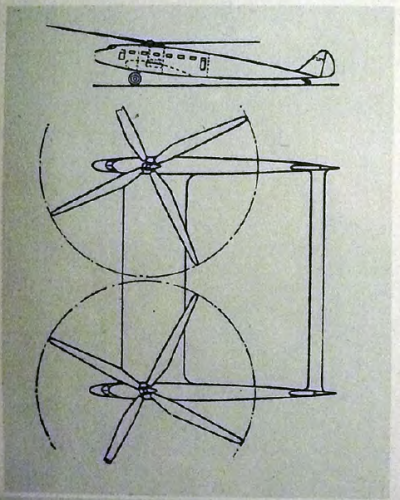
Focke Achgelis FA 223 Zwilling
"Dackel" - "Krabbe"

Versuchsflugzeug Dackel, Krabbe, Torpedoträger*

February 16–19, 1944
- Advantages and disadvantages compared to the S-boat
- Advantages and disadvantages compared to the torpedo aircraft
- Use as a transport aircraft

FA 223 "Zwilling"
- Sondertransporte
[special transports, in-flight refueling of helicopters from marine vessels, special weapons carrier, night and bad weather capabilities, search radar 50km range]
- Fliegendes S-Boot
[flying S-Boat torpedo carrier]
- Flakträger für Geleitsicherung
[Flak carrier for convoy escort armed with 2cm Flakvierling]
- Schwimmer für Krabbe
[Floats for Krabbe]
Flettner Fl 339
- armed with 2x SC 50 bombs
- night and bad weather capabilities
- search radar 10km range

15.06.1944**
FA 223 - FA 223 ZWILLING - Fl 339
"Taktisch-technische Forderungen an Hubschrauberflugzeuge für Einsatz über See"
[Tactical and technical requirements for helicopter for use over sea - 15.06.1944]

Sources:
Bundesarchiv Files
Signatur: RM 7/1240
Signatur: *RM 7/1243, Page: 71 - 77, 85 - 87
Signatur: **RM 7/171, Page: 696 - 704
 
Last edited:
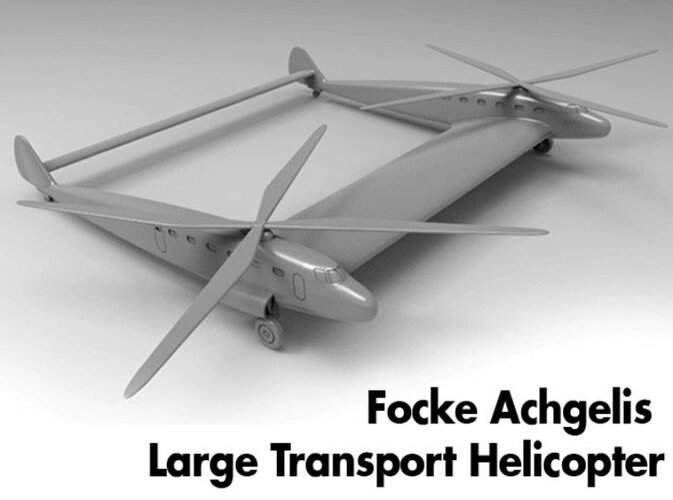
Focke Achgelis Heavy Lift Helicopter - 10 ton payload

Fa 223 Zwilling - Drawing

https://www.secretprojects.co.uk/threads/focke-achgelis-projects.4893/post-255027
Focke heavy lift helicopter - 1945
https://www.secretprojects.co.uk/threads/focke-achgelis-projects.4893/post-254822

Typ XXVII Midget Submarine
transport options e.g.

- Autogyro (flying submarine ?)
- Helicopter with four (or more) rotors
- Twin "Krabbe" vertically stacked (4x Fa 223)?

*February 2, 1944
Type XXVII Midget Submarine Transport
A tripod would have to be mounted on the submarine, supporting a rotor approximately 20 meters in diameter. The submarine would then be towed by an aircraft. The rotor would be powered by the airflow, keeping the submarine aloft. Shortly before reaching the deployment area, the tow line would be released, allowing the submarine to glide down to the water's surface, similar to a glider. On the water's surface, the tripod would be jettisoned along with the rotor. The pilot in the bow of the submarine would control the autogyro in the air.

**April 1944
Type XXVII Transport
As far as is known, K is currently investigating the transport of the Type XXVII, among other things, by towing it as an autogyro glider. This question was raised by Captain Spörel during a meeting during his official trip to the Laupheim Naval Research Center, without mentioning the project. Professor Focke stated at the time that, theoretically, a transport option for a load of approximately 10 tons was readily possible, but that this problem could not be solved by using an autogyro glider, since launching such a load would require, among other things, an extremely long takeoff distance.

March 3, 1944
Transport possibility of a 10-ton load
1.) Transporting 10 tons is possible by helicopter. Autogyro is considered out of the question.
2.) The maximum payload of existing helicopters (Focke Achgelis 223) is approximately 1 ton; the "Krabbe" project is expected to have a payload including fuel of 4 to 5 tons. The Fa 284 planned by Professor Focke, with two larger-diameter rotors, will have approximately the same payload but will require a significantly longer development time because the "Krabbe" uses existing rotors and engines. Therefore, Professor Focke also recommended the "Krabbe" device.
3.) A prerequisite for answering questions regarding development time and effort is experience with helicopters with four (or more) rotors, which is to be gained by the "Krabbe." It is expected that inflight refueling and maneuvering with vertically stacked "Krabben" can be performed analogously to similar nautical maneuvers.

Sources:
Bundesarchiv Files
Signatur: *RM 7/1258, Page: 66
Signatur: **RM 7/1239, Page: 388 - 395

In “Deutsche Geheimwaffen 1939-1945, Flugzeugbewaffnungen", Fritz Hahn briefly mentioned a German flying submarine developed by the Ingenieurbüro Glückauf.
 
Last edited:
From this book.
 

Attachments

  • 1.png
    1.png
    398.8 KB · Views: 34
  • 2.jpg
    2.jpg
    37.6 KB · Views: 30
  • 3.png
    3.png
    310.5 KB · Views: 28
the Focke-Achgelis Fa.267 was developed from Fa.223 as anti-submarine and transport helicopter project,also used as an ambulance helicopter,but the development terminated.

In addition to the army reconnaissance, anti-submarine warfare, and transport helicopter versions of the Fa 223, there were also versions that could be used as medical and rescue helicopters. The Fa 267 resembled a Fa 223, but had a storage option. for up to three injured people. Due to the war situation, development was prematurely terminated. The Fi 156 "Storcli" was already available for urgent wounded transport. For pure rescue missions, the Fa 223 C was planned in the medium term.
 
As a matter of interest, are there contemporary documentary references for what you state or are you attempting to join dots? I am not disputing the existence of the Fa 267 for which the RLM gave a devlopment order although the development was cancelled shortly thereafter but I've never come across any contemporary document giving details of what this type offered.
 

Similar threads

Back
Top Bottom